Fraud Blocker edunanny.com
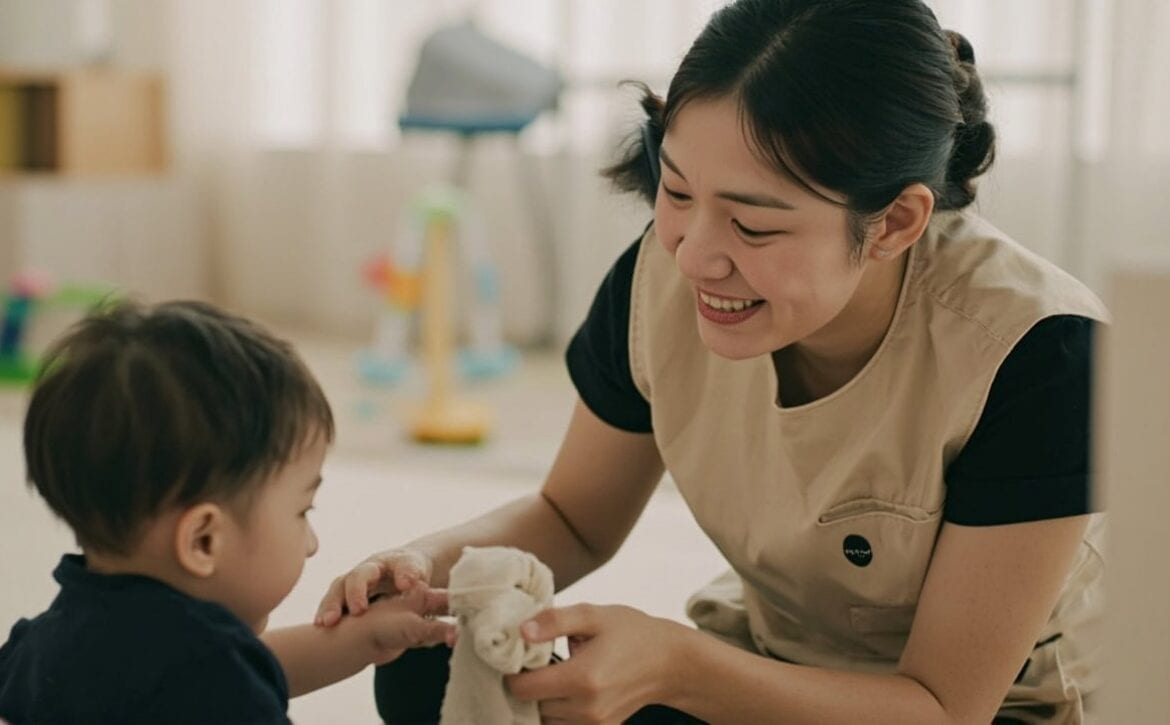
Caregiver and infant playing peek-a-boo with a cloth on the floor
September 30, 2026

Still There, Even When Hidden: The Tiny Magic Trick Your Childminder Practises All Day

Peek-a-boo thrills your baby one morning and falls flat by afternoon. That’s not a setback — it’s the work itself. Discover how object permanence develops through everyday hide-and-seek games and why repetition matters more than results.

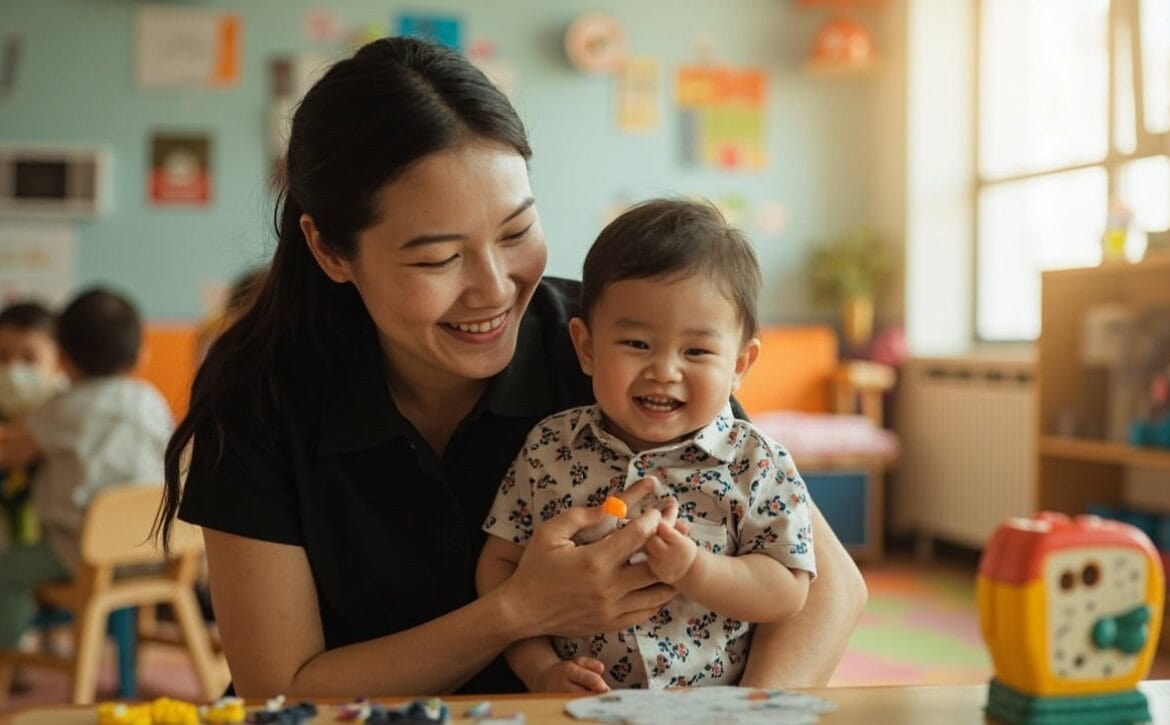
A childminder shares a board book with an infant, following the baby's reach toward a picture on the page.
September 30, 2026

Before She Knows It’s a Picture: How Shared Book Play Begins With Following a Baby’s Eyes

Many parents wonder whether picture books are worth the effort before a baby can talk. The answer lies not in the book itself, but in a childminder’s ability to follow the baby’s gaze, pause on what she notices, and wait — turning quiet looking into the first real step of learning.

Why Childminding Is Becoming a Professional Career
August 5, 2026

Beyond Babysitting: Why Childminding Is Becoming a Professional Career

Professional childminding combines purpose, flexibility and structured training. Explore the skills, support and opportunities behind a rewarding career with EduNanny.

Why Personalised Infant Care Matters More Than Ever | A Better Start for Your Baby
August 4, 2026

Why Personalised Infant Care Matters More Than Ever

Why Personalised Infant Care Matters More Than Ever | A Better Start for Your BabyEvery parent quickly discovers one important truth after bringing home a newborn:

No two babies are exactly alike.

Some babies happily nap for two hours at a time, while others wake after thirty minutes. Some feed every three hours like clockwork, while others have their own unpredictable rhythm. One infant may smile at everyone they meet, while another needs time before feeling comfortable with unfamiliar faces.

These differences aren’t unusual—they’re completely normal.

Every baby develops at their own pace, with their own personality, preferences and routines. That’s why personalised infant care has become increasingly important for modern families. Rather than following a one-size-fits-all approach, personalised care recognises that every child deserves individual attention, responsive caregiving and routines tailored to their unique needs.

At EduNanny, personalised care sits at the heart of both its home-based and centre-based childminding models. Instead of focusing only on supervision, the goal is to provide nurturing, consistent and responsive care that helps every infant feel secure while supporting healthy development.

So what exactly makes personalised infant care so valuable?


Every Baby Develops Differently

The first eighteen months of life are filled with incredible growth.

Within a relatively short period, babies learn to smile, roll over, sit independently, crawl, stand and eventually take their first steps. They also begin recognising familiar faces, expressing emotions, responding to voices and exploring the world around them.

However, these milestones do not happen according to a fixed timetable.

Some babies become confident crawlers before eight months, while others take a little longer. Some enjoy exploring independently, while others prefer staying close to familiar caregivers.

These differences are entirely natural.

Personalised infant care allows caregivers to respond to each baby’s individual pace instead of expecting every child to fit the same routine.

Rather than comparing children, experienced childminders observe each infant carefully, learning what helps them feel comfortable, engaged and secure throughout the day.


Why Smaller Care Ratios Make a Difference

One of the greatest advantages of childminding is the opportunity for more personalised attention.

When caregivers look after fewer infants at a time, they are better able to notice subtle changes in behaviour, recognise individual preferences and respond promptly to each child’s needs.

Instead of managing large groups, childminders can spend meaningful time with each infant throughout the day.

This might include:

  • Comforting a baby who needs extra reassurance.
  • Recognising early signs of tiredness.
  • Adjusting feeding times based on the child’s routine.
  • Encouraging developmental play suited to the infant’s age.
  • Celebrating small developmental milestones.

At EduNanny, personalised care remains a key focus across both home-based and centre-based childminding services. The programme is designed to preserve individual attention while supporting infants in safe and nurturing environments.


Every Feeding Routine Is Unique

Ask any experienced parent, and they’ll tell you that feeding is rarely identical from one baby to another.

Some infants prefer smaller, more frequent feeds.

Others naturally settle into longer feeding intervals.

Some babies require extra time to finish a bottle, while others drink quickly before happily returning to play.

Parents also develop their own feeding preferences, schedules and techniques that work best for their child.

One of the strengths of personalised childminding is the ability to continue these familiar routines.

Rather than expecting every infant to follow exactly the same schedule, childminders work closely with parents to understand how each baby feeds at home.

This continuity helps infants feel more comfortable while making the transition between home and childcare much smoother.

For parents, knowing that familiar routines are being respected provides tremendous reassurance.


A Real-Life Example

Imagine six-month-old Emma.

At home, Emma normally drinks her milk around 10.30 a.m. before taking a short nap. She prefers to be held upright for a few minutes after feeding and enjoys listening to soft music before falling asleep.

Instead of replacing this routine with a completely new schedule, a personalised childminder learns Emma’s preferences from her parents and incorporates them into her daily care.

Over time, Emma begins recognising familiar patterns wherever she is.

The result?

A happier baby, smoother transitions and less stress for everyone involved.


Better Sleep Begins with Familiar Routines

Sleep is one of the most important parts of an infant’s development.

A well-rested baby is often more settled, more engaged during play and better able to regulate emotions throughout the day.

However, getting babies to sleep isn’t always straightforward.

Every infant has their own sleep cues.

Some rub their eyes.

Some become unusually quiet.

Others become more active just before they are ready to sleep.

Experienced childminders learn to recognise these signals.

Rather than waiting until an infant becomes overtired, personalised care allows caregivers to respond early and help maintain healthy sleep routines.

Maintaining familiar sleep habits can also reduce unnecessary stress for infants who are adjusting to a new caregiving environment.


Another Everyday Example

Eight-month-old Noah usually falls asleep after his lunch.

His parents know he settles best with his favourite comfort blanket and a few quiet minutes before being placed in his cot.

Because his childminder understands this routine, Noah’s transition into nap time feels familiar rather than overwhelming.

Small details like these may seem simple, but they make a meaningful difference to a baby’s sense of comfort and security.


Strong Relationships Help Babies Feel Secure

Infants learn about the world through relationships.

Before they understand language, they learn through smiles, eye contact, gentle voices, familiar faces and responsive caregiving.

Over time, these repeated interactions help babies develop trust.

This is why consistent caregivers are so important.

When infants see the same familiar faces each day, they begin to feel safe.

They learn that someone will respond when they cry, comfort them when they’re upset and celebrate their milestones with them.

At EduNanny, matching is not simply about availability. The organisation prioritises creating compatible, sustainable relationships between families, infants and childminders because these relationships form the foundation of quality care.


Daily Communication Builds Trust

Personalised care extends beyond the infant—it includes parents too.

When families leave their baby with a childminder, they naturally want to know how the day has gone.

Did my baby finish their milk?

How long did they nap?

Were they cheerful today?

Did anything unusual happen?

Regular communication helps answer these questions.

Daily updates allow parents to remain connected to their child’s routine even while they are at work.

This ongoing communication also strengthens the partnership between parents and childminders.

Instead of working separately, both adults become part of the same caregiving team, sharing observations and helping maintain consistency between home and childcare.

For many parents, these conversations become one of the most valued parts of the childminding experience.


Personalised Care Supports Emotional Wellbeing

The first years of life are about much more than physical growth.

Babies are also developing emotionally.

Feeling safe, loved and understood helps infants build confidence to explore their surroundings.

Responsive caregiving teaches babies that their needs matter.

When caregivers consistently respond to hunger, tiredness, discomfort or the need for comfort, infants gradually develop a sense of security that supports healthy emotional development.

Personalised care makes this easier because childminders have the opportunity to truly know each child’s personality rather than applying identical approaches to every infant.


Technology Can Support Personalised Care

While relationships remain at the centre of childminding, technology can also enhance parents’ confidence.

For example, EduNanny provides nap-monitoring cameras for home-based childminding arrangements. These cameras improve visibility during infants’ rest periods while providing parents with additional reassurance about the care environment.

Technology is not intended to replace personal interaction.

Instead, it complements professional caregiving by increasing transparency and supporting quality assurance.


Why Personalised Care Matters Even More Today

Today’s families often juggle demanding careers, changing work arrangements and busy schedules.

Parents understandably want childcare that feels like an extension of home rather than simply a place where their child spends the day.

Personalised infant care offers exactly that.

By respecting each baby’s routines, understanding their unique personality and maintaining close communication with parents, childminders help create continuity between home and childcare.

This consistency benefits everyone.

Babies feel more secure.

Parents feel more confident.

Childminders gain a deeper understanding of the children they care for.


Every Little Detail Matters

To an adult, small routines may seem insignificant.

To a baby, they mean everything.

The way they are comforted before a nap.

The song they hear before feeding.

The smile that greets them each morning.

The familiar voice that reassures them when they wake.

These everyday moments gradually shape a child’s sense of safety, trust and belonging.

That’s why personalised infant care isn’t simply about providing individual attention.

It’s about recognising that every baby is wonderfully unique—and deserves care that respects who they are.

At EduNanny, personalised care remains central to every childminding journey. Through careful matching, professional training and a commitment to understanding each infant’s individual needs, the goal is to provide families with safe, nurturing and responsive care that supports every child’s early years.

Because when care is personal, every moment becomes an opportunity for a child to feel safe, valued and ready to grow.

Home-Based vs Centre-Based Childminding: Which One Is Right For Your Family?
August 4, 2026

Home-Based vs Centre-Based Childminding: Which One Is Right For Your Family?

Home-Based vs Centre-Based Childminding: Which One Is Right For Your Family? Choosing infant care is one of the biggest decisions new parents will make. Beyond finding someone trustworthy to care for your child, parents also need to decide what type of care environment will best support their infant’s growth and fit their family’s lifestyle.

In Singapore, families now have more choices than ever before. Alongside traditional infant care centres, childminding has emerged as another professional care option that offers personalised attention in both home-based and centre-based settings.

At first glance, parents often ask a simple question:

“Which one is better?”

The answer, however, is not quite that straightforward.

Neither home-based nor centre-based childminding is universally better than the other. Instead, each offers different strengths, and the right choice depends on your child’s personality, your family’s routine and the type of caregiving experience you value most.

At EduNanny, both home-based and centre-based childminding are designed around the same commitment to safety, professional training and quality care. While the settings may differ, both models aim to provide infants with nurturing environments where they can feel secure, supported and cared for.

Let’s explore the differences so you can make the decision that’s right for your family.


Understanding Home-Based Childminding

Home-based childminding takes place in an approved childminder’s home.

Rather than attending a large childcare centre, infants spend the day in a carefully prepared home environment that closely resembles their own daily surroundings.

This setting naturally creates a quieter atmosphere with fewer children and a greater emphasis on personalised routines.

Many parents are drawn to home-based childminding because it feels familiar.

For young infants who are still adjusting to being away from their parents, this home-like environment can make the transition gentler and more reassuring.

EduNanny’s own programme data reflects this preference. Between November 2024 and July 2026, nearly 80% of families who enquired about childminding expressed a preference for the home-based model.


Benefits of Home-Based Childminding

One of the biggest advantages is personalised attention.

With fewer infants in the environment, childminders are able to understand each child’s unique personality, routines and developmental needs more closely.

Parents often appreciate that their baby’s familiar routines can be maintained more easily, including:

  • Feeding schedules
  • Nap routines
  • Comfort preferences
  • Daily habits
  • Communication styles

Home-based care also offers greater continuity.

The same caregiver interacts with the infant throughout the day, allowing trusting relationships to develop over time.

Many families also value the convenience of choosing a childminder located close to home, making daily drop-offs and pickups easier.


Understanding Centre-Based Childminding

Centre-based childminding combines personalised infant care with the benefits of a professionally managed childcare environment.

Instead of operating in a residential home, care takes place within a dedicated childminding centre.

EduNanny currently operates its centre-based childminding service at Tampines East Community Club, where infants are cared for by trained childminders working as a collaborative team.

Although the environment differs from a home setting, the philosophy remains the same: providing responsive, attentive and high-quality care for every infant.


Benefits of Centre-Based Childminding

Parents often appreciate the additional support that comes from a team-based environment.

Rather than relying on one caregiver alone, centre-based childminders work together according to planned shift rosters that support daily operations.

This collaborative approach provides:

  • Additional adult supervision
  • Peer support among caregivers
  • Greater operational resilience
  • Continuity of care

According to EduNanny, the presence of multiple trained adults creates opportunities for greater collaboration while still allowing childminders to remain attentive to the infants under their care.

Parents who prefer structured environments may find this setting particularly reassuring.


Comparing Both Models

While both options provide professional childminding, the day-to-day experience differs slightly.

Home-Based ChildmindingCentre-Based Childminding
Home environmentDedicated childcare centre
Familiar household settingPurpose-designed care setting
Highly personalised routinesTeam-supported caregiving
Direct relationship with one primary caregiverCollaborative caregiving environment
Convenient neighbourhood locationsStructured centre operations
Quiet home atmosphereMore dynamic childcare environment

Importantly, both models share the same commitment to infant wellbeing and professional caregiving.


Safety Standards Remain the Same

One misconception is that home-based care involves fewer safeguards than centre-based care.

In reality, EduNanny applies comprehensive preparation requirements before any childminder begins caring for infants.

These include:

  • Background screening
  • First-aid training
  • Infant-care training
  • Practical assessments
  • Health checks
  • Suitability assessments
  • Ongoing learning
  • Home assessments for home-based childminders

Home-based childminders also undergo assessments of their caregiving environment before they begin operations, while approved homes receive essential equipment to support safe infant care.

Regardless of whether care takes place in a home or a centre, the focus remains on maintaining consistent standards of safety and quality.


Which Families Prefer Home-Based Childminding?

Home-based childminding may be particularly suitable for families who:

  • Prefer a quieter environment.
  • Value close relationships with one caregiver.
  • Want to maintain familiar home routines.
  • Appreciate neighbourhood convenience.
  • Have infants who benefit from gradual transitions.

Many first-time parents also appreciate the direct communication that naturally develops between themselves and the childminder.


Which Families Prefer Centre-Based Childminding?

Centre-based childminding may appeal to families who:

  • Prefer a structured childcare setting.
  • Appreciate team-based caregiving.
  • Value additional operational support.
  • Like dedicated childcare facilities.
  • Enjoy having multiple trained caregivers available.

The centre-based model also continues to attract strong interest. EduNanny reports that its current centre operates at full subscription capacity, demonstrating encouraging demand from families.


It’s About Compatibility, Not Competition

One important point often overlooked is that choosing between home-based and centre-based childminding isn’t about deciding which model is superior.

Instead, it’s about understanding what best suits your family’s circumstances.

Factors such as:

  • Location
  • Working hours
  • Infant temperament
  • Family routines
  • Care expectations
  • Travel convenience

all influence which option may be the better fit.

This is why EduNanny places significant emphasis on careful family-childminder matching rather than simply assigning the first available place. A successful placement depends on compatibility between the family’s needs and the childminder’s availability, location and caregiving arrangements.


Questions to Ask Yourself Before Deciding

If you’re still unsure which option is right, consider asking yourself these questions:

  • Does my baby adapt easily to new environments?
  • How important is travelling convenience?
  • Do I prefer a home-like atmosphere or a childcare centre?
  • How much do I value one-to-one relationships with caregivers?
  • What daily routine would be easiest for our family?

There are no right or wrong answers.

Every family’s priorities are different.


One Goal, Two Different Paths

Although home-based and centre-based childminding offer different experiences, they ultimately share the same purpose: providing infants with safe, nurturing and developmentally appropriate care while giving parents confidence and peace of mind.

Whether your child spends the day in a welcoming home environment or a professionally managed childminding centre, what matters most is the quality of care, the strength of the relationship with the caregiver and the confidence you have in the people looking after your child.

At EduNanny, both models are built on professional training, structured safeguarding, thoughtful matching and a commitment to personalised infant care. Rather than asking which option is better, parents may find it more helpful to ask which environment will help their child feel the safest, happiest and most supported.

Because the best childminding choice isn’t the same for every family—it is the one that fits yours.

Why Finding the Right Childminder Takes Time | EduNanny Singapore
August 4, 2026

The Truth About Finding the Right Childminder: Why Matching Takes Time


The Truth About Finding the Right Childminder: Why Matching Takes Time – Why Finding the Right Childminder Takes Time | EduNanny Singapore

In today’s digital world, we’re used to getting almost everything instantly. Food can arrive in under an hour, groceries can be delivered the same day, and transportation is available at the tap of a button. It’s no surprise that some parents wonder why finding a childminder can’t be just as quick.

The reality is that matching a family with the right childminder is fundamentally different from booking a service on demand.

When it comes to caring for an infant, speed should never come at the expense of safety, compatibility or quality. Unlike many other services, successful childminding depends on building a relationship that works not only for today, but for months—or even years—to come.

At EduNanny, every match is approached thoughtfully because the goal is not simply to fill an available slot. Instead, the priority is to create a safe, compatible and sustainable caregiving relationship that benefits the infant, the parents and the childminder alike.

So why does finding the right childminder sometimes take longer than parents expect? Understanding what happens behind the scenes can help families appreciate why careful matching ultimately leads to better outcomes.


Why Childminding Isn’t Like Booking a Taxi

Imagine opening a ride-hailing app.

A driver accepts your request, picks you up and, within minutes, the journey begins. Once you arrive at your destination, the interaction is over.

Childminding is completely different.

Instead of a journey lasting twenty minutes, you’re entrusting someone with your baby’s daily care for weeks, months or even years. This person will become part of your child’s routine, witness important developmental milestones and communicate with you regularly about your infant’s wellbeing.

That relationship cannot—and should not—be rushed.

A successful childminder match involves balancing numerous factors that affect both the child’s experience and the family’s daily life. Even when a childminder has an available place, it doesn’t automatically mean they are the right fit for every family.

The best matches are those where everyone’s needs align naturally.


Every Family Is Different

No two families have exactly the same childcare requirements.

Some parents work traditional office hours, while others have rotating shifts. Some need care five days a week, while others only require part-time arrangements. Every household has its own routines, expectations and priorities.

EduNanny recognises this diversity by looking beyond availability alone.

Rather than assigning families to the first available childminder, the matching process considers several important factors to determine compatibility. According to EduNanny, successful placements depend on alignment between the family’s location, preferred care hours, intended start date, service preferences, the infant’s routines and needs, as well as the childminder’s location, experience, availability and capacity.

This personalised approach helps ensure that each placement has the greatest opportunity to succeed.


Location Compatibility Matters More Than You Think

One of the most practical considerations is location.

Parents often assume that if a childminder has an available place, the arrangement should work. However, distance can have a significant impact on daily routines.

Consider the following questions:

  • How long is the commute before work?
  • Is the childminder located along the family’s daily route?
  • Will travel time be manageable during peak-hour traffic?
  • Can grandparents or other caregivers assist with drop-offs if necessary?

Even an additional fifteen or twenty minutes each way can become challenging when repeated every weekday.

Convenience is also one of the main reasons many parents are attracted to home-based childminding. EduNanny’s programme data shows that almost four out of five enquiries preferred the home-based model, reflecting the importance parents place on proximity and personalised care.

Finding a nearby childminder therefore plays a major role in creating a childcare arrangement that remains practical over the long term.


Matching Care Hours with Family Schedules

Work schedules vary greatly across Singapore.

Some parents begin work early in the morning. Others finish late in the evening. Healthcare professionals, retail employees, shift workers and essential service personnel often require childcare that differs from standard office hours.

At the same time, childminders also have structured operating schedules and personal commitments.

A successful match requires these schedules to align.

For example:

  • What time does care need to begin?
  • What time will parents collect their child?
  • Is flexibility occasionally required?
  • Are there recurring schedule changes?

When expectations differ significantly, the arrangement may become stressful for both families and childminders.

Taking time to understand each family’s schedule helps create a partnership that is realistic and sustainable rather than one that constantly requires last-minute adjustments.


Every Infant Has Unique Routines

Babies thrive on consistency.

Their feeding times, nap schedules and comforting routines all contribute to their sense of security.

Some infants settle quickly in new environments, while others require more gradual transitions. Some prefer being rocked before sleeping, while others fall asleep independently. Feeding habits also differ depending on age, developmental stage and family preferences.

These routines are deeply personal to each child.

One of the strengths of childminding is the ability to preserve these familiar routines as much as possible.

Before recommending a placement, EduNanny seeks to understand the infant’s daily habits and individual needs so that the selected childminder can provide continuity rather than disruption.

Maintaining consistency helps infants adjust more comfortably while giving parents confidence that their child’s daily rhythm is being respected.


Understanding Parent Expectations

Every parent has a different vision of what quality childcare looks like.

Some prioritise regular updates throughout the day.

Others value outdoor activities, sensory play or structured routines.

Some prefer detailed communication, while others simply want reassurance that their child is happy and safe.

These expectations influence the type of childminder that may be most suitable.

A successful childcare relationship depends on open communication and shared understanding from the beginning.

Taking time to discuss expectations helps prevent misunderstandings later and creates stronger partnerships between families and caregivers.

The goal isn’t simply to find any available childminder—it’s to find one whose caregiving style complements the family’s preferences.


Childminder Capacity Is Carefully Managed

Availability is another important consideration that parents may not always see.

Just because a childminder has previously cared for infants does not necessarily mean they have immediate capacity for another enrolment.

Each childminder operates within approved capacity limits designed to ensure that every infant receives appropriate attention and supervision.

Childminders also need sufficient time and resources to meet the needs of every child already under their care.

This careful capacity management protects both quality and safety.

Rather than overextending caregivers, EduNanny prioritises maintaining manageable workloads so that each infant continues receiving personalised attention.

The focus remains on quality of care—not simply increasing the number of enrolments.


Compatibility Creates Long-Term Success

A rushed placement may appear convenient initially but can create challenges later.

If travel becomes difficult…

If care hours prove unsuitable…

If routines are incompatible…

If expectations differ…

The arrangement may require unnecessary changes that disrupt both the infant and the family.

Taking additional time during the matching stage often reduces these risks.

A carefully considered match allows everyone to settle into a stable routine with greater confidence.

For infants, this stability supports emotional security.

For parents, it reduces daily stress.

For childminders, it enables them to provide consistent, focused care.


Safety Always Comes Before Speed

Perhaps the most important reason matching takes time is safety.

Every childminder entrusted with caring for infants must first complete multiple safeguarding requirements before deployment.

According to EduNanny, these include:

  • Background screening
  • First-aid training
  • Infant-care training
  • Practical examinations
  • Health checks
  • Suitability assessments
  • Home assessments for home-based care
  • Ongoing Learning Management System training

Only after demonstrating the required competencies and readiness are childminders permitted to begin providing care.

These safeguards exist because childcare involves far greater responsibility than simply supervising children.

Parents deserve confidence that every approved childminder has met clearly defined standards before welcoming an infant into their care.


Sometimes the Best Match Isn’t the First One

It can be disappointing when the first available childminder isn’t ultimately the right fit.

However, accepting a less suitable placement simply because it is available may not lead to the best experience for anyone involved.

Waiting a little longer for a better match often results in:

  • Greater convenience.
  • Better communication.
  • Stronger relationships.
  • Smoother transitions.
  • Longer-lasting childcare arrangements.
  • Happier infants.
  • More confident parents.

Quality childcare is built on trust, and trust develops when compatibility is prioritised from the beginning.


Looking Beyond Availability

One interesting insight from EduNanny’s programme is that strong public interest does not always translate immediately into enrolment.

Even when both parents and childminders express interest, placements may not proceed if locations, schedules, budgets, commencement dates or expectations do not align.

This highlights an important truth.

Childminding is not simply about finding an available caregiver.

It is about creating a partnership that supports the child’s development while fitting naturally into the family’s everyday life.

The matching process is therefore an investment in long-term success rather than a delay.


Why Patience Leads to Better Childcare

When parents begin searching for childcare, it’s understandable to hope for a quick solution.

However, choosing a childminder is one of the few decisions where taking a little more time can make a significant difference.

A carefully matched childminder becomes much more than someone who supervises a child during working hours.

They become a trusted caregiver, a consistent presence in the infant’s daily life and an important partner in supporting early development.

That relationship deserves thoughtful consideration.

At EduNanny, the goal has never been to make the fastest possible match. Instead, every placement aims to establish a safe, compatible and sustainable caregiving relationship built around the needs of the infant, the family and the childminder.

In the end, finding the right childminder isn’t about speed.

It’s about finding the right person, in the right place, at the right time—so your child can thrive in a safe, nurturing and supportive environment from the very first day.

What Makes a Great Childminder? Inside EduNanny's Childminder Training Programme
August 4, 2026

What Makes a Great Childminder? Behind the Training Every EduNanny Childminder Completes

Choosing someone to care for your infant is one of the biggest decisions any parent will make. Beyond finding someone who loves children, parents want reassurance that their child is in safe, capable and trustworthy hands. Questions such as Is the childminder qualified?, What training have they completed?, and How is quality maintained? naturally come to mind.

As home-based childminding becomes an increasingly recognised infant care option in Singapore, understanding how childminders are prepared has become more important than ever. While warmth, patience and genuine affection are essential qualities, professional childminding requires much more than simply having experience with children. It demands structured training, careful assessment, continuous learning and a strong commitment to safety.

At EduNanny, every childminder undergoes a comprehensive preparation process before being entrusted with the care of infants. This process has been designed to ensure that parents can have confidence in both the caregiver and the care environment. Rather than viewing childminding as informal babysitting, EduNanny approaches it as a professional caregiving role supported by structured standards, operational systems and ongoing development.

This article explores the journey every EduNanny childminder takes—from screening and training to certification and continuous professional development—and explains why these steps matter to every family.


Why Qualifications Matter

Infants experience rapid growth during their first eighteen months of life. Every day brings new developmental milestones, changing feeding routines, evolving sleep patterns and increasing curiosity about the world around them. Caring for children during this critical stage requires knowledge, attentiveness and consistency.

Parents today expect more than supervision. They seek caregivers who understand infant development, recognise individual needs and know how to respond appropriately in different situations. Professional preparation provides the foundation for delivering this level of care.

Qualified childminders are better equipped to:

  • Understand infant developmental milestones.
  • Establish healthy feeding and sleeping routines.
  • Create safe and stimulating environments.
  • Respond calmly during unexpected situations.
  • Build trusting relationships with both infants and parents.
  • Communicate effectively with families.

Professional preparation also creates consistency. When every childminder follows the same standards and best practices, families can have greater confidence that quality remains high regardless of who is providing care.


A Thorough Screening Process Before Training Begins

Becoming a childminder begins long before any infant enters the home or care setting.

At EduNanny, prospective childminders are first evaluated to determine whether they are suitable for the role. This initial stage helps ensure that only individuals who demonstrate the appropriate qualities proceed to training.

According to EduNanny’s operational framework, childminders must complete several mandatory requirements before deployment, including background screening, health checks and suitability assessments.

These checks are important because childminders work closely with infants and families. Parents must feel confident that the person caring for their child has been carefully assessed.

The screening process focuses not only on technical eligibility but also on qualities such as:

  • Responsibility
  • Patience
  • Reliability
  • Professionalism
  • Commitment to children’s wellbeing

By conducting thorough screening at the outset, EduNanny aims to establish a strong foundation of trust before formal training even begins.


First Aid: Preparing for Emergencies

Although every effort is made to prevent accidents, emergencies can occur unexpectedly. Being prepared to respond appropriately can make a significant difference.

For this reason, first-aid training forms an essential part of every EduNanny childminder’s preparation programme. Before deployment, first-aid training is listed as a mandatory requirement alongside other safeguarding measures.

First-aid knowledge helps childminders respond confidently should an infant require immediate attention while awaiting professional medical assistance.

Beyond emergency response, first-aid training also promotes greater awareness of everyday safety practices, enabling childminders to identify potential hazards and reduce risks before incidents occur.

For parents, knowing that their child’s caregiver has received first-aid training provides valuable reassurance and confidence.


Comprehensive Infant Care Training

Looking after infants requires specialised knowledge that differs significantly from caring for older children.

EduNanny therefore requires every childminder to complete dedicated infant-care training before they begin providing care. This requirement forms part of the organisation’s mandatory preparation process.

Infant-care training focuses on understanding the unique needs of babies from two months to eighteen months of age. During this period, infants develop rapidly and require responsive caregiving that supports their physical, emotional and cognitive development.

Training helps childminders understand:

  • Age-appropriate feeding routines.
  • Safe sleep practices.
  • Hygiene and sanitation.
  • Daily care routines.
  • Infant comfort techniques.
  • Observation of developmental changes.
  • Building secure caregiver-child relationships.

Equally important is learning that every infant is unique. Childminders are encouraged to work closely with parents to understand each child’s individual routines, preferences and personality.

Maintaining continuity between home and childminding care helps infants adjust more comfortably while providing parents with peace of mind.


Practical Assessments Before Deployment

Learning in the classroom is only one part of becoming a competent childminder.

Knowledge must also be translated into safe and effective caregiving practice.

To ensure readiness, EduNanny requires prospective childminders to complete practical examinations before they are approved to provide care. Practical examinations are listed as one of the compulsory deployment requirements.

These practical assessments allow childminders to demonstrate that they can apply what they have learned in realistic caregiving situations.

Rather than relying solely on written learning, practical assessments evaluate whether childminders can consistently perform caregiving tasks according to expected standards.

This emphasis on demonstrated competency reflects EduNanny’s commitment to ensuring that childminders are prepared not only in theory but also in practice.


Home Assessments for Home-Based Childminders

For families choosing home-based childminding, the environment itself plays an equally important role.

Parents naturally want reassurance that the home where their infant spends the day is safe, clean and suitable for childcare.

EduNanny therefore requires every home-based childminder to undergo a home assessment before commencing operations. This assessment is one of the mandatory preparation requirements outlined within the programme.

The purpose is to evaluate whether the home provides an appropriate setting for infant care.

Home assessments help ensure that care takes place within an environment that supports:

  • Infant safety.
  • Daily caregiving routines.
  • Practical operations.
  • Appropriate supervision.

To further support new childminders, EduNanny also provides essential equipment needed to establish an infant-care environment. This reduces the financial burden on aspiring childminders while helping to maintain consistent operational and safety standards across approved homes.

This support enables childminders to begin their caregiving journey with confidence while ensuring families receive a consistent standard of care.


Learning Doesn’t Stop After Certification

Professional caregiving is an ongoing journey rather than a one-time achievement.

Children’s needs evolve, operational practices improve and new knowledge continues to emerge. For this reason, EduNanny views continuous learning as an essential component of quality childcare.

Beyond initial preparation, childminders continue participating in learning through EduNanny’s Learning Management System (LMS). Ongoing LMS training is identified as a mandatory requirement for childminders.

Continuous professional development allows childminders to:

  • Refresh important knowledge.
  • Strengthen caregiving skills.
  • Stay updated on operational procedures.
  • Reinforce safety practices.
  • Maintain consistency in service quality.

Rather than treating certification as the end of training, EduNanny encourages continuous improvement throughout each childminder’s professional journey.


Technology Supporting Quality Assurance

Technology has become an important tool in strengthening childcare quality while supporting transparency for families.

EduNanny integrates technology into its operational model to complement, rather than replace, human caregiving.

One example is the provision of nap-monitoring cameras for home-based childminding arrangements. According to EduNanny, these cameras enhance visibility during infants’ rest periods and provide parents with additional reassurance regarding the care environment.

Technology also supports quality through structured digital learning and competency development.

By combining professional training with digital systems, EduNanny aims to maintain consistency across its growing childminder network while ensuring that every childminder continues meeting expected standards.

This balanced approach demonstrates how technology can strengthen—not replace—the human relationships that remain at the heart of quality childminding.


Professional Recognition Beyond Training

Completing training is only the beginning.

EduNanny also recognises childminders who successfully demonstrate their ability to provide safe, consistent and professional care within an operational home environment.

According to the programme, home-based childminders who successfully complete an infant’s intended care journey may receive formal home-based childminder certification recognising both their preparation and their demonstrated operational capability.

This recognition reflects EduNanny’s broader vision of developing childminding as a respected professional pathway rather than temporary or informal work.

Professional recognition benefits everyone involved.

For childminders, it acknowledges their dedication and competence.

For parents, it provides another layer of confidence that their child’s caregiver has met clearly defined standards.


Building Confidence Through Transparency

One of the greatest concerns for parents is uncertainty.

Who will be caring for my baby?

How were they selected?

What safeguards are in place?

How do I know they are ready?

EduNanny believes that transparency helps answer these questions.

By openly communicating the training journey, assessment process and quality assurance measures, parents gain a clearer understanding of the standards behind every childminder.

This openness helps build trust before a child even begins attending care.

Confidence grows when families understand that professional childminding involves far more than experience alone. It is supported by structured preparation, mandatory assessments, continuous learning and ongoing operational support.


A Professional Standard of Infant Care

As Singapore’s childminding landscape continues to evolve, professional standards will play an increasingly important role in shaping public confidence.

Families deserve more than convenience—they deserve assurance that every caregiver has been thoroughly prepared for one of life’s most important responsibilities.

At EduNanny, this preparation begins long before a childminder welcomes an infant into their care. Through comprehensive screening, mandatory training, practical assessments, home evaluations, continuous learning and technology-enabled quality assurance, the organisation seeks to provide families with safe, nurturing and professional childminding services.

Ultimately, great childminders are not defined by a single qualification or certificate. They are distinguished by their commitment to learning, their dedication to children’s wellbeing and the trust they build with every family they serve.

For parents, understanding this journey offers more than reassurance—it provides confidence that behind every EduNanny childminder is a carefully designed system focused on delivering safe, consistent and high-quality infant care

edunanny-068552c8352001bf21ed2a6c4a409f50
June 20, 2026

Beyond the Tour: What Smart Singapore Parents Look for in Childcare

The Quiet Anxiety of Choosing Childcare in Singapore—And the Framework That Changes Everything

There is a particular kind of quiet anxiety that settles in when you begin searching for childcare in Singapore. It is not the anxiety of doubt or ambivalence. It is the anxiety of someone who cares deeply and knows that the choice ahead matters enormously but cannot yet see clearly through the polished websites, the immaculate tour rooms, the confident claims, and the conflicting advice from well-meaning family members and strangers online.

You are not overwhelmed because you do not care. You are overwhelmed because you care too much to get this wrong.

If that feeling is familiar to you, know that it is also the first honest signal that you are already asking the right question. The question is not whether you should choose childcare—you have already weighed that decision against the realities of work, family, and the kind of future you want for your child.

The question that keeps you awake, the question that makes every centre tour feel like an audition where you are somehow both the judge and the judged, is a different one:

How do I know?

How do I know that this place will see my child the way I see my child? How do I know that the warmth shown on a tour will persist on a rainy Tuesday afternoon when no one is evaluating? How do I know that the staff who greet my infant with apparent tenderness will still respond with patience when my child is colicky, overtired, or simply having a difficult day?

These are not irrational fears. They are the fears of a thoughtful parent standing at one of the most consequential thresholds of early parenthood. And they are exactly the fears that the best childcare providers should be prepared to answer—not with polished scripts but with genuine transparency.

What This Guide Covers

  • How to observe a childcare centre beyond what tours reveal
  • The specific questions that expose philosophy versus marketing
  • What infant care ratios actually signal about quality
  • How to read a daily routine for signs of genuine responsiveness
  • Red flags and trust signals that experienced parents learn to recognise
  • How to evaluate developmental tracking and parent communication
  • What sets EduNanny Singapore apart in answering these questions directly

What to Notice Before You Ask Anything

Let us begin where every evaluation begins—not in the brochure or on the website, but in the physical space where your child will spend their days.

When you visit a childcare centre, the first thing to do is to notice what you are not being shown.

The waiting area is designed to impress. The classroom is prepared to enchant. The brochure tells you about the curriculum, the philosophy of the curriculum, and the curriculum of the philosophy. What the marketing cannot hide, and often does not think to hide, is what happens when no one is watching.

During the Visit, Look Beyond the Performance

  • Request to see the infant room during a care time—not during a scheduled tour slot. Ask to see how caregivers interact with children who are not performing for visitors.
  • Observe the environment forensically. Does the room smell of antiseptic and infant, or simply of air freshener? Are the corners padded? Are toys clean and age-appropriate? Is there natural light?
  • Notice the sounds. A room where infants are genuinely attended to sounds different from a room where infants are simply being supervised. There is a quality of responsiveness in the voices, a willingness to engage with fussiness rather than simply to quiet it.
  • Check the hygiene stations. Is the nappy-changing area separate from feeding areas? Is it cleaned between children? Is there a protocol you can observe? In infant care, hygiene is not a minor consideration—it is a daily practice that reveals whether a centre takes infant vulnerability seriously.
  • Observe the children who are not being shown to you. Notice what is happening at the periphery. Notice the child who is sitting alone. Notice whether the children seem genuinely content or whether they have been arranged to appear so.

The goal of a tour is to show you the centre at its best. Your goal is to see it as it is.


Questions That Reveal Philosophy, Not Just Policy

Then ask the questions that matter most. Not questions that can be answered with a rehearsed phrase, but questions that require explanation, observation, and honest reflection.

1. Staff-to-Child Ratios: The Architecture of Attention

In infant care, ratios are not an abstract metric. They are the architecture of attention.

In Singapore, regulatory minimums exist, but the best providers exceed them significantly. At EduNanny Singapore, our infant programme maintains ratios of up to one caregiver to three infants, ensuring individual responsiveness that newborns and young infants require.

When you hear that a centre meets the regulatory minimum, ask what that minimum actually is. When you hear that a centre has excellent ratios, ask to see the staffing schedule. Numbers can be disclosed with pride or with evasion. Listen for the difference.

2. The Daily Routine: What It Reveals About Beliefs

A routine is not merely a schedule of activities. It is a statement about what the centre believes infants need and when.

Look for routines that reflect infant biology rather than adult convenience:

  • Nap times should align with natural infant sleep cycles, not a master clock
  • Feeding times should be responsive rather than rigid
  • There should be unhurried floor play, exploration, and sensory engagement that builds neural pathways in ways structured activities cannot replicate

Ask how the routine accommodates individual variation. What happens when a child does not follow the schedule? How is that handled, and by whom? A centre whose routine is rigid to the point of inflexibility is a centre that serves its own needs rather than the needs of infants.

3. Developmental Milestones: Tracking and Communication

This is where many centres perform well on tours and perform less well in practice. The question is not whether milestones are observed, but whether they are documented, communicated, and used to inform care.

Ask to see a sample developmental report. Ask how often parents receive updates and in what format. Ask how the centre coordinates with families when a milestone is reached or when development seems to be lagging in a particular area.

A centre that takes development seriously will have systems for tracking, communicating, and responding. A centre that treats development as a checkbox will offer vague assurances.

4. Caregiver Continuity: Why Familiarity Matters for Infants

For infants, continuity of care is not a luxury. It is a foundational need.

A child who is passed between unfamiliar caregivers experiences a kind of low-grade stress that may not be visible but that shapes the quality of early attachment and their sense of security.

Ask specifically:

  • Who will be the primary caregivers for your child?
  • What is their training and how long have they been at the centre?
  • How does the centre handle staff turnover, sick leave, and holidays?
  • Will your child have a named primary caregiver, and will you have the opportunity to build a relationship with that person?

5. Questions That Expose Philosophy Rather Than Platitudes

When a centre tells you they prioritise safety, ask what that means in practice. When a centre tells you they support development, ask how they do so specifically. When a centre tells you they treat every child as an individual, ask how they accommodate individual differences in temperament, routine, and need.

These questions cannot be answered with a smile and a nod. They require explanation, and the quality of that explanation tells you a great deal.


Red Flags and Trust Signals: What Experienced Parents Notice

Beyond questions, there are signals that reveal what words attempt to conceal. Some signal caution. Others signal genuine quality.

Red Flags Worth Taking Seriously

  • Cannot or will not explain ratios clearly. This is a centre that does not want you to know them.
  • Becomes defensive when asked detailed questions. This is a centre that does not have satisfying answers.
  • Speaks in generalities when you ask for specifics. This is a centre that has something to protect.
  • Hurries you toward a decision. A centre that wants you to decide quickly is a centre that has something to hide. The best providers do not need to rush you.
  • Shows caregivers who appear rushed, overwhelmed, or emotionally distant. Infant care is demanding work. When caregivers are stretched too thin, children suffer in ways that may not be visible on a tour.
  • Communicates with parents infrequently, vaguely, or only reactively. In infant care, parents need to know what happened during the day. If the answers about communication do not satisfy you, that is a red flag worth heeding.

Trust Signals That Go Beyond Aesthetics

  • A centre that welcomes a second visit—that encourages you to return unannounced, that offers to connect you with current families—is a centre that is confident in what it offers.
  • A centre where caregivers’ faces show genuine engagement even when they do not know they are being observed. Look for responsiveness, not management.
  • A centre that invites you to observe care practices—the nappy-changing routine, the feeding setup, the nap environment—without deflection or discomfort.
  • A centre where communication is proactive rather than reactive—where you receive regular updates about your child’s day, their development, and their wellbeing without having to ask.

Trust Your Instincts—They Are Part of the Evaluation

Notice how you feel. This is not mysticism. It is pattern recognition.

You have been a parent for at least a few months now. You have learned to read your child’s cues, to sense when something is wrong, to trust the feeling that precedes understanding. Apply that same attunement to the environment.

If a place feels cold despite its warm colours. If a caregiver feels false despite their professional smile. If the whole enterprise feels more like a business than a vocation. Trust that feeling.

Your instincts are not the enemy of your evaluation. They are part of it.


How EduNanny Singapore Answers the Hardest Questions Directly

EduNanny Singapore was built on the belief that parents deserve better than polished tours that reveal nothing, better than reassuring platitudes that answer nothing, better than the anxiety of making a choice without a framework for evaluating it.

Rigorous Regulatory Foundation

We are part of the ECDA Childminding Pilot, which means our approach to infant care has been evaluated, approved, and integrated into Singapore’s broader ecosystem of early childhood support. When you choose EduNanny, you are not choosing an unregulated arrangement. You are choosing a provider that has been vetted by the very institutions responsible for protecting Singapore’s children.

Ratios That Reflect Our Beliefs

We maintain ratios of up to one caregiver to three infants—not because regulations require it, but because we know what research confirms: infants need individual attention, individual responsiveness, and individual attunement. We do not meet the minimum. We exceed it, because the minimum is not enough.

Transparent, Ongoing Communication

Parents receive regular updates about their child’s day, development, and wellbeing. We welcome questions. We encourage observation. Where deployed, our CCTV measures provide an additional layer of transparency—not because we distrust our caregivers, but because we believe parents should be able to see what their children experience when they are not there.

Caregivers Who Are Invested In, Not Burned Through

We do not burn through staff with high turnover. We invest in the people who care for your children, because quality care requires quality caregivers. When you choose EduNanny, you are not choosing an anonymous institution. You are choosing a team that knows your child’s name, your child’s needs, and your family’s values.

Flexible Support for Working Families

Our care is available Monday through Friday, in blocks designed to support the realities of working families in Singapore. We actively support the use of CDA and Baby Bonus funds, because we believe financial barriers should not prevent families from accessing quality care.

Thomas AI Chatbot: Support Between Visits

Our Thomas AI Chatbot is designed to make the experience of parenting and childminding easier—not as a replacement for human connection, but as a support for it. It answers your questions promptly, provides guidance when you need it, and connects you with the resources that make the journey smoother.


You Are Already the Parent Your Child Needs

Here is what sits beneath all of this practical guidance, the truth that no framework or checklist can fully capture:

The anxiety you feel is not a sign of inadequacy. It is a sign of love doing its work. The questions you ask are not obstacles to finding care. They are the beginning of choosing it wisely. The discernment you bring to this process is not a burden. It is a gift to your child—the gift of a parent who refuses to accept surface-level reassurance when depth matters.

Choosing with clarity is not a form of doubt. It is a form of confidence. It is the confidence of a parent who knows they can evaluate, question, observe, and decide.


Ready to See the Difference for Yourself

The childcare landscape in Singapore is vast. The options are many. The marketing is polished, and the advice is conflicting, and the pressure to decide quickly is real.

But you do not have to navigate this landscape without a framework. You do not have to rely on instinct alone, though instinct matters. You do not have to choose between emotional reassurance and practical guidance. You can have both, because both are part of what genuine quality looks like.

We built EduNanny for parents like you. For parents who ask the hard questions because they know easy answers are rarely the right ones. For parents who trust their instincts and want a provider that respects that trust. For parents who are not looking for the most impressive marketing or the cheapest option, but for the right fit, the genuine care, the transparency that makes trust possible.

You are not alone in this. The questions you are asking are questions we welcome, because we have answers we are proud to give. The observations you want to make are observations we invite, because we have nothing to hide.

Your child deserves the best. You are the person best positioned to determine what that looks like. And we are here—ready to meet you, ready to show you, ready to be the kind of childcare partner that Singapore parents deserve.

If you are ready to visit us, ask the hard questions, and see how EduNanny Singapore answers them, we would welcome the conversation. No pressure. No rush. Just honesty.

We invite you to get in touch to learn more about our approach, or explore our story to understand the values behind what we do.

EduNanny Singapore — Thoughtful childcare for families who ask the right questions.

edunanny-06854508b08df340716efc5f51fd2f99
June 20, 2026

The Security Paradox Why Your Child Thrives When You Choose Childcare

“`html

Understanding What You Are Really Afraid Of

Before we can address the fear, we need to name it clearly.

Singapore parents are not choosing childcare because they do not love their children. They are choosing childcare because they love them so much that they want to provide for them, protect them, and build something stable for their futures. They are choosing childcare because the rent does not pay itself, and because their career matters—not just as income, but as identity, as contribution, as the example they want their children to see of what it means to be a whole person with purpose and ambition and capability.

You are choosing childcare because you know that a child who sees their parents engaged, purposeful, and alive is a child who learns something invaluable about what it means to live fully.

And yet, even knowing all of this, the fear remains.

The fear says: I am choosing distance. I am choosing someone else over my child. I am letting go of something I will never get back.

Here is what I want you to hear: the fear is real. The guilt, when it comes, is not evidence of failure. It is evidence of love that has nowhere else to go. It is love misdirected, love turned inward, love that says: I want to be enough and I am afraid that I am not.

This fear is understandable. It is also, as you will come to see, based on a misunderstanding of how connection actually works between parents and children.

The Paradox of Presence: How Connection Really Works

Here is the counterintuitive truth that I have seen confirmed again and again in the families who come to us at EduNanny: the very act of choosing childcare with intention, with care, with the same love and deliberation you bring to everything else in your child’s life, can restore the closeness you fear you are losing. It does not replace the bond between you and your child. It protects it—and, in ways that may surprise you, it deepens.

Most parents operate from an assumption that sounds logical on the surface: connection is a bank account. Hours deposited equal connection earned. When you are away, the account drains. When you return, you make withdrawals. The more hours you spend with your child, the stronger the bond. The fewer hours, the weaker it becomes.

But this is not how human connection works. It is not how attachment develops. And believing this—truly believing this—is what makes the goodbye at the gate feel so heavy.

A child’s sense of connection to their parent is built on a single foundation above all others: security.

When a child feels secure, they do not spend their emotional energy worrying about whether their parent will come back, whether the world is safe, whether they are truly loved. They are free to explore, to play, to learn, to grow. And crucially, they are free to reach out.

The child who feels secure runs to you at the gate, arms open, face alight. They have spent their day in a world that felt trustworthy. They have been seen, held, responded to. And now they are ready—truly ready—to come home and be with you.

The child who feels insecure hesitates, clings, looks at you with something like accusation because they have spent the day holding themselves together in a world that did not feel entirely safe. They have not been free to explore. They have been conserving energy, waiting, bracing. And when they come home, they are not ready to connect. They are ready to demand.

This is the difference that quality care makes. Not in some abstract, philosophical way. In a real, observable, developmental way.

What This Means for Your Evenings Together

When your child is in an environment where they feel genuinely secure—where the caregiver is responsive, warm, trained, and consistent—they are not drifting away from you. They are building the emotional foundation that allows them to stay connected to you even when you are not in the room.

They are learning that the world can be trusted. They are learning that adults keep promises. They are learning that love does not disappear when it goes out of sight.

This changes the quality of your time together. The first hour at home, which might have felt tense and strained—your child unpredictable, you exhausted, both of you circling each other like unfamiliar animals—begins to soften. Your child is not holding onto their anxiety anymore. They are not asking you to make up for a day of loss. They are ready to be present. They are ready to connect.

The care your child receives during the day is not a substitute for your love. It is a support for it. It is the thing that allows you to come home as the parent you want to be: not depleted, not running on empty, but genuinely present. Emotionally available. Capable of giving your child the quality of attention that matters more than any number of hours.

What Quality Childminding Actually Looks Like

Understanding the principle is important. But you may be wondering: what does this look like in practice? How do I know if the care my child is receiving is the kind that builds security rather than eroding it?

Here are the qualities that matter most:

Responsiveness

When your child cries, do they receive a response? When they reach out, is there someone there? The ability of a caregiver to attune to a child’s signals—to notice, to respond, to attune—is the foundation of secure care. Your child is not looking for perfection. They are looking for consistency.

Warmth

Can you feel the warmth in the interactions? Does the caregiver engage with genuine warmth, not just mechanical competence? Your child can tell the difference. They are reading faces and tones long before they can read words.

Consistency

Children need predictability. They need to know that the same caregiver will be there tomorrow, that the routines will be familiar, that the world operates according to reliable rules. Inconsistency is destabilizing. It is the enemy of security.

Trained Attention

This matters especially for infants and young toddlers. The youngest children need unhurried attention. They need to be seen. They need a caregiver who is not juggling six other children, but who can be fully present to this one, this moment, this need. This is not a luxury. It is a developmental necessity.

Transparency

You should know your child’s day. Not just what they ate or how long they slept, but what made them laugh, what they were curious about, who they played with. Trust cannot be demanded. It must be built through openness.

The Fear That Is Really About You

There is another dimension to this that I want to speak to directly, because I know it lives in many of you.

The fear is not just about your child. It is about you.

It is about the fear that you are becoming less important in your child’s life. That as someone else spends more hours in your child’s day, your role diminishes. That your child will look at you one day and see a visitor, not a parent. That the person who cares for them will become the person they truly belong to, and you will become the person they go home to.

This fear is understandable. But I want to offer you a different understanding of what a parent’s role is.

A parent’s role is not, and has never been, defined by the number of hours spent in proximity to a child.

A parent’s role is to be the anchor. The steady point. The person who knows your child deeply because you made them. The person your child returns to not because you were there every moment, but because you are the person who matters most in a way that has nothing to do with time.

When your child is in quality care, something remarkable happens. Your child’s world expands safely. They form relationships with other caring adults. They learn to trust, to separate, to explore. And when they come home to you, they come home more whole than they would have been otherwise. More capable of being in relationship. More ready to receive what you have to give.

Your role does not shrink when your child is in quality care. It shifts. It deepens. The evenings and weekends and holidays and early mornings take on a different texture. They are not the recovery time after a day of loss. They are the time when your child shows you who they are becoming. When your love meets their growing self, not their anxiety.

Moving Past the Guilt: A Story of Transformation

There is something I want to name clearly: the guilt that often comes after the choice.

You have made your decision. Your child is in care. And still the guilt does not leave. It finds new ways to surface. You see a mother at the park who is there on a weekday and you wonder if you should be too. You read an article about the importance of parental presence and you feel a pang of inadequacy. Your child has a meltdown at the end of the day and you wonder if it is your fault, if you are the reason they are struggling, if you have broken something by choosing to work.

Here is what I want you to hear: guilt is love’s misdirection. It is love that has no productive outlet, so it turns inward and calls itself failure. It is the energy you have for your child, redirected into doubt. It is not evidence of what you have done wrong. It is evidence of how much you care.

The answer to guilt is not more sacrifice. It is not giving up your work or your self or your purpose in the name of being enough. The answer to guilt is confidence in your choice—and confidence comes from knowing that you have made it thoughtfully, intentionally, with your child’s wellbeing at the centre.

You have done that. You are doing that.

When guilt still comes—and it will—let it remind you of what matters to you. Then let it pass. Let it pass because you know, in the part of yourself that is more honest than the fear, that you are doing something hard and doing it with love.

Wei Lin’s Story

Let me tell you about a mother I will call Wei Lin. She is a marketing director with a three-year-old daughter named Anya. When Anya was eighteen months old, Wei Lin returned to work after her maternity leave ended. She had prepared for this. She had researched centres, visited four of them, asked the questions that mattered, and eventually chosen one that felt right. She had done everything a thoughtful parent could do.

And still, every morning, the goodbye was hard.

Not because Anya cried, though sometimes she did. But because Wei Lin felt something shift inside her each time she walked away. She describes it as a kind of shrinking. A sense that her daughter was slipping further from her reach, even as she stood at the gate.

What changed for Wei Lin was not a new childcare arrangement. What changed was a shift in how she understood what was happening—inside her and inside her daughter.

Wei Lin began to notice something shift in the evenings. The first hour at home, which had always felt tense and strained, began to soften. Anya was not holding onto her anxiety anymore. She was not asking Wei Lin to make up for a day of loss. She was ready to be present. She was ready to connect.

A year after Anya started at her EduNanny arrangement, Wei Lin told me something she had not expected to feel. She said: I think I am a better mother now than I was before.

She did not mean before she went back to work. She meant before she made the choice she had been so afraid of. Before she chose care with intention. Before she learned to understand what was really happening when she said goodbye at the gate each morning.

Wei Lin said she had expected to feel like she was losing her daughter. Instead, she felt like she was finally getting to know her. And when Anya looked at her, there was something in her daughter’s eyes that Wei Lin had not expected: trust. Not just the trust of a child who loves their parent. The deeper trust of a child who knows that the world is safe, that adults keep promises, that love does not vanish when it goes away for a while.

Anya reached for her mother not because she was desperate, but because she was free to.

Your Next Steps: Choosing With Confidence

Whether or not EduNanny is the right fit for your family, I want to offer you a framework for choosing any form of childcare with confidence.

Ask About the Caregiver’s Training and Approach

How do they respond when a child is upset? What is their philosophy on routines versus flexibility? What happens when a child is sick? The answers to these questions will tell you more than any brochure.

Observe the Environment

Is it warm? Is it organized? Is there evidence of children’s work on the walls? Do the children look engaged, not just occupied? Do the adults appear calm and present?

Ask About Ratios

How many children per caregiver? For infants, this matters enormously. Lower ratios mean more individual attention, more responsiveness, more security.

Request Transparency

Can you see pictures of your child’s day? Will you receive regular updates? Can you visit unannounced? Trust is built through openness.

Trust Your Instincts

You know your child better than anyone. If something feels off, pay attention to that feeling. If something feels right, trust that too.

What EduNanny Offers

We are part of the ECDA Childminding Pilot, bringing quality, accessible childminding to Singapore families through both home-based and community-based pathways. In our infant care settings, we maintain ratios of up to one to three, because the youngest children need unhurried attention. They need to be seen. They need a caregiver who can be fully present to this one, this moment, this need.

We believe in transparency because trust must be built, not demanded. Where deployed, we have CCTV measures in place. We communicate daily—sharing not just what your child ate or how long they slept, but what made them laugh, what they were curious about, who they played with. We want you to know your child’s day because it is not separate from your life together. It is part of it.

We believe in affordability within the pilot fee structures, because quality care should not only be available to those who can pay premium prices. CDA and Baby Bonus funds are usable with us, and we will help you navigate the practical details so that logistics never become a barrier to the care you want for your child.

We offer Monday to Friday care blocks because consistency is foundational. And we are available to families across Singapore because the need does not live only in certain neighbourhoods or certain income brackets.

This is what EduNanny is. We are not here to take your place. We are here to protect what you are building.

The Truth at the Heart of This

You are not choosing distance when you choose quality childcare. You are choosing to be present in the way that truly counts.

You are choosing to be the parent who comes home without depletion, without resentment, without the quiet anger that builds when ambition and love feel like they are at war. You are choosing to give your child a world that is safe and consistent and full of warm, trained, responsive care.

And you are choosing to come home and do the most important work there is: being with your child. Not as a caretaker. Not as a schedule manager. As their parent. As the person they belong to. As the anchor.

The fear you feel at the gate is not your weakness. It is your love, asking to be directed somewhere productive. So direct it. Choose the best care you can find. Choose it with intention. Choose it with confidence. And then come home and be what only you can be.

Your love is not in question. The bond between you and your child is stronger than the hours you spend apart. That is not a promise we make lightly. It is a promise we see fulfilled every day in the families who trust us.

You have already made the hardest part of the decision. You decided to love your child enough to provide for them, to build for them, to be an example of what it means to live fully. Everything else is just the shape that love takes.

Choose it thoughtfully. Choose it confidently. And trust that what you are protecting is bigger than any single day. It is your child’s whole life. It is your whole life together.

If this article has resonated with you, and if you would like to learn more about how EduNanny approaches infant care and childminding within the ECDA Childminding Pilot, we invite you to reach out. There is no obligation. There is only the conversation.

Because you are already doing the most important thing: you are paying attention. You are researching. You are feeling the weight of it and showing up anyway.

That matters. That is everything. Let us walk this road with you.


#EduNannySG #SingaporeChildcare #InfantCareSingapore #ChildmindingSG #WorkingParentsSingapore

“`

edunanny-0685373c488db31f2e718a305d70fd1b
June 20, 2026

The Weight Singapore Parents Carry That No One Names

The Silence in the Car: What Singapore Parents Carry That No One Talks About

There is a particular kind of silence that lives in the car on the way to work. It is not the silence of peace. It is the silence of a parent who has just dropped their child at someone else’s arms, and is driving away, and is thinking about it the entire journey.

That silence is more common in Singapore than anyone talks about. It is the silence of a thousand small griefs that modern parents in this city carry alone, because no one quite names them in the daylight.

We want to talk about that silence today. Not to solve it — because it is not a problem to be solved — but to sit with it, to see it clearly, and to tell you something we believe with all our professional conviction: the fact that you feel it at all is one of the most important things we can know about you.

Because the parents who come to us are not looking for a service. They are looking for someone who understands. They are not failing. They are carrying something vast and largely invisible, and they have been carrying it without a map, without a community, and without the honest language to name what it is.

This article is that language. It is for every parent in Singapore who has wondered, in the quiet space between dropping their child at childcare and arriving at the office, whether they are doing this right.


What Singapore Parents Actually Carry

It begins earlier than most people expect. Long before a child takes their first step or speaks their first word, the weight is already there. It arrives in the ultrasound room, in the quiet terror of becoming responsible for an entirely new human being. It settles in during maternity leave, in the middle of the night, when a parent wakes to check on a sleeping infant and wonders if they are doing this right — if they are enough.

And then the leave ends. And then work resumes. And then the real negotiation begins — not between parent and employer, though that is hard enough, but between two versions of the same person, living inside one body.

The parent who wants to be present, who aches for those hours spent away. And the parent who is trying to build a life, a home, a future — who knows that the money set aside for a preschool centre, or the fees for an infant sitter, is real money drawn from real dreams, and who carries the weight of that arithmetic quietly, without complaint.

The Financial Weight

Singapore has one of the highest costs of raising a child in the world. Not in the abstract — in the specific. In the spreadsheet that families quietly maintain. In the conversation that couples have late at night, weighing whether one income can stretch, whether the second career needs to wait, whether the flat needs to be bigger, whether the school fees are really that much for Montessori and then again that much for enrichment.

These are not hypothetical anxieties. They are the daily mathematics of Singapore parenthood, and they leave very little room for a parent to simply breathe.

The Cultural Weight

Then there is the pressure that has no price tag, but every parent feels it. The grandparent who says, “In my day, we raised five children without any of this,” and the well-meaning aunt who asks, “Why is he not talking yet? My daughter was speaking in full sentences at his age.” The family expectations that can feel less like support and more like surveillance.

The intergenerational divide between a generation that raised children in a Singapore that was poorer but simpler, and a generation raising children in one that is richer but infinitely more complicated, can leave parents feeling caught between worlds that do not quite understand each other.

The Comparison Trap

Above all of this, there is the comparison culture that social media has turned into an art form. The curated posts of organic meal prep, the thoughtfully arranged Montessori shelf, the well-traveled toddler with the perfectly chosen books. The parenting group chat where everyone’s child seems to be meeting milestones faster, sleeping through the night more peacefully, and thriving in ways that make a parent quietly wonder if they are the only one who is exhausted, confused, and making this up as they go.

The Most Invested Parents Feel the Worst

There is a paradox at the centre of modern parenting that we see again and again, and it breaks our hearts a little every time: the parents who feel the worst about their choices are almost always the parents who are trying the hardest.

The parent who lies awake at night second-guessing whether the infant care centre was the right choice is the parent who cares so much that every option feels insufficient. The parent who feels guilty about working is the parent who would give anything to be there and also knows, with painful honesty, that the life they are building requires their presence elsewhere.

The guilt does not mean you are doing something wrong. It means you have very high standards for what right should look like, and you live in a world where no choice fully satisfies them.

We have a generation of Singapore parents who are genuinely doing everything they can — working long hours, planning carefully, reading the research, attending the enrichment classes, saving every dollar — and who feel, more often than not, that it is not enough. That they are not enough.

When the truth is far simpler and far more human: they are navigating a set of pressures that no previous generation of parents in Singapore has faced in quite this way.


The Grief and Identity Shift That No One Warns You About

We need to talk about the grief, too, because it is real and it deserves to be named.

There is a grief that comes with parenthood that no one prepares you for. It is the grief of the old life — the spontaneity, the sleep, the identity that was yours alone, the dreams that used to fit neatly into a calendar. It is not that you would trade it. Almost no parent would. But grief does not care about whether the trade was worth it.

Grief is the honest response to a profound change, and it deserves to be named and held, not dismissed with the well-meaning reassurance that you should be happy because your child is healthy and beautiful and a miracle.

In Singapore’s High-Achievement Culture

The identity shift that accompanies becoming a parent in Singapore is particularly acute. In a society that prizes achievement, productivity, and trajectory, the choice to slow down, to prioritise, to reframe success around a small child’s wellbeing — that choice can feel like a kind of surrender.

Parents in Singapore often speak to us about the strange loneliness of being highly ambitious people who have chosen to make their children the centre of their world, and finding that the world around them does not always validate that choice. That the career-focused norm still carries an invisible prestige that the stay-at-home parent or the parent who leaves early for school pick-up does not quite receive.

This is not about one path being better than another. It is about the pain of a society that has not yet built full, generous language for the kind of love that a parent pours into raising the next generation — a love that does not produce a payslip but produces something that no payslip can replace.


Quality Childcare Is an Act of Love

Choosing childcare for your child is not a compromise. It is not an admission of defeat. It is not a failure of love.

Choosing childcare is an act of love that comes from a parent who recognises that their child thrives when they are in an environment of warmth, safety, and intentional care — and who has the courage to build that environment even when it means entrusting their most precious person to someone else’s hands.

We know what it costs to make that choice. We know the sleepless night before the first day. We know the way a parent stands at the gate of a centre and looks back one more time. We know because we have seen it thousands of times, across thousands of families, and we have never once mistaken it for indifference. We have only ever seen it as the most profound act of trust that one human being can offer another.

What Research Tells Us About Quality Care

Research spanning decades — across developmental psychology and neuroscience — consistently points to the quality of the caregiving environment in the early years as one of the most significant factors in a child’s emotional, cognitive, and social development. Not because parents do not matter. But because the first thousand days of a child’s life are a period of extraordinary neuroplasticity, and the environment in which that brain is wiring itself matters enormously.

Quality caregiving is not a substitute for a parent. It is an extension of the love that the parent has already begun.

When evaluating childcare options, the evidence points to several factors that genuinely matter:

  • Caregiver-to-child ratios — smaller groups mean more individual attention, more responsiveness, more safety
  • Caregiver consistency — children develop trust and security through predictable, stable relationships
  • Communication with parents — transparent, regular updates that help parents feel connected to their child’s day
  • Environment safety and intentionality — spaces designed for exploration, not just supervision
  • Caregiver training and support — professionals who are valued, trained, and treated as experts in early childhood

These are not luxuries. They are the foundations of care that truly supports both the child and the parent.


The EduNanny Approach: Supporting the Whole Family

What we have built through the EduNanny by BUTLER programme — in partnership with the ECDA Childminding Pilot — is a model of care designed not just to look after your child, but to look after the whole architecture of your family.

This means care built on ratios that allow for genuine attention — small group settings with ratios of up to one caregiver to three infants, so that every child is known, seen, and held with intention. It means home-based care pathways and community and centre-based options, because families in Singapore are not all the same shape, and the care you need may not look like the care the family next door needs.

It means care blocks designed around the working week, Monday through Friday, because we understand the rhythm of a Singapore family’s life. And it means a fee structure within the pilot framework that was designed to be accessible — because we believe that quality care should not be a luxury that only some families can reach.

The Caregiver as Professional

There is something else that we hold as non-negotiable, and it goes beyond the logistics. It is the belief that the caregiver — the childminder — is a professional of profound dignity and purpose.

She is not a stopgap between school runs. She is not a domestic helper with an added responsibility. She is an educator, an observer, a nurturer, and a partner to you as a parent. In our model, she is trained, supported, and treated as a professional whose expertise in early childhood development deserves to be honoured.

Communication as a Philosophy

When a family comes to EduNanny, we ask: what does this family need? What are the pressures they are navigating? Where are they feeling unsupported? Is it the morning transition? The communication gap? The uncertainty about whether their child is thriving in the way they hope? Is it the guilt they carry, day after day, that no one in their life has sat with and acknowledged?

We want to know all of it, because all of it matters.

Parents in Singapore are not able to be present during the workday. They cannot see what their child is doing, how they are responding to the caregiver, whether they are eating well, whether they are engaged, whether something is worrying them. And the not-knowing — that informational vacuum — is one of the most anxiety-producing aspects of returning to work after maternity or paternity leave.

We take that seriously. Depending on the service pathway, this includes structured updates, transparent communication channels, and where deployed, measures that give parents an additional layer of reassurance. These are not gimmicks. They are tools that serve a genuine emotional need — the need to feel connected to your child’s day even when you are not in the room.

Working Within Singapore’s Financial Reality

The EduNanny by BUTLER programme works within the ECDA Childminding Pilot framework, which means eligible families can access subsidy structures that make quality care more affordable. The Baby Bonus Cash Gift and Child Development Account — tools that the government has thoughtfully put in place to support Singaporean families — are usable within our service model.

We designed our model to fit within the real financial landscape of Singapore parenthood. Because the last thing a parent needs, alongside all the emotional weight, is to feel that the care their child deserves is simply out of reach.


Common Questions from Singapore Parents

“Am I failing my child by going back to work?”

No. The research does not support this fear. What children need is not a specific arrangement — a stay-at-home parent versus a working parent versus a childcare centre. What children need is a consistent, warm, responsive environment where they feel secure and where their development is actively supported.

If that environment includes quality childcare alongside your love at home, your child can and will thrive. The question is not whether you are present every single hour. The question is whether the hours you are present are full, and whether the hours you are not are handled with the same care and intentionality.

“How do I know if the caregiver is really good?”

Look for evidence of genuine engagement, not just supervision. A good caregiver observes, responds, and adapts to your child. She can tell you something specific about your child’s day — not just that they ate and slept, but how they were, what they were interested in, what made them laugh. She welcomes your questions and sees your involvement as a partnership, not an intrusion.

Ask yourself: does this person treat my child as a complete human being worthy of attention? Or as a task to be managed?

“What if my child cries every time I drop them off?”

Separation anxiety is a sign of secure attachment, not a sign that something is wrong. Your child cries because they love you and you are leaving. This is developmentally normal, often peaking between 8 and 14 months.

What matters is what happens after you leave. A quality caregiver will help your child regulate this distress, comfort them, and gradually help them settle. The tears at drop-off should shorten over time as trust builds — trust in you, and trust in the caregiver.

“Will my child remember this time?”

Your child may not remember the specific details of these early years. But the quality of these early experiences shapes the architecture of their brain — their sense of security, their ability to regulate emotion, their capacity for relationship. The investment you are making now, in quality care, is not visible but it is profound.

Letting Go of Perfect

There is a version of parenting that the internet sells you: the parent who never loses their patience, who serves only organic meals, who has the perfectly curated Montessori shelf, who never lets their child watch screens, who is always present, always intentional, always calm.

That parent does not exist. Or rather, if she does exist somewhere, she is likely exhausted, isolated, and performing a version of parenting that was never meant to be sustained.

Evidence-based parenting is not the same as chasing impossible perfection. Evidence-based parenting means understanding what research tells us actually matters — attachment, consistency, warmth, safety — and letting go of the rest. It means accepting that good enough parenting, done with love and self-awareness, is more than enough for your child to flourish.


You Are Enough

The invisible load that Singapore parents carry is real. It is heavy. And it is time it was named, honoured, and held with the seriousness it deserves.

We see you getting up before dawn to get everything ready so that the morning does not become a race. We see you on the MRT with the diaper bag and the stroller and the sideways glances from commuters who do not know that you are doing the most exhausting and the most important work a human being can do.

We see you in the office at three in the afternoon, checking your phone for the morning update from the caregiver, reading it three times, and then putting it away with a small exhale of something that is half relief and half longing. We see you in the evenings when your child finally sleeps and you sit in the dark kitchen for ten minutes, just sitting, because you have finally stopped moving and the silence is so loud that it feels like the only thing that is truly yours.

You are not failing. You are doing something extraordinarily difficult in one of the most demanding cities in the world, and you are doing it with love as your primary language.

The guilt you feel is not a warning sign. It is a compass. It is pointing you toward the people and the places and the choices that will serve your child well. Trust it, and then act on it, and then let it go enough to rest.

We know that choosing a caregiver — choosing us — is not a decision you make lightly. We know that it requires trust that must be earned, day after day, in small moments of reliability and honesty and genuine care for your child. We know that no amount of marketing language can replace the quiet, incremental proof that comes from watching your child come home happy, safe, and thriving.

If you would like to learn more about how EduNanny can walk alongside your family, we invite you to reach out. Not to make a decision today, but to have a conversation — about what you need, what you fear, and what you hope for. We are here to listen before we are here to serve.

Because quality care is not a luxury. It is not a compromise. It is an extension of the love you already carry. And you, the parent carrying it — you deserve to be seen, supported, and understood.


To learn more about EduNanny and our approach to development-oriented childminding, visit our website or read about the ECDA Childminding Pilot programme. You can also read our story and understand the standards and values behind our work with families in Singapore.