When to Help, When to Wait: A Childminder’s Infant Play Guide
When should an infant be helped during play? Follow the infant’s immediate response—not a fixed timer—to decide whether to wait, offer one cue, change the activity or step in.
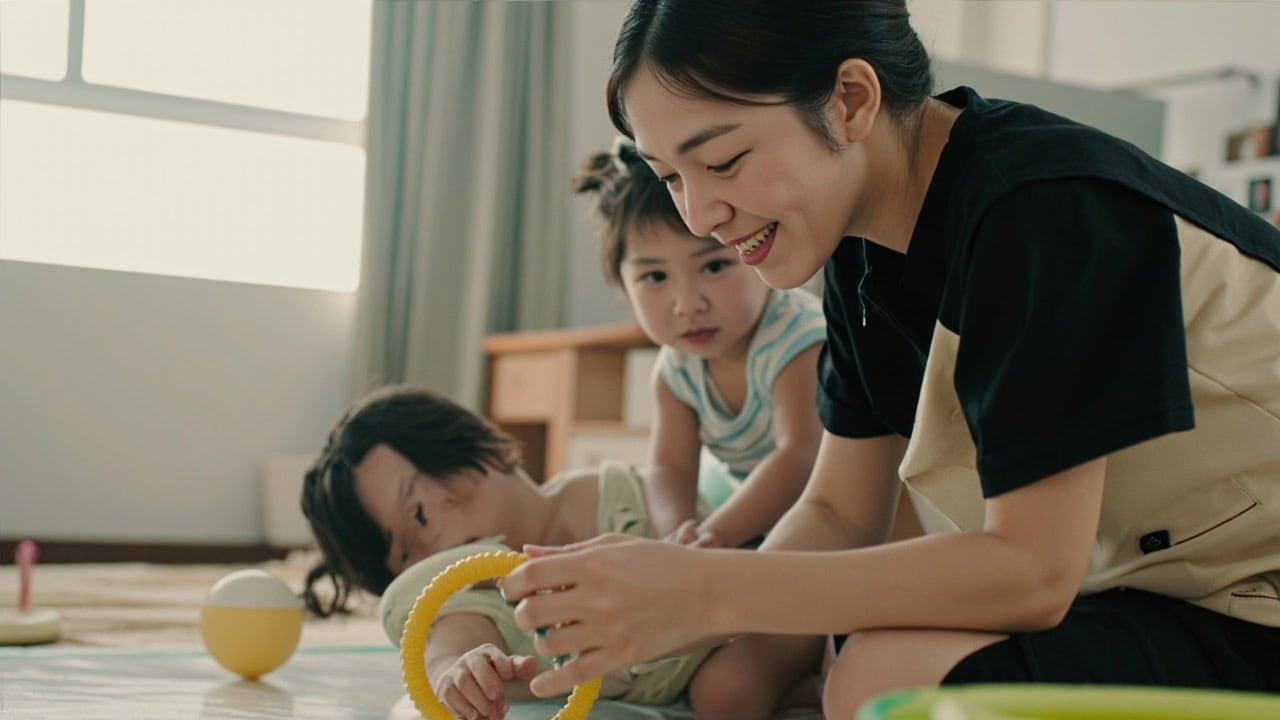
Consider this hypothetical scene: an infant sits on a clear play mat and stretches toward a soft ring that has rolled just beyond easy reach. The child pauses, looks toward the adult and reaches again. A childminder can move the ring closer, point, demonstrate, pick it up or wait. None of those options is automatically right; the next decision should turn on the infant’s response.
Responsive support for infant exploration is therefore less about finding a perfect response than noticing whether an interaction is still mutual. The Center on the Developing Child at Harvard University’s guide to “serve and return” says that when an adult returns a child’s “serve,” the child should be given a chance to respond. That principle does not set a required number of seconds, endorse a particular care ratio or prescribe a script. It offers a simpler practical test: did the adult’s action leave room for the infant to act?
Begin with the infant, not the intended lesson
An adult may begin with a worthwhile goal: keep the ring in reach, encourage a push, share a song or settle a transition. Trouble starts when the goal becomes more important than the infant’s immediate response. A cue selected in advance can still be changed or withdrawn if it does not produce engagement.
In this hypothetical example, the infant first looks at the ring and then at the childminder. The adult may respond to that look, but it does not establish that the infant wants the toy handed over. A glance toward the mat or a word for the object can be added, followed by observation. If the infant reaches, the exchange continues. If the infant turns away, repeating the cue is not automatically better.
This changes the adult’s role from director to responder without making the adult passive. The childminder remains responsible for a safe setup, notices changes in engagement and steps in when help or protection is needed. Initiative means the infant has a meaningful turn, not that the adult must never assist.
Use the smallest helpful response
When help appears useful, it can be scaled rather than delivered all at once. The following is an illustrative sequence for everyday play, not a fixed protocol or developmental timetable.
- Restore safe access: If a toy has moved somewhere difficult or unsafe, place it within safe reach before asking the infant to solve the next problem.
- Return attention: A look, gesture or brief word acknowledges the activity without supplying the action.
- Offer one directional cue: A glance toward an object or a simple phrase can redirect attention; its usefulness is shown by what the infant does next.
- Model once, if needed: An adult may demonstrate a push or show how two pieces fit, then stop rather than repeat the demonstration continuously.
- Step in when protection or immediate assistance is required: Direct help can take priority over preserving a self-directed attempt if the infant cannot safely manage an object or appears distressed.
Each part of this sequence is provisional. The adult should not escalate it simply because an activity is meant to become faster, quieter or more impressive. Nor should help be withheld merely to preserve the sequence. The purpose is to avoid unnecessary assistance while remaining responsive to need.
Timing follows the same logic. A pause may be brief or extended; the cited evidence does not establish a universal number of seconds. The adult can watch for a renewed reach, gaze, movement or vocalisation, and can end the pause when a different form of support is warranted. Availability matters as much as silence.
When to help an infant during play
The practical question is not “Has the infant had enough time?” but “What has the infant just shown?” A renewed reach or return of attention suggests that the current setup still has something to offer. A cue followed by a new action can be left without repetition. A baby who looks away, repeatedly changes target or appears distressed may need the object moved, the task simplified or the interaction ended.
Repeated explanation is not the same as responsiveness. If the adult speaks, demonstrates or repositions the same item several times without a change in the infant’s response, the adult should reconsider the cue. Responsiveness is not persistence; it is a willingness to withdraw, revise or stop.
Nor should adults turn each choice into a test. A child who does not continue an activity has not failed, and a pause should not be labelled as a lack of curiosity. The purpose of this decision guide is to protect the infant’s participation, not to extract a predetermined result. In a shared-book moment, an adult can end after one look; in a song, after one gesture. Those can be complete interactions without a measurable learning outcome.
Teaching can coexist with responsiveness—if the infant can answer
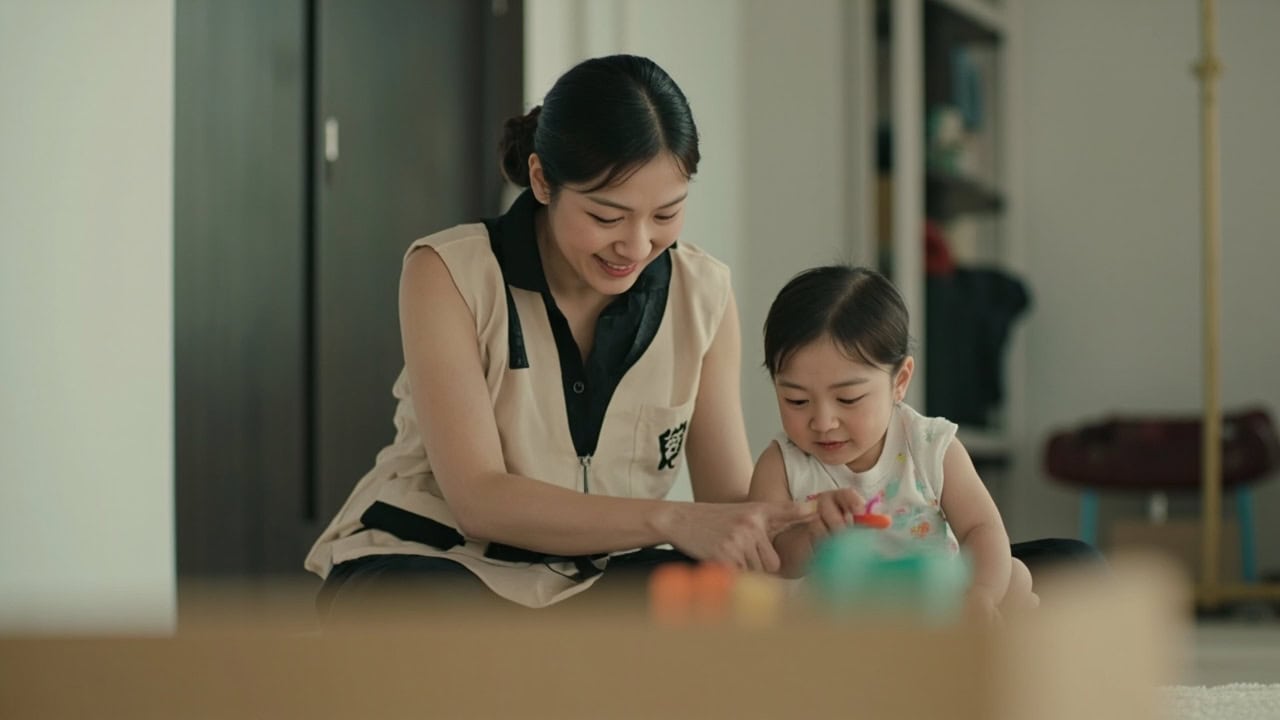
This is where the adult’s language matters. The abstract of a 2023 experiment, “Teaching or Learning from Baby”, reports that caregivers’ explicit goals to teach infants resulted, on average, in more controlling and adult-centred caregiving. The finding comes from that experiment; it does not show that every question, demonstration or learning opportunity is harmful, nor does it provide a rule for interacting with a particular child.
For parents, the useful contrast is between an adult-led question—“How do I get this object into the hoop?”—and a responsive one: “What is the infant attempting, and what response follows?” The study did not test that exact wording, but the distinction keeps adult intent from becoming the only measure of a successful exchange.
The alternative is not an interaction without teaching content. An adult might name an object after the infant looks toward it, model a simple action once or offer two safe choices through gesture. The infant may look, reach, vocalise, change target or leave. Those responses should not be overstated: looking at a picture is not reading, and responding to a phrase is not evidence of singing. No response needs to be converted into a performance.
Low density creates opportunity, not an outcome
Several infants can require attention at the same time. An adult who is not stretched across multiple demands may have more opportunity to notice one child’s gaze, return an action and adjust a cue. This is an organisational possibility, not proof that a numerical ratio changes development.
EduNanny’s ECDA Childminding Pilot Programme page states that infant care is provided in small-group environments with a maximum of three infants per childminder. That is EduNanny’s stated service limit, not independent evidence of an outcome. A maximum of three does not mean continuous one-to-one care, guarantee uninterrupted observation or demonstrate that the ratio causes stronger problem-solving. The external evidence cited here concerns responsive interaction or an experimental comparison of teaching goals; it does not test childminder-to-infant ratios.
For parents, density is therefore best treated as context for care, not a developmental promise. It may remove some competing demands, but the quality of each response still depends on what the childminder notices and how the adult responds. The number cannot replace observation, and “premium” should not mean a guaranteed developmental shortcut.
Questions that reveal responsive care
Parents looking at any infant-care setting can ask concrete questions. Does the childminder describe what the infant initiated before deciding what to do? Is there time for a response after an adult action? Are prompts changed or withdrawn when the infant’s behaviour changes? And does the adult step in when the situation is unsafe or the infant appears distressed?
These questions do not require a family to infer developmental effects from branding. They focus on observable practice: the child gets a turn, the adult pays attention to the answer, and safety remains primary. In the hypothetical reach for the ring, a responsive moment may end with the infant picking it up. It may instead end with a new sound, a change of target or a deliberate move to another activity.
The most useful question is therefore not how long a childminder waited, but whether each action opened space for the infant’s next action. That is a standard of care parents can observe, discuss and revisit as the infant—and the activity—change from one moment to the next.
Sources and further reading
- 5 Steps for Brain-Building Serve and Return · Center on the Developing Child at Harvard University
- Teaching or Learning from Baby · PubMed Central
- EduNanny® ECDA Childminding Pilot Programme · EduNanny
The images in this article were generated with AI for illustration. They do not show actual EduNanny staff, children or facilities.
Every family has different care needs. Speak with EduNanny to discuss care that is right for your child.