Beyond the Infant Childminding Age Range: Planning a Thoughtful Handover in Singapore
Singapore's infant childminding pilot has a published eligibility range of 2 to 18 months. As that boundary approaches, families can plan how to share useful routines, preferences and cues with the next caregiver.
As an infant grows, familiar care becomes a collection of small signals: a look toward a book, a response to a song, a gesture that invites another turn or a routine that helps the day settle. A parent may hope that the next caregiver will recognise these signals too. The aim is not to preserve every moment unchanged, but to offer enough useful context for a new adult to respond attentively.
Singapore’s published infant childminding pilot creates a specific planning point. The Early Childhood Development Agency (ECDA) says the pilot runs from 1 December 2024 to 31 December 2027 and that Singapore Citizen infants aged 2 to 18 months may participate. This is an eligibility boundary, not a developmental deadline or evidence that every child must change care arrangements at 18 months. A handover can organise useful information, but the evidence reviewed here does not establish that a particular handover format, by itself, improves developmental outcomes.
The Age Boundary Is a Programme Fact
An age range can answer an operational question: which infants may participate in a particular programme? It cannot answer every developmental or family question. Families still need to consider their child’s care needs, their own circumstances and the suitability of any proposed arrangement. The published boundary can prompt preparation, but it should not create pressure to rush a change or treat a particular age as a target.
Provider-specific arrangements require a separate check. The Ministry of Social and Development’s appointment announcement says that parents may contact appointed operators directly. That route is useful for asking about current availability, settling arrangements, communication practices and terms that may differ between providers.
It helps to keep two questions distinct. First, what does the official programme information say about eligibility and dates? Second, what does a particular operator currently offer? The first should be checked against official programme information; the second requires direct confirmation. Neither the age range nor an approaching calendar date can determine which care arrangement is necessary or beneficial for a particular child.
Premium Care Means Careful Individual Attention
Here, premium need not mean luxury or exclusivity. It can describe care in which an adult has enough opportunity to notice a signal, respond thoughtfully and leave room for the child’s next response. That is a description of care priorities, not evidence that a particular staffing number will produce a predictable developmental result.
The Center on the Developing Child at Harvard University describes serve and return as responsive, back-and-forth exchanges between a young child and a caring adult that play a key role in shaping brain architecture. This supports attention to infants’ signals as a general caregiving principle. It does not show that a handover form, a childminder ratio or a single transition appointment causes a measurable difference in later development.
Responsive care can appear in ordinary moments. If an infant reaches toward a board book, an adult can follow the child’s focus, respond to a look or sound and pause for another reaction. If a baby vocalises during a familiar song, the adult can repeat a phrase and wait. Treating these moments as opportunities for engagement does not turn them into tests. Looking at a colour is not the same as naming it; hearing a word in a song is not singing it; and looking at a picture is shared exploration rather than independent reading. The purpose is to follow the child’s interest without assigning a meaning the evidence cannot support.
Notes That Describe, Not Predict
Continuity begins with what adults have noticed during everyday care, not with a complicated form completed on the final day. A useful handover note is descriptive, current and specific. It records what an adult has seen, rather than what the child is expected or believed to become.
- the familiar sequence that helps the child settle, including a song, gesture, object or ordinary routine;
- the looks, sounds, movements and timing noticed around interest, tiredness, discomfort or a wish to continue;
- familiar books, songs, toys and activities, including what the child has been observed doing during them;
- the words, phrases, languages or communication preferences the family wants reflected in care; and
- who should receive routine updates and through which agreed channel.
For example, a hypothetical note might record that a child turns away when a room becomes noisy and looks again when a familiar song starts. Another might describe how a child often reaches toward a particular picture before looking at the adult holding it. These are observations, not diagnoses or labels. They give the next adult something specific to notice while allowing for a different response in a new setting.
A handover should also remain revisable. An observation made during one week may not describe the child a month later, and a cue that works at home may not work elsewhere. With the family’s agreement, share only the information the next caregiver needs to provide responsive care, using a channel everyone understands. The aim is to provide a starting point for listening, not to transfer an entire private history into a new room.
Questions for the Next Care Arrangement
Before care begins, families can ask how settling is introduced, whether a familiar routine can be used where appropriate, how the caregiver will learn a child’s cues, how updates are shared and what happens if the usual caregiver is unavailable. These are practical questions, not promises that a child will settle quickly or respond in the same way to every person.
It can also help to ask what a stated staffing ratio means in practice. What is the maximum number of infants the provider says may be assigned to one childminder? How are changes in attendance or absences handled? Who records an observation and passes it to a colleague? If a provider states a maximum group size, that is a description of a staffing arrangement; it does not promise uninterrupted individual attention at every moment. The useful question is not only how many infants are permitted, but how attentive care is organised when plans change.
Families can compare published descriptions with the setting, the proposed relationship and the answers given by the provider. Neither a group-size statement nor a handover form alone proves that care will be continuous or that it will generate a particular developmental outcome. Those wider promises would require evidence beyond a programme description or a first-party service page.
What a Provider’s Own Page Can Show
On its EduNanny® ECDA Childminding Pilot Programme page, EduNanny describes a Know-Your-Child appointment, session updates and monthly child development reports. It also states that its contract remains valid until the child turns 18 months. These are provider-specific statements. They are not ECDA-wide requirements and do not independently establish a developmental outcome.
For a family reviewing those details, the useful next step is to ask how matching works, what the reports contain, how session updates are communicated and what arrangements apply near the end of the stated contract. The provider’s page can describe what the organisation says it offers; direct clarification remains necessary for current terms. A service feature should not be confused with a guarantee of continuity, and a philosophy of individual attention should not be treated as proof of a measurable result.
A Plan That Leaves Room for the Child
As the upper end of the published eligibility range approaches, a family can make a modest plan: agree on a few useful observations, confirm who should receive them, ask the next provider about settling and updates, and keep the handover brief enough to revise. A calendar can prompt preparation, but it should not dictate the pace at which a child adapts to a new person, routine or room.
Children can respond differently to the same cue in different settings. The next adult can begin with observation rather than assuming that a familiar sound, object or gesture will work in exactly the same way. Notes should record what is happening now, while conversations remain open to what the child shows as the relationship develops.
Before making arrangements, recheck ECDA’s published eligibility and dates and speak directly with the relevant operator about current next steps and provider-specific terms. If the programme’s upper age boundary means that a family needs another arrangement after 18 months, a handover may carry forward useful routines, preferences and cues. It should not be presented as proof that changing settings is automatically better, seamless or developmentally beneficial. A thoughtful plan preserves context while leaving the child room to show what helps now.
Sources and further reading
- Childminding Pilot for Infants · Early Childhood Development Agency, Singapore
- ECDA Appoints Three Operators for New Childminding Pilot for Infants · Ministry of Social and Development, Singapore
- Serve and Return: Back-and-forth exchanges · Center on the Developing Child at Harvard University
- EduNanny® ECDA Childminding Pilot Programme · EduNanny
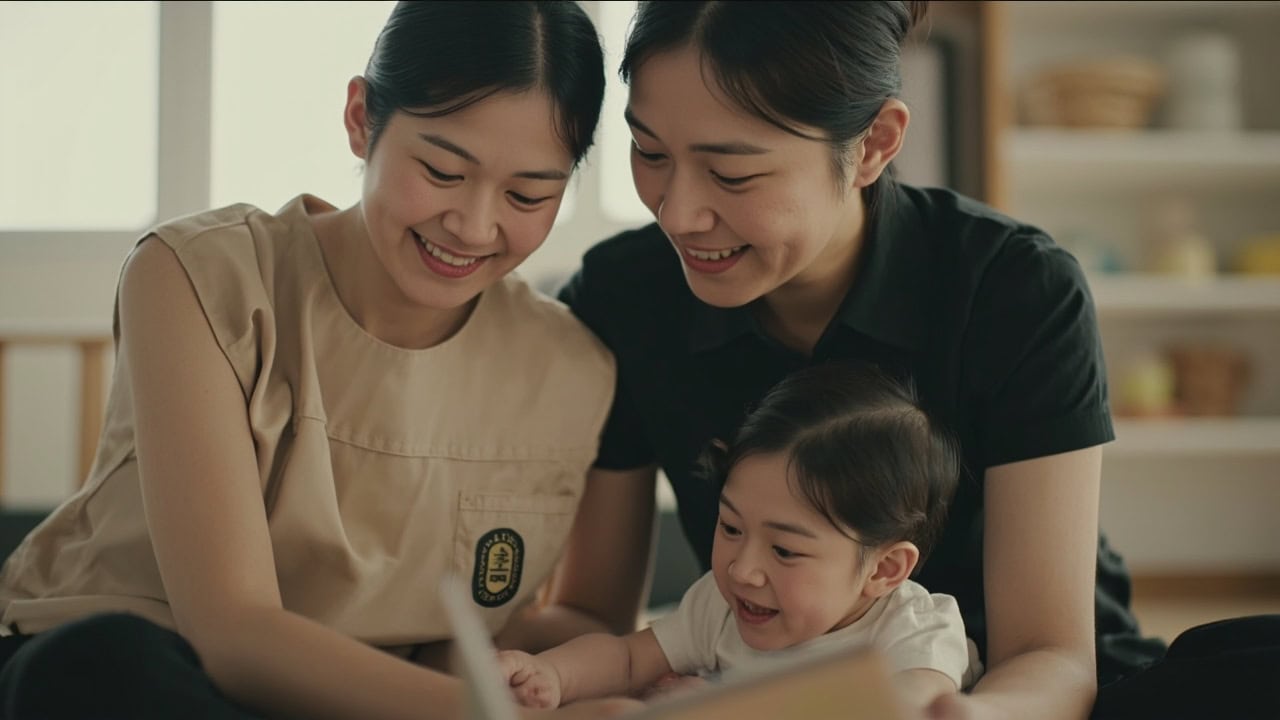
The images in this article were generated with AI for illustration. They do not show actual EduNanny staff, children or facilities.
Every family has different care needs. Speak with EduNanny to discuss care that is right for your child.