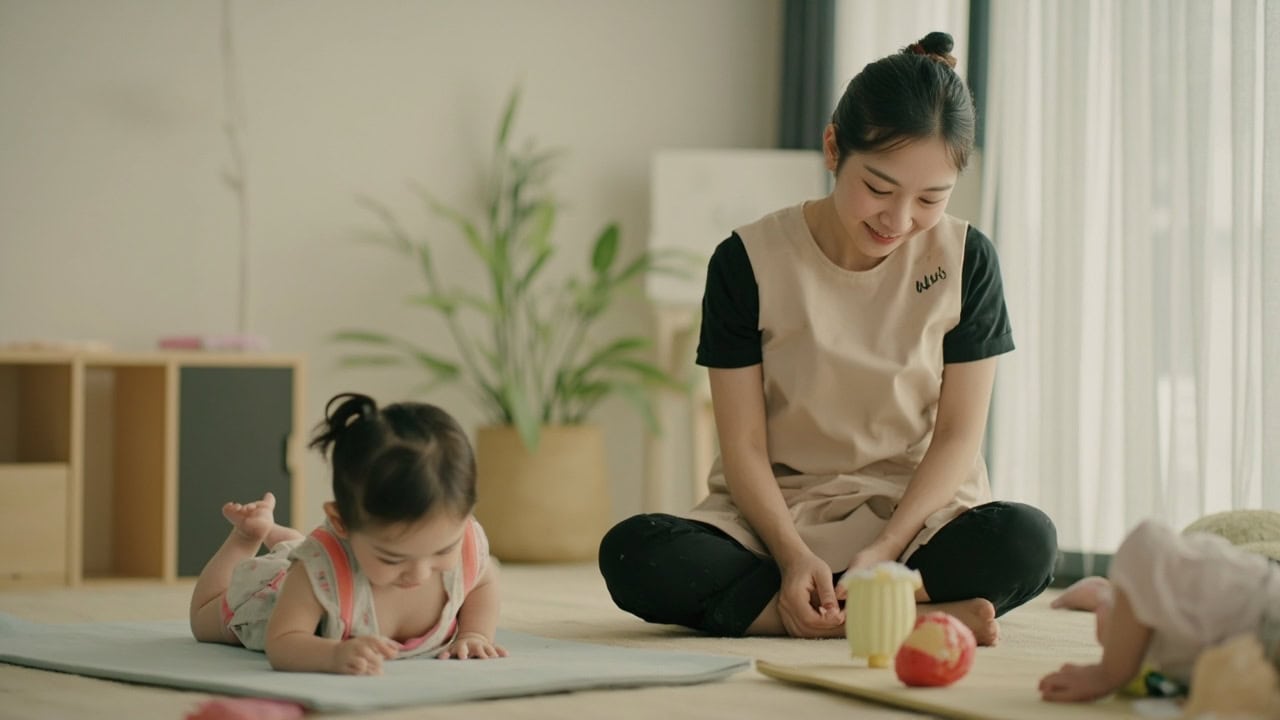
Who Owns the Next Turn in Infant Care?
Responsive infant interaction is not a special activity or a guaranteed outcome. It is a way of designing care so an adult notices a baby’s contribution, responds and leaves the next turn open to the infant.
In a hypothetical childminding room, an adult places a soft cloth within reach, begins a familiar song and then opens a picture book. The materials are ordinary. The important detail is what happens when the infant looks away, reaches or vocalises. If the adult changes course in response, the activity becomes more than the delivery of stimulation: it becomes a two-way exchange. That is the working idea of responsive infant interaction—and the reason it belongs in a discussion of care design, not only in a list of baby activities.
That framing is both simpler and more demanding. The overview from the Center on the Developing Child at Harvard University describes serve-and-return interactions as responsive, back-and-forth exchanges that play a key role in shaping brain architecture. That is evidence for an interaction principle, not a service outcome. Applied to childminding, it asks how the environment, routine and adult workload are arranged so a caring adult can notice an infant’s signal, return it and leave room for the next contribution.
The Activity Is Not the Interaction
A song, cloth or book can be used without a two-way exchange. The fact that a material is present tells us what an adult has prepared, not what an infant has contributed. In responsive infant interaction, the adult’s offer begins the exchange but does not have to own all of it. The infant’s next look, sound or gesture can influence what the adult does next.
The Center’s practical guide to serve and return makes the operational point direct: every time an adult returns a child’s serve, the child should be given a chance to respond. The guide also says taking turns can be quick. An adult therefore does not need to turn every silence into a longer explanation or a larger performance. The task is to make the return and the opening that follows possible.
A published study of mother-child and father-child serve-and-return interactions describes sounds, gestures and looking as ways infants take part in these exchanges. Applied carefully, that evidence keeps description bounded. Looking is not automatically evidence that an infant has named an object or colour, and a sound is not automatically a word. Responsive observation begins with what can be seen or heard, rather than with a more impressive interpretation.
Attention Is Part of the Care System
A group setting makes each exchange part of a larger workflow. An adult may need to respond to a sound from one infant, notice a reach from another and manage a transition while attending to both children. The evidence cited here does not test staffing arrangements, so it cannot show that one ratio produces a particular developmental result. It supports a narrower design question: how might attention be organised so that a signal can receive a response amid ordinary group demands?
EduNanny’s ECDA childminding pilot page describes its infant care as a small-group environment with a maximum of three infants per childminder. This is an exact first-party statement about the stated arrangement. It is not a promise of continuous one-to-one attention, and it is not evidence that infants in that setting will reach milestones sooner or outperform children elsewhere.
A stated maximum can nevertheless sharpen the operational discussion. The meaningful question is not whether the number sounds impressive in isolation, but whether the working arrangement gives an adult a realistic opportunity to notice a signal, complete a return and adjust the next action. Any claimed advantage from lower density remains a design hypothesis unless it is measured. In this context, premium can mean that individual observation and adjustment are explicit priorities; it cannot mean a guaranteed developmental result.
Build a Moment That Can Change Direction
A responsive routine needs to leave room for the infant to alter it. In a hypothetical song, the adult completes a phrase and pauses. The infant may look back, vocalise, move the hands or look away. Rather than assign one correct continuation, the adult can follow renewed attention, simplify the activity or stop. During shared book time, a gaze toward the page can shape what the adult presents next; a reach toward another object can shift the shared focus. These are hypothetical examples of responsive infant interaction, not a prescribed sequence.
No fixed number of seconds is established here. The Harvard guide says that turns can be quick; it does not prescribe a minimum waiting period. A pause is therefore an opening rather than a test, and it need not become a fixed ritual. The relevant standard is whether the adult remains able to notice what, if anything, follows.
A useful editorial framework treats an infant’s opportunity to contribute, and the adult’s response to it, as part of an activity’s purpose. The activity is not finished merely because the adult has sung a phrase, shown an object or filled every gap. This is also what separates a two-way exchange from a stage performance: after contributing, the infant does not have to follow an adult script. The adult remains responsive by changing course when the shared moment changes.
Process Notes, Not Developmental Scores
Observation in infant care can drift too quickly into prediction. The immediate task is to describe the exchange before assigning a developmental meaning. A professional reflection might record that an infant looked toward a cloth, the adult brought it into shared view, the infant vocalised and the adult paused. This is a hypothetical process note. It does not establish that the infant requested the cloth, identified its colour or produced language.
That level of description guards against two errors: assigning a meaning that the evidence does not support, and turning a brief exchange into a score. The cited study supplies examples of infant contributions, not a universal dictionary for interpreting them. A note such as responded to a vocalisation is more grounded than a broad label if an infant seems interested, because it states what occurred. The distinction makes feedback about the adult’s practice possible without pretending to predict a child’s future.
In this approach, consistency describes the care system, not uniformity in an infant’s behaviour. The adult’s responsibility is to observe accurately, return supportively and adjust. The supplied sources do not establish a fixed response time, a universal cue or a script that every child should follow. Those limits are not weaknesses in the idea of responsive interaction; they are reasons to keep the interpretation modest and the practice attentive.
Programme Scope Is Not Outcome Evidence
For the Singapore context, the official ECDA childminding pilot information states that the pilot runs from 1 December 2024 to 31 December 2027 and that Singapore Citizen infants aged 2 to 18 months may participate. Those details establish the programme’s scope. They do not establish any provider’s interaction quality, staffing arrangement or measured developmental gains.
The evidence in this article answers different questions and should remain separate. Harvard supplies the general interaction principle; its practical guide explains the need to give a child a chance to reply; the PubMed Central study provides concrete examples of infant contributions; EduNanny provides a first-party description of its small-group arrangement; and ECDA provides the official pilot dates and population scope. Combining these sources can clarify a design, but it cannot merge them into proof of an outcome.
No cited source here demonstrates that a maximum of three infants per childminder causes faster milestones, higher intelligence or guaranteed progress. General responsive-care research also cannot be used to claim that a particular provider produces superior developmental outcomes. Responsible brand communication can describe an operating intention while leaving outcome claims unmade.
Premium Is a Repeatable Way of Working
This makes a more precise meaning of premium infant care possible. It need not mean luxury, novelty or uninterrupted entertainment. It can mean that individual observation, two-way exchange and adjustment are built into the design of the day, while the limits of the arrangement remain clear. A stated low-density model is an operational choice; responsiveness is the quality of what happens within that model.
That standard can be demanding. A busy morning can contain many materials and few completed exchanges. A hypothetical quieter morning may show a repeated pattern: a signal is noticed, a response is made and the next turn is protected. The distinction lies in the workflow rather than in a showpiece activity. It also explains why two settings with similar toys or timetables can still differ in the quality of their exchanges.
Responsive infant interaction is ultimately a question of who gets to shape the next moment. In a well-designed exchange, the infant is not merely content to receive; the infant is allowed to affect what happens next. No milestone promise is needed. The meaningful unit is the small completed sequence: an adult notices, returns and makes room.
Sources and further reading
- Serve and Return: Back-and-forth exchanges · Center on the Developing Child at Harvard University
- 5 Steps for Brain-Building Serve and Return · Center on the Developing Child at Harvard University
- Mother-child and father-child “serve and return” interactions at … · PubMed Central, National Library of Medicine
- EduNanny® ECDA Childminding Pilot Programme · EduNanny
- Childminding Pilot for Infants · Early Childhood Development Agency, Singapore
The images in this article were generated with AI for illustration. They do not show actual EduNanny staff, children or facilities.
Every family has different care needs. Speak with EduNanny to discuss care that is right for your child.