A Low Ratio Is a Starting Point, Not a Developmental Promise
A low ratio of adults to children can describe a staffing arrangement, but it cannot prove better care or a developmental advantage. Here is how Singapore parents can verify the number and examine responsive care in practice.
Consider a hypothetical Singapore parent comparing two infant care descriptions. One leads with a low ratio of adults to children. Another leads with warm, responsive care. On an ordinary morning, when two babies need attention at once, what does the number actually tell the parent, and which claims can they verify?
A low ratio is worth verifying because it describes a staffing condition. It is not a complete description of care. A parent must also examine how caregivers respond, whether infants receive consistent individual attention and what, if anything, has been measured for a named group. Keeping staffing, interaction and measured results distinct gives the parent a clearer basis for comparison.
What a staffing ratio can establish
A staffing ratio describes how infants are counted against adults within a stated arrangement. A provider may report an average, a maximum or another defined arrangement. The wording matters. A maximum ratio sets a limit on how many infants may be counted for each adult in that arrangement. It cannot show, however, how often one caregiver notices, responds to or stays with one baby.
In a hypothetical settling period, one infant may vocalise, another may reach for a toy and a third may need a nappy change. The ratio cannot tell a parent who responds first, how the other infants are supported or whether each baby has time to respond in turn. Those details belong to the organisation of care.
A provider’s own description shows why attribution matters. EduNanny’s ECDA childminding programme page states that care is offered in small groups with a maximum of three infants per childminder. This is the provider’s stated arrangement, not independent evidence that every infant receives continuous individual attention. The programme page does not report measured developmental results.
When a brochure calls a ratio low, ask what the figure covers. Does it describe the usual group, the maximum group, a particular age range or a particular session? Can the count change during arrivals, departures or other transitions? A precise figure gives a parent something to verify, while the organisation of care gives it practical meaning.
What the research on ratios can support
An excerpt from a 2017 review of child staff ratios describes ratios as a key quality indicator in early childhood education and care programmes. It says that better ratios are “believed to improve child outcomes”.
That wording places ratios within a quality assessment, but it does not prove that a particular change causes a particular benefit. The excerpt gives no estimate of the size of any benefit and does not set out the review’s definitions, detailed methods, findings or limitations. It cannot support a claim that adding an adult caregiver or changing a group’s size causes a specific result for a particular infant. The evidence available here also does not compare Singaporean infant childminding settings or evaluate a named provider.
A service page can document what a provider says it offers. Evidence of a measured result would need details of the children, setting, period, measure and method. These answer different questions. A staffing description may be accurate while saying little about an outcome, just as a general research principle may be relevant without establishing what happened in one group of children.
Why interaction must be judged separately
The developmental material offers a separate line of evidence. Harvard’s guide to serve and return says that responding to a young child’s signals and needs provides an environment rich in back and forth experiences. Related material on brain architecture from the Center on the Developing Child says that responsive serve and return interactions with caregivers play an essential role in supporting healthy brain development.
These statements support the developmental relevance of responsive exchanges. They do not test a low staffing ratio or show that a particular number will produce those exchanges in a named setting. The connection between the staffing ratio and interaction therefore remains an inference: fewer infants per caregiver may give an adult more opportunity to notice and respond, but that opportunity may or may not be used consistently.
In an infant setting, responsiveness may appear during play, shared reading or routine care. A caregiver could notice gaze, sound or movement, offer a word or gesture and make room for the infant’s next response. This is an illustration, not a script that every baby will follow or a record of an observed service routine. Infants communicate differently, so an adult’s response must remain tied to the signals present in the moment.
The two Harvard pages are related explanations rather than independent studies that replicate one another. Together, they support a limited conclusion: responsive interaction matters, while the staffing number remains a separate question.
Questions that reveal how care works
A useful conversation should move beyond a slogan such as “individual attention” and seek a concrete account of what happens when an ordinary day becomes busy. A parent could ask:
- What does the number mean? Confirm whether it is an average or maximum, which ages and settings it covers, and what happens when the group changes.
- What happens when needs overlap? Ask how an immediate need is identified, how other infants are supported while the adult responds and how the family is informed.
- How does a caregiver respond? Ask how caregivers notice changes in an infant’s gaze, vocalisation or movement, what they do next and how the infant is given space to respond.
- What has actually been measured? If a setting makes a developmental claim, ask what was measured, for whom, where, over what period and by whom. A staffing statement or general research principle is not a result from that group.
These questions separate a staffing claim from daily practice. A stated ceiling cannot show how a caregiver manages when needs overlap, whether another infant receives an appropriate response, or whether an outcome has been studied. The questions help parents seek precise explanations and specific answers without expecting them to observe every minute.
A proportionate judgement in three stages
A parent can approach the decision in three stages:
- Verify the staffing condition. Is the figure an average or maximum, what does it cover and what happens when the group changes?
- Examine the care process. Can the provider describe how infants’ signals are noticed and answered when needs overlap?
- Ask for defined evidence for any stronger claim. What was measured, in which setting, for whom, by whom and over what period?
Choosing infant care carries real responsibility. A useful staffing figure can inform that decision, but it should not be expected to prove more than it can. A provider can describe small groups and an intention to be responsive. Such descriptions can clarify the service model, but they are not measured evidence about children in that setting.
If the number is accurate, the care process is clear and any outcome claim is supported by defined evidence, the parent has a sounder basis for comparison. If the answer is only that a low ratio guarantees better care or a developmental advantage, the stronger claim has not been demonstrated. A useful conversation leaves a parent with three answers: what the number means, how care is organised when needs overlap and what, if anything, has actually been measured.
Sources and further reading
- EduNanny® ECDA Childminding Pilot Programme · EduNanny
- Child-Staff Ratios in Early Childhood Education and Care … · PubMed Central
- A Guide to Serve & Return · Center on the Developing Child at Harvard University
- Brain Architecture: An ongoing process that begins before … · Center on the Developing Child at Harvard University
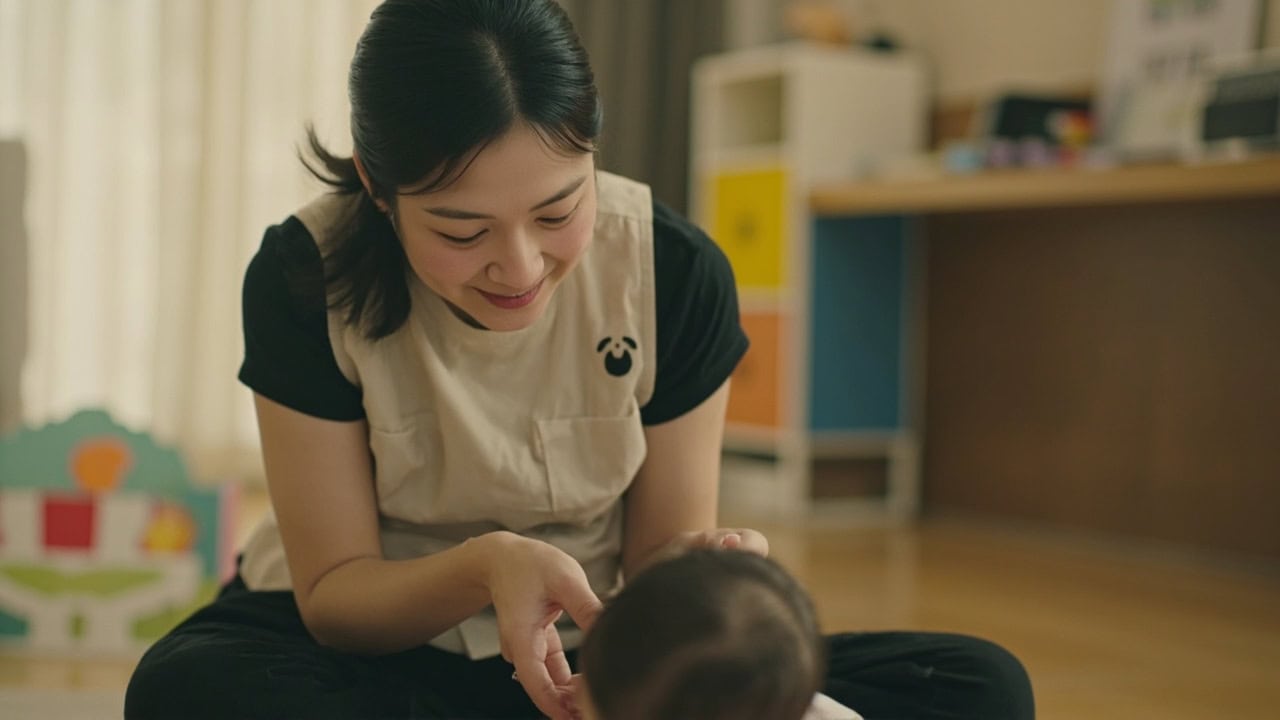
The images in this article were generated with AI for illustration. They do not show actual EduNanny staff, children or facilities.
Every family has different care needs. Speak with EduNanny to discuss care that is right for your child.