

Fraud Blocker edunanny.com

Category: Childminding

edunanny-2c7b681a-5957-4dc3-b1ef-181fdd865b51
October 6, 2025

Three Beat Attention Notice Name Nurture EduNanny A Science Driven Path to Joyful Infancy in Singapore
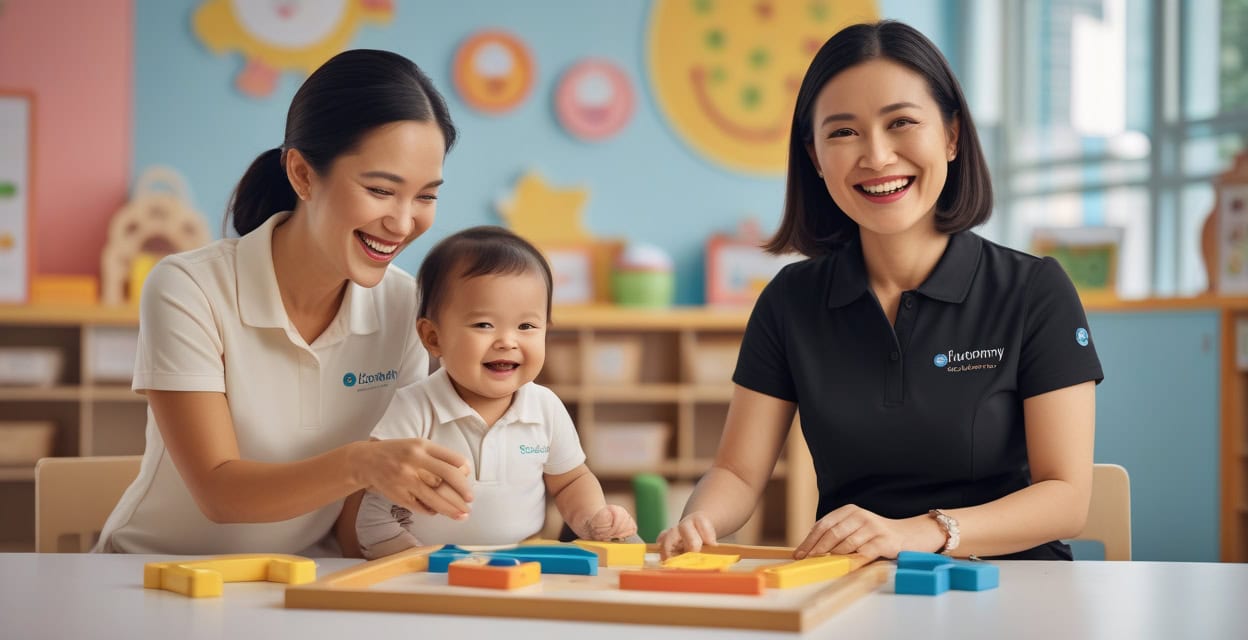
EduNanny Singapore: A New Everyday for Singapore’s Smallest Citizens

EduNanny Singapore: A New Everyday for Singapore’s Smallest Citizens

Good evening to parents, caregivers, neighbours, and friends. This is a message about the quiet rhythm that shapes our nation’s future: how we care for our youngest children in the ordinary hours of every day. EduNanny, born in Singapore and powered by science and compassion, is designed for the real lives of working families. We blend the rigour of early childhood research with practical, everyday systems that make care reliable, warm, and close. Centre-based and home-based childminding are offered, with distance support when continuity is needed. We operate Monday to Friday, 7am to 7pm, islandwide—because a dependable day is the scaffold of family life. We honour the dignity of the infant with an excellent 1:3 infant ratio, modern layouts that are calm and safe, and innovative CCTV for transparency and trust. Our programme sits within the ECDA Childminding Pilot, a National Social Initiative that advances meaningful local work through the Maximum Employment Mandate. It is affordable from $33/day, with fees payable by CDA/Baby Bonus. Learn more at EduNanny.com and Childminding.EduNanny.com.

The goal of infant care excellence is not a single grand promise, but thousands of small, consistent choices. EduNanny’s work is anchored in the wisdom of Montessori’s prepared environments, Pikler’s respectful care, Bowlby’s secure base, Vygotsky’s learning-in-relationship, and the modern science of attachment and brain development. Below, we translate that scholarship into the living language of your baby’s day, with actionable guidance for families and caregivers alike.


The Three-Beat Attention: Notice, Name, Nurture

The Three-Beat Attention: Notice, Name, Nurture

Notice: Catching the Cues

Infants communicate through subtle signals long before they can speak. Caregivers train to observe the first cues in every micro-moment—glances, posture changes, or a fist unclenching. Practical steps include:

  • Do a quick cue check every 15–20 minutes: is the baby hungry, tired, cold, or seeking comfort?
  • Record a short note after key interactions: “eye contact established; need for soothing identified; parent notified.”
  • Rotate attention to the baby’s main needs first, even during transitions, to prevent escalation.

Name: Giving Words to Feelings and Actions

Language wraps experience with meaning. Beyond labeling needs, we name actions and feelings to build understanding. Practical tips:

  • Use concrete phrases: “You’re hungry; you’re telling me with your mouth and hands.”
  • Pair words with facial cues and gestures to reinforce comprehension.
  • Speak in the home language alongside English when families choose—support bilingual development and cultural continuity.

Nurture: Responding with Calm, Paced Care

Response is the heart of trust. Nurture means feeding, changing, soothing, and monitoring in a calm tempo, with conversational touch and eye contact. Actionable practices:

  • Offer timed pauses during care routines so babies have space to signal readiness for the next step.
  • Maintain gentle touch and a warm tone; narrate the care sequence: “We’re washing hands, then we’ll sit for a snack.”
  • Document routine patterns to help families anticipate transitions and participate in the same rhythm at home.

In practice, the Three-Beat Attention turns ordinary moments—nappy changes, bottle feeds, transitions—into a daily seminar on trust. Over time, babies internalize predictability and agency. The first curriculum is not colours and shapes; it is confidence.
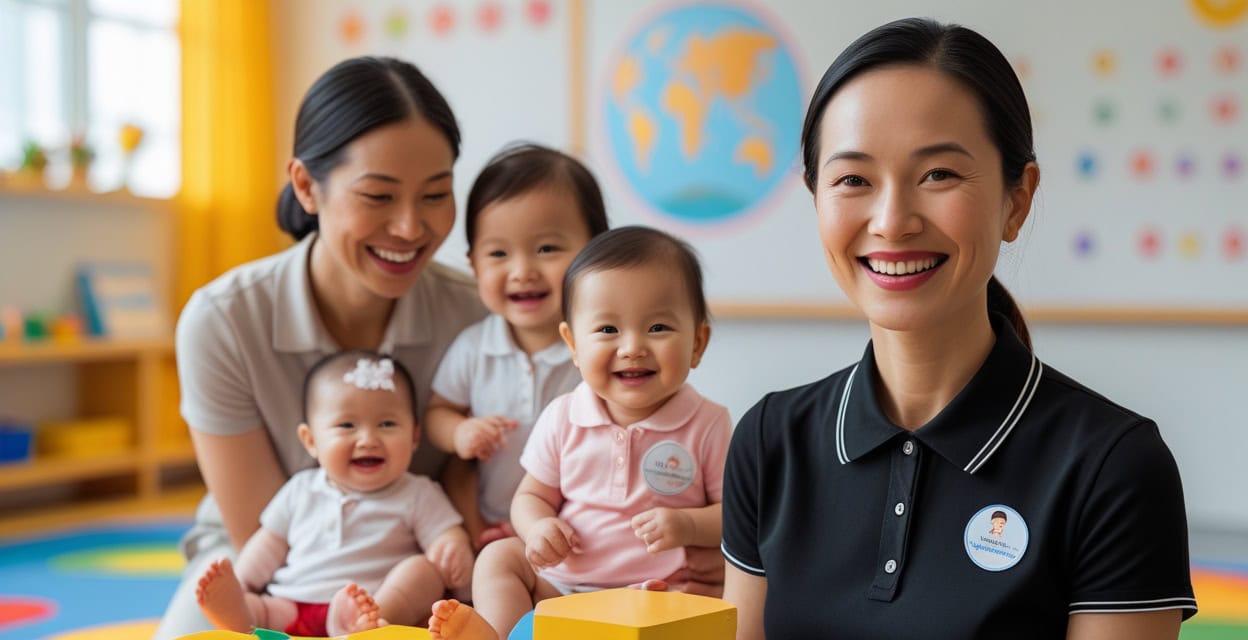

Safety as a Living Map: Design, Routine, and Transparent Accountability

Safety as a Living Map: Design, Routine, and Transparent Accountability

Design: Calm, Clutter-free Environments

Safety begins with the space itself. Practical design choices include:

  • Modern layouts that reduce visual clutter and clear trip hazards; care zones clearly delineated.
  • Low-shelf storage with inviting, reachable toys to encourage independent exploration at a safe pace.
  • Quiet corners and defined “care islands” for feeding, changing, and resting, all with clear sightlines for caregivers and families.

Routine: Rituals that Promote Safety and Consistency

Safety is a daily habit embedded in routine. Actionable routines include:

  • Daily safety walks and incident reviews to learn and improve; include caregivers, supervisors, and families in debriefs.
  • Regular emergency drills (fire, medical) with age-appropriate procedures and clear exit paths.
  • Staff practice of quiet handovers at start and end of day—concise checklists paired with a warm briefing.

Transparent Accountability: CCTV, Logs, and Open Lines

Transparency builds trust. Our approach includes:

  • Innovative CCTV that is framed as a safety and accountability tool—never a substitute for warm human interaction.
  • Open sightlines and supervised access to logs: feeding, naps, milestones, and sensitivities are tracked for continuity.
  • Clear safety protocols, with monthly skills labs and reflective supervision for caregivers.

Safety is a living map we redraw together—families, childminders, and supervisors—so every day is safer than the last. Implementing quiet handovers, daily safety walks, and transparent logs transforms safety from a poster into daily practice.
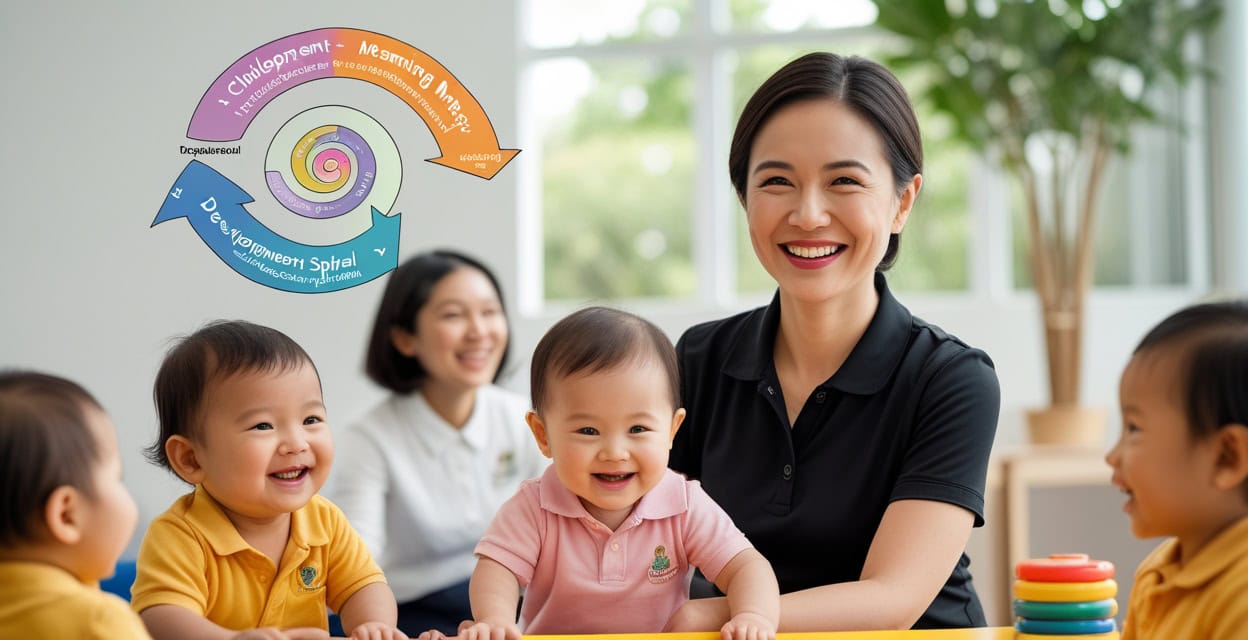

The Development Spiral: From Movement to Meaning to Mastery

The Development Spiral: From Movement to Meaning to Mastery

Understanding the Spiral

Human development unfolds as a spiral rather than a conveyor belt. Movement leads to perception; perception invites language; language supports problem-solving; social connection powers the engine. Our practice centers on four interconnected threads:

  • Movement: Gentle gross-motor invitations—tummy time, slow roll, supported reach—rooted in Pikler’s respect for intrinsic pace.
  • Perception: Sensorial play with everyday objects—spoons that chime, scarves that float, water that drips—Montessori-inspired clarity without over-stimulation.
  • Language: Short, face-to-face conversations that mirror and expand infant sounds—Vygotsky’s idea that we think with others before we think alone.
  • Social Connection: Scaffolding that strengthens trust and collaborative problem-solving with caregivers and family members.

Two-Hour Rhythm Cycles

Infant days are structured around rhythm, not rigidity. A representative two-hour cycle might look like:

  • Warm bodies: gentle movement invitations; tummy time; supported sit and reach.
  • Curious eyes and ears: sensorial play with safe, everyday objects; discovery play with rhythm and tempo.
  • Shared words: brief, bi-directional conversations that imitate and extend infant sounds.
  • Reset and rest: safe sleep spaces tuned to infant needs and ultradian rhythms; unhurried transitions between activities.

The spiral is bilingual by design when families opt in—home-language stories and songs alongside English—grounded in cultural relevance. It is scientifically aligned with infant sleep and wake cycles, and it is always adaptable to each child’s pace. The result: steady progress that feels like play.
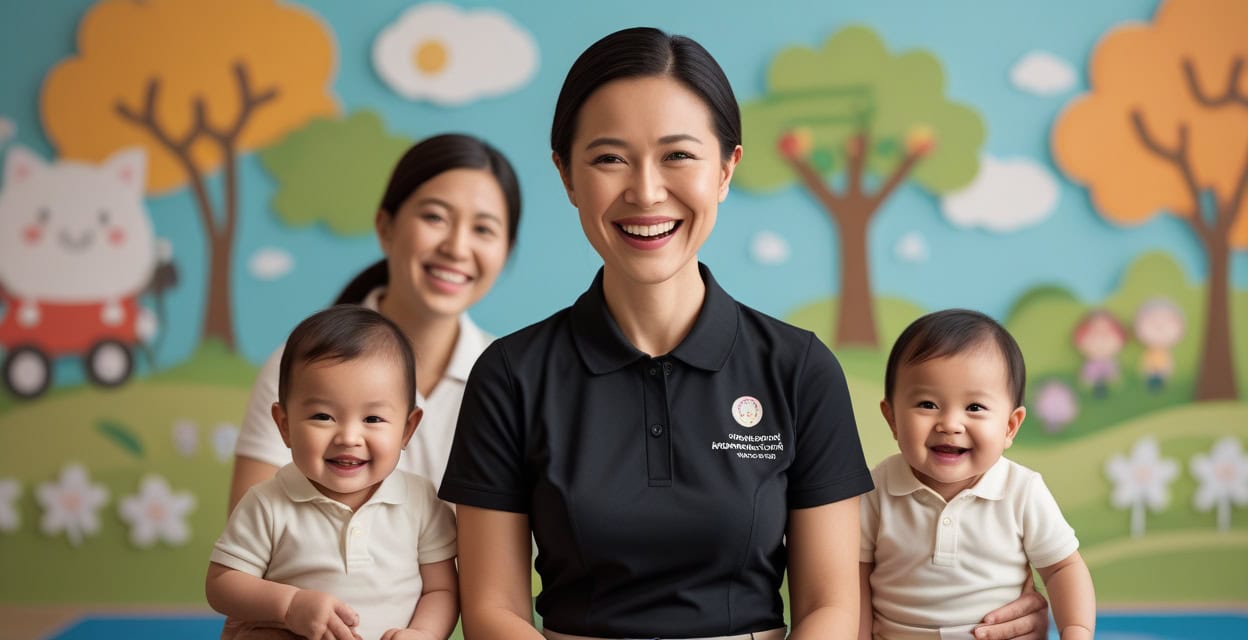

Joy Literacy: Learning to Read the World with Delight

Joy Literacy: Learning to Read the World with Delight

Joy Loops: Predictability, Choice, and Mastery

Joy literacy means happiness through competence and care. We design daily loops that create confidence and curiosity:

  • Predictable rituals: consistent welcome routines, meal routines, and goodbye rituals that signal safety and belonging.
  • Safe choices: guided autonomy within clear limits to foster decision-making and self-regulation.
  • Mastery moments: milestones engineered to be challenging but achievable—clapping at a new word, reaching a new attachment to a toy, or completing a small task independently.

Caregiver Language and Scripted Triumphs

Caregivers learn to script small wins that reinforce effort and resilience:

  • “You turned the page. That was your idea.”
  • “You waited, and I came. You can rely on me.”
  • “That sound surprised you; we’ll try it again together.”

When delight meets language and attuned presence, neural pathways for curiosity and resilience are strengthened. Tomorrow’s math, music, and mentorship begin with today’s giggle.
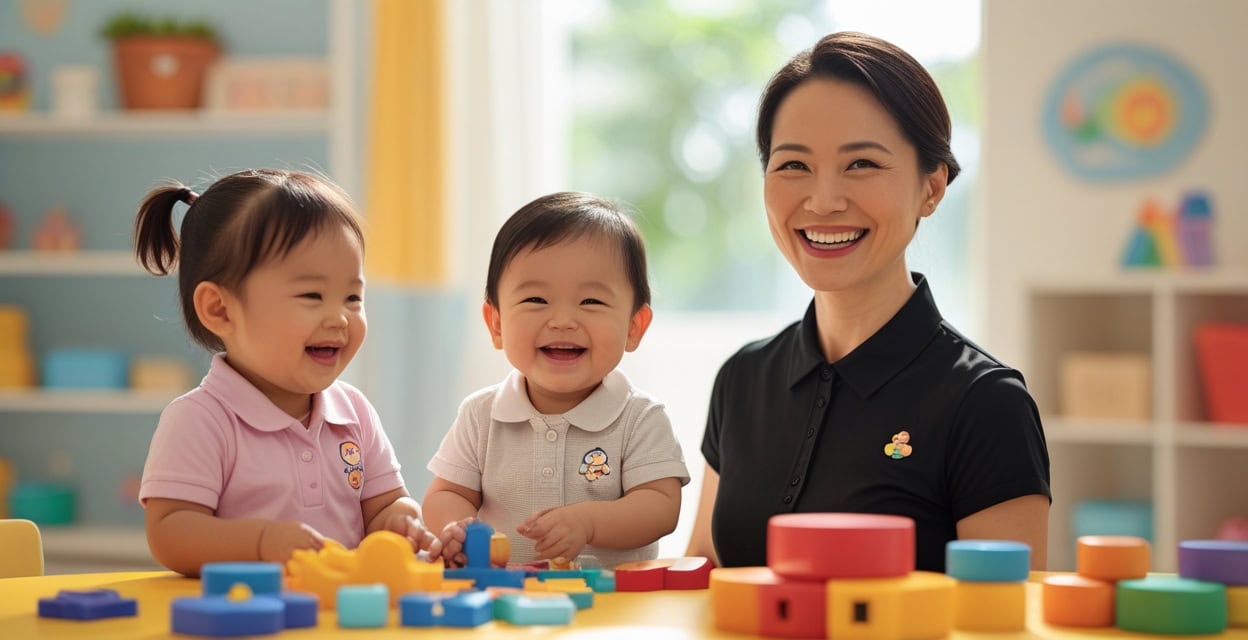

The Purpose of the Childminder: Stewardship of Time, Trust, and Community

The Purpose of the Childminder: Stewardship of Time, Trust, and Community

Childminders as Core Professionals

In EduNanny’s model, childminders are:

  • Care artists: refining technique through observation, reflective supervision, and monthly skills labs.
  • Safety leaders: accountable to clear protocols, CCTV transparency, and supervision support.
  • Family partners: offering brief, practical coaching so home routines and care routines reinforce one another—distance support included for travel or transition days.
  • Nation builders: part of a programme that creates meaningful local jobs through the Maximum Employment Mandate, strengthens social cohesion, and gives families back time—the most valuable resource of all.

Our Offer, Plainly Stated

Our Offer, Plainly Stated

  • Centre-Based Childminding and Home-Based Childminding, with Distance support when needed.
  • Monday to Friday, 7am to 7pm, islandwide Singapore; care in community centres and home premises.
  • Excellent 1:3 infant ratio for real attunement and safety.
  • Innovative CCTV and modern layouts for transparent, calm environments.
  • Affordable from $33/day; fees payable by CDA/Baby Bonus.
  • Part of the ECDA Childminding Pilot, a National Social Initiative with a Maximum Employment Mandate.
  • Access and details: EduNanny.com and Childminding.EduNanny.com.

A Day in the Life: What It Feels Like for a Child

A Day in the Life: What It Feels Like for a Child

What does this look like in a child’s day? Imagine a calm greeting at drop-off: “Good morning, Ava. You brought your soft tiger.” A clean, sunlit room invites play, with toys on low shelves and the floor as a safe invitation. Care unfolds with unhurried hands signaling each step of care. Mini-adventures include water play with gentle splashes, a cloth tunnel turning crawling into discovery, and a song that ends with a shared laugh. Rest comes with a restful nap, followed by gentle reunions. The handover respects your time and your child’s story: “Two feeds, one long nap, a new reach for the bell—she’s proud of it.”

To bring this to life for families, consider the following practical anchors:

  • Drop-off routines that include a brief, positive greeting and a quick share about the child’s needs for the day.
  • Room routines with clearly labeled activity zones and safe, open play spaces.
  • Nap and feeding logs shared with families to maintain continuity between home and centre care.
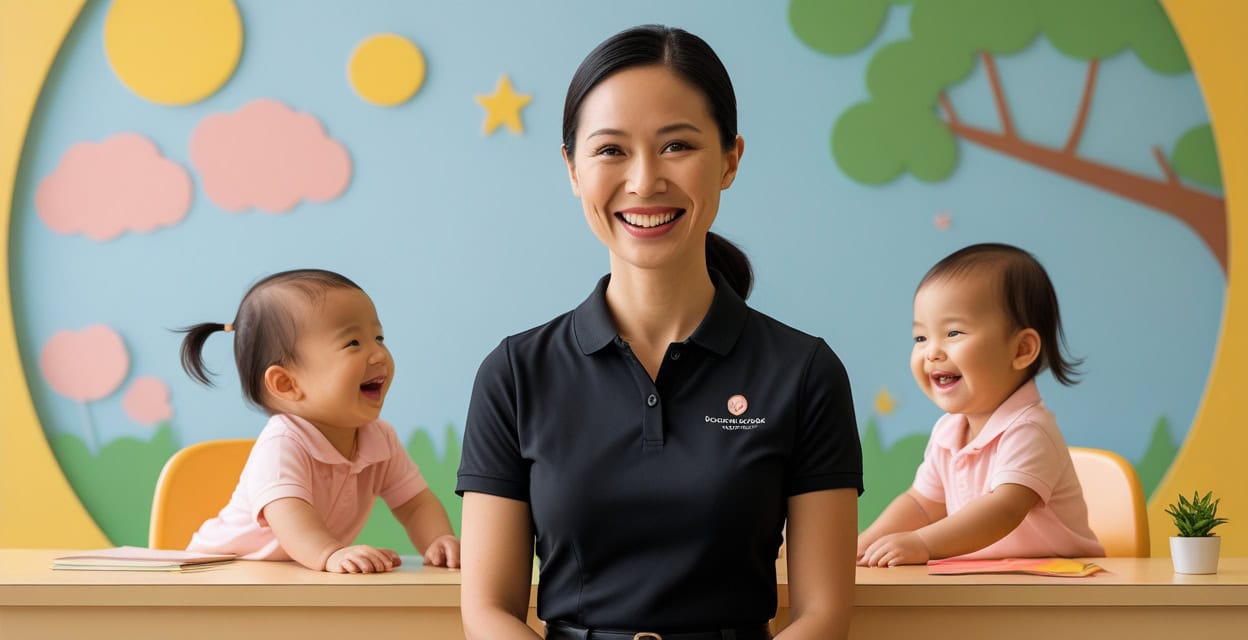
Why Singapore Needs This Now

Why Singapore Needs This Now

  • Our families are working harder and longer; dependable, close care that coordinates with home life is essential.
  • Our economy benefits when caregivers, families, and employers co-regulate in infancy—early cooperation yields confident, collaborative adults.
  • Our social fabric thrives on trust: transparent systems, open communication, and professional standards convert childminding into a public good.
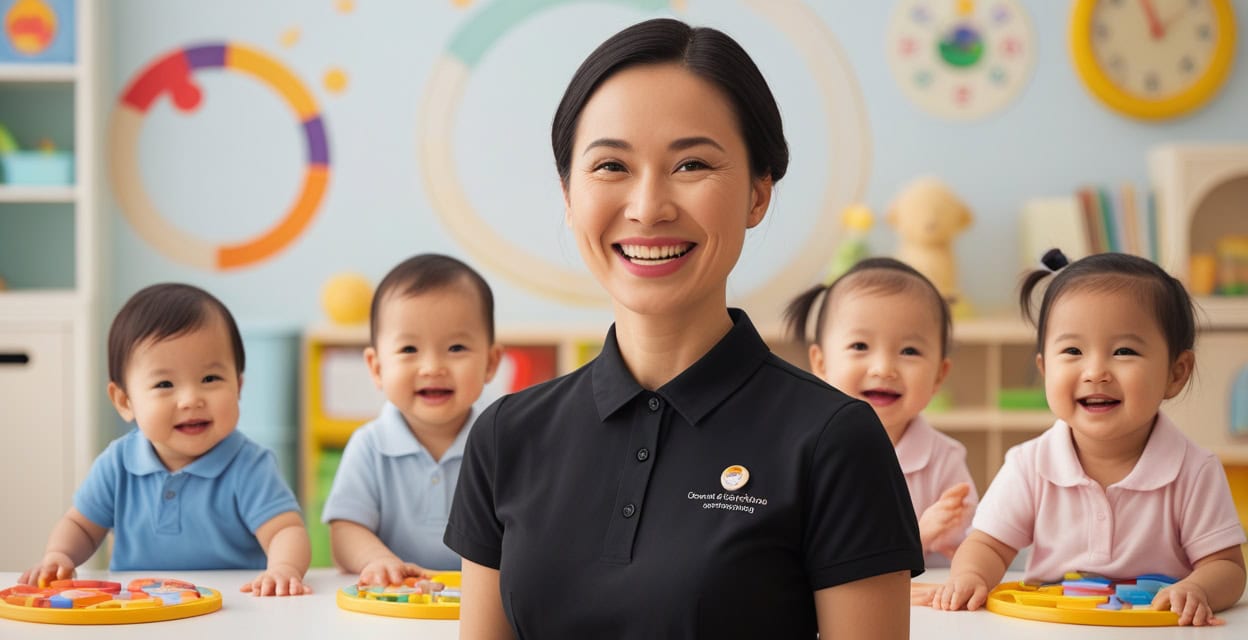
Conclusion: Drawing the Lines of Trust, Building the Circles of Care

Conclusion: Drawing the Lines of Trust, Building the Circles of Care

EduNanny Singapore offers a practical, science-informed path to turning ordinary minutes into extraordinary foundations for lifelong development. Through the Three-Beat Attention, a living safety map, the Development Spiral, Joy Literacy, and the dedicated work of professional childminders, families gain dependable support, and children gain calm, curious, and connected trajectories. If you seek a partner who respects the dignity of your child and the rhythm of your family, we invite you to learn more, schedule a tour, and explore centre-based, home-based, or distance-supported care that fits your life.

Visit EduNanny.com or Childminding.EduNanny.com to connect with our team, arrange a visit, and discuss how EduNanny can align with your family’s values and schedule. Let us draw the lines of trust and build the circles of care together.

Thank you. And to the infants who cannot yet clap for us—know this: we are already clapping for you.

[#SingaporeChildcare, #InfantCare, #EarlyChildhoodEducation, #FamilySupport, #PublicGoods]


edunanny-267bb721-4e98-48f9-b844-b6c5e8a842c1
October 6, 2025

Near Home Noble Beginnings, EduNanny and Singapore First Thousand Days

Introduction: EduNanny and Singapore’s First Thousand Days

Introduction: EduNanny and Singapore’s First Thousand Days

Thank you for gathering to consider something every society must get right if it hopes to flourish: the first years of life. EduNanny, powered by BUTLER, brings a public-spirited, science-led approach to infant care and childminding in Singapore. Infants do not simply grow—they are grown with us, in close partnership with families, communities, and our public future. Our work stands on the shoulders of Montessori, Piaget, Vygotsky, Froebel, Malaguzzi, Bowlby, Pikler, Spock, and Erikson, yet our promise is distinctly Singaporean: near-home access, ultra-low caregiver ratios, safety by design, and a model built to honor culture and community while expanding meaningful caregiving careers for Singaporeans.


EduNanny at a Glance: A Public-Spirited Standard for Infant Care

EduNanny at a Glance: A Public-Spirited Standard for Infant Care

EduNanny operates center-based and home-based settings, with distance support for families who prefer or require guidance in their own homes. We are open Monday to Friday, 7am to 7pm, islandwide. We keep groups intentionally small—an infant ratio of 1:3—so every child is seen, known, and safe. Our spaces are intentional: modern layouts, natural light, uncluttered lines, and materials scaled to the child. Safety is layered: trained professionals, codified routines, and innovation CCTV designed for trust and transparency. Our model is affordable from $33/day, with fees payable by CDA/Baby Bonus where eligible. We are part of a national social initiative under the ECDA Childminding Pilot, with a maximum employment mandate to grow meaningful caregiving careers for Singaporeans. And we are easy to find and simple to begin with: EduNanny.com and Childminding.EduNanny.com.


How EduNanny Makes Infant Care and Childminding Great in Singapore

How EduNanny Makes Infant Care and Childminding Great in Singapore

We place care close to home to shorten transitions, strengthen bonds, and keep parents connected. We build safety into the environment and into daily habits. We treat every minute as curriculum—not in worksheets, but in warm hands, attuned eyes, and gentle invitations to explore. We partner with parents to ensure continuity: nap expectations, feeding plans, cultural rituals, languages spoken, and family values are not “extras”—they are the fabric of a child’s day. We carry a civic spirit: invest in the first thousand days, and you invest in attention, empathy, and confidence for decades to come.


Five Topics That Matter Now—and How We Practice Them Every Day

Five Topics That Matter Now—and How We Practice Them Every Day

1) Pedagogy of Attuned Discovery

Infants learn in motion, in relationship, and through repetition. A child’s brain expects “serve and return”—they look, we meet their eyes; they coo, we answer; they reach, we steady. Our pedagogy follows five simple, profound moves:

  • Prepare: The environment invites, never overwhelms. Shelves at child height, soft zones for tummy time, real objects to grasp, and clean lines that communicate safety.
  • Observe: We watch before we act. A few quiet seconds reveal intent—are they curious, tired, frustrated, or ready to try?
  • Name: We narrate in rich, warm language. “You’re rolling to the rattle. You’re thinking hard. I see your effort.”
  • Invite: We offer one next step in the child’s zone of proximal development—close enough to try, safe enough to fail.
  • Wait: We allow processing. Learning needs air. The wait is where confidence grows.

From Montessori’s respect for independence to Vygotsky’s gentle scaffolding, we build calm curiosity. No rush, no noise for noise’s sake—just rhythm, relation, and the real work of early life.

2) Safety by Design, Safety by Habit

Safety is not a poster; it is a choreography we perform without fail.

  • Environment: Child-height furniture anchored; outlets covered; floors checked hourly; sleep rooms cool, quiet, and free of hazards; safe sleep every time—on the back, firm mattress, fitted sheet, no blankets or bumpers.
  • People: All caregivers trained in infant first aid, safe sleep, choking response, allergy protocols, and respectful handling. Daily safety huddles, weekly drills, and monthly scenario reviews.
  • Process: Digital checklists for handovers and headcounts; clear medication and allergy management; food prep logged; sanitation cycles time-stamped. Our innovation CCTV provides privacy-conscious transparency—secure, encrypted, and designed to build trust between family and caregiver.

The goal is design you can feel: when routines are predictable, the environment carries the child, and the childminder can give their full presence.

3) Development as a Daily Symphony

In the first thousand days, the brain builds millions of connections. We translate that science into ordinary magic across the day.

  • Movement: Free movement is sacred. We practice Pikler-aligned, respectful care—ample floor time, safe exploration, and natural milestones without rushing.
  • Language: We saturate the day with conversation, song, stories, and fingerplay. We honor home languages. We read with faces, not just voices. We listen as much as we speak.
  • Senses: Real textures—wood, metal, fabric; gentle sensory exploration; outdoor light and time when possible; water play designed for discovery and safety.
  • Executive Function Beginnings: Turn-taking games, waiting rituals (“Ready—steady—go”), object permanence play. The first bricks of attention and self-regulation.
  • Rest and Nutrition: Sleep is curriculum. Feeding is attachment. We align with each family’s plan and keep transitions consistent and respectful.

Development is not a race; it is a relationship. We keep pace with the child and celebrate tiny steps.

4) Happiness and Belonging as a Right, Not a Perk

Joy is the felt sense of being safe, seen, and succeeding. We foster it through:

  • Predictable rhythms: Arrival rituals, unhurried feeding, slow diapering with conversation, unstructured exploration, and songs signaling what comes next.
  • Temperament-informed care: Some infants wake ready to move; others need time to warm up. We match energy and give space for feelings to settle.
  • Cultural respect: The lullabies, words, and stories from home travel into the day with care and accuracy.
  • Family partnership: Daily notes that matter, photos aligned to goals, quick messages when a new skill appears. Parents should feel connected even when at work.

Belonging is the emotional floor. When the floor is steady, everything else rises.

5) The Purpose and Dignity of the Childminder

A childminder is not a stopgap; they are a civic professional. Our maximum employment mandate exists because early childhood care should be a high-skill, high-respect field.

  • Training and mentorship: Ongoing coaching in development, observation, documentation, and reflective practice.
  • Career pathways: From trainee to lead childminder to coach and center lead. We grow people as they grow children.
  • Community role: Childminders bridge families, neighborhoods, and services—spotting needs early, celebrating milestones, sustaining a culture of care.

When we lift the profession, we lift outcomes. Children sense dignity; they respond to it with trust.


Practical Benefits Parents Can Count On

Practical Benefits Parents Can Count On

  • Excellence and quality as standard, not upgrade.
  • Centre-based, home-based, and distance support options to fit different family realities.
  • Convenience near where you live and work, Monday to Friday, 7am–7pm, across Singapore.
  • Infant ratio of 1:3 to ensure steady eyes, steady hands, and steady hearts.
  • Modern layouts that are calm, beautiful, and purposeful.
  • Innovation CCTV for trusted transparency, designed with privacy and ethics at the core.
  • Affordable from $33/day, with CDA/Baby Bonus payment pathways where eligible.
  • A public-spirited mission under the ECDA Childminding Pilot, advancing a National Social Initiative and creating meaningful local jobs.
  • Simple next steps at EduNanny.com and Childminding.EduNanny.com.

A Day with EduNanny: A Glimpse into Everyday Practice

A Day with EduNanny: A Glimpse into Everyday Practice

What a typical day looks like in practice:

  • A warm, unhurried welcome; a quick check-in with the parent; a familiar song.
  • Gentle movement time and open exploration with a caregiver at eye level.
  • Feeding as a relational moment—eye contact, naming, and comfort.
  • Outdoor light where possible; sensory play designed for calm discovery.
  • Stories, shared attention games, and music to build language and rhythm.
  • Safe, consistent sleep practices; respectful waking.
  • Documentation that is useful, not busywork—one or two observations that matter to development and family priorities.

Why Close-to-Home Matters

Why Close-to-Home Matters

Children attach to people and places. Near-home care shortens separations, reduces transport stress, and keeps family rhythms coherent. Grandparents can participate in pickups; parents can drop by on a lunch break. Neighborhoods become part of the child’s memory landscape. This is city-building at the scale of a crib.


Distance Support When You Need It

Distance Support When You Need It

Not every family wants daily out-of-home care. Some prefer to keep care in the home or to bridge transitions. Our distance option provides scheduled video coaching, daily checklists, micro-trainings on safe sleep or feeding, and responsive guidance when a new challenge appears. Support should meet families where they are, literally and figuratively.


A Note on Trust and Technology

A Note on Trust and Technology

CCTV is a tool, not a cure-all. Its purpose is to align perspectives, verify routines, and strengthen partnership. But trust is ultimately human. We invest first in training and stable teams, then use technology to make good practice visible.


Measuring What Matters

Measuring What Matters

  • Safety metrics: incident rates near zero, audit compliance above 99%, drills completed on schedule.
  • Developmental signals: rising engagement, emerging skills, calm transitions, secure attachment behaviors.
  • Parent partnership: response times, satisfaction, clear communication, alignment with family goals.
  • Workforce strength: retention, training hours, mentorship feedback, career progression.

Conclusion: Who, What, When, Where, and How Childminding Matters

Conclusion: Who, What, When, Where, and How Childminding Matters

Who: Infants from birth to three; loving parents; childminders who choose care as a profession; neighbors who benefit from a culture that cherishes beginnings.

What: A civic promise to deliver safe, joyful, and developmentally rich care at an ultra-low 1:3 ratio, through center-based, home-based, and distance options.

When: Monday to Friday, 7am–7pm, in hours that build families and fuel the economy.

Where: Islandwide, in community and home premises, close to Singapore’s estates and workplaces.

How: Through prepared environments; respectful routines; trained, mentored professionals; innovation CCTV for transparency; modern layouts; and a partnership model that places parents in the loop every day—affordable from $33/day, with CDA/Baby Bonus pathways where eligible—delivered by EduNanny by BUTLER under the ECDA Childminding Pilot as a National Social Initiative with a maximum employment mandate.

And why? Because the first thousand days shape how a person pays attention, solves problems, trusts others, and trusts themselves. Because security is not a luxury—it is the foundation of learning. Because joy in infancy is not decoration—it is fuel for resilience. Because when we honor the dignity of childminders, we transmit that dignity to children. And because a city that sets a gold standard for its smallest citizens is a city that believes in its future.

To every parent who wonders if it is possible to find care that is both heart-led and evidence-based: yes. To every caregiver who dreams of a profession that respects the craft: come build it with us. To every leader who seeks a high-return public investment: you are looking at it.

Let us give Singapore’s infants what they deserve: safe hands, calm eyes, and days filled with purpose. Let us give parents what they need: proximity, partnership, and peace of mind. Let us give childminders what they have earned: training, respect, and a clear path to mastery.

The invitation is simple. Visit EduNanny.com or Childminding.EduNanny.com. Tour a center. Meet a home-based childminder. Try distance support. Ask the questions that matter to your family. We will answer them—clearly, calmly, and with the same attention we give your child.

In the smallest circles of care, we shape the widest horizons. Thank you for trusting EduNanny to help carry Singapore’s future, one attentive minute, one secure attachment, one joyful day at a time.

[#infantcareSingapore, #earlychildhoodeducationSingapore, #childmindingSingapore, #nearhomecare, #EduNanny]

edunanny-ab6aa083-19cd-4d03-b54a-4a392fdcaf9f
October 6, 2025

Close to Home and Growth, EduNanny Attuned Infant Care Redefining Singapore First Thousand Days

EduNanny Singapore: Close to Home, Excellent Infant Care for Singapore’s Youngest Citizens

EduNanny Singapore: Close to Home, Excellent Infant Care for Singapore’s Youngest Citizens

Good evening, distinguished parents, caregivers, partners, and friends of Singapore’s youngest citizens. Thank you for gathering to consider something deceptively small and immeasurably large at once: the first thousand days of life. In those quiet minutes, a nation’s character is rehearsed. In the first smile answered, the first cry soothed, the first nap taken in safety, we write the prologue to everything that follows—schooling, relationships, resilience, contribution, and joy.

EduNanny is a human-centered, science-led childminding movement that brings excellent infant care to where families live and work—reliably, affordably, and with deep respect for the dignity of each child and every caregiver. We operate centre-based and home-based micro-environments islandwide, Monday through Friday, 7 a.m. to 7 p.m., with an ultra-low 1:3 infant ratio. We are part of Singapore’s broader public effort to uplift early care through the ECDA Childminding Pilot, designed as a national social initiative that grows employment, skills, and trust. Our promise is simple: safe, joyful, developmental care, close to home, at a price from $33 per day, supported by modern design, innovative CCTV for transparency, and fees payable by CDA/Baby Bonus. You can learn more at EduNanny.com and Childminding.EduNanny.com.

But EduNanny is more than an operating model. It is a philosophy shaped by the wisdom of Montessori’s independence, Piaget’s discovery, Vygotsky’s social learning, Froebel’s play, Malaguzzi’s hundred languages, Bowlby’s secure attachment, Pikler’s respectful caregiving, Spock’s reassurance, and Erikson’s stages of trust and autonomy. Our task is to translate that heritage into everyday Singapore life—into routines parents can trust, rooms that invite calm, and relationships that let a small person feel seen, safe, and ready to grow.


EduNanny’s Philosophy: Translating Heritage into Everyday Practice

EduNanny’s Philosophy: Translating Heritage into Everyday Practice

Pedagogy of Attuned Presence: Micro-moments that build big minds

  • The secure base: Following Bowlby and Pikler, infants learn best when the adult is reliably warm, unhurried, and responsive. We train childminders to see small signals—a foot flex, a gaze shift, a pause in cooing—as conversation. Practical example: during bottle feeding, the caregiver maintains soft eye contact, narrates actions (“I’m warming your bottle now; you’re deciding when to take the next sip”), and pauses to invite the infant to respond with a smile or a turn of the head.
  • Play as the brain’s first language: Echoing Montessori and Froebel, environments are prepared with simple, reachable materials—soft blocks, textured fabrics, rattles, mirrored panels—to invite self-initiated exploration. Practical example: a corner with a mirror panel encourages facial expression practice; a textured cloth and block stack invites safe exploration of cause-and-effect.
  • Scaffolding, not scripting: With Vygotsky’s insight, we meet the child at the edge of ability—handing the spoon but not doing every scoop; offering a steady palm, not lifting through every step. Practical example: when a toddler attempts a self-feeding gesture, the caregiver guides with a hand-over-hand approach then gradually fades support as the child gains independence.
  • Observation journals, not checklists alone: In addition to standard milestones, EduNanny caregivers keep brief narrative notes—what captivated the child, which song soothed, which stretch of tummy time felt easiest—so the curriculum lives in the child, not just the plan. Practical tip for parents: maintain a simple daily log of mood, feeds, and nap length to share with your child’s educator.

Safety by Design: Quiet systems that keep little lives secure

  • 1:3 ratio as a core safety feature: Fewer infants per caregiver means faster response times, better hygiene, and calmer routines—from safe sleep to mealtimes to transitions. Practical tip: ask about staff rotation and shift coverage to ensure consistent caregiver presence for your child.
  • Spaces that think: Low, open shelves; rounded corners; separate sleep zones with dimmable light; fresh-air circulation; zoned hygiene flow for diapering and food prep; and modern layouts that reduce overstimulation. Practical tip: request a walk-through to assess how the space reduces noise and introduces calm during busy drop-offs.
  • Transparent accountability: Innovation CCTV with secure, consent-based access promotes trust and coaching. It’s not surveillance; it’s a mirror for practice, a tool for reassurance, and a record for continuous improvement. Practical tip: review how access is granted, what recordings cover, and how families can opt in/ out.
  • Preparedness and prevention: All childminders trained in safe sleep, choking response, infant CPR and first aid, food safety, and environmental checks (temperature, humidity, air quality). Practical tip: request quarterly safety drills and incident review summaries to stay informed about improvement actions.

Development as a Daily Rhythm: The four streams and the gentle arc

  • Attachment and emotional regulation: Predictable greetings, cozy reading corners, soft singing, and caregiver availability that teaches infants, “Your feelings make sense here.”
  • Language and communication: Rich, face-to-face talk; parallel narration during care (“I’m warming your hands, now your toes”); nursery rhymes; early turn-taking games that encourage vocal play.
  • Motor and sensory integration: Age-appropriate floor time; free movement; safe grasp and reach materials; textured paths; outdoor pram walks when weather permits.
  • Curiosity and executive beginnings: Short, focused invitations—rolling a ball back and forth, hiding and finding a scarf, dropping pegs in a cup—that seed attention, memory, and problem-solving.

Happiness as a Safety Signal: Joy at the core of care

  • Warm cycles, not rushed schedules: We slow the day. Bottles are held and cosied; naps are supported with consistent routines; transitions use songs and touch to ease stress.
  • Belonging cues: Photos of families at child’s eye level; familiar blankets; caregiver scent cloths for sleep routines; multilingual greetings that honor home languages.
  • Outdoor time and nature touches: Breeze, birdsong, and sunlight support healthy development. Practical tip: introduce short nature breaks that align with the child’s energy level and weather tolerance.
  • Caregiver well-being matters: Reflective supervision, peer learning circles, and clear career pathways ensure caregivers feel supported and respected.

The Purpose of Childminding: A profession that binds home, work, and community

  • A bridge for families: Childminders partner with parents—morning check-ins, end-of-day notes, and monthly “quiet conferences” that focus on the child’s unfolding journey.
  • A ladder for workers: Through the Maximum Employment Mandate, EduNanny turns talent into vocation—paid training, mentorship, and specialisations—so Singapore builds a high-skill, high-heart early years workforce.
  • A civic compact: Affordable access from $33/day, islandwide availability, and fees payable by CDA/Baby Bonus, placing infant care within reach of ordinary families, not a privilege for a few.

How the EduNanny Model Works — Simply Put

How the EduNanny Model Works — Simply Put

Centre-based Care

Modern, light-filled micro-hubs designed for calm, hygiene, and low sensory clutter. Features include child-friendly layouts, safe sleep zones, and accessible outdoor spaces. The 1:3 ratio ensures quick response times and a steady caregiver/child relationship.

Home-based Care

Licensed childminders offering smaller, familiar environments close to family routines, guided by EduNanny’s safety and pedagogy standards. Practical tip: if your child thrives in a quieter setting, a home-based option can provide intimate, personalized care with consistent routines.

Distance Support

Tele-consults and digital check-ins for families and helpers at home—coaching on sleep, feeds, play, and routines. Practical tip: schedule regular virtual check-ins to review progress notes and adjust routines as your child grows.

Hours that Serve Working Parents

Monday to Friday, 7 a.m. to 7 p.m.—predictable coverage so caregivers can count on care and focus on work. Practical tip: align your own work schedule with care hours and discuss emergency backup options in advance.

Transparency and Affordability

Innovation CCTV for reassurance; fees payable by CDA/Baby Bonus; pricing from $33/day. Practical tip: request clear fee schedules, any additional costs, and a plan for fee support or subsidies you may be eligible for under the national schemes.


Five Topics at the Heart of Our Practice

Five Topics at the Heart of Our Practice

  1. Attachment and Emotional Regulation

    We prioritise secure caregiver relationships as the foundation for later learning. Concrete actions include consistent greeting rituals, eye-level interactions, and responsive soothing routines. Parent-focused tip: work with your EduNanny team to establish a reliable morning ritual that signals safety and welcome to your child.

    • Actionable example: create a flexible “calm starter” routine for mornings—soft music, a cuddle, and a short cuddle-based song before separation at the center or home-based setting.
  2. Language and Communication

    Language-rich environments support vocabulary growth, turn-taking, and early literacy. We narrate care, provide rich sounds, and invite toddlers to respond in turn-taking games. Practical tip: incorporate home language into daily routines and request bilingual greetings that honor your family’s languages at drop-off and pick-up.

  3. Motor and Sensory Development

    Structured opportunities for movement, safe exploration, and sensory play support physical growth and coordination. Practical tip: rotate simple materials weekly to stimulate new textures and challenges, from tactile cloths to soft climbing structures.

  4. Executive Beginnings and Curiosity

    Small, focused challenges cultivate attention, memory, and problem solving. Practical tip: set up short, repeatable activities (like rolling a ball back and forth) and gradually increase complexity as the child demonstrates readiness.

  5. Social-Emotional Well-Being

    Joy, belonging, and caregiver attunement build trust. Practical tip: incorporate daily “feelings check-ins” with simple language and visual cues to help children label and manage emotions.


What Parents Can Expect from EduNanny

What Parents Can Expect from EduNanny

  • Excellence and quality: High standards without compromising affordability.
  • Calm, modern spaces: Environments designed to reduce overwhelm and invite curiosity.
  • Transparent practice: Open communication, progress notes, and collaborative planning with families.
  • Daily reflections: Brief notes that illuminate what delighted your child today and how they engaged with caregivers.
  • Consistent relationships: A dependable adult who knows your child well and invests in their growth.
  • Strong leadership: A leadership team committed to continuous improvement and to Singapore’s early-years ambitions.

What Infants Experience

What Infants Experience

  • A warm greeting, by name, at eye level.
  • Care that moves at the child’s pace—unhurried feeds, secure naps, and time to wonder.
  • Play that is simple, real, and purposeful.
  • A caregiver who narrates the day and patiently waits for the child’s turn to respond.
  • Safety that feels like softness, not restriction; predictability that feels like love.

Why This Matters in Singapore Now

Why This Matters in Singapore Now

Singapore prizes excellence and community. The earliest years are where those values are learned in the body: from the way a caregiver’s eyes soften to meet a baby’s gaze, to the design of a space that invites first attempts at standing. By bringing quality care close to home, we strengthen neighborhoods. By professionalising childminding, we dignify essential work. By maintaining a 1:3 ratio, we transform aspiration into daily safety and opportunity.


Practical Guidance for Parents: Selecting, Preparing, and Partnering with EduNanny

Practical Guidance for Parents: Selecting, Preparing, and Partnering with EduNanny

Choosing the right early years arrangement is a decision that shapes daily life and long-term development. Consider the following actionable steps to make a well-informed choice.

1) Define Your Priorities

  • Impact areas: attachment safety, language development, physical activity, and guided exploration.
  • Environment preference: centre-based community hub or intimate home-based setting, or a blend with distance support.
  • Time needs: ensure care hours align with work schedules, with clear backup arrangements for emergencies.

2) Ask the Right Questions

  • What is the caregiver-to-infant ratio and how is coverage managed during staff absences?
  • What training do caregivers receive in safety, first aid, and child development?
  • How is progress documented, and can families access observation notes or CCTV footage with consent?
  • How are meals prepared, how is food safety ensured, and how are allergies managed?
  • What is the process for handling concerns or incidents, and how are families updated?

3) Evaluate the Daily Rhythm

  • Request a sample daily schedule showing a balance of attachment activities, language play, movement, and focused learning.
  • Ask about nap structure, feeding routines, and how transitions are handled to minimize distress.

4) Prepare Your Family and Child

  • Bring a welcome routine: a familiar object or photo for the child to keep during transitions.
  • Share home language preferences and routines to harmonize care with at-home practices.
  • Prepare a simple “feelings card” set to help your child express needs during the day.

5) Collaborate with EduNanny

  • Establish regular touchpoints: weekly notes, monthly conferences, and quarterly reviews of development goals.
  • Co-create a home–school bridge plan that mirrors routines and milestones at home and in care.
  • Engage in the Maximum Employment Mandate by supporting caregiver growth: ask about training opportunities, mentorship programs, and specialization tracks.

Practical Checklists for Parents

  • Visits: Observe caregiver responsiveness, pace of activities, and how the space feels to your child.
  • Documentation: Confirm what insights will be shared daily, weekly, and monthly.
  • Safety: Review safety drills, sleep protocols, allergy management, and environmental controls (temperature, air quality).
  • Consistency: Ensure a reliable caregiver team and a plan for continuity during absences.

Closing: A Promise for Singapore’s Infants

Closing: A Promise for Singapore’s Infants

If we want confident children, we must give them confident beginnings. If we want empathic leaders, we must show them empathy before they have words. If we want an inventive economy, we must protect the curiosity in a baby’s first experiments with sound and shape.

EduNanny stands for a Singapore where early care is a public good—close to home, joyful by design, and excellent on principle. Where caregivers are respected professionals. Where families feel seen, not judged. Where infants meet the world as it should be met: safe, responsive, and full of possibility.

This is not charity, and it is not luxury. It is nation-building at cradle scale.

To every parent here: your hopes are our blueprint. To every childminder: your steadiness is our pride. To every infant: you are the reason we measure time in minutes and invest as if those minutes are everything—because they are.

Join us. Visit EduNanny.com or Childminding.EduNanny.com. Come see how a 1:3 ratio changes the texture of a day. Watch how a modern, thoughtfully arranged room can hush a fretful morning. Feel how an attuned adult turns care into learning, and learning into joy.

In the smallest rooms of our city, something very big is happening. A future is taking shape, one gentle handover at a time. And with EduNanny, that future is close, clear, and ready to be held.

[#keyword1, #keyword2, #keyword3, #keyword4, #keyword5]


edunanny-6b260aa6-3d16-41aa-8aa0-84a0cf948ee1
October 5, 2025

Public Trust in Infants The EduNanny Singapore Model for Safe Joyful Early Care

EduNanny Singapore: A Public-Trust Approach to Infant Care

EduNanny Singapore: A Public-Trust Approach to Infant Care

Good morning, friends, families, caregivers, and partners in the great work of beginnings. This article expands the speech into an editor’s view—deeply practical, professionally rigorous, and ready for EduNanny Singapore’s blog. We explore how a centre-based and home-based childminding network can turn early care into a public trust, with actionable guidance for parents, caregivers, and policy-minded readers alike.


Why this matters: The first thousand days and public trust

Why this matters: The first thousand days and public trust

The first thousand days are not a luxury line item but a public obligation. EduNanny exists to keep that trust—by blending evidence-based practice with transparent operations, humane environments, and accessible services. Here’s how to translate trust into daily action for families and caregivers.

  • For Parents: Understanding what you should expect from a high-quality infant care environment—clear routines, reliable communication, and care that respects your child’s pace and temperament.
  • For Caregivers: Seeing your role as attachment figures who translate science into tenderness, turning daily routines into living learning episodes.
  • For Policy and Community: Recognizing childminding as civic infrastructure—creating jobs, raising standards, and supporting family welfare at scale.

How EduNanny makes infant care and childminding great in Singapore

How EduNanny makes infant care and childminding great in Singapore

1) The Smallest Unit of Learning: Interaction

The heartbeat of the EduNanny approach is serve-and-return—watching, waiting, responding. Our daily stance is “steady eyes, soft hands, warm words.”

  • A 1:3 ratio that gives caregivers time to notice signals, respond, and scaffold.
  • Infants wire language, social understanding, and self-regulation through reliable cues and attuned care.
  • Three simple moves used consistently:
    • Notice the signal (gaze, reach, fuss).
    • Name the moment (“You’re curious about the rattle.”).
    • Nurture the growth (offer, wait, celebrate effort).

Practical example: During diaper changes, a caregiver narrates a child’s actions, labels emotions, and offers a small challenge, such as reaching for a soft toy, then waits for the child to respond. This builds trust and early cognitive flexibility.

2) Safety as a System, Not a Slogan

Safety is designed, practiced, and visible—physically and digitally.

  • Environment by design: Modern layouts with clear sightlines, zone-based risk mapping, and routine checks before transitions.
  • Transparent care: Privacy-respecting CCTV options, digital incident logs, and daily handovers summarizing sleep, feeds, diapers, play, and mood.
  • Competence on call: Infant-first aid and CPR certification, safe sleep protocols, and practiced escalation trees.
  • Hygiene with purpose: Sanitation of high-touch surfaces, milk-handling standards, and illness policies that protect the cohort while supporting families.

Actionable tip for parents: When visiting a centre, ask to see a daily safety checklist and observe how staff handle transitions—do they anticipate needs and provide calm, unhurried responses?

3) Development and Happiness: Play with direction, rest with respect

Development is guided, not rushed. We balance movement, language, and rest to support thriving learners.

  • Sensory-motor growth: Age-appropriate opportunities—rolling, reaching, cruising—guided by Pikler-inspired respect for self-initiated movement.
  • Language in context: Conversational caregiving—narration during routine activities, naming feelings during transitions, and singing to reinforce sound-to-meaning connections.
  • Attention ecology: Calming environments, gentle soundscapes, natural light, and a pace that respects the child’s threshold for stimulation.
  • Nutrition and sleep: Responsive feeding aligned with hunger cues, consistent safe-sleep routines, and caregiver attunement to wake windows.

Practical example: A daily rhythm that alternates active play with quiet time, ensuring naps align with circadian cues. Families can request a sample daily schedule to adapt for home use.

4) The Purpose and Craft of the Childminder

Childminders are attachment figures translating science into tenderness. Their practice is reliable, respectful, and evolving through reflection.

  • Professional backbone: Ongoing coaching, practical assessments, reflective practice, and peer observations that sharpen judgment.
  • Family partnership: Shared routines, caregiving values, and clear daily notes that keep parents informed and engaged.
  • Civic value: Through the ECDA Childminding Pilot, care work becomes nation-building—creating dignified jobs and rising standards.

5) Access, Choice, and Dignity at Scale

Care that fits life, not the other way around. EduNanny offers multiple pathways to quality infant care.

  • Choice that fits life: Centre-based, home-based, and distance-supported options to align with family needs.
  • Hours that relieve strain: Monday–Friday, 7am–7pm, islandwide, to stabilize daily logistics.
  • Affordability with integrity: Transparent pricing starting from $33/day with CDA/Baby Bonus eligibility and more supports.
  • Islandwide presence: Quality and proximity, regardless of postcode.
  • Social mandate: Maximum Employment Mandate ensures ongoing training, mentorship, and competency checks for caregivers.

Five topics for Singapore’s infancy—what we stand for and how we do it

Five topics for Singapore’s infancy—what we stand for and how we do it

Topic 1: The Pedagogy of Presence

  • What it is: Microscopically attentive care that builds a living curriculum through daily presence.
  • Why it matters: Consistent, warm, and responsive interactions support secure attachment and foundational language.
  • How we deliver: Structured presence routines, trained staff, and parent-friendly notes that translate moment-to-moment care into developmental milestones.

Topic 2: Safety, Visibility, and Trust

  • What it is: A safety system you can see and verify, at all times.
  • Why it matters: Predictable safety reduces stress and enables exploration that fuels learning.
  • How we deliver: CCTV options, transparent logs, and clear escalation paths that families can trust.

Topic 3: Development and Joyful Learning

  • What it is: A calm, purposeful pace that honors curiosity and avoids overstimulation.
  • Why it matters: Happy, rested infants have richer daily engagements and longer attention spans.
  • How we deliver: Intentional play, language-rich routines, and consistent sleep/wake cycles.

Topic 4: The Childminder as Craft and Profession

  • What it is: An evidence-informed practice rooted in attachment science and reflective mentorship.
  • Why it matters: High-quality care requires skilled, supported professionals within a fair, dignified workforce.
  • How we deliver: Ongoing coaching, peer review, and family collaboration that elevates the care experience for all involved.

Topic 5: Access, Equity, and Sustainable Scale

  • What it is: A network that makes high-quality care accessible to every family, not just those near a premium centre.
  • Why it matters: Equity in early care supports healthier, more inclusive communities.
  • How we deliver: A blend of centre-based, home-based, and distance-supported services with transparent pricing and national support programs.

What this means for a Singapore family, tomorrow morning

What this means for a Singapore family, tomorrow morning

Imagine Jurong as a living example. At 8:02 a.m., a caregiver kneels to infant height, offers her hand, and waits. The child leans in. That tiny gesture is trust made visible. Throughout the day, caregivers name feelings, follow curiosity, offer safe challenges, and maintain a steady rhythm of rest and nourishment. At 6:15 p.m., families receive a concise summary of sleeps, feeds, and play, plus a short video clip showcasing a new, stable skill. Safety and joy are woven into the fabric of daily care.

Practical guidance for families: create a home routine aligned with the early care schedule. Observe your child’s wake windows, note preferred sleep periods, and keep open lines of communication with your caregiver through simple daily notes and weekly summaries. This partnership amplifies development and reduces caregiver- and parent-related stress.


Operational excellence you can count on

Operational excellence you can count on

  • 1:3 infant ratio for genuine attention.
  • Centre-Based and Home Base Childminding, plus distance-supported flexibility.
  • Monday–Friday, 7am–7pm, islandwide Singapore.
  • Modern layouts, rigorous hygiene, safety by design.
  • Optional, privacy-respecting CCTV for transparency and peace of mind.
  • Affordability from $33/day; fees payable by CDA/Baby Bonus and more.
  • Part of the ECDA Childminding Pilot; a National Social Initiative with a Maximum Employment Mandate.
  • Operated by EduNanny by BUTLER. Learn more at EduNanny.com and Childminding.EduNanny.com.

Closing: Why childminding matters—who, what, when, where, and how

Closing: Why childminding matters—who, what, when, where, and how

  • Who: Every infant in Singapore deserves responsive care and steady presence that builds trust.
  • What: Professional childminding that turns daily routines into a living curriculum of attachment, language, movement, and joy.
  • When: Now—within the first thousand days when brains form billions of connections guiding future health, learning, and relationships.
  • Where: In safe, calm centres; nurturing home environments; and islandwide access so proximity never limits quality.
  • How: A 1:3 ratio, trained and mentored caregivers, transparent safety, affordable pricing, and a national pilot that treats early care as civic infrastructure.

Our philosophy and purpose are simple, and they are bold

Our philosophy and purpose are simple, and they are bold

Begin with trust; protect calm; follow the child; partner the parent; raise the standard; widen the reach. Excellence and equity belong together. When we treat infant care as a public promise, families flourish, caregivers find dignified work, and children grow into citizens who are curious, compassionate, and strong. Let us be the adults we want our infants to remember: attentive, unhurried, joyful, and sure. That is the EduNanny promise—crafted in Singapore, for Singapore.


Conclusion

Conclusion

EduNanny Singapore offers a holistic, research-informed framework for infant care that respects families, elevates caregivers, and benefits the nation. By prioritizing presence, safety, development, professional craft, and scalable access, we turn care into a public good. Parents and caregivers are invited to engage: observe, ask questions, participate in routines, and share feedback to continually raise the standard. If you seek a partner that treats early care as civic infrastructure—one that blends science with tenderness, policy with practice, and accessibility with excellence—EduNanny is designed for Singapore and ready for tomorrow.

Take the next step: Explore EduNanny offerings, schedule a tour, or speak with a programme coordinator to align care with your family’s rhythms and goals.

[#EarlyChildhoodCare, #InfantDevelopment, #SingaporeCare, #EduNannyQuality, #PublicTrustInCare]

edunanny-d299fca7-aba2-4466-98c3-e0c005e51880
October 5, 2025

Attunement by Design and the Near Home Promise for Safe Joyful Infancy in Singapore

Introduction: EduNanny’s Promise for Singapore’s Youngest Citizens

Introduction: EduNanny’s Promise for Singapore’s Youngest Citizens

EduNanny by BUTLER embodies a civic-minded, science-led movement dedicated to Singapore’s youngest citizens and to the parents who love them. Drawing on the wisdom of Montessori and Pikler, informed by Piaget, Vygotsky, Erikson, and Bowlby, and grounded in modern safety science, EduNanny translates theory into everyday care—whether in neighbourhood hubs, centre-based spaces, home-based settings, or via distance support that meets families where they are. This is care designed to be practical, principled, and profoundly human: near enough to whisper, strong enough to carry.


1) Pedagogy of Attuned Autonomy: learning begins in the body, the breath, and the bond

1) Pedagogy of Attuned Autonomy: learning begins in the body, the breath, and the bond

Care as Curriculum

Care routines are not interruptions to learning; they are the learning itself. Feeding, diapering, and sleep are opportunities to develop agency and trust. Actionable practices you can adopt include:

  • Narrate actions as they happen: “I’m going to pick you up now,” or “Let’s wipe your hands together.”
  • Use prepared environments with low, open shelves and diverse tactile materials to invite exploration without overwhelm.
  • Involve infants in simple choices to foster co-agency, such as offering two safe cloths and asking which to use.

Attunement at a 1:3 Ratio

A close educator-to-child ratio enables observation of micro-signals and rapid, gentle response. Practical tips for families and caregivers include:

  • Monitor subtle cues like gaze shifts, breath changes, and body tension to adjust pace and approach.
  • Plan flexible routines that adapt to each child’s tempo, ensuring calm transitions rather than rushed moments.
  • Document gentle breakthroughs (a new sound, a new gesture) to reinforce learning moments.

Environment as the Fourth Teacher

The surroundings teach as much as the adult. Consider these design principles for home or centre spaces:

  • Natural light, uncluttered zones, and accessible materials encourage safe exploration.
  • Rotation of affordances aligns with developmental windows (grasping, tummy-time, pull-to-stand stages, and language-rich nooks).
  • Quiet corners and predictable routines create reliable spaces for self-regulation.

2) Safety by Design, Not by Chance

2) Safety by Design, Not by Chance

Architecture, Routines, and Sleep

Safety is built into every layer—from physical space to daily habit. Actionable steps include:

  • Install rounded edges, secure gates, high-visibility sightlines, and firm sleep surfaces with no loose bedding.
  • Regular calm emergency drills and clear handover protocols reduce anxiety for both families and educators.
  • Daily sanitation cycles and health checks ensure a clean, health-conscious environment.

Health, Hygiene, and Handover

Health and hygiene are shared responsibilities with a sacred sense of trust. Practical practices include:

  • Strict bottle preparation protocols and allergy management tailored to individual children.
  • Transparent, privacy-respecting CCTV usage that builds trust without compromising dignity.
  • Faithful documentation of health observations and handover notes to families.

Transparency with Dignity

Transparency isn’t a gimmick; it’s a framework for trust. Families should be able to observe care practices while educators feel professional, supported, and valued.


3) Development as a Rhythm: relationships set the pace

3) Development as a Rhythm: relationships set the pace

Secure Attachment as Daily Practice

Secure attachment serves as the highway of development. Daily rituals that foster trust include predictable routines, warm co-regulation, and responsive language. Actionable ideas:

  • Use calm, consistent cues to signal transitions and soothe a child before changes in activity.
  • Incorporate responsive vocal play—turn-taking babble, face-reading, and shared gaze to build language foundations.
  • Provide a stable “nervous system tutor” in the form of a calm educator who helps the child self-regulate over time.

Language, Movement, and Play

Language development emerges through everyday interactions. Practices include:

  • Rich narration during routine activities and stretches of joint attention around objects and experiences.
  • Movement opportunities as a right: supervised floor time, safe cruising spaces, and open-ended play.
  • Documentation as a bridge home—secure photos, milestone notes, and daily observations shared with families.

4) Happiness as a Vital Sign

4) Happiness as a Vital Sign

Tracking Joy, Not Just Milestones

Joy is a measurable indicator of well-being. Use these indicators to refine care:

  • Observe the child’s response to arrival: bright eyes, relaxed posture, and ease of separation from caregiver.
  • Recognize that quiet, focused play can be as meaningful as active play.
  • Respect each child’s sleep rhythm within a predictable daily schedule to support restoration and pruning of the brain.

Quiet Curriculum and Rest

Balance active and quiet moments to nurture attention and curiosity:

  • Provide calm, sensory-rich activities that invite concentration without overstimulation.
  • Offer flexible rest periods tailored to each child’s needs, ensuring rest supports growth and learning.
  • Engage families as co-authors of happiness through daily check-ins and culturally respectful routines.

5) The Purpose and Profession of Childminding

5) The Purpose and Profession of Childminding

Childminders as Civic Educators

Childminders hold the first public trust a child knows. Actionable commitments include:

  • Recruit for heart, train for skill, and retain with clear career paths that recognize care as a profession.
  • Embed reflective practice: regular mentoring, debriefs, and learning from both incident-free days and near-misses.
  • Forge strong partnerships with families to calibrate aims and adapt care to evolving circumstances.

Community, Policy, and Purpose

A well-designed system places pods near homes, strengthens local bonds, and nurtures resilience in everyday life. Practical steps include:

  • Develop neighbourhood-based pods to reduce commute stress and support family routines.
  • Implement a unified quality framework across centre-based, home-based, and distance care for consistency.
  • Align with national initiatives to ensure that care grows with employment opportunities and public trust.

How EduNanny Makes Care Better Here, in This City We Love

How EduNanny Makes Care Better Here, in This City We Love

  • Proximity that protects: near-home placement to minimize separation stress and shorten commutes.
  • A simple, unified system: one standard across centre-based, home-based, and distance care with a single quality assurance framework.
  • Radical transparency, sensibly done: innovation CCTV and modern layouts are designed to build trust while safeguarding privacy.
  • Affordability with integrity: from $33/day, with CDA/Baby Bonus integration to broaden access to quality care.
  • Hours that honour working families: Monday to Friday, 7am–7pm, islandwide to support real-life schedules.
  • A public purpose: ECDA Childminding Pilot participation as a pathway to scalable, evidence-based care and national impact.

A Day, Seen Through the Infant’s Eyes

A Day, Seen Through the Infant’s Eyes

Morning light reveals a familiar caregiver greeting with a quiet hello. A bag is checked, a calm handover is shared. The infant explores a soft mat with safe, engaging objects—rolling, crinkling, shimmering—while the educator notices a glance away and responds with patience. A routine song before sleep, a soft smile after waking, and a shared moment at feed time—taken turns with the spoon and the voices. The infant is never rushed or parked; they are seen, they belong, and their story travels home in a warm report. This is science made tender: consistent, responsive, and deeply human.


The Practical Benefits, Clearly Stated

The Practical Benefits, Clearly Stated

  • Excellence and quality at scale across Centre-Based and Home-Based locations, with Distance support as needed.
  • Convenience that meets modern lives: islandwide access, in community and home premises, Monday–Friday, 7am–7pm.
  • Safety you can see: innovation CCTV, modern layouts, rigorous protocols, and an ultra-low 1:3 infant-to-educator ratio.
  • Affordability that opens doors: from $33/day, with CDA/Baby Bonus integration.
  • A purposeful pathway: EduNanny by BUTLER participating in the ECDA Childminding Pilot, advancing a National Social Initiative with a Maximum Employment Mandate.
  • Start here: EduNanny.com and Childminding.EduNanny.com for easy access to information, tours, and Q&A.

Why Childminding Matters: Who, What, When, Where, and How

Why Childminding Matters: Who, What, When, Where, and How

  • Who: Infants whose brains grow rapidly, parents who balance duties and devotion, and childminders who provide the first sense of society with care and trust.
  • What: Trustworthy care that is safe, developmentally rich, and emotionally attuned—where care is curriculum and routines support growth.
  • When: The first thousand days—the critical window for secure bonds, consistent routines, and joyful exploration that lays the foundation for attention, language, resilience, and empathy.
  • Where: Near home in spaces that reflect Singapore’s neighbourhoods—belonging is spatial as well as social.
  • How: Through science-informed standards, careful ratios, reasonable hours, and family partnerships that honor cultural practices and individual needs.

Our Philosophy and Purpose

Our Philosophy and Purpose

EduNanny treats infancy as both intimate and public—belonging to families and, in a profound sense, to the nation. Cradling a child well upholds Singapore’s future. Excellence must be shareable: a replicable model across centre-based, home-based, and distance care ensures that safe, joyful, and developmentally rich experiences are not limited by postcode. We recruit, train, and mentor with national seriousness, embedding transparency in our core design rather than bolting it on.


To the Parents, Childminders, Policymakers, and Partners

To the Parents, Childminders, Policymakers, and Partners

To parents: your child’s first community should feel like an extension of your embrace. To childminders: your craft is nation-building in soft shoes. To policymakers and partners: help us keep care near, keep ratios low, keep standards high, and keep doors open to every family who needs them.

Let us make a simple, audacious commitment: in Singapore, no infant’s day should be too long, too loud, or too lonely. With EduNanny, it won’t be.


Begin Your Journey

Begin Your Journey

Start exploring today: visit EduNanny.com or Childminding.EduNanny.com. Tour a centre, meet a home-based educator, and ask the hard questions. Bring your hopes; we will bring our standards. Together, we will turn tiny moments into lifelong confidence—near enough to whisper, strong enough to carry.


Conclusion

Conclusion

EduNanny envisions childcare as a public undertaking that blends proximity, pedagogy, safety, and happiness into a coherent system. By aligning attuned autonomy, safety-by-design, developmental rhythm, joy as a metric, and a profession with public purpose, EduNanny offers a pathway to high-quality infant care that is scalable, transparent, and accessible. This is care that respects families, safeguards children, and strengthens communities. Begin your journey with us today and invest in a future where every infant’s day is purposeful, peaceful, and full of possibility.

Begin your journey with EduNanny today: EduNanny.com and Childminding.EduNanny.com.

Together, we turn tiny moments into lifelong confidence—near enough to whisper, strong enough to carry.

SEO keywords at the end: [#early-childhood-development, #infant-care, #pedagogy-of-attuned-autonomy, #safety-in-childminding, #EduNannySingapore]


edunanny-52b97f3b-e8e4-4f32-952f-8a61f3feb095
October 5, 2025

The Attentive Minute and the Near Home Promise for Safe Joyful Infancy in Singapore

Introduction: A Clear Promise for Singapore’s Families, Caregivers, and Communities

Introduction: A Clear Promise for Singapore’s Families, Caregivers, and Communities

EduNanny is a project born from a simple, powerful belief: when an infant is cared for with
intelligence, consistency, and tenderness, families breathe easier, neighborhoods grow closer, and a nation grows stronger. This article expands on our vision, pedagogy, and public purpose—and offers practical, actionable guidance for parents, caregivers, and communities who want to partner with EduNanny to support the youngest learners in Singapore.


What is EduNanny?

What is EduNanny?

EduNanny operates as Singapore’s centre-based, home-based, and distance-support childminding service. Our hours run 7am to 7pm, Monday through Friday, islandwide, designed to keep care close to families while aligning with the latest science of early development. We uphold a three infants to one caregiver (1:3) ratio so every moment can be observed, interpreted, and responded to with precision and warmth. Our environments feature open sightlines, natural materials, and calm soundscapes, layered with transparent CCTV for trust with parents.

Key features include:

  • Centre-based, home-based, and distance-support options to fit diverse family needs
  • Open, evidence-informed environments designed for infant observation and safety
  • Transparency through CCTV for authorized parents; privacy-respecting practices
  • Participation in the ECDA Childminding Pilot; fees eligible for Baby Bonus/CDA
  • Maximum Employment Mandate to create quality, dignified jobs for trained childminders
  • Affordability with a starting price from $33/day

EduNanny is also a national social initiative—an ecosystem designed to be reliable, accountable, and accessible to all Singaporean families. Our aim is to embed high-quality childminding into the fabric of everyday life, so families can work with confidence and children can grow with consistency.


Topic One: The Attentive Minute—A Pedagogy of Micro-Moments

Topic One: The Attentive Minute—A Pedagogy of Micro-Moments

Development begins at birth and unfolds through micro-moments that build language, self-regulation, and secure attachment. Our pedagogy centers on attunement: reading the infant’s tiny cues—gaze, breath, finger splay, leg movement—and responding with just-enough support. This micro-attunement is only possible with a 1:3 ratio: it is not a luxury, it is the basic instrument of care.

What this looks like in practice

  • Pause before acting: A caregiver waits a beat to interpret the infant’s signal—eye contact, a smile, a gurgle—before lifting or guiding. Trust is reinforced in seconds, not hours.
  • Care episodes as learning labs: Feeding, diapering, and settling are designed as opportunities for language development, motor planning, and self-regulation rather than mere tasks.
  • Uninterrupted, meaningful play: Infants explore on safe, low surfaces; materials are chosen to invite discovery and self-directed time to maneuver, rather than placing infants in positions beyond their current abilities.

Practical guidance for parents at home

  • Set aside short, predictable routines (e.g., wake, feed, play, nap) and narrate what you’re doing to name actions and sensations for your child.
  • Use simple language during daily activities. For example, during diaper changes: “We’re wiping fresh and clean; you’re choosing which toy to hold.”
  • Offer a few open-ended play choices (two or three options) to invite initiative without overwhelm.

Topic Two: Safety as an Ecosystem—Not a Checklist

Topic Two: Safety as an Ecosystem—Not a Checklist

Safety is not a single policy; it is a culture practiced daily. It is the architecture of rooms, the choreography of routines, and the humility to stop, check, and correct when needed. Our safety ecosystem includes environments designed for infants, sleep practices by design, hygiene with intention, trained people, and privacy-respecting CCTV that builds trust.

Elements of the safety ecosystem

  • Infant-centric environments: rounded corners, secured furniture, quality air, non-toxic materials, soft color palettes, and natural light supporting circadian rhythms
  • Safe sleep by design: individual cots, firm mattresses, no loose bedding, consistent sleep logs, visual checks, and environment optimized for temperature and light
  • Hygiene with intention: explicit hand hygiene rituals, scheduled surface sanitation, proper milk handling, and clear illness-exclusion guidelines
  • Trained staff and practiced drills: CPR/first aid certification, child protection pathways, emergency egress plans, and timely incident reporting
  • Innovative CCTV: real-time visibility for authorized parents, reflective staff practice, and privacy-respecting use that strengthens trust

Safety insights families can apply at home

  • Establish a simple daily safety routine: check play areas for small hazards, ensure furniture is stable, and keep choking hazards out of reach.
  • Practice safe sleep habits consistent with professional guidelines: back-to-sleep, minimal bedding, and a quiet, dark room for naps.
  • Document and share concerns with your caregiver promptly—clear communication prevents risks from escalating and supports continuity of care.

Topic Three: The Arc of Development—From Sensation to Meaning

Topic Three: The Arc of Development—From Sensation to Meaning

Infant development follows a trajectory from sensation to meaning, interpreted through the lenses of Piaget, Vygotsky, Froebel, and Malaguzzi. At EduNanny, the caregiver’s role is to translate scientific insights into everyday practice, weaving together sensation, exploration, language, and social interaction into meaningful experiences.

Developmental framework in our settings

  • Sensory invitations: curated textures, weights, and sounds (wooden rings, cloth squares, soft rattles, culturally familiar objects) that encourage grasping, mouthing, shaking, and exploring.
  • Language in context: naming what the child sees and does, turning daily activities into language opportunities (e.g., “You’re lifting the cup with your left hand; the water is cool.”)
  • Scaffolding in the zone of proximal development: wait for initiation, then supply the next small step to sustain growth—slightly altering speed, distance, or material.
  • Documentation that dignifies early thought: photos, short notes, and transcripts that reveal infants’ choices; parents see patterns, caregivers refine practice, and the child’s competencies are honored from the start.

Practical activities for each setting

  • : Open studios and small nooks for movement and focus; guided exploration with safe, age-appropriate materials.
  • Home-based: Homelike routines with deliberate zoning for play, rest, and meals to reinforce security and predictability.
  • Distance support: Live coaching for families at home, with check-ins and individualized routines to maintain learning rhythms even when a child is not in our physical space.

Topic Four: Happiness, Belonging, and the Measures That Matter

Topic Four: Happiness, Belonging, and the Measures That Matter

Joy is not defined by noise or novelty; it is the felt sense of being understood and secure. Infants express happiness through relaxed bodies, alert eyes, social bids, and deep engagement. We measure wellbeing with the same seriousness as feeding and sleep, using simple, meaningful indicators.

How EduNanny cultivates happiness

  • Predictable daily cadence: unhurried arrivals, narrated caregiving, gentle transitions, and respectful departures.
  • Stable caregiving relationships: primary carer assignments within the 1:3 ratio to ensure familiar faces across the day.
  • Culture and belonging: songs, stories, and languages from the child’s world to make culture feel like home—Malay, Mandarin, Tamil, and English rhythms woven into daily life.
  • Simple wellbeing metrics: engagement spans, stress cues and recoveries, appetite consistency, sleep depth, initiations of play, and social referencing. Parents receive concise, meaningful updates that support understanding rather than overwhelm.

Practical guidance for fostering happiness at home

  • Maintain a predictable routine with gentle transitions—preview what’s coming next to reduce surprises.
  • Offer culturally resonant songs and stories to help your child feel seen and connected to their world.
  • Document moments of joy (e.g., a favorite toy, a smiling interaction) and share them with your caregiver to strengthen partnership.

Topic Five: The Civic Purpose of Childminders—A Promise Beyond the Doorstep

Topic Five: The Civic Purpose of Childminders—A Promise Beyond the Doorstep

A childminder is more than a caregiver in a room; she or he is a civic professional who enables parents to work with confidence, supports infants during their most impressionable years, and weaves safety and learning into ordinary hours. EduNanny views childminding as public infrastructure—reliable, respected, and ready when families need it.

EduNanny’s national commitment

  • Locate care near families across Singapore—centre-based, home-based, and distance support—to shrink commutes and grow family time.
  • Make high-quality care affordable from $33/day, with Baby Bonus/CDA eligibility to promote equity and access.
  • Provide dignified jobs with training, mentoring, and clear career ladders—the Maximum Employment Mandate for Singaporeans in this essential profession.
  • Set standards and invite transparent scrutiny—innovative CCTV, open communications, and a culture of continuous learning to sustain trust.

What families can do to partner effectively

  • Visit EduNanny facilities or rooms with your child; ask about the 1:3 ratio in practice, daily routines, and safety protocols.
  • Review daily updates and sample documentation to understand how learning is captured and shared.
  • Ask about the privacy protections around CCTV and how data is stored, accessed, and used.
  • Engage in distance-support check-ins to extend learning at home—co-create routines that reflect your child’s unique culture and needs.

What Families Can Expect—At a Glance

What Families Can Expect—At a Glance

EduNanny offers a clear, parent-facing package of care designed around reliability, learning, and accessibility. Here is what families can expect when they choose EduNanny:

  • as the baseline, not the upsell.
  • : modern layouts, curated materials, purpose-built infant rooms.
  • : intimate settings with careful zoning, consistent routines, and community roots.
  • : live coaching, secure digital check-ins, and personalized routines to extend learning at home.
  • : islandwide availability, Monday–Friday, 7am–7pm.
  • : CCTV for authorized parents, clear daily updates, and respectful data practices.
  • : trained carers, rehearsed emergency protocols, safe sleep routines, and hygienic operations.
  • : 1:3 infant ratio, attentive micro-moments, individualized play plans, and meaningful documentation.
  • : from $33/day; fees payable by CDA/Baby Bonus.
  • : part of the ECDA Childminding Pilot; advancing family stability and quality employment for Singaporeans.

Enrolling and Partnering with EduNanny: Practical Steps for Parents

Enrolling and Partnering with EduNanny: Practical Steps for Parents

Choosing childminding is a partnership. Here are practical steps to engage EduNanny effectively:

  • Schedule a guided visit to a centre-based site or a home-based minder to observe routines, safety practices, and caregiver-child interactions.
  • Ask to see sample daily notes and a typical weekly plan—look for consistency, language-rich interactions, and individualized play plans.
  • Request a home-distance coaching kickoff to align at-home routines with in-care practices for continuity.
  • Review safety policies, including safe sleep guidelines, hygiene rituals, and incident reporting processes.
  • Discuss payment options, subsidies, and how Baby Bonus/CDA can apply to your family’s needs.

Conclusion: Why Childminding Matters—Who, What, When, Where, and How

Conclusion: Why Childminding Matters—Who, What, When, Where, and How

Infants, families, and childminders together form a social fabric that underpins a thriving nation. The who is simple: infants, their families, and the trained professionals who translate need into nurture. The what is a precise, warm, and developmental practice—three infants to one caregiver, modern environments, safety rehearsed, and learning woven into every caregiving act. The when is every ordinary hour of the week—Monday through Friday, 7am to 7pm—because reliability is the quiet hero of family life. The where is close to home, islandwide—centre-based hubs, licensed home-based settings, and digital distance support—so every family can choose a blend that fits their season of life. The how is an ecosystem of safety, a pedagogy of micro-moments, a culture of transparency, and an ethic of public service—affordable, accessible, and accountable.

EduNanny’s philosophy is clear and ambitious: every infant deserves care worthy of their potential; every parent deserves partners they can trust; and every neighborhood deserves the dignity of reliable, high-quality childminding. We believe excellence belongs everywhere—in the centre and in the flat, in the morning feed and the afternoon nap, in the recorded observation and the shared smile. The first relationships a child experiences are not merely private blessings; they are public goods. If this vision resonates, we invite you to walk our rooms, meet our minders, and ask the hardest questions you have. Because in the attentive minute, futures are formed—and in Singapore, we intend to make every minute count.

Learn more or enroll at EduNanny.com and Childminding.EduNanny.com.


Conclusion: Why Childminding Matters—Who, What, When, Where, and How

Conclusion: Why Childminding Matters—Who, What, When, Where, and How

Infants, families, and childminders together form a social fabric that underpins a thriving nation. The who is simple: infants, their families, and the trained professionals who translate need into nurture. The what is a precise, warm, and developmental practice—three infants to one caregiver, modern environments, safety rehearsed, and learning woven into every caregiving act. The when is every ordinary hour of the week—Monday through Friday, 7am to 7pm—because reliability is the quiet hero of family life. The where is close to home, islandwide—centre-based hubs, licensed home-based settings, and digital distance support—so every family can choose a blend that fits their season of life. The how is an ecosystem of safety, a pedagogy of micro-moments, a culture of transparency, and an ethic of public service—affordable, accessible, and accountable.

The philosophy and purpose of EduNanny are simple and ambitious. We believe that every infant deserves care worthy of their potential; that every parent deserves partners they can trust; and that every neighborhood deserves the dignity of reliable, high-quality childminding. We believe that excellence belongs everywhere—in the centre and in the flat, in the morning feed and the afternoon nap, in the recorded observation and the shared smile. We believe that the first relationships a child experiences are not just private blessings; they are public goods. If this vision speaks to you—if you want your child to meet caregivers who see more, say less, and support exactly enough; if you want safety you can verify, learning you can witness, and joy you can feel—come talk to us. Walk our rooms. Meet our minders. Ask us the hardest questions you have. Because in the attentive minute, futures are formed. And in Singapore, we intend to make every minute count.

Learn more or enroll at EduNanny.com and Childminding.EduNanny.com.

SEO keywords: [#earlychildhood, #childminding, #Singapore, #infantdevelopment, #EduNanny]


edunanny-909bbc60-cab9-48a3-a862-d508325887c1
October 5, 2025

The Quiet Curriculum and the Near Home Promise Redefining Singapore First Thousand Days

Introduction: What EduNanny Is—and Why It Matters Now

Introduction: What EduNanny Is—and Why It Matters Now

Across Singapore, from HDB heartlands to city towers, parents are doing the bravest thing a society can ask of them: trusting someone else with their child’s first thousand days. EduNanny exists to make that trust reasonable, reliable, and radiant.

EduNanny by BUTLER is a centre-based and home-based childminding movement grounded in science, culture, and care. Under the ECDA Childminding Pilot, we operate as a national social initiative to bring high-quality infant care into neighborhoods, at an ultra-low 1:3 infant-to-caregiver ratio, Monday to Friday, 7am to 7pm, islandwide. We pair attuned pedagogy with safety-by-design, and we do it accessibly—fees payable by CDA/Baby Bonus and affordable from $33/day—so that dignity in the first thousand days is not a luxury but a public promise.

Our blueprint is simple to say and rigorous to execute:
– We keep infants safe, secure, and soothed.
– We respect infancy as a living curriculum, not a waiting room.
– We build trust through proximity, transparency, and partnership.
– We lift caregivers as professionals and citizens—because better jobs create better care.
– We make excellence convenient: near home, modern layouts, secure innovation CCTV, and flexible centre-based, home-based, and distance support.


Five Topics for a City That Cares

Five Topics for a City That Cares

1) The Quiet Curriculum: How Everyday Care Becomes Pedagogy

The infant’s classroom is not a worksheet; it is the choreography of caregiving. When a caregiver slows down to make eye contact during a diaper change, narrates a gentle hand-wash, or waits for the infant’s cue before offering the next spoon, learning is happening. This is the heartbeat of EduNanny’s pedagogy.

  • Attuned routines: Inspired by Pikler and Bowlby, caregiving rituals are predictable, present, and participatory. We narrate what we will do, pause for the infant’s signal, then respond. This builds trust and language together.
  • Play as inquiry: Montessori’s respect for independence meets Vygotsky’s idea of “just-right support.” We place simple, graspable objects within reach; we get down at eye level; we scaffold, then step back.
  • Language in layers: We speak to the baby—not over the baby. We label feelings, actions, cause-and-effect. Rich talk, songs, and turn-taking games drive vocabulary, attention, and attachment.
  • Environment as teacher: Calm palettes, soft light, reachable shelves, safe floor time, and open space for rolling, crawling, and cruising. The room cues exploration; the adult cues safety.

We call this the quiet curriculum: every caring act is an invitation to think, feel, and belong.

2) Safety Without Compromise: Design, Discipline, and Daily Practice

Love is a feeling; safety is a system. EduNanny’s safety model begins in design and never stops in practice.

  • 1:3 ratio: A real safeguard against missed cues and rushed decisions. Fewer infants per caregiver means better observation, calmer transitions, and faster response.
  • Secure spaces: Firm sleep surfaces, non-toxic materials, no loose bedding, clear cot checks, temperature-appropriate rooms, and hygienic food prep zones separated from play.
  • Evidence-based sleep: Back to sleep, face visible, no soft items, supervised naps, frequent checks. We train for safe sleep so families can rest easy.
  • Health and hygiene: Meticulous handwashing, surface sanitation, bottle and utensil protocols, and illness policies aligned with national guidance. Prevention isn’t glamorous; it is essential.
  • Practice for emergencies: Safety drills, infant first aid and CPR certification, incident reporting with learning loops, and clear evacuation routes. We practice so we never have to improvise.
  • Transparency with dignity: Innovation CCTV for parent reassurance, deployed with privacy safeguards and a clear ethical framework. Trust improves when families can see the care they feel.
  • Data care: We protect personal data and video access with secure systems. A child’s story is sacred; so is their data.

Safety is not a checkbox in our world—it is the architecture of confidence.

3) The Developmental Continuum: From Co-Regulation to Self-Regulation

Infancy is a river: attachment becomes curiosity; cooing becomes conversation; co-regulation becomes the first sparks of self-regulation. We guide that journey deliberately.

  • 0–6 months: Soothe, sense, and settle. Skin-to-voice connection, tummy time, gentle vestibular play, high-contrast visuals, and responsive feeding set the stage for secure attachment.
  • 6–12 months: Reach, roll, and relate. Object permanence games, safe cruising paths, peekaboo scaffolds for predictability, and sensory baskets for cause-and-effect.
  • 12–24 months: Words and will. Simple choices, parallel play with invitations to join, naming feelings, and modeling problem-solving in tiny doses.
  • 24–36 months: Autonomy with anchors. Toileting readiness support, cooperative clean-up, short story circles, early pretend play, and first friendships taught with gentle coaching.

Our caregivers map each child’s growth—not against the clock, but against their own arc—so transitions are timely, not forced.

4) Happiness as Daily Practice: Joy You Can Feel, Not Just Measure

An infant’s happiness isn’t noise and novelty; it’s safety, discovery, and warm arms when the world gets big. EduNanny treats joy like any serious craft: intentional and observable.

  • Predictable rhythms: When routines are steady, infants relax into exploration. Calm is the soil of curiosity.
  • Music, movement, and the outdoors: Soft rhythms, finger plays, stroller walks, balcony breezes, and shaded play when possible. Nature regulates; music bridges.
  • Emotional coaching: We validate distress, celebrate attempts, and cheer persistence. Our language—“You worked so hard to stack that!”—builds grit with kindness.
  • Belonging rituals: Family photos at infant eye level, multi-lingual lullabies, little celebrations for big firsts. A child deserves to see themselves in the room.

Happiness isn’t an outcome at the end of the day; it’s the tone of the day itself.

5) The Civic Craft of Childminding: Dignity, Professionalism, and Purpose

Childminding is not “helping out.” It is a profession, a vocation, and a public service. When we elevate caregivers, we elevate outcomes.

  • Professional pathways: Training in infant development, safety, responsive caregiving, and family partnership, with ongoing coaching and feedback loops.
  • Maximum Employment Mandate: As a national social initiative, we create meaningful jobs near home, especially for caregivers who bring lived wisdom and learnable skill. Better employment strengthens families and neighborhoods.
  • Community presence: Home-based micro settings and centre-based programs in community premises knit care into everyday life. Proximity is power—for drop-offs, for continuity, for social support.
  • Shared accountability: Clear standards, transparent reporting, and a culture that invites questions. Trust improves when everyone knows the playbook.

When childminders are respected, infants flourish, and parents breathe.


The Service Architecture: What Parents Can Count On

The Service Architecture: What Parents Can Count On

  • Hours and access: Monday–Friday, 7am–7pm, islandwide Singapore.
  • Models of care: Centre-Based Childminding and Home-Based Childminding, with Distance support for coaching, virtual check-ins, and continuity on days families need flexibility.
  • Ratios and rooms: A 1:3 infant-to-caregiver ratio; modern layouts that are calm, clean, and purpose-built for floor time and safe sleep.
  • Transparency and tech: Innovation CCTV with privacy safeguards, secure parent communication, and daily updates that show—not just tell—what your child experienced.
  • Affordability and support: Fees affordable from $33/day; payable by CDA/Baby Bonus.
  • A public mission: EduNanny by BUTLER participates in the ECDA Childminding Pilot as a National Social Initiative with a Maximum Employment Mandate, aligning quality care with job creation and community resilience.
  • How to explore: EduNanny.com and Childminding.EduNanny.com

What a Day Looks Like at EduNanny

What a Day Looks Like at EduNanny

Experience highlights that exemplify our approach and give families tangible reassurance.

  • Warm handover: Unhurried greetings, a health check, and a moment for parents to share the night’s sleep and morning mood.
  • Gentle start: Cosy floor time, mirror play, or a soft song as infants transition into the space.
  • Care rituals as learning: Nappy changes narrated, handwashing modeled hand-over-hand, bottle feeds with eye contact and respect for infant pacing.
  • Sleep with safety: Supervised naps on firm cot surfaces, back-lying, no loose items, and individual sleep logs.
  • Small-group play: Texture baskets, cause-and-effect toys, simple ramps for gross motor, and picture books that reflect the child’s world.
  • Family partnership: Photos and notes that connect the day’s moments with developmental goals—what we saw, what it means, and how home can continue the thread.

Who, What, When, Where, and How—Childminding That Truly Matters

Who, What, When, Where, and How—Childminding That Truly Matters

  • Who: Infants from birth to three, their families, and the professionals who choose caregiving as a calling. EduNanny’s teams are trained, attuned, and accountable; our parents are partners, not bystanders.
  • What: High-quality childminding that treats caregiving as curriculum and safety as system. We offer a continuum—centre-based, home-based, and distance supports—so families never have to choose between excellence and convenience.
  • When: The first thousand days, precisely when brains are most plastic, attachments are most formative, and family routines are taking root. We operate 7am–7pm to meet real working hours with real care.
  • Where: In neighborhoods across Singapore—community premises and home settings with modern layouts so infants learn where they live, and parents commute with confidence.
  • How: With a 1:3 ratio, attuned routines, safety-by-design, innovation CCTV with privacy principles, rigorous training, and an affordability model (from $33/day, CDA/Baby Bonus accepted) that democratizes quality.

Our Philosophy, Plainly Stated

Our Philosophy, Plainly Stated

  • Every infant deserves attentive eyes and unhurried hands.
  • Every act of care is an act of teaching.
  • Every caregiver deserves professional respect, training, and fair work.
  • Every parent deserves transparency, partnership, and peace of mind.
  • Every neighborhood deserves care that is excellent and near.

Closing: A Promise We Intend to Keep

Closing: A Promise We Intend to Keep

Singapore has always understood that infrastructure builds prosperity. Roads, rails, homes, and health. EduNanny asks our city to recognize one more piece of infrastructure: the small, steady circle where a caregiver and an infant meet at eye level and the world becomes safe enough to explore.

If we build that circle well—if we design for safety, train for attunement, pay for professionalism, and invite families to co-author the day—then we are not merely minding children. We are minding Singapore’s future.

Come see how we do it. Visit EduNanny.com or Childminding.EduNanny.com. Walk through our modern, calm rooms. Meet the caregivers who will know your child’s cues as well as you do. Ask every question you have. And leave knowing that in this city, the smallest citizens receive the greatest care.

Thank you—for your trust, for your partnership, and for believing, as we do, that excellence in infancy is the kindest way to shape tomorrow.

[#keyword1, #keyword2, #keyword3, #keyword4, #keyword5]

edunanny-abf84ea1-e970-41c6-9944-7d33b668308c
October 5, 2025

EduNanny Singapore The Centre and Home Based Model Delivering Ultra Low Ratio Safe Joyful Infancy for Zero to Three Islandwide

Introduction to EduNanny: A Standard for Singaporean Families

Introduction to EduNanny: A Standard for Singaporean Families

Good evening, parents, caregivers, neighbours, and partners in the making of childhood. Thank you for gathering to consider something both ordinary and profound: how a baby is held, fed, soothed, and seen—minute by minute—in the first seasons of life. EduNanny exists to make those everyday minutes count for Singaporean families, with excellence that is practical, visible, and close to where you live and work.

EduNanny by BUTLER is a Singapore-born childminding standard designed for infants and toddlers in the 0–3 window. We blend the precision of science with the warmth of home, and our model brings together:

  • Choice of settings: Centre-based childminding and home-based childminding, supported by distance options for parent coaching and at-home learning days.
  • Hours that match working families: Monday to Friday, 7am to 7pm, islandwide.
  • A true small-group experience: ultra-low 1:3 infant-to-carer ratio.
  • Spaces built for calm and learning: modern layouts, uncluttered spaces, natural light, floor-time zones, and safe sleep areas.
  • Transparency that builds trust: secure CCTV for oversight and parent visibility.
  • Access and affordability: fees from $33/day, with payments payable by CDA/Baby Bonus where applicable.
  • A national purpose: operating within Singapore’s childminding pilot framework, as part of a wider social initiative with a maximum employment mandate—creating meaningful, professional roles for caregivers while serving families across the island.

Our view is simple: when care is close, consistent, and expertly designed, babies flourish—and parents do too.


How EduNanny makes infant care and childminding great in Singapore

How EduNanny makes infant care and childminding great in Singapore

EduNanny brings high-quality infant care into the places families actually live. Here is how we translate philosophy into practical, observable impact for parents and children alike.

  • We place quality where families actually live. Community and home premises reduce commute stress, ease morning handovers, and create familiar routines that infants trust.
  • We keep groups tiny. A true 1:3 ratio supports responsive presence, a key factor in secure attachment and healthier development.
  • We turn routines into learning. Each bottle prep, diaper change, nap transition, and song is an opportunity for language growth and self-regulation—purposefully paced and respectful of the child’s tempo.
  • We design for calm. Thoughtful lighting, acoustics, floor materials, and cot placement reduce overstimulation and promote deep, restorative rest and joyful play.
  • We make trust visible. CCTV, daily notes, developmental snapshots, and clear policies turn parents from spectators into informed partners.
  • We support the whole economy of care. Reliable 7-to-7 hours, islandwide coverage, and CDA/Baby Bonus eligibility help parents work with peace of mind and help caregivers build respected careers.

Five Topics That Define Our Practice

Five Topics That Define Our Practice

1) Pedagogy of Everyday Moments: The Micro-Interaction Curriculum

Great infant pedagogy is unhurried attention applied many times a day. We draw on:

  • The prepared environments of Montessori;
  • Piaget’s exploratory drive;
  • Vygotsky’s guided participation;
  • Emmi Pikler’s observation-led care.

In practice, our carers apply a simple cycle daily:

  • Notice: Read signals—gaze, breath, hand reach, foot flex.
  • Name: Put words to experience—“You’re watching the fan spin,” “That sound surprised you.”
  • Nudge: Offer one small step—rotate a toy, slow a song, raise a mirror.
  • Nest: Pause and let the infant settle, integrate, and lead the next move.

Practical at home tips for parents:
– Create a gentle, predictable daily rhythm with small, connected steps (play, feeding, diapering, nap).
– Narrate what you observe during routine moments to boost language exposure.
– Use a simple object as a shared focus (a soft scarf, a rattle) to support joint attention.
– Record a brief daily highlight for your child’s developmental snapshot—this can be a short note or photo to discuss with your EduNanny carer.

2) Safety as Quiet Technology: Design, Discipline, and Daily Rituals

Safety is a rhythm, not a poster. Our approach integrates

  • Environment by design: Clear sightlines, cushioned floor zones, anchored furniture, non-toxic materials, and cot standards that exceed minimums.
  • Sleep discipline: Safe-sleep surfaces, back-lying, personal sleep sacks, and frequent checks logged digitally.
  • Feeding precision: Individual prep protocols for breast milk and formula, allergy-aware labeling, and carer certification in safe handling.
  • Cleanliness that protects: Regular sanitising, hand-wash rituals, pram and shoe protocols, and fresh-air ventilation standards.
  • Drill and skill: First aid and infant CPR training, emergency routing, and incident simulations per site.
  • Accountability: Secure CCTV, daily safety checklists, and prompt incident communication with families.

Practical tips for parents:
– Ask about a carer’s sleep safety protocols and how checks are logged.
– Inquire about hygiene routines after outdoor time or messy meals and how you’ll be updated.
– Review your home’s safety setup with your EduNanny team, including sleep space and play areas.

3) Development and Joy: Building Brains Without Breaking Pace

The best childhoods are attuned to the child’s natural tempo. Our day balances:

  • Floor freedom for rolling, crawling, and cruising;
  • Language bathing through songs, finger plays, naming games, and multilingual book baskets;
  • Social warmth in small circles to support turn-taking and mirroring;
  • Sensory right-sizing with soft light, textures, quiet corners, and outdoor time;
  • Rest as curriculum with protected nap windows that consolidate memory and mood;
  • Documentation that matters: brief daily notes and periodic snapshots to celebrate growth and gently set goals.

Actionable home strategies:
– Schedule short, frequent language moments during routine tasks (e.g., “Let’s name the colors of your blocks.”).
– Create cozy sensory corners at home with varied textures and soft lighting to help regulate arousal.
– Use a simple bedtime routine to support memory consolidation and secure attachment.

4) The Purpose of the Childminder: The First Teachers of Trust

Childminders are the first teachers of trust, shaping a child’s sense that the world is safe, predictable, and responsive. We invest in carers as professionals with:

  • A clear practice framework and ongoing coaching;
  • A career ladder with specialisations (sleep, nutrition, language play);
  • Reflective routines—five-minute end-of-day reviews that sharpen tomorrow’s care;
  • Community and dignity: fair scheduling, mentoring, and connection to a national mission of employment and service.

What parents can expect:
– Regular opportunities to observe care practices and discuss progress.
– Transparent feedback channels, including brief daily notes and longer periodic updates.
– A professional development path for carers that translates into consistent, high-quality care over time.

5) Family Partnership and Singaporean Practicalities: Logistics with Love

Singaporean families need reliability as well as philosophy. EduNanny delivers:

  • Hours that work: Monday–Friday, 7am–7pm; punctual handovers and backup plans.
  • Settings by choice: Centre-based for social vibrancy; home-based for intimate continuity; distance supports for at-home days or coaching.
  • Islandwide reach: Placement across neighbourhoods for true convenience.
  • Cost clarity: Options from $33/day, with CDA/Baby Bonus eligibility.
  • Radical transparency: Secure CCTV, simple policies, quick messaging, and face-to-face reviews.
  • A pathway for return-to-work parents: Predictable care that underwrites careers and wellbeing.

Practical guidance for families evaluating care options:
– Visit potential settings at different times of day to observe staff interactions and routines.
– Ask to see a safety checklist, incident log, and how you will receive daily updates on your child.
– Confirm the process for scheduling changes, backups, and holiday coverage to avoid gaps.


Concluding: Why Childminding Matters—and How EduNanny Serves

Concluding: Why Childminding Matters—and How EduNanny Serves

Who does childminding serve? Babies first—because their bodies and brains are building at astonishing speed. Parents—because work, rest, and family joy depend on trustworthy care. Carers—because meaningful employment should be skilled, respected, and supported. And Singapore—because today’s routines are tomorrow’s readiness.

What is childminding at its best? It is the art and science of turning ordinary care into secure attachment, language, motor mastery, and self-soothing—all inside a day that feels gentle and unhurried.

When does it matter? Every moment a baby reaches, looks, fusses, feeds, giggles, and sleeps. The 0–3 window is short; its effects are long.

Where should it happen? Where families can reach it easily—community settings and home premises across the island, with consistent standards and transparent practice.

How do we keep our promise? With ultra-low 1:3 ratios; trained, supported carers; modern, calm environments; secure CCTV; reliable 7am–7pm hours; clear safety systems; and a partnership mindset with parents.

EduNanny by BUTLER stands for excellence, quality, convenience, and affordability in Singaporean infant care—centre-based, home-based, and distance-supported—available islandwide, Monday to Friday, 7am to 7pm. We are proud to operate within Singapore’s childminding pilot framework as part of a national social initiative with a maximum employment mandate. Fees are payable by CDA/Baby Bonus where applicable. And because trust grows with clarity, you can learn more, compare settings, and begin your placement at EduNanny.com and Childminding.EduNanny.com.

Begin well. Be seen. Be safe. Be curious. This is what we owe our youngest, and this is what EduNanny is built to deliver—one tiny, thoughtful moment at a time.

Thank you.


Ready to Begin Your EduNanny Experience?

Ready to Begin Your EduNanny Experience?

Explore EduNanny options, compare settings, and start your placement today. Visit EduNanny.com and Childminding.EduNanny.com to view islandwide programmes, schedule visits, and access parent coaching resources. Join a nationwide effort that values trust, development, and the well-being of your child—and the professionals who care for them.

Key contact points for families:

  • Centre-based and home-based placements across Singapore
  • Distance-supported coaching and at-home learning days
  • Clear safety policies, CCTV visibility, and transparent communication
  • Fees, CDA/Baby Bonus eligibility, and flexible scheduling

EduNanny is committed to turning every ordinary moment into a moment of growth, safety, and connection. This is childhood—made thoughtful, supported, and within reach for all Singaporean families.

Learn more at: EduNanny.com and Childminding.EduNanny.com

[#keyword1, #keyword2, #keyword3, #keyword4, #keyword5]


edunanny-5d28f88e-cb25-48d6-b68e-4f6d580bf162
October 4, 2025

Trust at the Cradle The Five Streams Attunement Blueprint Redefining Singapore First Thousand Days

Opening the Circle: A Professional Vision for EduNanny Singapore

Opening the Circle: A Professional Vision for EduNanny Singapore

Good evening, friends, parents, caregivers, and partners in the work of human beginnings. We meet at a threshold that every nation must cross with reverence: the first thousand days of life. In those days, there is no such thing as “small.” A five‑second pause before a caregiver responds is not a delay—it is a lesson in trust. A gentle hand on a shoulder is not a gesture—it is a blueprint for belonging. Today we introduce EduNanny: a science‑led, heart‑forward childminding movement built in Singapore for Singapore, designed to make the ordinary acts of care extraordinary in their impact.


Who We Are: EduNanny by BUTLER

Who We Are: EduNanny by BUTLER

EduNanny is a centre-based and home-based childminding operator participating in the ECDA Childminding Pilot as part of a broader national social initiative. We exist to bring professional, affordable proximate infant care to families islandwide—Monday through Friday, 7 a.m. to 7 p.m.—with an ultra-low 1:3 infant ratio, modern spatial layouts, and live CCTV innovation embedded for transparency and partnership. We operate in communities and home premises. We support family budgets with fees payable by CDA/Baby Bonus. We make quality accessible, with options from $33/day. And we do all this while creating dignified jobs under a maximum employment mandate—because caring for children and caring for caregivers is the same work in two directions.


What Makes EduNanny Different: A Coherent Philosophy in Action

What Makes EduNanny Different: A Coherent Philosophy in Action

What makes EduNanny exceptional is not a single feature; it is a coherent philosophy put to work. We weave the wisdom of Montessori, Pikler, Bowlby, Piaget, Vygotsky, Froebel, Malaguzzi, Spock, and Erikson into a living practice tuned to Singapore’s rhythm, pace, and promise. Below are five vital lenses through which we design, train, and partner with families.

1) The Pedagogy of Attuned Learning

Development is not downloaded; it is co‑created. Our pedagogy rests on attunement: noticing, naming, and nurturing what an infant is already trying to do.

  • Respectful caregiving: slow, narrated routines that transform diapering, feeding, bathing, and settling into relationship‑rich micro‑lessons. Action: create a 10‑step routine log for each caregiver to use during transitions.
  • Design for discovery: low open shelves, soft light, safe mirrors, treasure baskets, heuristic play. Action: set up a monthly “discovery corner” with rotating materials tied to a theme (textures, sounds, shapes).
  • Language‑rich interaction: singing, parallel talk, rhymes, and mother‑tongue storytelling. Action: implement a daily 5‑minute language segment in the infant’s home language or a familiar language at home.
  • Individualized documentation: daily observation notes, photos, and mini‑learning stories. Action: maintain a child‑specific journal that parents review weekly with a short narrative and next steps.
  • Five‑second rule in practice: in moments of need, pause to read cues and respond appropriately. Action: provide a cue‑response checklist for caregivers and a short parent‑facing guide for common cues.

2) Safety as Architecture, Not Slogan

Safety is the floor, the walls, and the ceiling of trust—not an afterthought. We design spaces and routines that make safety visible and actionable.

  • Environment design: modern layouts to reduce blind corners, dedicated sleep, play, and caregiving zones, and clear lines of sight for staff and families. Action: deploy a quarterly safety walkthrough with a simple rating and quick fixes.
  • Evidence‑based sleep practices: independent cots, firm mattresses, no loose bedding, routine checks, temperature and noise control. Action: provide families with a safe sleep checklist for home transition.
  • Hygiene by habit: hand hygiene, sterilization, food safety, daily sanitation logs, and drills. Action: publish a weekly sanitation log for families to review online.
  • Competence and readiness: infant CPR/First Aid, safe sleep, choking response, and emergency protocols refreshed regularly. Action: implement a rotating quarterly certification calendar and mock drills.
  • Live transparency with privacy safeguards: CCTV provides audit visibility while protecting family privacy through consent, access controls, and data minimization. Action: offer families intermittent, consented live views during critical moments (drop-off, pick-up) with optional highlights when appropriate.
  • 1:3 infant ratio as a promise: more vigilant supervision and deeper relationships. Action: publish monthly staff‑to‑infant ratio reports and caregiver pairing strategies to ensure consistency.

3) A Developmental Continuum You Can See

Holistic development unfolds in braided streams. We track progress with a “Five‑Streams Passport” that is simple, shared, and humane.

  • Regulation and Rest: feeding rhythms, sleep patterns, soothing cues. Action: provide parents with a simple bedtime routine guide aligned with the child’s patterns.
  • Motor and Sensory: tummy time, reaching, grasping, rolling, crawling, cruising. Action: create a weekly “movement mini‑challenge” for caregivers and parents to try at home.
  • Communication and Language: cooing, babbling, joint attention, first signs, first words. Action: implement a daily language booster game in the home language with parents’ involvement.
  • Thinking and Problem‑Solving: cause‑and‑effect exploration, persistence, imitation, early categorization. Action: provide open‑ended toy sets and guided discovery prompts during care routines.
  • Belonging and Emotion: secure base behaviours, peer curiosity, joyful engagement. Action: schedule regular family‑involved activities and celebrate milestone moments with simple home activities.

Every infant receives a personal plan co‑created with parents. We do not compare children to each other; we compare each child to yesterday. Through daily notes, weekly reflections, and monthly mini‑conferences, families see growth as a story they co‑author.

4) Happiness as a Design Choice

Joy is built by routines that honor bodies, senses, and culture. Happiness is learned through safe, predictable, and culturally resonant environments.

  • Predictable, unhurried days: build in ample time for feeding, textures, naps, and warm hold. Action: create a daily rhythm map that families can reuse at home.
  • Warm, small communities: consistent carers, familiar routines, and known spaces. Action: implement a caregiver‑infant rotation plan that stabilizes attachments.
  • Culture‑forward caregiving: lullabies and stories in home languages, festival celebrations, familiar objects. Action: curate monthly culture moments and recommended home activities for families.
  • Practical partnerships with families: real‑time updates, photos, and carry‑over ideas. Action: provide a simple home activity kit with suggested daily slots for parent‑child interaction.
  • Caregivers cared for: reflective practice, supervision, and well‑being checks. Action: implement staff wellbeing huddles and professional development time as standard practice.

Happiness in infancy is expressed as soft eyes, steady breath, and curious exploration. We measure and nurture that daily in partnership with families.

5) The Purpose and Profession of Childminding

The word “childminder” carries the dignity of a craft. It is not casual work; it is a nation‑building vocation that shapes futures.

  • Professional pathways: recruitment, rigorous selection, mentorship, and ongoing certifications. Action: outline a clear career ladder and formal mentorship program for EduNanny staff.
  • Reflective culture: case reviews, peer learning, and practice labs. Action: implement monthly practice labs that address real‑life dilemmas with collective wisdom.
  • Ethical code: respect for families, transparent communication, and duty of care beyond the shift. Action: publish a family‑facing ethics charter and monthly transparency reports.
  • Local employment, national impact: a maximum employment mandate that widens entry points into meaningful care work. Action: partner with local training providers to create pathways for new carers and career progression for existing staff.
  • Community anchor: connecting families to resources, early intervention referrals, and neighbourhood networks. Action: establish a regional family support hub in each community served for quick referrals and guidance.

A Practical Tool: The Five‑Stream Passport

A Practical Tool: The Five‑Stream Passport

The Five‑Stream Passport is a simple, shareable framework to document, reflect, and celebrate a child’s development. Here is a practical example of how to implement it in a family setting:

  • Personalized plan: collaborate with parents to establish development goals across all five streams for the first 90 days.
  • Weekly snapshots: quick notes on progress in each stream, highlighted with a photo or short anecdote.
  • Monthly reviews: a short conference between caregiver and parents to adjust activities and expectations.
  • Home partnerships: provide a simple at‑home activity sheet aligned with the passport streams for consistency and carry‑over.

Quick Service Snapshot for Busy Parents

Quick Service Snapshot for Busy Parents

  • Delivery models: Centre‑Based Childminding and Home‑Based Childminding, with Distance support for guidance beyond the setting.
  • Hours and access: Monday to Friday, 7 a.m. to 7 p.m., islandwide Singapore, in community and home premises.
  • Ratios and rooms: ultra‑low 1:3 infant ratio; modern layouts designed to reduce stress and improve safety.
  • Transparency: innovative CCTV for compliance, training, and family partnership, with privacy safeguards.
  • Affordability: options from $33/day; fees payable by CDA/Baby Bonus; flexible scheduling within pilot guidelines.
  • Getting started: visit EduNanny.com and Childminding.EduNanny.com to learn more and arrange a tour or trial.

How EduNanny Makes Infantcare and Childminding Great in Singapore

How EduNanny Makes Infantcare and Childminding Great in Singapore

  • Proximity matters: care close to where families live and work reduces travel strain and keeps parent presence at critical edges of the day.
  • High standards, low barriers: trustworthy ratios, trained professionals, transparent environments, and practical pricing.
  • Science meets culture: a curriculum of attachment, exploration, and language that respects Singaporean rhythms and values.
  • Partnership with families: clear plans, daily visibility, and responsive support turn caregivers into trusted partners.
  • Investment in people: a national social initiative that dignifies caregiving work and multiplies employment while improving infant outcomes.

Getting Started: Who, What, When, Where, and How Childminding Matters

Getting Started: Who, What, When, Where, and How Childminding Matters

Who: Singapore’s youngest citizens, loving parents, and the childminders who stand watch and teach with presence.

What: Professional, transparent, and affordable childminding that turns routines into relationships and moments into milestones. EduNanny by BUTLER participates in the ECDA Childminding Pilot to bring a public‑spirited standard to everyday care.

When: Monday through Friday, 7 a.m. to 7 p.m.—with distance support and ongoing parent partnership beyond the clock.

Where: Across Singapore—centre‑based and home‑based pods in communities and homes, built with modern layouts that protect, soothe, and inspire.

How: With a 1:3 infant ratio; attunement‑led pedagogy; safety by design; innovative CCTV; trained, supported professionals; fees payable by CDA/Baby Bonus; and options from $33/day to keep quality within reach.


A Call to Action: Trust as the Child’s First Language

A Call to Action: Trust as the Child’s First Language

The philosophy and purpose of EduNanny, in one sentence, is this: to turn trust into the child’s first language. Trust that a caregiver will come. Trust that a need will be understood. Trust that the world is safe enough to explore and generous enough to welcome curiosity. From that trust flows everything else—attention, persistence, empathy, courage.

Singapore’s future is not waiting at the end of policy; it is blinking at the start of each day, in a cot, in a pod, in a caregiver’s arms. Let us make those first days worthy of the people we hope our children will become. Let us make excellence ordinary.

If you are a parent seeking a calm, competent beginning; a caregiver ready to grow a profession; or a partner who believes that infant care is nation‑building done softly and well—step into the circle with us.

Visit EduNanny.com or Childminding.EduNanny.com. Come see how five seconds of attuned care can open a lifetime of possibility.


Conclusion: A Reflective Ending and Call to Join

Conclusion: A Reflective Ending and Call to Join

In the first thousand days, trust becomes the foundation for lifelong learning. EduNanny exists to translate that trust into tangible routines, spaces, and relationships that nurture children, support families, and strengthen communities. By embracing attunement, safety as architecture, a clear developmental continuum, happiness as design, and the professionalcraft of childminding, we build a resilient system where high quality care is accessible, affordable, and inviting to every Singaporean family. Join us in creating a future where excellence is not a privilege but a standard woven into the daily rhythm of care.

Ready to engage? Explore tours, parent partnerships, and caregiver career pathways today.

Visit: EduNanny.com | Partner: Childminding.EduNanny.com


Key Ideas at a Glance

Key Ideas at a Glance

  • Attunement-led care improves trust and development
  • Safety by design protects children and provides transparency
  • A holistic five‑streams framework tracks development clearly
  • Joyful routines foster resilient, curious children
  • Professional, ethical, and community‑oriented childminding strengthens society

Note to readers: This article reflects EduNanny’s commitments to evidence‑based practice, cultural relevance, and the wellbeing of both children and caregivers within Singapore’s national context.

[#Education, #EarlyChildhoodCare, #SingaporeEducation, #InfantCareSingapore, #EduNannySingapore]
SEO Keywords

SEO Keywords

[#keyword1, #keyword2, #keyword3, #keyword4, #keyword5]

edunanny-f6c2fee7-6750-4ff0-877a-1508a61f5925
October 4, 2025

Designing Trust and Calm The EduNanny Blueprint for Safe Joyful Infancy in Singapore

EduNanny: A New Standard for Singapore’s Infants

EduNanny: A New Standard for Singapore’s Infants

Thank you for engaging with a vision that treats the first months of a child’s life as both a personal journey and a national responsibility. EduNanny is designed not merely as a service, but as a standard—an infrastructure of care that makes excellence visible, accessible, and worthy of trust. This long-form article expands on the EduNanny model, offering practical guidance, actionable steps for parents, and behind-the-scenes insights that illuminate how high-quality infant care can be delivered in today’s Singapore.


What is EduNanny? A Pedagogical, Safe, and Accessible Infant Care System

What is EduNanny? A Pedagogical, Safe, and Accessible Infant Care System

EduNanny is childminding reimagined for the level our infants deserve and our nation requires. It combines evidence-led pedagogy with human-centered practice, delivering centre-based care, home-based care, and distance-supported guidance islandwide. Operating from 7am to 7pm, Monday to Friday, it maintains an ultra-low 1:3 caregiver-to-infant ratio, ensuring vigilant supervision, meaningful interaction, and calm environments. The service is designed to be:

  • Centre-based, home-based, and distance-supported to meet family preferences;
  • Affordability without compromise and safety you can see;
  • Aligned with the ECDA Childminding Pilot and the Maximum Employment Mandate to dignify care work and expand opportunity;
  • Fees payable by CDA/Baby Bonus to simplify access; and
  • Described as care you would design for your own child, delivered near your own home.

Topic One: The Quiet Science of Care

Topic One: The Quiet Science of Care

Before language, infants communicate through cues. EduNanny translates foundational developmental science into daily practice. We draw on the work of Maria Montessori, Emmi Pikler, John Bowlby, Lev Vygotsky, Jean Piaget, and Erik Erikson to inform responsive routines rather than abstract theories.

Our daily practice follows a simple sequence: notice, wait, interpret, join. In a 1:3 setting, a caregiver can truly notice subtle cues—breath, gaze, muscle tone. Waiting creates a respectful pause that honors the infant’s initiative. Interpretation is calibrated by training in developmental science. Joining means matching rhythm and tone—posture, voice, tempo—so early experiences feel predictable and kind.

Practical implications for families:
– Observe during a visit: notice how caregivers respond to quiet cues (brief pauses, eye contact, soft touch) and how they pace activities to match an infant’s readiness.
– Expect a “rule of three”: interactions that avoid over-stimulation while providing consistent, meaningful engagement.
– Ask about professional development: how caregivers stay current with infant development research, and how observation notes feed into individualized care plans.


Topic Two: Safety as a System, Not a Slogan

Topic Two: Safety as a System, Not a Slogan

Safety in EduNanny is layered, systemic, and designed to be transparent. It is not a checklist to cross off; it is a living grid that supports every moment from arrival to departure.

  • Environment by design: Modern, uncluttered layouts guide safe movement and reduce risk. Sleep spaces follow safe-sleep guidelines—flat, firm mattresses; supine positioning; no soft bedding; temperature control; continuous visual checks.
  • The 1:3 advantage: Three infants with one professional ensures vigilant supervision without frantic overhead. Micro-groups reduce noise and stress hormones, enabling quick, calm interventions.
  • Prepared people: Every childminder is trained in infant CPR, choking response, hygiene protocols, bottle handling, diapering, and incident reporting. Safe handling of expressed breast milk is standard practice.
  • Daily diligence: Regular hazard scans, sanitation cycles, and secure daily reports track development and health observations, with privacy-respecting CCTV for oversight and audits.
  • Clear escalation: On-call senior educators or nurses, individualized care plans for allergies or medical needs, and practiced evacuation drills ensure preparedness for emergencies.
  • Transparency as trust: Optional parent access to CCTV and daily notes—shared, not surveilled—so families can see the care promises in action.

Topic Three: Development and the Shape of a Happy Infant

Topic Three: Development and the Shape of a Happy Infant

Happiness in infancy is a quiet, regulated state that emerges from secure relationships and predictable routines. EduNanny centers on routines that nurture nervous system regulation, curiosity, and confident self-regulation.

Nourish

Feeding is unhurried, responsive, and individualized. We respect breast milk and formula plans, paced feeding, and parental preferences. Caregivers log feeding cues, satiety signals, and fluid intake to support healthy growth without pressuring schedule-driven targets.

Rest

Sleep is protected by consistent routines, appropriate lighting, quiet environments, and proper sleeping posture. We learn each infant’s sleep-wake signature and tailor room conditions to support restful periods.

Move

Pikler-inspired free movement encourages infants to explore their bodies with safety and tempo. Tummy time is relational, with caregiver support beneath the elbow, fostering neck and core strength while respecting infant pace.

Sense and Say

Language development is supported through songs, narration, and bilingual exposure. Safe, natural materials aid sensory integration, and caregivers monitor for overstimulation, ensuring that joy remains restorative.

Track and Share

Daily summaries cover feeding, sleep, nappies, play, and meaningful moments. We celebrate micro-milestones and discuss opportunities for referral when needed, keeping families intimately informed without overwhelming detail.


Topic Four: The Civic Purpose of the Childminder

Topic Four: The Civic Purpose of the Childminder

  • Attachment at scale: One caregiver, three infants with consistent, warm interactions builds trust in real time.
  • Parental participation in the economy: Reliable care from 7am to 7pm reduces the mental tax on working parents and stabilizes household income.
  • Dignified care work: The Maximum Employment Mandate connects national initiatives to meaningful, local jobs with pathways for training and advancement.
  • Reduced childhood commute: Centre-based and home-based options in community spaces bring care closer to where families live and work.
  • Cultural continuity: Caregivers carry local language and traditions into daily care, embedding belonging and heritage from the earliest moments.

Topic Five: Choice Architecture That Respects Families

Topic Five: Choice Architecture That Respects Families

Families vary; a single rigid standard risks exclusion. EduNanny provides a flexible framework with consistency in quality and safety across formats.

  • Centre-based childminding: Purpose-built spaces with CCTV, predictable routines, socialization in micro-groups, and professional oversight.
  • Home-based childminding: Accredited homes with safety kits, environmental checks, and mobile quality audits—ideal for families seeking familiar surroundings.
  • Distance-supported guidance: For in-house care, educators offer virtual coaching, routines planning, and developmental check-ins—support wherever families are.
  • Operating envelope: Monday to Friday, 7am to 7pm, islandwide, with scalable hours as demand indicates.
  • Affordability: Transparent pricing from $33/day for qualifying arrangements, with CDA/Baby Bonus to ease access at point of need.
  • One constant standard: Regardless of model, every option adheres to the same safety system, 1:3 ratio, training pathways, and observation protocols.

A Day You Can Picture

A Day You Can Picture

A typical day begins at first light in a Jurong flat. A caregiver greets three infants by name, begins with handwashing and a calm hello. Bottles are logged, temperatures checked, and bags stowed. The room is calm—sunlight, tactile objects, and no screens in sight. Tummy time starts with support beneath the chest; a soft song matches each breath. The second infant feeds at a pace that respects cues, with expressed milk warmed safely. The third drifts to sleep after a short Mandarin story. A caregiver kneels at eye level to narrate a gentle roll and reach—no corrections, only encouragement. A daily note captures a new sound—ba-ba—sent to Mum at lunch. Afternoon sleep remains unhurried; the room cool and quiet. A sanitation cycle runs as naps begin. The day ends with a concise handover: food volumes, nappies, sleep windows, and a small victory—reduced startle responses to city clatter. A week later, the hawker cart’s noise is less startling. This is progress you can see and feel.


Why EduNanny Works in Singaporean Time

Why EduNanny Works in Singaporean Time

We built EduNanny around the realities of life in Singapore: long commutes, dense housing, multilingual households, and an economy that demands flexibility from parents. By offering centre-based and home-based care in community and home premises, by operating 7am to 7pm, by maintaining a 1:3 ratio, by using privacy-respecting CCTV for transparency, by enabling fees via CDA/Baby Bonus, and by aligning with ECDA’s Childminding Pilot as a national initiative with a Maximum Employment Mandate, we convert early care into everyday infrastructure.


Concluding: Who, What, When, Where, and How Childminding Matters

Concluding: Who, What, When, Where, and How Childminding Matters

  • Who: Infants in their first thousand days; parents who bring ambition and love; childminders who make care their vocation; and a nation that understands the moral math of beginnings.
  • What: Professional, developmentally aware childminding that merges pedagogy with protection—1 caregiver for 3 infants, trained and supervised, in modern spaces or accredited homes, with transparent systems and daily documentation.
  • When: Weekdays, 7am to 7pm, spanning the crucial first thousand days when brains are most plastic, habits most modifiable, and trust most learnable.
  • Where: Islandwide, near home, in community centers and residences; with distance-supported coaching meeting families wherever they are located.
  • How: A layered safety system; a developmentally intelligent routine; attachment-forward practice; privacy-respecting CCTV; rigorous training and audits; affordability starting at $33/day with CDA/Baby Bonus; and a public-spirited workforce policy that honours caregivers and expands jobs.

And the Why, the heartbeat: because every calm hand today becomes a confident step tomorrow. Infants who are responded to become children who can self-regulate; those children become adolescents who can learn and work; and those adolescents become adults who can love, lead, and build.


Practical Guidance for Parents: How to Choose and Work with EduNanny

Practical Guidance for Parents: How to Choose and Work with EduNanny

Choosing the right early care setting is a decision that shapes your child’s first experiences and your family’s daily rhythm. Here are practical steps, questions, and checklists to help families evaluate EduNanny options and make informed judgments.

  • Before you visit: List your top priorities (location, hours, language exposure, prenatal or postnatal support). Write down non-negotiables and nice-to-haves to compare options quickly.
  • During a tour – Centre-based: Observe layout, cleanliness, sleep spaces, and how caregivers greet infants. Note how micro-groups are organized (how many infants per caregiver in active times, and how transitions are managed).
  • During a tour – Home-based: Ask about the provider’s home safety checks, criminal background screening, environmental safety measures, and how visits are scheduled for consistency.
  • Distance-supported options: Clarify frequency and mode of coaching, how progress is documented, and what tools you will receive to support routines at home.
  • Key questions to ask caregivers:
    • What is your daily routine for infants in your care, and how flexible is it for individual cues?
    • How do you handle feedings, sleep, and soothing when an infant is unsettled?
    • What happens when there is a medical concern or allergy?
    • How is progress tracked and shared with families?
    • What training and ongoing professional development do caregivers receive?
    • How is privacy protected with CCTV and documentation?
  • Observation tips while at a centre: Look for calm, predictable routines; caregivers who speak softly and respond promptly; safe sleep practices observed; clean hands, and proper bottle handling protocols.
  • Observation tips for home-based care: Check safety measures (stairs, exits, smoke detectors), request a sample daily note to assess quality of documentation, and confirm access to audits or quality checks.
  • What to track at home: Friendly, redirections that preserve autonomy; consistency in routines; and open channels for daily or weekly updates from your EduNanny provider.
  • Budget and subsidies: Understand how CDA/Baby Bonus offsets costs and what the overall monthly expense will look like for your family.

Getting Involved: Tours, Tours, and Contact

Getting Involved: Tours, Tours, and Contact

Ready to experience EduNanny first-hand? Plan a guided tour of a centre, meet a qualified home-based childminder, or schedule distance-supported coaching to see how the model can fit your life. Engage with our team to design a week that aligns with your life and your child’s rhythm.


Ultimately, a Promise You Can Hold

Ultimately, a Promise You Can Hold

EduNanny is not merely a program; it is a public commitment to the earliest moments of life. It integrates research, practice, policy, and family partnership into a continuous cycle of improvement. By treating every micro-moment as curriculum, every caregiver as a professional, every parent as a partner, and every infant as a citizen in the making, EduNanny works toward a future where quality is affordable, safety is demonstrable, and joy is a daily reality for Singapore’s youngest learners.

Visit EduNanny.com and Childminding.EduNanny.com to learn more, tour a centre, meet an authentic home-based provider, or schedule distance-supported coaching. Let us design a week that fits your life and a start that fits your child.

[#keyword1, #keyword2, #keyword3, #keyword4, #keyword5]