Fraud Blocker edunanny.com

Category: Childminding

edunanny-4167cd9b-8d34-4d7d-8f59-ff9faf3ff126
October 20, 2025

Near Home Infants A Public Ethic For Safe Joyful Learning In Singapore With EduNanny

Introduction: EduNanny and Singapore’s Early Childhood Mission

Introduction: EduNanny and Singapore’s Early Childhood Mission

Good evenings to families, caregivers, colleagues, and friends who share a steadfast commitment to Singapore’s youngest citizens. EduNanny speaks to a simple, decisive question: how do we greet our infants each morning, keep them safe, and help them discover the world with calm, curiosity, and joy? This is not merely care; it is a public good—close to home, deeply human, and rigorously designed. EduNanny blends the warmth of family caregiving with the discipline of a modern early childhood system, drawing on Montessori, Piaget, Vygotsky, Froebel, Malaguzzi, Bowlby, Pikler, Spock, and Erikson to anchor practice in both heart and evidence.

In Singapore, EduNanny translates that canon into realities: busy mornings, long workdays, multi-generational households, and the shared wish that infants are safe, loved, and ready for tomorrow. Our purpose is clear: when a parent hands over a child at 7:15am, that parent experiences the same core assurance every day—my baby is known, my baby is safe, my baby is learning.


EduNanny at a Glance: Proximity, Precision, and Partnership

EduNanny at a Glance: Proximity, Precision, and Partnership

What makes EduNanny distinctly Singaporean is the triad of proximity, precision, and partnership:

  • Proximity: centre-based and home-based childminding near where families live and work, Monday through Friday, 7am to 7pm, islandwide.
  • Precision: ultra-low 1:3 infant ratio, modern safety-forward layouts, and innovation such as secure, consent-based CCTV for transparency and trust.
  • Partnership: a parent-first operating ethos, affordability from $33 per day with fees payable via CDA/Baby Bonus, and alignment with the ECDA Childminding Pilot as a national social initiative that also advances a maximum employment mandate for trained childminders.

We exist to create a shared frame: a dependable, near-home care ecosystem where infants are known, safe, and actively learning. This is the backbone of trust for families, caregivers, and communities alike.


The Five Living Practices That Make EduNanny Great in Singapore

The Five Living Practices That Make EduNanny Great in Singapore

The Minute That Matters: Micro‑attunement as Pedagogy

Infancy unfolds in moments, not lectures. Our pedagogy is micro‑attunement: noticing signals, responding at eye level, and extending moments into learning. Implementing this requires deliberate routines and staff training:

  • Observation at micro-pace: with a 1:3 ratio, caregivers watch breathing, gaze, and hand exploration for 30–60 seconds before acting.
  • Gentle invitation: narrate cues and actions without rushing—“I see your fingers open; you reached for the rattle.”
  • Learn-through-play: wait for a breath before intervening, then name the moment and offer a simple extension that invites problem‑solving.

Practical examples for parents: when your baby pauses before grabbing a toy, a caregiver might say, “You’re noticing the rattle. Your hand is open; I’ll wait with you.” This builds vocabulary, attention, and self-regulation. At home, mirror this approach during diaper changes, feeding, and floor play to create a continuous learning conversation.

Safety by Smallness: Defense‑in‑Depth for Everyday Peace of Mind

Safety is not a poster; it is engineering plus culture. EduNanny’s approach combines thoughtful design with disciplined practice:

  • Space design: rounded edges, soft zones for floor exploration, zoned sleeping areas with light control, and acoustically mindful environments that support calm rest.
  • Protective systems: health and hygiene routines with checklists, safe sleep practices, and line‑of‑sight supervision; consent-based CCTV enhances transparency while respecting privacy.
  • People practices: ratio discipline, regular drills, and reflective supervision to reinforce steady voice, deliberate hands, and predictable routines.

Actionable tips for families: request a safety walkthrough of rooms, ask about sleep setups (cribs, sleep sacks, room temperature), and discuss how CCTV policies work with your family’s privacy preferences. For providers, establish a weekly safety huddle, practice emergency drills, and document deviations with timely review.

The Growth We Can See: A Mesh of Milestones, Not a Race

Development is a weave, not a sprint. EduNanny uses a milestone mesh—structured yet humane—to blend observation, screening, and joyful practice:

  • Individual pathways: milestones guide care without rating; responders adjust the environment to readiness (reach, roll, babble, point).
  • Parental partnership: brief, clear updates on sleep, feeding, new movements, and emerging sounds keep families informed without data overload.
  • Continuity of care: the same caregiver follows the child, strengthening attachment and cognitive development through consistent interactions.

Practical use: create a simple milestone tracker for your child’s portfolio—monthly highlights, a photo, a note on social interaction, and a suggested home activity to reinforce the skill. For parents, review the mesh with your childminder during weekly touchpoints, and celebrate small breakthroughs together.

Designing Joy: The Architecture of Warmth and Wonder

Joy is purposeful in infancy. It fuels attention, memory, and resilience. EduNanny designs joy through rhythm, warmth, and appropriate challenge:

  • Warmth first: responsive touch, soft tones, and smiles that invite secure attachment and calm arousal.
  • Wonder next: open-ended materials, sensory baskets, floor-level mirrors, and age-appropriate provocations that spark curiosity without overwhelm.
  • Rhythm always: predictable arrivals, unhurried feeds, protected rests, and brief, rich play that follows the child’s energy and pace.

Parent tips: establish a predictable daily rhythm at home—same wake time, feeding cues, and nap window—so transitions feel seamless. At EduNanny spaces, look for consistent greeting rituals, unhurried routines, and opportunities for the child to lead play choices.

Guardians of the Neighborhood: The Purpose of Childminders

Childminders are civic professionals who anchor families in community life. They balance the parent’s promise with the child’s potential:

  • Local promise: near‑home care strengthens belonging, language support, and family networks within familiar streets and communities.
  • Professional promise: ongoing training, reflective practice, and high standards that support dignity and career growth, including a maximum employment mandate for stable, skilled care.
  • National promise: reliable early care supports parental work, reduces stress, and knits communities into stronger social infrastructure.

EduNanny’s model means childminders are not “just staff”; they are essential workers whose expertise translates into safer, happier, more capable children—and more resilient families.

Why This Model Fits Singapore Now

Why This Model Fits Singapore Now

Singapore’s families seek options that are close, consistent, and clear. EduNanny responds with an integrated ecosystem that respects daily life while elevating care standards:

  • Near‑home options: centre‑based studios and home‑based settings reduce transition fatigue and strengthen family routines.
  • Transparent safety: privacy‑respecting CCTV and clear safety protocols foster trust without sacrificing dignity.
  • Affordability and access: accessibility from $33/day, with CDA/Baby Bonus support, ensures that high‑quality care is within reach for more families.
  • Policy alignment: ECDA‑aligned pilots and a national initiative that values both child welfare and workforce development create scalable public infrastructure.

Practical guidance for families: map your commute, weigh centre vs. home options, and consider distance coaching to access専門 expertise without daily commuting. For policymakers and providers, view EduNanny as a blueprint for scalable, humane early care that respects local diversity while maintaining rigorous standards.
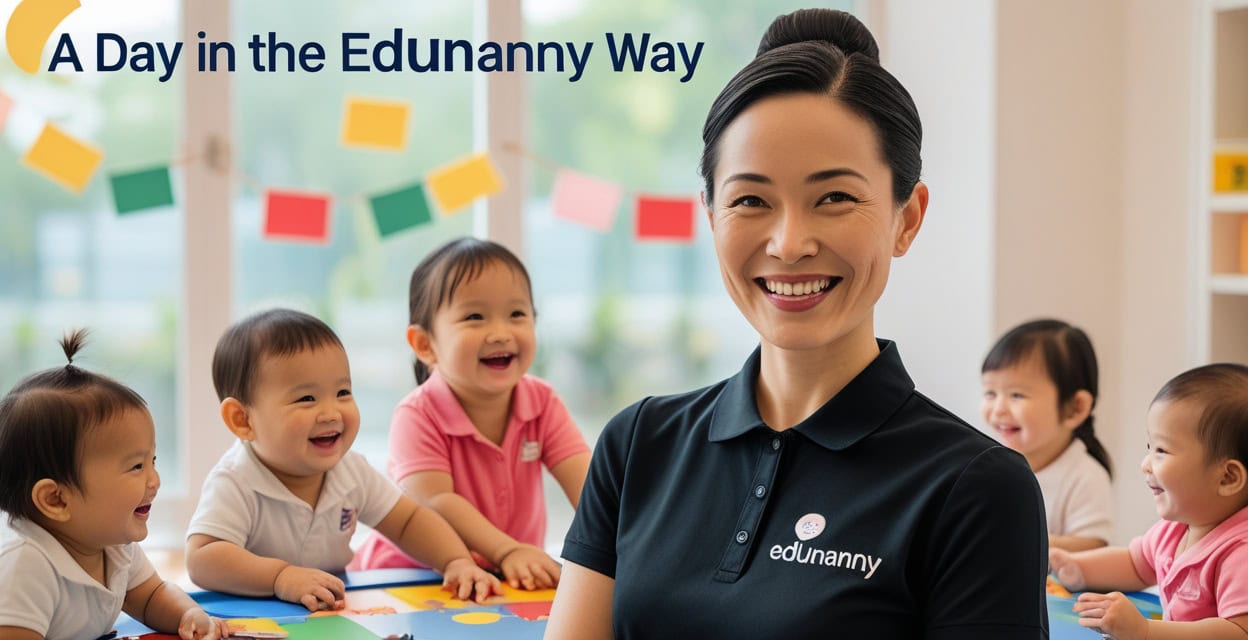

A Day in the EduNanny Way

A Day in the EduNanny Way

Morning: Greeting at eye level, calm handovers that confirm sleep, feeds, and mood. Floor time begins with gentle exploration; caregivers narrate cues and transitions, creating predictable rhythms.

Midday: Nourishing, responsive feeds—narrating cues and respecting pace. Naps are protected by design, not luck, with sleep areas calibrated for quiet and safety. Short, joyful activities—music, stories, and tactile play—are woven into the day.

Afternoon: Outdoor walks or sensory play that align with weather, energy, and developmental goals. Caregivers reflect on progress and adjust the environment to support next steps.

Evening: Handover to families with a brief, warm summary—three notable observations, one focal area for continued growth, and one moment of joy to remember. A routine that feels like home, even when at a centre.

Takeaway for families: a day that feels calm, purposeful, and connected—where your child’s learning emerges from daily routine, genuine relationships, and deliberate care.


Evidence Beneath the Poetry

Evidence Beneath the Poetry

  • Ultra‑low ratios correlate with higher quality interactions and safer environments.
  • Secure attachment in the first years predicts better self‑regulation, language, and social outcomes.
  • Consistent routines reduce stress hormones, stabilizing sleep and enhancing learning.
  • Proximity to home reduces transition fatigue and strengthens family–caregiver partnership.
  • Professional oversight and transparent practices, including CCTV where appropriate, increase trust and improve standards.

EduNanny translates these research findings into daily routines, caregiver training, and family communications so that evidence informs experience without losing the human touch.


What Parents Receive Beyond Care

What Parents Receive Beyond Care

  • Confidence: a known caregiver, a predictable day, and clear communication that fosters peace of mind.
  • Clarity: meaningful observations that help you parent with insight, not anxiety.
  • Community: a near‑home network that respects your family’s rhythms and languages.
  • Cost transparency: clear, affordable fees from $33/day, with CDA/Baby Bonus pathways to support budgets.
  • Choice: centre‑based or home‑based settings, plus distance guidance when you prefer expert eyes without daily drop‑offs.

What Childminders Receive Beyond a Job

What Childminders Receive Beyond a Job

  • Training and mentorship in infant pedagogy, health and safety, and family partnership.
  • Career ladders within EduNanny by BUTLER, connected to a maximum employment mandate that values stability and skill development.
  • Professional tools: modern layouts, planning protocols, and reflective supervision to sustain excellence over time.
Conclusion: The Public Ethic of Early Care and How EduNanny Serves the Promise

Conclusion: The Public Ethic of Early Care and How EduNanny Serves the Promise

Who we serve: Infants from birth to toddlerhood, their families, and the childminders who stand beside them. The circle is small, but its impact is national when built with intention, evidence, and care.

What we offer: Reliable, near‑home infant care that is safe, joyful, and developmentally wise. Not a holding space—an apprenticeship in trust, language, movement, and belonging. The hours matter: weekdays, 7am to 7pm, because reliability is essential in early care. Where: across Singapore—in centre‑based studios and home‑based settings designed for dignity—so families are never far from help, and children grow within their own communities.

How we deliver this: Through small ratios, attuned pedagogy, transparent safety, and professional childminders who are trained, supervised, and respected. Through affordability from $33/day with CDA/Baby Bonus pathways. Through an ECDA‑aligned pilot that treats care as civic infrastructure, and a national initiative that uplifts both families and the workforce.

The purpose is simple and profound: so that parents can work with peace of mind, infants can explore with steady hearts, and Singapore can maintain its quiet promise to every child: you are safe, you are seen, you can grow here.

This is more than a childcare model; it is a public ethic expressed at child’s eye level. Excellence and quality are not slogans—they are the way we design rooms, schedule days, hire and mentor staff, listen to parents, and measure progress. Centre‑based, home‑based, and distance support are not separate ideas; they are one ecosystem that flexes to the realities of family life. CCTV, modern layouts, and a 1:3 ratio are not features to compare; they are parts of a single safety system. Affordability is not marketing—it is the door that keeps the system accessible.

If this vision meets your family where you are, we invite you to walk with us. Visit EduNanny.com or Childminding.EduNanny.com. Tour a centre, meet a home‑based childminder, or speak with an advisor about distance guidance. Ask the questions that matter to you—about feeding, naps, allergies, learning goals, language, or special circumstances. We will answer plainly, because trust grows in the light.

A nation is measured by the way it greets its youngest each morning. With EduNanny by BUTLER, Singapore can greet them with presence, with safety, with wonder—and with a steady hand that says, every day, “You belong. Let’s learn.”

SEO keywords: [#earlychildhood, #SingaporeCare, #infantcare, #childminding, #EduNanny]


edunanny-729f3f91-41bb-48f2-be00-4fafb8007a69
October 20, 2025

EduNanny 1 to 3 Attunement and Safety Redefining Singapore First Thousand Days

EduNanny: A New Standard for Infant Care in Singapore

EduNanny: A New Standard for Infant Care in Singapore

Thank you for gathering to consider the most consequential investment a nation can make: the first months and years of a child’s life. In that brief span, the brain lays down more connections than at any other time. Attachment becomes trust, exploration becomes learning, and care becomes culture. EduNanny exists to make those early exchanges reliably excellent—close to home, transparent to families, and worthy of every child’s potential. This article expands that vision into practical guidance for parents, caregivers, and communities seeking to build radiant early foundations in Singapore.


The Five Lenses That Guide Our Practice

The Five Lenses That Guide Our Practice

1) The Ratio That Listens: Three Places for a Small Voice

At one caregiver to three infants, each child’s signals are audible. This ratio is not merely a number; it is a design choice for deep listening, secure base formation, and precise neurological development. When a caregiver can kneel to each baby’s level, naming cues and responding without rushing, learning begins at the speed of trust.

  • Practical implications for families:
    • Observe a shift in a center or home-based setting to confirm 1:3 in practice, not only on paper. Look for caregivers who pause, name cues, and respond within seconds rather than minutes.
    • Ask prospective centers to describe a typical 40–60 minute care window and show how they allocate time to each infant’s signals.
  • Key practices for caregivers:
    • Unhurried feeding: honor hunger and fullness cues, avoid pressure to finish a bottle or spoon-fed meal.
    • Uninterrupted floor time: provide infants space to roll, reach, and explore without interruption.
    • Sportscasting: narrate actions as you care (e.g., “You’re lifting the rattle with two hands”), turning movement into language and language into thought.
  • What success sounds like:
    • Quiet, calm rooms where a baby’s voice leads the rhythm of the day.
    • Caregivers who can name and respond to a variety of cues—hunger, tiredness, curiosity—without delay.

2) The Everyday Lab of Learning: Micro-Interactions as Curriculum

Learning for infants happens through tiny, intentional interactions—micro-interactions—that accumulate into big developmental gains. This quiet science respects the pace of each child and builds confidence from within.

  • Practical micro-interaction designs:
    • The hello moment: a named greeting, a shared smile, and a brief hand-over ritual that signals safety and predictability.
    • Touch-and-wait care routines: narrate, pause for infant response, then proceed—teaching consent and cooperation from the start.
    • Treasure baskets and heuristic play: safe textures, objects, and sounds allow cause-and-effect exploration and sensory discovery.
  • Home-friendly takeaways for parents:
    • Establish a simple morning hello ritual at home—eye contact, a name, and a gentle touch that signals safety before separating for the day.
    • Create a small, rotating set of safe textures (fabric, silicone, wood, smooth plastic) for exploration during tummy time or floor play.
    • Keep routines predictable: consistent feeding, napping, and play windows to support infants’ internal clock.

3) Safety as a Culture, Not a Checklist

True safety emerges from a culture of care—where every staff member is trained, every space is designed with eyes on the infant, and families have transparent visibility into daily care. Safety is a lived habit, not a passive standard.

  • Architectural principles:
    • Clear sightlines, rounded edges, infant-height design, slip-resistant zones, and sleep spaces separated from active play.
    • Natural light and calm color palettes to reduce stress for children and adults alike.
  • Transparency and trust:
    • Family-secure CCTV viewing that respects privacy while enabling real-time reassurance.
    • Digital health logs, recorded sleep checks, and feeding times accessible to families with simple, opt-in controls.
    • Consistent identity verification at handover to ensure safety across transitions.
  • Prepared people:
    • Caregivers trained in infant CPR and first aid, safe sleep practices, choking response, allergy protocols, and respectful soothing to de-escalate moments before they intensify.
    • Regular refreshers on safeguarding and child development to keep practice current with science.

4) Happiness with a Purpose: What We Measure and Why

Joy is a developmental asset. A joyful baby explores more, recovers quickly from frustrations, and relies on attunement to achieve growth. We measure “Happiness With Purpose” indicators to forecast language, social confidence, and resilience.

  • Core indicators:
    • Calm body tone and smooth recovery from fussing.
    • Frequent shared attention: caregiver and infant focus on the same object or person.
    • With-then-without support: a child can succeed with help, then attempt independently.
    • Exploration rate: time spent in self-chosen activity without distress.
  • Why these metrics matter:
    • Predictive value for language development, social competence, and resilience later in childhood.
    • Shifts the focus from rote routines to meaningful, attuned interactions that support autonomy.
  • Practical implementation for families:
    • Track small victories in a simple daily log—note a new gesture, a longer focus period, or a smile during a shared task.
    • Celebrate co-regulation moments (caregiver and child coordinating emotions) to reinforce secure attachment.

5) The Civic Profession of Childminding

Childminding is both intimate—building trust in the earliest relationships—and public—enabling parents to participate in work and empowering communities to thrive. EduNanny champions this profession as civic infrastructure: reliable, respected, and deeply integrated into neighborhoods.

  • Public-facing commitments:
    • Maximum Employment Mandate: creating high-quality jobs, fostering talent, and offering pathways for supervision, coaching, and lifelong learning.
    • A continuum of care: center-based hubs, licensed home-based environments, and distance supports that keep families connected.
    • Community anchors: neighborhood-based locations to minimize commute times and stabilize routines for infants.
  • Practical benefits for families:
    • Nearby care reduces transitions and increases family time in the evenings.
    • Transparent operations build trust and reduce parental stress about daily care.

What This Looks Like for a Family: A Day with EduNanny

What This Looks Like for a Family: A Day with EduNanny

Translating values into everyday practice means every hour has intention and calm. Here is a representative day to illustrate how the EduNanny approach unfolds in a real Singaporean family context.

  • 7:02am — Arrival and greeting: the caregiver names the baby, mirrors expressions, and offers a warm handshake with a soft voice, establishing safety and belonging.
  • 7:15am — Handover routine: the parent leaves with a live CCTV view and a simple plan for the day, visible on their phone.
  • 9:15am — Floor time and exploration: a caregiver narrates attempts, celebrates small victories, and provides gentle support for new motor skills.
  • 11:30am — Feeding aligned to hunger cues: pacing, responsive feeding, and a calm environment to support self-regulation.
  • 12:15pm — Sleep space and naps: safe sleep practices observed and monitored with recorded checks.
  • 3:00pm — Outdoor or sensory exploration: structured play with nature elements or sensory trays to broaden learning.
  • 6:15pm — Handover home: a brief daily highlight with photos and insights, setting up tomorrow’s plan.

The EduNanny Promise in Practical Terms

The EduNanny Promise in Practical Terms

  • Excellence and Quality: 1:3 infant ratio, trained and supervised caregivers, ongoing pedagogy aligned with global research and local standards.
  • Choice and Convenience: Centre-based, home-based, and distance supports; Monday–Friday, 7am–7pm; islandwide access.
  • Safety and Transparency: family-secure CCTV, visible layouts designed for calm, hygiene and sleep protocols that meet contemporary best practices.
  • Affordability and Access: options starting from $33/day; CDA/Baby Bonus eligible where applicable; alignment with ECDA Pilot and National Social Initiative goals.
  • Work and Wellbeing: reliable hours, proximity-based care, and a pathway for caregivers to grow professionally within a respected sector.

Why Childminding Matters—And Why Now

Why Childminding Matters—And Why Now

Infants deserve attuned, unhurried care. Parents deserve confidence and time to contribute to the workforce. Childminders deserve status and support. Employers benefit from predictable, dependable teams. Communities thrive when trust and routine become the norm.


Choosing EduNanny: What to Look For in a Care Partner

Choosing EduNanny: What to Look For in a Care Partner

  • Check the ratio in practice: observe a shift to confirm 1:3, not just the policy.
  • Staff training and supervision: inquire about ongoing training, mentorship, and access to coaching.
  • Safety culture: ask about CCTV privacy controls, sleep safety, emergency drills, and allergy protocols.
  • Transparency tools: what kinds of logs, daily plans, and senior-guardian access are available to families?
  • Proximity and scheduling: is there islandwide access, and do hours align with your work schedule?
  • Affordability and subsidies: confirm eligibility for CDA/Baby Bonus payments and any other supports.
  • Quality of life for families: how does the setting support family evenings and reduce commute fatigue?

Implementation and Context for Singapore: Public Alignment

Implementation and Context for Singapore: Public Alignment

EduNanny’s model aligns with Singapore’s ECDA Childminding Pilot and National Social Initiative goals. It combines center-based and licensed home-based care with distance touchpoints to maintain continuity of care when parents are at work. This approach supports parents, strengthens the caregiving profession, and builds a civic infrastructure that stabilizes families and communities.


Practical Steps for Parents Today

Practical Steps for Parents Today

  • Visit a site with a defined 1:3 ratio and ask to observe a caregiving cycle from arrival to handover.
  • Request access to live CCTV during a trial day or week, and ask about privacy controls and data usage policies.
  • Review the daily schedule and ask how micro-interactions are embedded into routines (hello moments, touch-and-wait, treasure baskets).
  • Ask for sample logs or dashboards that show feeding times, sleep checks, and developmental observations.
  • Discuss affordability options and confirm subsidy eligibility (CDA/Baby Bonus) before enrolling.
  • Plan a home routine that mirrors the EduNanny approach—brief morning hello ritual, predictable feeding and nap windows, and a consistent evening handover at a fixed time.

Conclusion

Conclusion

EduNanny envisions a Singapore where early care is not a patchwork solution but a polished public promise. By embedding a 1:3 ratio, micro-interactions as curriculum, a culture of safety, happiness with purpose, and a civic-minded profession, we can ensure every child begins with safety, learning, and joy that can be heard, seen, and felt. Parents, employers, and community leaders alike are invited to participate—tour a site, meet a caregiver, and witness how careful presence, thoughtful design, and transparent partnerships transform ordinary minutes into extraordinary beginnings. Let us build a Singapore where every child starts from a foundation of trust and possibility.

Visit EduNanny.com and Childminding.EduNanny.com to learn more. Tour a site. Meet a caregiver. See the difference a 1:3 ratio makes when it is matched with training, transparency, and heart. Let us shape a future where care is the earliest form of education and the nation’s strongest public service.

SEO keywords: [#earlychildhooddevelopment, #infantcare, #Singaporechildminding, #transparentcare, #EduNanny]


edunanny-ca14238a-5700-454d-baa0-66d105439ede
October 19, 2025

Near Home Care for Singapore Infants A Science Based Path to Calm Joyful Development with EduNanny

EduNanny Singapore: A Thoughtful Start for Singapore’s Youngest Citizens

EduNanny Singapore: A Thoughtful Start for Singapore’s Youngest Citizens

Good evenings, families, caregivers, neighbors, and friends of Singapore’s youngest citizens. This article expands the speech into a practical, editor-grade guide for parents and caregivers: how EduNanny translates development science into near-home care that is safe, joyful, and profoundly respectful of every child’s pace. Built on the wisdom of Montessori, Pikler, Bowlby, and Erikson—and aligned with Singapore’s unique rhythms of commute, shifts, grandparents, and daily work—EduNanny offers a clear, actionable pathway to high-quality infant care that you can trust, near your home and in your community.


What is EduNanny?

What is EduNanny?

EduNanny is a practical promise: professional childminding built to Singapore’s standards and pace. It blends evidence-based pedagogy with the lived realities of families to create near-home care that is accessible, accountable, and emotionally supportive for infants and their families.

  • Centre-based and home-based options, Monday–Friday, 7am–7pm, islandwide. We meet families where they live and work, offering flexible formats in both community and home premises.
  • Ultra-low 1:3 infant ratio. A low caregiver-to-child ratio protects presence, calm, and safety, enabling frequent, sensitive “serve-and-return” interactions.
  • Modern layouts with sightlines and clean air. Spaces designed for visibility and air quality, supporting infant-led movement and caregiver responsiveness.
  • Privacy-respectful CCTV for transparent oversight. Technology paired with clear privacy standards creates trust without compromising intimacy of care.
  • Affordability from $33/day, with CDA/Baby Bonus where eligible. Quality care should be accessible as a civic good, not a luxury.
  • A flexible pathway: centre-based, home-based, and distance support. Families can choose the model that best fits their life stage and needs, with expert guidance available remotely where needed.
  • A national, socially-minded initiative—EduNanny by BUTLER. Aligned to Singapore’s goals for safe starts, workforce participation, and local job creation under a maximum employment mandate.
  • Compliance and accountability: ECDA-aligned pilot parameters. EduNanny meets the regulatory requirements to bring structure, safety, and accountability to near-home care.

Five fresh commitments that guide our practice

Five fresh commitments that guide our practice

Our practice rests on five commitments designed to translate science into everyday care. Each commitment is paired with practical actions you can observe and leverage as a parent or caregiver.

  1. The Ground-Level Science: Pedagogy you can see, touch, and trust
    • Free movement before milestones: Infants are encouraged to move on firm, open floors with safe space, not padded train tracks. Layouts keep pathways clear and surfaces uncluttered to promote autonomous exploration.
    • Micro-scaffolding: Growth happens in small, responsive steps. We practice “one-more-step” coaching—one more reach, one more sound, one more social glance—without rushing development.
    • Language embedded in care: Every routine—nappy changes, feeds, burps—becomes a moment to narrate, name, and notice, weaving language into daily care rather than reserving it for “circle time.”
    • Curiosity first, toys second: Open-ended materials invite sustained concentration, problem-solving, and joy; simple objects become portals to exploration and language learning.
  2. Safety as a System: Three circles of protection
    • Circle One — The environment: Safe sleep by design, defined activity zones, daily checks for light and air, hazard-free paths, and childproofed layouts that reduce risk.
    • Circle Two — Professional practice: Rigorous hand hygiene, bottle labeling and sterilization, incident-prevention routines, emergency drills, and consistent mealtime and naptime protocols. Every shift begins with a readiness check; every day ends with a safety debrief.
    • Circle Three — Oversight and trust: Transparent privacy practices, unannounced internal audits, clear incident reporting, and alignment with ECDA requirements. Safety is culture, not just compliance.
  3. The Rhythm Engine: Development through predictable, loving routine
    • Predictable beats, flexible tempo: A stable arc—arrival, exploration, feeding, rest, outdoor moments when possible, and reflective handover—while honoring each infant’s cues.
    • Primary caregiving: One core caregiver builds a secure base by knowing your child’s signals, sleep windows, and comfort rituals.
    • Nutrition with dignity: Feeding as a relationship—eye contact, slow pacing, and responsive pauses; supportive of breastfeeding plans and safe bottle practices with equal respect.
    • Everyday science of smiles: Tracking well-being indicators (settling time, engagement, appetite, sleep quality) and adjusting the day accordingly.
  4. Joy as a Vital Sign: Measuring happiness with intention
    • The Calm-Play-Comfort index: Regularly observe and record calm body tone, engrossed play, and quick comfort after distress to monitor attachment and regulation.
    • The 15-minute scan: Brief caregiver check-ins throughout the day to prevent buildup of distress and to maintain connection.
    • The friendship of routine: Greeting rituals, song rituals, and farewell rhythms that create a sense of safety and belonging.
  5. The Purpose of the Childminder: Craft, calling, and community
    • Nation-builders: Childminders shape neural architecture through attention, empathy, patience, and curiosity—every interaction is civic work.
    • Professional pathways: Structured training, mentorship, reflective practice circles, and advancement routes from assistant to lead to trainer—dignity at work, dignity in care.
    • Maximum employment mandate: Neighborhood-based hiring and upskilling that stabilizes families and supports local economies.
    • Family partnership as standard: Daily handovers, secure digital updates, and monthly conferences keep home and care aligned.

How EduNanny looks in practice: a sample Monday

How EduNanny looks in practice: a sample Monday

Near-home care is about predictable, enriching routines that families can observe and replicate. Here is a practical snapshot you might see in a day at EduNanny:

  • 7:05am — Gentle arrival: Shoes off, warm greetings, a note about last night’s sleep. The infant’s primary caregiver begins with calm arms and a familiar song to ease transition.
  • 8:30am — Floor exploration: Infants explore with age-appropriate materials. Caregivers kneel at eye level, naming actions and emotions to build vocabulary and social awareness.
  • 10:15am — Feeding as conversation: Slow, attentive feeding with eye contact, brief pauses for cues, and respectful language that honors breastfeeding plans and bottle practices alike.
  • 11:30am — Rest in rhythm: Safe sleep routines, quiet environments, and familiar comfort cues that support secure sleep patterns.
  • 2:00pm — Outdoor air or window-view nature talk: Fresh air, movement, and early science talk—pointing, naming, and gentle exploration of the outdoor world.
  • 6:10pm — Handover as partnership: Two-minute briefing for families, including naps, feeds, play themes, and one home activity to try, ensuring continuity of care and home-life integration.

Why near-home childminding matters

Why near-home childminding matters

EduNanny emphasizes care that lives where families live. This approach matters for whom, what, when, where, and how:

  • Who: Infants from birth to three, working parents, grandparents who help, and childminders who carry a craft forward.
  • What: Safe, regulated, relationship-based care delivered in small groups that protect attention and joy.
  • When: The first thousand days, a period of rapid neural growth and foundation-building for lifelong health and learning.
  • Where: Across Singapore—in community and home premises—woven into daily life, anchored in local neighborhoods.
  • How: A 1:3 ratio; trained, mentored caregivers; sightline-rich spaces; privacy-respectful CCTV; routines that dignify care; and transparent partnerships with families and regulators.

The philosophy and purpose of EduNanny Childminding

The philosophy and purpose of EduNanny Childminding

  • Attachment first: A secure relationship is the engine of all learning.
  • Autonomy with assurance: Infants explore freely within safe boundaries; development is not rushed or restrained.
  • Culture as comfort: Home languages, family songs, and familiar foods create belonging and identity.
  • Safety by design: Safety is engineered, trained for, and accounted for in every routine and environment.
  • Equity through access: Center-based, home-based, and distance options with consistent hours and affordable pricing, making high-quality care within reach.
  • Community uplift: EduNanny as a national social initiative aligns care quality with job creation and parental workforce participation.

A note on transparency and trust

A note on transparency and trust

Innovation CCTV is not surveillance for its own sake; it is assurance with respect. We pair technology with clear privacy standards and human judgment to ensure safety without compromising the dignity of care. Distance childminding offers professional guidance to families who wish to care at home—virtual coaching, safety checks, and tailored routines—to keep learning vibrant wherever baby rests.


An invitation

An invitation

If you believe, as we do, that the first years are not a waiting room but a launchpad, we invite you to see how EduNanny works. Walk the light-filled rooms. Observe a 1:3 pod settling into play. Listen to the quiet language of care that says, “You matter. You are safe. You can try.”


Details for families

Details for families

  • Availability: Monday–Friday, 7am–7pm, islandwide Singapore.
  • Formats: Centre-Based Childminding, Home-Based Childminding, and Distance support.
  • Ratio: 1 caregiver to 3 infants.
  • Cost: Affordable from $33/day; fees payable by CDA/Baby Bonus where eligible.
  • Oversight: Privacy-respectful CCTV, modern layouts, daily safety routines, and alignment with ECDA regulations and pilot parameters.
  • Learn more or register: EduNanny.com and Childminding.EduNanny.com.

Transparency, trust, and ongoing partnership

Transparency, trust, and ongoing partnership

EduNanny emphasizes ongoing collaboration with families and regulators. Practical steps for families include:

  • Ask about the incident reporting pathways and how safety debriefs are shared with parents.
  • Request a tour of the space and observe the 1:3 pod in action during different times of day.
  • Discuss feeding plans, including breastfeeding support, bottle practices, and any dietary restrictions or cultural rituals.
  • Inquire about the teacher or caregiver’s professional development plan and mentorship opportunities there.
  • Understand how distance support works for home-based care—what virtual coaching looks like and how safety checks are conducted remotely.

Closing

Closing

In every pod, on every floor mat, and inside each tiny, trusting glance, Singapore’s tomorrow is learning to breathe, to notice, and to belong. Childminding is not background noise to economic life; it is the score that directs how children learn to be human. EduNanny’s purpose is simple and exacting: to make the most important minutes of the day—the infant minutes—calm, safe, and full of meaning. This is how we cradle families. This is how we honor caregivers. This is how we build leaders, five seconds at a time.

Thank you.


Conclusion

Conclusion

EduNanny Singapore offers a structured, evidence-informed approach to early childhood care that respects the science of development while honoring the realities of family life. By centering near-home care, maintaining a low 1:3 ratio, embedding safety as a system, and partnering transparently with families, EduNanny translates theory into everyday practice. Parents can use these principles to evaluate care options, advocate for their child’s needs, and participate actively in their child’s learning journey. Caregivers gain professional pathways that uplift communities and strengthen the workforce across Singapore. If you’re seeking a care model that treats infants as capable movers and curious thinkers, EduNanny presents a compelling, practical option worth exploring with your family.

If you’re ready to learn more, visit EduNanny.com or sign up for a tour of a nearby EduNanny pod. Your child’s first years deserve nothing less than thoughtful, safe, joyful, and future-focused care.

[#EduNanny, #InfantCareSingapore, #NearHomeCare, #EarlyChildhoodDevelopment, #SingaporeChildminding]

edunanny-be3cd13f-e346-44cd-84bd-a7fa5bba31ab
October 19, 2025

EduNanny Singapore, A Bold Evidence Based Path to Safe Joyful Infancy Across Islandwide Near Home Pods

EduNanny Singapore: A Bold, Evidence-Based Path to Early Care

EduNanny Singapore: A Bold, Evidence-Based Path to Early Care

In Singapore’s busiest hours of dawn and early mornings, the first moments of trust, care, and learning set the tone for a child’s entire day. EduNanny brings a disciplined, research-informed approach to infant care that blends Montessori-inspired environments, attachment-first practice, and practical safety. This is care that is close to home, affordable for families, and grounded in scalable, high-quality routines. The following guide expands the keynote vision into actionable strategies for parents, caregivers, and communities seeking to transform early childhood care in Singapore.


Our Model: Center-Based, Home-Based, and Distance-Enabled Support

Our Model: Center-Based, Home-Based, and Distance-Enabled Support

EduNanny exists to meet families where they are—whether that means a center, a home-based arrangement, or high-quality remote guidance. We operate across Singapore, Monday to Friday, 7am–7pm, with an ultra-low 1:3 infant ratio. Our spaces are modern, safe, and purposefully designed to support deep learning and secure attachment. Key features include.

  • Islandwide access with flexible enrollment options for center-based, home-based, and distance-enabled support.
  • Ultra-low ratio of 1 caregiver for every 3 infants, ensuring attentive care and responsive pauses for learning.
  • Prepared environments that balance safety with exploration—calm spaces for rest and dynamic spaces for discovery.
  • Optional secure CCTV and real-time digital logs to enhance transparency and peace of mind for families.
  • Affordability from $33/day with CDA/Baby Bonus eligibility to ease financial planning for caregivers and families alike.

The Four Guiding Ideas: Deepening Practice, Day by Day

The Four Guiding Ideas: Deepening Practice, Day by Day

The Attuned Minute: How Tiny Moments Create Lifelong Confidence

In the first thousand days, a child’s brain forms foundational pathways. EduNanny trains childminders to practice the Attuned Minute—Observe, Label, and Comfort in real time. This is not a theoretical moment; it is a practical routine that builds resilience, language, and trust.

  • Daily rituals: eye-level greetings at drop-off to signal safety and belonging.
  • Responsive feeding and Pikler-inspired free movement to honor each child’s pace.
  • Floor-time conversations with pre-verbal infants to seed early language and social cues.
  • Respectful diapering and care moments framed as relationship time, not chores.

Actionable tips for parents:

  • Practice a simple morning greeting routine with your child at home—get at eye level, name feelings, and offer one small choice (e.g., “Would you like to hold my hand or walk with me?”).
  • Use short, concrete labels during interactions (“I see you clapping your hands; you’re excited!”) to help your child connect actions with language.
  • Encourage caregivers to narrate ongoing activities: “You’re stacking blocks gently; I’m here to help when you need it.”

Safety by Design, Calm by Routine

Safety is more than a checklist; it is an architecture. EduNanny’s Safeguard Loop runs five steps through every day: Anticipate, Arrange, Check, Record, Review. From crib-to-cot sleep practices to clearly zoned play and sleep areas, safety becomes a consistent, daily rhythm that reduces risk and stress for both babies and caregivers.

  • Anticipate hazards and prepare spaces that minimize risk without limiting exploration.
  • Arrange age-appropriate furniture and materials to support independent movement.
  • Check systems daily: sleep logs, temperature logs, and room layouts to maintain safe environments.
  • Record incidents and observations in a transparent, non-punitive manner to drive improvements.
  • Review outcomes with families to sustain trust and align routines across home and care.

What parents can expect:

  • Consistent safe-sleep practices and hazard-mapped spaces tailored to each child’s needs.
  • Sanitation protocols that protect exploration but maintain a gentle touch for infants.
  • Trained first-aid and infant CPR readiness as standard practice.
  • Optional secure CCTV and a digital parent log for ongoing transparency.
  • Incident-prevention reviews that translate lessons into improved daily routines.

Development You Can See, Play You Can Trust

Learning emerges through the right materials in the right moments. EduNanny’s play provisions blend Montessori-inspired real objects with Froebel’s open-ended exploration and Vygotsky’s scaffolding. We honor each child’s pace while enriching every window of opportunity—sensory discovery, cause-and-effect, early language, social cues, and self-regulation.

  • Simple, beautiful, hands-on materials that invite manipulation and exploration.
  • Rich language modeling during routine care to expand vocabulary and narrative skills.
  • Floor-based free movement to build body confidence and coordination.
  • Mini social circles that foster turn-taking, imitation, and shared joy.
  • Caregivers documenting growth in everyday language you can use at home.

Joy as a Measurable Outcome, Not an Afterthought

Joy reflects the quality of daily care: calm engagement, predictable comfort, and curiosity. EduNanny tracks a practical “Joy Profile” across the week—comfort after wake-ups, interest in play, ease with transitions, brightness during social moments, and restful sleep—because happy infants learn better and families experience peace of mind.

  • Rhythms that help infants anticipate what comes next and feel secure.
  • Warm humor, songs, and micro-celebrations to acknowledge effort and progress.
  • Comfort-first settling; distress is resolved with sensitivity rather than rushed outcomes.
  • A shared language with parents to maintain joy across home and care environments.

The Role of the Childminder: Stewardship of Beginnings

The Role of the Childminder: Stewardship of Beginnings

In EduNanny’s model, the childminder is not a substitute parent or a task-doer. She or he is a steward of beginnings—responsible for dependable, dignified, and home-close care. EduNanny invests in professional growth and fair work pathways to uplift the caregiving profession because caregiver stability translates directly into child stability.

  • Professional development: continuous training in attachment, safety, and developmentally appropriate practices.
  • Strong, stable relationships that minimize turnover and maximize trust.
  • Clear communication with families to ensure alignment of routines, expectations, and goals.

How EduNanny Works in Singapore: A Comprehensive Service Model

How EduNanny Works in Singapore: A Comprehensive Service Model

EduNanny combines accessibility, safety, and developmentally meaningful practice. Our offerings are designed for families seeking options that fit their daily realities while upholding high standards of care.

  • Proximity and access: Center-based, home-based, and distance-enabled support islandwide.
  • Ultra-low ratio: 1:3 to ensure individualized attention and meaningful engagement.
  • Prepared environments: Modern, safe, and developmentally rich spaces.
  • Transparency: Optional CCTV, daily digital logs, and open communication channels.
  • Affordability: From $33/day with CDA/Baby Bonus options to support family budgets.
  • Public mission: Participation in ECDA’s Childminding Pilot as part of a national social initiative; a commitment to excellence, employment, and equity.
  • Easy start: Clear enrollment pathways via EduNanny.com and Childminding.EduNanny.com, with location and availability information.

Distance Support: Guidance When You Need It

Distance Support: Guidance When You Need It

Distance support complements on-site care by providing professional guidance to families at home or on the go. EduNanny offers remote parent coaching, feeding and sleep consultations, and secure digital communication so families can align routines, troubleshoot challenges, and maintain a cohesive caregiving circle even during workday travel or busy periods.

  • Remote coaching sessions tailored to your child’s development stage and family routines.
  • Digital resources and check-ins to support consistent practices across environments.
  • Secure messaging and logs that keep you informed without sacrificing flexibility.

Practical Guidance for Parents: Preparing for Enrollment and Beyond

Practical Guidance for Parents: Preparing for Enrollment and Beyond

Parents can take concrete steps to leverage EduNanny’s framework and weave it into daily life. The aim is to create a seamless, developmentally rich environment that supports both child and family wellbeing.

  • Before enrollment:
    • List your priorities: location, hours, language of instruction, and staff qualifications.
    • Prepare a simple daily routine to discuss with providers: wake-up time, feeding, naps, and play goals.
    • Develop a home-care plan that mirrors on-site practices (hydration cues, language exposure, and comfortable transitions).
  • Choosing between center-based, home-based, or distance-enabled care:
    • Center-based: consistent schedules, extended play environments, and built-in safety features.
    • Home-based: intimate settings, tailored routines, strong family-caregiver collaboration.
    • Distance-enabled: flexible coaching, remote guidance, and real-time support for travel or shifts.
  • What to ask during enrollment:
    • How is the 1:3 ratio maintained across different ages and times of day?
    • What safety protocols are in place for sleep, feeding, and diapering?
    • How are transitions and routines communicated to families?
    • What is the process for incident reporting and follow-up?
    • Can you show examples of the Joy Profile and growth documentation?

Home readiness tips to support EduNanny practices:

  • Set predictable routines that align with school-day rhythms, including a consistent wake-up and nap window.
  • Create a child-friendly space at home for language-rich interaction, with accessible books and safe exploration areas.
  • Develop a simple handover ritual for when caregivers change shifts or environments, emphasizing calm, clear communication.
  • Keep a small child-friendly log of milestones and moments that you can share with your EduNanny team.

Closing: Why Early Care Matters for Singapore—and How to Begin

Closing: Why Early Care Matters for Singapore—and How to Begin

The earliest moments set a nation’s trajectory. EduNanny’s framework demonstrates that safety, attunement, play, and joy can be designed into everyday care so that children grow confident, curious, and connected. A caregiver’s stability translates into a child’s stability; a prepared environment invites discovery; a transparent system builds trust between families and care teams. By embracing this approach, Singapore reaffirms its social contract: that every child deserves the best start, every family deserves real support, and society benefits when our youngest citizens thrive.


Enrollment and Next Steps

Enrollment and Next Steps

To learn more, schedule a tour, or begin enrollment, visit EduNanny.com or Childminding.EduNanny.com. Explore locations, availability, and pathways that fit your family’s needs. Join us in writing the next chapter of Singapore’s earliest care—near home, with care you can see, and a promise you can feel.

Call to Action: Take the first step toward a dependable, dignified, and home-close infant care experience that balances safety, learning, and joy for your child and your family.

SEO keywords: [#SingaporeInfantCare, #EarlyChildhoodDevelopment, #1to3CaregiverRatio, #ECDAPilot, #EduNannySingapore]


edunanny-4fbb80c3-2e6f-427b-b1d0-d2bdada718a2
October 19, 2025

EduNanny Singapore A Living Blueprint for Safe Joyful Infancy and Community Childminding

EduNanny Singapore: A Blueprint for Exceptional Infant Care and Childminding

EduNanny Singapore: A Blueprint for Exceptional Infant Care and Childminding

Singapore shows its character in how it greets its youngest citizens. EduNanny, introduced by BUTLER, embodies a national commitment to care that is both excellent and accessible—where centre-based and home-based childminding meet modern practice, transparency, and warmth. This article expands on the EduNanny approach, offering parents practical, actionable guidance drawn from real-world practice and cutting-edge early childhood development research. It is designed for families, caregivers, and the community seeking to understand how to turn every ordinary moment into a foundation for lifelong trust.


The EduNanny Model: From Vision to Everyday Practice

The EduNanny Model: From Vision to Everyday Practice

EduNanny is built to pair world-class practice with everyday convenience. Our model rests on three pillars: high-quality infant care, family-friendly access, and a transparent, evidence-informed approach to development.

  • Centre-Based and Home-Based Care: Island-wide availability, with care settings close to home and work. This reduces daily stress for families and strengthens routines.
  • Ultra-Low Ratios: A 1:3 infant-to-caregiver ratio supports continuous presence, prompt responsiveness, and intimate knowledge of each child’s cues.
  • Affordability and Accessibility: Competitive fees (from $33/day) supported by CDA/Baby Bonus, ensuring quality care is within reach for more families.
  • Safety, Transparency, and Distance Support: Innovation CCTV for peace of mind, secure access control, and remote coaching when parents need guidance away from home.

Beyond logistics, EduNanny emphasizes a culture—where care is a craft, and caregivers are trusted, well-supported professionals. The outcome is a day that feels familiar to a child, with safety as the default setting and discovery as the daily rhythm.


The Five Lenses That Guide Our Work

The Five Lenses That Guide Our Work

We offer five lenses to help families and caregivers understand how EduNanny builds a strong foundation for infant development. Each lens is practical, evidence-informed, and designed to translate into everyday actions.

1) The Responsive Triangle: Child, Carer, Environment

Infants learn through relationships, repetition, and constructive challenges. In EduNanny practice, this triad becomes a living system:

  • The child: Every infant is a unique pattern of sleep, hunger, curiosity, and comfort—observed calmly, without rush.
  • The carer: A secure base who names feelings, mirrors efforts, and scaffolds tiny steps into new abilities.
  • The environment: A calm, uncluttered space with reachable challenges—objects to grasp, ramps to climb, corners to look around, and words to hear.

Practical tips for parents and caregivers:

  • Practice “observe, respond, release”: pause to observe a cue, respond with a meaningful, timely action, then give the child space to try again.
  • In home settings, create a dedicated play area with adjustable spacing, low furniture, and safe exploration zones to encourage floor-time movement and independent reach.
  • Involve families in language-rich routines—naming objects, narrating tasks, and turning daily activities into conversational play (e.g., “What happens when we push this block?”).

2) Safety as Architecture, Not Afterthought

Safety is integrated into the design of spaces and the cadence of the day, not relegated to a checklist. It is the culture of care.

  • Design: Low, stable furniture; soft zones for rolling and crawling; clear sightlines; secure entry/exit; clutter-reducing layouts to minimize hazards.
  • Protocol: Hygiene cycles aligned to infant needs; safe sleep practices with regular checks; bottle-handling standards; and rehearsals for incident response that keep care continuous.
  • Staffing: A 1:3 ratio that ensures eyes on children, hands available, and minds present.
  • Transparency: Private, secure access combined with transparent documentation that respects privacy while keeping families informed.

Actionable steps for families evaluating safety at home:

  • Conduct a simple room safety audit: check for accessible cords, small objects, and unguarded stairs; create a “baby-safe path” with clearly defined safe zones.
  • Establish a consistent daily hygiene routine: washing hands before meals, clean bottle handling, and post-diaper-handling sanitation that mirrors the centre’s standards.
  • Use a predictable daily schedule so children experience calm transitions—e.g., a consistent nap window after lunch and before outdoor time.

3) Micro‑Milestones: Building the Whole Infant, Not Just a Skill

Birth to three is a rapid period of neural growth. We focus on small moments that compound into broad capability:

  • Language: Label everything at eye level; read daily; model turn-taking and conversational back-and-forth with coos, pauses, and smiles.
  • Motor: Encourage floor movement; provide safe surfaces with varied textures; introduce simple, progressive challenges (crawling over a gentle incline, standing with support).
  • Social-emotional: Consistent greetings, predictable routines, caregiver continuity to foster a sense of safety and curiosity.
  • Executive function (early foundations): Gentle waiting, simple choices, and shared cleanup rituals build focus, autonomy, and self-regulation.
  • Sensory regulation: Manage light, sound, and scent to prevent overstimulation and support attuned responses to needs.

Practical tools for families to track progress:

  • Weekly micro-observation notes: one area of growth, one moment of challenge, and one next-step activity for home.
  • Simple family-report sheets that translate professional observations into home-friendly language.
  • Quarterly “development snapshots” that align with play-based milestones and everyday routines.

4) Happiness as Daily Practice

Joy isn’t a bonus; it’s the soil in which learning takes root. Happiness indicators guide day-to-day care.

  • Three daily rituals: Warm arrival greeting, a familiar song or rhyme, and a quick narrative of a recent success before rest.
  • Comfort on demand: Respond quickly to needs, then invite exploration again to re-establish security and curiosity.
  • Natural light and outdoor time: Maximize fresh air and daylight for mood regulation and physiological regulation.
  • Protected rest: Respect sleep as essential for development, not downtime.

How to foster happiness at home:

  • Maintain predictable routines with small, flexible wiggle room for the child’s mood and energy levels.
  • Incorporate a daily “story of the day” that acknowledges a small success, reinforcing a growth mindset.
  • Balance quiet, solitary play with guided social play—short, meaningful interactions that push curiosity without pressure.

5) The Purpose of Childminding: A Craft of Quiet Leadership

Childminders are not temporary helpers; they are early-life leaders shaping social fabric, inclusion, and the care economy.

  • Social fabric: Daily routines and relationships that help families feel connected and supported.
  • Inclusion: Welcoming diverse abilities, cultures, and languages with dignity as standard, not exception.
  • Care economy: Investment in training, mentorship, and meaningful employment so caregivers themselves thrive.
  • Family partnership: Parents are respected as first teachers; collaborative planning aligns routines and observations for cohesive development.

A Day in the Life: Practical Rhythm for a Full Week

A Day in the Life: Practical Rhythm for a Full Week

A sample day provides a concrete picture of how EduNanny translates principles into lived experience, while leaving room for family-specific adjustments.

  • 7:00–8:30: Gentle arrivals, unhurried handovers, familiar greeting rituals. Families can check in via the CCTV stream for reassurance during the commute.
  • 8:30–9:30: Floor exploration and language circles—named objects, simple gestures, and small-group attention to foster early social skills.
  • 9:30–10:30: Nourishment and rest for younger infants; sensory invitations (soft ramps, treasure baskets) for older babies.
  • 10:30–11:30: Outdoor air when safe; otherwise indoor large-muscle activities with mindful spacing.
  • 11:30–13:30: Feeding, comfort, and protected sleep; safety checks and discreet documentation.
  • 13:30–15:30: Quiet play, story time, caregiver-led turn-taking activities.
  • 15:30–17:00: Snack, diapering, individualized interaction; language-rich exchanges and positive reinforcement.
  • 17:00–19:00: Staggered pickups, calm transitions, brief notes or photos for families to review later.

What Families Can Expect from EduNanny

What Families Can Expect from EduNanny

EduNanny delivers not only reliable care but an ecosystem designed to support families through the earliest years of parenthood and work-life integration.

  • Excellence and quality with ultra-low 1:3 ratios.
  • Centre-Based and Home-Based care options, plus distance-support coaching when needed.
  • Operating hours Monday–Friday, 7am–7pm, island-wide with community and home premises.
  • Innovation CCTV for transparency and reassurance, and secure access respecting privacy.
  • Modern, safety-focused layouts that promote calm and ease of movement.
  • Affordability from $33/day, with CDA/Baby Bonus applicability.
  • A National Social Initiative under the ECDA Childminding Pilot—advancing families and the workforce.
  • EduNanny by BUTLER: precision and heart in service to children and families.

Practical Guidance for Parents: How to Choose, Engage, and Partner with EduNanny

Practical Guidance for Parents: How to Choose, Engage, and Partner with EduNanny

Choosing the right caregiver setting is a critical decision. The following practical steps help families evaluate quality, build trust, and optimize development outcomes.

  • Before You Visit: Prepare a brief family profile that includes your child’s routines, feeding patterns, sleep needs, and any sensitivities. List questions about safety, caregiver training, and emergency procedures.
  • During a Tour: Observe caregiver interactions with children, the layout, and how routines unfold. Ask to see examples of micro-observations and progress notes.
  • Safety and Hygiene: Inquire about sleep practices, bottle handling, diapering protocols, and how hygiene cycles align with infant needs.
  • Communication: Request a clear schedule for daily reports, and ask how families receive updates when you are away (photos, notes, or CCTV access).
  • Progress and Milestones: Ask to see a sample micro-observation template and how progress is communicated—look for plain-language summaries, not jargon.
  • First Weeks Practices: Expect a gentle ramp-up with consistent routines, caregiver continuity, and early opportunities for home–centre collaboration (e.g., shared day plans).
  • Contingency Plans: Discuss back-up arrangements for caregiver illness or centre closures and how distance-supported coaching can bridge gaps.

From a caregiver perspective, families can support by maintaining consistent routines, sharing home observations, and participating in short, structured at-home activities that reinforce the day’s learning (e.g., turn-taking games, safe crawling routes, and simple naming games).


Reading Progress: How to Talk About Development at Home

Reading Progress: How to Talk About Development at Home

Families often benefit from translating professional observations into actionable home practices. The following tips help bridge home and EduNanny experiences:

  • Turn observations into daily talk: If a child shows interest in stacking cups, narrate the process at eye level and extend the activity with a slightly larger challenge.
  • Set tiny goals weekly: Choose one micro-milestone per week—e.g., “aim to share a toy during play”—and celebrate small victories with a family ritual.
  • Maintain consistency: Align sleep and feeding routines with centre practices where possible to support secure attachment and predictable transitions.
  • Track happiness indicators: Look for signs of ease in transitions, relaxed shoulders, and engaged eyes as positive indicators of well-being.

The National Context: Why This Matters Now

The National Context: Why This Matters Now

Singapore’s care landscape is evolving toward higher standards, wider access, and greater investment in the workforce that supports families. EduNanny aligns with ECDA’s Childminding Pilot, emphasizing safe environments, professional development, and flexible arrangements to meet diverse family needs. The goal is not only to care for infants but to cultivate a stable environment where trust, learning, and inclusion flourish from day one.


Conclusion: A Shared Commitment to Safe, Curious, and Confident Starts

Conclusion: A Shared Commitment to Safe, Curious, and Confident Starts

Education begins in ordinary moments—moments of naming, comforting, demonstrating, and exploring. EduNanny’s approach translates this insight into a practical, scalable model that supports families, caregivers, and children alike. By prioritizing safety as architecture, nurturing micro-milestones, and weaving happiness into daily practice, EduNanny helps Singapore build a future where every child’s day feels secure, familiar, and rich with discovery.

Explore EduNanny further, tour a centre or a home-based setting, and speak with a caregiver about schedules, affordability, and how CDA/Baby Bonus can support your family. Let us craft a plan that fits your life—centre-based, home-based, or distance-supported—so that excellence is not a luxury but the standard your child deserves.

Singapore shows its future in the way it greets a child each morning. With EduNanny, that greeting is steady, safe, and full of promise. May every small hand find a sure hold, every tiny voice find a patient ear, and every family find care that makes the day—and the years—better.

Thank you.

[#earlychildhood, #infantcare, #childminding, #SingaporeECDA, #EduNanny]

edunanny-189aa930-2110-4fd5-a1be-1506d77c9b3e
October 19, 2025

Public Spirit and Everyday Joy EduNanny and Singapore First Years One to Three

EduNanny: A Public-Spirited Vision for Singapore’s First Years

EduNanny: A Public-Spirited Vision for Singapore’s First Years

Good early childhood care is the foundation of a thriving society. EduNanny Singapore envisions a public-spirited childminding and infant care network that makes the best of developmental science practical, local, reliable, and joyful. It is care that respects the pace of every child, supports families, and strengthens neighbourhoods through presence, partnership, and professional craftsmanship.


What is EduNanny?

What is EduNanny?

EduNanny is a public-spirited childminding and infant care network designed for today’s families. It combines centre-based support, home-based care, and distance features that increase parent visibility into daily life. The model centres on an ultra-low infant-to-carer ratio of 1:3, modern environments, transparent technology, and a daily choreography of safety and learning. It operates as EduNanny by BUTLER and participates in the ECDA Childminding Pilot as a National Social Initiative with a Maximum Employment Mandate to create dignified jobs while delivering world-class care. The program offers islandwide availability, a mix of community and home premises, and affordability from $33/day with fees payable by CDA/Baby Bonus where eligible.

Practical examples for families include walking into a familiar centre or a trusted home setting, viewing a live schedule, and receiving daily notes that translate learning into home conversations. The model is designed to feel like a reliable partner rather than a service—one that families can trust, day after day.


Three Core Advantages to Daily Life

Three Core Advantages to Daily Life

  • Proximity with purpose: Care options are close to where families live and work, reducing commute strain, increasing time together, and anchoring trust within communities. Practical tip: map two reliable EduNanny options near home and near work and plan a one-week trial of two days per option to evaluate commute, handover routines, and daily notes.
  • Ultra-low ratios: Three infants to one trained carer, turning minutes into meaningful interactions and making safety proactive, not reactive. Actionable approach: request a daily “interaction log” that captures how each child spent time on meals, exploration, and language, so parents can reflect on progress with the carer.
  • Radical transparency: Privacy-respecting CCTV and clear communication so that parents know—not guess—how their child’s day is unfolding. Practical implementation: establish a weekly summary email or app notification that highlights milestones, mood, and key moments (e.g., first steps, new words) from the past week.

Five Pillars for the First Years

Five Pillars for the First Years

1) Pedagogy of Presence: watch, word, warmth

A baby learns through relationships first—then through the physical environment. EduNanny’s practice centers on three habits:

  • Watch: Attuned observation at eye level—reading cues before cries, noticing effort before outcome. Practical example: carers narrate a child crawling, indicating steps and decisions, so the infant sees cause-and-effect language in action.
  • Word: Naming sensations, actions, and feelings with rich, simple language that scaffolds cognition and self-understanding. Home tip: when a baby touches a textured toy, describe it: “This rough surface feels bumpy and cool.”
  • Warmth: Steady, predictable responses that tell the nervous system, “You are safe here.” Regulation precedes exploration; exploration fuels growth. Practical routine: a predictable nap window and soothing transitions that minimize distress and maximize curiosity.

In practice, Carers kneel at floor level, narrate a crawl, offer a hand without rushing, introduce new textures before new toys, and let infants lead with curiosity while safety boundaries remain clear. In a 1:3 micro-group, each child’s tempo is respected: one exploring rolling, another babbling, a third learning to stir with a spoon. Everyone is seen; nobody is hurried.

2) Safety as choreography, not a checklist

Safety becomes a daily dance with three beats:

  • Environment: Modern layouts with clear sightlines, cushioned edges, low open shelving, breathable sleep spaces, pram-safe entries, and climate-aware routines for tropical heat and storms.
  • Practice: The 1:3 ratio, zone supervision, clean-hands culture, safe sleep protocols, allergy-aware feeding, and calm transitions that minimise startle and overwhelm.
  • Transparency: Innovation CCTV for accountability, digital attendance and handover notes, routine safety audits, and emergency pathways rehearsed like a fire drill.

When safety is a well-choreographed practice, joy becomes possible. When joy is steady, development accelerates.

3) Development you can feel, not just measure

Brains build best when challenges are “just-right.” Days are designed around small wins in four domains:

  • Movement: Plenty of floor time, low furniture that invites pulling-to-stand, safe ramps and soft mats, and outdoor air when possible to build balance, strength, and grit.
  • Language: Conversational loops, songs at diaper changes, labeled emotions, and stories with faces and family photos to ground understanding.
  • Self-regulation: Predictable rhythms of nap and nourishment, gentle light and sound cues, and a “pause before help” that lets infants try, then try again.
  • Social play: Micro-groups teach turn-taking and noticing others’ feelings early—without overstimulation.

Parents report calmer evenings, fuller naps, new syllables, and more patient moments at home—the lived experience of development in action.

4) Joy as the engine of learning

Happiness in infancy is deep comfort paired with fascinating novelty. The Calm–Joy Curve guides daily life:

  • Avoid too little novelty (boredom) and too much (dysregulation); aim for a balance where eyes widen and breathing stays even.
  • Replace noisy rotation with curated repetition: familiar songs with a new verse, the same basket with one new object, a book read with a different voice.
  • End and begin with tiny ceremonies—warm greetings, unrushed goodbyes, a “hello hands” washing ritual—to anchor the day’s narrative.

If safety is the floor, joy is the light. Both are essential for sustainable development.

5) The vocation and public trust of the childminder

Childminding is a craft, not a gig. EduNanny supports carers as professionals with training, mentoring, observation feedback, and clear career progression. Core ethics include:

  • Dignity first: Speak respectfully about children and families, always.
  • Evidence-led: Reflect on what is observed, track patterns, and use data to improve care.
  • Partnership: Parents are co-authors of the child’s daily narrative, not customers.
  • Civic purpose: Under ECDA’s pilot and the Maximum Employment Mandate, we create stable, meaningful jobs that strengthen neighbourhoods while elevating standards.

The Benefits Parents Can Count On

The Benefits Parents Can Count On

  • Excellence and quality care: Available Monday to Friday, 7am–7pm, with centre-based and home-based options and distance features for real-time connection.
  • Proximity and convenience: Islandwide availability in community spaces and home premises, reducing commute and increasing family time.
  • Ultra-low 1:3 ratio: Deeper attention and safer practice through smaller groups.
  • Transparent innovation CCTV: Peace of mind with accountable safety and progress summaries.
  • Modern, safe environments: Layouts engineered for exploration, quiet rest, and efficient supervision.
  • Affordability: From $33/day, with CDA/Baby Bonus eligibility where applicable.
  • National social initiative: Part of ECDA’s Childminding Pilot with a Maximum Employment Mandate.
  • Educator partnership: EduNanny by BUTLER leads with evidence-based practice and continuous improvement.

Parents can also expect practical tools such as a daily diary, milestone highlights, and a secure portal showing sleep, feeds, and play themes. These tools become conversation starters at dinner tables and car rides home, linking care at the centre with learning at home.


How Our Model Fits Singapore’s Everyday Life

How Our Model Fits Singapore’s Everyday Life

EduNanny is designed to meet real daily needs across Singapore’s diverse communities. Practical scenarios include:

  • Jurong working parent: A 7am start with morning greetings, breakfast rituals, and a midday nap that protects evening family time.
  • Bedok grandparents: Centre-based mornings paired with home-based afternoons to maintain routine while respecting family rhythms.
  • Marine Parade business traveller: Distance features with scheduled video windows and daily summaries so a parent remains emotionally present across time zones.
  • Employer reliability: Consistent coverage and transparent practices reduce last-minute absences and support productivity and parental wellbeing.

Three Quiet Innovations That Change Everything

Three Quiet Innovations That Change Everything

  • The Micro-Transition Map: Each handover—car to door, door to room, room to nap—becomes a learning moment with fewer tears and more trust.
  • The Reflective Minute: After small struggles, carers document what helped. The living playbook is shared with parents to translate care gains into home gains.
  • The Calm Audit: Weekly checks on light, sound, scent, and traffic patterns to ensure the room breathes well and infants breathe well.

Affordability Without Compromise

Affordability Without Compromise

Quality must be accessible. EduNanny combines centre-based hubs, home-based settings, and efficient scheduling under a single national standard to keep costs low without compromising care. Rates start at $33/day with CDA/Baby Bonus eligibility where applicable, balancing child needs with family budgets.


A Word on Technology and Trust

A Word on Technology and Trust

Innovation CCTV supports coaching, accountability, and safety validation while respecting privacy. Parents receive thoughtful summaries—sleep, feeds, play themes, and milestones—so conversations on the ride home are informed and meaningful.


Closing: Why Childminding Matters—Who, What, When, Where, How

Closing: Why Childminding Matters—Who, What, When, Where, How

Who: Infants, families, carers, employers, and the nation. A secure beginning for every child is a stake for all citizens.

What: Reliable daily care that is safe, affectionate, and genuinely educational—woven through meals, movement, language, and rest.

When: The first thousand days, and every weekday from 7am to 7pm—moments that quietly shape extraordinary futures.

Where: Thoughtfully designed centres and warm home settings across neighbourhoods—close enough to feel part of daily life, consistent enough to form strong habits.

How: Ultra-low ratios, skilled carers, modern environments, innovation CCTV, parent partnership, and a funding model that respects families—delivered by EduNanny by BUTLER under the ECDA Childminding Pilot as a National Social Initiative with a Maximum Employment Mandate.


Conclusion

Conclusion

EduNanny stands for a society where the first years are nurtured with presence, professionalism, and genuine partnership. The five pillars translate science into daily practice; the 1:3 ratio ensures safety and depth of learning; transparency builds trust between carers and families; and affordability ensures no family is priced out of high-quality care. This is more than a service—it is a social compact: to turn care into culture, routines into rituals, and early days into durable confidence. If you want a Singapore where every infant begins with security, warmth, and expansive curiosity, join us. Visit EduNanny.com or Childminding.EduNanny.com to tour a centre, meet a carer, and read the day’s notes. The pathway from safety to joy to potential is built hour by hour, minute by minute.

Call to action: Explore EduNanny today, schedule a tour, and discover how a trusted partner can redefine the early years for your child and your family. Let us walk the day with you.

[#earlychildhood, #infantcare, #Singaporeeducation, #1to3ratio, #EduNanny]
edunanny-5fe81f7e-83f4-4678-a9f5-592012d9bf2e
October 19, 2025

From Handover to Growth The Near Home 1 to 3 Revolution Redefining Singapore’s First Thousand Days

Introduction: A Moment That Shapes a Nation

Introduction: A Moment That Shapes a Nation

Before the city has even shaken the night from its shoulders, a small hand curls around an adult finger. In that quiet moment, a nation’s future takes a breath. EduNanny was created for that exact moment—so that safety, joy, and development are not left to chance, but designed into every minute of care. This article expands on that vision, offering practical insights, actionable steps for parents, and a window into how EduNanny translates a powerful philosophy into daily practice across Singapore.


The EduNanny Promise in Practice

The EduNanny Promise in Practice

EduNanny by BUTLER is Singapore’s close‑to‑home infant care and childminding network—centre‑based, home‑based, and distance‑supported—built for working families, guided by science, and delivered with the dignity our infants deserve. Here is how the promise takes shape in everyday care:

  • Islandwide access from Monday to Friday, 7am to 7pm—near where you live and work.
  • Centre‑based and home‑based options, with distance support for days when flexibility is needed.
  • Ultra‑low 1:3 infant‑to‑carer ratio for attention you can feel and trust.
  • Transparent, innovation CCTV for safety, review, and professional learning.
  • Modern spaces with clear sightlines, natural light, and soothing acoustics.
  • Affordable access, from $33/day, with fees payable by CDA/Baby Bonus.
  • A national social initiative aligned to build trust, strengthen families, and expand dignified jobs under a maximum employment mandate.
  • Information and enrollment at EduNanny.com and Childminding.EduNanny.com.

The Trusted Trio: Child, Caregiver, Family

The Trusted Trio: Child, Caregiver, Family

At EduNanny, pedagogical excellence begins with relationship. We train our childminders to “See, Say, Support.” This is the practical engine behind trusted care.

See, Say, Support: A Practical Framework

  • See: Notice the infant’s cues without rushing—micro‑observations of gaze, breath, posture, and reach.
  • Say: Name what is happening—“You’re looking at the bright ball; your hand is trying to reach it”—to build language and calm.
  • Support: Offer just‑right help—enough to scaffold, not so much that it replaces discovery.

This is Piaget’s sensorimotor learning enriched by Vygotsky’s guided support, wrapped in Bowlby’s secure base. The result is trust that frees curiosity—and curiosity that accelerates learning.


Safety by Design: Architecture for Development

Safety by Design: Architecture for Development

Safety is not an afterthought; it is woven into every space, protocol, and practice. EduNanny’s safety framework is designed for both centre‑based and home‑based settings alike:

Environment by Design

  • Shore‑low shelves, rounded corners, clear sightlines.
  • Breathable rest zones with firm, flat sleep surfaces; no soft bedding or toys in cots.

Hygiene, Health, and Emergency Readiness

  • Frequent handwashing rituals; sanitisation cycles; temperature and humidity checks.
  • Illness protocols aligned to national guidance.
  • Emergency drills, evacuation maps, and clear communication trees for parents.

Visibility and Transparency: CCTV and Supervision

  • Secure, privacy‑respecting CCTV for transparency, incident review, and professional upskilling.
  • Continuous supervision with a 1:3 ratio and strategic rotations to maintain rapport and safety.

The Four Rivers of Development

The Four Rivers of Development

We unify the insights of Montessori, Froebel, Malaguzzi, Erikson, and contemporary neuroscience into four daily “rivers” that flow through a child’s day:

  • Movement: Free floor time, progressive tummy‑to‑side‑to‑back development, safe outdoor experiences; challenges without constraints that stifle exploration.
  • Language: Serve‑and‑return talk, songs, reading in multiple languages, and naming both feelings and objects.
  • Curiosity: Open‑ended materials, simple cause‑and‑effect explorations, guided peer encounters in tiny groups.
  • Belonging: Predictable rituals, family photos at eye level, culturally familiar lullabies, and respectful transitions.

Our 7am–7pm rhythm is unhurried and responsive—attuned feeding, rest on individual schedules, protected windows for exploration, calm handovers—so each infant experiences consistency without rigidity.


Joy as a Developmental Asset

Joy as a Developmental Asset

Joy is not mere entertainment; it is emotional safety that primes the brain for learning. EduNanny cultivates joy through:

  • Warm attunement and playful voices that lower cortisol and invite engagement.
  • Tiny victories—“You did it!” moments—that build self‑efficacy.
  • Gentle transitions with songs and touch cues.
  • Outdoor micro‑adventures: texture walks, sky‑watching, water play with safety protocols.
  • Partnership with parents: brief daily reflections, photos of learning moments, practical tips to ease home life.

The Craft and Calling of Childminders

The Craft and Calling of Childminders

Childminding is a profession with profound consequence. EduNanny invests in caregivers with:

  • Competency‑based training grounded in infant development, attachment, and responsive care.
  • Coaching in observation, documentation, and reflective practice.
  • Career ladders that reward mastery and leadership.
  • A maximum employment mandate that creates dignified jobs close to home, strengthening neighbourhood economies and family stability.

When we dignify the caregiver, we dignify the child. When careers are built with purpose, communities prosper.


EduNanny: Distinctly Singaporean

EduNanny: Distinctly Singaporean

What makes EduNanny uniquely Singaporean is a belief in excellence at the doorstep of every family:

  • Care brought to where families live—close‑to‑home circuits that reduce commute stress and preserve kinship ties.
  • A blended model of centre‑based reliability, home‑based warmth, and distance support for flexibility.
  • Alignment with national priorities—affordability, quality, and employment—so parents don’t have to choose between work and a strong start for their child.
  • Transparent, straightforward fees with CDA/Baby Bonus options so that quality is accessible.

A Day in the Life: Everyday Excellence in Practice

A Day in the Life: Everyday Excellence in Practice

Imagine a typical day at EduNanny:

  • A parent arrives at 7:40am. A two‑minute handover covers sleep notes, feeding, and a new favourite song. The infant recognizes the caregiver’s voice; shoulders relax.
  • Time is set aside for play, rest, and safe exploration. A secure note arrives at midday—a short video of a triumphant reach.
  • At 6:10pm, a warm reunion and a goodbye ritual that mirrors the morning. A day has passed in safety, skill, and kindness.

Policy and People: The Model in Action

Policy and People: The Model in Action

EduNanny participates in Singapore’s childminding transformation as a practical, people‑first solution. By expanding high‑quality places across community and home premises, we:

  • Meet family needs Monday–Friday, 7am–7pm, islandwide.
  • Offer ultra‑low ratios (1:3) that convert minutes into meaningful attention.
  • Use innovation CCTV and modern layouts to hard‑wire safety and transparency.
  • Provide affordability from $33/day, with CDA/Baby Bonus options.
  • Advance a national social initiative to grow employment with purpose and pride.

Who, What, When, Where, and How: Why Childminding Matters Now

Who, What, When, Where, and How: Why Childminding Matters Now

Framing the issue through a practical lens helps families navigate choices with confidence:

  • Who: Every infant in Singapore, every working parent balancing love and livelihood, every trained caregiver seeking purposeful work.
  • What: Relationship‑centred, safety‑by‑design infant care that turns daily routines into developmental gains.
  • When: Consistently, reliably—7am to 7pm, Monday to Friday.
  • Where: In your neighbourhood—home‑based and centre‑based settings designed for infants, not retrofit for them.
  • How: With trained professionals at a 1:3 ratio, with secure transparency, with science‑driven pedagogy, and with fees families can manage.
  • Why: Because the earliest years shape trust, and trust shapes attention, language, confidence, friendships, learning, and leadership.

Practical Guidance for Parents: From Observation to Involvement

Practical Guidance for Parents: From Observation to Involvement

Here are practical, actionable steps you can take to partner effectively with EduNanny and support your child’s development at home and in care.

Choosing Infant Care: What to Look For

  • Ask to see sample daily schedules and routine sheets that show feeding, sleep, play, and transitions.
  • Verify the caregiver ratio (1:3) and ask about caregiver turnover and continuity plans.
  • Review safety policies, sleep practices, hygiene routines, and illness protocols.
  • Request examples of how they document development, including language milestones and movement progress.
  • Inquire about the spaces: are there clear sightlines, age‑appropriate materials, and safe outdoor options?

Daily Home–Caregiver Collaboration: Concrete Practices

  • Maintain a simple daily log at home that mirrors what the caregiver records (feeding notes, sleep times, moods, new words).
  • Use the “See, Say, Support” framework at home: observe cues, name what you notice, and offer just enough help to promote exploration.
  • Introduce consistent routines: a morning ritual, a predictable goodbye, and a short end‑of‑day reflection with your child.
  • Engage in multilingual exposure where relevant—label objects and actions in the languages spoken at home and in the community.

Supporting Development Across the Four Rivers

  • Movement: Create safe spaces for crawling, tummy time, and assisted standing; use simple obstacle courses at home.
  • Language: Narrate daily activities; recite songs; read board books with rhythm and expression.
  • Curiosity: Offer open‑ended materials (blocks, simple puzzles, fabric, textures) and follow your child’s interests.
  • Belonging: Involve family photos, familiar lullabies, and transitions that honor attachment figures (caregiver to parent, etc.).

Observing Development: What to Watch For

  • Responsive social interactions, eye contact, and attempts at communication (gestures, sounds, facial expressions).
  • Emerging autonomy in self‑care tasks (feeding, dressing) and problem‑solving during play.
  • Consistency in mood, sleep patterns, and energy levels; seek guidance if persistent concerns arise.

Enrollment and Next Steps

Enrollment and Next Steps

Ready to explore EduNanny spaces near you? Here is a practical path to enrollment and getting started.

  • Visit EduNanny.com and Childminding.EduNanny.com to learn more and locate islandwide options.
  • Book a tour of centre‑based and/or home‑based spaces to experience the environment and meet the caregivers.
  • Prepare documentation: your child’s vaccination records, caregiver contact details, and any special needs notes.
  • Ask about payment options, including CDA/Baby Bonus, and understand how fees align with your budget.
  • Discuss transition plans and establish regular communication channels with your chosen caregiver.

Conclusion

Conclusion

EduNanny is designed to be the steady, loving rhythm beneath a child’s first explorations—a foundation of excellence felt in safety, joy, and development. By centering the infant, empowering the caregiver, and partnering with families and communities, EduNanny turns a daily routine into a meaningful journey of growth. If this vision resonates, explore spaces near you, engage with the educators who will know your child by name and cue, and consider how a close‑to‑home, high‑quality system can become the backbone of your family’s everyday life.

To learn more, visit EduNanny.com or Childminding.EduNanny.com and begin the conversation about centre‑based, home‑based, and distance‑supported care near you.

Join the movement to make high‑quality infant care accessible, transparent, and joyful for every family in Singapore.

[#EduNannySingapore, #InfantCareSingapore, #EarlyChildhoodDevelopment, #1to3Ratio, #SafetyByDesign]

edunanny-31eaebfb-e65b-4497-a0ee-d3252e9054c4
October 19, 2025

Near Home Attunement at Scale and the One to Three EduNanny Blueprint for Singapore First Thousand Days

Introduction to EduNanny

Introduction to EduNanny

Thank you for gathering to consider a simple, powerful idea: the first thousand days of life deserve the same care, design, and public commitment we bring to our best roads, hospitals, and schools. EduNanny was created for that promise. Not as a slogan, but as a daily practice—seven to seven, Monday through Friday—close to home, attuned to each infant, and accountable to every family.

EduNanny by BUTLER is a national childminding and infant‑care movement that blends world‑class developmental science with Singaporean reliability and community spirit. We offer centre‑based and home‑based childminding, with distance support for families who need flexible options. We operate islandwide, in neighbourhood centres and carefully prepared home premises; we keep an ultra‑low 1:3 infant ratio; we design modern, calm layouts you can see on secure CCTV; we open early and close late so families can breathe. We are a Childminding Pilot under the ECDA framework and a National Social Initiative with a Maximum Employment Mandate—elevating professional childminding as a dignified career and expanding quality care access at scale. And we do all this affordably, from $33 per day, with fees payable by CDA/Baby Bonus.

That is the infrastructure. But the heart of EduNanny is our way with infants: a pedagogy of attunement, safety, and joy rooted in the wisdom of Montessori’s prepared environment, Piaget’s discovery, Vygotsky’s guided participation, Froebel’s play, Malaguzzi’s “third teacher,” Bowlby’s secure attachment, Pikler’s respectful care, Spock’s common sense, and Erikson’s trust.


How EduNanny makes infant care and childminding great for Singapore

How EduNanny makes infant care and childminding great for Singapore

  • Proximity: Close‑to‑home pods and centres reduce daily friction. When care is nearby, transitions are calmer, drop‑offs are shorter, and infants feel anchored. Practical steps for families: map your commute, visit two nearby pods, and observe how staff greet families and handle transitions during peak times.
  • Ratio: A true 1:3 infant ratio is small enough for a caregiver to notice micro‑cues—breath, gaze, muscle tone—and respond in seconds. That responsiveness builds safety and the early brain. Actionable checklists for parents: ask prospective centres to share daily infant observation notes and example cue‑response pairs observed by caregivers.
  • Prepared environments: We craft spaces that invite movement and choice—low mirrors for body awareness, soft ramps for gross motor exploration, baskets of real‑world objects for rich sensory mapping. The room teaches before an adult speaks. Home‑based setups you can replicate: create a dedicated play corner with age‑appropriate objects, safe mirrors, and accessible materials at child height; rotate objects weekly to sustain curiosity.
  • Transparent partnership: Parents can see, ask, review, and decide. Our secure CCTV, daybooks, and end‑of‑day handovers make care visible and trustworthy. Practical guidance for families: schedule regular short video check‑ins, request weekly summary notes, and participate in quarterly family‑caregiver reviews to align on cues and routines.

Five unique topics for today’s conversation

Five unique topics for today’s conversation

1) The Learning Loop at 1:3: From Micro‑Cue to Mastery

Infants do not learn in lectures; they learn in loops—signal, response, repetition. At 1:3, a childminder can complete the loop every time:

  • Signal: A baby’s hand reaches for a rattle, then pauses. That pause is a question.
  • Response: The childminder moves to eye level, names the action, and waits. “You’re curious about the sound.”
  • Repetition: The baby explores; the childminder mirrors and extends—“soft tap, loud tap”—and stops before overstimulation.

Across a day, thousands of these loops wire attention, language, and self‑confidence. The loop is our craft. Practical tips for parents: narrate micro‑cues at home, pause deliberately to allow the infant to respond, and repeat activities to build predictable patterns that strengthen attention and comprehension.

2) Safety by Design: The Four Rings of Protection

Safety is not a checklist; it is a culture. We practice four rings:

  • Ring 1: Physical design: Sightlines across the room, no blind corners, low furniture anchored, cords concealed, non‑toxic materials, controlled entry. Design examples: modular, child‑scale furniture that still allows staff to observe every corner.
  • Ring 2: Protocol: A seven‑second scan during every transition; hands washed, surfaces sanitised; safe sleep verified by two eyes and breathing checks; incident drills practiced, not promised.
  • Ring 3: Relationship: Secure attachment reduces risk. A baby who feels seen signals distress early; a childminder who reads signals accurately builds rapid, empathetic responses.
  • Ring 4: Transparency: CCTV with privacy‑by‑design, daily logs, open‑door dialogue. Families see the day; trust compounds; safety deepens.

Practical parent takeaways: inquire about how transitions are managed, request a written safe‑sleep policy with sleep‑cue signs, and review CCTV access policies and privacy protections.

3) The Seven Daily Invitations: Development That Feels Like Play

Piaget gave us schemas; Montessori gave us the prepared environment; Froebel gave us play. We translate these into seven gentle invitations, offered to every infant each day:

  • Move free: Floor time over screen time—rolling, creeping, cruising. Movement builds body awareness and balance.
  • Touch real: Natural textures and household objects—wood, steel, cloth—so the brain maps the world honestly.
  • Mouth safely: Supervised oral exploration with age‑appropriate foods; tasting supports oral motor development and curiosity.
  • Hear human: Songs, simple narration, responsive turn‑taking. Language grows through conversation, not background noise.
  • See faces: Eye‑level interactions—smiles, imitation, labelled feelings—to seed social understanding.
  • Try small: Finger plays, large knobs, chunky puzzles—small challenges build early self‑efficacy.
  • Rest well: Predictable nap cues, dim spaces, and unhurried wind‑down; sleep consolidates learning.

Practical implementation: design a daily rhythm that interleaves movement, exploration, social interaction, and rest; document a few key cues and responses each day to refine responsiveness with your childminder.

4) The Climate of Joy: Measuring What Matters

Happiness in infancy is co‑regulation: the child borrows the adult’s calm. We tend to this climate deliberately:

  • Gentle starts: Begin each day with a slow hello and the child’s home cue—a blanket, a phrase, a song.
  • Predictable rhythms: A day that flows reduces cortisol and opens attention.
  • Micro‑rituals: The way we change a diaper—pause, explain, invite a lift of the hips—teaches dignity and cooperation.
  • Joy indicators: Track shared smiles, sustained engagement, and quick recoveries from frustration. These signals reflect a nervous system learning safety.

Practical guidance: parents can keep a simple joy log—note moments of mutual calm, moments of successful signaling, and moments when re‑establishing a calm was needed. Share these with your childminder weekly to strengthen alignment.

5) The Quiet Profession: Childminders as Civic Stewards

Great childminding is not a fallback job; it is a skilled public service. EduNanny invests in people and purpose:

  • Professional pathway: Training in infant development, health, safety, and family partnership; mentoring; observed practice; continuous learning.
  • Maximum Employment Mandate: Dignified roles across neighbourhoods, uplifting caregivers—many of them parents or mature workers—with fair pay and growth.
  • Community fabric: Near‑home care strengthens streets: parents meet, caregivers collaborate, neighbourhoods look out for their youngest.

Practical action: explore local professional development opportunities, ask about mentorship programs during visits, and inquire how EduNanny supports caregiver advancement, certification, and wage progression.


What this means for your family—practical benefits

What this means for your family—practical benefits

  • Access, islandwide: Centre‑based and home‑based childminding near MRTs and neighbourhood hubs. Distance supports and parent coaching available for families who blend care at home.
  • Hours that match real work: Monday to Friday, 7am to 7pm.
  • Affordability: From $33 per day, with fees payable via CDA/Baby Bonus.
  • Ultra‑low ratio: A true 1:3 infant ratio, not an aspiration.
  • Modern layouts: Child‑scale, light‑filled rooms designed for movement, safety, and visibility.
  • Innovation in transparency: Secure CCTV and daily digital daybooks so you are never out of the loop.
  • A living curriculum: The Seven Daily Invitations adapted to your child’s cues, not a one‑size schedule.
  • A partner you can reach: EduNanny.com and Childminding.EduNanny.com for information, enrolment, and conversation.

An explainer in relation to Singapore today

An explainer in relation to Singapore today

Singapore thrives on precision and trust. Families need care that is reliable and reachable; employers need stability; infants need time, attention, and attunement. EduNanny aligns these needs. By putting micro‑pods and centres close to home, we cut commute stress. By opening 7am–7pm, we reduce the daily squeeze. By keeping 1:3 ratios, we protect developmental quality. By training and employing childminders across estates, we build a resilient workforce and a stronger social fabric. This is infant care as civic infrastructure—human‑scale, science‑led, and neighbourhood‑rooted.


Who, what, when, where, and how—why childminding matters

Who, what, when, where, and how—why childminding matters

  • Who: Your infant, your family, and a trained, attuned childminder supported by a professional team and national standards.
  • What: Daily care that is safe, respectful, and intentionally developmental—feeding, changing, playing, resting, and learning woven into a calm rhythm.
  • When: The first thousand days, when the brain is most plastic; every weekday from 7am to 7pm, with consistency that steadies home and work.
  • Where: In centre‑based and home‑based settings across Singapore, chosen for proximity, design, and oversight; in your pocket through secure digital windows and daybooks.
  • How: With a true 1:3 ratio; prepared environments; the Four Rings of Safety; the Seven Daily Invitations; transparent CCTV; and a profession that is trained, mentored, and respected.

The philosophy and purpose of EduNanny Childminding

The philosophy and purpose of EduNanny Childminding

Our philosophy is simple:

  • Every infant deserves dignity: Care is done with a child, not to a child.
  • Attachment is the engine: A secure base supercharges development.
  • Play is the pedagogy: Curiosity leads; adults follow and extend.
  • Safety is a culture: Design, procedure, relationship, and transparency work together.
  • Families are partners: You know your child best; we bring trained eyes and steady hands.

Our purpose is public: to make excellence in infant care normal, reachable, and affordable across Singapore. To raise the status and skill of childminders. To let parents work without worry. To convert ordinary minutes into lifelong confidence. To prove that infrastructure can be measured in human outcomes—calm infants, supported families, connected communities.


Closing

Closing

Parents, you should not have to choose between your child’s safety and your day’s demands. Caregivers, your craft should be recognised as the quiet backbone of a thriving nation. Policymakers and neighbours, the first thousand days deserve our finest design.

EduNanny stands ready—centre‑based, home‑based, and distance‑supported; Monday to Friday, 7am to 7pm; islandwide; affordable from $33 per day with CDA/Baby Bonus; with an ultra‑low 1:3 ratio; with modern layouts, secure CCTV, and a living curriculum; as part of a Childminding Pilot and a National Social Initiative with a Maximum Employment Mandate.

This is how we make childminding not simply available, but excellent. This is how we honour the science and the soul of early childhood. This is how we cradle a future—patiently, attentively, joyfully—one small loop of learning at a time.

Join us. Visit EduNanny.com or Childminding.EduNanny.com. Walk through a nearby pod or centre. Meet the childminder who will learn your child’s cues and celebrate their first discoveries. Let’s build Singapore’s future where it begins—in the quiet, brilliant work of infancy, made visible, dignified, and near to home.

[#keyword1, #keyword2, #keyword3, #keyword4, #keyword5]

edunanny-cb8a4b7b-aae9-419a-8499-797e776881a1
October 18, 2025

The Listening Floor and the 1 to 3 Promise EduNanny and the Public Promise for Infants in Singapore

EduNanny by BUTLER: A Caring Science, Everyday Practice, and Public Promise for Singapore’s Infants

EduNanny by BUTLER: A Caring Science, Everyday Practice, and Public Promise for Singapore’s Infants

Good evenings, Singapore. Tonight we explore how EduNanny reimagines infant care and childminding as a civic mission—melding respected pedagogy with practical, daily execution. EduNanny is a centre-based and home-based movement available Monday to Friday, 7am to 7pm, islandwide. We do the simple things expertly and the complex things gently, so infants learn, families breathe, and communities grow. This article expands on the five living commitments that guide EduNanny’s work, and provides actionable insights for parents, caregivers, educators, and policy-minded readers alike.


Topic One: The Listening Floor—Attunement as Pedagogy at 1:3

Topic One: The Listening Floor—Attunement as Pedagogy at 1:3

The Listening Floor begins where infants move and meaningfully discover. Within a 1:3 circle, a childminder can listen deeply to quiet signals—yawns, reach for a rattle, or the gleam before a giggle. This attunement is the foundation of trust and early self-regulation.

Key components of Attunement in Practice

  • See–Say–Support cycle: Observe the cue, name the feeling or action, and support the next step. This builds self-regulation and secure attachment without coercion.
  • Integrated pedagogy: Blend free movement (Pikler) with purposeful independence (Montessori) and guided co-regulation (Vygotsky) to scaffold curiosity.
  • Language-rich routines: Use mirrors for self-awareness, rolling and reaching for gross motor growth, treasure baskets for sensory exploration, and babble-to-words routines for early language bloom.
  • Multi-language respect: In Singapore’s multilingual context, celebrate the “hundred languages of childhood” through song, gesture, and rhythm—incorporating English, Mandarin, Malay, and Tamil in daily routines.

Practical examples for families:

  • Start the day with a simple, shared routine: “Let’s check in with our feet and hands.” Observe what the infant does, narrate the moment, and respond with a gentle next-step activity (e.g., a roll to stretch, a reaching game).
  • Use everyday objects as learning tools—mirrors for self-recognition, safe household items for sensory play, and soft toys for turn-taking and sharing.

What parents can expect from EduNanny’s Listening Floor: calmer transitions, more explicit early communication, and a growing sense of security as infants realize their expressions lead to predictable responses.


Topic Two: The Safety Lattice—Designing Calm, Predictable Protection

Topic Two: The Safety Lattice—Designing Calm, Predictable Protection

Safety is not a checklist; it is an architecture. EduNanny designs modern layouts for line-of-sight supervision, low-to-floor movement, and hazard-free exploration. Our approach emphasizes active supervision, transparent routines, and consistent practices that reduce risk while supporting exploration.

Elements of a Safety-Forward Environment

  • Layout and supervision: Child-safe, open layouts with clear sightlines; two-person handovers; face-name checks during transitions.
  • Health and well-being: Ritualized infection control, hygiene practices, redundancy in allergy and dietary management, and regular infant-first-aid drills.
  • Emergency readiness: Structured drills, age-appropriate emergency responses, and documented reaction plans that caregivers can rehearse with families.
  • Innovation CCTV with privacy by design: Transparent, secure access that supports accountability while protecting privacy; families stay connected without compromising professional boundaries.

Practical tips for families:

  • Ask about the layout and sightlines of the care setting. Request a simple floor plan that shows safe zones, nap areas, and play corners.
  • Inquire about daily drills and how near-miss events are analyzed for continuous improvement.
  • Ask about privacy controls for CCTV: who can view, how data is stored, and how often footage is reviewed for safety and learning.

Expected outcomes: A calmer environment that supports focused exploration, predictable routines, and trust that safety and learning travel hand in hand.


Topic Three: The Joy Protocol—Daily Rhythms that Grow Happy Brains

Topic Three: The Joy Protocol—Daily Rhythms that Grow Happy Brains

Happiness in infancy grows from reliable rhythms: feed, play, rest, and repeat—responsive to cues rather than rigid clocks. Joy emerges from micro-moments of warmth, timing, and responsive care.

Four S’s of Practice

  • Seen: Caregivers actively observe and share warmth—eye contact, tone, and responsive touch.
  • Safe: Predictable routines, clear boundaries, and a secure environment for exploration.
  • Soothed: Attunement to distress, paced feeding, gentle transitions, and soothing strategies calibrated to the child’s cues.
  • Secure: Consistent caregiving that fosters a sense of safety, enabling curiosity and later problem-solving.

Daily living in practice:

  • Infant-friendly routines for nappy changes and feeding that invite conversation and participation from caregivers and families.
  • Nature, movement, music, and gentle sensory invitations: tummy-time, water-play safety, infant massage with consent, and culture-rich songs to echo home.
  • Daily care notes and developmental snapshots shared with families to extend the learning rhythm into home life.

How to translate this at home: Establish predictable, flexible routines that honor cues; celebrate small achievements; and incorporate simple nature experiences and music into daily moments.


Topic Four: The Singapore Childminder—A Civic Professional with Heart and Science

Topic Four: The Singapore Childminder—A Civic Professional with Heart and Science

Childminders are not “extra hands”; they are early architects of trust. EduNanny’s approach blends child development science, safety mastery, reflective practice, and professional mentorship to elevate caregiving as skilled, dignified work.

Professional growth and dignity for caregivers

  • Structured training: Ongoing education in attachment science, safety protocols, and reflective practice to sharpen judgment and responsiveness.
  • Career ladders: Clear pathways from foundational skills to mastery, with coaching and recognition of expertise in early childhood care.
  • Ethical practice: Dignity for every child, cultural respect for every family, confidentiality, and integrity in every interaction.

Policy alignment and public value: The Maximum Employment Mandate recognizes caregiving as skilled work, supporting stable jobs and professional trajectories for Singaporeans—parents returning to work, mid-career caregivers, and elder mentors alike.


Topic Five: Access Without Friction—Care Where Life Happens

Topic Five: Access Without Friction—Care Where Life Happens

Families need care that meets life where it is. EduNanny offers centre-based and home-based childminding across Singapore, Monday to Friday, 7am to 7pm, with neighbourhood options to reduce commute stress. Innovation CCTV reinforces transparency and keeps families connected to their child’s day.

Access, affordability, and trust

  • Pricing and subsidies: Fees start from $33/day; options to pay via CDA/Baby Bonus; transparency in cost structures and services.
  • Convenient access: Islandwide presence with centre and home-based options; easy enrolment processes and clear parent partnerships.
  • Communication and partnership: Regular updates, care notes, and open channels for questions or concerns to flow between families and educators.

Practical enrollment tips:

  • Schedule a visit to a centre or registered home to observe the listening floor in action and see how staff interact with infants.
  • Ask for a sample daily schedule and a 1:3 ratio demonstration during a real activity (e.g., roll, reach, baby massage session).
  • Request a breakdown of fees, available subsidies, and what is included (meals, materials, transport options, and incident reports).

How EduNanny Makes Infant Care Great in Singapore—A Clear Explainer

How EduNanny Makes Infant Care Great in Singapore—A Clear Explainer

Pedagogy meets care: EduNanny fuses attachment-first routines with cognitive, language, and motor development—creating a holistic approach that supports both security and growth.

Smaller ratios, bigger relationships: The 1:3 model unlocks attuned moments of teaching and responding that large groups cannot match, enabling deeper trust and richer learning experiences.

Safety engineered for modern life: Modern layouts and active supervision, paired with innovation CCTV for transparency and calm, deliver safety without sacrificing warmth and learning.

Mixed model for accessibility: Centre-based, home-based, and neighbourhood placements shorten distances to care and deepen trust with familiar surroundings and communities.

Practical, affordable, and accountable: Islandwide access, 7am–7pm, Monday–Friday; CDA/Baby Bonus subsidies; clear communication; and trained professionals who love the craft.


Conclusion: Why Childminding Matters—and Why EduNanny Is Here

Conclusion: Why Childminding Matters—and Why EduNanny Is Here

Who benefits from strong, compassionate childminding? Infants who need a secure base; parents who need reliable care; childminders who deserve respect and professional development; employers who value family stability; and neighbours who know that care is a public good. EduNanny offers care that is rigorous and warm—a daily weave of safety, development, and joy. The ordinary weekday, lived with presence and care, becomes the seed of extraordinary potential.

Where and how can you engage with EduNanny today? Consider these next steps:

  • Explore programmes and locations at EduNanny.com
  • Learn about childminding options at Childminding.EduNanny.com
  • Ask about fees payable by the CDA/Baby Bonus and affordable options from $33/day
  • Visit a centre or a registered home; meet the team; observe the listening floor in action

In the end, nations are built in quiet rooms—where a caregiver hums a familiar tune, an infant reaches for the future, and trust becomes the first language we all share. That is EduNanny’s promise to Singapore. And that future begins—happily, safely, purposefully—today.

Explore more deeply, and consider how EduNanny can partner with your family or your professional practice to elevate early childhood care in Singapore.

Keywords: EduNanny Singapore, Infant Care Singapore, Childminding Singapore, Montessori Pikler Vygotsky, Affordable Childcare Singapore

[#EduNannySingapore, #InfantCare, #Childminding, #MontessoriPiklerVygotsky, #AffordableChildcare]

edunanny-0601a605-7d52-4bc2-9eab-66faea2e7473
October 18, 2025

Near Home Pods and the First Thousand Days A Civic Blueprint for Safe Joyful Infancy in Singapore

Introduction

Introduction

In Singapore’s compact urban fabric, the first years of life unfold with remarkable speed and tenderness. The adults who walk beside infants—parents, caregivers, educators, and community partners—shape a child’s sense of safety, belonging, and possibility. The EduNanny promise is simple but ambitious: close, calm, and consistent care that feels like family, yet meets the standards of professional education and safety. This article builds on the spirit of the Homespun Beginnings speech and translates it into practical guidance for parents and caregivers, with real EduNanny insights you can apply from Day One.


The EduNanny Promise in Singapore

The EduNanny Promise in Singapore

EduNanny exists to turn daily routines into powerful opportunities for development. We offer a near‑home network of centre‑based and home‑based childminding that blends the intimacy of family life with the reliability of a professional standard. Key features include:

  • Excellent 1:3 infant ratio to ensure true attention and responsive care.
  • Monday–Friday, 7am–7pm availability islandwide, with centre‑based and home‑based settings.
  • Modern, calming environments designed for exploration and security.
  • Innovation like secure CCTV for partnership and accountability, paired with strict privacy safeguards.
  • Accessible pricing and options payable by government schemes such as CDA and Baby Bonus.
  • EduNanny operates as EduNanny by BUTLER within the ECDA Childminding Pilot, aligning with a national initiative to raise quality, widen access, and support maximum employment while centering families.

Our thesis is simple: when care is close, calm, and consistent, infants grow in trust; when trust grows, learning accelerates; and when learning accelerates, a child’s world—and our country’s future—expands. Below are five living ideas that shape every room, routine, and relationship.


Five Commitments to Infant Care

Five Commitments to Infant Care

1) A Listening Curriculum: Because development starts with being seen

Infancy is a conversation long before vocabulary emerges. The Listening Curriculum formalises this into daily practice:

  • Pause before prompting: practice a three‑second quiet window to observe gaze, gesture, or sound before offering an opportunity to respond.
  • Narrate the child’s world in multiple languages: English, Mandarin, Malay, and Tamil to reflect home languages and community belonging.
  • Work at eye level and at the infant’s tempo: follow their rhythm rather than imposing adult speed.
  • Micro‑journals: two or three short observations daily to anchor continuity between carers and with parents.
  • Protect uninterrupted exploration: adults step back at the right moments to let curiosity lead.
  • Practical tip for parents: keep a small “observations” notebook or app entry for one moment of discovery each day (e.g., “gazed at caregiver during song,” “reached for the rattle with intention”).

Actionable takeaway for families: at drop‑off, share one strength observed at home; at pick‑up, share one strength observed in care. This twin‑signal exchange reinforces trust across home and care settings.

2) Safety as Choreography: Because secure bodies make curious minds

Safety is not a checkbox; it is a shared rhythm—designed, practiced, and refined. Core elements include:

  • Sleep safety: firm mattresses, back‑to‑sleep positioning, no pillows or soft toys in cots, temperature‑appropriate clothing, and routine checks without disturbing rest.
  • Hygiene and health: rigorous hand hygiene on entry, after nappy changes, before feeding; sterilised equipment; clear illness protocols; confident first‑aid readiness.
  • Movement zones: soft, open floor space; stable furniture; cords out of reach; constant line‑of‑sight supervision; prevention over correction.
  • Secure partnership: CCTV for transparency paired with robust privacy standards; technology serves trust, not surveillance for its own sake.
  • Routine risk scanning: a morning space sweep, midday refresh after meals/nappy changes, end‑of‑day reset.

Practical insight for parents: review the care environment through a “safety rhythm” lens—are there visible cues for safe sleep, clean surfaces, and clear space for movement? If you notice a potential risk, speak up and request a quick re‑check routine with the carers.

3) The Four Rivers of Growth: Attachment, Movement, Language, Regulation

EduNanny threads daily life through four developmental rivers to carry infants forward. Practice examples you can adopt at home and in care settings:

  • Attachment: consistent primary carers within a 1:3 pod; familiar greetings; small rituals signaling belonging. Drop‑offs begin with a handover that includes one strength observed at home; pickups end with one strength observed in care.
  • Movement: daily tummy time, reaching games, rolling, cruising practice, soft climbing, outdoor pram walks when suitable. Celebrate motor milestones as processes, not deadlines.
  • Language and music: daily shared books, songs, fingerplays; responsive back‑and‑forth vocal play; welcome home languages and simple baby signs to reduce frustration and amplify agency.
  • Regulation: breathable routines for feeding, sleep, and play; dim lighting and calm voices before naps; soothing transitions; repair after upsetting moments without rushing.

Practical at‑home activities:

  • Attachment: create a simple goodbye ritual (wave, hug, and a tiny “goodbye moment” you repeat daily).
  • Movement: set up a mini obstacle course with pillows and safe cushions to encourage crawling and cruising; track progress with a tiny chart.
  • Language: narrate daily activities in two languages; use interactive reading times with picture books; incorporate a weekly song circle.
  • Regulation: practice slow, rhythmic transitions—dim the lights, speak softly, and offer a preferred security object during changes in activity.

4) Joy as a Vital Sign: Because happiness is information

Joy is a measurable signal of wellbeing and learning readiness. Treat daily delight as a data point you monitor and respond to:

  • Ask three quick questions each day: Did the child seek connection today? Did they sustain attention during a small challenge? What soothed them?
  • Interpret cues: smiles, relaxed shoulders, and engaged eyes signal positive states; changes may indicate overwhelm or fatigue requiring adjustment.
  • Daily delights: sensory play (water play, textures), mirror games, peekaboo, and person‑to‑person interactions that are warm and predictable.
  • Evidence of learning: route your observations toward both milestones and the quality of the interaction—the calm, curious state matters as much as a sprint to a milestone.

Practical parent guidance: keep a “joy log” for a week—note what activities produced smiles, what soothed when upset, and how the child initiates social exchanges. Use this to tailor care plans with educators.

5) The Childminder’s Craft: A profession with civic purpose

Childminders are trained professionals and civic partners. Strengthening this craft benefits families and communities alike. Focus areas include:

  • Training: practical safety, sleep, feeding, observation, family communication, and ethical technology use; ongoing reflective practice helps carers grow.
  • Career pathways: dignified roles near home that build community resilience while raising standards; pathways to advanced practice for experienced carers.
  • Documentation: brief daily logs and weekly summaries that are useful, jargon‑light, and respectful of family routines.
  • Family partnerships: intake conversations, collaborative care plans, shared routines, and open channels through platforms and regular check‑ins.

Practical tip for families: when meeting a potential caregiver, request a sample daily log and a short plan for a week that aligns with your home rhythms. Ask about training certificates and ongoing professional development goals.


Daily Life: How It Looks in a Day

Daily Life: How It Looks in a Day

Sample timeline to illustrate the rhythm of EduNanny care, with practical details you can adapt to your family:

  • 7:00–7:45am: Arrival is unhurried. Carers greet each child by name; parents share a detail from home and carers share a detail from yesterday to reinforce continuity.
  • Mid‑morning: Bottles, solids, sensorimotor play; tummy time framed as an ongoing story of effort and achievement; books are explored with joint attention and gentle narration.
  • Late morning: Nap routines are predictable—dim lights, soft music, gentle patting, and a quiet pause; rest is treated as a right, not a task left undone.
  • Afternoon: Outdoor pram walks (weather permitting), simple art projects to support grasp and texture, mirror talk to reinforce identity; carers narrate social moments with kind language.
  • 5:00–7:00pm: Departure moments are bridges—highlights, challenges, and a small care idea for home that aligns with family rhythms; transitions are smooth and predictable.

Why Near‑Home Matters in Singapore

Why Near‑Home Matters in Singapore

Singapore’s dense urban environment means proximity to care significantly reduces stress for families and strengthens community ties. Near‑home pods offer several tangible benefits:

  • Time savings: shorter commutes mean more moments for bonding, play, and learning at home.
  • Consistency: familiar corridors, neighbours, and playgrounds help children feel secure and see care as part of their everyday world.
  • Community resilience: proximity fosters networks among families, carers, and local partners, reinforcing social safety nets for working parents.

What Parents Can Expect from EduNanny

What Parents Can Expect from EduNanny

EduNanny sets clear expectations so families can partner with confidence:

  • Attentive people: gentle, trained childminders with a 1:3 infant ratio.
  • Thoughtful places: modern layouts that are soft, orderly, and calming in both centre-based and home-based settings.
  • Predictable routines: Monday–Friday, 7am–7pm, islandwide, across centre and home premises.
  • Transparent partnership: secure, ethical CCTV; daily updates; clear channels for feedback and collaboration.
  • Sensible fees: accessible pricing with options payable through CDA/Baby Bonus schemes.
  • Simple access: learn more at EduNanny.com and Childminding.EduNanny.com.

The Benefits at a Glance

The Benefits at a Glance

  • Excellence and quality you can feel in the room
  • Centre‑based and home‑based options to fit family rhythms
  • Near‑home distance and convenience that reduce daily stress
  • Affordable plans from $33/day, with CDA/Baby Bonus options
  • Monday–Friday, 7am–7pm, islandwide Singapore
  • In community and home premises with modern layouts for calm and safety
  • Excellent 1:3 infant ratio for true attention
  • Innovation like secure CCTV for partnership and accountability
  • EduNanny by BUTLER participating in the ECDA Childminding Pilot
  • A National Social Initiative aligned with a Maximum Employment Mandate
  • A living approach that integrates pedagogy, safety, development, and joy

A Brief Word on Standards

A Brief Word on Standards

Our practice rests on current evidence: safe sleep guided by health guidelines; serve‑and‑return as a foundation for brain development; hygiene protocols that are rigorous yet compassionate; and observation tools that honour culture, family routines, and individual differences. We train to these standards and audit them regularly. Children deserve consistency; parents deserve clarity and trust.


Conclusion: Why Childminding Matters—Who, What, When, Where, How

Conclusion: Why Childminding Matters—Who, What, When, Where, How

Who: Infants, parents, and the professionals who stand beside them. Childminders are not stand‑ins; they are co‑builders of a child’s first community.

What: Loving, structured, small‑group care that turns ordinary routines into learning, security, and belonging.

When: In the first thousand days and every weekday from 7am to 7pm, when families most need reliable partnership.

Where: Close to home, across Singapore—centre‑based and home‑based—because belonging grows best in familiar places.

How: With a 1:3 ratio, trained carers, safety by design, a listening curriculum, ethical technology, and family‑centred planning.

EduNanny invites you to join us as partners in care. If you are a parent, we welcome you. If you are a caregiver, we honour your craft. If you are a policymaker or partner, we invite you to walk with us as we lift the standard for the littlest among us. Visit EduNanny.com or Childminding.EduNanny.com to begin.

Homespun beginnings. Citywide confidence. In the quiet of each routine, the future of Singapore learns to feel safe, to be curious, and to belong. That is our promise—and our daily work. Thank you.

[#keyword1, #keyword2, #keyword3, #keyword4, #keyword5]