Fraud Blocker edunanny.com

Category: Childminding

edunanny-061ce221fb270f7b16d55a73c4b6600b
April 2, 2026

Why Your Children’s Sibling Bond Thrives in Quality Childcare

The Unspoken Weight You Are Carrying

If you are a parent in Singapore carrying this quiet weight — the sense that you are always one child short of being fully present — you are not alone. And what you have been worried about may need a different frame.

There is a version of dropping your children at childcare that plays on repeat in the minds of multi-child parents. You imagine your children waiting. Counting the hours. Missing you in the way that makes your heart ache when you think about it too long. You imagine them side by side but somehow alone, each one wondering where you have gone.

But the truth is more interesting than that. And more hopeful.

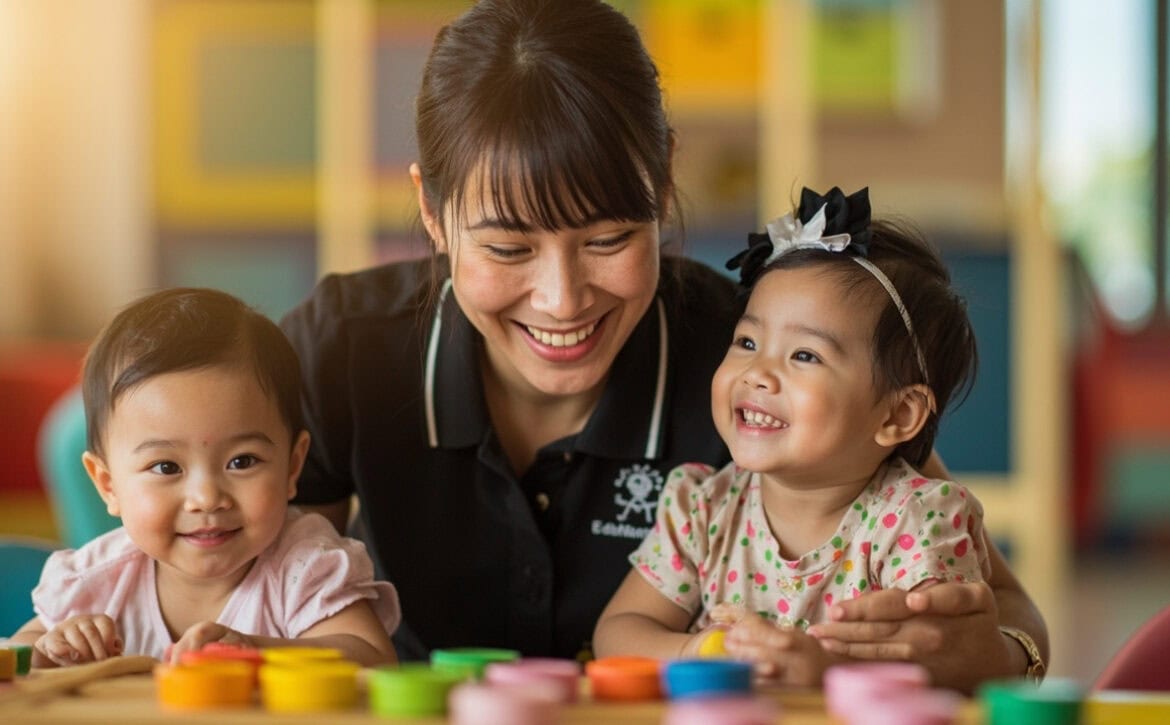
In quality childcare — one that understands how children actually grow, not just how they are kept safe — your children are beginning to build the relationship that will outlast almost every other in their lives. They are becoming each other’s first peer teachers.

Consider what siblings learn from each other that no parent can replicate:

  • Patience — because the other child does not operate on your schedule
  • Negotiation — because your daughter wants the red block and your son wants the same red block, and someone has to figure out why that block matters so much to both of them
  • Emotional granularity — because your three-year-old is learning to read your five-year-old’s face, to know the difference between frustrated and genuinely hurt, in a way that is more nuanced than anything you could explicitly instruct

Empathy is not a lesson. It is a living experiment that siblings conduct on each other, every single day.


The Sibling Peer Group: A Developmental Architecture

Developmental psychologists have a name for what your children are building in quality care: the sibling peer group. And it is one of the most powerful social architectures a child will ever belong to.

Here is how it works. When siblings are in an environment with thoughtfully grouped activities, shared rituals, and mixed-age interactions, they are not simply coexisting. They are constructing each other.

The older child becomes the one who shows the younger how things work — and in showing, learns too. The younger child becomes the one who reminds the older that wonder is not childish. It is essential.

Quality childcare does something that changes everything: it creates the conditions for that experiment to flourish. The educators understand that the dynamic between your children is as important as the development of each child individually.

There is something else worth naming. Sibling conflict in quality care settings is not a problem to be eliminated. It is a developmental opportunity.

When trained caregivers understand how to let siblings navigate disagreement with support rather than intervention, children learn something invaluable:

  • They learn that conflict is survivable
  • They learn that relationships can bend without breaking
  • They learn that they have the capacity to repair

These are not small lessons. These are the foundations of every meaningful relationship they will ever have.


Giving Your Whole Family Room to Breathe

Let me address something directly, because if you are a parent with multiple children, you have probably been carrying this guilt quietly for a long time. The guilt of divided attention. The fear that you are not enough for both of them, or all of them. The worry that siblings in care are somehow missing each other rather than growing together.

Here is a different way to see this.

Quality childcare does not fragment your attention across your children. It gives your whole family more room to breathe.

When your children are in an environment designed to support not just one child but the sibling constellation, something shifts. The pressure on you lightens. The children come home not depleted by competition for your attention, but enriched by what they have given and received from each other.

The evening feels different. The weekend feels different. You are not arriving home as a referee. You are arriving as a parent with something left to give, because the system was designed to sustain you too.


What Whole-Family Childcare Actually Looks Like

In Singapore, where coordinating multiple children’s schedules can feel like a second job, the practical reality of childcare matters enormously. Parents navigating multiple children’s activities, developmental stages, and emotional needs need more than a list of safety protocols. They need a system that understands the rhythms of a multi-child household.

Quality home-based care looks different from centre-based care in ways that matter for siblings specifically:

  • Consistent relationships — The same caregiver sees your children across different moods, different days, and understands their dynamic as a whole
  • Flexible mixed-age interaction — Siblings move between parallel play and collaborative play naturally, without the rigid grouping of larger centres
  • Home environment rhythms — The pace feels more like a family than an institution, which supports sibling bonds that thrive in less structured settings
  • Smaller ratios — Genuine attention becomes possible when caregiver-to-child ratios allow it

When childcare manages the sibling dynamic well, what you gain is not just time. You gain your family back. You regain the capacity to be present in the evenings, to actually enjoy your children rather than simply managing them.


Your Children Are Building Each Other

Here is what I want you to take away: the sibling bond is not just a byproduct of quality childcare. It is a return on the investment you are making.

When your children grow up with each other as teachers, as challengers, as confidants, as the first people they call when something goes right or something goes wrong — that bond is something you helped build by choosing an environment where it could develop. It is a legacy that extends far beyond the years of childcare itself.

You chose to have more than one child, or circumstances brought more than one child into your care, and somewhere along the way you realized that loving them individually did not mean you could automatically love them equally, or be present for them equally, or give each one the version of you that they needed in the exact moment they needed it.

That is not a failure. That is the human condition, and it has always been true, long before modern childcare existed.

What has changed — what quality childcare makes possible — is that you no longer have to navigate this alone.

You no longer have to wonder if your children are simply waiting for you, or whether they are building something together that you could never build for them. You no longer have to carry the weight of divided attention as if it were a personal shortcoming, when in fact it is a challenge that quality childcare was designed to address.

Your children are not missing you while they are in good care. They are becoming the people they are meant to be together.

And you — by making the choice to place them in an environment that understands the sibling relationship as a gift rather than a complication — are giving them the greatest possible preparation for the life they will share long after these years are over.

This is what whole-family childcare looks like. This is what it gives back to parents, to siblings, to the entire household system.


Choosing the Right Care: Questions Worth Asking

If you are currently researching options for your children in Singapore, here are the questions worth asking:

  1. How does this programme understand sibling dynamics? Look for answers that go beyond logistics. The best programmes see sibling relationships as part of the curriculum, not a scheduling detail.
  2. What does mixed-age interaction look like? Are siblings grouped intentionally? Are there shared rituals, collaborative activities, or times when they move freely between age-appropriate and mixed-age engagement?
  3. How is conflict handled? You want caregivers who support rather than simply intervene. Siblings need room to navigate disagreement — that is where the learning happens.
  4. What does communication look like? You should know how your children’s days actually unfold, including moments that involve their sibling dynamic.
  5. Does this programme understand your family’s rhythm? Multi-child households have a specific cadence. Your childcare should fit your life, not demand that your life fit it.

Will my children miss me too much?

Quality childcare does not replace you. It supplements your family system in ways that strengthen rather than diminish your bond with your children. When children come home from a day well-spent with peers and capable caregivers, they are often more available for connection, not less.

How do I know if childcare actually supports sibling relationships?

Ask specific questions: How are mixed-age activities structured? What happens when siblings disagree? How do caregivers observe and support the dynamic between my children? If a programme cannot answer these questions with intention and clarity, it may be treating sibling care as logistics rather than development.

Is home-based care better for siblings than centre-based care?

Both can work well. Home-based care often offers advantages in consistency, flexibility, and the intimate scale that allows sibling dynamics to be known and supported. But the quality of the specific programme matters more than the model. What matters is whether the caregivers understand sibling relationships as a developmental asset, not a complication to manage.

What about my guilt around divided attention?

The guilt you carry is understandable, but it is based on a false premise: that you should be able to do alone what a well-designed system does together. You are not dividing yourself too thin. You are one person meeting a family-sized challenge. Quality childcare does not compete with your love for your children. It extends your capacity to show up as the parent you want to be.


Finding the Right Fit for Your Family

EduNanny operates within the ECDA Childminding Pilot framework, which means their approach takes the whole family system seriously — not as a marketing phrase, but as a genuine commitment to how children grow.

When you choose home-based care through EduNanny, you are choosing an environment where your children’s sibling relationship is not a backdrop but a developmental asset. Where mixed-age interaction is intentionally facilitated. Where the rhythms of a multi-child household are understood as something to support, not simply manage.

Their structure — with thoughtful attention to ratios that allow genuine care, with communication that lets you understand what your children’s days actually look like — is built around the reality of family life in Singapore.

If you are ready to explore what whole-family childcare can look like for your family, EduNanny welcomes the conversation at their contacts page, or learn more about their approach on the about EduNanny page.


edunanny-061cdf29c4e259a48fc62f678614e92a
April 2, 2026

The Biology of Belonging: What Quality Childcare Means for Your Baby’s Brain

The Sensory World and Biology of Separation

When a child enters a new childcare environment for the first time, they encounter something their nervous system experiences as genuinely seismic. There is no framework yet for this. No language for “I will come back.” No concept of afternoon pickup. There is only the immediate, overwhelming reality of a room full of unfamiliar sensory information.

The light falls differently here. The air carries different smells — the cleaning agent on the floor, the faint milk-sweetness of other children, the particular warmth of bodies in a space that has been occupied for hours. The sounds are unfamiliar: other children, a different adult voice, the echo of the room against walls that have not yet learned the rhythms of this specific child’s ears.

Every sense is being taxed. Every nerve ending reports in from the frontier of an unknown world.

And then there is you — gone. In your place: a caregiver the child has never met, holding out a hand or offering a smile, or simply waiting with a patience that is not yet trusted.

The Caregiver as Biological Regulator

What happens next in that small body is physiological. Heart rate spikes. Stress hormones flood the bloodstream. The child does not yet have the cognitive development to reason through this. They only know: the familiar person has left. The world is new. Something must be done.

And so they cry.

That cry is not simply an expression of sadness. It is a biological imperative. It is a child’s entire communication system saying: this is an emergency, and I need someone to help me.

This is where the difference between quality care and mere supervision becomes not a philosophical distinction but a biological one.

A caregiver who understands child development — who has been trained not just to watch but to read — does not rush to silence the cry. They do not force a child to be calm before the nervous system has been given a reason to believe that calm is possible. They stay. They modulate their voice to a frequency that research has shown actually lowers cortisol in an infant’s body. They move slowly, predictably, so that nothing about their presence adds to the sensory overload. They become, in that moment, a biological regulator for a nervous system that has lost its anchor.

When the caregiver breathes deeply, the child’s body begins to remember that it can breathe too. When the caregiver’s voice carries the right warmth and tempo, the child’s heartbeat begins to slow.

The room, when thoughtfully designed, supports this. Light warm enough to not add to the sensory load. Floors with enough give that a child learning to walk does not bruise their shins on every fall. Background sound that is present but not chaotic — the gentle hum of a space that feels inhabited rather than empty. These are not cosmetic details. They are the texture of a child’s sensory world, and they either drain a developing nervous system or sustain it.


Curiosity, Routine, and the Foundation of Security

Slowly — and it should be slow — the child’s body begins to register that the alarm has not been followed by the predicted catastrophe. Nothing terrible has happened. The new adult has not left. The room has not become hostile. The crying, which began as a full-body emergency broadcast, begins to quiet into something more manageable: a whimper, a shuddering breath, and then, finally, a pause.

In that pause, something shifts. The child’s eyes, which were squeezed shut or staring in a fixed, overwhelmed way, begin to move. They start to look around. Not randomly — with intention. They are mapping this room. They are building, neuron by neuron, a picture of where they are and what is in it.

Curiosity is not the opposite of fear. It grows out of fear that has been survived. When a child’s nervous system has been helped through the initial alarm and has found, against expectations, that the world did not end — then a new capacity opens. The capacity to notice: there is a shelf with objects on it. There is a window where light moves in a particular way. There is a sound from the next room that happens at certain times and seems to mean something.

As the days accumulate — because quality care means consistency — that map becomes a territory. The room stops being an unknown and starts being a known.

This is how routine becomes not a cage but a form of liberation for a young child’s nervous system. When lunch always comes after the same song, when nap time always involves the same dimming of lights and the same soft voices, the child begins to develop the capacity for anticipation. They begin to know, before it happens, what comes next.

And this knowing is not boring to them. It is a relief. It is the feeling of a world that is not random, not chaotic, not threatening. It is the feeling of being able to predict your own experience — and that early, pre-linguistic sense that the world is knowable is the foundation upon which so much later security is built.


Supervision, Presence, and the Social World

Routine alone is not enough. A child needs the room to be predictable. But within that predictability, they also need to be seen as an individual. They need someone who notices which objects catch their particular attention, which sounds make them flinch, which textures they return to again and again, which children they prefer to be near, and which moments of the day their body seems to need extra support.

This is the distinction between supervision and presence. A supervisor watches. A present caregiver watches and responds — to the specific child in front of them, in this specific moment, with this specific need.

When that responsiveness is consistent, day after day, something extraordinary happens. The child begins to build a relationship with their caregiver that is not a replacement for family attachment but is its own genuine bond. The caregiver becomes a figure of safety, not because they look like a parent but because they have proven, through hundreds of small responsive interactions, that they can be trusted to know what this child needs and to meet it.

This relationship is the soil in which language grows. It is not simply because the caregiver teaches words — though they do. It is because when a child knows that they are understood, they become motivated to try to be more precisely understood.

A gesture leads to a sound. A sound leads to a word. A word leads to the experience of someone responding to it with the right object, the right response, the right acknowledgment. And so begins the long, lifelong process of learning that one’s inner world can be communicated, and that other people can be receivers of that communication.

Learning From Peers

The peers in the room are part of this relational world too. In the first months, it is mostly parallel — children near each other, aware of each other, but not yet engaged in the complex social choreography of shared play.

But even in parallel, something is happening. The child is learning what other children feel like nearby. They are learning that other small people have sounds and rhythms and moods that are different from their own. They are building, in the most primitive way, the understanding that they are not the only consciousness in the room.

When they are a little older, the first forays into social engagement begin. These are clumsy, egocentric, entirely age-appropriate attempts to connect: a child reaches for another’s toy, a child follows another child to where they are going, a child cries because another child came too close.

These are not failures of social skill. They are the first drafts of social skill. A caregiver who understands this holds the emotional safety of the space so that these attempts can happen and can be survived. They help children learn that other people can be both exciting and overwhelming, both interesting and frustrating, and that all of these feelings are part of being human.


The Quiet That Matters

Throughout the day, there are moments of overwhelm that are not dramatic — they do not look like a meltdown from the outside — but are significant in the life of the nervous system. A sudden noise. A child who comes too close. A change in routine, however small. A new face at the door.

Each of these moments triggers a micro-stress response in the child’s body. Cortisol is released. Heart rate rises. The alarm system activates, even if only briefly.

In a high-quality environment, the caregiver notices the child who has just flinched. They move to help, not by removing the child from the situation but by offering presence — a voice, a hand on the back, a calm acknowledgment of what just happened. They help the child’s nervous system learn that it can experience a small stress and return to baseline. That disruption does not mean danger. That overwhelm is not the end of safety.

But there is also a part of the childcare day that is rarely described and almost never photographed: the quiet part. The late afternoon, when the noise has softened and the energy of the room has settled into something gentler, when a child sits or crawls or stands at a window and does — nothing. Just looks. Just breathes. Just exists in a body that has been processing so much all day long.

This quiet is not a gap in the program. It is not the child being under-stimulated or bored. It is the child processing. It is the brain doing the slow, invisible work of integrating everything that has happened — the new faces, the new sounds, the new expectations, the moments of connection, the moments of stress, the triumphant achievement of standing alone, and the small disappointment of a toy that was taken away.

When a child is given space to be quiet, they are given something precious: the gift of their own inner life. They are allowed to be with themselves, to notice what is inside them, to develop the capacity to be alone in a way that is restorative rather than frightening.

This is where imagination begins. This is where a child stares at the wall and is, in fact, constructing an internal world that will later become the foundation for creativity, for reflection, for the ability to be with oneself in a meaningful way.

A room that allows for quiet is a room that respects the child as an interior being. And this respect — this recognition that the child has an inner world that matters — is one of the clearest marks of quality.


What the Reunion Tells You

And then, the day ends. You come back.

There is a reunion that happens at pickup that is more revealing than any daily report you will ever receive. Watch it. Really watch it. Not through the lens of your own relief — though that relief is real and valid — but through the lens of your child’s behavior.

Watch how they respond to your arrival. Do they run to you with the particular face they save only for you? Do they point to something in the room, wanting to share it, to tell you about this world they have been living in while you were gone? Do they seem settled in their body, regulated, comfortable in the space they are leaving?

Or do they seem desperate, clingy, rigid — showing you in their behavior that the hours apart were not a neutral experience but a difficult one?

The quality of care your child receives is written in that reunion. Not in what the caregiver tells you, but in what your child shows you with their body, their eyes, their readiness — or reluctance — to engage with the world they have come home from.

The Evening Transition

And then there is the drive home, or the walk home, or the time in the evening when you notice your child is not quite themselves. They are more demanding than usual, or more withdrawn. They need to be held in a particular way, or they push you away. They are exhausted in a way that goes beyond physical tiredness. They are depleted.

This depletion is the residue of a full day’s worth of inner experience. It is the price of learning to be in a world that is not home. And it is, in most cases, completely normal — children who have had a full day of processing, regulating, engaging, and growing will come home tired.

But it is also a window into the demands that were placed on your child during those hours. A child who is not just physically tired but emotionally ragged after every day in childcare is a child whose nervous system is being asked to work too hard without enough support.

A child who is tired but intact — tired but still themselves, still curious, still connected — is a child who has been in an environment that was manageable, that gave them enough regulation to survive the day without spending themselves down to the wire.

The transition home tells you something. Pay attention to it.


Why Choosing Care Is a Developmental Decision

What I have been describing is not a day in childcare. It is a day in the life of a child’s nervous system, relational world, and emerging sense of self.

The child who enters a high-quality childcare environment learns, over weeks and months, that the world has structure. That their needs will be noticed. That other people can be trusted to help them when they are overwhelmed. That other children are both individuals and companions. That being in a new place is frightening but survivable. That the familiar people — the ones they love most — will always, always come back.

The child who enters an environment where there are too many children for one adult to notice them all, where the pace is too fast for nervous systems to keep up, where there is no time for quiet, where stress is a constant rather than an exception — that child is also learning. But what they are learning is different.

They are learning that the world is loud and fast and indifferent to their needs. They are learning to manage alone, because alone is the only reliable state. They are learning that overwhelm is permanent, not temporary.

Both are real possibilities. Both are shaping a child. The question is which one you want for yours.

Questions to Ask When Choosing Infant Care

  • What is the caregiver-to-infant ratio? Fewer infants per caregiver means more attention, more regulation, more noticing of your child’s specific needs.
  • How consistent is the caregiver assignment? Will your child see the same face every day, or rotate between different people?
  • What does a typical day look like? Is there time built in for quiet, for processing, for the slow moments that a developing nervous system needs?
  • How do caregivers respond to a crying or overwhelmed child? Listen for language that reflects understanding of co-regulation — presence, modulation, patience — not just distraction or dismissal.
  • What training have the caregivers received? Look for training in child development, not just childcare certifications.
  • What does the reunion look like when you observe pickup? Do the children seem settled? Regulated? Connected to the adults in the room?
  • What communication can you expect? Is there transparency about your child’s day, and is the communication two-way?

What EduNanny Was Built For

EduNanny by BUTLER is a childminding service that was built with this understanding at its center. We are part of the ECDA Childminding Pilot, which means our service operates within a framework designed to make quality childminding accessible to families across Singapore. We offer pathways that include both home-based and community or centre-based environments, because families are different and the right setting depends on what a particular child and family need.

Our infant ratios are designed to allow for genuine presence — never more than three infants to one caregiver in our pilot model — because a caregiver who is truly present for a child is not the same as a caregiver who is managing a room. When we speak about what EduNanny offers, we are speaking about the conditions in which a child can develop the internal architecture of security, curiosity, and emotional regulation that will carry them through their entire life.

Training That Goes Beyond Supervision

Our caregivers are trained in understanding child development — in recognizing the cues that indicate a child is overwhelmed or curious or in need of connection, in the art of co-regulation. They are supported by systems that allow for clear communication with families, including transparency measures such as CCTV where deployed, and by structures that allow caregivers to focus on the children in their care rather than administrative burdens.

Accessibility Without Compromise

We are committed to making quality care accessible. Our pilot fee structures are designed with affordability in mind, and families in our program can use CDA and Baby Bonus where applicable, so that financial pressure does not force families into environments that do not serve their children’s development.

Consistency as the Foundation

Monday through Friday, in consistent care blocks, your child comes to know the rhythm of a place and the faces in it. The caregiver who holds your infant on Monday is the same caregiver on Wednesday, on Friday, on the following week. Consistency is not an accident in our model. It is the condition that makes everything else possible.


The Hours That Matter Most

Here is what I want you to take away.

The hours your child spends in childcare are not hours subtracted from their childhood. They are hours that are part of their childhood — hours in which something is being built, neuron by neuron, synapse by synapse, experience by experience, inside the only brain your child will ever have.

When you choose an environment where a caregiver notices your child, truly notices them, and responds to what they see — when the room is designed to support a developing nervous system rather than challenge it — you are not outsourcing care. You are investing in your child’s developmental architecture.

EduNanny by BUTLER was built on this understanding. We believe that the unseen hours matter as much as the seen ones. We believe that what a child feels when you are not in the room is as important as what you feel when you are. And we believe that every child deserves to be in an environment where their inner life — their fear and their curiosity and their need for connection and their capacity for wonder — is not just tolerated but understood.

You have trusted us with the hours you cannot see. That trust is not lost on us. It is the reason we build what we build, train who we train, and show up every morning to do what we do.

Because the life your child lives when you are not in the room — the sensory world, the emotional world, the relational world, the quiet processing world, the world of learning to feel safe in new places — that life is not separate from who they are becoming.

It is who they are becoming.

And that is why what happens in our care matters.


If you would like to explore whether EduNanny by BUTLER is the right fit for your family, we welcome you to reach out. We offer consultations where you can ask questions, observe our caregivers in action where possible, and understand how our approach translates into your child’s everyday experience.

Because you deserve to know what happens in the hours you cannot see. And your child deserves to be seen in those hours by people who understand what they are experiencing.

Learn more about EduNanny by BUTLER · About our approach

edunanny-061cdb6f8e946e8a224024acdd233ed8
April 2, 2026

What Singapore Parents Can Actually See When Their Child Is Thriving

The Quiet Question Every Singapore Parent Asks About Their Childcare Choice

There is a particular kind of quiet worry that settles into parents after they have made their childcare decision. It does not announce itself dramatically. It arrives in the small hours, in the moments between dropping your child at their care arrangement and the time you will pick them up again. It asks a question you cannot answer with certainty: Is this actually working? Did I choose well? Is my child genuinely thriving, or simply surviving?

If you are a parent in Singapore navigating the early years of your child’s life, you are operating in a landscape of extraordinary pressure and extraordinary love. The stakes feel impossibly high. Every interaction in these first months and years carries the weight of what it might mean for your child’s future. And yet, the signals that would tell you whether your childcare arrangement is genuinely serving your child remain frustratingly out of reach.

You receive photographs. You hear summaries. You trust the updates you are given. But something in you still wonders: Can I see for myself? Can I know?

You are not alone in this. And the answer is yes—you can know. You simply need the framework to recognize what quality actually looks like when it is taking root.


A Developmental Timeline: What Quality Looks Like From 6 Weeks to 1 Year

For too long, parents have been asked to evaluate quality childcare the way you might evaluate a restaurant by its exterior. You can see the cleanliness, the staffing levels, perhaps the equipment. But the thing that actually matters—the developmental vitality of your child, the invisible architecture of security and growth being built day by day—remains hidden from view.

We tell parents to trust their instincts, to observe their child, to look for signs of happiness. But we rarely give them the framework to interpret what they are seeing. Quality childcare produces observable, recognizable, predictable results across developmental time. When you know what to look for, you become something powerful: an informed observer of your own child’s growth.

At 6 Weeks: The Foundations of Calm

At six weeks, your child is still operating primarily in the realm of pure biological need. They are adjusting to life outside the womb. Sleep is fragmented, hunger is frequent, and their world is organized almost entirely around comfort and survival.

If you are evaluating quality at this stage, the signs are subtle but real. You will not see advanced social engagement. You will not see language. What you will see, if quality is present, is something foundational: the beginning of calm alertness. A baby who, when held and supported by consistent, attuned caregivers, begins to spend short stretches of time simply looking at the world. Not distressed. Not overwhelmed. Present.

In those early weeks, a baby’s nervous system is learning what safety feels like. Every responsive interaction, every gentle feeding rhythm, every moment where their need is met with consistent presence—this is not just caregiving. This is the first draft of your child’s inner architecture for trust.

What to look for at 6 weeks:

  • Emergence of quiet alertness—short periods where your baby is calm and engaged
  • Predictable settling patterns that skilled caregivers can read and respond to
  • Caregiver confidence—handling with informed gentleness, reading cues fluidly

At 3 Months: The Emergence of Reciprocity

Three months is a developmental threshold. It is the point where the newborn period begins to recede and something more interactive emerges. Your baby is developing visual tracking, beginning to follow faces and objects with intention. They are starting to coo, to produce those early vocalizations that are the precursors of language. Social smiling—genuine, responsive smiling in interaction with others—typically emerges around this time.

At three months, quality childcare reveals itself in what we call the emerging reciprocity. You are beginning to see a baby who is not just being cared for but is beginning to participate in their own care. They watch their caregiver’s face with concentration. They vocalize and then pause, waiting to see if a response will come. They are learning, in these small moments, that their actions have effect. That the world responds to them.

This is the earliest foundation of what will become confident social engagement, secure attachment, and ultimately, the belief that they matter—that their voice and presence are worth attending to.

What to look for at 3 months:

  • Reciprocal social smiling—not just spontaneous smiles, but smiles in response to interaction
  • Focused attention during care—concentrated engagement with their caregiver’s face and voice
  • Recognition of caregiver—visible preference and attention directed toward familiar care figures

By three months, you should be able to have a conversation about your child that goes beyond logistics. A quality caregiver will notice things and tell you about them—not in the formulaic language of a report card, but in the specific, observational way of someone who has spent real time with your child. They will tell you about the moment your baby laughed for the first time, or the way they prefer to be held, or the particular sound that calms them. This specificity is not incidental. It is evidence that your child is being seen as an individual.

At 6 Months: Confident Exploration from a Secure Base

Six months is where the developmental arc becomes more visible, and where the difference between surface-level happiness and deeper secure thriving begins to become legible.

By six months, your child has typically reached several milestones: sitting with support, reaching for and grasping objects, babbling with increasing variety, showing clear preference for familiar faces, and beginning to demonstrate the early seeds of stranger wariness—a healthy developmental stage that signals attachment security.

Quality childcare at six months is no longer just about responsive physical care. It is about the environment supporting your child’s expanding curiosity and emerging independence.

What to look for at 6 months:

  • Secure base behavior—exploration punctuated by confident check-ins with familiar caregivers
  • Stranger wariness—healthy caution around unfamiliar adults, signaling strong attachment
  • Growing caregiver trust—how they respond when handed to their caregiver in the morning, whether they settle into routines with predictability
  • Supported independence—the caregiver gives space for your baby to practice new skills while remaining nearby and responsive

The separation process, handled well, is not a sign that something is wrong. It is a sign that your child has formed a real attachment—and that they trust their caregivers enough to express their preference for you openly. When your six-month-old cries briefly at goodbye but is soothed quickly by their caregiver, that is evidence of a secure bond, not poor care.

At 1 Year: The Full Picture of Quality

One year. By now, your child has traveled an extraordinary distance from that six-week-old who was just learning to exist outside the womb. They are likely pulling to stand, beginning to cruise along furniture, perhaps taking their first independent steps. They understand simple words and commands. They point, they wave, they engage in joint attention—looking at something and then looking at you to share the experience. They are developing a sense of humor, showing preferences, expressing affection openly.

The one-year mark is where everything comes together in a way that is visible even to the untrained eye. By one year, you have enough data. You have twelve months of observation, twelve months of developmental change, twelve months of evidence about whether the childcare you chose is genuinely serving your child.

What to look for at 1 year:

  • Behavioral resilience—quick recovery from minor frustrations and upsets
  • Emotional regulation—ability to be soothed by caregivers and return to engagement
  • Peer engagement—first genuine interest in other children, shared laughs, offered toys
  • Warm caregiver bond—clear, positive attachment to at least one primary caregiver
  • Language and social cues—pointing, waving, responding to simple commands, joint attention

At one year, quality childcare reveals itself in behavioral resilience. Your child has encountered minor frustrations. They have had disagreements over toys, experienced the normal disappointments of shared attention, navigated the social complexity of being with other children and adults. What you are looking for is not the absence of these moments, but what happens after them. Can they be soothed by their caregiver? Do they return to play and engagement without lingering distress? This capacity for emotional recovery is one of the clearest indicators of secure attachment you will ever observe.

By one year, your child should have a clear, positive bond with at least one primary caregiver in their care arrangement. They should show pleasure at seeing this person, seek them out for comfort, and demonstrate confidence in their presence. This is not a replacement for your bond with your child. It is an extension of it—a sign that your child has been surrounded by adults capable of forming secure, nurturing relationships.


How to Evaluate Quality: A Practical Framework

Understanding the developmental timeline is one thing. Applying it to your own child is another. Here is a practical framework for recognizing quality—whether you are selecting a childcare arrangement for the first time or evaluating your current choice.

  1. Observe the calm, not just the activity. Quality care produces settled, engaged babies—not just busy ones. Look for periods of quiet alertness, not just stimulation.
  2. Watch for reciprocity. Your baby should be learning that their actions have effect—that the world responds to them. Look for social smiling, focused attention, vocalization and pause.
  3. Notice the secure base. At six months and beyond, your child should be able to explore and then return to their caregiver—not for rescue, but for connection.
  4. Ask for specificity. A quality caregiver will tell you specific things about your child: their preferences, their emerging quirks, the moments that mattered that day. Generic summaries are a red flag.
  5. Track the trajectory over time. Single observations are less meaningful than patterns. Look at what is happening across weeks and months, not just in any single pickup moment.
  6. Trust your read of the caregiver-child relationship. You know your child. If something feels warm and genuine, trust it. If something feels off, investigate.

Questions to Ask About Your Current Arrangement

  • Can I observe calm alertness in my baby after care sessions, not just agitation?
  • Does my caregiver know specific things about my child—their preferences, their rhythms, their emerging personality?
  • Does my child show signs of secure base behavior—exploration punctuated by confident check-ins?
  • Do I receive specific, observational updates rather than formulaic reports?
  • Does my child show warmth toward their caregiver alongside their attachment to me?
  • Do I see evidence of emotional resilience—quick recovery from minor upsets?

If the answer to these questions is yes, the evidence is there. You can trust it.


What Quality Childminding Actually Looks Like in Practice

For parents in Singapore evaluating their options, it helps to move from theory to practice. What does quality look like on a typical day, in a real care arrangement?

Quality childminding begins with ratios that allow for genuine attunement. When one caregiver is responsible for too many infants, responsive care becomes impossible. The child’s cries go unheard. The subtle cues that signal hunger or discomfort are missed. The individual attention that builds trust becomes a transaction rather than a relationship.

Quality also means consistency. Developing brains need predictable rhythms. Children thrive when they know what comes next—when the morning greeting is familiar, when nap routines are reliable, when the same trusted faces are present day after day. This does not mean rigidity. It means a care arrangement that prioritizes stability as a foundation for growth.

And quality means communication—not just reports, but genuine partnership. You should feel comfortable asking questions. You should receive specific observations about your child, not generic summaries. You should be able to see evidence of your child’s day through documentation, conversation, and the visible signs of a child who is thriving.

The childminder is not just a service provider. She is a developmental partner in your child’s life—part of the architecture being built in those early years. She teaches your child what the world is like, how adults treat children, whether people can be trusted, whether exploration is safe, whether their needs matter.


Addressing the Concerns Singapore Parents Actually Have

“How do I know if my child is actually thriving, or just appearing to be okay?”

Look for the trajectory across time, not any single moment. A child who is genuinely thriving will show the developmental patterns we have described: calm alertness at six weeks, reciprocal engagement at three months, confident exploration at six months, behavioral resilience at one year. Surface happiness is nice, but it is not enough. What you want to see is the pattern—the consistent evidence that your child’s nervous system is learning safety, that their social capacities are emerging on schedule, that they have genuine bonds with their caregivers.

“What if I chose the wrong arrangement?”

Choosing childcare is not a one-time decision you make and then live with forever. It is an ongoing relationship that you can evaluate continuously using the framework we have described. If you are not seeing the developmental markers of quality at each stage, that is information. It may mean adjustments are needed, or it may mean a different arrangement is right for your family. But you will never know unless you have the map to read the evidence.

“I’m worried about the cost versus the peace of mind”

Quality care is an investment in your child’s developmental architecture. The first year of life is not a period you can redo. The bonds formed, the security established, the neural pathways laid down—these matter enormously. We believe quality should not be a privilege reserved for families with unlimited budgets. Our fee structures have been designed with accessibility in mind, and our CDA and Baby Bonus fund arrangements are structured to be usable, because financial logistics should not force families into arrangements that do not serve their children’s developmental needs.

“What if my child seems fine but I’m still anxious?”

Anxiety about your child’s care is not a sign that something is wrong. It is a sign that you care deeply about getting this right. But if your child is showing the developmental markers of quality at each stage—if you are seeing calm, reciprocity, confident exploration, emotional resilience—then the evidence is there. Your anxiety may be looking for a problem that does not exist. The tools for answering your questions now exist. You have the map. Use it to give yourself permission to trust what you are seeing.


Where Quality Care Meets Developmental Science

At EduNanny, we have built our approach around what developmental science tells us about how infants thrive. This is not an accident. It is a design choice made in recognition of the fact that quality care is not a marketing claim—it is a visible, measurable reality that emerges over time.

Our approach begins with ratios that allow for genuine attunement. With up to one to three infants in our care during the pilot program, our caregivers have the space to observe, to respond, to truly know each child in their care. This is the foundation on which all other quality rests.

We are part of the ECDA Childminding Pilot, operating across both home-based and community pathways. This means our model is grounded in Singapore’s regulatory framework and designed to meet the real needs of Singapore families. Our Monday to Friday care blocks provide the consistency that developing brains need.

For families using CDA or Baby Bonus funds, these arrangements are designed to be usable, because we believe the financial logistics of childcare should not add to the emotional burden of parenting.

Our arrangements incorporate communication and observation measures that allow you to stay connected to your child’s day. We want you to be an informed observer—able to recognize what is working, to celebrate the milestones, to see the quality that is actually there.

When you place your child in quality care, you are not outsourcing parenting. You are expanding the circle of people who love and nurture your child. You are giving them additional experiences of security, of engagement, of developmental challenge and support. And you are giving yourself the gift of knowing that your child is in an environment designed around who they actually are—not just where they can be kept safe, but where they can truly grow.


Your Child’s Development Is Not a Mystery. It Is a Story—and You Are Learning to Read It.

You are not alone in this journey. You are not supposed to navigate the first year of your child’s life in isolation, guessing at every turn, wondering if you have made the right choices.

There are frameworks to guide you. There are people designed to walk alongside you. There is a map, and now you have it.

Watch the calm emerge at six weeks. Watch the reciprocity bloom at three months. Watch the confident exploration at six months. Watch the resilience and warmth at one year. And when you see these things, let yourself believe them.

The story of your child’s development, when you know what to look for, is beautiful. It tells you that you are doing this right. It tells you that your child is thriving. It tells you that the choice you made was not just a choice about logistics, but a choice about the kind of environment in which your child’s future is being quietly, lovingly built.

That is worth trusting. That is worth observing. And that is worth celebrating.

If you are looking for a childcare arrangement in Singapore where your child is not just supervised but truly known—where the ratios allow for genuine attunement, where communication helps you see quality for yourself—we welcome you to learn more about EduNanny.

Your child’s development is not a mystery. It is a story. And now, you are equipped to read it.


EduNanny is a Singapore-based childminding and childcare service built on trust, developmental value, and thoughtful care. Learn more about our approach or connect with our team to explore whether EduNanny is right for your family.

edunanny-061cd7e5603004f617e8e8e93a5e3178
April 2, 2026

How Quality Childcare Grows With Your Child Through Every Stage

You Chose Well — For the Child You Had Then

When you enrolled your child in care, you made a decision based on who they were at that moment. A six-month-old with specific sleep needs. A ten-month-old discovering how to grasp and reach. A one-year-old beginning to babble with intention.

You chose for that child, in that season, and that choice reflected love, thoughtfulness, and the best information you had at the time.

Here is what the childcare conversation rarely acknowledges: that child was always going to become someone different. The decision you made at enrolment was never meant to be the final answer. It was the beginning of a relationship — between your family and your childcare environment — that must evolve as your child evolves.

At EduNanny Singapore, this understanding shapes how we approach every engagement with families. Whether through our home-based pathway, community pathway, or centre-based options within the ECDA Childminding Pilot, we did not design our service to be a fixed solution for a fixed moment in your child’s life. We designed it to be an environment that grows with your child.


What Quality Infant Care Actually Looks Like

In the earliest months of infant care, the work is foundational. It is about establishing rhythms that mirror the security of home.

  • Sleep cycles are mapped in coordination with family routines
  • Feeding schedules are aligned between the childcare environment and the home
  • Caregiver-to-infant ratios are maintained at levels that allow for genuine attentiveness

At EduNanny, we maintain ratios of up to one to three for infants. This is not simply a technical specification. It is the difference between a caregiver who can read the subtle cues of a baby’s fatigue or hunger, and one who is spread too thin to notice until distress has already arrived.

That attentiveness in the infant stage builds the trust that makes every transition that follows possible.


Developmental Transitions in Quality Childcare

Around eight or nine months, most infants undergo what developmental researchers describe as a cognitive leap. Suddenly, objects have permanence. Strangers are distinguished from caregivers. The world becomes categorically more interesting.

In childcare, this manifests as a child who no longer wants to simply be held and entertained. They want to explore. They want to choose. They want to do things for themselves — and they want to do them repeatedly, with focus and determination.

A childcare environment that does not recognise this shift will frustrate this child. They will cry more. They will resist. They will seem, to a stressed parent picking them up at the end of the day, like something is wrong.

Nothing is wrong. Your child is developing exactly as they should. The question is whether your childcare is developing with them.

Stage What Changes What Quality Care Looks Like
0–6 months Sleep cycles, feeding coordination, attachment building High caregiver ratios, synchronised routines with home, responsive feeding
6–9 months Cognitive leap, object permanence, stranger awareness Adapted environment for exploration, caregiver sensitivity to separation cues
9–12 months Mobility surge, independence assertion, focused play Safe exploration spaces, choice-giving within boundaries, caregiver as guide
12–18 months Social emergence, parallel play, language comprehension explosion Gradual peer introduction, patience for frustration, celebrating communication attempts
18–24 months Full toddler independence, emotional intensity, rapid language growth Negotiation frameworks, consistent boundaries, language-rich interactions

How Quality Caregivers Read and Respond to Transition

At EduNanny, our caregivers are trained to read these transitions not as disruptions but as data.

When a toddler begins to assert independence — refusing help, demanding to climb, gesturing with fierce intentionality — our team reads that as readiness, not defiance. We adapt the environment. We offer choices within safe boundaries. We introduce peer interaction gradually.

The social emergence that happens between twelve and eighteen months is one of the most delicate and consequential transitions a child makes. Solitary play begins to give way to parallel play. Language comprehension outpaces expression, and the frustration that creates is real and must be met with patience, not dismissal.

Our caregivers are present for all of this — not as supervisors, but as skilled guides who understand what each developmental stage requires.


Caregiver Continuity: Does the Relationship Survive the Transition?

You have built a relationship with your child’s caregiver. You trust them. Your child knows them. And now your child is changing in ways that feel significant — more emotional, more physical, more demanding.

Does this caregiver still know my child? Does the relationship survive the transition?

It does. It must. And the way EduNanny approaches caregiver development reflects this.

Our caregivers are not replaced when a child moves from one developmental stage to the next. They are trained to evolve with the child. The relationship deepens and reshapes itself.

What began as soothing an infant becomes negotiating with a toddler, encouraging a one-year-old’s first attempts at sharing, celebrating a child’s emerging language with genuine delight.

A caregiver who has been with your child through the infant stage carries context that no new caregiver could replicate. They know how your child communicates before language arrives. They know what soothes, what startles, what excites. That knowledge is the foundation on which every subsequent stage is built.


Signs Your Child Is Transitioning Well

What should you actually be looking for to know whether your child is transitioning well within their childcare environment?

Adaptation Rather Than Sameness

A child who is transitioning well will show some temporary resistance — a regression in sleep, a brief increase in separation anxiety, a few days of heightened emotional intensity — but within a few weeks, you should see adaptation.

They are finding new rhythms. They are engaging with new activities. They are beginning to look comfortable in the evolved environment. That is what healthy transition looks like.

Caregiver Responsiveness

When you ask your caregiver how your child’s day went, the answer should reflect observation — specific, grounded, attentive. Not scripted. Not generic.

Your caregiver should be able to tell you what your child enjoyed, what challenged them, how they interacted with peers. That specificity is evidence that your child is being truly seen.

Your Child’s Energy After Care

A child who is consistently depleted after a day in care — not occasionally tired, which is normal, but consistently drained, withdrawn, or distressed — may be struggling to keep pace with their environment.

A child who comes home tired but animated, curious, still eager to share what happened, is telling you something important. They are engaged. They are growing. They may be tired because they are working hard, and that is healthy work.

Your Own Peace of Mind

If that trust has been eroded not by a specific incident but by a vague, persistent unease, that is worth examining. A quality childcare provider will welcome your questions as part of the partnership, not interpret them as doubt.

If you feel distant from what is happening in care, something may not be working. Asking questions is not doubting — it is advocating.


When to Ask Harder Questions

There are moments when a childcare arrangement genuinely needs to change. Some transitions reveal mismatches that were always there, masked by a younger developmental stage.

  • A child who was content as a passive infant may reveal a need for more stimulation than a quiet home-based setting provides
  • A child who thrived in a centre’s structured environment may reveal a need for more individualised attention as they grow

These are not failures. They are information. And a quality childcare provider — one that truly has your child’s development at the centre — will tell you when they see the limits of what they can offer, rather than holding on to an enrollment that no longer serves your child.

EduNanny does not promise to be everything for every family at every stage. What we promise is that we will be honest about what we see, responsive to what your child needs, and committed to evolving our approach as your child evolves.

Transitions also happen within the rhythm of the week. They happen when a child who was happily napping at nine months suddenly decides at fourteen months that sleep is optional. They happen when a toddler who has always eaten contentedly begins asserting preferences with startling vehemence. They happen in the micro-moments of every single day.

A childcare environment that is truly built for growth must be present in all of them. Across EduNanny’s pathways, we maintain open communication with families — regular updates, structured sharing of observations, and where deployed, measures such as CCTV access that allow parents to witness their child’s day directly. Not because we need to prove anything, but because parents who can see what is happening worry less and connect more.

Within the ECDA Childminding Pilot framework, our fee structures are designed to be accessible, and families can utilise CDA and Baby Bonus funds to support care arrangements. Quality care should not require families to choose between their child’s development and their household’s stability.


Childcare That Grows With Your Child

EduNanny was built for this. Not as a slogan, not as an aspiration, but as a daily practice embedded in the way our caregivers are trained, the way our environments are structured, and the way we communicate with families across Singapore.

We know that the children who walk through our doors at six months will not be the same children at eighteen months. We know that the needs of a one-year-old are categorically different from the needs of a newborn, and that the needs of a two-year-old will surprise you even now.

We plan for that. We train for that. We show up for it every day.

Your child is not a problem to be solved. Your child is a person unfolding, and every transition — every nap schedule that falls apart, every new word that arrives, every moment your toddler looks at you with that fierce, independent determination — is evidence that the growth you hoped for is happening.

The right childcare does not resist that growth. It does not try to freeze your child in the moment you enrolled them. It leans into it. It adapts. It evolves.

And so should your confidence in the choice you made.

You chose EduNanny — or you are considering choosing EduNanny — not because it is a perfect, permanent arrangement. You chose it because it is an environment designed to grow with your family, to meet each new stage with the same attentiveness and care that you would bring yourself.

That is what the early years deserve. That is what your child deserves.

And that is what EduNanny by BUTLER is here to provide — not just at the beginning, but at every stage of the remarkable, unfolding journey of your child’s first years.


If you are navigating a transition in your child’s care, or if you are looking for an environment designed to grow with your family from infant care through toddlerhood, we welcome the conversation. Reach out to learn how EduNanny Singapore can walk this journey with you.

Learn more about EduNanny · About our approach · ECDA Childminding Pilot

edunanny-061cd444ba835205b59d0e1270580e01
April 2, 2026

Your Baby’s Senses Are Building Their Brain in Childcare

The Sensory Reality of Quality Childcare

Consider, for a moment, what your child actually experiences in a well-designed infant care space. It is not passive. It is not blank. Every sense is receiving, processing, building.

Light That Teaches

Light enters differently here. It is warm, not harsh. It shifts gently through the morning, mimicking the rhythm of natural daylight rather than the flat fluorescence of a generic office. A child’s developing visual system needs this kind of variability to learn how to focus, how to gauge distance, how to process contrast.

A room bathed in even, artificial light teaches a child almost nothing about light itself. A room with soft gradients and shadows teaches them everything.

Sound That Builds

Sound matters in ways we rarely consider. The human voice — not television, not recorded music, not the mechanical din of a screen left running in the corner — is the most important sound environment for an infant’s auditory and language development.

In a quality childcare setting, the soundscape is curated, not chaotic. There is conversation. There is singing. There is the sound of other children, which teaches social hearing — the ability to pick out a single voice in a crowd, to understand meaning beneath noise.

This is the architecture of an auditory environment designed to grow neural pathways for language acquisition, for listening comprehension, for the kind of attention that will matter enormously when your child sits in a classroom years from now.

Touch That Maps the World

Then there is touch — perhaps the most foundational of all senses for early development. A child’s skin is an enormous sensory organ, and through touch they learn about temperature, pressure, texture, pain, and comfort.

The materials in a quality infant care environment are chosen deliberately: rough and smooth, warm and cool, hard and soft. These textures are not decoration. They are input. They are teaching a child’s somatosensory cortex — the part of the brain that processes physical sensation — to build a map of the physical world.

Movement That Develops

Movement is education. The vestibular sense — housed in the inner ear — tells a child where their body is in space, whether they are still or moving, whether they are upright or lying down. This sense develops through rolling and tumbling, through rocking, through being carried, through the gentle acceleration and deceleration of a caregiver walking with a child.

It is the foundation of balance, of coordination, of the body’s sense of its own position. A childcare environment that gives children freedom to move — to crawl, to climb, to be held and rocked and carried — is giving them the raw material for proprioception: the sense of one’s own body in space.

Smell That Communicates Safety

Beneath all of this, there is smell. The human olfactory system is uniquely wired to emotion and memory, more so than any other sense. A child learns safety partly through smell — the familiar scent of a caregiver’s skin, the particular warmth of breast milk or formula, the clean but not antiseptic smell of a well-maintained space.

When a childcare environment is saturated with synthetic fragrances, with cleaning chemicals that overwhelm rather than cleanse, it is communicating something to a child’s developing nervous system. That communication is not neutral. It is a signal — of alertness, of stress, of a world that is not quite safe.


Why the Environment Is the Curriculum

The neuroscience here is not complicated, though it is profound. In the first thousand days of life, a child’s brain is building approximately one million new neural connections every second. The speed of this construction is extraordinary and unrepeatable.

What determines which connections form, which pathways strengthen, which circuits become efficient and which remain fragile? The environment. Specifically, the sensory environment.

Every sensation that a child experiences either strengthens a neural pathway or fails to. Every experience of being held, of hearing language, of touching varied textures, of moving through space, of smelling the world around them — each of these experiences is a vote, neurologically speaking, for the development of the circuits that process those sensations.

This is why neuroscientists speak of critical periods in early development: windows of time when certain capacities must be developed or they will not develop fully. The sensory environment is not just pleasant or stimulating. It is, quite literally, building the architecture of your child’s brain.

Supervision vs. Development

This is why the distinction between a childcare space that merely supervises and a childcare space that actively develops is so consequential.

A generic infant room may keep children safe, fed, and clean. It may have colorful posters on the walls and plastic toys on shelves. But if the light is flat, if the soundscape is random, if the textures are all smooth and sanitized, if children are kept in carriers and bouncers more than they are held and allowed to move freely — the environment is not teaching. It is warehousing.

A quality childcare environment understands that every element of the space is a teaching tool. The way furniture is arranged teaches spatial awareness. The way transitions happen — from activity to meal, from meal to sleep — teaches time and anticipation. The way caregivers speak to children teaches conversation, turn-taking, the musicality of language.

The room is not a container for learning. The room is learning.


Why This Matters More in Singapore

For parents in Singapore, this reality carries particular weight. Our city is extraordinary — clean, efficient, modern, safe. But it is also, by design, a controlled environment. Apartments are climate-controlled, soundproofed, often hermetically sealed from the natural world.

The air your child breathes indoors is filtered. The light is artificial. The sounds are mechanical. Outside, the streets are smooth, the parks are manicured, the sensory variety of the natural world is present but curated, managed, reduced.

This is not a criticism of Singapore. It is an observation about what urban living costs us in terms of sensory richness.

The Risk of Sensory Poverty

Children growing up in high-rise apartments, especially in the early years, can experience what developmental scientists sometimes call sensory poverty — not the poverty of deprivation, but the poverty of sameness, of uniformity, of a world that does not vary enough to fully stimulate the developing senses.

Quality childcare, when it is designed with developmental intelligence, can fill this gap. A good infant care space brings texture back into a child’s life — wooden toys alongside plastic, natural fabrics alongside synthetic. It brings varied sound — not the relentless white noise of air conditioning, but voices, music, the beautiful chaos of children at play. It brings the smell of food cooking, of clean cotton, of a space that is cared for.

When you choose a childcare environment for your child in Singapore, you are not just choosing a place to keep them safe while you work. You are choosing an environment that will, for thousands of hours in the first five years of their life, literally build their brain.


What Quality Actually Looks Like

So what should you look for? How can you know, as a parent, whether the environment your child spends their days in is serving their development or simply containing it?

There are signs, if you know where to look.

After Pickup: What to Observe

A calm but engaged child. A child who has spent the day in a sensory-rich, developmentally intelligent environment often shows a particular quality of calm. Not lethargy — they have been engaged and active. But a groundedness, a comfort in their own body, a willingness to explore rather than to seek constant stimulation. They can be still. They can play independently. They can transition from one activity to another without falling apart.

Genuine curiosity. Children who are in environments that merely entertain them often demand entertainment. Children who are in environments that actively develop them often develop, instead, a genuine interest in the world — in how things work, in why things are the way they are, in the textures and sounds and smells of everyday life.

Physical confidence. Notice their relationship with their own body. Children who have had freedom to move, to climb, to fall and be caught, to roll and crawl and explore, often show a physical confidence that is not bravado but competence. They know where their body ends. They know how to balance. They are not afraid of moderate risk because they have learned, in a safe environment, what their body can do.

Better sleep. Notice their sleep. A child whose nervous system has been appropriately engaged and then gently transitioned toward rest often sleeps more soundly. The sensory day — rich but not overwhelming, varied but not chaotic — ends in a child who is genuinely tired in the way that growing brains need to be tired.

Questions to Ask During Visits

  • How is the space lit? Is it mostly artificial, or does natural light play a role in the day’s rhythm?
  • What does the space sound like when I visit? Is there conversation, or is it quiet in a way that suggests isolation?
  • What textures are available to the children? Wooden toys, natural fabrics, varied surfaces?
  • How much freedom of movement do the children have? Are they mostly contained, or do they have space to explore?
  • What does the space smell like? Clean, yes — but also warm and human, or antiseptic and synthetic?
  • How do caregivers speak to the children? Is there back-and-forth conversation, or mostly directives?

Making This Choice with Confidence

When you walk away from your child in the morning, you cannot see what is happening behind you. But perhaps now you can imagine it differently. Not as an absence, not as a blank space filled with anxiety, but as a room designed with intention.

A space where every element — the way the light falls, the way the floor feels beneath bare feet, the way a caregiver’s voice rises and falls in conversation, the way nap time smells of clean sheets and warm skin — is speaking to your child’s developing nervous system. Telling it: this is a place where you can grow. This is a place where you are safe to be exactly who you are, at exactly this stage of your becoming.

That is what quality infant care offers. Not just supervision. Not just safety. But a sensory environment shaped by developmental intelligence, by knowledge of how young brains build themselves, by respect for the profound learning that happens in the first five years not through instruction but through experience.

Answering the Questions You Really Have

“How do I know what really happens during the day?”
You cannot be in the room. You cannot see what you cannot see. But you can observe what your child shows you when they come home. You can ask the right questions during visits. You can notice whether your child seems regulated, curious, and confident — or depleted, overstimulated, and seeking constant sensory input just to feel normal.

“Isn’t any licensed childcare equally good?”
Licensing sets a floor, not a ceiling. It establishes minimum standards for safety, ratios, and basic care. But the difference between a room that merely meets standards and a room designed with developmental intelligence is the difference between a container and a curriculum. Two childcare settings can have identical licensing, identical ratios, identical toys — and offer radically different environments for your child’s sensory development.

“My child seems fine. Does this really matter?”
Children are remarkably resilient. They adapt to their environment, whatever it is. A child who has spent their early years in a sensory-poor environment may not seem obviously different from one who has had rich sensory input. The differences emerge over time — in attention, in regulation, in the ability to sit still and focus, in comfort with their own body in space, in the ease with which they learn language and navigate social situations. The neuroscience suggests that the foundation being built now — in these unseen hours — matters enormously for what your child will be capable of later.


Where the Environment Is a Form of Care

This is the quiet architecture of quality infant care. It is not loud. It does not announce itself. A child does not notice that the light is carefully calibrated or that the soundscape has been designed. They simply feel, in their body, in their developing nervous system, that this is a place where they are safe to explore, safe to learn, safe to be small and curious and dependent.

The environment itself communicates to them — not in words, but in sensation — that they are held.

EduNanny understands this. As part of the ECDA Childminding Pilot, the approach to infant care is built around developmental intelligence — where every element of the environment is considered a tool for growth, not just a feature of the space.

With infant ratios of up to one-to-three in care settings, your child’s sensory environment is never lost in a crowd. Communication is prioritized, with transparency measures including CCTV in deployed settings, so you can feel connected to these hours that matter so much.

For families planning financially, CDA and Baby Bonus funds can be used, which eases the pressure of managing childcare costs alongside all the other demands of raising a young family in Singapore.

These are practical matters. They matter enormously. But beneath them is the deeper question: what kind of environment do you want your child to inhabit during these foundational years? And for that question, the answer is not in a brochure. It is in the quality of light, the texture of what your child’s hands can touch, the sound of voices speaking to them with warmth and attention, the smell of a space that feels like care.


Begin with What You Now Know

Your child’s senses have been learning since before they were born. In the months and years ahead, they will learn through thousands of hours of sensory experience — some rich, some impoverished, most somewhere in between.

What you choose now, for the environment that will hold them during your working hours, is not a small thing. It is one of the most consequential choices you will make as a parent.

And it is a choice that can be made with confidence, when you know what to look for, when you understand that the room itself is the teacher, when you trust that there are places designed not just to keep children safe but to actively grow them.

A space where the environment is not a backdrop but a form of care. Where the room itself is speaking to your child, even when you are not there to hear it. Where your child’s senses are being used as the tools they were designed to be — and where what they are learning is this: that the world is full of texture, and light, and sound, and warmth, and that they are ready for all of it.

Because you deserve to walk away in the morning knowing that what is happening behind you is good. That the light is warm. That the voices are kind. That your child’s senses are being used as the tools they were designed to be — and that what they are building, hour by hour, is exactly what you hoped they would build: a foundation for everything that comes next.

Explore EduNanny’s Infant Care Options →


EduNanny is a trusted, development-oriented childcare and childminding service for families in Singapore. Learn more about us or get in touch to discuss your family’s needs.

edunanny-061cd0ce0e84439eca56e93f4d68f7db
April 2, 2026

Beyond the Drop-Off: Building Partnership With Your Child’s Caregiver

The Moment You Realize Someone Else Knows Your Child

There is a moment — and if you are a parent in Singapore navigating infant care, you probably already know it — when you realize that the person who cares for your child five days a week has become someone your daughter or son turns to in ways that sometimes surprise you.

Your daughter has started saying a word you have never heard at home. Your son has developed a preference — for a certain song, a particular toy, the window seat where he watches the world — and you learned about it from someone else.

This is not a crisis. It is not even unusual. But for many parents, it marks the beginning of a feeling they rarely name aloud: the quiet, persistent question of how to belong in a relationship that exists partly outside their presence, partly outside their control, and entirely inside their heart.

The paperwork is signed. The first drop-off is survived — with maybe a tear or two from someone small and someone not so small. And then what?

For too many families in Singapore, the answer is: you wait at pickup, exchange pleasantries, trust that the day went well, and carry the uncertainty home with you.

But enrollment is not an ending. It is a beginning — and not always of what you expected.


What Enrollment Actually Begins

What begins is something far more demanding and far more rewarding than finding good childcare. What begins is the ongoing, evolving, sometimes uncomfortable, always important work of partnership.

Not the partnership of a service provider and a client. Not the partnership of a school and a parent. The partnership of two people who share the same child, who want the same things for that child, and who must learn, over months and years, how to be on the same side of the table — even when the table is not always level.

This is the tension that most parenting resources in Singapore never quite address. They tell you how to choose a caregiver. They tell you how to prepare your child for transitions. They tell you to trust your instincts.

These things matter — truly they do. But they do not tell you what happens after.

They do not tell you how to show up for a relationship you did not choose but must now navigate. They do not tell you how to communicate without micromanaging, how to raise a concern without breaking trust, how to honor someone’s expertise while remaining, ultimately, the decision-maker for your own child.


The Parents Who Thrive: What They Understand

The parents who feel most at ease with their child’s caregiver are rarely the ones who found the “perfect” arrangement. They are the ones who stopped treating the arrangement as a transaction and started treating it as a relationship.

They understood — perhaps gradually, perhaps with some missteps along the way — that the caregiver who walks alongside their family is not someone hired to do a job and leave. She is someone who has become part of the emotional architecture of that child’s life.

And the parents who thrive in this arrangement are the ones who found a way to be part of that architecture too.

Questions That Go Beyond the Surface

What does that look like in practice? It looks like knowing what questions to ask at pickup that go beyond “did she eat, did she sleep.” It looks like asking about the texture of her day — what made her laugh, what frustrated her, what she reached for when she needed comfort.

These are not nosy questions. They are the questions of a parent who is paying attention, who is building a picture of her child’s inner life even when she is not in the room to see it.

And when a caregiver knows you ask these questions, something shifts. She starts to see you not as someone who will judge her or evaluate her, but as someone who cares as deeply as she does about the small person in the middle.

Reading the Signs of a Healthy Dynamic

It looks like learning to read the signs of a healthy dynamic. Your child runs to her caregiver when you drop him off, and your first instinct might be a small, complicated pang — should it not be me?

But if you stay with that feeling, you will miss what is actually happening. Your child is showing you something extraordinary. He is showing you that he feels safe enough with this person to want her when you are gone.

That is not a betrayal of your bond. That is proof that the bond is strong enough to hold him when you step away.

A child who runs to his caregiver with joy is a child who has learned what security feels like. That is the partnership working. That is both of you doing your jobs.


How to Raise Concerns Without Breaking Trust

The partnership works best when it is tended with intention — not just when something goes wrong, but in the ordinary rhythms of communication and respect.

There will be days when something unsettles you. Perhaps your child came home with a mark you cannot explain. Perhaps she mentioned a phrase that concerned you. Perhaps he seemed more tired than usual, or more withdrawn, or just — different.

Your instinct might be to demand answers, to interrogate, to escalate. And sometimes escalation is right. But before you go there, pause.

Ask yourself: what am I actually trying to find out? Am I trying to understand, or am I trying to control? Am I looking for partnership, or am I looking for permission to doubt?

The Phrase That Changes Everything

The parents who build lasting, trusting relationships with their caregivers have learned to voice concerns without accusation, to ask questions without hostility.

They say: “I noticed this and I wanted to talk about it.”

Instead of: “What happened?”

The first approach invites collaboration. The second invites defensiveness. And the caregiver who feels defensive will not tell you what you really need to know. The caregiver who feels trusted will tell you everything.

Holding Both Truths at Once

This does not mean you defer to expertise you do not trust. It does not mean you swallow concerns or ignore red flags. It means you hold both truths at once:

  • You are the parent, the decision-maker, the one ultimately responsible.
  • The person caring for your child has knowledge, experience, and insight that you do not have.

Both of these things are true.

The parent who cannot hold both truths tends toward either micromanagement or disengagement — and neither serves the child. The parent who can hold both truths tends toward something rarer and more valuable: genuine collaboration.


What Genuine Collaboration Looks Like

You arrive at pickup, and your child’s caregiver tells you that she had a breakthrough today — she finally said a new word, or she ate something new, or she climbed the big slide at the playground and looked so proud.

Your response is not “oh that’s great” while you gather your things. Your response is: “I have been trying to get her to eat that at home. What did you do?”

And she tells you, and you listen, and maybe the next day you try her approach, and it works, and you mention it the following week — “we tried your thing and it worked, thank you.”

That is not a transaction. That is a relationship. That is two people learning from each other on behalf of a child.

When the Pieces Align

Or perhaps it looks like this: you have noticed something about your child’s temperament that you have not been able to articulate to anyone. You mention it in passing to the caregiver, almost apologetically.

And she says: “Oh, I have noticed that too. I have been doing X when she gets like that.”

And suddenly you realize you have been doing Y at home, and she has been doing X, and your child has been getting inconsistent messages. And now that you know, you can align.

That is the partnership working. That is what happens when parents and caregivers stop orbiting each other at a polite distance and start actually talking.


EduNanny: Partnership as a Design Principle

Your child’s caregiver is not your employee. She is not a stranger. She is not a convenience or a compromise. She is a person who has been trusted with something precious, and she is doing that work with skill, with care, and — we believe — with love.

This kind of partnership does not happen by accident. It requires something from the family — a willingness to be vulnerable, to communicate, to trust when trust has not yet been earned and to rebuild it when it falters.

But it also requires something from the arrangement itself. It requires a structure that makes communication possible, that holds transparency as a value rather than a threat, that gives caregivers the respect and the conditions they need to be full partners rather than isolated workers.

There is a difference between a philosophy and a structure. A philosophy can be held sincerely and still not survive a Tuesday afternoon when everyone is tired. A structure is what remains when things are hard.

How Our Model Supports the Partnership

Feature What It Means for Your Family
Home-based care Your child is not one of twenty or thirty in a room. Focused, responsive care is possible — and sustainable.
Up to 1:3 caregiver ratio Caregivers can truly know your child. Communication goes deeper because there is time to observe, to notice, to share.
Monday–Friday care blocks Reliable, consistent care that lets you work, plan, and breathe — without the anxiety of unpredictable arrangements.
CCTV access where available You can see what your child sees. Not because we have something to hide, but because you deserve to see. Partnership requires visibility.
Communication protocols Updates that go beyond the perfunctory. Questions welcomed. Concerns handled with care, not defensiveness.
Affordable pilot fees Child Development Account and Baby Bonus funding can apply. This is not just a good choice — it is a possible one for many families.

We are part of the ECDA Childminding Pilot, and we take that responsibility seriously. The pilot exists because Singapore recognized — as many societies are now recognizing — that the way we care for our youngest children matters, not just for families, but for the kind of society we are building.

Transparency, over time, builds something more valuable than reassurance. It builds evidence — evidence that your child is thriving, that the caregiver who holds her during the afternoon is the same person who celebrates her small victories, that this arrangement is doing exactly what it is supposed to do.


Ready to Begin the Work That Matters

If you are a parent in Singapore who is navigating this — who has enrolled your child and found yourself unsure how to be present in a relationship that exists partly beyond your reach — you are not alone.

Addressing What Parents Actually Worry About

“I do not know how to be this kind of parent.”

The fear many Singapore parents carry is the fear of not knowing how to be the kind of parent this arrangement requires. You were not trained for this. There is no manual. Your own parents may not have used childcare at all, or if they did, the landscape was so different that their experience feels irrelevant.

You are navigating something new, and you are doing it while sleep-deprived, while working, while trying to hold together all the pieces of a life that includes a small person who depends on you absolutely — and also, infuriatingly, sometimes prefers someone else.

The uncertainty you feel is not a sign that you are doing it wrong. It is a sign that you care enough to notice, to question, to want to do better. The parents who never wonder whether they are showing up enough are usually the ones who are not paying attention.

“What if something goes wrong?”

There will be imperfect days. There will be miscommunications. There will be moments when the gap between what you expected and what happened feels like a chasm.

Here is what the families who have found their footing in this arrangement have learned: they stopped trying to be the only expert in their child’s life and started being the kind of expert who welcomes other experts. They stopped managing the relationship from a distance and started inhabiting it.

They stopped asking “how do I know if this is working?” and started looking — really looking — at the evidence right in front of them:

  • A child who runs to her caregiver with joy and runs back to her parent with the same joy.
  • A child who is learning, growing, changing, thriving.
  • A child who has more than one safe person in her life and is not confused by that but strengthened by it.

“Is my child getting mixed messages?”

When you see your child running toward the caregiver with genuine delight, that is your child telling you something important: she feels held. When your child comes home and tells you about her day with a caregiver’s name woven into the story — “Mdm Lian says the ants have tunnels” — that is your child telling you that she is being noticed, taught, cherished by someone who matters.

That is not a diminishment of your role. That is an expansion of your child’s world.

And when you, as a parent, learn to hold that truth — to feel genuine warmth toward the person who holds your child during the hours you cannot — you will find something unexpected. You will find confidence.

Not the false confidence of control, but the quiet, steady confidence of someone who knows she is part of something larger than herself.


A Partnership Worth Showing Up For

EduNanny was built for parents who want more than a service. We were built for parents who understand that the caregiver raising their child is not someone they hired and should not be someone they manage. She is someone they partner with. She is part of their village, whether that village was chosen or grew.

We believe that when families and caregivers are brought together in a structure that values communication, respects expertise, holds transparency as a habit rather than a policy, and places the child’s well-being at the center — everything changes.

  • The anxiety quiets.
  • The questions become smaller.
  • The answers become clearer.
  • And the child — the child flourishes.

If you are ready to explore a model where partnership is not an afterthought but a foundation, we invite you to connect with us and learn more about what we are building together with families across Singapore.

Your child’s caregiver is not your employee. She is your partner. And if you are ready to show up for that partnership, your child will show you it was worth it — day after day, in small moments and big ones, in words you did not expect and milestones you will not forget.

That is the partnership working. That is what we are here for.

And we are honored to be here with you.


#infantcareSingapore #childmindingSG #parentcaregiverpartnership #EduNannySG #homebasedchildcare

edunanny-061ccd28c5cb2b44b8dc91026e5c30db
April 2, 2026

The Father’s Voice Singapore’s Childcare Industry Has Overlooked

The Gap No One Talks About

Singapore has no shortage of parenting content. There are articles about picking the right school, the right enrichment, the right routine. There are forums where parents trade tips on handling separation anxiety, tracking milestones, and packing the diaper bag.

But if you pay attention to who these conversations are really speaking to, the answer becomes clear: they are speaking to mothers. Not always explicitly, but in their language, their assumptions, their imagined reader. This is not a criticism of those resources — mothers carry enormous weight in these decisions, and they deserve every tool and support the industry can offer. But it means something has been left out.

Fathers in Singapore — especially in the dual-income professional households that define so much of modern family life here — are deeply present in their children’s lives. They are changing nappies and learning the rhythms of infant feeding. They are waking in the night and soothing colicky newborns. They are the ones who research, who read, who ask questions in the quiet hours after their children have finally fallen asleep.

And yet, when it comes to the architecture of childcare — the actual decisions about who will care for their children and how — these fathers often feel they do not have a legitimate seat at the table. They are welcomed to tours. They are asked to sign forms. But the conversation itself — the one about values and philosophy and what kind of care their child truly needs — seems to happen around them rather than with them.

This is the gap EduNanny Singapore was built to address. Not as an afterthought, not as a concession to modern sensibilities, but because we believe the father’s voice is not optional. It is essential.


What Intentional Fatherhood Looks Like

What does it look like when a father is not just present at the childcare decision, but genuinely part of its architecture?

It begins with the questions he brings — the ones that may not be written on any official tour checklist, but that sit with him when he walks through a centre’s doors. He notices things. He notices whether the caregivers kneel to speak at a child’s eye level, or whether they speak down. He notices how his child reacts to being handed over — not just the crying, but the quality of the crying, and more importantly, what happens after. Does the caregiver offer genuine comfort? Does she have a technique, or is she simply waiting for the moment to pass?

He notices the environment. Not in the way a facilities manager would, but in the way a parent does — scanning for hazards, for sharp corners, for the spacing between children during nap time. He notices whether the rooms smell like cleaning products or like children, whether the afternoon light is warm or fluorescent, whether the noise level is chaotic or has some kind of rhythm to it.

These are not superficial observations. They are the observations of a man who has spent his professional life paying attention to details that matter, who brings the same rigour to his child’s world that he brings to everything else. The difference is that in the office, that attention is expected and rewarded. In a childcare setting, he is often made to feel as though he is overstepping — as though his questions are an imposition rather than an indication of engagement.

Intentionality in childcare means more than showing up. It means showing up with questions. With curiosity. With the understanding that the months and years his child spends in someone else’s care will shape not just the child’s development, but the texture of their earliest relationships, their earliest sense of safety, their earliest understanding of what the world feels like when they are not with the people who made them.


The Anxiety of the Goodbye

There is another tension that lives quietly in many Singapore fathers, and it deserves to be named. It is the anxiety of the goodbye.

Not the simple, logistical anxiety of running late or managing the morning rush. Something deeper. The specific fear of being the one who leaves. Of being the figure the child watches disappear through the door.

Fathers do not always have permission to feel this. In the cultural scripts that surround Singapore parenting, mothers are allowed grief at separation — it is expected, even normalised. But a father who feels his chest tighten when his toddler reaches for him at the door, who drives to work replaying the moment his daughter cried and wondering if she is still crying now — he is often not sure whether that feeling is allowed. Whether it makes him less capable, or more human.

We want to tell him it makes him more human. The fact that he feels it is not evidence of weakness. It is evidence of deep attachment. It is evidence that he has not separated himself from the emotional reality of what childcare means — for his child, and for himself.

And here is what that recognition does: it transforms the goodbye from a moment of failure into a moment of intention. The father who understands his own grief in that moment is also the father who chooses carefully. Who does not settle for a childcare arrangement that treats his child as one of many. Who asks not just whether a centre is accredited, but whether the caregivers understand what it means to hold a child through that transition. Whether they have time to give, or merely a schedule to keep.


What to Look For in Quality Childcare

If you are a father beginning this search — or somewhere in the middle of it — here are the questions and observations that actually matter.

The Environment

  • Do caregivers kneel to speak at a child’s eye level, or speak down to them?
  • What does the room smell like? Cleaning products, or the warm scent of children?
  • Is the lighting warm and natural, or harsh and fluorescent?
  • Does the space feel chaotic, or does it have a discernible rhythm?
  • Are hazards and sharp corners addressed? Is spacing appropriate during nap time?

The Caregiver-Child Dynamic

  • How does your child react when handed over — and what happens after the initial crying?
  • Does the caregiver have genuine comfort techniques, or is she simply waiting for the moment to pass?
  • How does she speak about the children when they are not in the room? Does she know them as individuals?
  • Is there a handover routine that respects both the child and the parent?

Communication and Transparency

  • Do updates go beyond the logistical — what they ate, when they slept — to include observations about mood, curiosity, and development?
  • Is there a genuine two-way conversation available, or does communication feel like reporting?
  • Are parents encouraged to ask questions, or does the arrangement feel like a one-way street?
  • What is the caregiver-to-child ratio? For infants, lower numbers mean more individual attention.
  • Is there consistency in caregivers, or does your child see different faces frequently?
  • Does the schedule allow for responsive care, or is everything on a rigid timetable?

These are not questions that require a childcare expert to ask. They are the questions of a man who pays attention. And they are the questions that will tell you whether a care arrangement sees your child — and sees you — as an individual, or as one of many.


EduNanny Singapore: Built for This

We have talked about what fathers bring to this decision — the attention, the questions, the anxiety, the love. But what should they be looking for in return?

EduNanny operates under the ECDA Childminding Pilot, which means we are part of a national effort to expand the range of care options available to Singapore families. We offer home-based care, community-based care, and centre-based care — recognising that different families have different needs, and that the architecture of childcare should be flexible enough to fit the architecture of actual family life.

For infants, we maintain ratios of up to one caregiver to three children. That is not an arbitrary number. It is a deliberate structure that allows each child to be truly seen — to be known by name, by temperament, by the small rhythms that make them who they are. In larger settings, children can become faces in a group. In our model, they remain individuals.

Our care operates Monday through Friday, in structured blocks that give families predictability and allow caregivers to build consistent rhythms with the children in their charge. Consistency matters in infant development. It is not just about routine — it is about trust. When a child knows what comes next, when the same familiar face greets them at the same familiar time each morning, they develop a security that becomes the foundation for everything else: exploration, curiosity, the willingness to learn, the ability to form relationships outside the family.

We also understand that affordability matters. Singapore families make real financial decisions about childcare, and we do not believe quality should be available only to those who can pay premium prices. Our pilot fee structures are designed to be accessible, and where applicable, CDA funds and Baby Bonus can be used — because we want the choice of quality care to be a real choice, not a theoretical one.

Communication and Trust

Handing over your child to someone else’s care requires trust. And we know that trust is not given automatically — it is built. That is why our arrangements include communication measures that keep parents informed not just about what their child ate and when they napped, but about the quality of their day. Whether they were curious and engaged. Whether something seemed off and the caregiver noticed. Whether the small person who left the house in the morning came home as the same small person, or whether something had shifted.

Some of our arrangements include CCTV measures. We understand that this may raise questions, and we want to be direct about why we include it: not because we do not trust our caregivers, but because we trust the anxiety that parents carry. Because we know that a father who can check in on his child’s day — even briefly, even just to see the image of his daughter stacking blocks or his son being read to — carries less worry home with him in the evening.

Support for the Road Ahead

EduNanny has developed Thomas, an AI chatbot designed to support parents and caregivers in navigating the decisions and daily realities of childcare. We know that parents have questions — not just before enrolment, but in the days and months that follow. Questions about development, about feeding, about sleep, about the thousand small concerns that arise when you are responsible for a new human being.

Thomas is not a replacement for human guidance. It is an extension of it — a resource that is available when you need it, that draws on evidence and experience, that helps you find clarity in moments of uncertainty. For fathers specifically, who may not have the same informal networks of parenting advice that mothers often develop, Thomas offers a space to ask what is on your mind without judgment. What does this behaviour mean? Is this normal? What should I be paying attention to? These are not weakness-signalling questions. They are the questions of a man who is paying attention, who wants to do well, who refuses to let his child be raised by default.


For the Whole Family

When EduNanny speaks to fathers — when we recognise their role as co-architects, as full partners in the childcare decision — we are not diminishing mothers. We are saying that the family is whole, and that whole families deserve care arrangements that reflect that wholeness.

The father who feels confident in his role is not a father who has taken something from the mother. He is a father who has claimed what was already his: the right to care deeply, to question thoughtfully, to participate fully. And the mother who sees a childcare brand that takes fathers seriously is often the mother who feels less alone — who recognises that the partnership she hoped for is actually being modelled by the people she is trusting with her child.

This is what family-centred care means at its most honest. Not an abstraction. Not a marketing phrase. A real commitment to treating every member of the family as someone with a legitimate voice.


The Father at the Door

There is a father at the childcare door. He is present, capable, and carrying something he has not quite found the words for. He loves his child. He wants the best. He is not certain whether his uncertainty makes him a good father or a weaker one.

Here is what we want him to know: his presence at that door is not ceremonial. His questions are not impositions. His anxiety is not evidence of inadequacy — it is evidence of a heart that has not hardened itself against the vulnerability of loving a small person in an uncertain world.

The goodbye he feels is the goodbye of a man who has not abandoned his child to convenience. The questions he asks are the questions of a man who reads situations carefully, who brings professional rigour to the most important project of his life. The care he wants for his child — not just adequate care, not just functional care, but care that sees his child as a unique individual with a temperament and preferences and a whole future being shaped by these earliest experiences — that care is not a luxury. It is an act of fatherly love.

Choosing well is not a secondary act of fatherhood. It is a primary one. It is one of the most fatherly things a man can do: to pay attention, to ask questions, to refuse to settle, to show up not just physically but with his whole self — his curiosity, his concern, his intelligence, his heart.

At EduNanny Singapore, we see that father. We have been waiting to speak to him. And we believe that the childcare arrangement he deserves is one that sees him too — not as a supporting character in someone else’s story, but as the co-architect of his child’s world that he has always been.

That is why we are here. That is why we do what we do. And that is why, when you walk through our doors — whichever door that is, for whatever arrangement suits your family — we will not ask you to fit a role that does not belong to you. We will ask you to be who you are: present, attentive, deeply invested, and wholly committed to the small person in your arms.

That is the father we serve. That is the father we believe in.

And we are honoured to walk this road alongside him.


If you are a father in Singapore exploring childcare options for your child — or if you simply want to ask questions about what a quality care arrangement looks like — we are here.

Explore our care options, schedule a conversation with our team, or speak with Thomas, our AI support assistant, at your convenience. No question is too small. No concern is an imposition.

You belong at this table. And your child deserves the care you are thoughtful enough to seek.

edunanny-061cc65770c58c3f9f9a7f9e94cd5e22
April 2, 2026

What the First Week of Childcare Is Really Like for Parents

The First Week: What No One Tells You About Your Child’s First Days in Childcare

There is a particular silence that fills the car on the way to childcare in those first mornings. You know the one. The kind where the only sound is the engine and the small, persistent hum of the air conditioning, and somewhere in that silence is a version of you that is already rehearsing the goodbye.

You have packed the milk bottles. You have checked the spare clothes twice. You have chosen the outfit that your child slept well in because you needed them to sleep well in it. And still, you are not ready. You will never feel ready.

And that is the first thing you need to hear: readiness is not the measure. The measure is that you are going anyway.

In Singapore, where dual-income households are the norm and infant care options range from centre-based to home-based childminding, thousands of parents make this drive every morning. Most of us do not talk about what it actually costs to walk through those gates. Not the financial cost, not the logistics cost, but the psychological weight of leaving your child in someone else’s arms and trusting that the separation will close cleanly.

What the first week really looks like:

  • Day one feels worse than it looks. Your child may cry, or they may go quiet. Either response is normal. Neither tells you the whole story.
  • The pickup is often more confusing than the drop-off. Your child may not rush to you. They may seem flat or upset. This is not evidence that the day went badly.
  • Days two and three are usually the hardest. The novelty has worn off. Your child now knows what is happening. This resistance is not regression. It is the work of adaptation.
  • By day four or five, small signs of settling usually appear. A flicker of recognition at pickup. A moment of engagement with the room. These are not signs that the transition is complete. They are signs that it has begun.
  • Your anxiety is not weakness. It is evidence that you are paying attention to something real.

This article is about that first week. The real one. Not the milestone version we post on social media, but the quiet, uncertain, often ambiguous experience of watching your child begin a new chapter and not being able to see the ending yet.


What Actually Happens on Days One Through Three

The drop-off itself is usually brief. Most centres and childminding services are practiced at this transition. They have seen wide eyes and clenched fists and the particular determination of a toddler who does not yet have words for what they are feeling.

The caregiver takes your child. Your child looks back. You say something like, “I will be back soon,” and you mean it, but the word soon is a strange little lie because you do not yet know what soon will feel like when you are the one waiting.

You walk away. You check your phone eleven times before 9 a.m. You jump every time the school calls, even though you know they are just following routine. You eat lunch without tasting it. You sit through meetings with half your attention on the present and half in that classroom, watching through some invisible window for evidence that your child is okay.

The Pickup Complication

Here is where day one often gets harder, because you arrive expecting relief. You expect your child to rush toward you with the particular joy of reunion. Sometimes that happens. But more often in those early days, the pickup is ambiguous.

Your child sees you. They may or may not come to you immediately. They may be calm, or they may be upset, or they may seem strangely flat, as if they have been holding something together and now that you are here, they are not sure what to do with the feeling of having held it together.

You ask the teacher how the day was. The teacher says it was good. Your child played. Your child ate. Your child had a nap.

But none of this tells you what you actually want to know: did my child feel abandoned? Did they cry? Did they wonder where I was?

You cannot know. Not fully. Not yet.

When the Resistance Deepens

By day two and three, the picture often becomes more complex, not less. The novelty has worn off. Your child knows now what is happening when you put on your shoes in the morning.

They may resist at the door. They may cry in a way that feels different from yesterday’s tears, deeper and more purposeful. They may go limp in your arms at the drop-off, or go rigid, or go silent in a way that is far more alarming than any amount of crying.

You interpret this as regression. You interpret this as evidence that your child is not ready, that you pushed too fast, that you should pull back.

But here is another way to read these days: what you are witnessing is not failure. What you are witnessing is the work of adaptation.

Your child is processing something significant. They are learning that you leave and you return. They are learning that the caregivers are safe. They are learning that this place is a space where they will eventually belong. This learning is not comfortable. It was never going to be comfortable. But it is not damage. It is development.

Your child needs you to stay calm inside your own uncertainty long enough for them to find their footing.


What Genuine Settling Looks Like

Somewhere around day four or five, something shifts. Not dramatically. Not in a way that would be obvious to anyone watching from the outside. But you may notice it at pickup.

Your child looks up when you arrive, and there is a flicker of recognition that is different from the confusion of day one. They may not run to you. They may not even smile. But there is something in the way they see you that has changed. There is a small, tentative acknowledgment that you are here, and you are here to take them home, and this pattern is becoming familiar.

The caregiver tells you that your child played near another child today, or laughed at something, or walked confidently to the water table without pausing at the door. These are not signs that the transition is complete. They are signs that the transition has begun.

Settling Is Not the Same as Compliance

This matters: genuine settling is not the same as compliance. A child who is merely complying will sit quietly and follow instructions and show no distress. This may look like settling on the surface, but it is not the same thing.

Genuine settling is a child who is beginning to engage. They may still cry at drop-off. They may still have difficult moments during the day. But underneath that, there is a curiosity that is reasserting itself. There is a willingness to be interested in the room, in the other children, in the toys and songs and routines.

When you see that flicker, even if it is small, even if it is surrounded by struggle, that is the signal you have been waiting for. That is evidence that your child is not simply enduring. They are adapting.

When the Timeline Is Different

Not every child’s journey through the first week looks like this. Some children take longer. Some children resist more deeply. Some children seem fine during the day and fall apart at home, where they feel safe enough to finally release what they have been holding.

All of this is within the range of normal. The timeline is not the measure. The direction is the measure. As long as your child is moving, even slowly, toward engagement and comfort, they are on track.

If the resistance is deepening instead of shifting, if your child seems to be getting worse rather than better, that is a conversation to have with the caregivers and, if needed, with your paediatrician. But the vast majority of children are doing exactly what they need to do, in their own time, at their own pace.


Your Own Experience of This Week

There is a particular kind of communication that matters in these early days, and it is not the kind that comes in daily reports or photographs, though those have their place.

What you need from your childcare provider is something more specific: the texture of your child’s day, not just the content.

You need to know not just that they ate, but how they ate. You need to know not just that they napped, but whether they settled quickly or needed extra comfort. You need to know whether they sought out other children or stayed near the caregivers, whether they pointed at things with interest or moved through the room with guarded eyes.

These details will not come in a standard update. They require a caregiver who is paying attention, who is willing to tell you not just what happened but how it felt.

What Happens to Your Home During the Transition

There is something else that happens in the first week that we rarely speak about: your home changes. The routines that held your family together are suspended. The mornings look different. The evenings look different.

If you have other children, the sibling who used to have your full attention is now navigating the fact that something has shifted. You come home tired, and not just physically tired, though you are that too. You come home emotionally depleted, carrying the residue of a day spent in uncertainty.

You may find yourself short-tempered with your other children, or distracted at dinner, or unable to fully land in the moment because part of you is still in that classroom, still watching for the signal that your child is okay.

This is normal. This is the cost of transition, and it is paid not just by your child but by everyone in the household.

The first week is not just your child’s adjustment. It is your family’s adjustment. Be gentle with yourselves. Do not expect the rhythms to return immediately. Give the transition room to breathe.


What Quality Care Looks Like in the First Week

When you are researching infant care in Singapore, you will encounter many options: centre-based care, home-based childminding, nanny services, and hybrid models. Each has its strengths. What matters most in the first week is not the setting itself but what happens within it.

Here is what quality care looks like when your child is in the early days of transition:

  • Attentive ratios. In infant care, smaller ratios mean your child’s caregiver is not dividing attention across a large group. They are present, available, and able to notice the small signals that indicate how your child is feeling.
  • Observation without agenda. Good caregivers watch your child closely enough to tell you the truth about how they are adapting. They note moments of resistance and moments of quiet engagement. They track the small shifts that indicate movement, however slow, toward comfort.
  • Communication that goes beyond logistics. You receive not just updates about feeding and sleeping, but observations about your child’s emotional state. How they settled. Who they gravitated toward. What made them curious. These details tell you whether the adaptation is progressing.
  • Consistency of caregivers. In the first week, your child needs to form a relationship with specific people, not rotate through a roster. Consistency builds the trust that makes settling possible.
  • Partnership with parents. Quality care means the caregiver sees themselves as working alongside you, not replacing you. They answer your questions honestly. They welcome your concerns. They understand that your anxiety is not interference. It is care.

Questions to Ask Before You Enrol

  1. What is the caregiver-to-infant ratio? In infant care, smaller is generally better. Ask specifically about how many infants each caregiver is responsible for.
  2. Who will be my child’s primary caregiver? Will your child form a relationship with one person, or will they rotate through multiple caregivers?
  3. What does communication look like on a typical day? Ask for specifics. Will you receive written updates? Can you message the caregiver directly? What can you expect to know about your child’s day?
  4. What is the settling process? A quality provider will have a clear, thoughtful approach to the first week. Ask them to walk you through what you can expect on day one, day three, and day five.
  5. Can I visit unannounced? Transparency about access matters. A quality provider will not be defensive about this question.

The EduNanny Singapore Approach to the First Week

We built EduNanny Singapore with this week in mind. Not just the decision to enrol, not just the logistics of care, but the lived experience of the transition itself.

As part of the ECDA Childminding Pilot, we have designed our approach around what families actually need during this time:

  • Infant ratios of up to one to three mean your child’s caregiver is not juggling multiple infants simultaneously. They are present, attentive, and able to respond to the small cues that tell them how your child is feeling.
  • Home-based pathways offer an alternative to the centre environment for families who feel their child may benefit from a smaller, more intimate setting during transition.
  • Community and centre-based options provide structured environments where children gradually learn the rhythms of group care, with clear routines that help them anticipate what comes next.
  • Care blocks Monday through Friday because consistency matters in the first weeks. Irregular attendance extends the adaptation period unnecessarily.
  • Communication practices designed for this week. We give you the texture of the day, not just the facts of it. Where CCTV measures are deployed, we offer transparency about access and purpose. And our Thomas AI Chatbot is available to answer your real-time questions, trained not on marketing language but on the actual concerns of parents in transition: the questions you are too embarrassed to ask, the worries that feel too small to call about, the midnight uncertainties that need a response before morning.

We are not promising you a pain-free transition. We are not telling you that your child will settle quickly or easily or without struggle. What we are telling you is this: we understand what you are going through. We have seen it before. We know the shape of it. And we are here, in the room with your child, paying attention to what is actually happening so that we can tell you the truth.


Reassurance for the Worries You Carry

“What if my child cries every day at drop-off?”

Crying at drop-off can persist for weeks, even after your child has begun to settle during the day. This is not contradictory. Your child can be safe, engaged, and comfortable in care while still experiencing the separation at the door as genuinely difficult. The goal is not to eliminate the tears. The goal is to watch for the evidence underneath them: Is your child beginning to explore? Is there a flicker of engagement when you arrive at pickup? Are they adapting in their own way and at their own pace?

“How do I know if the care is actually good?”

Ask specific questions. Not “did my child have a good day?” but “how did my child settle for nap?” and “who did they spend time near?” and “what made them laugh?” The quality of the answers will tell you whether your caregiver is truly observing your child or simply reporting logistics. Good care is present in the details.

“What if I change my mind? What if this was the wrong choice?”

The question is not whether this choice was perfect. The question is whether it was thoughtful, intentional, and responsive to your family’s needs. Most families who make this decision with care and consistency find that the early weeks were harder than the months that followed. If, after honest conversation with caregivers and perhaps your paediatrician, you feel the placement is not working, you have options. But give the transition the time it needs before concluding that it has failed.

“I’m embarrassed by how anxious I feel.”

You should not be. The parents who navigate this week best are not the ones who feel confident. They are the ones who can tolerate uncertainty without acting on it. They are the ones who feel the fear and still drive to childcare in the morning. They are the ones who can sit with ambiguous pickup cues and wait for more information before drawing conclusions.

This is hard. It requires a kind of emotional discipline that is not talked about enough. We celebrate the child’s resilience, but we rarely celebrate the parent’s resilience — the willingness to stay in the discomfort of not knowing long enough for knowing to arrive.

You are doing that work. It matters.


The Moment That Will Come

There is a moment that I think about often. It happens at the end of the first week, sometimes at pickup on Friday, sometimes not until the following Monday. It is the moment when your child lets go of the caregiver’s hand and walks toward the classroom on their own.

Not because they have stopped needing you. But because they have begun to trust that you will return.

There is no fanfare. There is no ceremony. It is a small thing, almost invisible. But if you are watching for it, you will see it. And something in your chest will unclench. Not completely. Not yet. But enough. Enough to believe that this is working. That your child is going to be okay. That you made the right choice.

That moment will come. I cannot tell you exactly when. But it will come.

In the meantime, drive to childcare tomorrow morning. Walk through the gates. Hand your child to the caregiver who has been waiting for them. Say the words you always say. And then leave, even though it is hard.

Leave, and go to work, and try to eat lunch, and check your phone fewer times than yesterday. And when you pick them up, ask the caregiver what you really want to know: not just what happened, but how it felt. Listen to the answer. And trust that the direction is right, even if the pace is slow.

You are doing something brave. Not because you are not afraid, but because you are afraid and you are doing it anyway. That is the definition of love in these early years of parenting. Not the absence of doubt, but the willingness to move forward in the presence of it.

If you are ready to explore what EduNanny Singapore can offer your family, we invite you to speak with us. We will not rush you. We will not pressure you. We will answer your questions honestly and help you think through whether our approach is the right fit for where you are right now.

Welcome to EduNanny Singapore. We are glad you are here.

edunanny-061cc2929b8c4acec421161172bfcb14
April 2, 2026

What Your Baby Absorbs During Those Unseen Childcare Hours

Quick Summary: What Your Child Absorbs in Their Unseen Hours

  • Children experience environments differently than adults — their sensory systems are still developing, meaning they absorb everything: sounds, smells, light quality, emotional tones
  • The first thousand days are extraordinary — the brain forms connections faster than at any other time, and sensory and emotional experiences during this window shape neural architecture for life
  • Quality care addresses the whole child — not just observable behaviour but the internal sensory and emotional experience that parents cannot see
  • Your instincts matter — you are the interpreter of your child’s inner life, and those observations are a form of deep knowledge
  • The right environment makes a real difference — not visible in a single day, but accumulating over months and years into a child who is calmer, more curious, and more secure

The Invisible Architecture of Your Child’s World

A child’s senses do not develop in sequence. They develop together, woven into a single experience of being in the world. Long before your child has words to describe what they are experiencing, their entire sensory system is wide open, absorbing everything — the hum of an air conditioner, the particular quality of light in a room, the smell of hand lotion on a caregiver’s hands, the way a chair feels when they push against it with their feet.

These are not background details. For a child in the first thousand days of life, these are the raw materials of development.

Neuroscience has given us a way to understand what parents have always sensed intuitively: that young children do not experience their environment the way adults do. Their sensory systems are still forming. They lack the filters, the learned ignores, the neural shortcuts that allow us to screen out stimulation.

What we walk past without noticing, they feel fully. What we tune out, they absorb.

  • The sound level in a room that feels normal to an adult can be overwhelming to a toddler
  • The visual complexity of a cluttered space can be overstimulating rather than engaging
  • The emotional tone of a space — warmth or tension, calm or chaos — registers not just in their minds but in their bodies

In Singapore’s climate, where air conditioning is constant and indoor spaces are the norm for much of the day, these sensory considerations become even more significant. The quality of artificial light, the ambient sound levels in a room of playing children, the air circulation and any associated scents — all of these register differently in a developing nervous system than they do in an adult’s.

This is the invisible architecture of early childhood. It is invisible because we cannot see it with our eyes. But it is architecture nonetheless — a structure that shapes everything that is built upon it.


Why the First Thousand Days Matter More Than You Know

You may have heard of the first thousand days. This is not a marketing phrase. It is a window of extraordinary developmental sensitivity that runs from conception through approximately the first two years of life — and in some frameworks, through the first three.

During this period, the brain forms connections at a speed it will never again achieve. The sensory systems calibrate. The stress response system learns what safety feels like and what danger feels like. The foundations of language, of social-emotional intelligence, of cognitive flexibility, and of physical coordination are all being laid — and they are being laid in response to the environment the child inhabits.

What this means for parents is both a responsibility and a gift. It means that the environments your child inhabits during these days matter in ways that are difficult to overstate. And it means that the work of finding quality care is not about ticking boxes or comparing credentials alone — it is about finding an environment that understands what your child is experiencing during those unseen hours and that is designed with that experience at its centre.


A Morning in Quality Childcare: What It Feels Like from Inside

Consider, for a moment, what a single morning in quality care might feel like to your child.

They wake, perhaps still drowsy, and the room they enter has a particular quality of light — not the harsh overhead glare that can feel clinical and destabilising, but a softer, warmer illumination that communicates: this is a place you can settle.

There is a smell in the air — not the sterile non-scent of industrial cleaning products, but something gentler, perhaps a natural scent used in small amounts that creates a sense of place and familiarity. The sounds are varied but not chaotic — the murmur of other children, the particular rhythm of a caregiver’s voice reading a story, the sound of their own hands working with a material, building something, figuring something out.

Around them, the space has a kind of spatial rhythm. Objects are arranged in a way that makes sense to a child — within reach, in a proportion that feels right, arranged to invite movement and discovery without overwhelming. There is room to move. There is room to be still. The space breathes.

And then there is the caregiver — not just present in body but attuned in that deeper way that young children are exquisitely sensitive to. The caregiver notices when a child’s body tenses and responds with a calm presence that communicates safety. They notice when a child is seeking connection and offer it in a way that meets the child exactly where they are. They notice when a child is becoming dysregulated and intervene before the child is fully overwhelmed.

This attunement is not something that can be scripted or systematised. It is a quality of presence that must be cultivated, supported, and valued as a core competency of quality care.

In this environment, a child’s nervous system learns something essential: that the world is a place where their signals are received, where their needs are met, where they are understood. This is not a small thing. This is the foundation upon which all future learning is built.

A child who feels safe is a child who can explore. A child who feels seen is a child who can grow.


What EduNanny Singapore Was Built to Hold

EduNanny Singapore was built on a simple but powerful premise: that quality infant and toddler care is not a transaction. It is a relationship. It is an environment. And it is, most importantly, a response to the whole child — not just their observable behaviour but their internal experience, their sensory world, their emotional landscape.

We are part of the ECDA Childminding Pilot, a government-supported initiative that recognises the vital role of childminding in Singapore’s early childhood ecosystem. This pilot makes quality care more accessible and more affordable for families, with fee structures designed to reduce the financial burden that so many parents carry.

It opens pathways both for families who prefer home-based care — where a trained childminder cares for your child in a familiar, smaller-scale environment — and for those who choose community or centre-based arrangements that offer their own rhythms of learning and connection.

In infant care settings within this framework, ratios are kept intentionally small — up to one to three infants per caregiver — because the reality is that newborns and toddlers do not benefit from being part of a large group. They benefit from being seen.

We know that Singapore parents need more than philosophy. You need to know what is happening when you are not there. You need to feel that the invisible world your child inhabits is not actually invisible to the people caring for them.

That is why communication and transparency are woven into how EduNanny operates — where measures such as CCTV are deployed, parents have visibility into the environment. That is why regular updates, open dialogue, and genuine partnership with families are not extras but part of how we work.

Practical matters matter too: Monday to Friday care blocks that align with working life, the ability to use your Child Development Account and Baby Bonus funds, options that work within the rhythms of Singapore family life. These are not secondary concerns. They are how we make quality care a real possibility, not just an aspiration.


Your Role as Parent: The Interpreter of Inner Life

So what is your role, as a parent, in all of this?

You are not an evaluator. You are not a quality auditor. You are something more profound: you are the interpreter of your child’s inner life.

You are the one who knows the particular quality of your child’s laughter, the specific way they seek comfort, the unique texture of their curiosity. You are the person who notices when something has shifted — not because of anything you were told, but because of something you sensed in the way your child moved through the evening, or reached for you at pickup, or talked about their day in the language they are still learning.

This is not a burden. It is a gift. Because it means that your instincts are not something to override or second-guess. They are a form of deep knowledge that deserves to be honoured.

When you choose a care environment, you are not looking for a service that merely satisfies a checklist. You are looking for a place that will see your child the way you do — a place that will hold the invisible world with the same care and attention you bring to it.

Questions Worth Sitting With

  • How does the space feel when you walk in? Not just to you — but notice how your child responds. Are they drawn to explore, or do they cling? Do they seem tense or relaxed?
  • What is the sound environment like? Is there a constant hum of noise, or is there variation and rhythm? Can you hear the difference between a space for active play and a space for quiet?
  • How does the light feel? Harsh overhead lights, or warmer, more diffused illumination that feels settled rather than stimulating?
  • How do the caregivers interact with children who are not their own? Are they warm, responsive, patient? Do they notice small moments of distress or need?
  • What is the ratio of caregivers to children? Especially for infants and toddlers, smaller numbers allow for the attunement that matters most.
  • How do they communicate with parents? Is there a genuine partnership, or does it feel like a transaction at pickup?
  • When you observe, do the children seem at ease? Not perfectly behaved — children in quality care are allowed to be fully themselves. But do they seem safe?

No checklist will answer every question. But these observations, combined with your own instincts as your child’s interpreter, will give you a picture that no brochure can provide.

Addressing the Concerns You Carry

Singapore parents face real pressures: the cost of quality care and the weight of that financial commitment, the logistics of two-career households and the rhythms of working life, the guilt that can accompany even the most thoughtful decision to return to work, the uncertainty of whether the choice you have made is the right one.

These are not weaknesses. They are the honest costs of loving deeply. And they deserve an answer that is more than reassurance — they deserve a different kind of care.

If you feel guilty about leaving your child, know this: the guilt you carry is not a sign that you are making the wrong choice. It is a sign that you take this responsibility seriously. Children are shaped by many environments — and a thoughtfully chosen, quality care environment is one of them. What matters is not whether you are present every moment, but whether the environments your child inhabits are worthy of them.

If you wonder how to know what is really happening when you are not there, look for a care arrangement that offers transparency — regular updates, open communication, visibility into the daily environment. Ask how they handle moments of distress or transition. Ask to observe, more than once, at different times of day. The best care will not just allow this scrutiny — it will welcome it.

And if you worry about making the wrong choice: you will make the best choice you can with the information you have. And then you will continue to observe, to listen to your child, to trust your instincts. Quality care is not a single decision — it is an ongoing relationship that includes the ability to adjust as your child’s needs change and as your understanding deepens.


The World Your Child Is Living Inside Right Now

There is a truth that every parent comes to understand in their own time: that the most important things are often the ones that cannot be seen.

The way your child feels when they are held. The way they light up when they discover something new. The way they carry a memory of safety into a room full of strangers. These are not measurable. They do not fit on a report card. But they are the things that matter most.

Your child is living inside an environment right now — whether it is with us or elsewhere — that is shaping who they are becoming. They are absorbing sounds and smells and textures and light and the particular quality of a caregiver’s voice. They are building a sense of whether the world is a safe place. They are forming memories that will not surface in words for years but that are already influencing how they see themselves, how they relate to others, how they trust.

You cannot be in that room with them. But you can choose a room that deserves to hold them. You can choose a place that understands what it means to be small in this world and that takes that responsibility with the seriousness it deserves.

EduNanny was built to be that place. Not because we have all the answers — no one does — but because we are committed to the question. We ask, in every decision we make: what is this like for the child? What are they sensing? What are they feeling? What are they building inside themselves that we cannot see but that will matter for the rest of their lives?

This is not the kind of question that leads to easy answers. But it is the kind of question that leads to better care.

We cannot show you the invisible architecture of your child’s day. But we can promise you that it is something we think about — in the design of our spaces, in the training of our caregivers, in the rhythms we create, in the way we receive your child each morning and release them each afternoon.

Your child is living inside a world you cannot see.

Let it be a good one.


Ready to explore what quality infant and childminding care looks like at EduNanny Singapore?

We welcome you to schedule a conversation, visit our environment, and learn more about who we are and what we offer. Choosing care is one of the most important decisions you will make — and we are here to support you through it with honesty, warmth, and the genuine care your child deserves.

We also invite you to learn more about our participation in the ECDA Childminding Pilot and how this makes quality, subsidised care more accessible for Singapore families.

edunanny-061cbf4bafc61a867ae72ae21a33cb72
April 2, 2026

The Daily Rituals That Transform Singapore Childcare

Quality Childcare: A Daily Practice, Not a One-Time Decision

Singapore’s working parent rhythm is particular. Long hours, competitive workplaces, extended family expectations, and a cost of living that presses down on every household decision. The childcare arrangement is not made in a vacuum. It is made in the context of all of that pressure, and it must be sustained in that context too.

This is not a failure of Singapore families. It is the reality within which quality must be built.

What we are offering here is not a way to eliminate the tension but to inhabit it with more skill. To notice the rhythm. To tend it daily. To understand that the small moments—the unhurried handover, the attentive pickup, the genuine evening exchange—are not small at all. They are the infrastructure itself.


The Morning Handover: Where the Day Begins

There is a particular quality to the goodbye that matters far more than most parents realise. In the early days—the first week, the first month—the goodbye is charged with emotion. Your child cries. You feel the pull in your chest. The caregiver steps in with practiced warmth, and you leave, carrying that image of your child’s face with you through your entire workday.

But what happens to that goodbye six months later? A year later? The tears have often faded by then, and so has much of the conscious attention parents bring to the handover moment. This is precisely where the quality of care either deepens or quietly erodes.

The goodbye matters not because your child will remember it as a dramatic scene but because it is a daily ritual of connection that communicates something essential:

  • That leaving is safe
  • That the person taking over is trusted
  • That the transition from your hands to theirs is not a rupture but a bridge

When this ritual becomes automatic—when you find yourself checking your phone before you have even reached the lift—it is easy to miss what is actually happening.

Consider these questions:

  • Is your child running toward their caregiver with genuine warmth?
  • Is there a moment of eye contact, a small exchange?
  • Is there a handover of emotional state as much as physical care?

These are not luxuries. They are the texture of the trust you have built.

And here is something that rarely gets said: the goodbye is also for you. The moment you hand your child over, you are also handing over a part of your anxiety, your attention, your working memory. A good morning handover transfers not just your child but the emotional weight of that transition.

When it works well, you leave feeling lighter. When it is rushed or distracted, you carry that weight into your day, and so does your child.

Notice what your mornings feel like. Notice what you feel as the lift doors close. That noticing is the first skill in the daily practice of sustaining quality care.


The Evening Reunion: Reading the Day’s Data

By the time you pick your child up, you have been working for hours. Your mind is full of meetings and emails and the particular mental arithmetic of a Singapore working parent—school fees due, parent-teacher meeting to attend, the week’s groceries still not bought. You arrive at the pickup point, and your child runs to you, and for a moment, the day feels complete.

But here is where most parents stop looking. The evening reunion is information. It is data about the quality of care your child received all day, and it is available to you every single day—if you know how to read it.

This is not about interrogating your child or your caregiver. It is about noticing:

  • When your toddler climbs into your arms after pickup, how does their body feel? Relaxed or tense?
  • When you ask them what they did today, what do they say, and how do they say it?
  • When you arrive and your child is happily absorbed in an activity, look at that activity. Is it developmentally appropriate? Is it the kind of play that teaches, that builds, that stretches?
  • When your infant is in the caregiver’s arms as you arrive, how does the caregiver interact with you? Is there a warm handoff, a genuine exchange of information, or are you simply collecting your child like a parcel?

These are not judgment moments. They are continuity moments. The evening reunion is where the care your child received during the day either connects with the care you will provide tonight or exists in a separate compartment, invisible and unintegrated.

Quality childcare is not something that happens to your child while you are away and then ends when you arrive. It is a thread that runs through the entire day, and the evening is where you pick up that thread and weave it forward.

For Singapore parents, this is particularly important. Our days are long. Our commutes are real. The hours between pickup and bedtime are compressed and often frantic. But within that compression lies an opportunity: to extend the learning, the warmth, the rhythms of the care setting into your home.

When your child comes home and shows you something they made, ask about it. When they use a word or phrase you have not taught them, wonder where it came from. When they fall asleep more easily on some nights than others, consider what might be different about those days. The evening is not just the end of the childcare day. It is the bridge between what happened in your absence and what will happen in your presence.


Rhythm, Not Just Schedule: Childcare as Family Infrastructure

Now let us name something that most childcare conversation sidesteps: the difference between a schedule and a rhythm.

A schedule is what you put on the refrigerator. Eight a.m., drop-off. Six p.m., pickup. It is external, mechanical, administrative.

A rhythm is something your family generates together over time. It is the felt sense of how your days move, how your child transitions between states, how your household breathes.

Schedules can be maintained even when rhythms collapse. And when rhythms collapse, no schedule will save you.

The concept of childcare rhythm as family infrastructure is not poetic language. It is a practical recognition that the arrangement you have chosen—whatever form it takes—becomes load-bearing. It holds up other things:

  • Your ability to work with focus
  • Your marriage or partnership and its capacity to sustain intimacy when you are both exhausted
  • Your older child’s sense of security
  • Your own sense of yourself as a competent, present parent

When the rhythm is working, these things hold. When it frays, they all feel the strain.

The weekend is where Singapore working parents often feel the sharpest contrast. After five days of structured childcare, the unstructured hours of Saturday and Sunday can feel like a different country entirely. The rhythms that served your child all week seem to dissolve. Bedtimes slip. Meals become erratic. The learning that was building through the week through consistent, purposeful interaction does not necessarily continue.

This is not a failure of parenting. It is the nature of the beast. But it is also an opportunity.

The weekend is where you extend the quality of the care week into the life of your family. It does not require elaborate planning or educational activities that feel like work. It requires presence. It requires the willingness to notice what your child noticed during the week and to follow that noticing together.

Consider the small things:

  • Saying yes to the extra book at bedtime
  • Taking the longer walk through the park
  • Having the unhurried meal where conversation flows
  • Bringing intentionality from the childcare setting into your own home

Your child’s development does not pause on Saturday. The brain that was building language all week continues to build language on the weekend. The social skills that were developing in the care setting continue to develop in your living room. The question is not whether this development will happen but whether you are present within it, whether you are adding to it, whether your weekend hours are deepening what the week began.


Signs Your Caregiver Partnership Needs Attention

You chose your caregiver because something felt right. Trust was established. Competence was demonstrated. But partnerships evolve. The caregiver who was perfect for your four-month-old is not necessarily the same presence your sixteen-month-old needs. The arrangement that worked when you were on maternity leave and working from home three days a week may not serve you well now that you are back in the office full time.

How do you know when the partnership is thriving? How do you know when it needs attention?

The signs are often subtle:

  • Your child seems comfortable but not excited to see their caregiver
  • The caregiver completes tasks competently but without the warmth that originally drew you in
  • You find yourself dreading the morning drop-off even though nothing specific is wrong
  • You stop asking questions
  • You stop receiving the kind of updates that make you feel genuinely connected to your child’s day

These are not emergencies. They are invitations—an invitation to look more closely, to have a conversation that goes beyond logistics.

Questions to Ask Yourself

  • Do I look forward to talking with my child’s caregiver, or do I dread it?
  • Do I feel genuinely informed about my child’s day, or just updated on logistics?
  • Does my child show warmth toward their caregiver, or just tolerance?
  • Do I trust my caregiver to notice things I would notice?
  • Would I feel comfortable raising a concern, or do I avoid difficult conversations?

Common Parent Concerns

“Am I paying attention to the right signals?”

Most parents notice plenty. The question is whether they trust their observations. If your child runs to their caregiver with warmth, if they come home relaxed rather than tense, if they are building language and skills and connection—these are real signals. Trust them. If something feels off, that feeling is also data. Pay attention to both the external evidence and your internal knowing.

“What if I feel like I cannot raise concerns with my caregiver?”

This is a significant warning sign. A healthy caregiver partnership should have room for honest conversation without fear of judgment or consequence. If you find yourself avoiding difficult topics, either the relationship needs attention or the arrangement itself may need review. Quality care invites partnership, not performance.

“Is it selfish to want more than just competent care?”

No. You are not looking for competence alone. You are looking for genuine attention—caregivers who will notice your child with the same care you bring yourself. This is not an unreasonable ask. It is the baseline for quality. Singapore parents are not asking for perfection. They are asking for partnership.


When Care Needs to Evolve

Here is a question that eventually confronts every parent who has chosen quality childcare: When does my child’s care need to change?

The answer is not simple, because children do not develop on schedules. But there are signals worth noticing.

  • When your infant begins to crawl and then walk, the care environment must adapt physically
  • When your toddler starts asking questions with genuine curiosity, the care environment must adapt intellectually
  • When your child begins to need peer interaction in a way they did not before, the care environment must adapt socially

These are not dramatic transitions. They are quiet evolutions that, if met with responsive adjustment, keep the care arrangement aligned with your child’s actual needs rather than the needs they had six months ago.

Some parents resist change because it is disruptive. It is easier to keep things as they are, to assume that what was working will continue to work. But a childcare arrangement that does not evolve becomes, over time, a childcare arrangement that is no longer truly serving your child.

The Arc of Development

Different stages call for different configurations. A home-based arrangement with a dedicated caregiver may be ideal for the first year, when your infant needs consistent, individualised attachment. As your child moves into the toddler years, the enriched social environment of a centre-based setting may become more valuable.

These are not failures of the earlier choice. They are the natural arc of development.

What matters is that the change happens thoughtfully, with your child’s continuity and security held as the priority. The home-based caregiver who has been with your family since infancy can become a guide in the transition, helping your child carry the relationship forward even as the setting shifts.

How do you know if the arrangement is still right for your child?

Ask whether the arrangement is still meeting your child’s actual developmental stage, not the one they were in six months ago. Children change. Care should adapt. If you notice your child is craving more social interaction, more challenge, more independence, that is not a failure of your current arrangement—it is your child growing, and your care should grow with them.


What Quality Childminding Looks Like in Practice

In the ECDA Childminding Pilot that EduNanny operates through BUTLER, quality is not an abstract promise. It is a set of practices that can be observed, experienced, and sustained over time.

The 1-to-3 Infant Ratio: In home-based infant care, a 1-to-3 ratio means your child is not one of fifteen in a room. It means there is genuine attention—your infant’s cries are heard, their rhythms are known, their development is tracked not through checklists but through daily presence.

Transparent Communication: Quality communication is not a formal report that feels like homework. It is the kind of transparent, genuine exchange that lets you know what your child ate, how they slept, what made them laugh, and what challenged them. This is a daily practice of partnership that allows you to read the evening reunion with greater clarity and to carry the quality of the care setting forward into your own hours with your child.

Built-In Partnership Structures: There are built-in opportunities for review, for adjustment, for the kind of honest exchange that keeps the partnership vital. This is not administrative oversight. It is relational maintenance—the recognition that quality care is not a static achievement but a living practice.

Pathways That Accommodate Growth: The choice between home-based and community or centre-based care is not a one-time decision that locks you in forever. EduNanny’s understanding of both pathways—and the flexibility to move between them—means that adaptation is not a rupture but a growth.


Begin the Daily Practice

We have spoken about mornings and evenings, about rhythms and partnerships, about the evolution of care over time. But we have not moved far from the original question at all. We have simply followed that question to its proper home.

The answer to Is this still working? is not a single inspection or a moment of confidence or a perfect decision made once and filed away. The answer is a daily practice. It is:

  • The unhurried handover in the morning
  • The attentive reunion in the evening
  • The honest conversation with your caregiver
  • The noticing of what your child needs and when the care environment must shift

It is the recognition that quality childcare is not something you purchase but something you participate in, something that deepens through consistent attention and honest reflection.

There is a way of thinking about childcare that treats it as a solution to a problem. You have a child. You have work. You need care. You find care. The problem is solved.

But the families we know—the Singapore parents who show up, who carry the weight of long hours and tight schedules and the particular pressure of raising children in one of the most demanding cities in the world—are not looking for problem-solving. They are looking for something more enduring. They are looking for rhythms that sustain. They are looking for partners who will notice what they notice, who will care about what they care about, who will be present not just at enrollment but in the thousands of ordinary days that follow.

EduNanny was built for this daily practice—not for the moment of decision but for the years of partnership that follow. The pilot fee structures are designed to be accessible, and payment mechanisms including CDA and Baby Bonus are integrated to reduce the administrative friction that adds stress to already-stressed households.

Beyond the features, beyond the structure, beyond the logistics that any service can list, EduNanny is built on a conviction: that the daily rhythms of quality childcare are the architecture within which children thrive. And that architecture must be tended—not once, at enrollment, but every single day.

The question is not just: Is this still working?

The question is: How do I tend it so that it continues working? How do I build rhythms that hold? How do I be the kind of partner to my caregiver, my child, my family that this daily practice requires?

EduNanny Singapore is here to walk this road with you. Not just at the beginning. Not just at enrollment. But every day after.

Because quality childcare is not a destination. It is a daily practice, and it is open to you now.

If you are ready to explore what a sustained partnership in your child’s care could look like, we invite you to begin a conversation with us.


EduNanny is a trusted, development-oriented childminding and childcare service for families in Singapore. Learn more about our approach or explore how we can support your family.