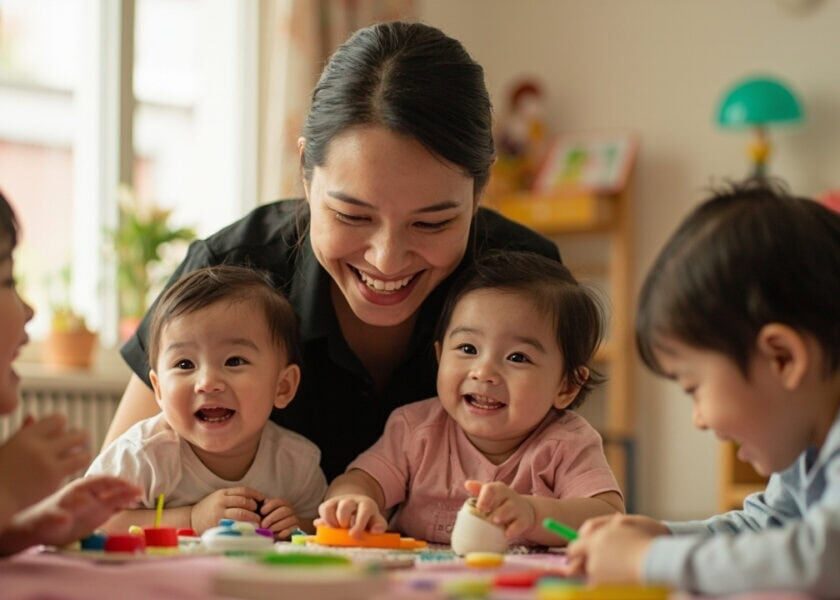
What Singapore Parents Can Actually See When Their Child Is Thriving
The Quiet Question Every Singapore Parent Asks About Their Childcare Choice
There is a particular kind of quiet worry that settles into parents after they have made their childcare decision. It does not announce itself dramatically. It arrives in the small hours, in the moments between dropping your child at their care arrangement and the time you will pick them up again. It asks a question you cannot answer with certainty: Is this actually working? Did I choose well? Is my child genuinely thriving, or simply surviving?
If you are a parent in Singapore navigating the early years of your child’s life, you are operating in a landscape of extraordinary pressure and extraordinary love. The stakes feel impossibly high. Every interaction in these first months and years carries the weight of what it might mean for your child’s future. And yet, the signals that would tell you whether your childcare arrangement is genuinely serving your child remain frustratingly out of reach.
You receive photographs. You hear summaries. You trust the updates you are given. But something in you still wonders: Can I see for myself? Can I know?
You are not alone in this. And the answer is yes—you can know. You simply need the framework to recognize what quality actually looks like when it is taking root.
A Developmental Timeline: What Quality Looks Like From 6 Weeks to 1 Year
For too long, parents have been asked to evaluate quality childcare the way you might evaluate a restaurant by its exterior. You can see the cleanliness, the staffing levels, perhaps the equipment. But the thing that actually matters—the developmental vitality of your child, the invisible architecture of security and growth being built day by day—remains hidden from view.
We tell parents to trust their instincts, to observe their child, to look for signs of happiness. But we rarely give them the framework to interpret what they are seeing. Quality childcare produces observable, recognizable, predictable results across developmental time. When you know what to look for, you become something powerful: an informed observer of your own child’s growth.
At 6 Weeks: The Foundations of Calm
At six weeks, your child is still operating primarily in the realm of pure biological need. They are adjusting to life outside the womb. Sleep is fragmented, hunger is frequent, and their world is organized almost entirely around comfort and survival.
If you are evaluating quality at this stage, the signs are subtle but real. You will not see advanced social engagement. You will not see language. What you will see, if quality is present, is something foundational: the beginning of calm alertness. A baby who, when held and supported by consistent, attuned caregivers, begins to spend short stretches of time simply looking at the world. Not distressed. Not overwhelmed. Present.
In those early weeks, a baby’s nervous system is learning what safety feels like. Every responsive interaction, every gentle feeding rhythm, every moment where their need is met with consistent presence—this is not just caregiving. This is the first draft of your child’s inner architecture for trust.
What to look for at 6 weeks:
- Emergence of quiet alertness—short periods where your baby is calm and engaged
- Predictable settling patterns that skilled caregivers can read and respond to
- Caregiver confidence—handling with informed gentleness, reading cues fluidly
At 3 Months: The Emergence of Reciprocity
Three months is a developmental threshold. It is the point where the newborn period begins to recede and something more interactive emerges. Your baby is developing visual tracking, beginning to follow faces and objects with intention. They are starting to coo, to produce those early vocalizations that are the precursors of language. Social smiling—genuine, responsive smiling in interaction with others—typically emerges around this time.
At three months, quality childcare reveals itself in what we call the emerging reciprocity. You are beginning to see a baby who is not just being cared for but is beginning to participate in their own care. They watch their caregiver’s face with concentration. They vocalize and then pause, waiting to see if a response will come. They are learning, in these small moments, that their actions have effect. That the world responds to them.
This is the earliest foundation of what will become confident social engagement, secure attachment, and ultimately, the belief that they matter—that their voice and presence are worth attending to.
What to look for at 3 months:
- Reciprocal social smiling—not just spontaneous smiles, but smiles in response to interaction
- Focused attention during care—concentrated engagement with their caregiver’s face and voice
- Recognition of caregiver—visible preference and attention directed toward familiar care figures
By three months, you should be able to have a conversation about your child that goes beyond logistics. A quality caregiver will notice things and tell you about them—not in the formulaic language of a report card, but in the specific, observational way of someone who has spent real time with your child. They will tell you about the moment your baby laughed for the first time, or the way they prefer to be held, or the particular sound that calms them. This specificity is not incidental. It is evidence that your child is being seen as an individual.
At 6 Months: Confident Exploration from a Secure Base
Six months is where the developmental arc becomes more visible, and where the difference between surface-level happiness and deeper secure thriving begins to become legible.
By six months, your child has typically reached several milestones: sitting with support, reaching for and grasping objects, babbling with increasing variety, showing clear preference for familiar faces, and beginning to demonstrate the early seeds of stranger wariness—a healthy developmental stage that signals attachment security.
Quality childcare at six months is no longer just about responsive physical care. It is about the environment supporting your child’s expanding curiosity and emerging independence.
What to look for at 6 months:
- Secure base behavior—exploration punctuated by confident check-ins with familiar caregivers
- Stranger wariness—healthy caution around unfamiliar adults, signaling strong attachment
- Growing caregiver trust—how they respond when handed to their caregiver in the morning, whether they settle into routines with predictability
- Supported independence—the caregiver gives space for your baby to practice new skills while remaining nearby and responsive
The separation process, handled well, is not a sign that something is wrong. It is a sign that your child has formed a real attachment—and that they trust their caregivers enough to express their preference for you openly. When your six-month-old cries briefly at goodbye but is soothed quickly by their caregiver, that is evidence of a secure bond, not poor care.
At 1 Year: The Full Picture of Quality
One year. By now, your child has traveled an extraordinary distance from that six-week-old who was just learning to exist outside the womb. They are likely pulling to stand, beginning to cruise along furniture, perhaps taking their first independent steps. They understand simple words and commands. They point, they wave, they engage in joint attention—looking at something and then looking at you to share the experience. They are developing a sense of humor, showing preferences, expressing affection openly.
The one-year mark is where everything comes together in a way that is visible even to the untrained eye. By one year, you have enough data. You have twelve months of observation, twelve months of developmental change, twelve months of evidence about whether the childcare you chose is genuinely serving your child.
What to look for at 1 year:
- Behavioral resilience—quick recovery from minor frustrations and upsets
- Emotional regulation—ability to be soothed by caregivers and return to engagement
- Peer engagement—first genuine interest in other children, shared laughs, offered toys
- Warm caregiver bond—clear, positive attachment to at least one primary caregiver
- Language and social cues—pointing, waving, responding to simple commands, joint attention
At one year, quality childcare reveals itself in behavioral resilience. Your child has encountered minor frustrations. They have had disagreements over toys, experienced the normal disappointments of shared attention, navigated the social complexity of being with other children and adults. What you are looking for is not the absence of these moments, but what happens after them. Can they be soothed by their caregiver? Do they return to play and engagement without lingering distress? This capacity for emotional recovery is one of the clearest indicators of secure attachment you will ever observe.
By one year, your child should have a clear, positive bond with at least one primary caregiver in their care arrangement. They should show pleasure at seeing this person, seek them out for comfort, and demonstrate confidence in their presence. This is not a replacement for your bond with your child. It is an extension of it—a sign that your child has been surrounded by adults capable of forming secure, nurturing relationships.
How to Evaluate Quality: A Practical Framework
Understanding the developmental timeline is one thing. Applying it to your own child is another. Here is a practical framework for recognizing quality—whether you are selecting a childcare arrangement for the first time or evaluating your current choice.
- Observe the calm, not just the activity. Quality care produces settled, engaged babies—not just busy ones. Look for periods of quiet alertness, not just stimulation.
- Watch for reciprocity. Your baby should be learning that their actions have effect—that the world responds to them. Look for social smiling, focused attention, vocalization and pause.
- Notice the secure base. At six months and beyond, your child should be able to explore and then return to their caregiver—not for rescue, but for connection.
- Ask for specificity. A quality caregiver will tell you specific things about your child: their preferences, their emerging quirks, the moments that mattered that day. Generic summaries are a red flag.
- Track the trajectory over time. Single observations are less meaningful than patterns. Look at what is happening across weeks and months, not just in any single pickup moment.
- Trust your read of the caregiver-child relationship. You know your child. If something feels warm and genuine, trust it. If something feels off, investigate.
Questions to Ask About Your Current Arrangement
- Can I observe calm alertness in my baby after care sessions, not just agitation?
- Does my caregiver know specific things about my child—their preferences, their rhythms, their emerging personality?
- Does my child show signs of secure base behavior—exploration punctuated by confident check-ins?
- Do I receive specific, observational updates rather than formulaic reports?
- Does my child show warmth toward their caregiver alongside their attachment to me?
- Do I see evidence of emotional resilience—quick recovery from minor upsets?
If the answer to these questions is yes, the evidence is there. You can trust it.
What Quality Childminding Actually Looks Like in Practice
For parents in Singapore evaluating their options, it helps to move from theory to practice. What does quality look like on a typical day, in a real care arrangement?
Quality childminding begins with ratios that allow for genuine attunement. When one caregiver is responsible for too many infants, responsive care becomes impossible. The child’s cries go unheard. The subtle cues that signal hunger or discomfort are missed. The individual attention that builds trust becomes a transaction rather than a relationship.
Quality also means consistency. Developing brains need predictable rhythms. Children thrive when they know what comes next—when the morning greeting is familiar, when nap routines are reliable, when the same trusted faces are present day after day. This does not mean rigidity. It means a care arrangement that prioritizes stability as a foundation for growth.
And quality means communication—not just reports, but genuine partnership. You should feel comfortable asking questions. You should receive specific observations about your child, not generic summaries. You should be able to see evidence of your child’s day through documentation, conversation, and the visible signs of a child who is thriving.
The childminder is not just a service provider. She is a developmental partner in your child’s life—part of the architecture being built in those early years. She teaches your child what the world is like, how adults treat children, whether people can be trusted, whether exploration is safe, whether their needs matter.
Addressing the Concerns Singapore Parents Actually Have
“How do I know if my child is actually thriving, or just appearing to be okay?”
Look for the trajectory across time, not any single moment. A child who is genuinely thriving will show the developmental patterns we have described: calm alertness at six weeks, reciprocal engagement at three months, confident exploration at six months, behavioral resilience at one year. Surface happiness is nice, but it is not enough. What you want to see is the pattern—the consistent evidence that your child’s nervous system is learning safety, that their social capacities are emerging on schedule, that they have genuine bonds with their caregivers.
“What if I chose the wrong arrangement?”
Choosing childcare is not a one-time decision you make and then live with forever. It is an ongoing relationship that you can evaluate continuously using the framework we have described. If you are not seeing the developmental markers of quality at each stage, that is information. It may mean adjustments are needed, or it may mean a different arrangement is right for your family. But you will never know unless you have the map to read the evidence.
“I’m worried about the cost versus the peace of mind”
Quality care is an investment in your child’s developmental architecture. The first year of life is not a period you can redo. The bonds formed, the security established, the neural pathways laid down—these matter enormously. We believe quality should not be a privilege reserved for families with unlimited budgets. Our fee structures have been designed with accessibility in mind, and our CDA and Baby Bonus fund arrangements are structured to be usable, because financial logistics should not force families into arrangements that do not serve their children’s developmental needs.
“What if my child seems fine but I’m still anxious?”
Anxiety about your child’s care is not a sign that something is wrong. It is a sign that you care deeply about getting this right. But if your child is showing the developmental markers of quality at each stage—if you are seeing calm, reciprocity, confident exploration, emotional resilience—then the evidence is there. Your anxiety may be looking for a problem that does not exist. The tools for answering your questions now exist. You have the map. Use it to give yourself permission to trust what you are seeing.
Where Quality Care Meets Developmental Science
At EduNanny, we have built our approach around what developmental science tells us about how infants thrive. This is not an accident. It is a design choice made in recognition of the fact that quality care is not a marketing claim—it is a visible, measurable reality that emerges over time.
Our approach begins with ratios that allow for genuine attunement. With up to one to three infants in our care during the pilot program, our caregivers have the space to observe, to respond, to truly know each child in their care. This is the foundation on which all other quality rests.
We are part of the ECDA Childminding Pilot, operating across both home-based and community pathways. This means our model is grounded in Singapore’s regulatory framework and designed to meet the real needs of Singapore families. Our Monday to Friday care blocks provide the consistency that developing brains need.
For families using CDA or Baby Bonus funds, these arrangements are designed to be usable, because we believe the financial logistics of childcare should not add to the emotional burden of parenting.
Our arrangements incorporate communication and observation measures that allow you to stay connected to your child’s day. We want you to be an informed observer—able to recognize what is working, to celebrate the milestones, to see the quality that is actually there.
When you place your child in quality care, you are not outsourcing parenting. You are expanding the circle of people who love and nurture your child. You are giving them additional experiences of security, of engagement, of developmental challenge and support. And you are giving yourself the gift of knowing that your child is in an environment designed around who they actually are—not just where they can be kept safe, but where they can truly grow.
Your Child’s Development Is Not a Mystery. It Is a Story—and You Are Learning to Read It.
You are not alone in this journey. You are not supposed to navigate the first year of your child’s life in isolation, guessing at every turn, wondering if you have made the right choices.
There are frameworks to guide you. There are people designed to walk alongside you. There is a map, and now you have it.
Watch the calm emerge at six weeks. Watch the reciprocity bloom at three months. Watch the confident exploration at six months. Watch the resilience and warmth at one year. And when you see these things, let yourself believe them.
The story of your child’s development, when you know what to look for, is beautiful. It tells you that you are doing this right. It tells you that your child is thriving. It tells you that the choice you made was not just a choice about logistics, but a choice about the kind of environment in which your child’s future is being quietly, lovingly built.
That is worth trusting. That is worth observing. And that is worth celebrating.
If you are looking for a childcare arrangement in Singapore where your child is not just supervised but truly known—where the ratios allow for genuine attunement, where communication helps you see quality for yourself—we welcome you to learn more about EduNanny.
Your child’s development is not a mystery. It is a story. And now, you are equipped to read it.
EduNanny is a Singapore-based childminding and childcare service built on trust, developmental value, and thoughtful care. Learn more about our approach or connect with our team to explore whether EduNanny is right for your family.