Your Baby’s Senses Are Building Their Brain in Childcare
The Sensory Reality of Quality Childcare
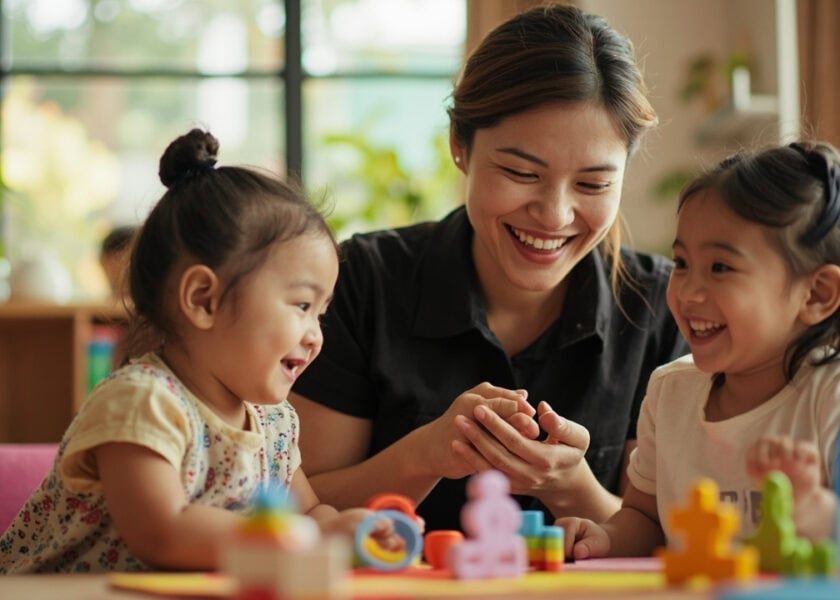
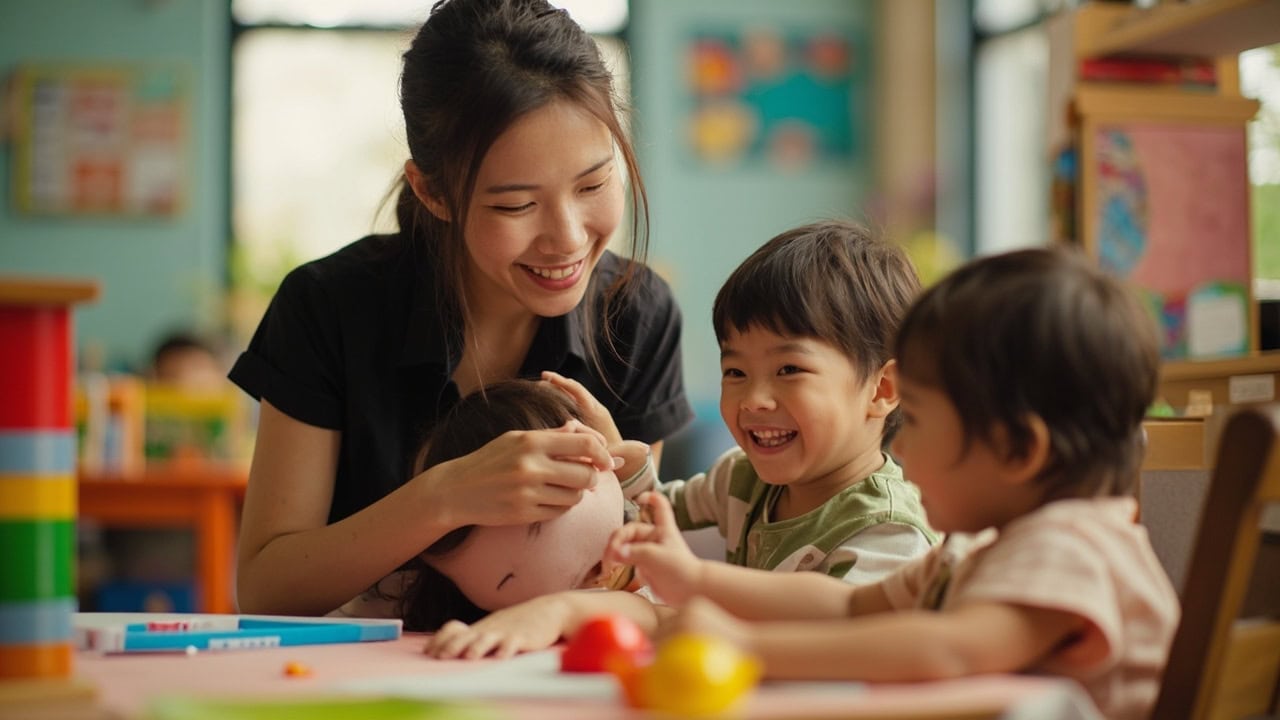
Consider, for a moment, what your child actually experiences in a well-designed infant care space. It is not passive. It is not blank. Every sense is receiving, processing, building.
Light That Teaches
Light enters differently here. It is warm, not harsh. It shifts gently through the morning, mimicking the rhythm of natural daylight rather than the flat fluorescence of a generic office. A child’s developing visual system needs this kind of variability to learn how to focus, how to gauge distance, how to process contrast.
A room bathed in even, artificial light teaches a child almost nothing about light itself. A room with soft gradients and shadows teaches them everything.
Sound That Builds
Sound matters in ways we rarely consider. The human voice — not television, not recorded music, not the mechanical din of a screen left running in the corner — is the most important sound environment for an infant’s auditory and language development.
In a quality childcare setting, the soundscape is curated, not chaotic. There is conversation. There is singing. There is the sound of other children, which teaches social hearing — the ability to pick out a single voice in a crowd, to understand meaning beneath noise.
This is the architecture of an auditory environment designed to grow neural pathways for language acquisition, for listening comprehension, for the kind of attention that will matter enormously when your child sits in a classroom years from now.
Touch That Maps the World
Then there is touch — perhaps the most foundational of all senses for early development. A child’s skin is an enormous sensory organ, and through touch they learn about temperature, pressure, texture, pain, and comfort.
The materials in a quality infant care environment are chosen deliberately: rough and smooth, warm and cool, hard and soft. These textures are not decoration. They are input. They are teaching a child’s somatosensory cortex — the part of the brain that processes physical sensation — to build a map of the physical world.
Movement That Develops
Movement is education. The vestibular sense — housed in the inner ear — tells a child where their body is in space, whether they are still or moving, whether they are upright or lying down. This sense develops through rolling and tumbling, through rocking, through being carried, through the gentle acceleration and deceleration of a caregiver walking with a child.
It is the foundation of balance, of coordination, of the body’s sense of its own position. A childcare environment that gives children freedom to move — to crawl, to climb, to be held and rocked and carried — is giving them the raw material for proprioception: the sense of one’s own body in space.
Smell That Communicates Safety
Beneath all of this, there is smell. The human olfactory system is uniquely wired to emotion and memory, more so than any other sense. A child learns safety partly through smell — the familiar scent of a caregiver’s skin, the particular warmth of breast milk or formula, the clean but not antiseptic smell of a well-maintained space.
When a childcare environment is saturated with synthetic fragrances, with cleaning chemicals that overwhelm rather than cleanse, it is communicating something to a child’s developing nervous system. That communication is not neutral. It is a signal — of alertness, of stress, of a world that is not quite safe.
Why the Environment Is the Curriculum
The neuroscience here is not complicated, though it is profound. In the first thousand days of life, a child’s brain is building approximately one million new neural connections every second. The speed of this construction is extraordinary and unrepeatable.
What determines which connections form, which pathways strengthen, which circuits become efficient and which remain fragile? The environment. Specifically, the sensory environment.
Every sensation that a child experiences either strengthens a neural pathway or fails to. Every experience of being held, of hearing language, of touching varied textures, of moving through space, of smelling the world around them — each of these experiences is a vote, neurologically speaking, for the development of the circuits that process those sensations.
This is why neuroscientists speak of critical periods in early development: windows of time when certain capacities must be developed or they will not develop fully. The sensory environment is not just pleasant or stimulating. It is, quite literally, building the architecture of your child’s brain.
Supervision vs. Development
This is why the distinction between a childcare space that merely supervises and a childcare space that actively develops is so consequential.
A generic infant room may keep children safe, fed, and clean. It may have colorful posters on the walls and plastic toys on shelves. But if the light is flat, if the soundscape is random, if the textures are all smooth and sanitized, if children are kept in carriers and bouncers more than they are held and allowed to move freely — the environment is not teaching. It is warehousing.
A quality childcare environment understands that every element of the space is a teaching tool. The way furniture is arranged teaches spatial awareness. The way transitions happen — from activity to meal, from meal to sleep — teaches time and anticipation. The way caregivers speak to children teaches conversation, turn-taking, the musicality of language.
The room is not a container for learning. The room is learning.
Why This Matters More in Singapore
For parents in Singapore, this reality carries particular weight. Our city is extraordinary — clean, efficient, modern, safe. But it is also, by design, a controlled environment. Apartments are climate-controlled, soundproofed, often hermetically sealed from the natural world.
The air your child breathes indoors is filtered. The light is artificial. The sounds are mechanical. Outside, the streets are smooth, the parks are manicured, the sensory variety of the natural world is present but curated, managed, reduced.
This is not a criticism of Singapore. It is an observation about what urban living costs us in terms of sensory richness.
The Risk of Sensory Poverty
Children growing up in high-rise apartments, especially in the early years, can experience what developmental scientists sometimes call sensory poverty — not the poverty of deprivation, but the poverty of sameness, of uniformity, of a world that does not vary enough to fully stimulate the developing senses.
Quality childcare, when it is designed with developmental intelligence, can fill this gap. A good infant care space brings texture back into a child’s life — wooden toys alongside plastic, natural fabrics alongside synthetic. It brings varied sound — not the relentless white noise of air conditioning, but voices, music, the beautiful chaos of children at play. It brings the smell of food cooking, of clean cotton, of a space that is cared for.
When you choose a childcare environment for your child in Singapore, you are not just choosing a place to keep them safe while you work. You are choosing an environment that will, for thousands of hours in the first five years of their life, literally build their brain.
What Quality Actually Looks Like
So what should you look for? How can you know, as a parent, whether the environment your child spends their days in is serving their development or simply containing it?
There are signs, if you know where to look.
After Pickup: What to Observe
A calm but engaged child. A child who has spent the day in a sensory-rich, developmentally intelligent environment often shows a particular quality of calm. Not lethargy — they have been engaged and active. But a groundedness, a comfort in their own body, a willingness to explore rather than to seek constant stimulation. They can be still. They can play independently. They can transition from one activity to another without falling apart.
Genuine curiosity. Children who are in environments that merely entertain them often demand entertainment. Children who are in environments that actively develop them often develop, instead, a genuine interest in the world — in how things work, in why things are the way they are, in the textures and sounds and smells of everyday life.
Physical confidence. Notice their relationship with their own body. Children who have had freedom to move, to climb, to fall and be caught, to roll and crawl and explore, often show a physical confidence that is not bravado but competence. They know where their body ends. They know how to balance. They are not afraid of moderate risk because they have learned, in a safe environment, what their body can do.
Better sleep. Notice their sleep. A child whose nervous system has been appropriately engaged and then gently transitioned toward rest often sleeps more soundly. The sensory day — rich but not overwhelming, varied but not chaotic — ends in a child who is genuinely tired in the way that growing brains need to be tired.
Questions to Ask During Visits
- How is the space lit? Is it mostly artificial, or does natural light play a role in the day’s rhythm?
- What does the space sound like when I visit? Is there conversation, or is it quiet in a way that suggests isolation?
- What textures are available to the children? Wooden toys, natural fabrics, varied surfaces?
- How much freedom of movement do the children have? Are they mostly contained, or do they have space to explore?
- What does the space smell like? Clean, yes — but also warm and human, or antiseptic and synthetic?
- How do caregivers speak to the children? Is there back-and-forth conversation, or mostly directives?
Making This Choice with Confidence
When you walk away from your child in the morning, you cannot see what is happening behind you. But perhaps now you can imagine it differently. Not as an absence, not as a blank space filled with anxiety, but as a room designed with intention.
A space where every element — the way the light falls, the way the floor feels beneath bare feet, the way a caregiver’s voice rises and falls in conversation, the way nap time smells of clean sheets and warm skin — is speaking to your child’s developing nervous system. Telling it: this is a place where you can grow. This is a place where you are safe to be exactly who you are, at exactly this stage of your becoming.
That is what quality infant care offers. Not just supervision. Not just safety. But a sensory environment shaped by developmental intelligence, by knowledge of how young brains build themselves, by respect for the profound learning that happens in the first five years not through instruction but through experience.
Answering the Questions You Really Have
“How do I know what really happens during the day?”
You cannot be in the room. You cannot see what you cannot see. But you can observe what your child shows you when they come home. You can ask the right questions during visits. You can notice whether your child seems regulated, curious, and confident — or depleted, overstimulated, and seeking constant sensory input just to feel normal.
“Isn’t any licensed childcare equally good?”
Licensing sets a floor, not a ceiling. It establishes minimum standards for safety, ratios, and basic care. But the difference between a room that merely meets standards and a room designed with developmental intelligence is the difference between a container and a curriculum. Two childcare settings can have identical licensing, identical ratios, identical toys — and offer radically different environments for your child’s sensory development.
“My child seems fine. Does this really matter?”
Children are remarkably resilient. They adapt to their environment, whatever it is. A child who has spent their early years in a sensory-poor environment may not seem obviously different from one who has had rich sensory input. The differences emerge over time — in attention, in regulation, in the ability to sit still and focus, in comfort with their own body in space, in the ease with which they learn language and navigate social situations. The neuroscience suggests that the foundation being built now — in these unseen hours — matters enormously for what your child will be capable of later.
Where the Environment Is a Form of Care
This is the quiet architecture of quality infant care. It is not loud. It does not announce itself. A child does not notice that the light is carefully calibrated or that the soundscape has been designed. They simply feel, in their body, in their developing nervous system, that this is a place where they are safe to explore, safe to learn, safe to be small and curious and dependent.
The environment itself communicates to them — not in words, but in sensation — that they are held.
EduNanny understands this. As part of the ECDA Childminding Pilot, the approach to infant care is built around developmental intelligence — where every element of the environment is considered a tool for growth, not just a feature of the space.
With infant ratios of up to one-to-three in care settings, your child’s sensory environment is never lost in a crowd. Communication is prioritized, with transparency measures including CCTV in deployed settings, so you can feel connected to these hours that matter so much.
For families planning financially, CDA and Baby Bonus funds can be used, which eases the pressure of managing childcare costs alongside all the other demands of raising a young family in Singapore.
These are practical matters. They matter enormously. But beneath them is the deeper question: what kind of environment do you want your child to inhabit during these foundational years? And for that question, the answer is not in a brochure. It is in the quality of light, the texture of what your child’s hands can touch, the sound of voices speaking to them with warmth and attention, the smell of a space that feels like care.
Begin with What You Now Know
Your child’s senses have been learning since before they were born. In the months and years ahead, they will learn through thousands of hours of sensory experience — some rich, some impoverished, most somewhere in between.
What you choose now, for the environment that will hold them during your working hours, is not a small thing. It is one of the most consequential choices you will make as a parent.
And it is a choice that can be made with confidence, when you know what to look for, when you understand that the room itself is the teacher, when you trust that there are places designed not just to keep children safe but to actively grow them.
A space where the environment is not a backdrop but a form of care. Where the room itself is speaking to your child, even when you are not there to hear it. Where your child’s senses are being used as the tools they were designed to be — and where what they are learning is this: that the world is full of texture, and light, and sound, and warmth, and that they are ready for all of it.
Because you deserve to walk away in the morning knowing that what is happening behind you is good. That the light is warm. That the voices are kind. That your child’s senses are being used as the tools they were designed to be — and that what they are building, hour by hour, is exactly what you hoped they would build: a foundation for everything that comes next.
Explore EduNanny’s Infant Care Options →
EduNanny is a trusted, development-oriented childcare and childminding service for families in Singapore. Learn more about us or get in touch to discuss your family’s needs.