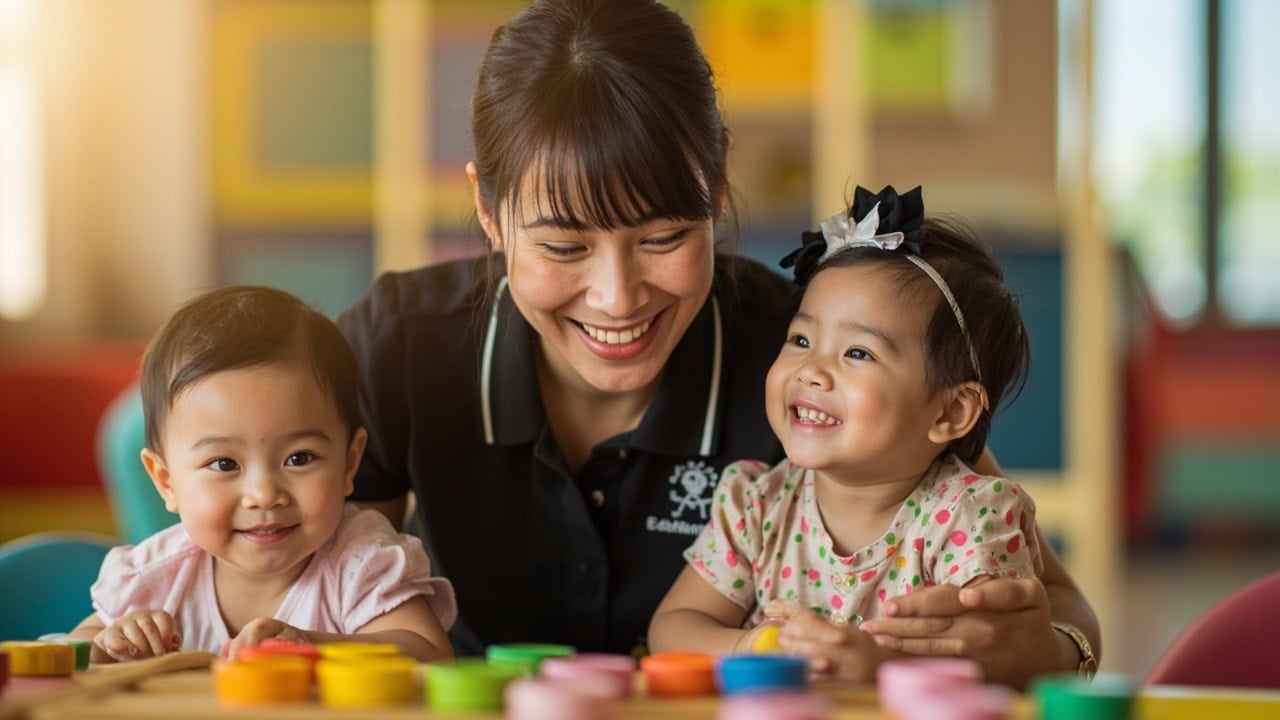
The Daily Rituals That Transform Singapore Childcare
Quality Childcare: A Daily Practice, Not a One-Time Decision
Singapore’s working parent rhythm is particular. Long hours, competitive workplaces, extended family expectations, and a cost of living that presses down on every household decision. The childcare arrangement is not made in a vacuum. It is made in the context of all of that pressure, and it must be sustained in that context too.
This is not a failure of Singapore families. It is the reality within which quality must be built.
What we are offering here is not a way to eliminate the tension but to inhabit it with more skill. To notice the rhythm. To tend it daily. To understand that the small moments—the unhurried handover, the attentive pickup, the genuine evening exchange—are not small at all. They are the infrastructure itself.
The Morning Handover: Where the Day Begins
There is a particular quality to the goodbye that matters far more than most parents realise. In the early days—the first week, the first month—the goodbye is charged with emotion. Your child cries. You feel the pull in your chest. The caregiver steps in with practiced warmth, and you leave, carrying that image of your child’s face with you through your entire workday.
But what happens to that goodbye six months later? A year later? The tears have often faded by then, and so has much of the conscious attention parents bring to the handover moment. This is precisely where the quality of care either deepens or quietly erodes.
The goodbye matters not because your child will remember it as a dramatic scene but because it is a daily ritual of connection that communicates something essential:
- That leaving is safe
- That the person taking over is trusted
- That the transition from your hands to theirs is not a rupture but a bridge
When this ritual becomes automatic—when you find yourself checking your phone before you have even reached the lift—it is easy to miss what is actually happening.
Consider these questions:
- Is your child running toward their caregiver with genuine warmth?
- Is there a moment of eye contact, a small exchange?
- Is there a handover of emotional state as much as physical care?
These are not luxuries. They are the texture of the trust you have built.
And here is something that rarely gets said: the goodbye is also for you. The moment you hand your child over, you are also handing over a part of your anxiety, your attention, your working memory. A good morning handover transfers not just your child but the emotional weight of that transition.
When it works well, you leave feeling lighter. When it is rushed or distracted, you carry that weight into your day, and so does your child.
Notice what your mornings feel like. Notice what you feel as the lift doors close. That noticing is the first skill in the daily practice of sustaining quality care.
The Evening Reunion: Reading the Day’s Data
By the time you pick your child up, you have been working for hours. Your mind is full of meetings and emails and the particular mental arithmetic of a Singapore working parent—school fees due, parent-teacher meeting to attend, the week’s groceries still not bought. You arrive at the pickup point, and your child runs to you, and for a moment, the day feels complete.
But here is where most parents stop looking. The evening reunion is information. It is data about the quality of care your child received all day, and it is available to you every single day—if you know how to read it.
This is not about interrogating your child or your caregiver. It is about noticing:
- When your toddler climbs into your arms after pickup, how does their body feel? Relaxed or tense?
- When you ask them what they did today, what do they say, and how do they say it?
- When you arrive and your child is happily absorbed in an activity, look at that activity. Is it developmentally appropriate? Is it the kind of play that teaches, that builds, that stretches?
- When your infant is in the caregiver’s arms as you arrive, how does the caregiver interact with you? Is there a warm handoff, a genuine exchange of information, or are you simply collecting your child like a parcel?
These are not judgment moments. They are continuity moments. The evening reunion is where the care your child received during the day either connects with the care you will provide tonight or exists in a separate compartment, invisible and unintegrated.
Quality childcare is not something that happens to your child while you are away and then ends when you arrive. It is a thread that runs through the entire day, and the evening is where you pick up that thread and weave it forward.
For Singapore parents, this is particularly important. Our days are long. Our commutes are real. The hours between pickup and bedtime are compressed and often frantic. But within that compression lies an opportunity: to extend the learning, the warmth, the rhythms of the care setting into your home.
When your child comes home and shows you something they made, ask about it. When they use a word or phrase you have not taught them, wonder where it came from. When they fall asleep more easily on some nights than others, consider what might be different about those days. The evening is not just the end of the childcare day. It is the bridge between what happened in your absence and what will happen in your presence.
Rhythm, Not Just Schedule: Childcare as Family Infrastructure
Now let us name something that most childcare conversation sidesteps: the difference between a schedule and a rhythm.
A schedule is what you put on the refrigerator. Eight a.m., drop-off. Six p.m., pickup. It is external, mechanical, administrative.
A rhythm is something your family generates together over time. It is the felt sense of how your days move, how your child transitions between states, how your household breathes.
Schedules can be maintained even when rhythms collapse. And when rhythms collapse, no schedule will save you.
The concept of childcare rhythm as family infrastructure is not poetic language. It is a practical recognition that the arrangement you have chosen—whatever form it takes—becomes load-bearing. It holds up other things:
- Your ability to work with focus
- Your marriage or partnership and its capacity to sustain intimacy when you are both exhausted
- Your older child’s sense of security
- Your own sense of yourself as a competent, present parent
When the rhythm is working, these things hold. When it frays, they all feel the strain.
The weekend is where Singapore working parents often feel the sharpest contrast. After five days of structured childcare, the unstructured hours of Saturday and Sunday can feel like a different country entirely. The rhythms that served your child all week seem to dissolve. Bedtimes slip. Meals become erratic. The learning that was building through the week through consistent, purposeful interaction does not necessarily continue.
This is not a failure of parenting. It is the nature of the beast. But it is also an opportunity.
The weekend is where you extend the quality of the care week into the life of your family. It does not require elaborate planning or educational activities that feel like work. It requires presence. It requires the willingness to notice what your child noticed during the week and to follow that noticing together.
Consider the small things:
- Saying yes to the extra book at bedtime
- Taking the longer walk through the park
- Having the unhurried meal where conversation flows
- Bringing intentionality from the childcare setting into your own home
Your child’s development does not pause on Saturday. The brain that was building language all week continues to build language on the weekend. The social skills that were developing in the care setting continue to develop in your living room. The question is not whether this development will happen but whether you are present within it, whether you are adding to it, whether your weekend hours are deepening what the week began.
Signs Your Caregiver Partnership Needs Attention
You chose your caregiver because something felt right. Trust was established. Competence was demonstrated. But partnerships evolve. The caregiver who was perfect for your four-month-old is not necessarily the same presence your sixteen-month-old needs. The arrangement that worked when you were on maternity leave and working from home three days a week may not serve you well now that you are back in the office full time.
How do you know when the partnership is thriving? How do you know when it needs attention?
The signs are often subtle:
- Your child seems comfortable but not excited to see their caregiver
- The caregiver completes tasks competently but without the warmth that originally drew you in
- You find yourself dreading the morning drop-off even though nothing specific is wrong
- You stop asking questions
- You stop receiving the kind of updates that make you feel genuinely connected to your child’s day
These are not emergencies. They are invitations—an invitation to look more closely, to have a conversation that goes beyond logistics.
Questions to Ask Yourself
- Do I look forward to talking with my child’s caregiver, or do I dread it?
- Do I feel genuinely informed about my child’s day, or just updated on logistics?
- Does my child show warmth toward their caregiver, or just tolerance?
- Do I trust my caregiver to notice things I would notice?
- Would I feel comfortable raising a concern, or do I avoid difficult conversations?
Common Parent Concerns
“Am I paying attention to the right signals?”
Most parents notice plenty. The question is whether they trust their observations. If your child runs to their caregiver with warmth, if they come home relaxed rather than tense, if they are building language and skills and connection—these are real signals. Trust them. If something feels off, that feeling is also data. Pay attention to both the external evidence and your internal knowing.
“What if I feel like I cannot raise concerns with my caregiver?”
This is a significant warning sign. A healthy caregiver partnership should have room for honest conversation without fear of judgment or consequence. If you find yourself avoiding difficult topics, either the relationship needs attention or the arrangement itself may need review. Quality care invites partnership, not performance.
“Is it selfish to want more than just competent care?”
No. You are not looking for competence alone. You are looking for genuine attention—caregivers who will notice your child with the same care you bring yourself. This is not an unreasonable ask. It is the baseline for quality. Singapore parents are not asking for perfection. They are asking for partnership.
When Care Needs to Evolve
Here is a question that eventually confronts every parent who has chosen quality childcare: When does my child’s care need to change?
The answer is not simple, because children do not develop on schedules. But there are signals worth noticing.
- When your infant begins to crawl and then walk, the care environment must adapt physically
- When your toddler starts asking questions with genuine curiosity, the care environment must adapt intellectually
- When your child begins to need peer interaction in a way they did not before, the care environment must adapt socially
These are not dramatic transitions. They are quiet evolutions that, if met with responsive adjustment, keep the care arrangement aligned with your child’s actual needs rather than the needs they had six months ago.
Some parents resist change because it is disruptive. It is easier to keep things as they are, to assume that what was working will continue to work. But a childcare arrangement that does not evolve becomes, over time, a childcare arrangement that is no longer truly serving your child.
The Arc of Development
Different stages call for different configurations. A home-based arrangement with a dedicated caregiver may be ideal for the first year, when your infant needs consistent, individualised attachment. As your child moves into the toddler years, the enriched social environment of a centre-based setting may become more valuable.
These are not failures of the earlier choice. They are the natural arc of development.
What matters is that the change happens thoughtfully, with your child’s continuity and security held as the priority. The home-based caregiver who has been with your family since infancy can become a guide in the transition, helping your child carry the relationship forward even as the setting shifts.
How do you know if the arrangement is still right for your child?
Ask whether the arrangement is still meeting your child’s actual developmental stage, not the one they were in six months ago. Children change. Care should adapt. If you notice your child is craving more social interaction, more challenge, more independence, that is not a failure of your current arrangement—it is your child growing, and your care should grow with them.
What Quality Childminding Looks Like in Practice
In the ECDA Childminding Pilot that EduNanny operates through BUTLER, quality is not an abstract promise. It is a set of practices that can be observed, experienced, and sustained over time.
The 1-to-3 Infant Ratio: In home-based infant care, a 1-to-3 ratio means your child is not one of fifteen in a room. It means there is genuine attention—your infant’s cries are heard, their rhythms are known, their development is tracked not through checklists but through daily presence.
Transparent Communication: Quality communication is not a formal report that feels like homework. It is the kind of transparent, genuine exchange that lets you know what your child ate, how they slept, what made them laugh, and what challenged them. This is a daily practice of partnership that allows you to read the evening reunion with greater clarity and to carry the quality of the care setting forward into your own hours with your child.
Built-In Partnership Structures: There are built-in opportunities for review, for adjustment, for the kind of honest exchange that keeps the partnership vital. This is not administrative oversight. It is relational maintenance—the recognition that quality care is not a static achievement but a living practice.
Pathways That Accommodate Growth: The choice between home-based and community or centre-based care is not a one-time decision that locks you in forever. EduNanny’s understanding of both pathways—and the flexibility to move between them—means that adaptation is not a rupture but a growth.
Begin the Daily Practice
We have spoken about mornings and evenings, about rhythms and partnerships, about the evolution of care over time. But we have not moved far from the original question at all. We have simply followed that question to its proper home.
The answer to Is this still working? is not a single inspection or a moment of confidence or a perfect decision made once and filed away. The answer is a daily practice. It is:
- The unhurried handover in the morning
- The attentive reunion in the evening
- The honest conversation with your caregiver
- The noticing of what your child needs and when the care environment must shift
It is the recognition that quality childcare is not something you purchase but something you participate in, something that deepens through consistent attention and honest reflection.
There is a way of thinking about childcare that treats it as a solution to a problem. You have a child. You have work. You need care. You find care. The problem is solved.
But the families we know—the Singapore parents who show up, who carry the weight of long hours and tight schedules and the particular pressure of raising children in one of the most demanding cities in the world—are not looking for problem-solving. They are looking for something more enduring. They are looking for rhythms that sustain. They are looking for partners who will notice what they notice, who will care about what they care about, who will be present not just at enrollment but in the thousands of ordinary days that follow.
EduNanny was built for this daily practice—not for the moment of decision but for the years of partnership that follow. The pilot fee structures are designed to be accessible, and payment mechanisms including CDA and Baby Bonus are integrated to reduce the administrative friction that adds stress to already-stressed households.
Beyond the features, beyond the structure, beyond the logistics that any service can list, EduNanny is built on a conviction: that the daily rhythms of quality childcare are the architecture within which children thrive. And that architecture must be tended—not once, at enrollment, but every single day.
The question is not just: Is this still working?
The question is: How do I tend it so that it continues working? How do I build rhythms that hold? How do I be the kind of partner to my caregiver, my child, my family that this daily practice requires?
EduNanny Singapore is here to walk this road with you. Not just at the beginning. Not just at enrollment. But every day after.
Because quality childcare is not a destination. It is a daily practice, and it is open to you now.
If you are ready to explore what a sustained partnership in your child’s care could look like, we invite you to begin a conversation with us.
EduNanny is a trusted, development-oriented childminding and childcare service for families in Singapore. Learn more about our approach or explore how we can support your family.