The Biology of Belonging: What Quality Childcare Means for Your Baby’s Brain
The Sensory World and Biology of Separation
When a child enters a new childcare environment for the first time, they encounter something their nervous system experiences as genuinely seismic. There is no framework yet for this. No language for “I will come back.” No concept of afternoon pickup. There is only the immediate, overwhelming reality of a room full of unfamiliar sensory information.
The light falls differently here. The air carries different smells — the cleaning agent on the floor, the faint milk-sweetness of other children, the particular warmth of bodies in a space that has been occupied for hours. The sounds are unfamiliar: other children, a different adult voice, the echo of the room against walls that have not yet learned the rhythms of this specific child’s ears.
Every sense is being taxed. Every nerve ending reports in from the frontier of an unknown world.
And then there is you — gone. In your place: a caregiver the child has never met, holding out a hand or offering a smile, or simply waiting with a patience that is not yet trusted.
The Caregiver as Biological Regulator
What happens next in that small body is physiological. Heart rate spikes. Stress hormones flood the bloodstream. The child does not yet have the cognitive development to reason through this. They only know: the familiar person has left. The world is new. Something must be done.
And so they cry.
That cry is not simply an expression of sadness. It is a biological imperative. It is a child’s entire communication system saying: this is an emergency, and I need someone to help me.
This is where the difference between quality care and mere supervision becomes not a philosophical distinction but a biological one.
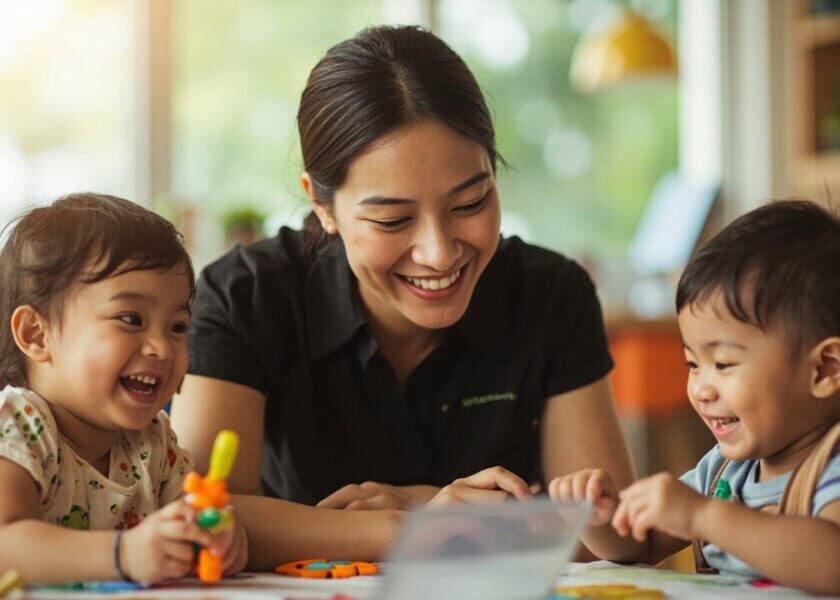
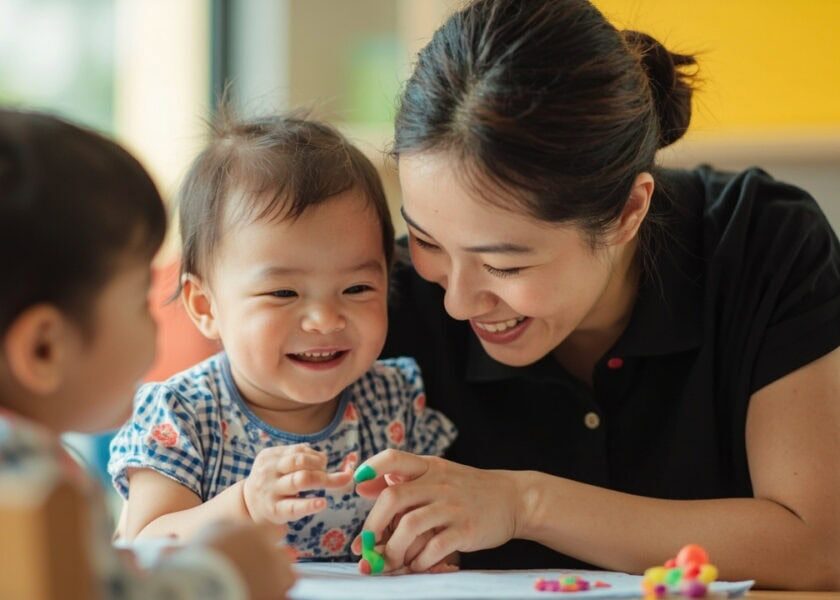
A caregiver who understands child development — who has been trained not just to watch but to read — does not rush to silence the cry. They do not force a child to be calm before the nervous system has been given a reason to believe that calm is possible. They stay. They modulate their voice to a frequency that research has shown actually lowers cortisol in an infant’s body. They move slowly, predictably, so that nothing about their presence adds to the sensory overload. They become, in that moment, a biological regulator for a nervous system that has lost its anchor.
When the caregiver breathes deeply, the child’s body begins to remember that it can breathe too. When the caregiver’s voice carries the right warmth and tempo, the child’s heartbeat begins to slow.
The room, when thoughtfully designed, supports this. Light warm enough to not add to the sensory load. Floors with enough give that a child learning to walk does not bruise their shins on every fall. Background sound that is present but not chaotic — the gentle hum of a space that feels inhabited rather than empty. These are not cosmetic details. They are the texture of a child’s sensory world, and they either drain a developing nervous system or sustain it.
Curiosity, Routine, and the Foundation of Security
Slowly — and it should be slow — the child’s body begins to register that the alarm has not been followed by the predicted catastrophe. Nothing terrible has happened. The new adult has not left. The room has not become hostile. The crying, which began as a full-body emergency broadcast, begins to quiet into something more manageable: a whimper, a shuddering breath, and then, finally, a pause.
In that pause, something shifts. The child’s eyes, which were squeezed shut or staring in a fixed, overwhelmed way, begin to move. They start to look around. Not randomly — with intention. They are mapping this room. They are building, neuron by neuron, a picture of where they are and what is in it.
Curiosity is not the opposite of fear. It grows out of fear that has been survived. When a child’s nervous system has been helped through the initial alarm and has found, against expectations, that the world did not end — then a new capacity opens. The capacity to notice: there is a shelf with objects on it. There is a window where light moves in a particular way. There is a sound from the next room that happens at certain times and seems to mean something.
As the days accumulate — because quality care means consistency — that map becomes a territory. The room stops being an unknown and starts being a known.
This is how routine becomes not a cage but a form of liberation for a young child’s nervous system. When lunch always comes after the same song, when nap time always involves the same dimming of lights and the same soft voices, the child begins to develop the capacity for anticipation. They begin to know, before it happens, what comes next.
And this knowing is not boring to them. It is a relief. It is the feeling of a world that is not random, not chaotic, not threatening. It is the feeling of being able to predict your own experience — and that early, pre-linguistic sense that the world is knowable is the foundation upon which so much later security is built.
Supervision, Presence, and the Social World
Routine alone is not enough. A child needs the room to be predictable. But within that predictability, they also need to be seen as an individual. They need someone who notices which objects catch their particular attention, which sounds make them flinch, which textures they return to again and again, which children they prefer to be near, and which moments of the day their body seems to need extra support.
This is the distinction between supervision and presence. A supervisor watches. A present caregiver watches and responds — to the specific child in front of them, in this specific moment, with this specific need.
When that responsiveness is consistent, day after day, something extraordinary happens. The child begins to build a relationship with their caregiver that is not a replacement for family attachment but is its own genuine bond. The caregiver becomes a figure of safety, not because they look like a parent but because they have proven, through hundreds of small responsive interactions, that they can be trusted to know what this child needs and to meet it.
This relationship is the soil in which language grows. It is not simply because the caregiver teaches words — though they do. It is because when a child knows that they are understood, they become motivated to try to be more precisely understood.
A gesture leads to a sound. A sound leads to a word. A word leads to the experience of someone responding to it with the right object, the right response, the right acknowledgment. And so begins the long, lifelong process of learning that one’s inner world can be communicated, and that other people can be receivers of that communication.
Learning From Peers
The peers in the room are part of this relational world too. In the first months, it is mostly parallel — children near each other, aware of each other, but not yet engaged in the complex social choreography of shared play.
But even in parallel, something is happening. The child is learning what other children feel like nearby. They are learning that other small people have sounds and rhythms and moods that are different from their own. They are building, in the most primitive way, the understanding that they are not the only consciousness in the room.
When they are a little older, the first forays into social engagement begin. These are clumsy, egocentric, entirely age-appropriate attempts to connect: a child reaches for another’s toy, a child follows another child to where they are going, a child cries because another child came too close.
These are not failures of social skill. They are the first drafts of social skill. A caregiver who understands this holds the emotional safety of the space so that these attempts can happen and can be survived. They help children learn that other people can be both exciting and overwhelming, both interesting and frustrating, and that all of these feelings are part of being human.
The Quiet That Matters
Throughout the day, there are moments of overwhelm that are not dramatic — they do not look like a meltdown from the outside — but are significant in the life of the nervous system. A sudden noise. A child who comes too close. A change in routine, however small. A new face at the door.
Each of these moments triggers a micro-stress response in the child’s body. Cortisol is released. Heart rate rises. The alarm system activates, even if only briefly.
In a high-quality environment, the caregiver notices the child who has just flinched. They move to help, not by removing the child from the situation but by offering presence — a voice, a hand on the back, a calm acknowledgment of what just happened. They help the child’s nervous system learn that it can experience a small stress and return to baseline. That disruption does not mean danger. That overwhelm is not the end of safety.
But there is also a part of the childcare day that is rarely described and almost never photographed: the quiet part. The late afternoon, when the noise has softened and the energy of the room has settled into something gentler, when a child sits or crawls or stands at a window and does — nothing. Just looks. Just breathes. Just exists in a body that has been processing so much all day long.
This quiet is not a gap in the program. It is not the child being under-stimulated or bored. It is the child processing. It is the brain doing the slow, invisible work of integrating everything that has happened — the new faces, the new sounds, the new expectations, the moments of connection, the moments of stress, the triumphant achievement of standing alone, and the small disappointment of a toy that was taken away.
When a child is given space to be quiet, they are given something precious: the gift of their own inner life. They are allowed to be with themselves, to notice what is inside them, to develop the capacity to be alone in a way that is restorative rather than frightening.
This is where imagination begins. This is where a child stares at the wall and is, in fact, constructing an internal world that will later become the foundation for creativity, for reflection, for the ability to be with oneself in a meaningful way.
A room that allows for quiet is a room that respects the child as an interior being. And this respect — this recognition that the child has an inner world that matters — is one of the clearest marks of quality.
What the Reunion Tells You
And then, the day ends. You come back.
There is a reunion that happens at pickup that is more revealing than any daily report you will ever receive. Watch it. Really watch it. Not through the lens of your own relief — though that relief is real and valid — but through the lens of your child’s behavior.
Watch how they respond to your arrival. Do they run to you with the particular face they save only for you? Do they point to something in the room, wanting to share it, to tell you about this world they have been living in while you were gone? Do they seem settled in their body, regulated, comfortable in the space they are leaving?
Or do they seem desperate, clingy, rigid — showing you in their behavior that the hours apart were not a neutral experience but a difficult one?
The quality of care your child receives is written in that reunion. Not in what the caregiver tells you, but in what your child shows you with their body, their eyes, their readiness — or reluctance — to engage with the world they have come home from.
The Evening Transition
And then there is the drive home, or the walk home, or the time in the evening when you notice your child is not quite themselves. They are more demanding than usual, or more withdrawn. They need to be held in a particular way, or they push you away. They are exhausted in a way that goes beyond physical tiredness. They are depleted.
This depletion is the residue of a full day’s worth of inner experience. It is the price of learning to be in a world that is not home. And it is, in most cases, completely normal — children who have had a full day of processing, regulating, engaging, and growing will come home tired.
But it is also a window into the demands that were placed on your child during those hours. A child who is not just physically tired but emotionally ragged after every day in childcare is a child whose nervous system is being asked to work too hard without enough support.
A child who is tired but intact — tired but still themselves, still curious, still connected — is a child who has been in an environment that was manageable, that gave them enough regulation to survive the day without spending themselves down to the wire.
The transition home tells you something. Pay attention to it.
Why Choosing Care Is a Developmental Decision
What I have been describing is not a day in childcare. It is a day in the life of a child’s nervous system, relational world, and emerging sense of self.
The child who enters a high-quality childcare environment learns, over weeks and months, that the world has structure. That their needs will be noticed. That other people can be trusted to help them when they are overwhelmed. That other children are both individuals and companions. That being in a new place is frightening but survivable. That the familiar people — the ones they love most — will always, always come back.
The child who enters an environment where there are too many children for one adult to notice them all, where the pace is too fast for nervous systems to keep up, where there is no time for quiet, where stress is a constant rather than an exception — that child is also learning. But what they are learning is different.
They are learning that the world is loud and fast and indifferent to their needs. They are learning to manage alone, because alone is the only reliable state. They are learning that overwhelm is permanent, not temporary.
Both are real possibilities. Both are shaping a child. The question is which one you want for yours.
Questions to Ask When Choosing Infant Care
- What is the caregiver-to-infant ratio? Fewer infants per caregiver means more attention, more regulation, more noticing of your child’s specific needs.
- How consistent is the caregiver assignment? Will your child see the same face every day, or rotate between different people?
- What does a typical day look like? Is there time built in for quiet, for processing, for the slow moments that a developing nervous system needs?
- How do caregivers respond to a crying or overwhelmed child? Listen for language that reflects understanding of co-regulation — presence, modulation, patience — not just distraction or dismissal.
- What training have the caregivers received? Look for training in child development, not just childcare certifications.
- What does the reunion look like when you observe pickup? Do the children seem settled? Regulated? Connected to the adults in the room?
- What communication can you expect? Is there transparency about your child’s day, and is the communication two-way?
What EduNanny Was Built For
EduNanny by BUTLER is a childminding service that was built with this understanding at its center. We are part of the ECDA Childminding Pilot, which means our service operates within a framework designed to make quality childminding accessible to families across Singapore. We offer pathways that include both home-based and community or centre-based environments, because families are different and the right setting depends on what a particular child and family need.
Our infant ratios are designed to allow for genuine presence — never more than three infants to one caregiver in our pilot model — because a caregiver who is truly present for a child is not the same as a caregiver who is managing a room. When we speak about what EduNanny offers, we are speaking about the conditions in which a child can develop the internal architecture of security, curiosity, and emotional regulation that will carry them through their entire life.
Training That Goes Beyond Supervision
Our caregivers are trained in understanding child development — in recognizing the cues that indicate a child is overwhelmed or curious or in need of connection, in the art of co-regulation. They are supported by systems that allow for clear communication with families, including transparency measures such as CCTV where deployed, and by structures that allow caregivers to focus on the children in their care rather than administrative burdens.
Accessibility Without Compromise
We are committed to making quality care accessible. Our pilot fee structures are designed with affordability in mind, and families in our program can use CDA and Baby Bonus where applicable, so that financial pressure does not force families into environments that do not serve their children’s development.
Consistency as the Foundation
Monday through Friday, in consistent care blocks, your child comes to know the rhythm of a place and the faces in it. The caregiver who holds your infant on Monday is the same caregiver on Wednesday, on Friday, on the following week. Consistency is not an accident in our model. It is the condition that makes everything else possible.
The Hours That Matter Most
Here is what I want you to take away.
The hours your child spends in childcare are not hours subtracted from their childhood. They are hours that are part of their childhood — hours in which something is being built, neuron by neuron, synapse by synapse, experience by experience, inside the only brain your child will ever have.
When you choose an environment where a caregiver notices your child, truly notices them, and responds to what they see — when the room is designed to support a developing nervous system rather than challenge it — you are not outsourcing care. You are investing in your child’s developmental architecture.
EduNanny by BUTLER was built on this understanding. We believe that the unseen hours matter as much as the seen ones. We believe that what a child feels when you are not in the room is as important as what you feel when you are. And we believe that every child deserves to be in an environment where their inner life — their fear and their curiosity and their need for connection and their capacity for wonder — is not just tolerated but understood.
You have trusted us with the hours you cannot see. That trust is not lost on us. It is the reason we build what we build, train who we train, and show up every morning to do what we do.
Because the life your child lives when you are not in the room — the sensory world, the emotional world, the relational world, the quiet processing world, the world of learning to feel safe in new places — that life is not separate from who they are becoming.
It is who they are becoming.
And that is why what happens in our care matters.
If you would like to explore whether EduNanny by BUTLER is the right fit for your family, we welcome you to reach out. We offer consultations where you can ask questions, observe our caregivers in action where possible, and understand how our approach translates into your child’s everyday experience.
Because you deserve to know what happens in the hours you cannot see. And your child deserves to be seen in those hours by people who understand what they are experiencing.
Learn more about EduNanny by BUTLER · About our approach