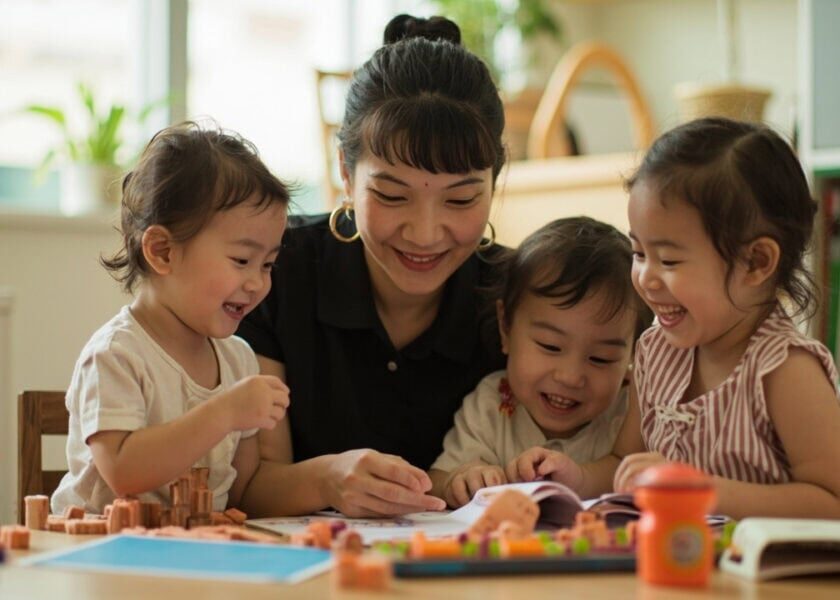
Beyond the Drop-Off: Building Partnership With Your Child’s Caregiver
The Moment You Realize Someone Else Knows Your Child
There is a moment — and if you are a parent in Singapore navigating infant care, you probably already know it — when you realize that the person who cares for your child five days a week has become someone your daughter or son turns to in ways that sometimes surprise you.
Your daughter has started saying a word you have never heard at home. Your son has developed a preference — for a certain song, a particular toy, the window seat where he watches the world — and you learned about it from someone else.
This is not a crisis. It is not even unusual. But for many parents, it marks the beginning of a feeling they rarely name aloud: the quiet, persistent question of how to belong in a relationship that exists partly outside their presence, partly outside their control, and entirely inside their heart.
The paperwork is signed. The first drop-off is survived — with maybe a tear or two from someone small and someone not so small. And then what?
For too many families in Singapore, the answer is: you wait at pickup, exchange pleasantries, trust that the day went well, and carry the uncertainty home with you.
But enrollment is not an ending. It is a beginning — and not always of what you expected.
What Enrollment Actually Begins
What begins is something far more demanding and far more rewarding than finding good childcare. What begins is the ongoing, evolving, sometimes uncomfortable, always important work of partnership.
Not the partnership of a service provider and a client. Not the partnership of a school and a parent. The partnership of two people who share the same child, who want the same things for that child, and who must learn, over months and years, how to be on the same side of the table — even when the table is not always level.
This is the tension that most parenting resources in Singapore never quite address. They tell you how to choose a caregiver. They tell you how to prepare your child for transitions. They tell you to trust your instincts.
These things matter — truly they do. But they do not tell you what happens after.
They do not tell you how to show up for a relationship you did not choose but must now navigate. They do not tell you how to communicate without micromanaging, how to raise a concern without breaking trust, how to honor someone’s expertise while remaining, ultimately, the decision-maker for your own child.
The Parents Who Thrive: What They Understand
The parents who feel most at ease with their child’s caregiver are rarely the ones who found the “perfect” arrangement. They are the ones who stopped treating the arrangement as a transaction and started treating it as a relationship.
They understood — perhaps gradually, perhaps with some missteps along the way — that the caregiver who walks alongside their family is not someone hired to do a job and leave. She is someone who has become part of the emotional architecture of that child’s life.
And the parents who thrive in this arrangement are the ones who found a way to be part of that architecture too.
Questions That Go Beyond the Surface
What does that look like in practice? It looks like knowing what questions to ask at pickup that go beyond “did she eat, did she sleep.” It looks like asking about the texture of her day — what made her laugh, what frustrated her, what she reached for when she needed comfort.
These are not nosy questions. They are the questions of a parent who is paying attention, who is building a picture of her child’s inner life even when she is not in the room to see it.
And when a caregiver knows you ask these questions, something shifts. She starts to see you not as someone who will judge her or evaluate her, but as someone who cares as deeply as she does about the small person in the middle.
Reading the Signs of a Healthy Dynamic
It looks like learning to read the signs of a healthy dynamic. Your child runs to her caregiver when you drop him off, and your first instinct might be a small, complicated pang — should it not be me?
But if you stay with that feeling, you will miss what is actually happening. Your child is showing you something extraordinary. He is showing you that he feels safe enough with this person to want her when you are gone.
That is not a betrayal of your bond. That is proof that the bond is strong enough to hold him when you step away.
A child who runs to his caregiver with joy is a child who has learned what security feels like. That is the partnership working. That is both of you doing your jobs.
How to Raise Concerns Without Breaking Trust
The partnership works best when it is tended with intention — not just when something goes wrong, but in the ordinary rhythms of communication and respect.
There will be days when something unsettles you. Perhaps your child came home with a mark you cannot explain. Perhaps she mentioned a phrase that concerned you. Perhaps he seemed more tired than usual, or more withdrawn, or just — different.
Your instinct might be to demand answers, to interrogate, to escalate. And sometimes escalation is right. But before you go there, pause.
Ask yourself: what am I actually trying to find out? Am I trying to understand, or am I trying to control? Am I looking for partnership, or am I looking for permission to doubt?
The Phrase That Changes Everything
The parents who build lasting, trusting relationships with their caregivers have learned to voice concerns without accusation, to ask questions without hostility.
They say: “I noticed this and I wanted to talk about it.”
Instead of: “What happened?”
The first approach invites collaboration. The second invites defensiveness. And the caregiver who feels defensive will not tell you what you really need to know. The caregiver who feels trusted will tell you everything.
Holding Both Truths at Once
This does not mean you defer to expertise you do not trust. It does not mean you swallow concerns or ignore red flags. It means you hold both truths at once:
- You are the parent, the decision-maker, the one ultimately responsible.
- The person caring for your child has knowledge, experience, and insight that you do not have.
Both of these things are true.
The parent who cannot hold both truths tends toward either micromanagement or disengagement — and neither serves the child. The parent who can hold both truths tends toward something rarer and more valuable: genuine collaboration.
What Genuine Collaboration Looks Like
You arrive at pickup, and your child’s caregiver tells you that she had a breakthrough today — she finally said a new word, or she ate something new, or she climbed the big slide at the playground and looked so proud.
Your response is not “oh that’s great” while you gather your things. Your response is: “I have been trying to get her to eat that at home. What did you do?”
And she tells you, and you listen, and maybe the next day you try her approach, and it works, and you mention it the following week — “we tried your thing and it worked, thank you.”
That is not a transaction. That is a relationship. That is two people learning from each other on behalf of a child.
When the Pieces Align
Or perhaps it looks like this: you have noticed something about your child’s temperament that you have not been able to articulate to anyone. You mention it in passing to the caregiver, almost apologetically.
And she says: “Oh, I have noticed that too. I have been doing X when she gets like that.”
And suddenly you realize you have been doing Y at home, and she has been doing X, and your child has been getting inconsistent messages. And now that you know, you can align.
That is the partnership working. That is what happens when parents and caregivers stop orbiting each other at a polite distance and start actually talking.
EduNanny: Partnership as a Design Principle
Your child’s caregiver is not your employee. She is not a stranger. She is not a convenience or a compromise. She is a person who has been trusted with something precious, and she is doing that work with skill, with care, and — we believe — with love.
This kind of partnership does not happen by accident. It requires something from the family — a willingness to be vulnerable, to communicate, to trust when trust has not yet been earned and to rebuild it when it falters.
But it also requires something from the arrangement itself. It requires a structure that makes communication possible, that holds transparency as a value rather than a threat, that gives caregivers the respect and the conditions they need to be full partners rather than isolated workers.
There is a difference between a philosophy and a structure. A philosophy can be held sincerely and still not survive a Tuesday afternoon when everyone is tired. A structure is what remains when things are hard.
How Our Model Supports the Partnership
| Feature | What It Means for Your Family |
|---|---|
| Home-based care | Your child is not one of twenty or thirty in a room. Focused, responsive care is possible — and sustainable. |
| Up to 1:3 caregiver ratio | Caregivers can truly know your child. Communication goes deeper because there is time to observe, to notice, to share. |
| Monday–Friday care blocks | Reliable, consistent care that lets you work, plan, and breathe — without the anxiety of unpredictable arrangements. |
| CCTV access where available | You can see what your child sees. Not because we have something to hide, but because you deserve to see. Partnership requires visibility. |
| Communication protocols | Updates that go beyond the perfunctory. Questions welcomed. Concerns handled with care, not defensiveness. |
| Affordable pilot fees | Child Development Account and Baby Bonus funding can apply. This is not just a good choice — it is a possible one for many families. |
We are part of the ECDA Childminding Pilot, and we take that responsibility seriously. The pilot exists because Singapore recognized — as many societies are now recognizing — that the way we care for our youngest children matters, not just for families, but for the kind of society we are building.
Transparency, over time, builds something more valuable than reassurance. It builds evidence — evidence that your child is thriving, that the caregiver who holds her during the afternoon is the same person who celebrates her small victories, that this arrangement is doing exactly what it is supposed to do.
Ready to Begin the Work That Matters
If you are a parent in Singapore who is navigating this — who has enrolled your child and found yourself unsure how to be present in a relationship that exists partly beyond your reach — you are not alone.
Addressing What Parents Actually Worry About
“I do not know how to be this kind of parent.”
The fear many Singapore parents carry is the fear of not knowing how to be the kind of parent this arrangement requires. You were not trained for this. There is no manual. Your own parents may not have used childcare at all, or if they did, the landscape was so different that their experience feels irrelevant.
You are navigating something new, and you are doing it while sleep-deprived, while working, while trying to hold together all the pieces of a life that includes a small person who depends on you absolutely — and also, infuriatingly, sometimes prefers someone else.
The uncertainty you feel is not a sign that you are doing it wrong. It is a sign that you care enough to notice, to question, to want to do better. The parents who never wonder whether they are showing up enough are usually the ones who are not paying attention.
“What if something goes wrong?”
There will be imperfect days. There will be miscommunications. There will be moments when the gap between what you expected and what happened feels like a chasm.
Here is what the families who have found their footing in this arrangement have learned: they stopped trying to be the only expert in their child’s life and started being the kind of expert who welcomes other experts. They stopped managing the relationship from a distance and started inhabiting it.
They stopped asking “how do I know if this is working?” and started looking — really looking — at the evidence right in front of them:
- A child who runs to her caregiver with joy and runs back to her parent with the same joy.
- A child who is learning, growing, changing, thriving.
- A child who has more than one safe person in her life and is not confused by that but strengthened by it.
“Is my child getting mixed messages?”
When you see your child running toward the caregiver with genuine delight, that is your child telling you something important: she feels held. When your child comes home and tells you about her day with a caregiver’s name woven into the story — “Mdm Lian says the ants have tunnels” — that is your child telling you that she is being noticed, taught, cherished by someone who matters.
That is not a diminishment of your role. That is an expansion of your child’s world.
And when you, as a parent, learn to hold that truth — to feel genuine warmth toward the person who holds your child during the hours you cannot — you will find something unexpected. You will find confidence.
Not the false confidence of control, but the quiet, steady confidence of someone who knows she is part of something larger than herself.
A Partnership Worth Showing Up For
EduNanny was built for parents who want more than a service. We were built for parents who understand that the caregiver raising their child is not someone they hired and should not be someone they manage. She is someone they partner with. She is part of their village, whether that village was chosen or grew.
We believe that when families and caregivers are brought together in a structure that values communication, respects expertise, holds transparency as a habit rather than a policy, and places the child’s well-being at the center — everything changes.
- The anxiety quiets.
- The questions become smaller.
- The answers become clearer.
- And the child — the child flourishes.
If you are ready to explore a model where partnership is not an afterthought but a foundation, we invite you to connect with us and learn more about what we are building together with families across Singapore.
Your child’s caregiver is not your employee. She is your partner. And if you are ready to show up for that partnership, your child will show you it was worth it — day after day, in small moments and big ones, in words you did not expect and milestones you will not forget.
That is the partnership working. That is what we are here for.
And we are honored to be here with you.
#infantcareSingapore #childmindingSG #parentcaregiverpartnership #EduNannySG #homebasedchildcare