Fraud Blocker edunanny.com

Category: Childminding

edunanny-065758a940076bdd4395673cb6d6073e
May 16, 2026

Your Child Is Telling You Everything: Signs of Genuine Thriving

The Question Every Singapore Parent Asks at Drop-Off

There is a particular silence that follows the morning handover. You have handed your child to someone else, walked back to your car or caught the MRT, and the day stretches ahead. You know your child is safe, that the arrangements are good, that the caregivers are kind. And yet somewhere in the quiet of those morning hours, a question surfaces that you cannot quite silence:

Is my child truly okay? Not just settled. Not just managing. But okay in the way that matters for the long arc of their growth.

This question lives beneath the surface of almost every Singapore parent who entrusts their child to someone else’s care. It is not a sign of doubt or anxiety. It is a sign of love—and it deserves an honest answer.

This article offers that answer: not as reassurance alone, but as understanding. Because children are constant communicators. They tell us everything we need to understand about their inner world, not in words but in behavior, in the quality of their play, in how they move through the hours we are not there to see. The question is not whether our children are speaking. The question is whether we know how to listen.

In This Article

  • How genuine emotional adjustment differs from surface compliance
  • What thriving actually looks like beyond the first weeks
  • Why caregiver quality is the foundation of everything
  • Questions to ask when choosing childcare in Singapore
  • How EduNanny Singapore approaches the parent-caregiver partnership

How Children Actually Adjust to Childcare

In those first weeks of childcare—whether home-based or centre-based—every child is engaged in the same fundamental work. They are learning whether this new world is safe. Not intellectually understanding it, but sensing it in their bodies, in the tone of voices around them, in whether their needs are met with consistency.

This is not a test they are passing or failing. It is a biological process that has been unfolding in human children for as long as humans have raised children in groups outside the immediate family.

The Secure Base: Where Adjustment Begins

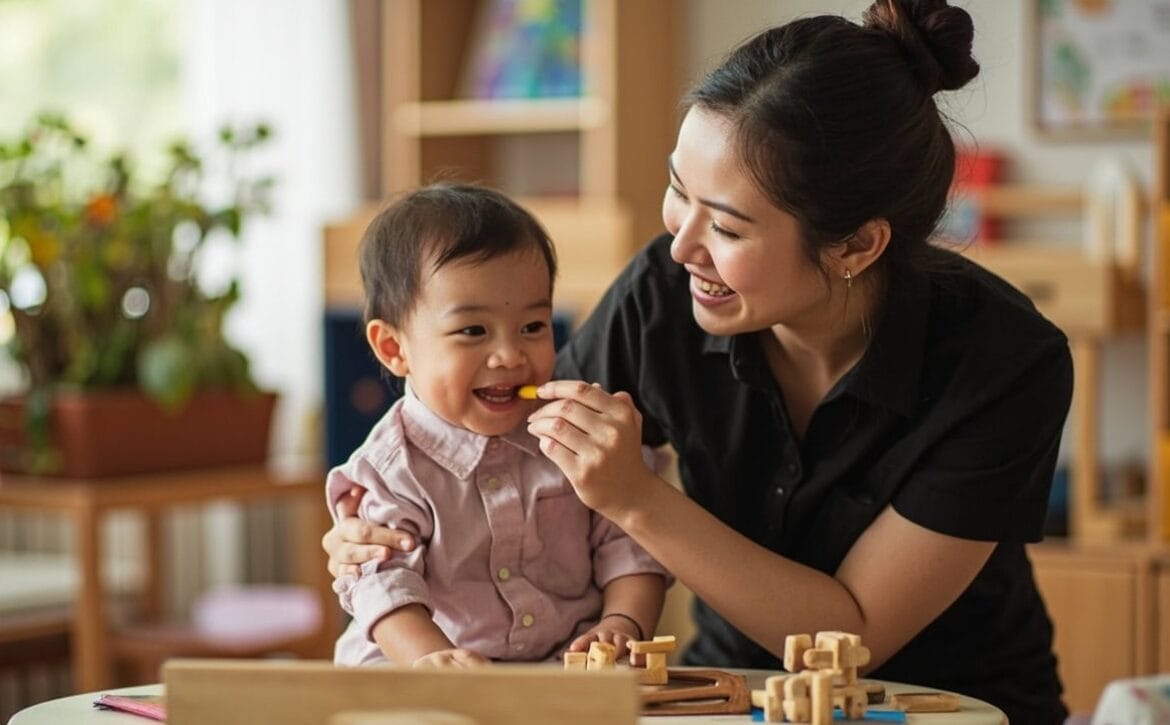
A child who is beginning to feel safe will not necessarily stop crying at drop-off immediately. But something shifts in the quality of that distress. It becomes less panicked, more protest-like. The child may still be upset, but they are looking toward the caregiver now—not just away from you. They are checking whether this adult will respond.

When that response comes, reliably, even once, something builds. It is the beginning of what developmental psychologists call a secure base.

A secure base is a person—your child’s caregiver—who your child learns to trust not as a replacement for you, but as a reliable extension of your care. When a child has a secure base, they can explore the world around them with confidence because they know where to return when they need comfort.

In a childcare setting, this looks like:

  • A child who, after initial hesitation, begins to engage with toys, with other children, with the rhythms and routines of the day
  • A child who, when distressed, seeks out a specific caregiver and settles more quickly in their arms than elsewhere
  • A child who, over weeks and months, is visibly less depleted at pickup than they were in those first difficult days

Genuine Adjustment vs. Surface Compliance

This is the distinction that matters most.

A child who is merely compliant may seem quiet, may appear to have settled—but something is missing. There is a flatness to their engagement. They are not exploring. They are enduring.

Surface compliance looks like: a quiet child who never cries, who seems content, but who shows little spark or engagement with their environment.

Genuine adjustment looks like: a child who may have hard moments, even tears, but who is also visibly engaged, exploring, connecting—with bursts of energy and curiosity that show they are present, not just surviving.

The Non-Linear Nature of Adjustment

Here is what every parent needs to know: this process takes time, and it does not move in a straight line.

A child who seemed fully settled may regress after a long weekend, a holiday, or an illness. This is not a failure. This is how attachment works. It is built through repeated experiences of reunion after separation, of needs met after they are expressed.

The childcare journey is not a mountain you climb once and descend from. It is a winding path your child walks, sometimes advancing and sometimes circling back. Your role as a parent is not to judge whether they are progressing fast enough, but to remain steady, to trust the process, and to partner with the caregivers walking beside you on that path.


Signs Your Child Is Genuinely Thriving, Not Just Settling

Initial adjustment is only the beginning. Beyond those first weeks, what does it look like when a child is genuinely flourishing in their childcare arrangement—not just surviving it?

What Thriving Looks Like Over Time

They play with depth. Not just activity for activity’s sake, but sustained, imaginative play that shows cognitive engagement. Watch for this at pickup or on weekends: the child who can lose themselves in a scenario, who builds narratives with toys, who engages deeply rather than flitting from one thing to the next.

They solve problems. How to fit the blocks together. How to negotiate for a toy. How to navigate a social conflict with another child. These small, everyday problem-solving moments are markers of cognitive and social development unfolding.

They show a full range of emotions—including frustration and anger. This is actually a positive sign. A child who feels genuinely safe is not performing constant contentment. They are confident enough to express displeasure, knowing they will still be held.

They develop rituals and preferences they claim as their own. The way they like their blanket arranged. The song they ask for at nap time. The friend they seek out at circle time. These small ownership behaviors show investment in their environment.

They develop a visible inner life. You will see it at pickup. Not just a happy child, but a child who has stories to tell, who runs to show you something, who talks about their day with genuine enthusiasm. This is the sign of a child who has been present in their own development, an active participant in the hours you were apart.

What This Looks Like at Different Stages

Stage Surface Indicators Depth Indicators
Weeks 1–4 Crying decreases; child accepts caregiver Child looks toward caregiver for comfort; protest is purposeful, not panicked
Weeks 5–12 Child seems comfortable at pickup Child seeks specific caregiver; engagement is curious, not passive
Months 3–6 Child appears happy overall Child shows emotional range; has preferences and rituals; brings stories home
Months 6–12+ Child settles easily Child problem-solves; forms peer relationships; shows visible inner life

Why Caregiver Attention Is the Foundation of Everything

These signs of thriving can only emerge when the conditions for genuine development are present. And those conditions begin with one thing: the quality of attention your child receives.

The ratio of caregivers to infants is not just a logistical detail. It is the foundation of everything.

When a caregiver is responsible for one, two, or at most three infants, something changes in the quality of attention each child receives:

  • There is time to notice when a child’s play deepens and to support that deepening
  • There is space to respond to distress with presence rather than efficiency
  • There is the ability to learn each child’s particular language—their unique signals, the specific ways they communicate hunger, tiredness, overwhelm, or delight

Beyond ratios, consistency matters profoundly. A child forms trust through repeated, predictable experiences. When the same caregiver is present day after day, the child can build that secure base. When caregivers rotate frequently, that foundational security is harder to establish.

Singapore parents should feel empowered to ask: Who will be my child’s primary caregiver? How consistent is the staffing? What happens when a caregiver is sick or leaves?


Building the Right Partnership With Your Child’s Caregivers

You are not a passive observer of your child’s development. You are an active participant—and the best childcare arrangements reflect this.

A Two-Way Dialogue

Good childcare is not a one-way street where care is delivered and you observe results. It is an ongoing dialogue, a shared observation of your child, a willingness to adjust when what is being done is not working for them.

We expect you to tell us what you see at home. We commit to telling you what we see during the day. Together, we build a picture of your child’s development that neither of us could see alone.

Transparency That Honors Your Need to Know

Singapore parents carry particular burdens: the cost of living, the demands of dual-income households, the pressure to return to work before you feel ready, the guilt that sometimes surfaces not because you have done anything wrong but because the culture around parenting has made guilt feel inevitable.

We do not want to add to that burden. We want to offer something different: not just practical support, but knowledge. We want you to leave every conversation understanding more about your child, not feeling more uncertain.

Where deployed, our arrangements include communication measures that allow you to feel connected to your child’s day—to see through the uncertainty, to have windows into what you cannot witness directly. This is not surveillance. It is honoring the reality that you, as a parent, need to know your child is okay, and that knowledge should not require blind trust alone.

Trust is built through information, through relationship, through the consistency of what you are told matching what you observe in your child at home.

When Something Is Not Working

If your child is showing signs of distress that persist beyond the normal adjustment period—if they are more withdrawn at home, if they seem depleted rather than energized by their time in care—these are messages that deserve attention.

They may point to:

  • A mismatch in caregiving style
  • A ratio that is too high for your child’s particular needs
  • A pacing of the day that does not suit your child’s temperament

These are not failures. They are information—and a good childcare arrangement should be set up to receive and respond to that information honestly and quickly.


What to Look For and Ask When Choosing Childcare in Singapore

Understanding these concepts is one thing. Applying them to your own child’s situation is another. Here is how to use this framework as you evaluate childcare options and as you observe your child over time.

Questions to Ask During Your Search

  1. What is the caregiver-to-infant ratio? Smaller is generally better for genuine development.
  2. Who will be my child’s primary caregiver? How consistent is staffing?
  3. How do you communicate with parents? What windows can I expect into my child’s day?
  4. How do you handle adjustment periods? What is your approach when a child is struggling?
  5. What does a typical day look like? Is there rhythm and routine that allows children to anticipate what comes next?

What to Observe at Home

As your child settles into childcare, pay attention to:

  • The quality of their play: Is it sustained and imaginative, or flat and perfunctory?
  • Their emotional range: Do they show frustration, anger, joy, delight—or only a sameness?
  • Their stories: Do they have things to tell you about their day?
  • Their energy at pickup: Are they depleted and collapsed, or tired but present?
  • Their curiosity: Are they exploring their home environment with confidence?

Trust Your Instincts

You know your child better than anyone. If something feels off—if your instinct says your child is not okay even if they appear calm at drop-off—that instinct deserves attention.

A good childcare arrangement will welcome that conversation. They will observe alongside you, share what they see, and work with you to understand what your child is communicating.

Building Your Village

What you are doing when you arrange childcare—whether through a home-based arrangement with a trusted childminder or through a centre-based pathway—is building a village. It is not a replacement for family. It is an extension of it.

The caregivers who care for your child become part of your child’s understanding of who is safe, who can be trusted, who loves them even when you are not in the room. This is a profound responsibility—and it shapes children in ways that last long beyond these early years.

A child who has a secure base with their caregiver often shows increased security with you as well—not because the caregiver replaced you, but because they are learning, across multiple relationships, that adults are reliable, that care is consistent, that they can venture out and return.


Why EduNanny Singapore: Our Approach to Early Childhood Care

EduNanny Singapore operates within the ECDA Childminding Pilot framework, designed with these developmental realities in mind. We offer both home-based care and pathways through community and centre-based settings, because families are not all the same and the kind of care that works for one may not work for another.

What remains constant across our approach:

  • Small ratios that make real attention possible
  • Consistency that allows attachment to form
  • Transparent communication with parents that transforms childcare from a black box into shared understanding
  • Flexibility within pilot fee structures and CDA/BabyBonus usability to ease the financial weight of quality care

But beneath all of it is something simpler: we see your child. Not as a task to be managed, not as a slot to be filled, but as a whole person in the middle of the most important work of early life.

We see the way they light up when they master a new skill. The way they process a disappointment. The way their understanding deepens over weeks and months—how they begin to anticipate routines, how their language explodes after they first arrive, how they form attachments to other children as well as caregivers, building a social world that will shape them in ways we are only beginning to understand.

We see you too. The parent who drops off with that particular mixture of love and reluctance. The parent who texts to ask how nap time went. The parent who wonders if their child is truly okay in the hours of separation.

We know that you are doing the best you can. We know that you did not receive a manual for this. We know that the hours you are apart from your child are not wasted time but necessary time—for you and for them—and that they deserve to be hours of genuine growth, not just safe waiting.


Ready to Begin the Conversation

When you drop your child off tomorrow morning, or next week, or whenever your childcare journey begins, notice what you feel. That tenderness. That slight ache. That question that surfaces: are they truly okay?

The answer is that your child is communicating constantly—in every behavior, in every expression, in the quality of their play and the depth of their sleep and the way they reach for you at pickup. They are telling you about their inner world.

As you learn to hear them, as you build the partnership with the caregivers who share in this work, as you develop your own framework for understanding what genuine thriving looks like, something changes. Not just for your child, but for you.

You become a more attentive parent. A more confident one. Someone who trusts their own observations and knows how to interpret what they see.

That is the gift of understanding. Not the absence of worry, but the transformation of worry into something useful. Into presence. Into the kind of attention that children feel, even when they cannot name it, and that shapes them in ways that will last long beyond these early years.

Early childhood is the most consequential time in human development. The conditions under which children grow in those early years matter more than we have historically acknowledged. Every study, every observation, every child who has walked into quality care and walked out months later more confident, more curious, more themselves—this tells us that what happens in these hours matters. It is not a footnote in your child’s life. It is the foundation.

EduNanny Singapore is here to walk this path with you. To offer the knowledge, the care, the partnership, and the village that every child and every family deserves.

Your child is telling you something. We hope, after today, you feel a little more ready to listen.

If you are exploring childcare options in Singapore and want to understand how our approach supports genuine child development—beyond surface settling to real thriving—we welcome the conversation.

Learn more about home-based and centre-based pathways available through the ECDA Childminding Pilot framework, and find the arrangement that fits your family’s needs.


Every child deserves a secure beginning. Learn more about the EduNanny approach.

edunanny-06574aa0cf779515cefe46749e81a64c
May 16, 2026

How Singapore Parents Can Recognize True Quality in Childcare

The Three Dimensions Where Quality Reveals Itself

Most parents ask the questions they have been told to ask—ratios, qualifications, meals, curriculum. These questions matter. But they rarely distinguish between one option and another, because most centres have acceptable answers to them.

What you need to know is what quality looks like when it is actually present. Quality in childcare is not abstract. It is observable. It reveals itself across three dimensions, and when you learn to watch for them, they become one of the most empowering tools you have as a parent.

Dimension One: What Your Child Reveals

The first place to look is at your child. Not at the centre, not at the programme—your child.

Arrival and Departure

Consider how your child responds to arrival. Not just on the first day, but over time. A child who feels genuinely held by the care environment will show increasing ease—not necessarily excitement every morning, but a willingness to go, an absence of dread, a settling into routine.

Watch their body language. Notice whether they move toward their caregiver with recognition, or merely tolerate the handoff. These small gestures carry information. A child who feels known will show it.

What They Bring Back

Consider what they tell you about their days. When a child is in an environment of genuine engagement, they bring back fragments—stories, songs, names of children they have played with, small discoveries they have made.

When the care is adequate but not exceptional, children often struggle to articulate much beyond the routines: we ate, we slept, we played. The richness of what they share is a window into the richness of what they experienced. This difference is more significant than it might first appear.

Overall Development

Consider their overall development—not just physical growth, but the soft signs of cognitive and emotional progress. Are they picking up language at a pace that reflects responsive interaction? Are they developing social instincts—sharing, taking turns, reading the emotions of others? Are they becoming more confident in their independence, or more anxious?

Quality care, over time, produces a child who is expanding, not just being kept safe. These observations are not diagnostics. They are signals. And when you begin to read them with intention, you will be surprised at how clearly they tell their story.

Dimension Two: What Caregivers Show You

This dimension requires more courage to examine: what you observe in the caregivers themselves.

Most parents focus on scripted interactions—the warm greetings during tours, the professional presentations during orientations. But the moments that reveal character are elsewhere.

How They Respond to Difficulty

Ask yourself: how do the caregivers respond when something goes wrong? When a child is upset, frustrated, or acting out, how does the caregiver respond? With patience? With genuine curiosity about what is driving the behaviour? With a calm, respectful tone that treats the child as a person who deserves understanding?

These moments are revealing. A caregiver who can remain grounded and kind during conflict has moved beyond the performative warmth of their job description into something more authentic. This is the quality you cannot manufacture with a tour script. You can feel the difference.

The Unguarded Moments

Notice how they speak to children when they are not aware of being watched. The tone of voice, the level of respect in their language, the way they handle transitions—these are the unguarded moments that tell you who they really are. A caregiver who is genuinely warm will be warm when no one is keeping score.

How They Communicate Difficulty

When something difficult happens—a fall, a conflict between children, a moment when your child was distressed—how is it communicated to you?

Quality caregivers and quality programmes do not hide difficulty. They communicate it clearly, without blame, without minimising. They trust parents enough to share the whole picture, including the moments that were not perfect. That kind of honest communication is not a sign of weakness. It is a sign of confidence. And it is one of the clearest indicators you will find.

Dimension Three: What Daily Life Tells You

Here is a truth that is rarely spoken plainly: the most revealing aspects of a childcare environment are often the most mundane.

How do the children move through their day? How are transitions handled—are they rushed and chaotic, or do they reflect an understanding of children’s need for predictability and gentle pacing? How do mealtimes and nap times function? What does the programme actually do all day, and does that reflect an understanding of how young children learn?

The Gap Between Philosophy and Practice

Walk through a centre during an ordinary afternoon, not just a formal tour, and pay attention to what you see. Are the children engaged, or merely occupied? Is the noise the noise of joyful discovery, or the noise of children who have nothing meaningful to do? Are the caregivers down at the children’s level, interacting and facilitating, or are they positioned apart, supervising but not engaging?

The small details of daily life tell you more than any brochure ever could. They reveal whether the stated philosophy has been genuinely integrated into practice, or whether it is simply a layer of language applied to the surface.

Reading the Environment

Look at how the space is used. Is it arranged to invite exploration and interaction, or simply to manage large groups? Do the materials on offer reflect an understanding of child development, or are they generic and impersonal?

The environment is not decoration. It is a statement of intent about how children are valued and how learning is understood.


The Questions That Reveal Truth

Beyond watching and observing, there are questions worth asking—questions that probe beneath the surface of policy and into the domain of understanding.

Ask a caregiver what they do when a child refuses to sleep. Ask what happens during a conflict between children. Ask how they would describe their approach to a difficult moment with a parent. Ask them what they find most challenging about this work.

Listen carefully to the answers. Do they respond with specific, thoughtful examples—stories from their actual experience? Or do they give you generalities, rehearsed phrases, corporate language?

A caregiver who has genuinely reflected on their work will speak with specificity. They will tell you what they actually do, not just what they believe in theory. The way a caregiver answers difficult questions tells you whether they have thought deeply about their practice or whether they are simply executing a script.

This is the practical eye we are talking about developing. It is not about expertise you lack. It is about paying attention to the things that matter, and trusting that when you see them, you will recognise them.


Where EduNanny Fits: Making Quality Observable

The quality we have been describing—quality that reveals itself through your child’s development, through caregiver authenticity, through daily routines that reflect genuine understanding—this is what EduNanny Singapore is built to offer.

EduNanny operates within the ECDA Childminding Pilot, a framework designed to make quality infant care genuinely accessible to Singapore families. The pilot structure is intentional: it creates the conditions for the kind of individualised, attentive care that is nearly impossible to find in large centre settings.

With ratios that allow caregivers to know each child as a person—not just a name on a roll—EduNanny creates the space for quality to actually emerge in daily life. When there are fewer children to care for, caregivers can be present in a different way. They notice the small shifts. They respond to the individual child. They build the kind of relationship that leaves marks on a child’s development.

Families can access care through home-based or centre-based pathways, depending on what fits their circumstances. Care blocks run Monday through Friday, providing the reliable structure that working parents need. Within the pilot fee structures, the cost is designed to be genuinely affordable. CDA and Baby Bonus funds can be used—removing one more barrier between families and quality care.

Where CCTV measures are deployed, they serve a clear purpose: transparency and trust. Parents can feel confident that the care their child receives is visible, accountable, and open. Communication is prioritised—not just the expected daily updates, but genuine dialogue about your child’s development, their moods, their discoveries, and their struggles.

These are not just features. They are expressions of a philosophy: that parents deserve to be active participants in understanding their child’s care, not passive recipients hoping for the best.


Addressing Your Concerns

The fear that often sits beneath all this is the fear that you will miss something important. That you will be fooled by a polished presentation while the reality is something else entirely. Here is how to think about that fear.

“What if I miss something important?”

The answer is not to become hypervigilant or to second-guess every decision. It is to develop the observational framework we have been describing—because when you know what to look for, you stop worrying about what you might miss. You start trusting what you see.

“How do I know if the warm welcome during tours is real?”

You cannot know this from the tour alone. But you can know it from what comes after: how your child settles, what they tell you about their day, how the caregiver handles the inevitable difficult moments, how communication flows when something does not go perfectly. The tour is a beginning, not a verdict. The relationship reveals itself over time.

“I don’t have the expertise to evaluate childcare professionals.”

You do not need expertise. You need attention. You do not need to understand child development theory. You need to observe whether your child is thriving, whether the caregiver treats your child with respect, whether the daily environment reflects genuine care.

Your instincts are more reliable than you think. This article is not about replacing your judgement with a checklist. It is about helping you trust the judgement you already have.

“What if I make the wrong choice?”

The question assumes that choosing well means choosing perfectly. It does not. Choosing well means developing the capacity to evaluate, to observe, to recognise quality when it is present—and to recognise when something is not working. That capacity stays with you. If the first choice does not meet the standard you have learned to recognise, you will know. And you will be able to act.


How to Begin: A Practical Starting Point

If you are beginning this evaluation journey, here is where to start:

  1. Observe your child before and during any care arrangement. What are they like on a typical morning? What do they tell you about their day when they come home? These are your baselines. They will tell you when something changes.
  2. Visit during ordinary times, not just tour hours. Ask if you can observe an afternoon, not just the morning orientation. What you see during an unscripted afternoon reveals more than any prepared presentation.
  3. Ask the difficult questions. How do you handle a child who is having a hard time? What happened the last time something went wrong? How do you communicate that to parents? Listen not just for the answer, but for the quality of the thinking behind the answer.
  4. Watch the caregiver, not just with your child, but with all the children. How do they speak to other children when they are not aware of your presence? How do they handle transitions? These unguarded moments reveal character.
  5. Trust the accumulation of small signals. No single observation is definitive. But when small signals accumulate in the same direction, they tell a story. Pay attention to patterns. They are more reliable than any single impression.

Moving Forward with Confidence

The goal was never to find the perfect childcare arrangement. The goal was to develop the capacity to recognise quality when it is present—and to trust that capacity in yourself.

What helps is not more reassurance. It is more clarity. It is developing the practical eye we have been describing, and knowing that when you see quality, you can trust it. It is moving from hoping you chose well to knowing how to evaluate well.

When you have that kind of clarity, something changes. The anxiety loosens its grip. The relationship with your child deepens, because you are no longer carrying the burden of wondering. You are engaged with your child’s life in a different way—not with doubt, but with the kind of informed certainty that allows you to be fully present.

That parent is giving their child something invaluable: the security of being truly seen and understood, by caregivers and by the parent who chose them. The signs are there. When you know how to look, you will always know.

EduNanny Singapore welcomes families who are looking for something more—genuine quality infant care and childminding built on trust, attention, and the kind of honest communication that lets parents stay connected to their child’s daily life. Learn more about EduNanny’s approach or get in touch to begin a conversation about what care that truly observes and understands your child can look like.

edunanny-06573c8607a9d59f6ab8b8a1ddcbcbb2
May 16, 2026

What Your Child Is Becoming: Understanding Early Development as a Singapore Parent

What Your Child Is Becoming: The Science of Early Development

When a child spends their early years in quality childcare, something remarkable happens every single day.

Their brain is building itself at a pace it will never again reach. Connections are forming between neurons at a rate that neuroscience has documented extensively across decades of research. Language is being absorbed—not just in explicit lessons, but in every conversation, every song, every moment of being spoken to with attention and warmth. Social intelligence is developing through daily interaction with peers and educators. Motor skills are refining through the simple, repeated act of reaching, grasping, crawling, walking, climbing. Emotional regulation is being learned through the experience of feeling big feelings and being met with calm, consistent responses.

This is not metaphor. It is developmental science, and it tells us that the early years are not simply a waiting period before “real life” begins. They are real life. They are the foundation upon which everything else is built.

Every day that your child spends in quality care, something meaningful is happening inside them. Growth is occurring—not just physical growth, though that is real too, but cognitive, emotional, social, and relational growth. The child who left you this morning is not the same child who will come home to you tonight.

This is not a burden to place upon you. It is an invitation—an invitation to notice, to become a student of your own child’s development, to move beyond the question “Was my child okay today?” to the richer question: What is my child becoming, and how can I understand and support that becoming?


The Four Domains of Growth: What Parents Need to Understand

Developmental growth in the early years does not happen in a single, undifferentiated stream. Researchers and educators have identified distinct domains that, while deeply interconnected, offer useful frameworks for understanding what your child is working on. You do not need a degree in child development to recognise these domains in your own child. You need willingness to pay attention.

Cognitive Development

In the cognitive domain, you are looking for signs of thinking that is becoming more complex:

  • Object permanence—the understanding that things exist even when they cannot be seen. You hide a toy under a blanket and your baby searches for it. This represents a significant cognitive leap.
  • Symbolic play—when your toddler takes a block and calls it a phone, or feeds a doll as if it were real. This is the beginning of abstract thinking.
  • Problem-solving—your child is beginning to solve simple problems through trial and error, building the capacity for persistence that will serve them for a lifetime.
  • Curiosity and questioning—the “why” phase is not just adorable; it is cognitive development at its most active. A child who asks constant questions is building their understanding of how the world works.

Language Development

In the language domain, you are looking for the progression from sounds to words to sentences to conversation. But you are also looking for the things that are harder to measure:

  • Does your child seem to understand more than they can express?
  • Are they beginning to follow two-step instructions?
  • Do they use language to connect with you—not just to request things, but to share experiences?
  • Do they show interest in books, in being read to, in the texture of language itself?

Language development in the early years is not about producing prodigies. It is about the emergence of communication as a tool for relationship.

Social-Emotional Development

In the social-emotional domain, you are looking for the foundations of human connection:

  • Does your child show preference for certain people?
  • Are they beginning to show awareness of others’ emotions?
  • Do they develop the capacity to self-soothe, with support?
  • Are they beginning to show empathy, even in its earliest and simplest forms?
  • Are they developing a sense of security that allows them to explore, knowing they can return to a secure base?

Motor Development

In the motor domain, you are looking for the refinement of both gross and fine motor skills:

  • Gross motor skills—large movements like crawling, walking, climbing, running
  • Fine motor skills—smaller movements like picking up small objects, manipulating tools like crayons, spoons, and eventually pencils

You are also looking for the integration of motor and cognitive development—when your child begins to use their body to solve problems, to experiment, to learn about the physical world through movement.


Reading Your Child: Observation as an Act of Love

Here is where many parents feel stuck. They know, intellectually, that development is happening. But they do not always have a framework for seeing it, or for understanding what they are looking at when they observe their child in those precious hours between pickup and bedtime.

The transition moments offer more information than you might expect. How does your child respond when you arrive? Is there ease, or reluctance? Does your child initiate connection immediately, or need a moment to transition back to you? These are not problems to solve. They are information. They are your child’s way of telling you something about how they experienced the day.

Then there is what happens in the hours between pickup and bedtime. The dinner table conversation that is not really a conversation yet but is something—the way your toddler hands you a book with complete intention, the new sound they make when playing, the way they handle frustration differently than they did a month ago. These moments are data. They are evidence of the learning that occurred while you were apart.

A Framework for Observation

Observation, in this context, is not about clinical assessment or hypervigilant monitoring. It is about cultivating a quality of attention—slowing down enough in those after-care hours to actually see your child.

Ask yourself:

  • What is my child gravitating toward? What toys, activities, or books capture their interest?
  • How does my child approach challenges? With frustration? With persistence? With curiosity?
  • What is my child trying to communicate, even before they have words?
  • What seems easier for my child now than it was a month ago?
  • What seems harder? Where do they need more support?

Trust that noticing. You know your child better than anyone. When you observe carefully and reflect on what you see, you are building understanding that no external assessment can replace.

One Truth Worth Holding Gently

Children develop on their own timelines. This is not a platitude; it is a developmental reality. One child will walk at ten months. Another will not walk until fifteen months. Both are within the range of typical development. One child will speak their first words at nine months. Another will not speak until after their first birthday. Both are fine.

The danger comes when we begin to compare—to measure our own child against other children, against averages, against expectations that do not account for the beautiful individuality of each human being.

Your child’s development is a story that is being written in real time. It has its own plot, its own rhythm, its own arc. Your job is not to accelerate that story or to compare it to other stories. Your job is to understand it, to witness it, and to support it.


Extending Your Child’s Development at Home

Understanding your child’s development is valuable in itself. But it becomes even more powerful when you can extend that development in your home environment—when the learning that happens in childcare can be continued, reinforced, and built upon in the hours you share together.

This does not require elaborate activities or expensive materials. It requires intention and presence.

If your child spent the day working on stacking blocks at childcare: consider providing opportunities at home to continue that exploration. Stack containers in the kitchen. Build with cardboard boxes. Find age-appropriate toys that extend the same spatial reasoning skills.

If they were engaged in sensory play: find safe ways to bring sensory exploration into your home environment. Water play in the basin. Playdough (even a simple homemade version). Rice or sand in a tray.

If they are developing language: narrate your daily life together. “I am washing the vegetables. I am cutting the carrot into pieces. Now I am putting the pieces into the pot.” This narration is not just filling silence. It is building language, concept by concept.

If they are developing independence: create space for them to practise. Let them try putting on their own shoes, even if it takes longer. Let them help carry small items. Praise the effort, not just the outcome.

These domains do not develop in isolation, of course. A child’s cognitive development affects their social-emotional development. Their motor skills open up new possibilities for exploration and learning. Language becomes the tool through which all other development is expressed and extended. Understanding this interconnection is part of understanding your child as a whole person—not a collection of milestones to be checked off.


The Partnership Between Parent and Childcare Provider

This is where the partnership between parent and childcare provider becomes essential—not as a marketing phrase, but as a living practice.

EduNanny was built on a particular belief, one we want to share with you plainly. We believe that parents are not passive recipients of childcare services. They are the primary architects of their child’s development, and our role is to support, inform, and empower that architecture.

This means that we are invested in your understanding as much as we are invested in your child’s care. Our job is not complete when we hand your child back to you at the end of the day. Our job is complete when you feel you understand your child’s day, when you have insight into what is developing, and when you know how to extend that development in your home environment.

This philosophy shapes everything about how EduNanny operates within the ECDA Childminding Pilot. We have chosen a model with ratios that allow for genuine attention—one educator for every three infants in our care. This is not a regulatory minimum; it is a design choice. It means more observation. More individual interaction. More capacity to notice and document the small moments of growth that might otherwise be missed.

Questions That Reveal a Genuine Partnership

Not all childcare providers offer this kind of communication. If you are evaluating options, here are the questions that reveal whether a provider is genuinely invested in keeping you informed:

  • What did my child seem most engaged with today?
  • What is my child curious about right now?
  • What seems to challenge my child?
  • How is my child relating to other children in the group?
  • What new skill did my child attempt?
  • How did my child respond to challenges or big feelings today?
  • What can I do at home to support what my child is working on?

These are not intrusive questions. They are the questions of a parent who wants to understand. The right childcare partner will welcome them.

Addressing Common Concerns

“Will my child form a secure attachment if they spend their early years in childcare?”

Attachment is not a finite resource that gets divided. Children can form multiple secure attachments. They can have you at the centre of their relational world and still develop warm, supportive, nurturing relationships with skilled educators who see them, respond to them, and support their growth. This is not a threat to your role as parent. It is an enrichment of your child’s life.

“How do I know if my child is actually learning, not just being babysat?”

The question to ask is not whether your child is okay, but what they are learning. In quality care, the answer to “what did my child learn today” is always yes. Your child is always learning. The question is whether the programme creates the conditions for that learning to be visible, documented, and communicated to you.

“I feel guilty about leaving my child. Is that normal?”

It is entirely normal. It also does not need to define your experience. The love you have for your child and the desire to be present with them are beautiful things. When channelled into intentional engagement—asking questions, observing carefully, extending development at home, communicating with educators—that love becomes a powerful force for your child’s growth.


What EduNanny Offers Within the ECDA Childminding Pilot

We want to be direct about what we offer, because Singapore parents deserve clarity when making decisions about their children’s care.

Within the ECDA Childminding Pilot, EduNanny provides:

  • Small group ratios—one educator for every three infants, allowing for genuine individualised attention
  • Intentional observation and documentation—so that we can share meaningful insights with you about your child’s day
  • Communication rhythms—designed to go beyond daily logistics into the substance of your child’s development
  • Monday through Friday care blocks—structured around the realities of Singapore family life
  • Flexible payment options—including CDA and Baby Bonus usability
  • Home-based pathways—for families who prefer that arrangement
  • Transparent operations—including transparency measures that provide additional assurance to parents

We are not a service that simply watches your child while you work. We know that many childcare providers can offer that. What we offer is something different: a genuine investment in your child’s development, and an investment in your capacity to understand and support that development.


Your Role in Your Child’s Development: Moving Forward

As you understand more about attachment and development, you can bring that understanding home. You can be intentional about the quality of presence you offer your child in the hours you have together. You can notice when your child needs connection and when they need space. You can learn to read their cues, to understand their temperament, to see them as the unique individual they are rather than as a generic “child” whose development should follow a universal template.

This is what it means to know your child. Not just to love them, though of course you love them—that goes without saying. But to truly understand them. To have insight into why they respond the way they do, what they need, what they are working on, what they are afraid of, what excites them, what makes them feel safe.

This kind of understanding does not come all at once. It comes through patient, ongoing attention. It comes through the accumulation of small observations over time. It comes through conversations with people who also know your child—who see them in different contexts, who have different windows into who they are becoming.

And this is the gift of the partnership we are offering. It is not that we will tell you everything—there is no childcare provider who can do that, because no one knows your child the way you do. But we can offer you pieces of the puzzle. We can help you see your child from another angle. We can support your understanding of what is happening in those hours when you are apart, so that when you come back together, you can meet your child where they are.

There is a word that captures what this is all about: attachment. In the context of early development, attachment is not a soft concept. It is a biological imperative. Children are wired for attachment. Their brains develop in response to the quality of their attachments. The security they feel—or do not feel—in their earliest relationships shapes the architecture of their minds in profound and lasting ways.

This is why the quality of your child’s relationships in childcare settings matters so much. Not because educators can replace parents—they cannot, and should not—but because children can form multiple secure attachments, and the experiences they have in quality care contribute to the people they are becoming.

The child who went to childcare this morning is changed. They are different in some small way than they were when they left your arms. They have learned something. They have grown. They have taken one more step along the path of becoming whoever they are going to be.

Your job, and ours, is to understand that path. To see it clearly. To support it well.

If you are looking for a childcare partner who sees parents as the primary architects of their child’s development—someone who will not just keep your child safe, but will actively invest in your understanding of what is happening and how you can extend it—EduNanny would welcome a conversation with you.


Tags: #SingaporeChildcare #InfantCareSG #ChildmindingSingapore #EarlyChildhoodDevelopment #EduNannySG #ECDAChildmindingPilot #SingaporeParents #ChildDevelopment #QualityChildcare #ParentingInSingapore

edunanny-06572e6345587e5d9feef92f9fe5dce8
May 16, 2026

The Signal Your Child Sends Home Every Afternoon

The Question Every Parent Carries

There is a moment that happens every afternoon in Singapore. You arrive at the childcare door, or your child is handed back to you, and something passes between you. Your child may not say very much. They might be tired, or quiet, or they might rush into your arms with an explosion of words about something that happened, someone they played with, a song they learned.

But underneath all of that, you are looking for something. You are asking a question that no app can answer and no daily report can fully satisfy. You want to know: was my child okay today? Not just physically safe, but really okay. Was today a good day? Was my child happy? Was my child seen?

This question is not trivial. It sits beneath the surface of every enrollment decision, every facility tour, every conversation with a caregiver. And it is the most important question you will ask today—and probably tomorrow, and the day after that.


Why Modern Systems Miss What Matters

Most of the systems built around modern childcare are designed to answer a different question entirely. They tell you what time your child ate, how long they napped, what activities were on the schedule. These things matter. But they are not the same as knowing what your child actually experienced.

In Singapore, this tension is especially real. We live in a society where both parents often work, where the extended family may not be nearby, where the distances between home and childcare and office create a daily geography of separation. We have built wonderful tools to bridge these distances: communication apps, photo updates, daily diaries.

And yet, many parents will tell you that despite all of this information, something still feels missing. They still find themselves wondering whether the happy photo really captures the full truth of the day. Whether their child is truly thriving, or simply surviving the hours they are apart.

This is not a failure of the systems. It is something more fundamental—something that our constant connectivity has perhaps made harder to see.


Reading Your Child’s Real Report

The truth is, your child is already telling you everything you need to know. They have been telling you all along.

The report you are looking for is not in an app. It is in the way your child walks toward you at the end of the day. It is in their body language, their tone of voice, the games they want to play, the things they ask about, the way they sleep at night.

Your child is communicating their inner world to you constantly, and the quality of their day is written in their behavior in ways that no photograph can capture and no summary can replace.

Learning to read this report is not about becoming a child development expert. It is about trusting the connection you already have with your child, and learning to slow down just enough to notice what is already there.

Signs of Genuine Security

When children are in an environment where they feel genuinely secure, something remarkable happens. They are able to be fully themselves. They explore, test their growing capabilities, express their full range of emotions, and form real attachments with the adults who care for them.

When you pick up your child from this kind of environment, you may notice something. Your child might be tired—they have been busy learning and growing. But there is a quality to their tiredness that is different from mere exhaustion. There is a lightness to them.

They might have a lot to tell you, or they might be content in comfortable silence. But either way, you sense that something meaningful has happened in the hours apart. When you sit together in the evening, your child might engage with you in a way that feels deep and connected. They might play independently with a sense of security, checking in with you not because they are anxious but because they trust you are there. They might sleep well—not from exhaustion but from the kind of deep contentment that comes from a day of healthy engagement.

When Something Feels Off

A child who has spent their day in an environment where they were well-fed and safely supervised but not truly seen may come home with a very different presentation.

They may be clingy in a way that feels more desperate than affectionate. They may have difficulty settling, or their sleep may be restless. They may have learned to perform a version of happiness because they have learned that this is what gets positive attention, and the real complexity of their inner experience stays hidden.

This child is not unsafe. They are simply not thriving in the way that is possible when care goes beyond supervision and enters the realm of genuine attention.

The difference between these two children is not always obvious. You will not find it spelled out in a checklist. You will find it in the subtle but profound differences in the way your child moves through the world after a day of care.


What Genuine Care Looks Like

Quality care is not primarily about facilities or curricula or even activities. It is about the quality of attention your child receives throughout the day.

Why Attention Ratios Matter

When an infant care setting maintains a ratio of one caregiver to three infants, something changes in the quality of attention each child receives. It becomes possible to notice the small things: the slight change in a baby’s mood that might indicate tiredness or hunger or discomfort. It becomes possible to respond with genuine attunement rather than schedule-driven routine.

This is not simply a matter of better supervision. It is the difference between care that manages children and care that accompanies them.

  • In the first kind of environment, a child is part of a group that must be kept safe and entertained.
  • In the second kind of environment, each child is known.

A known child communicates differently than a managed child. They are more expressive, not less. They are more themselves, not less. The very behavior that a parent is looking for when they ask was my child okay today becomes more visible when the ratio of attention is high enough to allow for genuine noticing.

What to Look For

  • Caregivers who are present, not just supervising. They are engaged with the children, not looking at screens or distracted by administrative tasks.
  • Children who are curious and explorative. Not quiet because they have been told to be still, but engaged because they feel secure enough to investigate.
  • Emotional expression is welcomed. Children are not punished for crying or for expressing frustration. Caregivers respond with comfort and guidance.
  • Routines that serve the child, not the schedule. Feeding and sleeping happen when children need them, not at rigid predetermined times.
  • Caregivers who notice small changes. They can tell when a child is off-color before it becomes a full meltdown.

The Pickup Observation

When you collect your child, pause for a moment before you look at the app or ask the caregiver what happened today. Instead, simply observe your child.

Notice how your child moves toward you. What is their body language communicating? Are they tired but content, or tired in a way that suggests stress? Do they seem relieved to see you, or clingy in a way that suggests anxiety? What do they want to do in the first few minutes after pickup?

These observations are real data. They tell you something meaningful about your child’s day.


EduNanny’s Approach to Childcare in Singapore

This is the foundation of what EduNanny by BUTLER has built, and it is why the approach here is different from what you might find elsewhere.

EduNanny operates as part of the ECDA Childminding Pilot, which represents a thoughtful response to a real need in Singapore’s childcare landscape. The pilot recognizes that families have different needs and that one-size-fits-all solutions do not serve every family well.

Whether through home-based care, community pathways, or centre-based settings, EduNanny offers families meaningful choices in how and where their children are cared for. What unites all of these pathways is a shared commitment to the quality of attention we have been discussing: the kind of care that makes each child visible and known.

The care blocks run Monday through Friday, which is the rhythm that many Singapore families find most practical for their working lives. The pilot fee structures are designed to be accessible, and families may find that CDA funds and Baby Bonus contributions can be applied in ways that make this quality of care more within reach.

Trust, Peace of Mind, and Your Evening Rituals

When care is affordable and fits into the practical realities of family life, parents can relax into the arrangement rather than worrying about its sustainability. And that relaxation—that peace of mind—is itself part of what your child picks up on.

A parent who is not anxious about the logistics of childcare is a parent who can be fully present at pickup time. The visible calm of a parent who trusts their arrangements is itself part of what creates the conditions for a child to show their full self.

Communication in this setting is designed not to replace your relationship with your child but to support it. You will receive updates, and where applicable, transparency measures including communication tools and even CCTV access in some settings—all intended to give you real visibility into your child’s day.

But these tools are not the point. The point is what happens between you and your child when you are together. The tools help you trust the environment. Your daily observations of your child help you trust yourself.

The evening rituals matter too. The walk home or the drive home, the bath time, the bedtime story, the quiet conversation before sleep. These are not merely routines to fill time. They are the spaces where daily reconnection happens. When your child knows that these moments are protected—that you are genuinely present with them and interested in hearing about their day—they learn to offer you more of what they experienced.

A good childcare arrangement supports these rituals. It does not compete with them. It ends each day at a time that allows for reconnection, not rushing.


Practical Guidance for Choosing Infant Care

If you are currently researching childcare options in Singapore, here are the questions that matter most:

  1. What is the caregiver-to-infant ratio? Lower ratios mean more individual attention and better attunement to your child’s needs.
  2. Do caregivers seem genuinely engaged? During your visit, notice whether staff are present with the children or distracted by other tasks.
  3. How do the children look? Not just whether they are clean and safe, but whether they seem curious, engaged, and at ease.
  4. What happens at pickup? Is there time for a meaningful handover? Can you observe your child without rushing?
  5. What is the environment’s philosophy around emotional care? Ask how they handle separation anxiety, frustration, or emotional expression.
  6. Are routines flexible? Quality care adapts to the child’s needs, not the other way around.

Addressing Common Concerns

How do I know if the caregiver really knows my child? Ask yourself whether the caregiver can tell you something specific—not just that they ate well or slept well, but something particular. A caregiver who knows your child might mention that they are currently fascinated by wheels, or that they have a particular way of expressing when they need comfort. This depth of knowledge comes from sustained, attentive care.

What if I cannot read the signals properly? You do not need to become an expert. What you need is an environment where the signals are clear enough to read. When care is genuinely attentive, your child’s behavior at the end of the day reflects the truth of their experience. Your job is not to decode hidden messages—it is to notice what is already visible.

What if the daily report looks good but something still feels wrong? Trust that feeling. The daily report captures activities and routines. It cannot capture the emotional texture of your child’s day. If something feels off, observe more closely. Ask questions gently. The discrepancy between a positive report and an anxious child may tell you something important about the quality of care.

Is it selfish to prioritize my peace of mind? No. Your peace of mind is part of the equation. A child reads their parent’s emotional state. When you are genuinely relaxed about your childcare arrangements, your child benefits. Choosing care that gives you real confidence is choosing care that benefits your child.

And finally, after you choose: trust your observations at pickup. They are telling you something real.


You Are Already Paying Attention

Here is what I want you to take away: you already know more than you think you do.

Every parent has had the experience of sensing that something was not quite right before any evidence confirmed it. You might have noticed that your child seemed slightly off at pickup—more withdrawn or more agitated than usual—and later discovered there had been some small upset during the day that no report mentioned.

This instinct is not paranoia. It is the deepest form of knowledge you have about your child, built through months and years of intimate attention. Your child’s body language, their patterns of speech, the particular quality of their engagement with you—these are data points that no app can capture and no outsider can interpret as well as you can.

What EduNanny offers is not a replacement for this knowledge but an environment that supports it. When you pick up your child and observe their state, you want that observation to reflect reality. You want the child you see to be the child who was there all day, not a carefully curated version designed to reassure you.

A high-quality environment makes this possible because it has no reason to curate. The child who comes home is already doing well—already engaged and curious and secure—because that is what the environment has supported.

This is what we mean when we say the report your child gives you is the most honest quality report available. It is not subject to the biases of self-reporting or the limitations of documentation. It is not filtered through someone else’s interpretation. It is your child, in their body, in their behavior, telling you the truth about their day.

The Daily Cycle That Builds Foundations

When I think about what EduNanny offers to families in Singapore, I think about this daily cycle:

  • The morning drop-off, when trust is handed over.
  • The hours in between, when your child is in the care of people who have the time and the attention to know them well.
  • The pickup, when your child returns to you carrying everything that happened in their body and behavior.
  • The evening, when you have the time and space to be together.
  • And then tomorrow, the cycle beginning again—but with each day’s experience adding to the foundation of security and trust your child is building.

This is what matters most in the early years—more than any curriculum, more than any metric of development. What your child is building is a sense of the world as a place where they are known and valued, where their needs are met not just physically but emotionally, where separation does not mean abandonment, where the adults in their life can be trusted to return.

This foundation will carry them forward into every relationship and every challenge they will ever face. And it is built, one day at a time, through thousands of small moments of care and attention.

You are already giving this to your child. You are already wondering, already looking for the signs that tell you whether your child is okay.

Your attention is not wasted. Your intuition is not paranoia. The report your child gives you at the end of every day is real information, meaningful information, and it is enough.

When you find a childcare arrangement that makes this report visible—that allows your child to come home as themselves rather than a managed version of themselves—you have found something valuable. You have found care that works with your relationship rather than around it. You have found an environment where your child can thrive because they are seen, and because what they show you at the end of the day reflects the truth of their experience.

Your child is already telling you everything. All you have to do is listen.


Ready to Learn More?

If this approach resonates with you, we would be glad to share more about what EduNanny by BUTLER offers. Our team is happy to answer your questions, walk you through the ECDA Childminding Pilot options, and help you find the right fit for your family.

Connect with our team →

The report your child gives you every single day is waiting to be read. We would like to help make it a good one.

edunanny-065720105094d0cc4a3ab1bd039dd710
May 16, 2026

The Choice That Changes How Your Child Is Known

The Question Every Singapore Parent Asks Quietly

There is a question that sits in the back of your mind during those late nights researching childcare options in Singapore. You might not have voiced it yet, not even to your partner. But it is there, waiting.

It usually surfaces in the weeks before enrollment, or sometimes in the months after you have already made your choice. It feels almost too simple to matter. But the moment you hear it, it changes how you see every option in front of you.

Here it is: When I leave my child in someone’s care each morning, what am I actually choosing?

Not the logistics. Not the fee. Not the proximity to your office or the operating hours. Those matter, yes. But beneath them, something deeper is at stake. And it is worth naming, because it is the thing that will matter most in the years to come.

Every day your child spends in care is a day of development. Whether that development is intentional or not, it is happening. The question is not whether your child will be shaped by these experiences. They will be. The question is whether that shaping is something you have chosen, or something you have simply accepted.

This is the conversation Singapore parents deserve to have before they enroll. And it begins here.


What You Are Actually Choosing Between

Most parents enter the childcare search knowing what they need on paper. Somewhere safe. Someone reliable. Hours that work and a fee that fits the budget. These are legitimate concerns, and they deserve practical answers.

But beneath these immediate needs, something more important is unfolding. When you walk through the doors of a childcare centre, you are walking into a system. There is nothing inherently wrong with systems. They are designed to be efficient, scalable, and consistent. A good centre will have trained staff, a structured curriculum, and clear safety protocols. These are genuine strengths.

However, a system is designed around the institution, not around your child. A system allocates attention across multiple children simultaneously. It follows a schedule written for many, not for one. It measures progress in group benchmarks because that is what a system can track.

When your child is one of fifteen in a room, or twenty-five, or more, the mathematics of individualized attention becomes difficult. This is not a criticism of the dedicated, loving educators who work in these settings. It is simply an observation about architecture. The structure of institutional care, by its very nature, operates differently than care built around a single child or a very small group.

Here is the distinction that matters:

  • Institutional care is built around the institution’s needs, organized to serve multiple children efficiently and consistently.
  • Individualized care is built around your child, organized to serve your child’s unique developmental trajectory.

The difference is not just about ratio numbers. It is about whether care is designed for your child, or whether your child is expected to adapt to pre-designed care. This distinction shapes everything that follows.


A Morning in Two Different Models

Let us look at what a typical morning actually looks like under each model.

At an institutional childcare centre:

Your child wakes, if they are still napping on the centre’s schedule rather than their own natural rhythm. They are changed, fed, and brought into a room where other children of similar age are gathered. Activities begin: song time, craft time, snack time, nap time. The day follows a rhythm designed to serve the group.

Under individualized childminding:

Your child wakes in familiar surroundings. The caregiver knows them by name, by mood, by the particular cry that means hunger versus the one that means tiredness. There is no transition from one environment to another, no jarring change of scene. The caregiver ratio is one to three, perhaps one to two. Your child’s day is organized around them, not around a group schedule.

This is not a minor distinction. It is the difference between two fundamentally different models of what childcare is for. One prioritizes management. The other prioritizes your child.


Why the First Years Disproportionately Matter

One of the most important shifts in how we understand early childhood development is this recognition: infants are not simply waiting to grow. They are learning constantly.

Every interaction, every response, every moment of attunement or misattunement between a caregiver and a child is wiring something in the brain. The neural pathways formed in the first years of life become the foundation for emotional regulation, language acquisition, social confidence, and cognitive flexibility.

This is not a new theory. Developmental science has understood this for decades. What it means practically is that the quality of caregiving is not a luxury feature or an optional extra you add if you can afford it. It is the environment in which your child’s brain is literally being built.

So when we ask what separates quality care from standard care, we need to look beneath surface features. It is not the color of the walls or the brand of the toys. It is not even the qualifications on paper, though those matter. It is something more fundamental: whether your child’s care is designed around your child’s development, or whether your child’s development is expected to fit into a pre-designed care structure.

What genuine developmental engagement looks like:

  • A caregiver who notices when your child is fascinated by the texture of a wooden spoon and uses that moment to introduce language
  • Recognizing when your child is overwhelmed by a group activity and adjusting the environment accordingly, rather than forcing the child to cope
  • Understanding that a child’s frustration is not a problem to be managed but a signal to be responded to with patience and support
  • Tracking development not in comparison to a group norm, but in the context of that individual child’s unique trajectory

None of this requires extraordinary measures. It requires something surprisingly rare: genuine, sustained attention. And sustained attention at a ratio of one to three is simply different from sustained attention at one to twenty. The difference is not incremental. It is architectural.


The Real Cost of Settling for Supervision

Singapore parents are some of the most thoughtful, well-researched parents in the world. You read, you ask questions, you compare. You want to make the right choice. But the childcare market does not always make it easy to see what you are choosing between, because the language used is often the same.

Every centre will tell you they prioritize development. Every centre will tell you their staff are caring. These are not lies, but they can be misleading, because the meaning behind the words varies enormously.

Development in a centre context often means a structured curriculum delivered to a group. Care in a centre context often means safety, warmth, and basic needs being met. These are real goods. They matter. But they are not the same as individualized developmental engagement.

There is a quiet guilt that hovers over discussions of premium childcare in Singapore, as though wanting more for your child is somehow selfish or indulgent. Let us be clear: wanting your child to receive care designed around their individual developmental needs is not a luxury. It is a reasonable, responsible aspiration.

Children are remarkably resilient. They adapt. They find ways to thrive even in imperfect circumstances. But adaptation is not the same as flourishing. And the question is not whether your child is surviving in care, but whether they are genuinely developing in ways that take advantage of this critical window.

Developmental science tells us that the environment in which your child’s brain is being built matters enormously. And that environment is not a minor detail. It is the daily context of your child’s life during the years when the most learning is happening.


EduNanny: Making Individualized Care Accessible

EduNanny by BUTLER operates within the ECDA Childminding Pilot, and this matters for reasons that go beyond program status. The pilot represents a deliberate, structured effort to make individualized care accessible, not as a charity case, but as a recognized model with official backing and sustainable fee structures.

For families across Singapore, this means that developmental care at small ratios is not a fantasy reserved for the wealthy. It is a real option, with real support mechanisms in place.

What the pilot makes possible:

  • Home-based arrangements and connections to community-based options, depending on what fits your family’s circumstances
  • Monday to Friday care blocks structured to support working parents
  • Utilization of CDA and Baby Bonus funds, because the system should work for you, not against you
  • Fees designed to be affordable, because children who benefit most from individualized attention should not be only those whose parents can pay premium private rates

EduNanny addresses the legitimate need for transparency through clear communication protocols, regular updates, and where deployed, CCTV access so you can see for yourself what your child’s day looks like. These are not gimmicks. They are acknowledgments of a parent’s legitimate need to know.

The caregiver who joins your family through EduNanny is not a stranger you are handing your child to. They are a trained, vetted professional who understands infant development, prepared to recognize and respond to your child’s individual needs, operating within a model that makes individualized attention possible because the ratios allow for it.

This is the difference between a childcare model that asks your child to fit in, and one that fits itself around your child.


Questions to Ask Before You Choose Infant Care in Singapore

If you are in the process of evaluating childcare options, these questions will help you see beneath the surface of what is being offered:

  1. What is the caregiver-to-child ratio? This is the single most concrete indicator of whether individualized attention is structurally possible.
  2. How is the daily schedule structured? Is it built around group routines or individual needs? Can it flex when your child needs something different?
  3. How is development tracked? Is it measured against group norms, or against your child’s own trajectory?
  4. What is the philosophy of care? Ask them to describe what a typical day looks like from your child’s perspective, not from the institution’s perspective.
  5. Can you observe a session? Quality providers welcome scrutiny. Pay attention to how children are responded to when they are upset, tired, or curious.
  6. What happens when there is a concern? How do they communicate with parents? What is their approach to developmental delays or behavioral challenges?

The answers you receive will tell you whether you are looking at a system designed to manage children, or a model designed to develop them.


Every Child Deserves to Be Known

This is not a revolutionary idea. It is an ancient one. Every child deserves to be seen. But in the context of modern childcare, it has become radical, because so much of the system is built around efficiency and scale rather than around the individual child.

We believe this does not have to be the case. Singapore families should not have to choose between convenient supervision and truly individualized care. When you leave your child in someone’s care, you should feel not just relief, but genuine confidence. And your child should feel not just safe, but known.

Not watched. Not just kept safe. Known.

Your child will grow. They will change. They will become someone shaped by every day they have lived. The daily experiences of these early years leave lasting imprints. This is not a reason to paralyze yourself with anxiety. It is a reason to be thoughtful. To ask the questions that matter. To look beneath the surface of what is being offered and understand what you are actually choosing.

When you choose individualized developmental care, you are choosing a daily environment where your child’s curiosity is noticed, their language is responded to, their emotional states are acknowledged and supported, and learning is not a scheduled event but a constant, natural feature of every interaction.

No caregiver, no model, no system can guarantee perfection every moment. But the model you choose shapes the probabilities. It shapes the baseline. It shapes what your child can expect from the world of care and learning.

If this perspective resonates with you, we invite you to learn more about EduNanny’s approach to individualized developmental care within the ECDA Childminding Pilot. Ask questions. Visit if you can. See for yourself what care built around your child actually looks like.

Because you now know what you are choosing between. And that knowledge is the beginning of a better choice for your child.


EduNanny by BUTLER is a development-oriented childminding service for Singapore families. Learn more about our approach to individualized care or get in touch to discuss your family’s needs.

edunanny-0657122729897764667ad4d897a19d11
May 16, 2026

The Bridge That Keeps You Close

What This Article Covers

For parents who are time-poor but want the full picture, here is a quick overview:

  • The real fear underneath your morning goodbye is not about safety—it is about connection and missing moments
  • Quality childcare extends your attention throughout the day rather than replacing your presence
  • Genuine communication means thoughtful observation, not just photos or generic updates
  • Developmental continuity means your child’s learning and attachment patterns carry seamlessly between home and childcare
  • You remain the captain—a good childcare system collaborates with you, not replaces you
  • EduNanny Singapore builds its model around sustained parent-child connection as a core principle

The Fear That Lives Underneath the Goodbye

Here is what I have learned, working alongside families in Singapore: the anxiety that accompanies that morning moment is almost never about safety. Parents in Singapore are rigorous. They have researched. They have visited. They have asked questions about qualifications, ratios, and emergency protocols.

The fear is more specific than that, and more tender.

It is the fear of being a stranger in your own child’s life. It is the fear of coming home at the end of the day to a child who has grown, changed, learned something new—and having no idea what it was. It is the fear of becoming a guest in the daily story of your own son or daughter.

That fear deserves to be taken seriously. Not dismissed with reassurances, but genuinely addressed.

The conversation I want to begin here is about what it actually means to stay connected to your child during the hours when you are not physically present. Not the performative version of connection—the photos pushed to your phone, the generic “had a great day” messages, the highlight reel that tells you everything was fine without telling you anything real.

But genuine, substantive connection. The kind that helps you understand your child more deeply. The kind that makes you feel like you were there, even when you were not.


Quality Childcare as a Daily Bridge

Instead of imagining quality childcare as a replacement for your presence, imagine it as an extension of your attention. A system that keeps your parental instincts informed, involved, and active throughout the day.

When this works well, separation does not create distance. It creates a bridge. And on that bridge, information flows in both directions.

You learn about your child. The caregivers learn from you. And your child moves through the day feeling held by a consistent understanding of who they are and what they need.

This is the philosophy at the center of quality childminding. Not childcare as a service you hand off to, but childcare as a daily partnership you remain inside of.

What Genuine Communication Looks Like in Practice

For working parents, what actually helps them feel connected to their child’s day?

It starts with knowing what happened, not just that something happened. A good childcare system does not just tell you that your child ate lunch. It tells you what they ate, how much, and that they were proud of using a spoon for the first time.

It does not just tell you that your child played. It tells you which corner of the room they gravitated toward, what they built with the blocks, who they sought out when they needed comfort, and how long it took for them to settle.

There is a difference between a photograph and an understanding. There is a difference between “napped well” and knowing that your child fought sleep for forty minutes, asked for their favorite book twice, and eventually settled with their thumb in and their small hand resting on the edge of the cot.

That second version does not just inform you. It lets you return to your child at the end of the day and say, “I know about your nap today. I know you were tired but you wanted that book.”

And your child, even the smallest ones, feels recognized. Known. Seen by you, not just by the caregiver.

No Reset Between Home and Childcare

The learning your child does at home does not vanish when they enter childcare. The attachment patterns they have formed with you do not pause. The rhythms and preferences and quirks that make them who they are do not reset.

A well-designed childcare system honors that continuity. It builds on what you have established at home. It communicates with you about what it is building. And it does not try to replace your role as your child’s primary developmental partner—it invites you deeper into it.

Your child is not two different people. They are one child, moving through different spaces. Quality care recognizes this. It creates a thread of continuity that runs through the entire day, so that your child feels the same attuned attention whether they are with you or with their caregiver.


The Quiet Guilt and Why It Is Misplaced

There can be a quiet guilt that accompanies choosing childcare. A feeling that by leaving your child in someone else’s care, even for the best reasons, even out of necessity, you are somehow failing them.

I want to say clearly: that guilt, where it exists, is misplaced. But I also understand that understanding something intellectually and feeling it are different things.

What helps the feeling is not platitudes. What helps is evidence that your child is not just fine, but flourishing. And evidence of flourishing is not found in generic reassurances. It is found in specifics:

  • It is found in the caregiver who notices that your child finally let go of the rail and stood alone for three seconds
  • It is found in the observation that your child chose the same book for the third day running and sat through the whole thing
  • It is found in being told, with genuine detail, that your child is being seen, known, and engaged with as the specific person they are

That kind of knowledge does not just reassure parents. It transforms the emotional quality of the separation. Instead of wondering and worrying, you can rest in the understanding that your child’s day is not a void to you. It is a story you are part of.

The Parent as Active Developmental Partner

When you choose quality childcare, you are not outsourcing parenting. You are enlisting support for it. And a good childcare system knows this. It does not position itself as the authority on your child. It positions itself as a collaborator—with you, the parent, as the captain of that collaboration.

What does this look like on the ground?

  • Caregivers who ask you questions and take your answers seriously
  • Caregivers who notice things during the day and bring them to you in ways that invite your input
  • Caregivers who understand that you know your child in ways no one else ever will, and who treat that knowledge as essential data, not a threat to their expertise
  • A system that sends you updates not because it has to, but because it genuinely believes you have a right to be present in your child’s day

The goal is not to make your child dependent on childcare, but to support the healthy, secure attachment between you and your child—so that when you are together, and when you are apart, your child carries the quiet certainty that you are there, you are paying attention, and you know them.

That certainty is the foundation on which a child’s capacity to explore, to learn, to connect with others, and to feel secure in the world is built. Quality childcare, designed with this purpose, supports that foundation rather than undermining it.


How EduNanny Singapore Bridges the Gap

Working with families under the ECDA Childminding Pilot, EduNanny has built its model around the conviction that communication is not an add-on to quality care. It is inseparable from it.

The caregivers are trained not only to provide attentive, warm, developmentally appropriate care—which they do, with ratios of up to one to three for infants—but to observe, record, and share what they see in ways that keep parents genuinely informed.

When you drop your child off in the morning, you are not just handing them over. You are entering into a daily exchange:

  • You share what happened at home—the new word they said yesterday, the food they refused, the way they were clingy and you wondered if they were coming down with something
  • Your caregiver takes that in, and that information shapes how they approach your child during the day
  • Then, at pickup or throughout the day, you receive not a checklist but a narrative—a thoughtful account of moments that mattered, observations that illuminate, and insights that help you understand your child more fully

What EduNanny Offers

Feature What It Means for You
ECDA Childminding Pilot Structured, government-supported pathway prioritising child development over mere supervision
Infant ratios up to 1:3 Every child receives meaningful, individualised attention throughout the day
Monday to Friday coverage Reliable, consistent care so you can leave for work knowing your child is in good hands
Thoughtful observation systems Daily narrative updates that go beyond “all good” to tell you what your child’s day was actually like
Transparent environment Where CCTV measures are deployed, parents have visibility into the care environment
CDA and Baby Bonus usability Fees structured within the pilot framework for accessibility

A Thoughtful Middle Ground in Singapore

For too long, parents in Singapore have been caught between extremes: large centre-based operations where individual children can feel like numbers, and informal arrangements where consistency and quality can vary unpredictably.

EduNanny occupies a thoughtful middle ground—structured enough to ensure quality, consistency, and accountability, yet intimate enough, through its ratios, training, and communication philosophy, that children are not just cared for but genuinely known.

It is designed for the reality of modern Singapore family life: parents who work, who need reliability, who want to be present as parents in more than name during the hours they are apart from their children.


Practical Advice for Choosing Infant Care in Singapore

If you are currently researching your options, here are the questions that matter most:

  1. Ask about communication systems. How will you know what your child’s day was actually like? Push beyond “we send updates” to understand what kind of updates—checklists or narratives?
  2. Enquire about ratios. For infants, lower ratios mean more individual attention. Ask specifically how many children each caregiver is responsible for.
  3. Observe the exchange at drop-off and pickup. Does the caregiver ask about your child’s morning? Do they share observations that show they were paying attention to specifics?
  4. Consider continuity. Will your child have a consistent caregiver, or will they encounter different people each day? Consistency matters for attachment and trust.
  5. Trust your instincts. If something feels off during a visit—a lack of transparency, caregivers who seem stretched thin, an environment that feels institutional rather than warm—take that seriously.

Separation Does Not Have to Be a Loss

The morning goodbye is real. The fear is real. The worry that you will miss something—that your child will have a moment of wonder or frustration or breakthrough and you will not be there to witness it—that lives in the back of your mind during meetings, during commutes, during the times when you cannot check your phone.

I do not want to dismiss that. It is a legitimate concern, born from love, and it deserves a legitimate answer.

The answer is not to tell you that you have nothing to worry about. The answer is to offer you something better: a system that keeps you genuinely connected.

Not through notifications that say “all good,” but through thoughtful, substantive communication that tells you what your child’s day was actually like. Not through photos that prove survival, but through observations that prove understanding. Not through reassurance alone, but through the daily practice of keeping you inside your child’s story, even when you are not in the room.

EduNanny Singapore was built on this conviction. That working parents deserve more than the absence of harm. They deserve presence, participation, and partnership. They deserve to leave their child in the morning and spend the day knowing that they will come home to a child who has been seen, known, and cared for—and who will be able to feel, in the quality of your attention, that you were there too, in all the ways that matter.

The separation does not have to be a loss. When the connection is real, when the communication is genuine, when the care is designed with this purpose at its centre—separation becomes something else.

It becomes a bridge.

And on that bridge, you and your child meet, every single day, in the middle of a life you are building together.


If you are ready to explore what sustained, meaningful connection with your child during the working day could look like, we would love to hear from you. Learn more about who we are and the ECDA Childminding Pilot that shapes our approach.

edunanny-0657041583295abfbf9e336a3b44d4a0
May 16, 2026

Beyond Supervision: What Quality Developmental Childcare Looks Like in Singapore

Supervision Versus Development: The Question Behind the Question

Here is what we have learned in our work with families across Singapore: most parents who are evaluating childcare options are asking the right question in the wrong way.

They ask, is this place safe? Is this person reliable? Can I trust them with my child?

These are essential questions, and they deserve honest answers. But beneath them lies a more fundamental question, one that is harder to articulate but far more consequential.

The real question is not whether your child is supervised. The real question is what is happening to your child while they are being supervised.

This distinction matters more than most parents realize when they begin their search. And it matters more than most childcare providers are willing to explain, because it is easier to offer reassurance than to invite comparison.

Let us be direct about what we mean. Supervision is the baseline. It is necessary but not sufficient. Supervision means that a capable adult is present, that a child is not in danger, that basic needs are met. Any responsible arrangement—whether a family member, a neighbor, or a general childcare service—can provide supervision. If that were all you were seeking, there would be little reason to distinguish between options, and little reason to prioritize one arrangement over another based on anything beyond convenience and cost.

But children in the years before school are not simply waiting. They are building.

Every interaction, every response to their curiosity, every pattern of emotional attunement or misattunement, every conversation overheard and every small frustration managed or mismanaged, contributes to the architecture of who they are becoming.

The brain is not merely developing during these years. It is being shaped by experience in ways that are profound, lasting, and surprisingly sensitive to the quality of care a child receives.

This is not an abstract observation. It has direct implications for the choices you make about who will spend their days with your child.


What Trained Caregivers Actually See

Consider what happens when a trained caregiver encounters a child’s frustration.

The untrained observer might see a tantrum, or at best, a difficult moment that needs to pass. The trained caregiver sees a child who is working through a developmental stage, whose frustration reveals something about where their language skills are, where their emotional regulation is, what kind of scaffolding they need to move through this moment and come out the other side with more capacity than they had before.

The trained caregiver reads the signals that untrained eyes miss entirely, and responds in ways that are not just calming but instructive. The child is not merely soothed. The child is learning what to do with big feelings. The child is building the internal resources that will serve them in a classroom, on a playground, and eventually in relationships far more complex than anything we can foresee.

This is what we mean when we speak about intentional developmental engagement. It is not a curriculum imposed on a child. It is a way of being present with a child that recognizes every moment as an opportunity.

  • The diaper change becomes a language lesson.
  • The transition from play to snack becomes a lesson in patience and anticipation.
  • The conflict over a toy becomes a supervised exercise in negotiation and empathy.

The trained caregiver does not wait for teachable moments. She creates them, or recognizes them the instant they appear, and she uses them with the same intentionality that a skilled teacher brings to a prepared lesson.


What the Research Shows

You might reasonably ask: is this really different? Does it actually change outcomes? Or is this simply a more expensive way of describing the same thing that happens when a warm, caring person spends time with a child?

It is a fair question, and it deserves a fair answer.

The research on early childhood development consistently shows that the quality of caregiver interaction, particularly the quality of language exposure and emotional responsiveness, has measurable effects on language acquisition, school readiness, social competence, and even long-term academic outcomes.

Children who receive responsive, developmentally supportive care show stronger vocabulary development by age three, greater emotional regulation in the early school years, and more positive approaches to learning.

These are not subtle differences visible only to researchers. They are the differences between a child who arrives at primary school ready to learn and one who is already playing catch-up, between a child who can manage the social complexity of a classroom and one who finds it overwhelming, between a child who sees herself as capable and one who has already learned to doubt it.


How to Recognise Quality When You See It

The question is not whether quality matters. The evidence is clear that it does.

The question is whether you can know, when you are making your decision, whether the care your child will receive is genuinely developmental or merely supervisory.

Here are the markers that distinguish professional developmental care from general childcare:

  • Caregiver qualifications that go beyond basic first aid: Professional training in child development, not just childcare basics. Understanding of developmental stages, typical and atypical trajectories, and how to support each child’s individual progress.
  • Ratios that allow for genuine engagement: Small numbers matter. When one caregiver is responsible for three infants rather than five or six, every interaction can be responsive rather than reactive. Attention is not divided; it is focused.
  • Intentional use of daily routines: Feeding, nappy changes, transitions, and rest times are recognized as learning opportunities, not merely tasks to complete.
  • Observation and documentation: Trained caregivers notice patterns, track progress, and can articulate what they see. They know the difference between a child who is typically developing and one who may need additional support.
  • Ongoing professional development: Standards are not a one-time credential. Quality care requires continuous learning, reflection, and growth.

When you are evaluating childcare options in Singapore, ask directly about these markers. Ask about caregiver qualifications—not just “are they trained?” but what training they have and whether they understand developmental stages. Ask about ratios and observe how a caregiver responds to a child’s frustration or curiosity. Ask about consistency: will your child have a primary caregiver who knows them well over time?

A quality provider will be able to explain how daily routines are designed to support development, not just get through the day. And participation in recognized frameworks like the ECDA Childminding Pilot signals a commitment to professional standards that goes beyond minimum requirements.


Why Consistency Compounds Over Time

Professional standards and caregiver qualifications matter in another way that is easy to overlook: they compound over time.

When a caregiver is well-trained and supported, she grows in her skill. When she grows in her skill, every child in her care benefits. The child who spends twelve months in consistent developmental care is not simply twelve months more developed than the child who spent those months in passive supervision. They are qualitatively different in how they approach learning, in how they regulate their emotions, in how they engage with other children and adults.

The hours spent in someone else’s care are not filler between your mornings and evenings. They are the hours in which your child’s future is being built, one interaction at a time.

This is why caregiver consistency matters so much. A child who has three different caregivers in six months is not receiving the same cumulative benefit as a child who has one highly skilled caregiver who knows them well, who understands their rhythms and preferences, who can read their signals with increasing precision over time.


What EduNanny Singapore Offers

Our caregivers are trained professionals who understand child development not as a collection of theoretical knowledge but as a living practice. They are trained to observe, to notice, to interpret what they see. They know that a child’s play is not idle activity but the work through which children make sense of their world. They know that the way they respond to a child’s question shapes whether that child will keep asking questions, whether curiosity will remain alive or gradually dim.

They understand developmental stages well enough to recognize when a child is progressing typically and when something deserves closer attention.

But training is only the beginning. What distinguishes EduNanny’s approach is the ongoing investment in caregiver development. Professional standards are not a one-time credential. They are sustained through continuous learning, reflective practice, and a culture that takes seriously the responsibility of shaping young minds.

This is why we participate in the ECDA Childminding Pilot. It is why we maintain ratios that allow for genuine engagement rather than mere supervision. In our infant care settings, we uphold standards that few providers in Singapore commit to, with ratios of up to one caregiver to three infants.

This is not an accident of policy. It is a deliberate choice because we know that developmental care requires time, attention, and the capacity to respond to each child as an individual. You cannot manufacture that responsiveness in a crowded room.

The home-based pathway we offer reflects the same philosophy. When care takes place in the child’s own environment or in the caregiver’s home, the continuity of relationship is protected, the familiar surroundings reduce stress, and the caregiver can tailor every interaction to the specific rhythms and needs of that child.

For families who prefer community or centre-based settings, we provide that option as well, with the same commitment to intentional developmental engagement, the same standards of caregiver qualification, and the same communication transparency that lets you know, on any given day, what your child is experiencing.

A Note on Cost and Accessibility

Quality requires investment. Professional training costs money. Small ratios cost money. Ongoing caregiver development costs money. These are not expenses we seek to minimize because we believe the return justifies them.

But we also believe that developmental care should not be accessible only to the wealthy. Our pilot fee structures are designed to be affordable, and we ensure that CDA funds and Baby Bonus payments can be used. We want the families who most value developmental care to be able to access it regardless of income.

How We Maintain Trust

Professional qualification is verified, not self-reported. Our caregivers hold recognized credentials and participate in ongoing professional development that goes beyond initial certification.

We maintain transparency about our standards and our caregiver qualifications because we believe parents deserve to know exactly who is caring for their children and what training those caregivers have received.

We understand that trust is built through visibility. Our communication practices are designed to give parents real insight into their child’s day, and CCTV transparency is available where deployed, so you can see for yourself the quality of care your child receives.


The Question That Changes Everything

Let us return to the moment we began with. You are at home, or at the park, or in the car, and your child does something unexpected. She resolves a small conflict with words rather than force. He anticipates the sequence of an unfamiliar routine with calm rather than anxiety. She uses a phrase that reveals comprehension beyond what you had realized she possessed.

And you wonder, with a mixture of pride and curiosity, where did that come from?

The answer, if you have chosen well, is that it came from every day. From the intentional design of routines, from the responsive language environment, from the caregiver who saw your child as a developing person worthy of deliberate attention.

It came from someone who understood that the hours spent in care are not filler between your mornings and evenings. They are the hours in which your child’s future is being built, one interaction at a time.

EduNanny Singapore was founded on the belief that every child deserves this kind of care, and that every parent deserves to know, with confidence, that their investment is producing real results.

We have built our standards around that belief. Our caregiver qualifications, our ratio commitments, our communication practices, our Monday to Friday care blocks designed around the rhythms of working families, our participation in the ECDA Childminding Pilot—all reflect a single conviction: that the difference between supervision and development is the difference that matters most.

When you choose EduNanny, you are choosing to believe that who cares for your child matters. You are choosing to act on the evidence that quality in the early years produces compounding advantages across language, emotional regulation, social confidence, and school readiness.

You are choosing to trust professionals who have dedicated themselves to this work, who understand its weight and its meaning, and who will treat your child with the seriousness that every developing person deserves.

The question is not whether you can afford quality care. The question is whether you can afford not to choose it—not for the peace of mind, though that matters, and not for the convenience, though that has value too.

But for your child’s future, which is being shaped in every moment, including the hours you are not there.

We would be honored to be part of that shaping. And we would be grateful for the trust it takes to let someone else share in the work of raising your child.


What Quality Developmental Care Looks Like

Choosing childcare is one of the most consequential decisions a family makes. The difference between supervision and development is real, measurable, and lasting. It shows up in language, in emotional regulation, in school readiness, and in the confidence a child carries into new situations.

At EduNanny Singapore, we have built our practice around a single conviction: that who cares for your child matters profoundly. Our caregivers are trained professionals, our ratios are designed for genuine engagement, and our standards are maintained through continuous learning and reflective practice.

If you are looking for care that goes beyond supervision—if you want someone who will see your child as a developing person worthy of deliberate, thoughtful attention—we invite you to learn more about what we offer.

You can also read more about our approach or explore our services to see whether EduNanny is the right fit for your family.

edunanny-0656f6401b98df583d7cdcd6e85700f7
May 16, 2026

What Your Child Learns During Those Hours Apart From You

The Hours You Do Not See: What Your Child Is Actually Learning at Childcare

There is a particular silence that fills the car after you have dropped your child at childcare. You have done everything right. You kissed her forehead, you waved with a little too much enthusiasm, you said the words you always say—“Mummy will be back soon, have a wonderful day”—and you walked out before she could see your face change.

Now you are in the car and the engine is running and you are asking yourself the question that lives in the space between every Singapore parent and their child’s first months of care:

What is she actually doing right now?

This is not a question of safety. You have chosen carefully. You have walked through the centre or welcomed the childminder into your home and you trust, at some level, that your child is physically well. But safety is a floor, not a ceiling. Somewhere beneath the logistics and the reassurance and the rational understanding that other children your child’s age thrive in childcare every single day, there is a quieter, more tender wondering:

Is this hour meaningful? Is she learning anything? Is she engaged, or just occupied? Is someone noticing her?

These are not anxious questions. They are loving ones. They come from the most ordinary and profound desire a parent can have: to understand what is happening to your child in the hours you are not there to witness it.

This article takes you inside the day your child is actually living—not the one you imagine when you are sitting in your office trying to concentrate on a spreadsheet, but the real one, with its own rhythms, its small triumphs, its unnoticed learning, its particular texture. It gives you a language for those hours, so that when you pick your child up at the end of the day, you can hold them with more understanding and more confidence.


Before Your Child Arrives: The Prepared Environment and Handover

The morning begins before your child arrives. The educators—or in a home-based setting, the childminder—have already been there for some time. The space has been prepared. The materials have been arranged. Not randomly, but with intention.

The toys on the shelf are at eye level. The different areas of the room are arranged to invite different kinds of engagement: one corner for building and manipulating, one for quiet reading, one for movement, one for art. The lighting is warm. The noise level is considered.

The space itself teaches. This is what early childhood educators call the prepared environment, and it is one of the most powerful tools in quality childcare. Your child does not just enter a room. She enters a landscape designed to invite her curiosity, support her current abilities, and gently extend them.

When you arrive with your child, the first few minutes matter more than they might appear. This is where information travels between you and the person who will care for your child for the next several hours. What did she sleep like last night? Is she cutting a tooth? Has she been unusually clingy?

These details are not small talk. They are essential data. In a setting with a high-quality child-to-caregiver ratio—and in quality infant care, that ratio can be as intimate as one to three—these details are noticed and acted upon:

  • A child who did not sleep well needs extra co-regulation
  • A child who is cutting a tooth has more acute comfort needs today
  • A child who is clingy benefits from a slower, warmer transition

When there are fewer children and more attentive eyes, these signals do not get lost. They become the invisible architecture of the day that follows.

You hand your child over. The educator meets your child’s eyes, speaks to her directly, offers a warm greeting that acknowledges her as a person, not just a small body to be managed.

Your child might cry. This is normal. This is the expression of a very reasonable preference for you over anyone else. What happens next matters enormously.

The educator does not distract your child away from her distress, nor does she shame you for leaving. She holds your child with calm confidence and offers her presence as a bridge. Within minutes—sometimes longer, but often fewer than you might expect—your child begins to settle. Not because she has forgotten you, but because she has begun to trust that this place contains a reliable person who can meet her needs.

This is the first lesson of the childcare day. It is not academic. It is emotional. It is: I can feel safe with someone other than my parents. The world contains other trustworthy people.


The Morning: Where Learning Begins in Earnest

Let us imagine your child is eight months old. She is in what developmental psychologists call the sensorimotor stage—a clinical way of saying that she understands the world primarily through her body and her senses. She is not ready for abstract lessons. She is ready to explore with her hands, her mouth, her eyes, her whole self.

And so the morning in quality infant care is built around exactly this kind of exploration.

Your eight-month-old is on the mat with a basket of objects in front of her. A wooden ring. A soft cloth. A rattle with a gentle sound. She picks them up, turns them, mouths them, drops them, watches them fall.

To you, this might look like play. To a trained educator, this is a laboratory:

  • She is learning about weight and texture and cause and effect
  • She is building neural pathways that will one day support mathematical reasoning, spatial awareness, and scientific thinking
  • She is developing her pincer grip—the fine motor skill that will eventually allow her to hold a pencil

When she drops an object and looks to see where it went, she is building object permanence—the understanding that things continue to exist even when she cannot see them. This milestone changes everything about how she relates to the world.

Your child might be eighteen months old instead. Then the morning looks different. She is walking, perhaps running, certainly into everything. She is in what educators sometimes call the “I do it myself” phase—she is discovering her own agency.

She is pulling things out of baskets, stacking blocks, trying to climb on things that should not be climbed on. The quality childcare environment has anticipated this: there are safe opportunities for climbing, and there are objects that can be stacked and knocked down and stacked again—which is not frustration, it is the purest form of scientific experimentation.

In a setting with a one-to-three ratio, your toddler has three times the chance of having her interests noticed and followed. When she picks up a block and looks at it with that particular concentration, the educator can be there. She can offer a word—“block,” “red,” “tower”—which adds language to sensation. She can extend the play by introducing a second block, or a cardboard tube, or a small car.

This is not intrusion. This is what educators call scaffolding: offering exactly the next challenge that builds on what the child is already doing, rather than imposing a lesson from outside.

Contrast this with a setting where one adult is watching six infants. The child who is engaged is rarely followed deeply. The play is not extended. The language is not layered. The difference is not visible on a camera feed. It is visible over months—in vocabulary size, in social confidence, in the complexity of a child’s play.


The Rhythm of the Day: Why Routine and Transitions Matter

The morning in quality childcare is not only about play with objects. It is also about the rhythm that holds everything together.

There are transitions in any child’s day—moments when one activity ends and another begins. These transitions are often treated as administrative necessities: cleanup time, hand-washing time, circle time. But in a thoughtfully designed childcare day, transitions are themselves learning opportunities.

They are moments when children practice the skills that will serve them for a lifetime:

  • Waiting
  • Following a sequence
  • Managing the disappointment of ending something enjoyable
  • Trusting that something else good will follow

When the educator rings a small bell to signal the end of free play, she is not just making noise. She is teaching your child that sounds carry meaning, that routines have structure, and that adults keep their promises.

For infants and toddlers, this rhythm is not a constraint. It is a comfort. Children thrive on predictability not because they lack spontaneity, but because predictability allows them to build internal maps of the world. When your child knows, in her body, that after play comes snack, she does not need to waste energy worrying about when or whether food is coming. She can relax into the present moment. She can engage deeply with her play because she trusts that her needs will be met on schedule.

This is the deep gift of intentional routine: it frees children to learn.


Mealtimes, Rest, and the Afternoon: Sustained Engagement

When your eighteen-month-old sits at a low table with a small group of peers and a plate of food, she is doing much more than eating. She is practicing self-feeding, which builds hand-eye coordination and fine motor control. She is learning social rules: we sit while we eat, we use utensils, we say “more” or “thank you.” She is noticing when someone else is hungry too. She is experiencing new foods in a context where an attentive adult can note her preferences and gently expand them.

When your infant is held for a bottle, she is not just being fed. She is being held. The warmth of a human body, the sound of a heartbeat, the eye contact that communicates “you matter, you are seen”—these are not luxuries. They are neurological necessities.

Research on infant development consistently shows that the quality of caregiver attunement during feeding is as important as the nutrition itself. In a setting where one caregiver feeds one to three infants, this attunement is possible. The caregiver notices when a baby slows down, pauses, looks away—cues that the baby is becoming full—and responds to these cues rather than pushing the bottle to finish.

This teaches the baby that her internal signals are respected and heard. This is the earliest lesson in bodily autonomy, in self-regulation, in trust.

Rest is treated with the same intentionality. Nap time is not a waiting period. It is an active part of the developmental day. Sleep consolidates memory. It allows the brain to process the morning’s experiences, to sort them, to file them in the places where they will become learning.

In a quality infant care setting, sleep is not managed by the clock alone. It is read from the child’s cues. When the educator notices your child’s eyelids growing heavy, her play slowing, her fussiness rising, she responds. She creates a calm sleep environment—dim light, white noise, a consistent soothing presence—and allows your child to fall asleep in her own time and her own way.

By midday, your child has already been through a full cycle of waking, engaging, feeding, and resting. Her nervous system is maturing throughout these cycles. In the afternoon, she is often ready for a different kind of engagement.

In a quality childcare setting, the afternoon includes what educators call sustained shared thinking—those moments when a child and an adult are deeply engaged in a shared activity, building on each other’s ideas, asking questions, solving problems together. This might look like:

  • A child and educator building an elaborate tower and then deliberately knocking it down to see it fall
  • A group of toddlers working together to push a large box across the room, negotiating through gestures and sounds
  • A baby and educator playing peekaboo, each round building anticipation and delight

These moments look simple. They are not. They are the foundation of everything your child will eventually learn about collaboration, persistence, and the pleasure of shared attention.

A photograph of your child at play shows you a moment. What it cannot show you is the network of interactions, observations, and responses that surround that moment: the educator’s hand hovering nearby, ready to support a wobbling totterer; the quiet word of encouragement that extended your child’s building project from five blocks to twelve; the observation note that was jotted down afterward so that tomorrow’s activities could build on today’s progress.

This is the invisible curriculum of quality childcare. It is the difference that makes a measurable difference over time.


Pickup Time: The Information Bridge

Now it is late afternoon. The light is softening. The energy in the room is shifting. Parents will arrive soon.

The educator has been preparing for this too, though not in the way you might expect. Pickup time is not just a logistical transition. It is an information bridge.

When you arrive, the educator speaks to you not just with a cheerful “She had a great day!” but with specific, useful detail:

  • Your child discovered she could balance on one foot today
  • She showed unusual interest in the rhyme about the five little ducks
  • She was a bit clingy this afternoon and the educator spent extra time holding her during circle time

These details are gold. They tell you what your child is experiencing, what she is interested in, what she might need support with at home.

This is the moment where you, as a parent, can take the baton. The childcare day does not end when you pick up your child. The learning continues. When you notice, at dinner, that your child is trying to balance on one foot—just like at childcare—you can acknowledge it, celebrate it, build on it.

“You balanced on one foot today! You are getting so strong! Let’s practice together.”

You can read her the duck rhyme before bed. You can ask questions, even if she cannot yet answer in words. You can mirror back what you know about her day, and in doing so, you are teaching her that what she experiences away from you is still connected to you, still valued, still part of the ongoing story of her life.

This is how quality childcare and quality parenting reinforce each other. Not as competing demands on your child’s time, but as two environments—home and care—that together create the conditions for extraordinary development.


Why Quality Matters More Than Adequate—and How to Evaluate Your Options

There is a conversation that happens sometimes, in parenting groups and online forums, about whether childcare is “worth it.” Whether children are better off at home with a parent, or with extended family, or in some other arrangement.

These conversations are not wrong to exist, but they often miss the point. The question is not whether childcare is worth it in some abstract, comparative sense. The question is: what kind of childcare?

Because the difference between adequate care and excellent care is not a matter of degree. It is a matter of kind.

A child in a setting with intentional environmental design, with attentive observation, with low ratios and trained educators who understand child development—that child is not merely being watched. She is being engaged. She is being seen. She is participating in a day that has been designed to support her neurological, emotional, social, and physical development in every hour.

Studies on early childhood development consistently show that the quality of care in the first three years has lasting effects on language development and vocabulary size, social-emotional regulation and confidence, cognitive flexibility and problem-solving abilities, and school readiness. These differences emerge not from dramatic interventions but from the accumulation of thousands of small, attentive interactions—the kind that happen when a trained educator has the time and capacity to notice, respond, and extend.

If you are currently researching childcare options in Singapore, here are some questions worth asking during your centre or home visit:

  1. What is the child-to-caregiver ratio? For infants, lower is better. One-to-three is ideal; one-to-four is acceptable; one-to-six or higher makes deep engagement difficult.
  2. How are transitions handled? Look for calm, predictable routines rather than abrupt changes or extended waiting.
  3. What does the environment communicate? Is it designed for children—warm lighting, accessible materials, clear zones—or does it feel like a scaled-down office?
  4. What do educators share at handover? Specific observations (“she showed interest in the textured balls today”) rather than generic reassurances (“she was fine”) indicate attentive practice.
  5. How is rest managed? Responsive sleep practices, where educators watch for tired cues rather than enforce rigid nap schedules, reflect an understanding of child development.
  6. What happens during play? Are educators present and engaged, extending play and adding language? Or are they primarily managing safety?

The answers to these questions will tell you far more than a tour or a camera feed can. What matters is not what the environment looks like, but what happens in it—the quality of attention, the intentionality of design, the depth of engagement.

Common Concerns Addressed

“I worry my child isn’t learning anything.” Learning in infancy does not look like school. Your child is building the foundational architecture of her mind—through sensory exploration, through movement, through the experience of being responded to by an attentive adult. Every time she drops a toy and watches where it falls, she is learning about gravity. Every time an educator says “you’re working so hard on that tower”, she is building language. Every time she navigates a disappointment and is met with calm reassurance, she is learning emotional regulation. Learning is happening. It is simply invisible without the right framework to see it.

“What if my child cries every day?” Some separation distress is normal and expected. It reflects a healthy attachment to you, not a problem with childcare. What matters is how educators respond: with calm presence rather than distraction or dismissal. Over time, most children settle. If prolonged distress continues beyond a few weeks, it is worth a conversation with the educator to understand what might be happening.

“Is home-based care as good as centre-based?” Both can be excellent. Both can be inadequate. What matters is the quality of the individual caregiver, the ratios maintained, the intentionality of the environment, and the training of the person caring for your child. Ask about qualifications, ratios, and how the day is structured, regardless of the setting.

“How do I know what’s happening if I can’t be there?” Cameras can show you what your child looks like. They cannot show you what your child is learning, feeling, or becoming. That understanding comes from communication—from educators who take time to share meaningful observations, from handover conversations that go beyond logistics. The best childcare does not just care for your child. It makes that care visible.


What EduNanny Offers

EduNanny by BUTLER is built on a simple but profound premise: that every infant and toddler deserves to be engaged, not just cared for. That every parent deserves to feel confident—not just comfortable, but genuinely confident—that the hours apart are hours of meaning.

Operating within the ECDA Childminding Pilot, EduNanny maintains ratios that allow children to be known as individuals, not managed as groups. This means:

  • Trained educators who understand child development and can read cues in real time
  • Intentional environment design that invites exploration and supports developmental goals
  • Specific, useful communication with parents—not just “she had a good day,” but observations about what she tried, what she enjoyed, what she discovered
  • Flexible care arrangements that reflect the realities of working families across Singapore
  • Support for CDA and Baby Bonus to make quality care accessible

EduNanny is not just a service. It is an approach—one that recognises that parents and childcare are not parallel tracks. They are one track, flowing in the same direction, with you at the centre of your child’s life even when you are not in the room.


Returning to the Question

Let us return to the car. To that moment after drop-off when you asked yourself the question.

What is she actually doing right now?

She is not just being watched. She is being held, and fed, and noticed. She is exploring a prepared environment that has been designed for her. She is building neural pathways through her senses, her movements, her interactions. She is learning that the world contains reliable people, that routines create safety, that play is the work of childhood, that her needs matter and will be met.

She is doing all of this not despite being in childcare, but because of it—because quality childcare is not a compromise. It is a gift you are giving her. It is a space where she can grow in ways you might not have imagined.

And when you pick her up, and the educator tells you about her morning, and you carry those details home and weave them into your evening together, you are not a separate force from her childcare experience. You are the other half of it. You are the home that receives what the day has built, and builds upon it in turn.

You are not leaving your child in someone else’s hands. You are choosing a partner in your child’s development.

And that choice—that intentional, thoughtful, well-informed choice—is one of the most loving things you can do.

The question is no longer “What is she doing while I am away?”

The answer is: she is growing. She is learning. She is becoming.

And you made that possible.


If you are looking for childcare in Singapore that treats every hour as an opportunity for learning—and every parent as a partner in that learning—EduNanny is here to answer your questions and walk beside you in this decision.

Get in touch to explore your options.

edunanny-0656da0916b5d0ca6ebd0903967c8834
May 16, 2026

The Daily Partnership Model That Keeps Singapore Parents Connected

The Gap That Doesn’t Have to Exist

That wondering you feel at the gate—that quiet wondering about what happens in your absence—does not have to become a permanent condition. That distance you sense between your knowledge of your child and what happens in care is not inevitable. It is a structural gap, and like most gaps, it can be bridged.

Not by hoping for the best. Not by choosing the right provider and then releasing all control. But by building something that most childcare conversations in Singapore never talk about: a daily partnership.

Parents do not want to replace their child’s caregivers. They do not want to micromanage or undermine them. What parents want is something far simpler and far more profound—they want to remain the most important person in their child’s life. They want to know that the hours apart are not erasing their influence.

What Great Childcare Actually Requires

Great childcare is not a service transaction. It is a partnership in which both parties are essential and neither is complete without the other.

When this framing clicks, everything changes. You stop seeing yourself as either a trusting client or a vigilant manager. You become what you actually are: the parent who knows this child best, in daily partnership with a skilled caregiver who adds dimension to that knowledge rather than replacing it.

The Research Behind Partnership

The fear that your caregiver will know your child better than you do—that the hours apart will gradually shift the axis of your child’s world—is understandable. It is based on a real understanding of how attachment works, of how children form their deepest bonds, of how presence shapes a child’s sense of security.

But here is what research consistently tells us, across cultures and decades: children who have secure attachments to multiple caregivers thrive more, not less. They are more adaptable, more emotionally resilient, more capable of trust. When your child forms a genuine bond with a skilled caregiver, that does not diminish your bond. It expands your child’s capacity for connection.

Your role is not to be the only person your child loves. Your role is to be the person your child comes home to—the person who knows her story, who holds her history, who weaves together everything that happened in your absence into the ongoing narrative of who she is becoming.


The Three Habits of Daily Partnership

Partnership is not a feeling. It is a set of behaviors—the things you do every day. Here are the habits that transform a childcare arrangement into a genuine partnership.

Habit 1: Meaningful Exchange

“Communication” is a word that sounds important but means nothing concrete. Meaningful exchange is specific. It is the five minutes at pickup where you do not just ask “How was my child today?” and accept “She was fine” as an answer.

Meaningful exchange looks like asking:

  • “What was the hardest part of her morning?”
  • “What made her laugh today?”
  • “Did she seem like herself at naptime?”
  • “What was she drawn to this afternoon?”

These questions are not nosy. They are the questions of a parent who understands that their child’s day had texture, and that texture matters.

Here is what many parents in Singapore do not realize: your caregiver is waiting for these questions. Caregivers who love their work want to tell you about your child. They want to share the moment your daughter mastered a new sound, or the way your son held his cup for the first time. But they are also busy. They will default to brevity unless you invite them into a richer conversation.

When you ask a specific question, you are not just gathering information. You are signaling that you are a partner in your child’s day, not a client receiving a report.

Habit 2: Reading Between the Lines

Partnership requires you to develop a skill that takes time but changes everything: reading between the lines of what caregivers tell you.

Caregivers, like all of us, communicate in incomplete ways. When a caregiver says, “Your child was a bit tired today,” there is often more underneath. Was she tired because she did not sleep well at home? Was she fighting sleep because of a developmental leap? Was there something about the morning’s activity that overwhelmed her?

These are not questions you ask confrontationally. They are questions you hold gently, in partnership, and explore together over time.

The same is true for positive reports. When a caregiver says your child had a wonderful day, that is lovely. But partnership means asking, “What made it wonderful? What was she drawn to?” Because your child does not exist in two separate worlds. There is only one child, and every detail you gather helps you understand her more completely.

Habit 3: Knowing When to Lead and When to Defer

Every parent is the expert on their own child. You know your child’s rhythms, her preferences, her fears, her joys. You know that she falls apart when she is overtired, that she needs a specific stuffed animal to sleep, that she melts down in large groups but thrives in small ones.

But partnership requires the wisdom to know when your parental knowledge should lead, and when it should make room for the caregiver’s insight.

A skilled caregiver, over time, will notice things you cannot see. She will notice how your child interacts with other children, how she responds to certain teaching approaches, how her development is unfolding in a group setting. Partnership means receiving this insight with openness rather than defensiveness. It means asking, “What are you noticing? Help me understand what you’re seeing.”

And conversely, there will be moments when you need to speak up clearly—when your child has a health condition that affects her day, when there is a major change at home, when something in the care arrangement is not working. Partnership means being able to raise these concerns directly, respectfully, and without guilt. Because your child needs you to be her advocate. Not her manager. Not her inspector. Her advocate.


The Three Seasons of Partnership

Partnership evolves. It deepens. It has different textures in different seasons. Understanding this progression helps parents stay patient during the hard moments and intentional during the easier ones.

The Settling-In Phase

This is the hardest phase for most parents. It is when your anxiety is highest, when you are still learning to read your caregiver, when the routines are not yet established, when every handover feels like a small test.

During this phase, partnership looks like patience. It looks like overcommunication—sharing more than you think is necessary, because your caregiver is learning your child too. It looks like asking questions without expecting perfect answers, because trust is being built one interaction at a time.

The Rhythm Phase

This is when routines become familiar, when your child settles into care, when you and your caregiver begin to develop a shared language.

Partnership here looks like consistency—showing up every day, engaging in the exchange every day, treating the relationship as ongoing rather than transactional. It looks like small acts of recognition: remembering the caregiver’s birthday, sharing a photo your child drew at home, bringing back something small from a trip.

These are not bribes. They are the currency of partnership. They say, “You matter to us. You are part of our village.”

The Deep Partnership Phase

This is the one that most families never reach because they treat childcare as a service rather than a partnership.

This is when your caregiver knows your child’s moods before you do. This is when you can communicate in shorthand, when a glance across the room tells a story, when your child benefits from two adults who are genuinely aligned in supporting her growth.

This is what great childcare looks like. And it is only possible when both parties have invested in the relationship over time.


EduNanny’s Partnership Model

Most childcare arrangements in Singapore do not teach parents how to build partnership. They leave parents to figure it out alone, or they frame childcare as a service that either works or does not.

EduNanny was built differently.

As part of the ECDA Childminding Pilot, EduNanny operates on a philosophy that has been understood in other countries for decades: home-based and community-based care, when done with intention and quality, is not a lesser option than centre-based care. It is a different option, with specific advantages that larger settings cannot replicate.

Designed for Depth

In our home-based pathway, your child is cared for in a smaller setting, with ratios of up to one caregiver for every three infants. This is not a compromise. This is design.

Smaller ratios mean deeper observation, more individualized care, stronger bonds. Your caregiver is not managing twelve children at once. She is learning your child.

Accessible and Sustainable

Great childcare should not be a luxury available only to families with significant disposable income. Partnership works best when it is stable, ongoing, and sustainable—and financial stress makes partnership harder.

The fee structures within the pilot are designed to be affordable. Payment mechanisms include CDA and Baby Bonus usability, so you can access the support you are already entitled to.

Reliable Rhythms

Partnership cannot flourish in a model of unpredictability. Care blocks run Monday to Friday, because Singapore families need reliable, consistent support. When you know your child is in care on the same days, at the same times, with the same caregiver, you can build the rhythms that partnership requires.


Addressing Your Real Concerns

Trust and Transparency

For many parents in Singapore, trust is not an abstract concept. It is a daily, visceral need. You want to know what is happening with your child. You want to feel that you are not sending your child into a black box every morning.

At EduNanny, transparency is not just a feature. It is a mindset. It is the expectation that your caregiver will tell you things—not just when you ask, but proactively. It is the expectation that if something happened during the day, you will hear about it, even if it is not a big thing.

This is why caregivers are trained not just in child development, but in communication. Because the quality of your child’s care depends partly on what happens when you are not there, and partly on what happens in the exchange between you and the caregiver after. Both matter.

The Fear of Being Replaced

You might worry: what if my child loves her caregiver more than me? What if the bond they form erodes my role as her parent?

This fear is based on an outdated model of childcare—the idea that there is a finite amount of love and care to go around, and if the caregiver gets some, the parent gets less.

The research tells a different story. Children thrive when they have secure attachments to multiple caring adults. A skilled caregiver does not replace you. She expands your child’s world. She gives her a second anchor, a second safe harbor, and the knowledge that she is loved in more than one place.

Your child running to you at the end of the day, asking about her caregiver’s songs, talking about her friends at care—these are not signs that you have been replaced. They are signs that your child is learning to love well, and that you are the person she comes home to.

What Quality Childminding Looks Like

When evaluating any childminding arrangement, look for these indicators:

  • Individualized attention: Are ratios small enough that your child can be truly seen?
  • Two-way communication: Does the caregiver ask you questions about your child, or only give one-way updates?
  • Consistent presence: Will your child see the same caregiver every day, or will faces constantly change?
  • Proactive transparency: Are you kept informed, or only when you ask?
  • Respect for your expertise: Does the caregiver value what you know about your child?
  • Room for questions: Can you raise concerns without feeling like a difficult parent?

A Different Kind of Parenting

The way we care for our children reveals what we believe about children. And the way we partner with those who care for our children reveals what we believe about ourselves as parents.

If we believe that good parenting means doing everything ourselves, we will exhaust ourselves and limit our children. If we believe that outsourcing childcare means outsourcing our role, we will feel guilty and disconnected.

But if we believe something different—if we believe that parenting is the most important work of our lives, and that it is work best done in community, with skilled partners who amplify rather than replace our contribution—then we open ourselves to a different kind of parenting. One that is sustainable. One that is honest about its limits. One that trusts our children to love more than one person and to thrive in more than one place.

At EduNanny, we designed our model around the conviction that the daily rituals of partnership—the exchange, the observation, the mutual respect, the shared investment in a child’s growth—are not extras. They are the work. They are what makes quality care durable over time. They are what allows a parent to walk away at the gate each morning not with guilt or anxiety, but with the quiet confidence that their child is held by someone who sees her, knows her, and loves her well.

And when you come home at the end of the day, and your child runs to you, and you ask her what she did while you were apart—you will hear the answer in the way she talks about her caregiver. You will hear it in the songs she sings. You will hear it in the way she talks about her friends.

And you will know—not because someone told you, but because you have been living it every day—that your child has not been waiting for you to come back. She has been thriving while you were apart, and she is glad you are home.

That is what partnership does. It keeps your child’s story whole, even when you are apart.

EduNanny was built on this belief. Not as a service provider. Not as a childcare option among many. As a partner.


If you are researching infant care or childminding in Singapore, we would be honored to walk this road with you. Reach out to learn more about how our model is designed around daily partnership, consistent rhythms, and the conviction that you remain the most important person in your child’s life—even while you are apart.

edunanny-0656cc2217828a0771adff16094963b0
May 16, 2026

The Pickup Signs Singapore Parents Learn to Watch For

What Your Child’s Pickup Moment Actually Reveals

There is a particular quality of light at four o’clock in the afternoon in Singapore. It softens the walls of childcare centres and the facades of HDB blocks alike. If you have ever picked up your child at the end of a care day, you know exactly what that light feels like on your skin while you wait.

You are not just waiting to collect your child. You are waiting to find out how their day was. Not the sanitised version. Not the logged version. Not the brief verbal update squeezed into thirty seconds. The real version. The one written on their face, in the way they move, in whether they run toward you or hesitate at the threshold.

This ordinary window between five and six o’clock is one of the most emotionally charged minutes of your day. And it is also, if you know what to look for, one of the most honest.

Here is what to watch for:

  • The body — Loose shoulders, unhurried movement, physical availability to be reached
  • The reconnection — Whether they seek you out, orient toward your face, settle into your presence
  • The curiosity — Small, specific observations: “Mummy, the ceiling fan was making a funny sound”
  • The contrast — A well-nurtured child arrives available. A dysregulated child arrives shut down, withdrawn, or already at boiling point

Patterns matter far more than single moments. One difficult pickup means very little. A trend across weeks means everything.


Reading the Signs: What Your Child’s Body Tells You

The whole story lives in your child’s body. In the quality of their reconnection with you. In the ease or difficulty of the handover from the care setting back into your arms.

The first sixty minutes after pickup is the most legible reflection of your child’s day that exists. More informative than any tour you took before enrolling. More honest than any brochure. More immediate than any end-of-day summary.

At this moment, your child’s defences are low. They have just moved between two worlds. They are not yet fully performing the role of “child at home” or “child at school.” They are somewhere in between, and in that in-between state, their nervous system is telling the truth.

Physical Availability

A child who has spent their day in a warm, responsive, well-staffed environment tends to arrive home with a particular physical quality that is hard to describe but easy to recognise. There is a looseness in their shoulders. Their movements are unhurried. They do not arrive collapsed or rigid. They arrive available.

That word matters. Available to be with you. Available to be reached. Available to be held—not because it is the only thing that soothes them, but because they are ready to be close.

The Quality of Reconnection

Watch the reconnection. Not whether they smile. Whether they seek you out. Whether they move toward you, orient toward your face, look for you in the room. A child who feels securely attached and well cared for will often make a beeline—sometimes literally—toward the person they trust most.

Once they reach you, notice whether they are able to settle. Can they let go of the care setting in their body? Can they settle into your presence, or do they remain vigilant, glancing back at the door, staying half in the other world?

When a child can leave a care environment and re-enter a parent’s presence feeling settled and reachable, that is evidence that someone has been doing very careful, very consistent, very human work with them all day.

The Quiet Sign of a Good Day

A well-rested, well-nurtured child who has spent their day in a setting that balances structure and stimulation will often arrive home in a state of quiet, sustained curiosity. They want to tell you something. They point. They ask small, specific questions.

“Mummy, the ceiling fan was making a funny sound today.”

“Papa, I saw a butterfly.”

The specificity matters. Children who have been merely occupied—who have been in front of screens or left without sufficient engagement—often arrive home flat. They may be compliant, even 乖巧, but they are not alive with the small questions that mean a day has been absorbed and processed.

When Something Is Off

And then there is the child who arrives home already dysregulated. Not the kind of tiredness that follows a genuinely active and enriching day, which is entirely different. But the kind of dysregulation that suggests the day has been too much in the wrong way. Shut down. Withdrawn. Responding slowly or not at all. Meltdowns that feel disproportionate and seem to come from nowhere—but in fact have been building all day. Regression in skills they had previously mastered, like toilet training or speech development.

These are not signs of a bad child. They are signals. They are your child’s nervous system telling you something about the quality of care they received that day.


Thriving vs. Struggling: A Practical Comparison

Understanding the difference between a child who is merely tired and a child who is genuinely struggling matters. Here is a guide to help you read what you are seeing over time.

What Thriving Looks Like Signs Worth Noticing
Loose shoulders, unhurried movement Rigid posture, collapsed body, moving slowly as if depleted
Seeks you out, orients toward your face Avoids eye contact, looks past you, moves toward the exit instead
Settles into your presence within minutes Remains vigilant, glances back at the door, cannot let go of the setting
Brings something home: a drawing, a leaf, a small treasure Arrives with nothing, no interest in sharing or showing
Offers small, specific observations unprompted Flat affect, minimal speech, responds slowly or with single words
Curious and engaged even a few hours after pickup Meltdowns that escalate, regression in mastered skills

What matters is not any single observation. What matters is the pattern over days and weeks. One difficult pickup tells you very little. A trend toward ease and reconnection—or toward struggle and withdrawal—tells you everything.


Why the Morning Sets the Stage for the Evening

What you observe at pickup is the downstream result of something that happened much earlier in the day. It begins the moment your child walks through the door in the morning.

A quality care environment treats the morning transition as sacred. Not as an administrative moment. As a psychological one. The way a caregiver receives your child at drop-off: the warmth of the greeting, whether they crouch down at your child’s eye level, whether they acknowledge your child’s emotional state even before they acknowledge yours, whether the handoff feels like a warm passage rather than a cold transfer of responsibility.

This sets the tone for the entire day. A child who feels genuinely welcomed—who feels that their caregiver is glad to see them—carries that feeling forward. And a caregiver who is attentive at drop-off is almost certainly the same caregiver who is attentive at every point in between.

The same intentional care is applied at the other end of the day. A good pickup is prepared. The caregiver does not simply call your child’s name as you arrive at the door. They prepare your child: a few minutes of warning, help transitioning from the ending activity to the act of leaving, assistance gathering their things, a warm goodbye with eye contact that communicates something essential—that this departure is okay, that it has been a good day, that the world you are taking them into is a good one too.

These are not small, sentimental gestures. They are the architecture of emotional security, rendered in the everyday language of a childcare setting.


What EduNanny by BUTLER Is Built Around

We arrived at these ideas not theoretically, but by listening to parents in Singapore, watching children, and understanding that the anxiety of the pickup window is not a weakness to be managed. It is a signal to be honoured.

EduNanny by BUTLER participates in the ECDA Childminding Pilot, offering Singapore families home-based and centre-based childminding pathways that meet the real needs of parents and the developmental needs of children. Not as a supplementary option, not as a last resort, but as a primary pathway that is properly supported, properly resourced, and properly designed.

The Decisions That Produce a Different Pickup

We keep ratios low. Up to one caregiver to three infants in our infant care settings. The quality of attention a child receives is inversely related to the number of children in the room. When a caregiver can genuinely know each child, notice when a child’s energy shifts, respond in real time to a need before it becomes a cry—everything changes. The child arriving home is not a product of crowd management. They are a product of individual attention.

We maintain consistent schedules. Our care blocks run Monday to Friday. Children need predictability. A consistent caregiver, a consistent environment, is not a luxury. It is the soil in which a child’s sense of security grows. And when parents can trust that Tuesday at five o’clock will look and feel like Thursday at five o’clock, a different kind of confidence emerges. The pickup window stops being a moment of anxious scanning and starts being a moment of reunion.

We make financial access real. Singapore families carry real financial considerations alongside their desire for quality. Our pilot fee structures are designed to be accessible. CDA and Baby Bonus can be used, and we make that process clear and straightforward.

We are transparent where it matters. CCTV, where applicable, is available not as surveillance but as reassurance—a tool that serves the relationship between parent and provider.

The Belief Beneath Everything

Beyond the structures and the ratios and the operational details, what EduNanny is really committed to is something harder to quantify. We believe that the person caring for your child is not a peripheral figure in your family’s life. They are not a service provider in the transactional sense. They are a significant presence in your child’s daily experience, and the quality of their warmth, their consistency, their attunement, their professional skill, matters in ways that echo forward into your child’s development.

The childminder matters. The infant care professional matters. We refuse to treat their role as anything less than what it is.


What Singapore Parents Actually Worry About

Not every difficult pickup is a sign that something is wrong with your childcare choice. Children adjust. Children have hard days. A new environment, a transition, a developmental leap, a sleep-deprived night before, a mild illness—all of these can produce a difficult pickup. We are not asking parents to catastrophise every hard handoff.

We are asking them to notice patterns. To ask themselves, over days and weeks, whether the pickup window is trending toward ease and reconnection, or toward struggle and withdrawal. Patterns tell the truth that single moments cannot.

A difficult first week at a new centre is not evidence of failure. A difficult fourth week, after the novelty has worn off and the real patterns are emerging, is information. One meltdown after a poor night’s sleep is normal. A child who arrives home dysregulated three or four days a week, consistently, is telling you something.

What you are observing at pickup is not a test to pass or a judgment to fear. It is the simplest, most accessible, most honest form of communication that exists between a childcare provider and a parent, delivered daily, free of charge, requiring no special training to read.


Your Pickup Observation Guide

Before you pick up your child, before you reach for them, stand still for ten seconds and just watch. This is not a test. It is an invitation to see what is already there.

  1. Watch how they emerge. Their face, their posture, the way they hold themselves in the body. Are their shoulders up near their ears, or are they relaxed?
  2. Watch whether they see you first. Or are they already elsewhere in their body—looking past you, looking at the floor, looking at the door?
  3. Watch whether they move toward you. Or toward the general direction of the exit. These are different destinations entirely.
  4. Watch what they are carrying. A drawing. A leaf. A small treasure they decided to keep from the day. Children who are engaged and stimulated bring things home. Children who are merely passing time do not.
  5. Ask yourself the simple question. Is this a child who has been okay today? Not a perfect day. Nobody has perfect days. But an okay day. A day in which they were met with warmth, with attention, with the kind of care that does not need to be extraordinary to be effective. It just needs to be present. It needs to be consistent. It needs to be real.

And if the answer is yes—more often than not, over time—then something important is happening. Your childcare is working. Your child is being held, seen, and nurtured during the hours you are not there. And they are coming home to you as the same child you left in the morning. Not diminished. Not changed in worrying ways. Not dysregulated beyond the normal range of a child’s difficult day. But the same child. Growing. Learning. Curious. Connected to you in a way that has not been severed or frayed by the hours in between.


The Promise Behind the Pickup Window

Every Singapore parent who has enrolled their child in some form of childcare knows this moment. And most of us have stood in it wondering: what am I actually seeing right now? Is my child okay? Is this working? Is the place we chose really the right one?

These are not anxious, irrational questions. They are the right questions. And they deserve more than a shrug and a “they seemed fine.”

What we are building at EduNanny by BUTLER is not just a service. It is a daily promise. That when you drop your child into our care, we receive them with full attention. That during the hours with us, they are not one among many. They are the one. And when the end of the day comes, we send them back to you in a way that reflects everything we believe about what children deserve.

That confidence is not arrogance. It is not denial. It is the natural result of paying close attention, day after day, and building the conditions that make what parents observe at pickup not accidental, but inevitable.

If you are a parent in Singapore researching infant care or childminding and you want to see what this looks like in practice, we invite you to come and observe. Not for a tour of facilities. For a pickup. Come at the end of a care day and watch what you now know how to watch.

Ask us about our ratios, our schedule, our approach to transitions, and what you can expect to see when you arrive. We will tell you the same thing we tell every parent: watch your child. They will show you the truth.

The pickup window is not a test that parents have to pass. It is a gift. It is a daily, ongoing dialogue between you and the people caring for your child, and it belongs to you.

We are here to be part of that conversation.

EduNanny by BUTLER. Childcare that receives your child the way you would.

To learn more about EduNanny and our approach to thoughtful, development-oriented childminding, or to get in touch with our team, we welcome your questions.