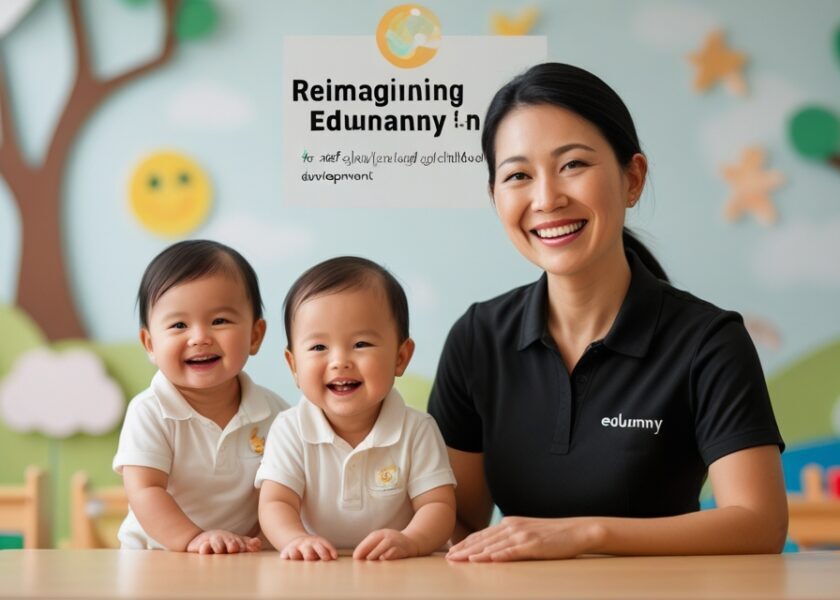
The Choice That Changes How Your Child Is Known
The Question Every Singapore Parent Asks Quietly
There is a question that sits in the back of your mind during those late nights researching childcare options in Singapore. You might not have voiced it yet, not even to your partner. But it is there, waiting.
It usually surfaces in the weeks before enrollment, or sometimes in the months after you have already made your choice. It feels almost too simple to matter. But the moment you hear it, it changes how you see every option in front of you.
Here it is: When I leave my child in someone’s care each morning, what am I actually choosing?
Not the logistics. Not the fee. Not the proximity to your office or the operating hours. Those matter, yes. But beneath them, something deeper is at stake. And it is worth naming, because it is the thing that will matter most in the years to come.
Every day your child spends in care is a day of development. Whether that development is intentional or not, it is happening. The question is not whether your child will be shaped by these experiences. They will be. The question is whether that shaping is something you have chosen, or something you have simply accepted.
This is the conversation Singapore parents deserve to have before they enroll. And it begins here.
What You Are Actually Choosing Between
Most parents enter the childcare search knowing what they need on paper. Somewhere safe. Someone reliable. Hours that work and a fee that fits the budget. These are legitimate concerns, and they deserve practical answers.
But beneath these immediate needs, something more important is unfolding. When you walk through the doors of a childcare centre, you are walking into a system. There is nothing inherently wrong with systems. They are designed to be efficient, scalable, and consistent. A good centre will have trained staff, a structured curriculum, and clear safety protocols. These are genuine strengths.
However, a system is designed around the institution, not around your child. A system allocates attention across multiple children simultaneously. It follows a schedule written for many, not for one. It measures progress in group benchmarks because that is what a system can track.
When your child is one of fifteen in a room, or twenty-five, or more, the mathematics of individualized attention becomes difficult. This is not a criticism of the dedicated, loving educators who work in these settings. It is simply an observation about architecture. The structure of institutional care, by its very nature, operates differently than care built around a single child or a very small group.
Here is the distinction that matters:
- Institutional care is built around the institution’s needs, organized to serve multiple children efficiently and consistently.
- Individualized care is built around your child, organized to serve your child’s unique developmental trajectory.
The difference is not just about ratio numbers. It is about whether care is designed for your child, or whether your child is expected to adapt to pre-designed care. This distinction shapes everything that follows.
A Morning in Two Different Models
Let us look at what a typical morning actually looks like under each model.
At an institutional childcare centre:
Your child wakes, if they are still napping on the centre’s schedule rather than their own natural rhythm. They are changed, fed, and brought into a room where other children of similar age are gathered. Activities begin: song time, craft time, snack time, nap time. The day follows a rhythm designed to serve the group.
Under individualized childminding:
Your child wakes in familiar surroundings. The caregiver knows them by name, by mood, by the particular cry that means hunger versus the one that means tiredness. There is no transition from one environment to another, no jarring change of scene. The caregiver ratio is one to three, perhaps one to two. Your child’s day is organized around them, not around a group schedule.
This is not a minor distinction. It is the difference between two fundamentally different models of what childcare is for. One prioritizes management. The other prioritizes your child.
Why the First Years Disproportionately Matter
One of the most important shifts in how we understand early childhood development is this recognition: infants are not simply waiting to grow. They are learning constantly.
Every interaction, every response, every moment of attunement or misattunement between a caregiver and a child is wiring something in the brain. The neural pathways formed in the first years of life become the foundation for emotional regulation, language acquisition, social confidence, and cognitive flexibility.
This is not a new theory. Developmental science has understood this for decades. What it means practically is that the quality of caregiving is not a luxury feature or an optional extra you add if you can afford it. It is the environment in which your child’s brain is literally being built.
So when we ask what separates quality care from standard care, we need to look beneath surface features. It is not the color of the walls or the brand of the toys. It is not even the qualifications on paper, though those matter. It is something more fundamental: whether your child’s care is designed around your child’s development, or whether your child’s development is expected to fit into a pre-designed care structure.
What genuine developmental engagement looks like:
- A caregiver who notices when your child is fascinated by the texture of a wooden spoon and uses that moment to introduce language
- Recognizing when your child is overwhelmed by a group activity and adjusting the environment accordingly, rather than forcing the child to cope
- Understanding that a child’s frustration is not a problem to be managed but a signal to be responded to with patience and support
- Tracking development not in comparison to a group norm, but in the context of that individual child’s unique trajectory
None of this requires extraordinary measures. It requires something surprisingly rare: genuine, sustained attention. And sustained attention at a ratio of one to three is simply different from sustained attention at one to twenty. The difference is not incremental. It is architectural.
The Real Cost of Settling for Supervision
Singapore parents are some of the most thoughtful, well-researched parents in the world. You read, you ask questions, you compare. You want to make the right choice. But the childcare market does not always make it easy to see what you are choosing between, because the language used is often the same.
Every centre will tell you they prioritize development. Every centre will tell you their staff are caring. These are not lies, but they can be misleading, because the meaning behind the words varies enormously.
Development in a centre context often means a structured curriculum delivered to a group. Care in a centre context often means safety, warmth, and basic needs being met. These are real goods. They matter. But they are not the same as individualized developmental engagement.
There is a quiet guilt that hovers over discussions of premium childcare in Singapore, as though wanting more for your child is somehow selfish or indulgent. Let us be clear: wanting your child to receive care designed around their individual developmental needs is not a luxury. It is a reasonable, responsible aspiration.
Children are remarkably resilient. They adapt. They find ways to thrive even in imperfect circumstances. But adaptation is not the same as flourishing. And the question is not whether your child is surviving in care, but whether they are genuinely developing in ways that take advantage of this critical window.
Developmental science tells us that the environment in which your child’s brain is being built matters enormously. And that environment is not a minor detail. It is the daily context of your child’s life during the years when the most learning is happening.
EduNanny: Making Individualized Care Accessible
EduNanny by BUTLER operates within the ECDA Childminding Pilot, and this matters for reasons that go beyond program status. The pilot represents a deliberate, structured effort to make individualized care accessible, not as a charity case, but as a recognized model with official backing and sustainable fee structures.
For families across Singapore, this means that developmental care at small ratios is not a fantasy reserved for the wealthy. It is a real option, with real support mechanisms in place.
What the pilot makes possible:
- Home-based arrangements and connections to community-based options, depending on what fits your family’s circumstances
- Monday to Friday care blocks structured to support working parents
- Utilization of CDA and Baby Bonus funds, because the system should work for you, not against you
- Fees designed to be affordable, because children who benefit most from individualized attention should not be only those whose parents can pay premium private rates
EduNanny addresses the legitimate need for transparency through clear communication protocols, regular updates, and where deployed, CCTV access so you can see for yourself what your child’s day looks like. These are not gimmicks. They are acknowledgments of a parent’s legitimate need to know.
The caregiver who joins your family through EduNanny is not a stranger you are handing your child to. They are a trained, vetted professional who understands infant development, prepared to recognize and respond to your child’s individual needs, operating within a model that makes individualized attention possible because the ratios allow for it.
This is the difference between a childcare model that asks your child to fit in, and one that fits itself around your child.
Questions to Ask Before You Choose Infant Care in Singapore
If you are in the process of evaluating childcare options, these questions will help you see beneath the surface of what is being offered:
- What is the caregiver-to-child ratio? This is the single most concrete indicator of whether individualized attention is structurally possible.
- How is the daily schedule structured? Is it built around group routines or individual needs? Can it flex when your child needs something different?
- How is development tracked? Is it measured against group norms, or against your child’s own trajectory?
- What is the philosophy of care? Ask them to describe what a typical day looks like from your child’s perspective, not from the institution’s perspective.
- Can you observe a session? Quality providers welcome scrutiny. Pay attention to how children are responded to when they are upset, tired, or curious.
- What happens when there is a concern? How do they communicate with parents? What is their approach to developmental delays or behavioral challenges?
The answers you receive will tell you whether you are looking at a system designed to manage children, or a model designed to develop them.
Every Child Deserves to Be Known
This is not a revolutionary idea. It is an ancient one. Every child deserves to be seen. But in the context of modern childcare, it has become radical, because so much of the system is built around efficiency and scale rather than around the individual child.
We believe this does not have to be the case. Singapore families should not have to choose between convenient supervision and truly individualized care. When you leave your child in someone’s care, you should feel not just relief, but genuine confidence. And your child should feel not just safe, but known.
Not watched. Not just kept safe. Known.
Your child will grow. They will change. They will become someone shaped by every day they have lived. The daily experiences of these early years leave lasting imprints. This is not a reason to paralyze yourself with anxiety. It is a reason to be thoughtful. To ask the questions that matter. To look beneath the surface of what is being offered and understand what you are actually choosing.
When you choose individualized developmental care, you are choosing a daily environment where your child’s curiosity is noticed, their language is responded to, their emotional states are acknowledged and supported, and learning is not a scheduled event but a constant, natural feature of every interaction.
No caregiver, no model, no system can guarantee perfection every moment. But the model you choose shapes the probabilities. It shapes the baseline. It shapes what your child can expect from the world of care and learning.
If this perspective resonates with you, we invite you to learn more about EduNanny’s approach to individualized developmental care within the ECDA Childminding Pilot. Ask questions. Visit if you can. See for yourself what care built around your child actually looks like.
Because you now know what you are choosing between. And that knowledge is the beginning of a better choice for your child.
EduNanny by BUTLER is a development-oriented childminding service for Singapore families. Learn more about our approach to individualized care or get in touch to discuss your family’s needs.