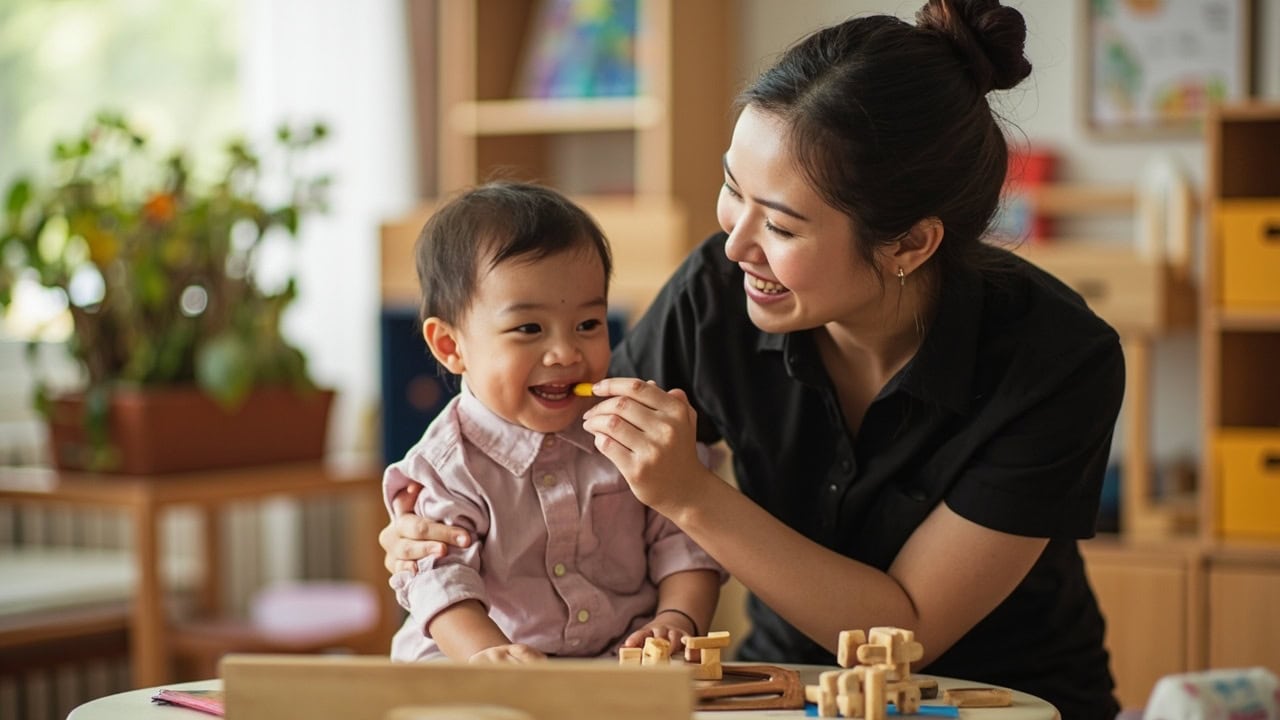
What Your Child Learns During Those Hours Apart From You
The Hours You Do Not See: What Your Child Is Actually Learning at Childcare
There is a particular silence that fills the car after you have dropped your child at childcare. You have done everything right. You kissed her forehead, you waved with a little too much enthusiasm, you said the words you always say—“Mummy will be back soon, have a wonderful day”—and you walked out before she could see your face change.
Now you are in the car and the engine is running and you are asking yourself the question that lives in the space between every Singapore parent and their child’s first months of care:
What is she actually doing right now?
This is not a question of safety. You have chosen carefully. You have walked through the centre or welcomed the childminder into your home and you trust, at some level, that your child is physically well. But safety is a floor, not a ceiling. Somewhere beneath the logistics and the reassurance and the rational understanding that other children your child’s age thrive in childcare every single day, there is a quieter, more tender wondering:
Is this hour meaningful? Is she learning anything? Is she engaged, or just occupied? Is someone noticing her?
These are not anxious questions. They are loving ones. They come from the most ordinary and profound desire a parent can have: to understand what is happening to your child in the hours you are not there to witness it.
This article takes you inside the day your child is actually living—not the one you imagine when you are sitting in your office trying to concentrate on a spreadsheet, but the real one, with its own rhythms, its small triumphs, its unnoticed learning, its particular texture. It gives you a language for those hours, so that when you pick your child up at the end of the day, you can hold them with more understanding and more confidence.
Before Your Child Arrives: The Prepared Environment and Handover
The morning begins before your child arrives. The educators—or in a home-based setting, the childminder—have already been there for some time. The space has been prepared. The materials have been arranged. Not randomly, but with intention.
The toys on the shelf are at eye level. The different areas of the room are arranged to invite different kinds of engagement: one corner for building and manipulating, one for quiet reading, one for movement, one for art. The lighting is warm. The noise level is considered.
The space itself teaches. This is what early childhood educators call the prepared environment, and it is one of the most powerful tools in quality childcare. Your child does not just enter a room. She enters a landscape designed to invite her curiosity, support her current abilities, and gently extend them.
When you arrive with your child, the first few minutes matter more than they might appear. This is where information travels between you and the person who will care for your child for the next several hours. What did she sleep like last night? Is she cutting a tooth? Has she been unusually clingy?
These details are not small talk. They are essential data. In a setting with a high-quality child-to-caregiver ratio—and in quality infant care, that ratio can be as intimate as one to three—these details are noticed and acted upon:
- A child who did not sleep well needs extra co-regulation
- A child who is cutting a tooth has more acute comfort needs today
- A child who is clingy benefits from a slower, warmer transition
When there are fewer children and more attentive eyes, these signals do not get lost. They become the invisible architecture of the day that follows.
You hand your child over. The educator meets your child’s eyes, speaks to her directly, offers a warm greeting that acknowledges her as a person, not just a small body to be managed.
Your child might cry. This is normal. This is the expression of a very reasonable preference for you over anyone else. What happens next matters enormously.
The educator does not distract your child away from her distress, nor does she shame you for leaving. She holds your child with calm confidence and offers her presence as a bridge. Within minutes—sometimes longer, but often fewer than you might expect—your child begins to settle. Not because she has forgotten you, but because she has begun to trust that this place contains a reliable person who can meet her needs.
This is the first lesson of the childcare day. It is not academic. It is emotional. It is: I can feel safe with someone other than my parents. The world contains other trustworthy people.
The Morning: Where Learning Begins in Earnest
Let us imagine your child is eight months old. She is in what developmental psychologists call the sensorimotor stage—a clinical way of saying that she understands the world primarily through her body and her senses. She is not ready for abstract lessons. She is ready to explore with her hands, her mouth, her eyes, her whole self.
And so the morning in quality infant care is built around exactly this kind of exploration.
Your eight-month-old is on the mat with a basket of objects in front of her. A wooden ring. A soft cloth. A rattle with a gentle sound. She picks them up, turns them, mouths them, drops them, watches them fall.
To you, this might look like play. To a trained educator, this is a laboratory:
- She is learning about weight and texture and cause and effect
- She is building neural pathways that will one day support mathematical reasoning, spatial awareness, and scientific thinking
- She is developing her pincer grip—the fine motor skill that will eventually allow her to hold a pencil
When she drops an object and looks to see where it went, she is building object permanence—the understanding that things continue to exist even when she cannot see them. This milestone changes everything about how she relates to the world.
Your child might be eighteen months old instead. Then the morning looks different. She is walking, perhaps running, certainly into everything. She is in what educators sometimes call the “I do it myself” phase—she is discovering her own agency.
She is pulling things out of baskets, stacking blocks, trying to climb on things that should not be climbed on. The quality childcare environment has anticipated this: there are safe opportunities for climbing, and there are objects that can be stacked and knocked down and stacked again—which is not frustration, it is the purest form of scientific experimentation.
In a setting with a one-to-three ratio, your toddler has three times the chance of having her interests noticed and followed. When she picks up a block and looks at it with that particular concentration, the educator can be there. She can offer a word—“block,” “red,” “tower”—which adds language to sensation. She can extend the play by introducing a second block, or a cardboard tube, or a small car.
This is not intrusion. This is what educators call scaffolding: offering exactly the next challenge that builds on what the child is already doing, rather than imposing a lesson from outside.
Contrast this with a setting where one adult is watching six infants. The child who is engaged is rarely followed deeply. The play is not extended. The language is not layered. The difference is not visible on a camera feed. It is visible over months—in vocabulary size, in social confidence, in the complexity of a child’s play.
The Rhythm of the Day: Why Routine and Transitions Matter
The morning in quality childcare is not only about play with objects. It is also about the rhythm that holds everything together.
There are transitions in any child’s day—moments when one activity ends and another begins. These transitions are often treated as administrative necessities: cleanup time, hand-washing time, circle time. But in a thoughtfully designed childcare day, transitions are themselves learning opportunities.
They are moments when children practice the skills that will serve them for a lifetime:
- Waiting
- Following a sequence
- Managing the disappointment of ending something enjoyable
- Trusting that something else good will follow
When the educator rings a small bell to signal the end of free play, she is not just making noise. She is teaching your child that sounds carry meaning, that routines have structure, and that adults keep their promises.
For infants and toddlers, this rhythm is not a constraint. It is a comfort. Children thrive on predictability not because they lack spontaneity, but because predictability allows them to build internal maps of the world. When your child knows, in her body, that after play comes snack, she does not need to waste energy worrying about when or whether food is coming. She can relax into the present moment. She can engage deeply with her play because she trusts that her needs will be met on schedule.
This is the deep gift of intentional routine: it frees children to learn.
Mealtimes, Rest, and the Afternoon: Sustained Engagement
When your eighteen-month-old sits at a low table with a small group of peers and a plate of food, she is doing much more than eating. She is practicing self-feeding, which builds hand-eye coordination and fine motor control. She is learning social rules: we sit while we eat, we use utensils, we say “more” or “thank you.” She is noticing when someone else is hungry too. She is experiencing new foods in a context where an attentive adult can note her preferences and gently expand them.
When your infant is held for a bottle, she is not just being fed. She is being held. The warmth of a human body, the sound of a heartbeat, the eye contact that communicates “you matter, you are seen”—these are not luxuries. They are neurological necessities.
Research on infant development consistently shows that the quality of caregiver attunement during feeding is as important as the nutrition itself. In a setting where one caregiver feeds one to three infants, this attunement is possible. The caregiver notices when a baby slows down, pauses, looks away—cues that the baby is becoming full—and responds to these cues rather than pushing the bottle to finish.
This teaches the baby that her internal signals are respected and heard. This is the earliest lesson in bodily autonomy, in self-regulation, in trust.
Rest is treated with the same intentionality. Nap time is not a waiting period. It is an active part of the developmental day. Sleep consolidates memory. It allows the brain to process the morning’s experiences, to sort them, to file them in the places where they will become learning.
In a quality infant care setting, sleep is not managed by the clock alone. It is read from the child’s cues. When the educator notices your child’s eyelids growing heavy, her play slowing, her fussiness rising, she responds. She creates a calm sleep environment—dim light, white noise, a consistent soothing presence—and allows your child to fall asleep in her own time and her own way.
By midday, your child has already been through a full cycle of waking, engaging, feeding, and resting. Her nervous system is maturing throughout these cycles. In the afternoon, she is often ready for a different kind of engagement.
In a quality childcare setting, the afternoon includes what educators call sustained shared thinking—those moments when a child and an adult are deeply engaged in a shared activity, building on each other’s ideas, asking questions, solving problems together. This might look like:
- A child and educator building an elaborate tower and then deliberately knocking it down to see it fall
- A group of toddlers working together to push a large box across the room, negotiating through gestures and sounds
- A baby and educator playing peekaboo, each round building anticipation and delight
These moments look simple. They are not. They are the foundation of everything your child will eventually learn about collaboration, persistence, and the pleasure of shared attention.
A photograph of your child at play shows you a moment. What it cannot show you is the network of interactions, observations, and responses that surround that moment: the educator’s hand hovering nearby, ready to support a wobbling totterer; the quiet word of encouragement that extended your child’s building project from five blocks to twelve; the observation note that was jotted down afterward so that tomorrow’s activities could build on today’s progress.
This is the invisible curriculum of quality childcare. It is the difference that makes a measurable difference over time.
Pickup Time: The Information Bridge
Now it is late afternoon. The light is softening. The energy in the room is shifting. Parents will arrive soon.
The educator has been preparing for this too, though not in the way you might expect. Pickup time is not just a logistical transition. It is an information bridge.
When you arrive, the educator speaks to you not just with a cheerful “She had a great day!” but with specific, useful detail:
- Your child discovered she could balance on one foot today
- She showed unusual interest in the rhyme about the five little ducks
- She was a bit clingy this afternoon and the educator spent extra time holding her during circle time
These details are gold. They tell you what your child is experiencing, what she is interested in, what she might need support with at home.
This is the moment where you, as a parent, can take the baton. The childcare day does not end when you pick up your child. The learning continues. When you notice, at dinner, that your child is trying to balance on one foot—just like at childcare—you can acknowledge it, celebrate it, build on it.
“You balanced on one foot today! You are getting so strong! Let’s practice together.”
You can read her the duck rhyme before bed. You can ask questions, even if she cannot yet answer in words. You can mirror back what you know about her day, and in doing so, you are teaching her that what she experiences away from you is still connected to you, still valued, still part of the ongoing story of her life.
This is how quality childcare and quality parenting reinforce each other. Not as competing demands on your child’s time, but as two environments—home and care—that together create the conditions for extraordinary development.
Why Quality Matters More Than Adequate—and How to Evaluate Your Options
There is a conversation that happens sometimes, in parenting groups and online forums, about whether childcare is “worth it.” Whether children are better off at home with a parent, or with extended family, or in some other arrangement.
These conversations are not wrong to exist, but they often miss the point. The question is not whether childcare is worth it in some abstract, comparative sense. The question is: what kind of childcare?
Because the difference between adequate care and excellent care is not a matter of degree. It is a matter of kind.
A child in a setting with intentional environmental design, with attentive observation, with low ratios and trained educators who understand child development—that child is not merely being watched. She is being engaged. She is being seen. She is participating in a day that has been designed to support her neurological, emotional, social, and physical development in every hour.
Studies on early childhood development consistently show that the quality of care in the first three years has lasting effects on language development and vocabulary size, social-emotional regulation and confidence, cognitive flexibility and problem-solving abilities, and school readiness. These differences emerge not from dramatic interventions but from the accumulation of thousands of small, attentive interactions—the kind that happen when a trained educator has the time and capacity to notice, respond, and extend.
If you are currently researching childcare options in Singapore, here are some questions worth asking during your centre or home visit:
- What is the child-to-caregiver ratio? For infants, lower is better. One-to-three is ideal; one-to-four is acceptable; one-to-six or higher makes deep engagement difficult.
- How are transitions handled? Look for calm, predictable routines rather than abrupt changes or extended waiting.
- What does the environment communicate? Is it designed for children—warm lighting, accessible materials, clear zones—or does it feel like a scaled-down office?
- What do educators share at handover? Specific observations (“she showed interest in the textured balls today”) rather than generic reassurances (“she was fine”) indicate attentive practice.
- How is rest managed? Responsive sleep practices, where educators watch for tired cues rather than enforce rigid nap schedules, reflect an understanding of child development.
- What happens during play? Are educators present and engaged, extending play and adding language? Or are they primarily managing safety?
The answers to these questions will tell you far more than a tour or a camera feed can. What matters is not what the environment looks like, but what happens in it—the quality of attention, the intentionality of design, the depth of engagement.
Common Concerns Addressed
“I worry my child isn’t learning anything.” Learning in infancy does not look like school. Your child is building the foundational architecture of her mind—through sensory exploration, through movement, through the experience of being responded to by an attentive adult. Every time she drops a toy and watches where it falls, she is learning about gravity. Every time an educator says “you’re working so hard on that tower”, she is building language. Every time she navigates a disappointment and is met with calm reassurance, she is learning emotional regulation. Learning is happening. It is simply invisible without the right framework to see it.
“What if my child cries every day?” Some separation distress is normal and expected. It reflects a healthy attachment to you, not a problem with childcare. What matters is how educators respond: with calm presence rather than distraction or dismissal. Over time, most children settle. If prolonged distress continues beyond a few weeks, it is worth a conversation with the educator to understand what might be happening.
“Is home-based care as good as centre-based?” Both can be excellent. Both can be inadequate. What matters is the quality of the individual caregiver, the ratios maintained, the intentionality of the environment, and the training of the person caring for your child. Ask about qualifications, ratios, and how the day is structured, regardless of the setting.
“How do I know what’s happening if I can’t be there?” Cameras can show you what your child looks like. They cannot show you what your child is learning, feeling, or becoming. That understanding comes from communication—from educators who take time to share meaningful observations, from handover conversations that go beyond logistics. The best childcare does not just care for your child. It makes that care visible.
What EduNanny Offers
EduNanny by BUTLER is built on a simple but profound premise: that every infant and toddler deserves to be engaged, not just cared for. That every parent deserves to feel confident—not just comfortable, but genuinely confident—that the hours apart are hours of meaning.
Operating within the ECDA Childminding Pilot, EduNanny maintains ratios that allow children to be known as individuals, not managed as groups. This means:
- Trained educators who understand child development and can read cues in real time
- Intentional environment design that invites exploration and supports developmental goals
- Specific, useful communication with parents—not just “she had a good day,” but observations about what she tried, what she enjoyed, what she discovered
- Flexible care arrangements that reflect the realities of working families across Singapore
- Support for CDA and Baby Bonus to make quality care accessible
EduNanny is not just a service. It is an approach—one that recognises that parents and childcare are not parallel tracks. They are one track, flowing in the same direction, with you at the centre of your child’s life even when you are not in the room.
Returning to the Question
Let us return to the car. To that moment after drop-off when you asked yourself the question.
What is she actually doing right now?
She is not just being watched. She is being held, and fed, and noticed. She is exploring a prepared environment that has been designed for her. She is building neural pathways through her senses, her movements, her interactions. She is learning that the world contains reliable people, that routines create safety, that play is the work of childhood, that her needs matter and will be met.
She is doing all of this not despite being in childcare, but because of it—because quality childcare is not a compromise. It is a gift you are giving her. It is a space where she can grow in ways you might not have imagined.
And when you pick her up, and the educator tells you about her morning, and you carry those details home and weave them into your evening together, you are not a separate force from her childcare experience. You are the other half of it. You are the home that receives what the day has built, and builds upon it in turn.
You are not leaving your child in someone else’s hands. You are choosing a partner in your child’s development.
And that choice—that intentional, thoughtful, well-informed choice—is one of the most loving things you can do.
The question is no longer “What is she doing while I am away?”
The answer is: she is growing. She is learning. She is becoming.
And you made that possible.
If you are looking for childcare in Singapore that treats every hour as an opportunity for learning—and every parent as a partner in that learning—EduNanny is here to answer your questions and walk beside you in this decision.
Get in touch to explore your options.