Your Child Is Telling You Everything: Signs of Genuine Thriving
The Question Every Singapore Parent Asks at Drop-Off
There is a particular silence that follows the morning handover. You have handed your child to someone else, walked back to your car or caught the MRT, and the day stretches ahead. You know your child is safe, that the arrangements are good, that the caregivers are kind. And yet somewhere in the quiet of those morning hours, a question surfaces that you cannot quite silence:
Is my child truly okay? Not just settled. Not just managing. But okay in the way that matters for the long arc of their growth.
This question lives beneath the surface of almost every Singapore parent who entrusts their child to someone else’s care. It is not a sign of doubt or anxiety. It is a sign of love—and it deserves an honest answer.
This article offers that answer: not as reassurance alone, but as understanding. Because children are constant communicators. They tell us everything we need to understand about their inner world, not in words but in behavior, in the quality of their play, in how they move through the hours we are not there to see. The question is not whether our children are speaking. The question is whether we know how to listen.
In This Article
- How genuine emotional adjustment differs from surface compliance
- What thriving actually looks like beyond the first weeks
- Why caregiver quality is the foundation of everything
- Questions to ask when choosing childcare in Singapore
- How EduNanny Singapore approaches the parent-caregiver partnership
How Children Actually Adjust to Childcare
In those first weeks of childcare—whether home-based or centre-based—every child is engaged in the same fundamental work. They are learning whether this new world is safe. Not intellectually understanding it, but sensing it in their bodies, in the tone of voices around them, in whether their needs are met with consistency.
This is not a test they are passing or failing. It is a biological process that has been unfolding in human children for as long as humans have raised children in groups outside the immediate family.
The Secure Base: Where Adjustment Begins
A child who is beginning to feel safe will not necessarily stop crying at drop-off immediately. But something shifts in the quality of that distress. It becomes less panicked, more protest-like. The child may still be upset, but they are looking toward the caregiver now—not just away from you. They are checking whether this adult will respond.
When that response comes, reliably, even once, something builds. It is the beginning of what developmental psychologists call a secure base.
A secure base is a person—your child’s caregiver—who your child learns to trust not as a replacement for you, but as a reliable extension of your care. When a child has a secure base, they can explore the world around them with confidence because they know where to return when they need comfort.
In a childcare setting, this looks like:
- A child who, after initial hesitation, begins to engage with toys, with other children, with the rhythms and routines of the day
- A child who, when distressed, seeks out a specific caregiver and settles more quickly in their arms than elsewhere
- A child who, over weeks and months, is visibly less depleted at pickup than they were in those first difficult days
Genuine Adjustment vs. Surface Compliance
This is the distinction that matters most.
A child who is merely compliant may seem quiet, may appear to have settled—but something is missing. There is a flatness to their engagement. They are not exploring. They are enduring.
Surface compliance looks like: a quiet child who never cries, who seems content, but who shows little spark or engagement with their environment.
Genuine adjustment looks like: a child who may have hard moments, even tears, but who is also visibly engaged, exploring, connecting—with bursts of energy and curiosity that show they are present, not just surviving.
The Non-Linear Nature of Adjustment
Here is what every parent needs to know: this process takes time, and it does not move in a straight line.
A child who seemed fully settled may regress after a long weekend, a holiday, or an illness. This is not a failure. This is how attachment works. It is built through repeated experiences of reunion after separation, of needs met after they are expressed.
The childcare journey is not a mountain you climb once and descend from. It is a winding path your child walks, sometimes advancing and sometimes circling back. Your role as a parent is not to judge whether they are progressing fast enough, but to remain steady, to trust the process, and to partner with the caregivers walking beside you on that path.
Signs Your Child Is Genuinely Thriving, Not Just Settling
Initial adjustment is only the beginning. Beyond those first weeks, what does it look like when a child is genuinely flourishing in their childcare arrangement—not just surviving it?
What Thriving Looks Like Over Time
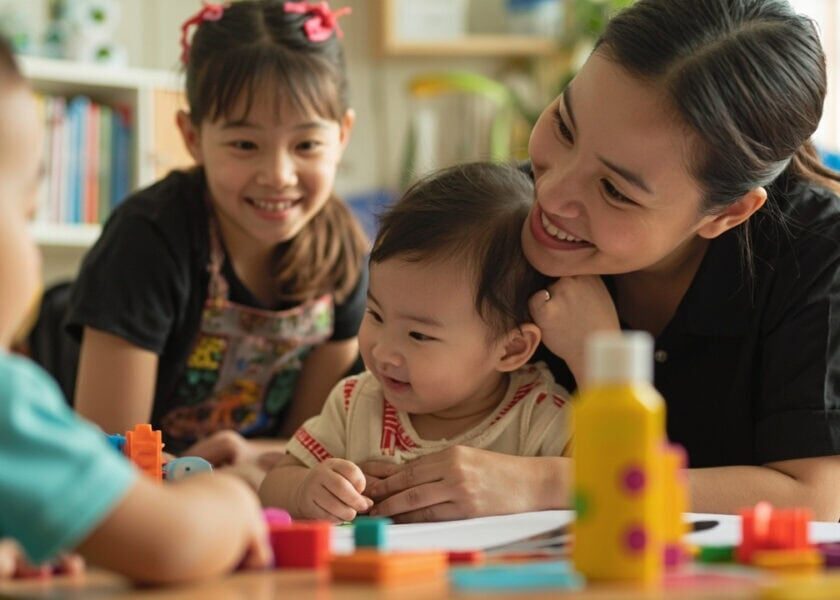
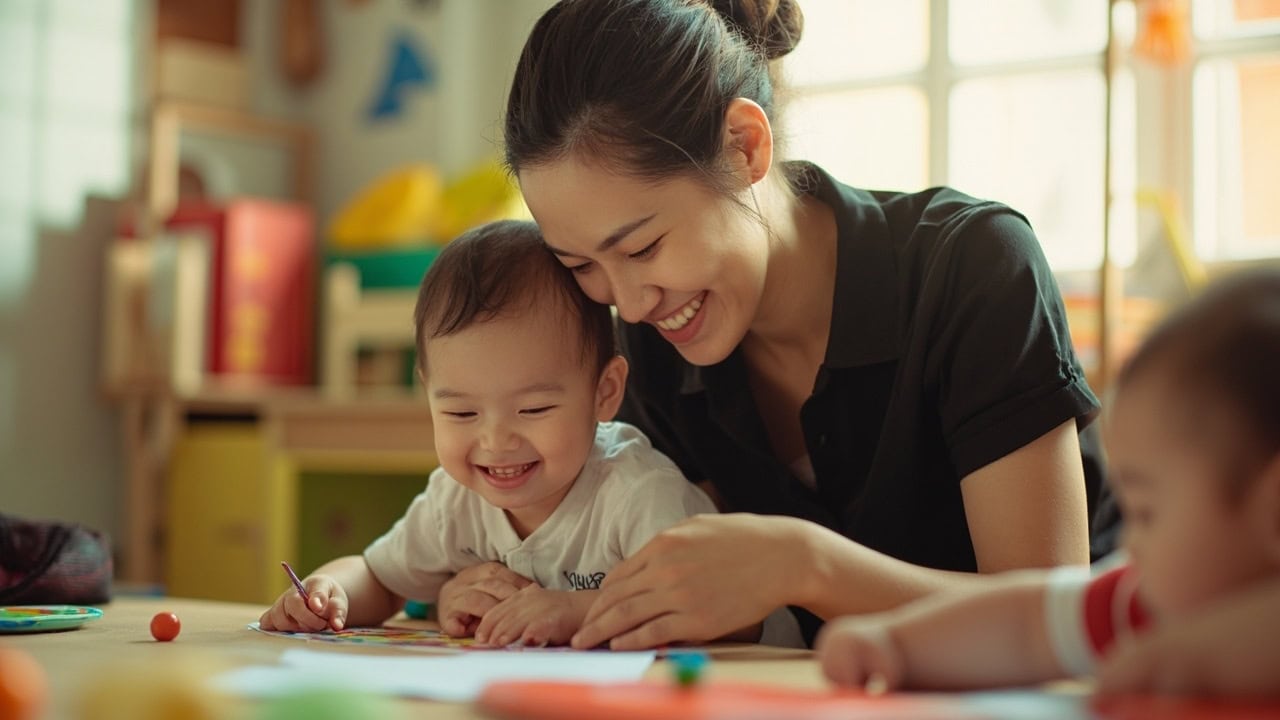
They play with depth. Not just activity for activity’s sake, but sustained, imaginative play that shows cognitive engagement. Watch for this at pickup or on weekends: the child who can lose themselves in a scenario, who builds narratives with toys, who engages deeply rather than flitting from one thing to the next.
They solve problems. How to fit the blocks together. How to negotiate for a toy. How to navigate a social conflict with another child. These small, everyday problem-solving moments are markers of cognitive and social development unfolding.
They show a full range of emotions—including frustration and anger. This is actually a positive sign. A child who feels genuinely safe is not performing constant contentment. They are confident enough to express displeasure, knowing they will still be held.
They develop rituals and preferences they claim as their own. The way they like their blanket arranged. The song they ask for at nap time. The friend they seek out at circle time. These small ownership behaviors show investment in their environment.
They develop a visible inner life. You will see it at pickup. Not just a happy child, but a child who has stories to tell, who runs to show you something, who talks about their day with genuine enthusiasm. This is the sign of a child who has been present in their own development, an active participant in the hours you were apart.
What This Looks Like at Different Stages
| Stage | Surface Indicators | Depth Indicators |
|---|---|---|
| Weeks 1–4 | Crying decreases; child accepts caregiver | Child looks toward caregiver for comfort; protest is purposeful, not panicked |
| Weeks 5–12 | Child seems comfortable at pickup | Child seeks specific caregiver; engagement is curious, not passive |
| Months 3–6 | Child appears happy overall | Child shows emotional range; has preferences and rituals; brings stories home |
| Months 6–12+ | Child settles easily | Child problem-solves; forms peer relationships; shows visible inner life |
Why Caregiver Attention Is the Foundation of Everything
These signs of thriving can only emerge when the conditions for genuine development are present. And those conditions begin with one thing: the quality of attention your child receives.
The ratio of caregivers to infants is not just a logistical detail. It is the foundation of everything.
When a caregiver is responsible for one, two, or at most three infants, something changes in the quality of attention each child receives:
- There is time to notice when a child’s play deepens and to support that deepening
- There is space to respond to distress with presence rather than efficiency
- There is the ability to learn each child’s particular language—their unique signals, the specific ways they communicate hunger, tiredness, overwhelm, or delight
Beyond ratios, consistency matters profoundly. A child forms trust through repeated, predictable experiences. When the same caregiver is present day after day, the child can build that secure base. When caregivers rotate frequently, that foundational security is harder to establish.
Singapore parents should feel empowered to ask: Who will be my child’s primary caregiver? How consistent is the staffing? What happens when a caregiver is sick or leaves?
Building the Right Partnership With Your Child’s Caregivers
You are not a passive observer of your child’s development. You are an active participant—and the best childcare arrangements reflect this.
A Two-Way Dialogue
Good childcare is not a one-way street where care is delivered and you observe results. It is an ongoing dialogue, a shared observation of your child, a willingness to adjust when what is being done is not working for them.
We expect you to tell us what you see at home. We commit to telling you what we see during the day. Together, we build a picture of your child’s development that neither of us could see alone.
Transparency That Honors Your Need to Know
Singapore parents carry particular burdens: the cost of living, the demands of dual-income households, the pressure to return to work before you feel ready, the guilt that sometimes surfaces not because you have done anything wrong but because the culture around parenting has made guilt feel inevitable.
We do not want to add to that burden. We want to offer something different: not just practical support, but knowledge. We want you to leave every conversation understanding more about your child, not feeling more uncertain.
Where deployed, our arrangements include communication measures that allow you to feel connected to your child’s day—to see through the uncertainty, to have windows into what you cannot witness directly. This is not surveillance. It is honoring the reality that you, as a parent, need to know your child is okay, and that knowledge should not require blind trust alone.
Trust is built through information, through relationship, through the consistency of what you are told matching what you observe in your child at home.
When Something Is Not Working
If your child is showing signs of distress that persist beyond the normal adjustment period—if they are more withdrawn at home, if they seem depleted rather than energized by their time in care—these are messages that deserve attention.
They may point to:
- A mismatch in caregiving style
- A ratio that is too high for your child’s particular needs
- A pacing of the day that does not suit your child’s temperament
These are not failures. They are information—and a good childcare arrangement should be set up to receive and respond to that information honestly and quickly.
What to Look For and Ask When Choosing Childcare in Singapore
Understanding these concepts is one thing. Applying them to your own child’s situation is another. Here is how to use this framework as you evaluate childcare options and as you observe your child over time.
Questions to Ask During Your Search
- What is the caregiver-to-infant ratio? Smaller is generally better for genuine development.
- Who will be my child’s primary caregiver? How consistent is staffing?
- How do you communicate with parents? What windows can I expect into my child’s day?
- How do you handle adjustment periods? What is your approach when a child is struggling?
- What does a typical day look like? Is there rhythm and routine that allows children to anticipate what comes next?
What to Observe at Home
As your child settles into childcare, pay attention to:
- The quality of their play: Is it sustained and imaginative, or flat and perfunctory?
- Their emotional range: Do they show frustration, anger, joy, delight—or only a sameness?
- Their stories: Do they have things to tell you about their day?
- Their energy at pickup: Are they depleted and collapsed, or tired but present?
- Their curiosity: Are they exploring their home environment with confidence?
Trust Your Instincts
You know your child better than anyone. If something feels off—if your instinct says your child is not okay even if they appear calm at drop-off—that instinct deserves attention.
A good childcare arrangement will welcome that conversation. They will observe alongside you, share what they see, and work with you to understand what your child is communicating.
Building Your Village
What you are doing when you arrange childcare—whether through a home-based arrangement with a trusted childminder or through a centre-based pathway—is building a village. It is not a replacement for family. It is an extension of it.
The caregivers who care for your child become part of your child’s understanding of who is safe, who can be trusted, who loves them even when you are not in the room. This is a profound responsibility—and it shapes children in ways that last long beyond these early years.
A child who has a secure base with their caregiver often shows increased security with you as well—not because the caregiver replaced you, but because they are learning, across multiple relationships, that adults are reliable, that care is consistent, that they can venture out and return.
Why EduNanny Singapore: Our Approach to Early Childhood Care
EduNanny Singapore operates within the ECDA Childminding Pilot framework, designed with these developmental realities in mind. We offer both home-based care and pathways through community and centre-based settings, because families are not all the same and the kind of care that works for one may not work for another.
What remains constant across our approach:
- Small ratios that make real attention possible
- Consistency that allows attachment to form
- Transparent communication with parents that transforms childcare from a black box into shared understanding
- Flexibility within pilot fee structures and CDA/BabyBonus usability to ease the financial weight of quality care
But beneath all of it is something simpler: we see your child. Not as a task to be managed, not as a slot to be filled, but as a whole person in the middle of the most important work of early life.
We see the way they light up when they master a new skill. The way they process a disappointment. The way their understanding deepens over weeks and months—how they begin to anticipate routines, how their language explodes after they first arrive, how they form attachments to other children as well as caregivers, building a social world that will shape them in ways we are only beginning to understand.
We see you too. The parent who drops off with that particular mixture of love and reluctance. The parent who texts to ask how nap time went. The parent who wonders if their child is truly okay in the hours of separation.
We know that you are doing the best you can. We know that you did not receive a manual for this. We know that the hours you are apart from your child are not wasted time but necessary time—for you and for them—and that they deserve to be hours of genuine growth, not just safe waiting.
Ready to Begin the Conversation
When you drop your child off tomorrow morning, or next week, or whenever your childcare journey begins, notice what you feel. That tenderness. That slight ache. That question that surfaces: are they truly okay?
The answer is that your child is communicating constantly—in every behavior, in every expression, in the quality of their play and the depth of their sleep and the way they reach for you at pickup. They are telling you about their inner world.
As you learn to hear them, as you build the partnership with the caregivers who share in this work, as you develop your own framework for understanding what genuine thriving looks like, something changes. Not just for your child, but for you.
You become a more attentive parent. A more confident one. Someone who trusts their own observations and knows how to interpret what they see.
That is the gift of understanding. Not the absence of worry, but the transformation of worry into something useful. Into presence. Into the kind of attention that children feel, even when they cannot name it, and that shapes them in ways that will last long beyond these early years.
Early childhood is the most consequential time in human development. The conditions under which children grow in those early years matter more than we have historically acknowledged. Every study, every observation, every child who has walked into quality care and walked out months later more confident, more curious, more themselves—this tells us that what happens in these hours matters. It is not a footnote in your child’s life. It is the foundation.
EduNanny Singapore is here to walk this path with you. To offer the knowledge, the care, the partnership, and the village that every child and every family deserves.
Your child is telling you something. We hope, after today, you feel a little more ready to listen.
If you are exploring childcare options in Singapore and want to understand how our approach supports genuine child development—beyond surface settling to real thriving—we welcome the conversation.
Learn more about home-based and centre-based pathways available through the ECDA Childminding Pilot framework, and find the arrangement that fits your family’s needs.
Every child deserves a secure beginning. Learn more about the EduNanny approach.