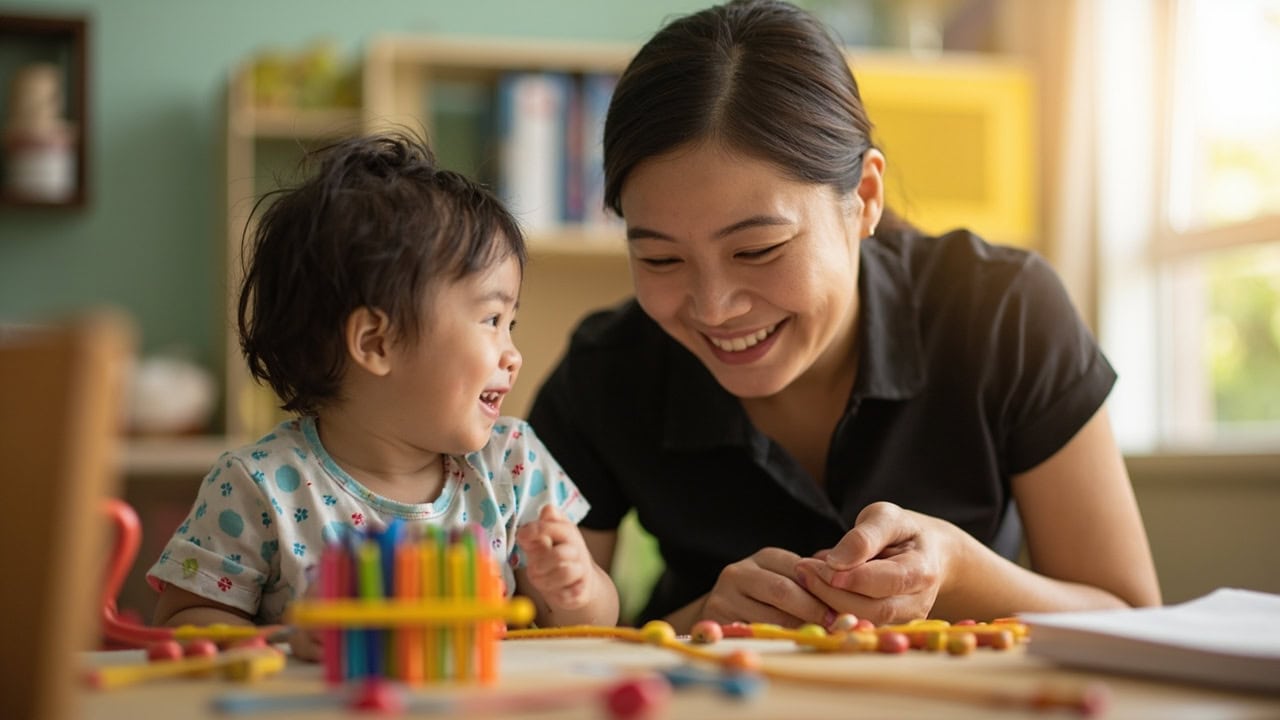
The Bridge That Keeps You Close
What This Article Covers
For parents who are time-poor but want the full picture, here is a quick overview:
- The real fear underneath your morning goodbye is not about safety—it is about connection and missing moments
- Quality childcare extends your attention throughout the day rather than replacing your presence
- Genuine communication means thoughtful observation, not just photos or generic updates
- Developmental continuity means your child’s learning and attachment patterns carry seamlessly between home and childcare
- You remain the captain—a good childcare system collaborates with you, not replaces you
- EduNanny Singapore builds its model around sustained parent-child connection as a core principle
The Fear That Lives Underneath the Goodbye
Here is what I have learned, working alongside families in Singapore: the anxiety that accompanies that morning moment is almost never about safety. Parents in Singapore are rigorous. They have researched. They have visited. They have asked questions about qualifications, ratios, and emergency protocols.
The fear is more specific than that, and more tender.
It is the fear of being a stranger in your own child’s life. It is the fear of coming home at the end of the day to a child who has grown, changed, learned something new—and having no idea what it was. It is the fear of becoming a guest in the daily story of your own son or daughter.
That fear deserves to be taken seriously. Not dismissed with reassurances, but genuinely addressed.
The conversation I want to begin here is about what it actually means to stay connected to your child during the hours when you are not physically present. Not the performative version of connection—the photos pushed to your phone, the generic “had a great day” messages, the highlight reel that tells you everything was fine without telling you anything real.
But genuine, substantive connection. The kind that helps you understand your child more deeply. The kind that makes you feel like you were there, even when you were not.
Quality Childcare as a Daily Bridge
Instead of imagining quality childcare as a replacement for your presence, imagine it as an extension of your attention. A system that keeps your parental instincts informed, involved, and active throughout the day.
When this works well, separation does not create distance. It creates a bridge. And on that bridge, information flows in both directions.
You learn about your child. The caregivers learn from you. And your child moves through the day feeling held by a consistent understanding of who they are and what they need.
This is the philosophy at the center of quality childminding. Not childcare as a service you hand off to, but childcare as a daily partnership you remain inside of.
What Genuine Communication Looks Like in Practice
For working parents, what actually helps them feel connected to their child’s day?
It starts with knowing what happened, not just that something happened. A good childcare system does not just tell you that your child ate lunch. It tells you what they ate, how much, and that they were proud of using a spoon for the first time.
It does not just tell you that your child played. It tells you which corner of the room they gravitated toward, what they built with the blocks, who they sought out when they needed comfort, and how long it took for them to settle.
There is a difference between a photograph and an understanding. There is a difference between “napped well” and knowing that your child fought sleep for forty minutes, asked for their favorite book twice, and eventually settled with their thumb in and their small hand resting on the edge of the cot.
That second version does not just inform you. It lets you return to your child at the end of the day and say, “I know about your nap today. I know you were tired but you wanted that book.”
And your child, even the smallest ones, feels recognized. Known. Seen by you, not just by the caregiver.
No Reset Between Home and Childcare
The learning your child does at home does not vanish when they enter childcare. The attachment patterns they have formed with you do not pause. The rhythms and preferences and quirks that make them who they are do not reset.
A well-designed childcare system honors that continuity. It builds on what you have established at home. It communicates with you about what it is building. And it does not try to replace your role as your child’s primary developmental partner—it invites you deeper into it.
Your child is not two different people. They are one child, moving through different spaces. Quality care recognizes this. It creates a thread of continuity that runs through the entire day, so that your child feels the same attuned attention whether they are with you or with their caregiver.
The Quiet Guilt and Why It Is Misplaced
There can be a quiet guilt that accompanies choosing childcare. A feeling that by leaving your child in someone else’s care, even for the best reasons, even out of necessity, you are somehow failing them.
I want to say clearly: that guilt, where it exists, is misplaced. But I also understand that understanding something intellectually and feeling it are different things.
What helps the feeling is not platitudes. What helps is evidence that your child is not just fine, but flourishing. And evidence of flourishing is not found in generic reassurances. It is found in specifics:
- It is found in the caregiver who notices that your child finally let go of the rail and stood alone for three seconds
- It is found in the observation that your child chose the same book for the third day running and sat through the whole thing
- It is found in being told, with genuine detail, that your child is being seen, known, and engaged with as the specific person they are
That kind of knowledge does not just reassure parents. It transforms the emotional quality of the separation. Instead of wondering and worrying, you can rest in the understanding that your child’s day is not a void to you. It is a story you are part of.
The Parent as Active Developmental Partner
When you choose quality childcare, you are not outsourcing parenting. You are enlisting support for it. And a good childcare system knows this. It does not position itself as the authority on your child. It positions itself as a collaborator—with you, the parent, as the captain of that collaboration.
What does this look like on the ground?
- Caregivers who ask you questions and take your answers seriously
- Caregivers who notice things during the day and bring them to you in ways that invite your input
- Caregivers who understand that you know your child in ways no one else ever will, and who treat that knowledge as essential data, not a threat to their expertise
- A system that sends you updates not because it has to, but because it genuinely believes you have a right to be present in your child’s day
The goal is not to make your child dependent on childcare, but to support the healthy, secure attachment between you and your child—so that when you are together, and when you are apart, your child carries the quiet certainty that you are there, you are paying attention, and you know them.
That certainty is the foundation on which a child’s capacity to explore, to learn, to connect with others, and to feel secure in the world is built. Quality childcare, designed with this purpose, supports that foundation rather than undermining it.
How EduNanny Singapore Bridges the Gap
Working with families under the ECDA Childminding Pilot, EduNanny has built its model around the conviction that communication is not an add-on to quality care. It is inseparable from it.
The caregivers are trained not only to provide attentive, warm, developmentally appropriate care—which they do, with ratios of up to one to three for infants—but to observe, record, and share what they see in ways that keep parents genuinely informed.
When you drop your child off in the morning, you are not just handing them over. You are entering into a daily exchange:
- You share what happened at home—the new word they said yesterday, the food they refused, the way they were clingy and you wondered if they were coming down with something
- Your caregiver takes that in, and that information shapes how they approach your child during the day
- Then, at pickup or throughout the day, you receive not a checklist but a narrative—a thoughtful account of moments that mattered, observations that illuminate, and insights that help you understand your child more fully
What EduNanny Offers
| Feature | What It Means for You |
|---|---|
| ECDA Childminding Pilot | Structured, government-supported pathway prioritising child development over mere supervision |
| Infant ratios up to 1:3 | Every child receives meaningful, individualised attention throughout the day |
| Monday to Friday coverage | Reliable, consistent care so you can leave for work knowing your child is in good hands |
| Thoughtful observation systems | Daily narrative updates that go beyond “all good” to tell you what your child’s day was actually like |
| Transparent environment | Where CCTV measures are deployed, parents have visibility into the care environment |
| CDA and Baby Bonus usability | Fees structured within the pilot framework for accessibility |
A Thoughtful Middle Ground in Singapore
For too long, parents in Singapore have been caught between extremes: large centre-based operations where individual children can feel like numbers, and informal arrangements where consistency and quality can vary unpredictably.
EduNanny occupies a thoughtful middle ground—structured enough to ensure quality, consistency, and accountability, yet intimate enough, through its ratios, training, and communication philosophy, that children are not just cared for but genuinely known.
It is designed for the reality of modern Singapore family life: parents who work, who need reliability, who want to be present as parents in more than name during the hours they are apart from their children.
Practical Advice for Choosing Infant Care in Singapore
If you are currently researching your options, here are the questions that matter most:
- Ask about communication systems. How will you know what your child’s day was actually like? Push beyond “we send updates” to understand what kind of updates—checklists or narratives?
- Enquire about ratios. For infants, lower ratios mean more individual attention. Ask specifically how many children each caregiver is responsible for.
- Observe the exchange at drop-off and pickup. Does the caregiver ask about your child’s morning? Do they share observations that show they were paying attention to specifics?
- Consider continuity. Will your child have a consistent caregiver, or will they encounter different people each day? Consistency matters for attachment and trust.
- Trust your instincts. If something feels off during a visit—a lack of transparency, caregivers who seem stretched thin, an environment that feels institutional rather than warm—take that seriously.
Separation Does Not Have to Be a Loss
The morning goodbye is real. The fear is real. The worry that you will miss something—that your child will have a moment of wonder or frustration or breakthrough and you will not be there to witness it—that lives in the back of your mind during meetings, during commutes, during the times when you cannot check your phone.
I do not want to dismiss that. It is a legitimate concern, born from love, and it deserves a legitimate answer.
The answer is not to tell you that you have nothing to worry about. The answer is to offer you something better: a system that keeps you genuinely connected.
Not through notifications that say “all good,” but through thoughtful, substantive communication that tells you what your child’s day was actually like. Not through photos that prove survival, but through observations that prove understanding. Not through reassurance alone, but through the daily practice of keeping you inside your child’s story, even when you are not in the room.
EduNanny Singapore was built on this conviction. That working parents deserve more than the absence of harm. They deserve presence, participation, and partnership. They deserve to leave their child in the morning and spend the day knowing that they will come home to a child who has been seen, known, and cared for—and who will be able to feel, in the quality of your attention, that you were there too, in all the ways that matter.
The separation does not have to be a loss. When the connection is real, when the communication is genuine, when the care is designed with this purpose at its centre—separation becomes something else.
It becomes a bridge.
And on that bridge, you and your child meet, every single day, in the middle of a life you are building together.
If you are ready to explore what sustained, meaningful connection with your child during the working day could look like, we would love to hear from you. Learn more about who we are and the ECDA Childminding Pilot that shapes our approach.