Fraud Blocker edunanny.com

Category: Childminding

edunanny-fb55b45b-d059-4aee-9a8d-6680a2e2906d
August 20, 2025

EduNanny Singapore December 2024 to December 2027 Redefining Infant Care Through Ultra Low Ratio and Near Home Community Based Childminding

Overview of EduNanny Infant Childminding Service

Overview of EduNanny Infant Childminding Service

EduNanny by BUTLER is an ECDA-appointed operator participating in Singapore’s national Childminding Pilot (December 2024 to December 2027). We cater to Singapore Citizen infants aged 2 to 18 months who are not concurrently enrolled in ECDA-licensed infant care centres. Care is delivered in both home-based and community premises islandwide, Monday to Friday, 7am to 7pm, in half-day or full-day blocks. Each childminder supports one to a maximum of three infants at any one time. Parents can pay with CDA (Baby Bonus) for subsidised hours, making high-quality infant care more affordable. Full-day care starts from $33 before GST; half-day from $16.50 before GST—Singapore’s most accessible doorway to evidence-led, dignified infant care in small, protected groups.

  • Ultra low ratio, ultra high attention: A cap of 1:3 enables responsive “serve-and-return” interactions throughout the day. More eyes, more ears, more heart for your child.
  • Transparent safety: ECDA-backed background checks, mandatory trainings (infant first aid, basic infant care, food safety), incident protocols, and carefully designed environments meeting industry standards.
  • Near-home convenience: Community-based and home-based options reduce commute time and stress for families.
  • Smart affordability: Subsidised half-day (5 hours) and full-day (10 hours) blocks keep quality care within reach; CDA monies accepted for subsidised hours.
  • Dignity for caregivers: Professionalising childminding through training, coaching, and clear pathways to excellence—because excellent conditions for adults translate directly into excellent care for infants.
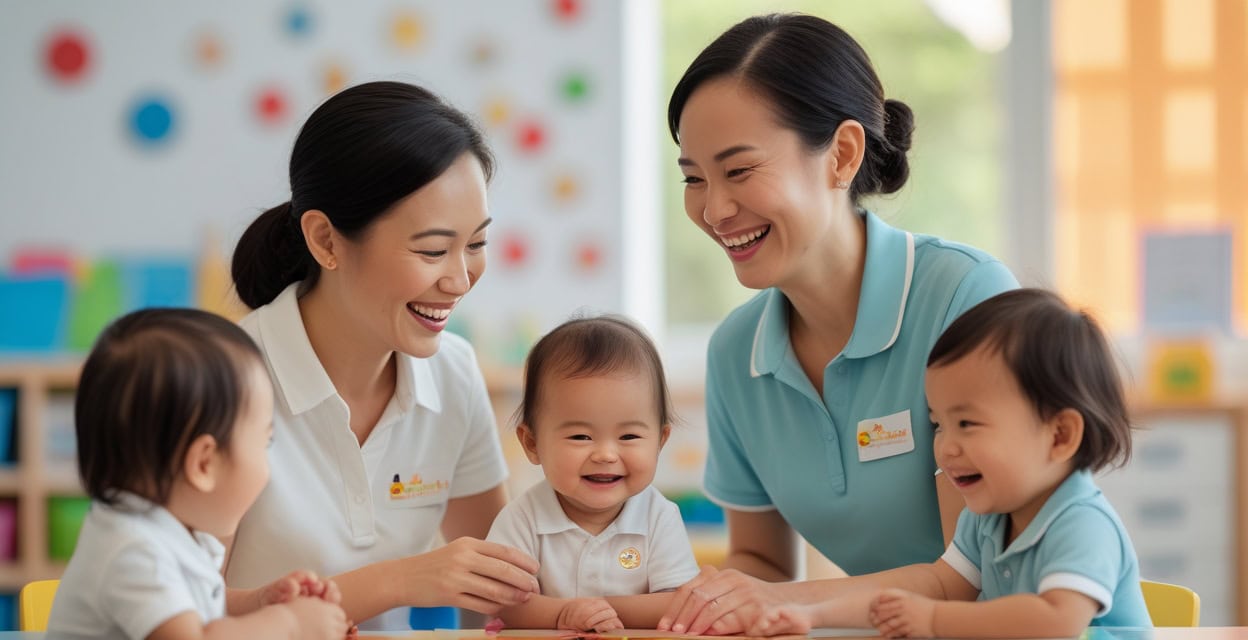
How EduNanny Makes Infant Care Great in Singapore

How EduNanny Makes Infant Care Great in Singapore

  • Ultra-low ratio, high attention: With a 1:3 setup, caregivers can promptly respond to cues, co-regulate emotions, and provide consistent routines that anchor infants’ days.
  • Transparent safety culture: Robust safety practices, documented protocols, and ongoing coaching ensure daily discipline around cleanliness, sleep, feeding, and hygiene.
  • Near-home convenience: Proximity matters for continuity of care and parental peace of mind. Community spaces are designed for accessibility and confidence.
  • Accessible affordability: Subsidised hours and CDA funding make high-quality infant care feasible for families, without compromising safety or warmth.
  • Caregiver dignity and growth: Continuous training, coaching, and career pathways empower caregivers to deliver deeper, more attuned care.
Four Pillars of Practice: Heart and Science, Harmonised

Four Pillars of Practice: Heart and Science, Harmonised

1) The Attachment Ratio: 1 to 3 and the architecture of trust

Guided by Bowlby’s attachment theory and Erikson’s trust-versus-mistrust stage, EduNanny builds caregiving around predictable, nurturing relationships. In a 1:3 setting, childminders can:

  • Respond promptly to cues (hunger, fatigue, overstimulation) and co-regulate emotions, preventing distress from escalating.
  • Offer consistent routines that anchor infants’ internal clocks: feed–sleep–play rhythms, and gentle transitions narrated to the child.
  • Practice respectful caregiving in the spirit of Pikler: slow, attuned touch during diapering, time for infants to anticipate what happens next, and freedom to explore movement on safe floor space.
  • See the child as a unique person—“known, not managed”—ensuring secure bases for exploration and growth.

2) The Prepared World: spaces that invite independent discovery

Drawing on Montessori’s prepared environment, EduNanny creates spaces designed to reduce frustration and invite self-initiated exploration. In community spaces and carefully audited home setups, you’ll find:

  • Modern layouts with clear sightlines and hazard-mapped zones to support supervision without intruding on curiosity.
  • Minimal, high-quality materials to reduce overstimulation and invite focused play.
  • Low shelves, floor-time mats, and ample natural light to support safe self-directed exploration.
  • Safe sleep zones and hygienic feeding stations that reinforce routines and calm transitions.

3) Safety without shadows: systems that protect and reassure

Safety is a daily discipline, not a document. We combine ECDA standards with robust internal practices:

  • People safety: ECDA-conducted background checks; mandatory trainings in infant first aid, safe sleep, feeding, and hygiene; ongoing coaching and observations.
  • Environment safety: Detailed hazard audits, childproofing, daily checklists, and safe equipment; CCTV in community caregiving spaces; opt-in CCTV in caregiving areas for home-based care during service hours with privacy safeguards.
  • Health integrity: A No Sick Child Policy to protect group health; clear guidance for parents when a child is unwell and options to reschedule or extend care under policy terms.
  • Safe sleep and feeding: Back-to-sleep guidance, firm sleep surfaces, no soft bedding; individualized feeding plans; strict milk handling and sterilisation protocols.

4) Joy that teaches: play, language, and the beginnings of self

From Froebel to Vygotsky, we know learning begins in relationships. With one to three infants per caregiver, EduNanny emphasizes:

  • Mirroring infant sounds, tracking gaze, and sustaining serve-and-return exchanges to build early language and social understanding.
  • Balancing lively and quiet play to regulate arousal and encourage deep focus: songs, fingerplays, peek-a-boo, cosy reading moments, and tummy-time exploration.
  • Gentle documentation—short observation notes and photos with parental consent—to celebrate milestones and identify early needs for support.
  • Respectful cultural and bilingual exposure through songs and simple words that reflect each family’s languages and traditions.
What Childminding Is For: A Renewed Social Covenant

What Childminding Is For: A Renewed Social Covenant

Childminding is a distinct professional practice with purpose and dignity:

  • For infants: to be cradled in safety, treated with respect, and given space to discover.
  • For parents: to have care you can rely on near your home, at a price that respects your budget and the value of your work.
  • For Singapore: to build neighbourhood networks of care, dignify caregiving work, and maximise employment and upskilling in a field that shapes our collective future.

EduNanny Benefits at a Glance

EduNanny Benefits at a Glance

  • Ultra low ratio: Maximum 1:3 infant ratio.
  • Certified EduNanny childminders: Trained in infant first aid, basic infant care, and food safety; continuously coached.
  • Background checks: Certified and verified in partnership with ECDA.
  • Safety transparency: CCTV in community spaces; opt-in CCTV in caregiving areas for home-based care during service hours, with privacy safeguards.
  • No Sick Child Policy: Protects the group and provides clear guidance for families when a child is unwell.
  • National initiative: Appointed under the ECDA Childminding Pilot (Dec 2024–Dec 2027).
  • Care settings: Centre-based and home-based options in community and home premises.
  • Environment design: Modern, hazard-mapped layouts with safe sleep and hygienic feeding setups.
  • Schedule flexibility: Monday to Friday, 7am–7pm; 5-hour or 10-hour blocks; number of days per week adjustable; islandwide availability (excluding public holidays).
  • Affordability: Fees from $33 per full day and $16.50 per half day before GST during subsidised hours; CDA monies accepted for subsidised hours.
  • Innovation and accountability: Incident protocols, family communication, and development notes.
  • Proximity and convenience: Reduced commute, increased family time.
  • Professional pathways: National initiative supporting caregiver employment and upskilling in local communities.
  • Support: EduNanny Concierge for seamless onboarding and ongoing assistance.
  • Learn more: EduNanny.com and Childminding.EduNanny.com
A Day Inside EduNanny

A Day Inside EduNanny

  • Arrival: Warm greeting at infant eye level, quick health check, labelled belongings, and hand hygiene.
  • Morning rhythm: Feed, cuddle, outdoor or window-view moment when appropriate; sensory play on mats; songs and simple books; nap following the infant’s cues.
  • Midday: Unhurried feeds; diapering with gentle narration; tummy-time or floor exploration; one-to-one time for infants needing extra reassurance.
  • Afternoon: Calm play, music, and language-rich exposure; another nap if needed; tidy routines; brief handover with parents highlighting wins and needs.
Who, What, When, Where, How: Why Childminding Matters

Who, What, When, Where, How: Why Childminding Matters

Who

Singapore Citizen infants aged 2 to 18 months not concurrently enrolled in ECDA-licensed infant care centres; families who value small-group, relationship-rich care.

What

Professionally delivered childminding in home and community spaces, capped at one to three infants per childminder, aligned to ECDA’s industry standards.

When

Mondays to Fridays, 7am to 7pm, in half-day (5h) and full-day (10h) subsidised blocks, excluding public holidays.

Where

Islandwide availability—neighborhood proximity, real continuity, and real convenience.

How

By uniting attachment science, a prepared environment, rigorous safety, and joyful play—made affordable through the national pilot so every family has a fair chance at excellent care. In these first months, we do not simply keep a child safe; we help them feel safe. A child who feels safe will reach, explore, listen, look back, and reach again.

The EduNanny Philosophy in a Sentence

We promise presence: attentive, trained, transparent, and near your home—so your infant’s first adventures unfold with dignity and delight, and your family gains the freedom to work, rest, and hope.


How to Sign Up

How to Sign Up

  • Visit https://edunanny.com/edunanny-ecda-childminding-service/ and fill out the enquiry form, or message us via WhatsApp from the same page.
  • EduNanny Concierge responds promptly to understand your needs, eligibility, preferred location, and schedule.
  • Schedule a site visit—home-based or community space—to meet the childminder, view the environment, and discuss routines.
  • Enroll with confidence. We’ll guide you through documentation, CDA payment options for subsidised hours, and your child’s personalised care plan.

Conclusion

Conclusion

EduNanny represents more than a pilot; it signals a new social habit for a new generation: high-trust infant care that is affordable, nearby, and deeply human. By centering small-group, relationship-rich care taught through attachment science, prepared environments, and rigorous safety, EduNanny helps families breathe, while every infant feels seen, safe, and celebrated. If you are a parent to a Singapore Citizen infant between 2 and 18 months, navigating return-to-work decisions, or seeking care that truly mirrors your family’s values, EduNanny is ready. Visit our site, connect with a Concierge, and begin your child’s first thousand days with presence you can see, and love your child can feel.

[#infantcare, #childminding, #Singapore, #earlychildhooddevelopment, #EduNanny]


edunanny-62c97917-e3a6-4cce-9714-6c9b3cb9343e
August 20, 2025

EduNanny in Singapore ECDA Pilot 2024 to 2027 A Gentle Beginning for Infants and a Steady Path for Families

Introduction: A Gentler Beginning for Singapore’s Infants

Introduction: A Gentler Beginning for Singapore’s Infants

Thank you for gathering to imagine something both simple and profound: a gentler beginning for our infants, and a steadier, more confident stride for families. This EduNanny vision draws on the wisdom of Montessori, Piaget, Vygotsky, Froebel, Malaguzzi, Bowlby, Pikler, Spock, and Erikson—and pairs it with pragmatic partnerships that recognize busy mornings, open hearts, and high standards. This article presents a WordPress-ready, in-depth guide to EduNanny’s Infant Childminding Service in Singapore, including practical steps, everyday routines, and actionable insights for families navigating early care and development.


EduNanny Infant Childminding Service: An Appointed Operator in the ECDA Pilot

EduNanny Infant Childminding Service: An Appointed Operator in the ECDA Pilot

EduNanny is designed to make infant caregiving more affordable, safe, reliable, and personal for Singaporean families with infants aged 2 to 18 months. As an appointed operator in the ECDA Childminding Pilot (1 December 2024 to 31 December 2027), EduNanny operates with safeguards, training, and quality protocols that modern families expect and deserve. Under this pilot, each childminder cares for no more than three infants at a time—whether in their home or in an approved community space.


The Five Core Ideas That Shape Our Practice

The Five Core Ideas That Shape Our Practice

1) Attachment and the Power of the Quiet Three

The 1:3 ratio is not just a number—it’s a promise. It means enough time for “serve-and-return” interactions, the foundation of language and emotional regulation. Secure attachment, guided by Bowlby’s principles, becomes the launchpad for courage. At EduNanny, consistent, responsive care builds secure attachment, so infants venture, return, and venture again.

Inspired by Pikler, we honor natural movement and infant agency. Milestones aren’t rushed; we create safe spaces where curiosity leads the lesson plan. Practical tips for families:

  • Observe a childminder’s “serve-and-return” moments: how they imitate, respond, and expand a baby’s vocalizations or gestures.
  • Encourage easy, predictable daily rhythms at home to complement the care environment (e.g., a short, soothing pre-nap routine).
  • Use simple, responsive language during routines—narrating actions, naming objects, and labeling emotions to build vocabulary and emotional literacy.

2) Safety You Can See, Systems You Can Trust

Safety is an ecosystem, not a checklist. EduNanny assesses environments, removes hazards, and rehearses emergency protocols. Every childminder is trained in infant first aid and basic care before deployment.

  • CCTV: Community spaces have CCTV for transparency; home-based care offers opt-in CCTV in caregiving areas during care hours to balance peace of mind with household privacy.
  • Health and hygiene: A no-sick-child policy protects infants and staff. Common-sense exclusions apply (fever ≥37.5°C, vomiting, diarrhoea, suspected contagion). Medication is administered only with parent instructions on dose, timing, and watch-outs.
  • Sleep safety: Back to sleep, firm mattresses, no loose bedding, routine checks; sleep practices are evidence-based and non-negotiable.
  • Background checks: ECDA conducts checks on childminders; for home-based care, adults with regular access to the home are checked as well.

3) The Learning Science of the First Thousand Days

Piaget’s schemas, Vygotsky’s zone of proximal development, and Froebel’s play principles guide micro-moments: a rattle becomes physics; peekaboo becomes object permanence; babble becomes conversation.

We use a rhythm, not a rigid schedule: feed, rest, play, explore. Predictability lowers stress, and stress reduction fuels neural growth. Practical tips for parents:

  • Create language-rich moments: name objects, describe actions, and narrate feelings during daily routines.
  • Design simple, repeated activities that foster problem-solving (e.g., stacking cups during bath time, hiding a toy under a cloth and revealing it).
  • Document development with short, observable notes—share milestones with your childminder to tailor activities to your infant’s interests.

4) Joy as a Standard, Not a Nice-to-Have

Infants learn best when they feel safe, seen, and soothed. EduNanny designs calm spaces, gentle transitions, and warm rituals—greeting songs, sensory baskets, and outdoor time where available. Caregiver well-being matters because a regulated adult co-regulates a child.

  • Establish predictable greetings and farewells to foster security at transitions.
  • Incorporate sensory play that supports exploration without overstimulation (soft textures, safe musical stimuli, varied scents).
  • Encourage caregiver self-care and peer support through structured supervision and professional development.

5) The Modern Childminder: Educator, Guardian, Neighbour

The childminder is the everyday architect of trust—equal parts expert and ally. Our professionals are certified, trained, and reflective. EduNanny coaches childminders in observation, responsive routines, and respectful caregiving, while inviting parent voice for ongoing partnerships.

  • Continuous professional development: monthly reflective practice and supervised experiences to elevate caregiving quality.
  • Partnership with families: regular updates, milestone celebrations, and goal co-creation to align home and care environments.
  • Community integration: childminders act as neighbors—helping families feel rooted and supported in their local area.

A Day in the EduNanny Experience

A Day in the EduNanny Experience

What a typical day can feel like for your infant and family within the 1:3 model:

  • Arrival: A calm hello, health check, and a brief chat with parents to align on the day’s plan.
  • Morning: Gentle sensory exploration, tummy time, songs, and safe outdoor time when possible.
  • Midday: Unhurried feeds, responsive cuddles, and safe sleep with consistent routines.
  • Afternoon: Books, language play, movement, and quiet discovery; quick documentation shared with parents.
  • Closure: A succinct handover highlighting observed progress, next steps, and upcoming milestones.

Why Families Choose EduNanny

Why Families Choose EduNanny

  • Ultra-low ratio: 1 childminder to 1–3 infants—deep, responsive care.
  • Ultra-low density: Calm, uncluttered environments designed for safety and focus.
  • Certified childminders: Trained in infant first aid and basic care; ongoing professional development.
  • Background-checked: ECDA checks for childminders and, in home-based care, for adults with regular household access.
  • Safety-first culture: Clear incident protocols, safe sleep standards, hygiene routines, and no-sick-child policy to minimise spread.
  • Transparency: CCTV in community spaces; opt-in CCTV in caregiving areas for homes during care hours.
  • Affordability: From $33 per full day (10 hours) before GST during subsidised hours; half-day (5 hours) at $16.50 before GST; CDA/Baby Bonus may be used during subsidised hours.
  • Flexibility and convenience: Monday to Friday, 7am–7pm (excluding public holidays); choose number of days and blocks that suit your family.
  • Nationwide reach: Islandwide availability with home-based and community-based sites under the ECDA Pilot; centre-based options within EduNanny’s ecosystem.
  • Modern environments: Thoughtful layouts and materials designed to respect infant movement and curiosity.

Where EduNanny Fits in Singapore’s Care Landscape

Where EduNanny Fits in Singapore’s Care Landscape

For families who want intimacy without isolation, the 1–3 model blends the warmth of home with training, oversight, and standards. For infants, it’s the Goldilocks zone—ample peer interaction for social learning, enough individual attention for secure attachment, and structured routines that support healthy development. For the nation, EduNanny represents a practical step toward a resilient future: strong starts for children, real support for parents, and dignified professional pathways for caregivers.


Who, What, When, Where, How—Why Childminding Matters Now

Who, What, When, Where, How—Why Childminding Matters Now

  • Who: Infants aged 2 to 18 months who need attuned relationships, and parents seeking confidence beyond supervision.
  • What: Evidence-based childminding that treats safety as culture, attachment as curriculum, and play as serious learning.
  • When: During the most sensitive brain-development window where everyday interactions shape lifelong pathways.
  • Where: Carefully vetted home-based and community spaces across Singapore—close to where families live and work.
  • How: Ultra-low ratios, trained and background-checked childminders, clear health and safety standards, transparent communication, and affordable, flexible access.

EduNanny’s Philosophy and Purpose

EduNanny’s Philosophy and Purpose

Our purpose is to dignify infancy and support families. We believe:

  • Infants deserve: A trusted, familiar adult and a calm place to grow.
  • Parents deserve: Clarity, partnership, and a service that fits real life.
  • Childminders deserve: Training, respect, and a clear professional pathway.
  • Communities thrive: When the earliest years are safe, joyful, and thoughtfully guided.

Practical Essentials at a Glance

Practical Essentials at a Glance

  • ECDA eligibility: Singapore Citizen infants 2–18 months, not concurrently enrolled in ECDA-licensed infant care centres.
  • Hours and fees (subsidised care): Half-day (5 hours) $16.50 before GST; Full-day (10 hours) $33.00 before GST; Monday–Friday, 7am–7pm (excluding public holidays); CDA/Baby Bonus may be used during subsidised hours.
  • Locations: Home-based and community spaces (CCTV in community spaces; opt-in CCTV in caregiving areas for homes).
  • Health policy: No-sick-child policy; medications only with parent instructions.

How to Sign Up

How to Sign Up

  1. Step 1: Visit https://edunanny.com/edunanny-ecda-childminding-service/ and complete the enquiry form—or message via WhatsApp from the same page.
  2. Step 2: EduNanny Concierge Team responds, learns your needs, and recommends suitable home or community sites.
  3. Step 3: Book a site visit to meet the childminder and see the environment.
  4. Step 4: Confirm your schedule (half or full day blocks, number of days), complete enrolment, and prepare for a gentle start.

Implementation: Practical Advice for Parents

Implementation: Practical Advice for Parents

To maximize outcomes from EduNanny’s model, consider these practical strategies:

  • Prepare a one-page care brief: Include baby’s routines, feeds, sleep history, allergies, favorite soothing strategies, and any cues the infant uses when distressed.
  • Create consistent routines at home: Align home routines with the care environment—e.g., similar nap times or feeding routines to reduce transitions.
  • Leverage documentation: Use EduNanny’s simple observation notes to celebrate small milestones and adjust activities as your infant grows.
  • Encourage family partnerships: Schedule regular updates and participate in joint goal setting for development milestones.
  • Plan for transitions: When moving between home-based and community spaces, gradually acclimate your child to new environments with short initial visits.

In Closing

In Closing

When we lower ratios, we raise attention. When we honour routines, we quiet stress. When we design for safety and joy, infants reveal what they were ready to do all along. Childminding matters because it touches the future at its softest point—where trust is formed, curiosity awakens, and families are steadied. EduNanny stands ready—with science in our practice, heart in our hands, and Singapore in our purpose. We invite you to visit, to ask, to see, and to feel the difference a thoughtful 1–3 model makes.

Because the first thousand days are not just the beginning of childhood; they are the beginning of everything.


Conclusion

Conclusion

EduNanny’s 1:3 infant care model blends attachment theory, safety, and developmental science into a practical, affordable solution for Singaporean families. With clear health policies, transparent communication, and professional, well-supported childminders, EduNanny aims to be a trusted partner in the earliest years. If you’re balancing work, family, and growth, consider how the EduNanny approach can provide a steady foundation for your child’s first thousand days—and beyond.

SEO keywords: [#InfantCareSingapore, #ECDAChildminding, #EduNanny1to3, #FirstThousandDays, #SingaporeChildcareAccessibility]


edunanny-b4830e52-9221-45b2-a1e9-0c768a39d541
August 20, 2025

EduNanny in the ECDA Pilot 2024 to 2027 Redefining Infant Care Through Ultra Low Ratios Across Singapore

Introduction: What is EduNanny Infant Childminding?

Introduction: What is EduNanny Infant Childminding?

EduNanny by BUTLER is an appointed operator under the ECDA Childminding Pilot (1 Dec 2024–31 Dec 2027). This program brings infant care to ultra-low-density, ultra-low-ratio settings—one childminder caring for one to three infants—across Singapore, Monday to Friday, 7am to 7pm. Our service is designed to fit families in two practical formats: home-based childminding at the childminder’s residence and community-based care in modern, purpose-designed spaces. This model prioritizes care scaled to human rhythm, not crowd size, making quality infant care both accessible and sustainable.

Key details to know as you consider EduNanny:

  • Two care formats: Home-based childminding and community-based care in designed spaces.
  • Operating hours: Monday to Friday, 7am–7pm, islandwide.
  • Affordability: From $33/day for full-day blocks (10 hours) or $16.50/half day (5 hours) before GST during subsidised hours, payable via CDA/Baby Bonus, with flexible day selections.

Our aim is not to replace family life but to weave infant care into it—by supporting parents with dependable routines, trained caregivers, and transparent practices that keep families connected to their child’s daily growth.


Five Ideas Guiding Our Work

Five Ideas Guiding Our Work

1) The Pedagogy of Presence: One adult, three infants, a thousand micro-moments

In practice, this means attachment-informed care that honors each infant’s signals. Examples include:

  • Consistent, emotionally attuned routines: Greeting rituals, predictable feeding and nap times, and calm transitions help infants learn that the world is safe and that their signals are noticed.
  • Respectful caregiving: Narrated diaper changes, slow baths, and deliberate feeding conversations—making the care routine the curriculum itself.
  • Prepared environment: Low shelves, open floor space, natural materials, and spaces that invite exploration rather than passive entertainment.
  • Scaffolding in the zone of proximal development: Gentle prompts that match each infant’s pace—encouraging curiosity without overstimulation.

2) Safety by Design: People, Place, Practice, Proof

Safety is a holistic system built into every touchpoint. Practical elements include:

  • People: Background checks for childminders and relevant household members, infant-first-aid certification, basic food safety, and safe sleep training.
  • Place: Clean, hazard-minimised environments with secure gates, safe sleep zones, and appropriate ratios; CCTV available in community spaces with privacy-respecting opt-in options for homes.
  • Practice: Daily hygiene protocols, no-sick-child policies to protect small groups, and clear medication administration plans when needed.
  • Proof: Checklists, observation logs, and CCTV for accountability and learning, ensuring trust through verifiable practices.

3) Development by Design: The First 1,000 Days Done Well

Infant development is shaped by daily, intentional experiences. We emphasize:

  • Individualised daily plans: Tailored feeding, sleep, and play routines aligned with each family’s preferences and infant cues.
  • Sensorial, screen-free play: Tummy-time progressions, grasp-and-release activities, cause-and-effect exploration, early language exposure through storytelling, and infant sign language.
  • Safe sleep and feeding: Evidence-based routines, upright holds after feeds, paced bottle-feeding to reduce reflux, and safe supine sleep with clear crib practices.
  • Observation-led planning: Caregivers document small milestones and adjust experiences in real time, translating developmental science into daily practice.

4) Joy as a Learning Engine: Happiness is Not Extra—it Is the Method

Joyful, secure environments foster growth. We cultivate:

  • Warm attunement: Caregivers model calm nervous systems to help infants regulate themselves.
  • Purposeful novelty: Just enough new textures, sounds, and outdoor experiences to keep curiosity alive without overwhelming the senses.
  • Micro-rituals: Routine greetings, predictable song times, and consistent nap cues build a sense of safety and courage in babies.

5) A Civic Purpose: Childminding as a National Social Initiative

EduNanny is more than care—it’s a movement toward stronger families and a professional, proximate caregiving workforce. Our approach supports:

  • Family-strengthening: Ultra-low ratios enable secure attachments that bolster resilience and lifelong learning.
  • Employment with dignity: Up-skilling and stable roles for caregivers in communities across Singapore.
  • Accessibility and convenience: Both home-based and centre-based options reduce travel friction and bring quality care closer to where families live and work.

EduNanny Advantage: What This Means for Your Family

EduNanny Advantage: What This Means for Your Family

  • Ultra Low Ratio: An excellent 1:3 infant-to-childminder ratio for high-quality attention and responsive care.
  • Ultra Low Density: Calm, small-group settings that protect immune systems and support sustained attention.
  • Safety and Transparency: Certified, background-checked childminders with CCTV in community spaces and opt-in home privacy options.
  • National Initiative: Appointed under the ECDA Childminding Pilot, aligned with industry standards and incident protocols.
  • Quality, Every Day: Infant first aid, safe sleep, food safety, and respectful care training as baseline practice.
  • Modern Layouts: Purpose-designed community spaces and well-prepared home environments that feel like home.
  • Flexible, Convenient: Monday–Friday, 7am–7pm, islandwide across home and community premises.
  • Affordable: From $33/day full-day or $16.50/half-day before GST during subsidised hours; CDA/Baby Bonus accepted.
  • Clear Health Policy: No sick child policy for group safety, with family-first escalation and care plans.
  • Two Pathways: Home-based childminding and centre/community-based childminding.
  • Technology with Care: CCTV, digital logs, and parent communication designed for peace of mind.
  • National Social Purpose: Part of a broader movement to strengthen families and professionalise care.

Eligibility and Practical Details

Eligibility and Practical Details

  • Who: Singapore Citizen infants aged 2 to 18 months.
  • Where: Childminders’ homes and community spaces across Singapore.
  • When: Mondays to Fridays, 7am–7pm (excluding public holidays), in half-day (5-hour) or full-day (10-hour) blocks.
  • Fees during subsidised hours: $16.50 (half day) or $33.00 (full day) before GST; CDA/Baby Bonus can be used.
  • Important: Infants cannot be concurrently enrolled in an ECDA-licensed infant care centre while using the pilot.

How We Keep Your Infant Safe, Healthy, and Known

How We Keep Your Infant Safe, Healthy, and Known

  • Safe sleep: Supine sleep, firm mattress, no loose bedding, and documented checks.
  • Feeding: Paced bottle-feeding, responsive cues, safe handling and storage of milk.
  • Hygiene: Handwashing protocols, surface disinfection, and clean toy cycles.
  • Health: No sick child policy to protect ultra-small groups; clear return-to-care guidelines.
  • Medication: Only with written parental instructions—dose, timing, method, and watch-outs.
  • Supervision: Always within line of sight; safe ratios preserved indoors and during pram walks.
  • Documentation: Daily notes on feeds, naps, diapers, mood, and milestones.

Four Promises to Parents

Four Promises to Parents

  • Your infant’s cues will be heard the first time.
  • Your infant’s body will be handled with respect and calm.
  • Your infant’s day will be structured but never rushed.
  • You will always know how the day went—what we observed, loved, and learned.

What It Means to Choose EduNanny: Practical Guidance for Families

What It Means to Choose EduNanny: Practical Guidance for Families

Choosing EduNanny means embracing care that integrates development, safety, and family life. To make the transition smooth, consider these practical steps:

  • Prepare a simple settling-in plan: a calendar of 2–3 settling days, with the same caregiver if possible, and a favorite comfort item for the infant.
  • Share detailed cues and routines: nap times, feeding rhythms, sleep associations, and any medical considerations with your caregiver in writing.
  • Set up a weekly communication rhythm: a short note or log entry each day to celebrate small milestones and flag concerns early.
  • Develop a back-up plan: have a primary and a secondary caregiver and discuss continuity of care in case of illness or absence.
  • Prepare the home environment: a calm feeding corner, safe sleep area, and toy rotation that echoes the prepared environment principles.

The EduNanny Philosophy and Purpose

The EduNanny Philosophy and Purpose

We believe the smallest classrooms should uphold the biggest standards. Trust and transparency can coexist—through a calm infant’s gaze, through open daily notes, and through responsible CCTV use. Our prepared environment aims to nurture the soul, attachment fosters resilience, and play remains the child’s first language. Most of all, we believe families should never have to choose between safety, development, convenience, and affordability. With EduNanny, you do not have to choose—you can receive all of these).\p>


How to Sign Up

How to Sign Up

Ready to explore EduNanny? Here are the steps to begin the journey:

  • Visit the EduNanny ECDA Childminding Service page: edunanny.com/edunanny-ecda-childminding-service/
  • Fill out the enquiry form or message us via WhatsApp to start a dialogue with the EduNanny Concierge Team.
  • Receive a response and schedule a site visit (home-based or community-based) to experience the setting firsthand.
  • Enrol and begin a gentle, guided settling-in period tailored to your infant’s temperament and routine.

Where to Learn More

Where to Learn More

  • EduNanny: EduNanny.com
  • Childminding by EduNanny: Childminding.EduNanny.com

Conclusion

Conclusion

If it takes a village to raise a child, it takes a prepared, professional, and proximate village to raise one well. EduNanny exists to make that village real—one childminder, one infant, one family at a time. Let us help you turn care into growth, routine into relationship, and each day into a quiet masterpiece of safety and joy.

Thank you for your trust. We are ready when you are—Monday to Friday, 7am to 7pm—across Singapore.

[#keyword1, #keyword2, #keyword3, #keyword4, #keyword5]

edunanny-b79511f7-7902-4668-ad5a-adb4c9e892e0
August 20, 2025

Cradling Infants in Singapore The EduNanny One to Three Pilot for Safe Joyful Development 2024 to 2027

Introduction: A Simple Conviction, A Big Promise

Introduction: A Simple Conviction, A Big Promise

Good evening, parents, grandparents, caregivers, and partners in Singapore’s future. I stand before you with a simple conviction: infancy is not a waiting room for childhood; it is the workshop where trust, curiosity, and resilience are built. EduNanny Infant Childminding was created to honour those first thousand days with precision, warmth, and the quiet power of evidence-based care—so every family, in every neighbourhood, can access infant care that is safe, joyful, and deeply human.

EduNanny is appointed by ECDA under the national Childminding Pilot for Infants, running from 1 December 2024 to 31 December 2027. We serve Singapore Citizen infants aged 2 to 18 months, in childminders’ homes or thoughtfully designed community spaces, at an ultra-low 1:3 ratio—one childminder to a maximum of three infants. Care is islandwide, Monday to Friday, 7am to 7pm, with Government-subsidised blocks that keep fees affordable: $16.50 for a half day (5 hours) or $33.00 for a full day (10 hours), before GST. Parents can use CDA (Baby Bonus) to pay during subsidised hours. This is a national initiative designed to make infant care safe, reliable, and within reach—without compromising on quality.


EduNanny at a Glance: What We Do and Why It Matters

EduNanny at a Glance: What We Do and Why It Matters

We did not set out to be everything to everyone. We set out to be consistently excellent at the things that matter most to a baby’s mind, body, and heart. Here is how EduNanny translates evidence into everyday care:

  • One-to-three Attention. Ultra-low density and ultra-low ratio are not slogans; they are a pedagogy. At 1:3, a childminder can truly observe, respond, and scaffold each baby’s rhythms—feeding, sleeping, sensory exploration, and social engagement—with patience and fidelity.
  • Home-based Intimacy, Community-based Consistency. Families may choose a trained, certified childminder’s home or a nearby community space set up and overseen by EduNanny. Both pathways follow the same safety, hygiene, and developmental standards; both are supervised by our Concierge Team and ECDA-appointed protocols.
  • Clear Safety Contract. Community spaces are equipped with CCTV (as required). In childminders’ homes, CCTV use is encouraged and available in caregiving areas during care hours with consent, aligned with ECDA guidance to balance safety and privacy. All childminders undergo background checks, are certified in infant first aid and basic infant care, and receive ongoing coaching.
  • Dignified Policies. We maintain a No Sick Child Policy to protect all infants—paired with clear communication, care protocols, and help to coordinate alternatives if your little one is unwell.

Five Pillars of Our Infant Pedagogy, Safety, Development, and Happiness

Five Pillars of Our Infant Pedagogy, Safety, Development, and Happiness

The Architecture of Attachment

A baby’s first curriculum is the caregiver’s face. Secure attachment is built in micro-moments: how we greet, how we offer a bottle, how we pause to let the infant respond, how we return after a nap. We train our childminders in attuned caregiving inspired by Bowlby and Pikler: slow, respectful routines; consistent language; predictable transitions. With only three infants per childminder, those moments are not rushed. They are narrated, shared, and repeated—exactly how trust is made. Practical tips for families at home include: establishing a daily greeting ritual, narrating your actions during routine care, and allowing the infant moments of co-regulation through responsive touch and calm voice tones.

The Science of Safe Environments

Safety is not a checklist; it is a culture. We design care environments that anticipate infant movement and curiosity—low shelves, soft boundaries, hazard-free surfaces, and modern layouts that invite exploration without risk. We practise daily health screening, rigorous hygiene, and clear incident protocols. Every caregiving act—preparing milk, sterilising equipment, supporting tummy time—is executed with clear, audited standards. In community spaces, CCTV offers visibility and accountability; in home settings, CCTV is available with consent during care hours, aligned with the Pilot’s privacy and safety balance. Families can translate these safeguards into home routines: keep play areas uncluttered, practice handwashing before meals, and maintain a simple, shared health plan with your childminder.

Micro-Community Learning

Infants learn from people and patterns. At 1:3, we harness the power of a micro-community—small enough for deep bonds, rich enough for early social learning. One infant reaches for a rattle; another watches, then grasps. A babble becomes a duet. This is Vygotsky’s zone of proximal development at baby scale: the adult guides, the peers inspire, and the child’s capacities stretch. We embed sensory play, music, and floor time that reflects Montessori’s respect for independence and Froebel’s joy in simple, purposeful play. Home-based families can support this by providing consistent daily routines, varied textures (soft fabrics, natural materials), and opportunities for safe exploration with caregiver guidance.

The Rhythm of Joyful Routines

Predictable routines liberate, not confine. Infants thrive on patterns that honour their internal clocks: feed, play, rest, repeat. We view care tasks—diapering, bottle-feeding, nap transitions—as relational rituals. Each routine is a moment of conversation, eye contact, and gentle choice-making. Over weeks, you will see calmer naps, steadier feeds, longer periods of focused play, and the early signs of self-regulation that set a foundation for lifelong learning. Families can complement this by creating predictable home routines aligned with EduNanny’s approach (e.g., similar nap windows, feeding cues, and soothing strategies).

The Professional Purpose of a Childminder

A great childminder is an educator of the everyday. Our childminders are trained, certified, supervised, and celebrated as professionals. They document progress, communicate with families, and practise reflective care—What did the infant show me today? How did I respond? What will we try tomorrow? This professionalism is backed by national standards, background checks (including household members in home settings), mandatory training, and ongoing coaching. Purpose and pride are non-negotiables. Parents benefit from regular updates, clear care plans, and structured opportunities to discuss growth, concerns, and next steps with the EduNanny Concierge.


What Parents Can Expect from EduNanny

What Parents Can Expect from EduNanny

  • Ultra Low Ratio, Ultra Low Density: 1 childminder to a maximum of 3 infants.
  • Certified and Background Checked: ECDA checks and EduNanny vetting; infant first aid and core care training mandatory.
  • CCTV Provided: In community spaces; offered in caregiving areas in homes with consent, during care hours, aligned with ECDA guidance.
  • No Sick Child Policy: Clear health standards to protect all infants.
  • Affordable, National, Reliable: ECDA Childminding Pilot; subsidised hours Monday–Friday, 7am–7pm; choose half day or full day; pay with CDA during subsidised hours.
  • Islandwide Convenience: Home-based and community-based options near where you live and work; pram-friendly access; modern, practical layouts.
  • Quality and Excellence: Standardised care plans, daily updates, and a dedicated EduNanny Concierge for support.
  • Flexibility with Accountability: Choose the number of days per week and the block of hours per day; consistent documentation and incident processes.
  • A Social Purpose: A national initiative expanding access to dignified infant care while creating meaningful employment for trained childminders.

A Day in EduNanny Care

A Day in EduNanny Care

Arrival is unhurried. Temperatures checked, hands sanitised, a warm greeting at the infant’s eye level. A brief parent handover—sleep, feeds, mood—then a gentle transition to a familiar play mat. Mid-morning, infants rotate through sensory invitations: soft fabrics, natural rattles, mirror play, and a few minutes of outdoor air when suitable. Feeds are calm and responsive; naps are protected and quiet. After rest, there’s music, finger play, early sign language, and floor time for motor milestones—rolling, reaching, supported sitting. Documentation is sent to parents with photos, notes on appetite, sleep windows, diapering, and mood. The day ends as it began: with presence, a summary of learning moments, and a consistent goodbye ritual. For families, this translates into reliable daily updates, a window into your infant’s world, and a shared sense of progress.


Home-based or Community-based—What’s Right for You?

Home-based or Community-based—What’s Right for You?

  • Home-based Care: Offers domestic warmth, family rhythms, and a close-knit routine in a trained childminder’s residence. CCTV can be provided in caregiving areas with consent during care hours. Ideal for families seeking a familiar, intimate setting that mirrors home life.
  • Community-based Care: Offers a purpose-fitted micro-hub designed for childminding: modern layouts, dedicated care zones, and CCTV in line with Pilot requirements. Great for families seeking structured spaces with curated, age-appropriate environments and peers for early social learning.
  • Choosing: Both options adhere to the same safety, hygiene, and pedagogical standards. Consider space, commute, caregiver compatibility, and whether you prefer a home-like routine or a micro-community setting. Discuss with the EduNanny Concierge to find the best match for your family’s needs.

How the Pilot Works—Clear, Simple, Affordable

How the Pilot Works—Clear, Simple, Affordable

  • Eligibility: Singapore Citizen infants, 2–18 months, not concurrently enrolled in ECDA-licensed infant care centres.
  • Hours: Monday to Friday, 7am–7pm; choose 5-hour or 10-hour blocks that fit your workday.
  • Fees before GST: $16.50 (half day), $33.00 (full day). CDA can be used for subsidised hours.
  • Ratio: Maximum three infants per childminder at any time.
  • Locations: Childminders’ homes and community spaces—available islandwide.
  • Quality Governance: Training, background checks, and ongoing coaching maintained to national standards with ECDA oversight.

Why Childminding Matters Now—Who, What, When, Where, How

Why Childminding Matters Now—Who, What, When, Where, How

  • Who: Singaporean families seeking safety, reliability, and warmth in care; childminders pursuing professional pathways; infants whose futures are shaped by daily micro-moments.
  • What: Ultra-low-ratio infant care that unites science and heart—attachment, safety, routines, and joyful exploration.
  • When: Precisely when it matters most—the first thousand days, when early neural connections are rapidly formed.
  • Where: In your community—near home, near work—so care is a companion to family life, not a barrier to it.
  • How: Through national standards, rigorous training, CCTV-enabled transparency, respectful routines, and a relentless focus on each infant’s cues and competencies.

The EduNanny Philosophy and Purpose for Parents and Infants

The EduNanny Philosophy and Purpose for Parents and Infants

We believe every infant deserves three things: secure relationships, safe exploration, and joyful routines. We believe every parent deserves three things: trust, transparency, and affordability. And we believe every childminder deserves three things: training, respect, and meaningful work. EduNanny’s purpose is to bring these beliefs to life—patiently, predictably, and at scale across Singapore—so that a nation’s promise is cradled in the everyday excellence of care. Our approach puts infants at the center, partners with families, and elevates childminders as true professionals shaping tomorrow’s learning foundations.


How to Sign Up

How to Sign Up

  1. Visit https://edunanny.com/edunanny-ecda-childminding-service/ and fill out the form, or enquire via WhatsApp from the page.
  2. EduNanny Concierge Response: We’ll confirm eligibility, understand your routine, and propose nearby home- or community-based options.
  3. Site Visit: Book a visit to meet the childminder, tour the space, review safety features (including CCTV arrangements), and discuss your infant’s care plan.
  4. Enrolment: Choose your schedule—half day or full day, number of days per week—complete documentation, and receive a thoughtful transition plan.

Our Covenant to You

Our Covenant to You

  • We will never trade ratio for volume.
  • We will treat every routine as a learning moment.
  • We will be transparent—about health, safety, and daily care.
  • We will respect the infant as an active partner in their own growth.
  • We will honour parents as the first and forever teachers.

EduNanny Exists to Shape Tomorrow

EduNanny Exists to Shape Tomorrow

EduNanny exists so that Singapore’s infants are cared for not by chance, but by design. Ultra-low ratio. Ultra-high trust. Safety that is visible. Joy that is felt. Development you can see. For the first smile of the morning, the first confident crawl, the first wave goodbye at pickup—these are not small things. They are the architecture of tomorrow.


Conclusion

Conclusion

EduNanny invites you to partner with us in building beautiful beginnings—one attentive moment, one safe space, one thriving infant at a time. If you’re a parent seeking trusted, transparent, and affordable infant care that respects your child’s pace and your family’s needs, explore our options, connect with our EduNanny Concierge, and consider how an ultra-low-ratio approach can become a foundational support for your child’s early years.

SEO keywords: [#InfantCareSingapore, #EduNannySingapore, #UltraLowRatio, #AttachmentTheory, #EarlyDevelopment]


edunanny-0dccd41f-d25f-47fc-aec9-ee48388e496f
August 20, 2025

Cradling Tomorrow in Singapore How EduNanny One to Three Infant Care Model Shapes the Future

Opening: A Simple, Profound Moment

Opening: A Simple, Profound Moment

Good evening, parents, grandparents, caregivers, and partners in the beautiful work of raising Singapore’s youngest citizens. Imagine a moment when an infant rests safely in a caregiver’s arms, fed without rush, spoken to softly, and laid down in a calm, uncluttered space. In those quiet minutes, the brain learns to trust, curiosity begins to bloom, and the world first feels safe. Futures begin here—not in grand gestures, but in consistent, responsive moments. This is the heart of EduNanny.


EduNanny Infant Childminding: A Singapore-First Approach

EduNanny Infant Childminding: A Singapore-First Approach

EduNanny by BUTLER is an ECDA-appointed operator under Singapore’s three-year Childminding Pilot (1 Dec 2024 – 31 Dec 2027). Our mission is to make infant caregiving affordable, safe, reliable, and close to home. We care for Singapore Citizen infants aged 2 to 18 months in ultra-low-density settings—always a maximum of three infants per childminder—at a childminder’s home or in modern community-based hubs across the island.

  • Hours you can count on: Mondays to Fridays, 7am–7pm (excluding public holidays)
  • Flexible blocks and fees (before GST): Half-day 5 hours at $16.50; Full-day 10 hours at $33.00
  • Use your CDA (Baby Bonus) funds during subsidised hours
  • Islandwide availability with home-based and community hub options
  • Transparent environments: CCTV in community hubs (required); CCTV available in home settings with consent and during care hours
  • Health-first practice: a No Sick Child policy for contagious illnesses to protect the group, with clear medication protocols when needed
  • Every childminder background-checked and trained: infant first aid, basic infant care, and food safety—and assessed for caregiving temperament and home suitability
  • 1:3 infant ratio for responsive, relationship-based care
  • Ultra low density, modern, child-safe layouts in hubs
  • Monday–Friday reliability; convenience near your neighbourhood; affordability that expands access

How EduNanny Makes Infant Care Exceptional in Singapore

How EduNanny Makes Infant Care Exceptional in Singapore

We are, at our core, designers of daily life for infants. Our playbook is simple: reduce ratios, raise quality, embed safety, and honour the science of early bonds.

1) The Three-to-One Promise: Architecture for Attachment

Infancy is a conversation before it becomes language. With a 1:3 ratio, each child receives micro-moments of attuned care—calm feeding; unhurried diapering; face-to-face “serve and return” exchanges that build secure attachment. Influenced by Pikler’s respectful caregiving, Montessori’s prepared environment, and Vygotsky’s gentle scaffolding, EduNanny childminders follow each infant’s cues, pace, and rhythms. Fewer infants per adult is not a luxury; it is the foundation for emotional security, emerging self-regulation, and a lifelong love of learning.

2) Safety by Design, Not by Chance

Safety is architecture, training, and culture working together:

  • Premises: child-safe layouts, gated zones, anchored furniture, hazard controls, and hygienic routines—audited and coached by our team
  • People: mandatory background checks by ECDA (extended to regular household members for home-based care) and operator-level screening; infant first aid, basic care and food safety training before deployment
  • Protocols: health screening at drop-off; No Sick Child policy for contagious conditions; incident management with documented timelines; medication only with parent instructions (dose, timing, method, side effects)
  • Visibility: CCTV in community hubs; in-home CCTV offered with consent, positioned in caregiving areas during service hours—balancing privacy and peace of mind

3) A Micro-Curriculum for the First Years: Quietly Powerful, Deeply Human

Our “curriculum” is not worksheets—it is a responsive routine that grows the whole child.

  • Motor mastery: tummy time, open floor play, and safe, real movement (no containers or flashy contraptions that limit agency)
  • Language and social: songs, warm narration of daily care, book sharing, peer mirroring in tiny groups
  • Sensory and cognition: simple, beautiful objects—baskets of natural textures, cause-and-effect play, sound exploration
  • Rest and nourishment: sleep-promoting environments; paced feeding; observation-led routines aligned with each infant’s cues
  • Observation: educators document patterns (signals, sleep, feeding, new skills) to individualise care and share meaningful updates with parents

4) Happiness You Can Feel (and See)

Infant happiness is quiet, but unmistakable. We look for:

  • Secure-base behaviours: a child separates calmly and seeks comfort as needed, returning to play
  • Harmonious routines: steady feeding, unhurried transitions, restful naps
  • Curiosity: sustained engagement with simple materials; early gestures; joyful babble
  • Emotional tone: warm choreography in the room—gentle voices, predictable rhythms, sensitive touch

Happiness is not entertainment; it is the felt safety that frees the brain to explore. Our low ratio and low density make this possible.

5) The Profession and Purpose of Childminding

Childminders are not “extra hands.” They are co-regulators and culture builders. EduNanny invests in:

  • Selection and mentoring: temperament screening, home suitability checks, and continuous coaching
  • Professional dignity: clear standards, fair scheduling, islandwide placements
  • Career pathways: ongoing workshops, peer networks, and reflective practice routines
  • Community purpose: placing safe, quality care close to families expands access, supports working parents, and strengthens neighbourhood bonds

A Day with EduNanny

A Day with EduNanny

A day with EduNanny is a rhythm of calm, connection, and clarity for parents and infants alike.

  • vigorous but gentle welcome: quick health check, caregiver-to-caregiver briefing
  • Nourish and connect: paced feeding, cooing conversation, and eye contact
  • Movement and play: floor time, songs, outdoor strolls where possible
  • Rest: quiet rooms, darkened spaces, and safe sleep practices
  • Documentation: observations noted, highlights shared, and a calm handover at pick-up

Why This Matters Now

Why This Matters Now

Singapore’s families deserve caregiving that is both human and high standard—deeply kind and rigorously safe. The Childminding Pilot provides national scaffolding; EduNanny brings the craft. Together, we are making high-quality infant care more accessible: islandwide, flexible, and affordable from $16.50 (half-day) or $33.00 (full-day) before GST, with CDA payable during subsidised hours.


Key Benefits at a Glance

Key Benefits at a Glance

  • Ultra-low ratio: 1 educator to 3 infants
  • Ultra-low density: small group calm for better sleep, feeding, and focus
  • Safety-first: background checks, training, clear protocols, and CCTV in community hubs
  • Transparent care: optional CCTV for home settings with consent
  • Flexible care blocks: 5 or 10 hours within 7am–7pm, Mon–Fri
  • Islandwide convenience: home-based care and community hubs with modern, centre-style layouts
  • Affordable: before GST fees; CDA (Baby Bonus) usable during subsidised hours
  • Consistent hours: designed for working families
  • Certified EduNanny childminders: trained, coached, and supported
  • Health protections: No Sick Child policy for contagious illnesses to safeguard every infant

Eligibility and Important Notes

Eligibility and Important Notes

  • For Singapore Citizen infants aged 2–18 months
  • Not concurrently enrolled in ECDA-licensed infant care
  • Services delivered at childminders’ homes or in community spaces
  • Up to 3 infants per childminder at any time (inclusive of any children the childminder is caring for)
  • Subsidised hours are Mon–Fri, 7am–7pm (excluding public holidays); parents may flex days per week and select half-day or full-day blocks

Who, What, When, Where, and How—Why Childminding Matters

Who, What, When, Where, and How—Why Childminding Matters

  • Who: Singapore’s infants and families, supported by certified EduNanny childminders who are trained, background-checked, and mentored
  • What: Safe, responsive infant care in ultra-low-ratio, low-density settings at home or in community hubs
  • When: Mondays to Fridays, 7am–7pm, in 5- or 10-hour subsidised blocks during the ECDA Childminding Pilot (2024–2027)
  • Where: Islandwide—near your home, in your community
  • How: Evidence-informed routines; vigilant safety; meaningful parent partnership; transparent environments; affordability through government subsidies and CDA use

Our Philosophy and Purpose

Our Philosophy and Purpose

EduNanny stands for three promises:

  • Presence: Every infant is seen, heard, and held—not rushed
  • Pedagogy: Care moments are learning moments, shaped by observation and respect
  • Public purpose: When infant care becomes more affordable, safer, and closer to home, the whole society rises

This work is not only about today’s naps and feeds. It is about tomorrow’s citizens—their resilience, empathy, and confidence. With a 1:3 ratio, certified and background-checked childminders, and a culture of safety and joy, we ensure the earliest days are both tender and strong.


How to Sign Up

How to Sign Up

  • Visit https://edunanny.com/edunanny-ecda-childminding-service/ and fill up the form, or enquire via WhatsApp through the site
  • Receive a response from our EduNanny Concierge Team
  • Confirm your appointment for a site visit (home-based or community hub)
  • Enrol, personalise your care blocks (5 or 10 hours), and begin
  • You may also browse Childminding.EduNanny.com or EduNanny.com for more information

Closing

Closing

If we get infancy right, more things go right for a lifetime. EduNanny’s islandwide, Monday-to-Friday care from 7am to 7pm—at an ultra-low 1:3 ratio, with transparent safety and modern, thoughtfully designed spaces—offers families what matters most: trust. Let us meet in that quiet, powerful space where a baby feels safe and, therefore, brave. Where care is steady, and learning is woven into every gentle touch. Where parents can work with peace of mind, and where community is not an idea but a daily practice. This is EduNanny. This is how Singapore cares for its future—one held, happy infant at a time.

SEO Keywords: [#EduNanny, #InfantCareSingapore, #ChildmindingPilot, #EarlyChildhoodDevelopment, #SingaporeParents]


edunanny-328af8d7-bb62-4889-aeda-7f9dcf67d487
August 20, 2025

EduNanny Singapore Elevating Infant Care and Childminding for a Stronger Future

EduNanny Singapore: Elevating Infant Care and Childminding for a Stronger Future

EduNanny Singapore: Elevating Infant Care and Childminding for a Stronger Future

Good evening to all families, caregivers, partners, and friends who share a belief in the transformative power of the earliest days. This article presents EduNanny’s philosophy, practice, and practical guidance drawn from years of professional care, research-informed routines, and a commitment to dignity, safety, and joy for every child. Here you will find clear, actionable steps for parents, caregivers, and communities who want to turn daily care into lasting development.


Why EduNanny: A Purposeful, Professional Path for Infant Care

Why EduNanny: A Purposeful, Professional Path for Infant Care

EduNanny was born from a conviction: the earliest days of life are not a waiting room for “real learning” but the workshop where character, confidence, and curiosity are quietly forged. Our model blends the heart of dedicated childminders with the discipline of research. We bring this partnership to homes, neighborhoods, and thoughtfully designed centres—across Singapore—to create safe, joyful, and purposeful care wherever families live and work.

Key features you’ll find in our approach include a human-centered, evidence-guided framework, a transparent technology plan, a family-friendly service design, and a professional path for childminders. This article expands on four core ideas and translates them into practical steps you can apply today.


Core Idea 1: Attachment as Architecture — Three Calm Certainties

Core Idea 1: Attachment as Architecture — Three Calm Certainties

The strongest foundation for lifelong learning is secure attachment. EduNanny’s approach centers on three certainties that guide every moment with an infant.

Devoted Relationship: Continuity and Co-regulation

What it means in practice:

  • Assign a primary childminder for each infant to foster a stable bond and consistent signals for comfort.
  • Co-regulate emotions by identifying cues early—from a frown to a sigh—and respond with calm, predictable soothing patterns (gentle touch, soft voice, slow pace).
  • Practice name-to-face recognition and individualized soothing plans. Learn each child’s unique preferences, feeding cues, sleep patterns, and delight triggers.

Practical parent tips:

  • Keep a simple “first-thing” routine for the morning (greeting, diapering, initial cuddle) to reinforce security.
  • Record a short daily note of cues you observed at home and share with your caregiver to maintain continuity.
  • Choose a settling ritual (e.g., a rocking song or a particular lullaby) and use it consistently to help transitions.

Predictable Rhythm: A Child’s Daily Heartbeat

What this looks like in daily life:

  • Unhurried routines with a repeating sequence: wake, connect, explore, refuel, rest.
  • Flexible pacing that respects each child’s tempo—no shouting, no rushed transitions.
  • Regular opportunities for both quiet and active engagement to support regulation and curiosity.

Actionable steps for families and providers:

  • Establish a simple timetable for the day and hold to it as much as possible, while remaining responsive to cues of fatigue or overstimulation.
  • Use predictable transitions—e.g., a “sound cue” or a song before moving from play to meal or nap.
  • Involve families in the rhythm by sharing a weekly snapshot of routines and any adjustments needed for home routines.

Responsive Environment: Learning Through Attuned Space

EduNanny spaces are designed for action and discovery, not overstimulation:

  • Infant-friendly layouts with floor-level access, soft lighting, natural materials, and safe, reachable provocations.
  • Curated, age-appropriate materials: textures, simple cause-and-effect toys, mirrors for self-awareness, language corners for talk and song.
  • An emphasis on attunement—caregivers read the room, adjust pace, and slow transitions when needed.

Sample home and centre tweaks:

  • Keep clutter low and curated; rotate materials to maintain novelty while avoiding overstimulation.
  • Arrange spaces at infant eye level to encourage exploration and autonomy in safe bounds.
  • Offer language-rich routines—narrate care steps, label feelings, and invite child-initiated conversations.

A Day with EduNanny: A Sample Schedule and Practical Routines

A representative day might include:

  • Warm arrival ritual that acknowledges the child’s feelings.
  • Breakfast and conversation to nourish social engagement.
  • 12–18 minutes of floor-time exploration to support sensorimotor growth.
  • Outdoors or fresh-air break for reset and development of vestibular skills.
  • Nap with consistent soothing and routine cues.
  • Sensory play after waking with simple, guided activities.
  • Short, meaningful rituals—hand-washing songs, feeding as conversation, and diapering as connection.

Parents can adapt these templates to home life by identifying two or three reliable rituals that travel well between home and EduNanny environments.


Core Idea 2: Safety You Can See, and Safety You Can Feel

Core Idea 2: Safety You Can See, and Safety You Can Feel

Five Ways We Layer Safety

  • People: Calm, reflective caregivers trained in infant CPR/first aid, safe sleep, choking response, hygienic routines, and ongoing supervision.
  • Place: Environments designed at infant eye level with safe-sleep surfaces, clear sightlines, secured furniture, hazard-free electrics, appropriate temperature and light, and safe outdoor testing via risk-benefit assessments.
  • Process: Daily start-up environment scans, safe sleep protocols, bottle/food chain-of-custody, hygienic diapering, and clear illness-exclusion policies with compassionate execution.
  • Technology: Optional CCTV for transparency, with strict privacy controls, and digital daily logs detailing feeding, sleep, mood, and milestones.
  • Community: Shared care plans with parents, pediatric guidance when needed, and neighborhood networks that support vigilance and collaboration.

Translating Safety into Everyday Practice

Safety should feel like a calm, respectful atmosphere rather than a checklist. Here are practical practices to implement at home and in care settings:

  • Establish a predictable safety routine: safe sleep practices, separate bottle and food handling to avoid cross-contamination, and clear diapering steps that emphasize dignity and care.
  • Practice evacuation and lost-child drills in a low-stress manner to ensure quick, calm responses if needed.
  • Use technology thoughtfully: if CCTV is used, set boundaries and discuss privacy expectations with caregivers and family members.
  • Maintain daily logs and weekly summaries for parents, highlighting any changes in mood, sleep, appetite, or milestones.

Core Idea 3: A Micro‑Curriculum for the Under‑Threes — Learning Woven into Life

Core Idea 3: A Micro‑Curriculum for the Under‑Threes — Learning Woven into Life

Infants are not blank pages; they are active learners. EduNanny’s micro-curriculum emphasizes experiences over formal lessons, with a focus on every-day moments that build a strong foundation.

Sensorimotor Mastery

  • Stable floor time, tummy time, and opportunities for movement in safe spaces.
  • Opportunities for rolling, creeping, and pulling to stand—paired with supportive handling that respects pace.
  • Open space for exploration with textured toys and simple cause-and-effect materials to encourage curiosity.

Practical home tips:

  • Set aside a daily “floor-time” window with soft mats and age-appropriate toys to encourage motor exploration.
  • Offer a rotating set of textures (fabric, wood, silicone) and encourage the child to explore with hands and mouth in safe guidelines.

Early Language and Relationship

  • “Talk-Sing-Read” as a daily habit: caregivers narrate routines, label emotions, and pause for turn-taking.
  • Incorporate bilingual rituals when families desire; use simple phrases and songs in both languages to build dual-language familiarity early.
  • Use rhymes, rhythm, and daily reading to promote vocabulary growth and social engagement.

Foundations of Executive Function

  • Even in infancy, children practice focus and self-regulation through moments like waiting for a bottle or taking turns with a toy.
  • Design brief, playful waiting periods, simple hide-and-find activities, and joint attention moments that build patience and persistence.

Social-Emotional Literacy

  • Coach the moment: name emotions, model gentle interactions, and celebrate small social victories (sharing a block, waiting for a turn).
  • Use predictable soothing strategies during meltdowns to support co-regulation and trust.

Sensory and Schema Play

  • Rotate baskets of materials following Froebel/Montessori-inspired ideas: threading rings, fabric squares, containers to fill and dump, shakers for comparison.
  • Encourage repetition of meaningful patterns to help children master choices and predict outcomes.

For toddlers, EduNanny adds meaningful errands that instill dignity and cooperation:

  • Carrying a cloth, placing cups on a tray, choosing a book for a younger child—small responsibilities that build pride and agency.

Core Idea 4: Joy as a Developmentalneed and a Family Right

Core Idea 4: Joy as a Developmentalneed and a Family Right

Joy is a developmental nutrient—necessary for regulation, exploration, and secure return to caregivers. EduNanny tracks observable indicators of thriving to keep joy visible and accountable.

Signals of Thriving

  • Appetite and digestion: steady intake, fewer feeding battles.
  • Sleep consolidation: predictable rhythms and easier settling.
  • Curiosity: time spent in self-directed exploration and goal-directed play.
  • Joint attention: shared gaze, shared delight with caregivers.
  • Soothing index: how quickly upset returns to calm with support.

Distance coaching and home routine tune-ups are practical ways to sustain joy, even from afar. Use weekly video calls to review routines, celebrate small wins, and adjust routines when signals dip.


The EduNanny Service Model: Built for Singaporean Families

The EduNanny Service Model: Built for Singaporean Families

  • Monday–Friday, 7am–7pm, islandwide, with options for centre-based or home-based settings.
  • Centre-based childminding in modern layouts or home-based care in carefully prepared residences. One standard of care across environments.
  • Optional CCTV, daily digital updates, and open communication to build trust and partnership.
  • Fees from $33 per day, payable by CDA/Baby Bonus, ensuring quality care is accessible to more families.
  • 1:3 infant ratio to ensure high-quality attention and individualized care.
  • Part of the ECDA Childminding Pilot, aligned with national work-family policies and a pathway for professional caregiving.
  • Distance coaching, consistent EduNanny philosophy across settings, and ongoing support for transitions between home and care.
  • EduNanny by BUTLER—excellence, quality, and convenience without compromise.

Practical guidance for families:

  • Tour rooms, meet caregivers, and ask about continuity plans if staff changes occur.
  • Request a sample day plan for both centre and home settings to compare routines and space design.
  • Discuss privacy expectations if CCTV is used and establish clear guidelines for what is recorded and who can view it.

The Purpose of the Childminder: A Quiet Profession with Public Impact

The Purpose of the Childminder: A Quiet Profession with Public Impact

A great childminder is not a substitute parent; she is a second secure base. She protects unhurried moments, reads pre-verbal signals, and turns routine into relationship. She is a scientist, observing patterns; an artist, shaping experience. She carries a public purpose as she helps parents participate in the economy, sustains talent in the workforce, and strengthens social fabric. By professionalizing the role—through training, fair wages, mentoring—we honor a craft that enables all other learning to flourish.


Closing: Who, What, When, Where, and How Childminding Matters

Closing: Who, What, When, Where, and How Childminding Matters

  • Who: Infants building trust; parents pursuing careers; caregivers building vocation; employers and the nation benefiting from stronger families and healthier futures.
  • What: The daily work of protection, presence, and play that becomes language, regulation, and confidence—the bedrock of later learning and life.
  • When: Not someday. Weekdays, 7am–7pm; during the early months when brains are most malleable and habits of heart are formed.
  • Where: In calm-centred centres and prepared homes across Singapore’s neighborhoods.
  • How: Ultra-low 1:3 ratio, evidence-guided practice, safety you can see and feel, a micro-curriculum woven into routines, and affordability that expands access.

The Philosophy Behind EduNanny: Excellence as a Daily Practice

The Philosophy Behind EduNanny: Excellence as a Daily Practice

Excellence is personal—every caregiver, every family, and every child’s experience matters. Safety is a system—the visible calm of well-designed spaces and practiced routines. Learning is woven into love—the everyday moments that become vocabulary, self-regulation, and early social skills. Our promise is clear: islandwide availability, flexible formats, distance coaching when needed, optional CCTV for transparency, modern environments, and affordable fees, all within a public mission to empower families and strengthen livelihoods.


Conclusion: Join EduNanny in Elevating Singapore’s Early Years

Conclusion: Join EduNanny in Elevating Singapore’s Early Years

Together, we can turn infancy into a shared beginning of opportunity: secure attachments, safe spaces, joyful routines, and a micro-curriculum that makes every day meaningful. For families, this means caregivers who partner with you in your child’s first culture—the culture of care. For caregivers, it means professional pathways that honor expertise, nurture growth, and provide dignity in every shift. For communities and the nation, it means a stronger economy, healthier families, and a brighter future built on the first reliable relationships a child experiences.

If this vision resonates, we invite you to learn more, tour our spaces, meet our people, and ask the hard questions. The best care welcomes scrutiny. The best partnerships start with conversation. Visit EduNanny.com and Childminding.EduNanny.com to explore, tour, or enroll. Let us help you design days that are safe, joyful, and truly developmental.

EduNanny by BUTLER: excellence, quality, and convenience, without compromise.

Call to action: Schedule a family tour, speak with a caregiver about your child’s needs, and begin a journey where early care becomes a national advantage for Singapore’s future.

To the parents: you are not merely choosing a place to park your child; you are choosing partners in your child’s first culture—the culture of care. To the caregivers: you are builders of inner architecture; your calm becomes their calm. To our community: invest in the first years, and every later year becomes easier to teach, safer to live, and richer to work.

If this vision resonates, come visit us. Walk the rooms. Meet the people. Ask the hard questions. The best care welcomes scrutiny. The best partnerships begin with conversation.

SEO keywords: [#earlycare Singapore, #infantcare best practices, #childminding Singapore, #familyworkbalance, #educationfrombirth]


edunanny-830ebf38-c5a6-4361-9798-0adb5fe33bec
August 20, 2025

EduNanny Singapore A Human Centered Evidence Driven Blueprint for Safe Joyful Infant Care

EduNanny Singapore: A Human-Centered, Evidence-Driven Vision for Infant Care

EduNanny Singapore: A Human-Centered, Evidence-Driven Vision for Infant Care

Ladies and gentlemen, parents and grandparents, educators and community builders, this is a call to consider something that is both humble and nation-shaping: how a baby is held, how a caregiver listens, how a room is lit, and how a day is rhythmically lived. EduNanny represents a movement that aligns heart and science—where world-class early childhood practice meets everyday convenience and uncompromising safety. This article dives deep into the EduNanny model, translating the vision into practical guidance for families, caregivers, and communities in Singapore.


EduNanny in Singapore: The Model in Practice

EduNanny in Singapore: The Model in Practice

EduNanny by BUTLER participates in Singapore’s ECDA Childminding Pilot as a national social initiative. The model operates Monday to Friday, 7am to 7pm, islandwide in both centre-based and home-based settings, with distance support for families who need guidance at home. It upholds an ultra-low 1:3 infant-to-educator ratio, uses transparent CCTV for accountability and peace of mind, and offers affordable access—from $33 per day—with fees payable by CDA/Baby Bonus where eligible. This section explains how those elements translate into daily practice and measurable outcomes for child development.

Key takeaways for families and practitioners:

  • Strong relationship-first approach with a primary caregiver for each child.
  • Transparent safety systems that combine space design, hygiene, technology, training, and supervision.
  • A learning philosophy that treats everyday moments as opportunities for discovery and language growth.
  • Flexible network options to fit families’ lives—centre-based, home-based, and distance support.
  • Professionalization of childminders with clear career pathways and reflective practice.

The Five Commitments That Define Everyday Care

The Five Commitments That Define Everyday Care

First: Secure Attachments, Brave Explorers—the 1:3 Promise

At the foundation is relationship. With a maximum of three infants to one trained childminder, caregivers can truly notice subtle cues and respond with attuned, consistent care. Each child is assigned a primary caregiver to anchor routines and trust.

  • Gentle caregiving inspired by Pikler and Bowlby: respect each child’s tempo and readiness.
  • Predictable rituals: arrival greetings, unhurried diapering with narration, eye-level feeding, and routines that become learning moments.
  • Language-rich interactions: describe the world, sing in English and Mother Tongue, and introduce baby sign to invite expression and reduce frustration.
  • Movement that honors development: safe floor-time, open space, and low apparatus to support natural gross-motor growth without forcing milestones.
  • Practical implications for families: observe your child’s primary caregiver during the first two weeks—note consistency, responsiveness, and the quality of language used during routine transitions.

Second: Safety as a System, Not a Slogan

Safety is a living system of people, spaces, and routines. It is never a checkbox on a wall but a daily practice shared by all staff and families.

  • Space: modern layouts, low shelving, soft corners, clear sight lines, and zoned lighting that supports calm alertness. Sleep spaces follow evidence-based safe sleep practices.
  • Hygiene: enhanced cleaning protocols, health screening at entry, meticulous handling of bottles, food, and pump parts; ongoing documentation keeps families informed beyond reassurance.
  • Technology: CCTV usage is designed to support accountability and culture while protecting privacy and dignity.
  • Training: childminders receive first aid, infant CPR, safe sleep, allergy response, and safeguarding training, with regular drills and reflective debriefs.
  • Supervision: the 1:3 ratio remains constant; no child is out of sight, and no moment is dismissed as “just a minute.”
  • Practical implications for families: ask about your centre’s safety audits, sleep-training practices, and how parents access daily records and observations.

Third: Learning Hidden in the Ordinary—the Pedagogy of Everyday Wonder

The earliest months are not a pause before learning; they are learning in action. The micro-curriculum seeds curiosity and confidence through simple, intentional experiences.

  • Sensory invitations: natural materials, varied textures, mirrors for self-awareness, and light-and-shadow play that fosters attention and visual tracking.
  • Language and music: call-and-response songs, rhythm tapping, and picture talk to build phonological awareness long before reading begins.
  • Care-as-curriculum: slow, narrated caregiving builds vocabulary, executive function (waiting turns), and body awareness (consent-based touch and transitions).
  • Observation and documentation: track cues and progress in a concise, meaningful way; families receive updates that matter rather than noise.
  • Practical implications for families: request a sample weekly micro-curriculum plan and a monthly progress note that highlights one learning milestone and one social-emotional skill.

Fourth: A Care Network That Fits Life—Centre, Home, and Distance

Families live at different speeds; EduNanny’s network adapts to their needs. The model supports centre-based care, home-based care, and distance coaching to keep development on track.

  • Centre-Based Childminding: purpose-designed spaces near transport hubs, with structured routines, peer interactions, and on-site leadership.
  • Home-Based Childminding: licensed, neighborhood homes that offer intimacy, continuity, and the comfort of familiar settings—especially for younger infants.
  • Distance Support: virtual coaching, daily routines guidance, and check-ins to sustain development when attendance at a centre or home is temporarily impractical.
  • Hours and accessibility: Monday to Friday, 7am–7pm, with clear upfront pricing and flexible scheduling options.
  • Practical implications for families: compare the perceived intimacy of home-based care with the structured resources of centre-based care, and consider distance coaching as a support during illness, travel, or caregiver transitions.

Fifth: Childminders as Civic Professionals—the Purpose Behind the Work

Singapore thrives when the people who care for its youngest citizens are dignified, trained, and supported. EduNanny contributes to a national vision with a maximum employment mandate and clear professional pathways.

  • Career pathways: structured training, mentorship, and progressive roles from Trainee to Lead Childminder and Mentor.
  • Reflective practice: weekly case reflections and learning circles to build judgment, empathy, and skilled craft.
  • Community weaving: early sign detection—feeding challenges, sleep disruptions, parental fatigue—and connections to community resources. Care is never isolated; it is held within a network.
  • Practical implications for families: recognize and celebrate the professional role of childminders, and participate in reflective sessions or parent partnerships that strengthen the care network.

A Day in EduNanny Care: What It Feels Like

A Day in EduNanny Care: What It Feels Like

Imagine a day that begins with purposeful welcome and ends with partnership. A typical day unfolds as follows:

  • 7:32am: A parent hands over their child. The childminder mirrors the infant’s expression and a gentle greeting begins the day.
  • Health check and calm hello: routines are narrated, and the child is guided into the day with a sense of safety.
  • Transitions with music and rhythm: songs during moves, soft sneakers on wooden floors, and shared laughter during peekaboo.
  • Care routines with clarity: labeled bottles, properly warmed milk, and mindful diapering with gentle narration.
  • Nap and outdoor time: peaceful sleep observation and outdoor air when weather allows.
  • 6:10pm handover: a story-rich update that notes what was noticed, what was tried, and what will be built on tomorrow—parents leave with partnership, not just a tired child.

Why Childminding Matters—Who, What, When, Where, and How

Why Childminding Matters—Who, What, When, Where, and How

  • Who: Infants and their parents, whose confidence is a public good; and childminders, whose craft shapes our collective future.
  • What: Responsive care that protects, teaches, and delights—turning daily routines into secure bonds and steady growth.
  • When: Precisely when families need it—7am–7pm, Monday to Friday, aligning with working lives and baby rhythms.
  • Where: In purpose-built centres, licensed neighborhood homes, and via distance guidance—so the infant is safe, known, and calm in the place that suits them best.
  • How: Ultra-low 1:3 ratio, thoughtful space design, rigorous safety, warm pedagogy, transparent technology, and fair, professionalized work.

The EduNanny Philosophy and Purpose

The EduNanny Philosophy and Purpose

EduNanny exists to make the earliest care in Singapore exemplary, accessible, and human. Excellence without warmth is brittle; warmth without structure is fragile. EduNanny holds both: a system that honors families’ values, respects cultural heritage, and meets the demands of modern work—all while centering infants in every design decision.

Practical implications for families and caregivers:

  • Access: options for centre-based or home-based care with clear, upfront pricing and eligibility for CDA/Baby Bonus where applicable.
  • Warmth and structure: care that blends empathetic, responsive interactions with a well-organized, safety-focused environment.
  • Parent partnership: ongoing communication, collaborative goal-setting, and timely updates that inform rather than overwhelm.
  • Career dignity: professional development opportunities, mentorship, and meaningful roles for childminders.

Guidance for Parents: How to Engage with EduNanny-Style Care

Guidance for Parents: How to Engage with EduNanny-Style Care

  • Tour and observe: schedule a centre or home-based tour; note how caregivers greet children, how staff speak with families, and how routines are narrated.
  • Ask about ratios and staffing: confirm the 1:3 policy, how primary caregivers are assigned, and how substitute staff maintain continuity.
  • Inquire about safety practices: listen for explicit safety routines, safe sleep practices, hygiene protocols, and how records are kept.
  • Clarify learning outcomes: request examples of daily micro-curriculum activities, how language and cognitive development are fostered, and how progress is documented.
  • Discuss inclusion and language: explore how English and Mother Tongue are integrated, and how sign language or gestures are used to support communication.
  • Understand access to support: ask about distance coaching options for illness recovery, caregiver trials, or preference for home-based care.
  • Review eligibility and payments: confirm CDA/Baby Bonus eligibility and plan options that fit your family rhythm and budget.

Implementing EduNanny Principles at Home

Implementing EduNanny Principles at Home

  • At-home routines as learning moments: narrate actions, name objects, and describe emotions to scaffold language and social-emotional development.
  • Safe sleep culture: follow evidence-based sleep safety guidelines, ensure a safe sleep environment, and communicate sleep patterns with caregivers.
  • Responsive caregiving: observe cues and respond promptly; use consistent routines to help regulate babies’ arousal and sleep.
  • Language-rich playing: sing, talk, and read with planned yet flexible activities; introduce new vocabulary and songs in both English and Mother Tongue.
  • Home-care documentation: keep a child’s daily highlights and questions for the next caregiver handover, fostering continuity.

Conclusion

Conclusion

EduNanny’s vision centers on the infant as a person, not a schedule, and on caregiving as a civic act—nurturing trust, curiosity, and resilience from the very first months. By embracing the 1:3 ratio, built-in safety systems, everyday pedagogy, flexible care networks, and professional development for childminders, EduNanny aims to turn early care into a foundation for a stronger society. If this vision resonates, consider exploring EduNanny’s centre-based, home-based, and distance-support options, and engage with caregivers and communities that share a commitment to quality, warmth, and safety for Singapore’s youngest citizens.

Every baby is a somebody, right now. Every routine is a lesson. Every caregiver’s calm voice is a message: you are safe, you are seen, you can grow.

To learn more or begin enrollment discussions, consider visiting EduNanny.com or Childminding.EduNanny.com in your own time and neighborhood.

SEO keywords: [#earlychildhood, #infantcare, #Singapore, #childminding, #EduNanny]


edunanny-498e81f8-1fb6-4c19-9e2a-5c2f9da91095
August 20, 2025

EduNanny and the Promise of Safe Joyful Infancy in Singapore

Bringing Safety and Discovery to Infants: EduNanny’s Promise

Bringing Safety and Discovery to Infants: EduNanny’s Promise

Good evening to every parent, caregiver, and partner who believes a city’s future starts with how it greets its youngest citizens. Picture a tiny hand grasping one finger—a quiet vow that says, “Show me the world safely.” EduNanny by BUTLER begins at that moment of trust, at the quiet junction of safety and discovery, so that every infant in Singapore experiences the day with calm, curiosity, and care, and every parent goes to work with certainty, not worry.


Introduction to EduNanny

Introduction to EduNanny

EduNanny by BUTLER is a new standard for infant care and childminding in Singapore. It rests on a simple promise: harmonize science, heart, and everyday logistics so families thrive. We operate across Centre-Based Childminding and Home-Based Childminding, with a Distance support layer that delivers expert guidance and monitoring wherever families are. Designed for Singapore’s rhythm—Monday to Friday, 7am to 7pm, islandwide—EduNanny aligns caregiving with working hours, commutes, and the real lives of modern families.

We carry forward the wisdom of Bowlby’s secure attachment, Pikler’s respectful caregiving, Montessori’s prepared environment, Vygotsky’s social learning, and Erikson’s stages of trust and autonomy—and translate them into daily practice Singapore can feel in every routine, every handover, every smile.


How EduNanny makes infant care and childminding great in Singapore

How EduNanny makes infant care and childminding great in Singapore

  • We build trust first. A named key caregiver anchors each infant’s day for continuity and attunement.
    • Practical example: A daily two-minute handover between the morning and afternoon caregiver, with a one-page cue sheet noting feeding times, preferences, and a favorite soothing technique.
    • Action for parents: Ask for a weekly handover sheet and request a named “primary caregiver” who will be your child’s consistent contact.
  • We reduce noise and crowding. A 1:3 infant ratio creates room for patient, responsive care.
    • Practical example: Small-group activities that rotate weekly—sensory trays, soft climbers, and story corners—to ensure every infant receives individualized attention within a shared space.
    • Action for parents: Observe a caregiving rotation and confirm that each infant has dedicated time for one-on-one engagement each day.
  • We design for safety. Thoughtful layouts, vigilant routines, and innovation in CCTV keep guardianship visible and accountable.
    • Practical example: Clear sightlines in play areas, safe sleep setups with documentation, and two-person checks for medications and handovers.
    • Action for parents: Request a viewable safety plan and a sample drill of what happens during a fire drill or medical moment.
  • We respect your time and budget. Reliable 7-to-7 care, islandwide convenience, and affordability from $33/day with fees payable by CDA/Baby Bonus.
    • Practical example: Transparent fee schedules, bundled options for hybrid schedules, and optional accelerated enrollment that respects family timing.
    • Action for parents: Compare cost scenarios across centre-based, home-based, and distance-supported options to plan your childcare budget.
  • We invite parents into the circle. Live visibility options, transparent communications, and development notes keep you in the loop.
    • Practical example: Daily photo or short video snapshots, weekly development notes, and a monthly progress review with your caregiver.
    • Action for parents: Set preferred visibility levels and request monthly developmental summaries to track milestones.
  • We serve the nation’s purpose. As part of the ECDA Childminding Pilot and a National Social Initiative, we align quality care with a Maximum Employment Mandate to grow good jobs in caregiving while elevating standards for infants.
    • Practical example: Structured career ladders for staff, from assistant to lead caregiver to supervisor and mentor, with ongoing training and ethics commitments.
    • Action for parents: Support a caregiver’s professional development by asking about training milestones and coaching opportunities.

What parents can access today

What parents can access today

  • Excellence and Quality in Centre-Based and Home-Based settings. Evidence-based routines, attuned caregivers, and consistent daily structures.
  • Distance guidance and check-ins for hybrid schedules. Real-time advice and virtual support for families balancing work from different locations.
  • Convenience: Monday–Friday, 7am–7pm, islandwide Singapore. Flexible access across communities and home environments.
  • Community and home premises to suit different needs. Options that fit your living situation, including home-based care with approved spaces.
  • Excellent 1:3 infant ratio. More time for responsive interaction, less rushing through routines.
  • Innovation CCTV and Modern Layouts. Visible guardianship with privacy safeguards, enabling calm communication with families.
  • Affordable from $33/day; fees payable by CDA/Baby Bonus. Clear financial support channels to ease budgeting.
  • EduNanny.com and Childminding.EduNanny.com for enrollment and details. Easy access to information, enrollment steps, and ongoing updates.

Five foundations that guide our practice

Five foundations that guide our practice

1) Attachment as Infrastructure

Attachment is not a “nice-to-have”—it is the architecture of the infant brain. When a baby is met, mirrored, and soothed reliably, neural pathways support calm attention and secure exploration. EduNanny’s key-person model ensures each infant has a steady, emotionally available caregiver. Practical strategies include:

  • Establishing a consistent morning greeting ritual with the same caregiver present for the first 15 minutes of the day.
  • Maintaining a predictable nap sequence with a calm, singing cue that signals wind-down time.
  • Documenting infant cues (eye-gaze, vocalizations, reaching for objects) and tailoring responses accordingly.

2) The Safety Continuum

Safety is a culture, not a checklist. Our approach spans design, process, people, technology, and family partnership.

  • Design: Sightlines, gated zones, ergonomic stations, safe sleep environments, and materials vetted for infant use.
  • Process: Two-person verification for medication and handovers, sanitation cycles, and emergency drills that feel calm rather than alarming.
  • People: Ongoing training, infant-first aid, reflective supervision, and fatigue-aware rostering to prevent burnout.
  • Technology: CCTV aligned with privacy principles, access control, and clear incident documentation for review.
  • Family partnership: Shared safety protocols for excursions, travel, and home routines—because safety is continuous across center, home, and transit.

3) Play: The First Language of Learning

Play is how infants learn before words. We curate play that is respectful and developmentally intelligent:

  • Montessori-inspired materials inviting focus and purposeful exploration.
  • Heuristic play with everyday objects to encourage problem-solving and fine-motor skills.
  • Vygotskian scaffolding through responsive dialogue, turn-taking, and peer mirroring in safe, small groups.
  • Rich language environments—songs, rhymes, narrations—that build early literacy foundations.
  • Singapore’s cultural textures—music, stories, and gentle bilingual immersion—to foster identity and belonging early.

Practical tip for parents: Create a daily “language moment” at home—a 5-minute storytelling routine using shared pictures or toys to reinforce vocabulary and narrative skills.

4) The Joy Index

Joy is a physiological signal that a child feels safe enough to learn. We measure well-being through:

  • Secure routines: predictable feeding, sleep, and play windows balancing stimulation with rest.
  • Micro-choices: tiny acts of agency, like choosing a cup or a toy, that foster autonomy.
  • Co-regulation: caregivers model calm; infants borrow that calm until they self-soothe.
  • Family fit: alignment of home and care routines so a child’s body clock isn’t pulled in two directions.
  • Staff well-being: rested, respected caregivers create joyful rooms; schedules designed to prevent burnout.

Action for families: Note a simple joy metric at the end of each day—what brought your child a smile, a moment of curiosity, or a sense of security—and share it with your caregiver.

5) The Public Purpose of Childminders

Childminders are civic professionals. They enable parents to work, nurture the next generation, and knit neighborhoods together. EduNanny’s Maximum Employment Mandate opens dignified, well-trained roles across Singapore—center-based teams, home-based hosts, and distance-support coaches—so care jobs multiply alongside care quality. We uphold a code of ethics, ongoing training, and a clear career ladder from assistant to lead caregiver to supervisor and mentor. When we professionalize care, we professionalize the future.

Implementation tips for communities and employers: advocate for structured training cohorts, document career ladders, and celebrate caregiver milestones to reinforce pride and retention in the sector.


A day in the life with EduNanny

A day in the life with EduNanny

A typical day with EduNanny is calm, predictable, and rich in learning opportunities.

  • Morning: Quiet welcomes where caregivers greet each infant by name, share a brief moment with parents, and review the day’s cues.
  • Mid-morning: Floor-time exploration with soft climbers, tactile trays, and gentle music.
  • Nap time: Individualized naps; sleep is invited, never forced.
  • Afternoon: Outdoor air when possible, gentle water play on hot days, and story time to reinforce language and listening skills.
  • Throughout the day: Parent snapshots and development notes, with designated CCTV zones providing visibility and accountability without intruding on intimacy.
  • Evening: At 6:45pm, “soft landings”—calm handovers, a digest of the day, and alignment on the home routine so transitions are gentle and predictable.

Why this matters now

Why this matters now

  • Who: Parents who deserve peace of mind; infants who deserve attuned, dignified care; caregivers who deserve a respected profession.
  • What: Childminding that is safe, joyful, and developmentally intelligent—delivered in center-based and home-based settings with distance support for modern schedules.
  • When: Monday to Friday, 7am–7pm—reliability as a form of love expressed through logistics.
  • Where: Islandwide Singapore, in community premises and carefully prepared home environments.
  • How: Through a 1:3 ratio, trained caregivers, innovation CCTV, modern layouts, reflective practice, and partnership with families—at an accessible price, from $33/day, with CDA/Baby Bonus support.

The EduNanny philosophy and purpose

The EduNanny philosophy and purpose

We believe the first years are not a waiting room for “real school.” They are the school. Every feed is a lesson in trust. Every nap, a lesson in letting go. Every playful exchange, a lesson in language, logic, and love. Our purpose is to guard these lessons with precision and tenderness—and to make them accessible to every family who needs them.

We are here to make childminding undeniably good for Singapore:

  • Good for infants, who receive secure, language-rich, play-centered days.
  • Good for parents, who gain time, certainty, and a true partner.
  • Good for the nation, as part of the ECDA Childminding Pilot and a National Social Initiative that lifts standards, creates employment, and strengthens family stability.

Let me end where I began—with that tiny hand and the promise it asks us to keep

Let me end where I began—with that tiny hand and the promise it asks us to keep

If we get infancy right, we get society right. If we make safety visible, joy predictable, and learning inevitable, tomorrow will not surprise our children; it will welcome them.


Enroll, visit, or learn more

Enroll, visit, or learn more

Enroll, visit, or learn more at EduNanny.com and Childminding.EduNanny.com. EduNanny by BUTLER stands ready—center-based, home-based, and distance-enabled—Monday to Friday, 7am to 7pm, islandwide. Affordable from $33/day, with fees payable by CDA/Baby Bonus. A 1:3 ratio. Innovation CCTV. Modern layouts. A Maximum Employment Mandate. A public promise kept in private moments of care.


Final reflection and call to action

Final reflection and call to action

Let’s hold the future gently—and hold it to a higher standard. Thank you for envisioning a Singapore where every infant’s first experiences are safe, joyful, and deeply human. Take the next step to enroll, inquire about caregiver arrangements, or learn more about the EduNanny approach that places early relationships at the heart of lifelong learning.

[#EduNanny, #SingaporeChildcare, #InfantCare, #AttachmentResearch, #EarlyLearning]

edunanny-ef25ddc2-890b-4a37-9426-aac729998f9d
August 20, 2025

7 to 7 Promise, EduNanny Covenant of Attachment Autonomy and Inquiry for Singapore Future Leaders

Introduction: A Promise Made Each Morning

Introduction: A Promise Made Each Morning

In the quiet minutes before the centre doors greet the day, EduNanny reaffirm its core tenet: a parent entrusts their child to care that is both deeply personal and professionally excellent. From 7 a.m. to 7 p.m., islandwide, Monday through Friday, EduNanny exists to honor that promise with consistent heart, clear safety, and a pedagogy you can feel. This is more than childcare; it is a daily covenant that supports families, strengthens communities, and helps Singapore build a future of curious, confident, and connected children.


EduNanny: A National Network for Safe, Feelable Pedagogy

EduNanny: A National Network for Safe, Feelable Pedagogy

EduNanny by BUTLER is designed for Singaporean families who need safety they can verify, pedagogy they can feel, and convenience they can count on. We offer Centre-Based and Home-Based childminding with the same standard of quality across settings. The model includes:

  • Ultra-low 1:3 infant ratio to protect vigilance and foster secure attachments.
  • Modern layouts engineered for visibility, calm, and comfort.
  • Innovation CCTV with consent-based access and privacy protocols to deepen trust without intruding on dignity.
  • Alignment with ECDA’s Childminding Pilot and National Social Initiatives to serve families and Singapore’s workforce.
  • Fees payable by CDA/Baby Bonus where eligible, with options starting from an affordable $33/day.
  • Distance-enabled support to keep parents connected when work takes them across town or overseas.

What makes EduNanny distinct is how every feature is woven into a single promise: to protect attachment, dignify care as a profession, build resilient infants, and support practical convenience with trusted transparency.


Four Pillars for Today’s Infants and Tomorrow’s Singapore

Four Pillars for Today’s Infants and Tomorrow’s Singapore

1) Pedagogy of the Three Circles: Attachment, Autonomy, and Inquiry

Learning in infancy is fundamentally relational. Our daily practice channels the wisdom of many theories—Bowlby on secure attachment, Pikler on respectful care, Montessori on prepared environments, Vygotsky on guided participation, and Erikson on early trust—into three enduring circles:

  • Attachment: Predictable, attuned caregiving during every micro-moment—feeding, changing, soothing—builds a child’s inner sense that the world is safe and worthy of curiosity.
  • Autonomy: Infants are supported to do “with” rather than be done “to.” From unhurried movement to self-initiated exploration, we cultivate agency early.
  • Inquiry: Purposeful play—sensory, motor, social—invites infants to test ideas, exercise working memory, and begin the lifelong habit of wondering.

A typical EduNanny day unfolds in gentle arcs: warm arrival rituals, body-and-sense exploration, rich language experiences, restorative moments, and outdoor or community experiences where appropriate. Each arc has a developmental intention and a reflective close, creating rhythm without rushing the child.

2) Safety as a Culture, a Design System, and a Daily Discipline

Safety is more than a checklist—it is a living culture expressed in every choice we make:

  • Culture: Psychological safety starts with caregiver stability. Our Maximum Employment Mandate reduces turnover and deepens relationships that keep infants secure.
  • Design System: Environments with clear sightlines, rounded corners, non-toxic materials, and light-diffusing spaces calm the nervous system while reducing risk. Innovation CCTV supports supervision and trust, with privacy and consent at the forefront.
  • Daily Discipline: Strict ratio integrity (1:3 for infants) paired with proactive hazard scans, allergy and health protocols, safe sleep practices, and emergency readiness drills. Incident reviews feed back into ongoing staff training to raise safety practice continuously.

3) Development as a Series of Gentle Competencies, Not a Race of Milestones

Growth is tracked through calmly progressive competencies that honor each infant’s tempo:

  • Body: Encouraging free movement on safe surfaces, moving from tummy time to rolling, crawling, and cruising—celebrating body wisdom rather than rushing to devices or milestones.
  • Senses and Language: Daily language baths—songs, face-to-face talk, and shared book experiences—paired with rich sensory play. We model turn-taking long before words arrive.
  • Emotion and Social: Co-regulation first; self-regulation later. Caregivers mirror calm, label emotions, and scaffold positive peer interactions with patience.
  • Sleep and Nutrition: Evidence-based routines, responsive feeding, and respect for individual patterns. We partner with families to ensure home and care settings act as one.

All progress is documented with clear observations shared through parent channels so you not only see what your child did, but what they are learning to do next.

4) Joy and Meaning as the Daily Currency of Growth

Joy is a developmental nutrient at EduNanny. We embed happiness into daily practice:

  • Rituals and routines that belong to each child—arrival songs, goodbye waves, and celebrations of small wins.
  • Culturally rooted stories, languages, and gentle festivals that help infants feel the world is warm and welcoming.
  • Outdoor and neighborhood experiences when feasible, because sunlight, breeze, and birdsong are authentic teachers.
  • Caregiver well-being woven into operations, because cared-for adults care best for children.

The Purpose and Profession of Childminding

The Purpose and Profession of Childminding

Childminding is a civic profession that strengthens families, unlocks workforce participation, and anchors neighborhoods in care. EduNanny elevates this profession by:

  • Creating career pathways, continuous training, and reflective practice that transform caring for infants from “babysitting” to early development stewardship.
  • Providing a national network that ensures consistent standards across centre-based, home-based, and distance-supported care.
  • Offering transparent technology that empowers parents to partner with caregivers as active participants in their child’s growth.

Practical Benefits for Singaporean Families

Practical Benefits for Singaporean Families

  • Excellence and quality across Centre-Based, Home-Based, and Distance-enabled care.
  • Affordable options from $33/day; fees payable by CDA/Baby Bonus where eligible.
  • Operating hours from 7 a.m. to 7 p.m., Monday to Friday, islandwide.
  • Care in community and home premises, with the same pedagogy and safety standards.
  • Ultra-low 1:3 infant ratio to protect vigilance and deepen attachment.
  • Innovation CCTV for consented visibility and assurance.
  • Modern layouts designed for safety, calm, and connection.
  • EduNanny by BUTLER within ECDA’s Childminding Pilot and National Social Initiatives.
  • Maximum Employment Mandate to create a stable, skilled caregiving workforce.
  • Easy access: EduNanny.com and Childminding.EduNanny.com.

Actionable Guidance for Parents: Implementing EduNanny Principles at Home and in Community

Actionable Guidance for Parents: Implementing EduNanny Principles at Home and in Community

Parents can extend EduNanny’s principles into everyday routines to reinforce secure attachment and curious development:

  • Establish a predictable daily rhythm: Consistent wake times, meals, naps, and bedtime rituals create a stable platform for learning and security.
  • Prioritize responsive caregiving: Watch for cues, respond promptly, and narrate actions to validate the child’s experience (for example, “I see you’re hungry—let’s eat together”).
  • Foster autonomy with age-appropriate choices: Offer two safe options for meals, clothes, or activities to cultivate decision-making and agency.
  • Create language-rich environments: Sing, read aloud, point to pictures, name feelings, and encourage turn-taking conversations even with very young children.
  • Embed safety into routines: Teach safe sleep positions, proper feeding practices, and age-appropriate hazard checks; maintain a simple, consistent home hazard scan.
  • Partner with care teams: Use parent portals or daily logs to share observations, questions, and goals; align home and care settings to support the child’s learning arc.
  • Celebrate small wins: Recognize progress in motor skills, language, social interactions, and self-regulation with positive reinforcement and family rituals.
  • Model well-being for caregivers: Caregiver happiness is contagious; share how you manage stress, rest, and balance at home to support children’s sense of safety.

For Educators and Caregivers: Best Practices from EduNanny’s Model

For Educators and Caregivers: Best Practices from EduNanny’s Model

Educators play a pivotal role in translating philosophy into daily care. Consider these practical practices to maintain fidelity to EduNanny’s pillars:

  • Maintain vigilant ratios with planning: Schedule caretakers to ensure 1:3 coverage is preserved even during peak moments or shift changes.
  • Design spaces for visibility and calm: Arrange furniture to maximize sightlines; use soft, non-toxic materials; create quiet zones for rest and reflection.
  • Use observation as a learning tool: Collect gentle competency data during daily activities; share narratives with families that link observed behaviors to developmental goals.
  • Leverage transparent technology ethically: Provide real-time updates and progress highlights while safeguarding privacy; invite families into the child’s learning conversation.
  • Practice reflective supervision: Regularly review incidents and successes; adapt training to address emerging needs and preserve caregiver well-being.

How EduNanny Delivers on the Promise

How EduNanny Delivers on the Promise

  • National network that pairs ultra-low ratios with rigorous standards across centre-based, home-based, and distance-supported care.
  • Environments designed to be beautiful and safe, with child-friendly layouts and materials that calm and engage.
  • Transparent technology that builds trust and involvement without compromising dignity.
  • Professional caregivers whose stability is intentional and strategic, not accidental.
  • Affordability and access that include CDA/Baby Bonus options, so high-quality care is within reach for more families.

Conclusion: Who, What, When, Where, and How Childminding Matters

Conclusion: Who, What, When, Where, and How Childminding Matters

Who does childminding serve? Infants seeking dependable love, parents seeking trustworthy support, communities seeking resilience, and a nation seeking citizens who are secure, curious, and compassionate.

What is childminding at its best? The daily art of attachment and inquiry, the science of safety practiced with discipline, and the craft of turning routines into relationships that fuel growth.

When does it matter most? In the first thousand days, when the brain builds its most enduring architecture—and every weekday from 7 a.m. to 7 p.m., when families are working and infants are learning how the world feels.

Where does it belong? In neighbourhood centres that welcome community, in homes that honor family rhythms, and across digital touchpoints that connect families without replacing human presence.

How does EduNanny deliver on this promise? With a national network that pairs ultra-low ratios with rigorous standards, environments that are safe and beautiful, technology that is transparent and respectful, professional caregivers whose stability is a strategic asset, and affordability that makes quality care accessible to more families.

Parents of Singapore, your child’s first teachers are the adults who meet them eye to eye, wait an extra beat before lifting, narrate the world with warmth, and see competence budding even in the tiniest hands. That is EduNanny’s calling. That is our promise.

If you are a parent seeking care that feels like family and performs like a profession, visit EduNanny.com or Childminding.EduNanny.com. If you are a caregiver ready to elevate your calling, join us. Together, we will give every infant both roots and runways—roots in secure attachment, and runways for curiosity, confidence, and joy.

Thank you, Singapore. The future begins in our arms—and we are ready.

SEO keywords: [#keyword1, #keyword2, #keyword3, #keyword4, #keyword5]


edunanny-a6696fe7-bf94-4eba-afc2-141de2016b0e
August 20, 2025

EduNanny Cradling Singapore Future with Safety Joy and Holistic Care for the First Thousand Days

EduNanny: A Public Promise for Singapore’s Infants

EduNanny: A Public Promise for Singapore’s Infants

In Singapore’s first thousand days, trust, prepared environments, and consistently skilled care shape not only a child’s development but the future social and economic well-being of the nation. EduNanny by BUTLER emerges as a public promise within the ECDA Childminding Pilot—a National Social Initiative with a Maximum Employment Mandate to professionalize childminding, expand dignified jobs, and give every baby a safe, joyful, and developmentally rich start. We operate centre-based and home-based settings, with distance-enabled support for families who need flexibility. We are islandwide, Monday to Friday, 7am to 7pm, maintaining an ultra-low 1:3 infant ratio. We bring modern layouts, standardized safety, and innovations like secure CCTV to every space we touch. Our commitment to excellence is paired with affordability—from just $33/day, with fees payable by CDA/Baby Bonus. Learn more at EduNanny.com and Childminding.EduNanny.com.

What makes infant care great in Singapore is not a single product or policy. It is an ecosystem of trust: prepared environments, trained hearts, and evidence-guided practice, delivered with cultural humility and practical convenience. EduNanny stands on the shoulders of Montessori’s prepared environment, Piaget’s sensorimotor discovery, Vygotsky’s gentle scaffolding, Froebel’s play, Malaguzzi’s “hundred languages,” Bowlby’s attachment, Pikler’s respectful caregiving, Spock’s confidence in parents, and Erikson’s first task of trust. But we also stand beside you—working parents, caregivers, and communities—because greatness in infant care is a team sport.


Five Commitments That Define EduNanny

Five Commitments That Define EduNanny

First commitment: Attuned Pedagogy in the Smallest Moments

A baby’s curriculum is not a classroom; it is relationship. With a 1:3 ratio, our childminders practice serve-and-return interactions—spotting the baby’s “offer” (a glance, a coo, a kick), waiting a beat, then responding in a warm, contingent, and predictable way. This is Bowlby in practice, Pikler in posture, and Vygotsky in tempo: we scaffold by noticing, not by rushing.

Our prepared environments—both centre-based and home-based—are designed for sensorimotor learning in the Piagetian sense: firm, safe surfaces for rolling and creeping; uncluttered shelves at infant height; simple objects for heuristic play; and calm light that invites attention rather than overwhelms it. We follow Montessori’s maxim to never do for the child what the child can try for themselves, while holding them with tenderness.

We document daily: sleep, feeds, nappies, mood, milestones, and micro-observations so each baby’s care plan evolves with the child. We don’t chase milestones; we court readiness. We don’t speed infancy; we savor it.

EduNanny insight for parents: at home, you can mirror this approach by shaping your daily routines as moments of responsive interaction. Put away distractions during feeding and diapering, narrate what you’re doing, and pause to observe your infant’s cues. This small practice builds trust and language development from day one.

  • Practical action: implement a “response first” rule during every caregiving moment—pause, watch, and respond before proceeding with the next action.
  • Practical action: maintain a simple log of daily routines and notable cues to share with your EduNanny team, ensuring continuity across care settings.
  • Practical action: design a safe, uncluttered play space at home that invites independent exploration while you supervise closely.

Second commitment: Safety as a Culture, Not a Checklist

Safety begins before the first cuddle. Our hiring is rigorous. Our training is continuous. Our supervision is reflective. Our centres feature modern layouts with visibility lines, soft-edged materials, safe sleep rooms, and controlled access. In home-based settings, we standardize proofed environments and equipment to the same bar.

Our secure CCTV is about partnership and accountability—protecting children and childminders, supporting reflective practice, and building trust with parents. Privacy protocols and professional boundaries are central because dignity and safety go hand in hand. We practice safe sleep, safe feeds, safe transport, and safe hygiene every time, with emergency readiness drilled, not assumed.

EduNanny insight for parents: safety is a daily culture. Ask about staff training schedules, caregiver-to-child ratios, sleep arrangements, sanitation routines, and how emergency drills are practiced. Transparent communication is a signal of safety you can trust.

  • Practical action: request a sample safety protocol book and a short staff training calendar when evaluating a centre or home-based option.
  • Practical action: inquire about privacy guidelines for CCTV usage and how families access playback or summaries while protecting staff dignity.
  • Practical action: review a child’s safety plan with your caregiver, including emergency contacts and care procedures for common health events.

Third commitment: Development Through Joy, Play, and Rhythm

Learning in infancy is embodied—touch, rhythm, voice, and movement. Our childminders are trained to be musically responsive: mirroring baby coos, narrating routines, and pacing feeding with breath and pause. This is Erikson’s trust-versus-mistrust lived in warm, predictable care.

We design days with rhythm, not rigidity: sleep windows aligned to cues; tummy time as a continuum; gradual transitions to solids; outdoor air and natural light whenever possible; bilingual soundscapes and book-sharing as joyful habits, not perfunctory tasks. We honor Froebel’s insight that play is the work of childhood and extend Malaguzzi’s “hundred languages” to include touch, balance, and gaze.

Assessment is low-stress and practical. We track functional capacities—self-soothing, hand-to-mouth coordination, object permanence, separation tolerance—because these are the building blocks of resilience.

EduNanny insight for parents: embed everyday routines with deliberate, playful interactions. For example, turn changing time into a gentle song-and-narration routine, then switch to a calm, soothing lullaby before the next activity to reinforce security and predictability.

  • Practical action: create a simple daily rhythm card for your child’s caregiver that outlines wake times, feeding cues, nap windows, and play moments.
  • Practical action: incorporate active play for gross motor development (tummy time, supported sitting, safe exploration) and language-rich activities (narration, naming objects, storytelling).

Fourth commitment: Family Partnership and Everyday Happiness

Happiness for infants begins with secure attachment; happiness for parents begins with clarity and convenience. EduNanny offers both.

  • Modalities that fit your life: Centre-Based Childminding for community rhythm and resources; Home Base Childminding for continuity; Distance support for coaching and oversight when care remains in your home.
  • Hours that match your day: Monday to Friday, 7am to 7pm, islandwide.
  • Tools that keep you close: daily updates; transparent records; secure CCTV where available; scheduled touchpoints that fit your calendar.
  • Fees that respect families: affordable from $33/day; fees payable by CDA/Baby Bonus.
  • Locations that honor neighborhoods: modern layouts in community premises, thoughtful adaptations in home settings—with consistent standards.

We see families in their fullness—diverse schedules, languages, and hopes. We host parent circles, provide evidence-based guidance, and connect you to allied services when needed. Because all care is co-care.

EduNanny insight for parents: prioritize care partnerships where you feel heard and informed. Seek regular check-ins, transparent reporting, and opportunities to participate in parent circles or advisory discussions about care quality and program improvements.

  • Practical action: establish a monthly or bi-monthly parent–caregiver meeting to review your child’s rhythms, health, and milestones.
  • Practical action: request bilingual or multilingual communication options if you and your family speak more than one language at home.

Fifth commitment: The Purpose and Dignity of Childminding as a Profession

If we want better outcomes for babies, we must build better careers for the adults who care for them. EduNanny’s Maximum Employment Mandate is not an HR line—it is a social contract. We create pathways from assistant to lead childminder to mentor; we fund ongoing training; we provide reflective supervision; and we celebrate care excellence the way other sectors celebrate success.

Childminding is skilled work. It requires measured patience, clinical vigilance, and artistic improvisation. When we dignify this profession, we stabilize families, strengthen communities, and elevate national productivity. This is how infant care becomes a national advantage, not just a private arrangement.

  • Practical action: pursue continuous professional development with a clear career path—from aide to lead childminder to mentor—and track competency milestones.
  • Practical action: advocate for fair compensation, structured supervision, and recognized qualifications to sustain high-quality care.

How EduNanny Makes Childminding Great in Singapore

How EduNanny Makes Childminding Great in Singapore

  • Excellence and Quality: standardization with heart—high standards without sterility, warmth as the baseline of care.
  • Choice and Convenience: Centre-Based, Home-Based, and Distance options; islandwide coverage; Monday–Friday, 7am–7pm.
  • Trust by Design: ultra-low 1:3 infant ratio; safe, modern layouts; secure CCTV innovation; transparent reporting.
  • Inclusion and Affordability: from $33/day; CDA/Baby Bonus accepted; multi-language, culturally attuned practice.
  • Public Purpose: ECDA Childminding Pilot, National Social Initiative, and a Maximum Employment Mandate that lifts skills and livelihoods.

A Simple Framework for Families: Who, What, When, Where, and How

A Simple Framework for Families: Who, What, When, Where, and How

Who does childminding matter for?

  • Infants: the difference between stress biology and secure attachment, foundational for future learning.
  • Parents: a trusted bridge that enables work, rest, and loving engagement.
  • Childminders: a respected profession with clear training, progression, and dignity.
  • Singapore: a strategic investment in human capital, social cohesion, and national resilience.

What is great childminding?

  • Safe, attuned, and developmentally-informed care delivered consistently.
  • Pedagogy in diaper changes, dignity in feeding, curiosity in play, and measurable quality backed by humane practice.

When is the right time?

Now. The first thousand days are a window of opportunity for neural development, attachment formation, and the creation of lifelong learning habits.

Where does it happen?

  • Centre-based spaces with modern layouts and clear sightlines.
  • Home-based settings that are prepared and supported for consistent quality.
  • Across the island, in neighborhoods that feel like an extension of family.
  • On your phone when needed, through secure updates and distance guidance.

How do we deliver it?

  • With an ultra-low 1:3 infant ratio.
  • With trained childminders supported by reflective supervision.
  • With secure CCTV innovation and transparent communication.
  • With centre-based, home-based, and distance options tailored to family needs.
  • With affordability and access—fees payable by CDA/Baby Bonus, from $33/day.
  • With public-purpose alignment—ECDA Childminding Pilot, National Social Initiative, and a Maximum Employment Mandate.

Conclusion: Cradling Possibility—Together

Conclusion: Cradling Possibility—Together

In the hands of a skilled childminder, an infant’s day looks simple: feed, sleep, play, repeat. Yet inside that rhythm, futures are being written. EduNanny commits to safety, joy, and purposeful development in every moment of care; to supporting parents with practical hours, transparent updates, and accessible options; and to elevating childminders so they can elevate children. We treat infant care not as a private scramble but as a public good worthy of our best thinking and deepest care.

If this vision resonates, walk with us. Visit EduNanny.com or Childminding.EduNanny.com. Tour a centre. Meet a home-based childminder. Ask about distance support. Use your CDA/Baby Bonus. Tell us your child’s rhythms and your family’s hopes. We will listen, design with you, and show up—Monday to Friday, 7am to 7pm, islandwide—because your child’s first thousand days cannot be rescheduled.

In the hands of a skilled childminder, an infant’s day looks simple, but futures are being written. With EduNanny, those futures are written with safety, joy, and purpose. And that, Singapore, is how we cradle possibility—together.

[#EduNannySingapore, #InfantCareSingapore, #ChildmindingSingapore, #EarlyChildhoodDevelopment, #First1000Days]