Fraud Blocker edunanny.com

Category: Childminding

edunanny-f1211a01-741f-44b8-83df-7901f8f5db17
August 19, 2025

EduNanny Singapore A Pedagogy of Attachment, Play, and Public Purpose

EduNanny Singapore: A Pedagogy of Attachment, Play, and Public Purpose

EduNanny Singapore: A Pedagogy of Attachment, Play, and Public Purpose

Good evening, families, caregivers, partners, and champions of Singapore’s youngest citizens. This article expands the vision you heard in the speech, translating pedagogy into practical action for parents and caregivers, and outlining how EduNanny translates timeless child development principles into a modern, Singapore-ready service. Built on Montessori respect for the child, Pikler’s trust in free movement, Vygotsky’s social learning, Bowlby’s secure attachment, Piaget’s discovery through play, Erikson’s stages of trust and autonomy, Froebel’s reverence for play, Spock’s humane common sense, and Malaguzzi’s concept of a hundred languages, EduNanny makes these traditions actionable, transparent, and accessible to every family.


What is EduNanny?

What is EduNanny?

EduNanny is a national standard for dignified childminding—center-based, home-based, and distance-guided—designed for Singapore’s rhythms and realities. It represents a continuum of care that is:

  • Mon-Fri support, 7am–7pm across islands, in community and home premises.
  • 1:3 infant ratio with a primary caregiver system to build secure attachment.
  • Transparent by design with opt-in CCTV for peace of mind and coaching data for teams.
  • Modern, calm environments designed to be cognitively rich and physically safe.
  • Affordable care from $33/day, with CDA/Baby Bonus payments where eligible.
  • EduNanny by BUTLER—an integrated service accessible at EduNanny.com and Childminding.EduNanny.com, aligned to ECDA pilots and Singapore’s family-work resilience goals.

This is not only a care model; it is a holistic ecosystem that supports families, commercially viable care networks, and a workforce of trained childminders. It bridges the best of international child development science with Singapore’s unique family and work realities.


First theme: Attachment is architecture, not sentiment

First theme: Attachment is architecture, not sentiment

In the first year of life, the brain architects its own security system. Drawing on Bowlby, EduNanny builds reliable relationships through a primary caregiver model within a 1:3 infant ratio. The result is secure attachment, smoother sleep, calmer feeding, and a child who learns that the world is predictable and safe. Here are practical actions you can apply at home or in a EduNanny setting:

  • Consistency matters: assign a primary caregiver for a baby’s daily routine. Even in group settings, ensure a familiar caregiver handles the baby’s key moments—feeding, soothing, and diapering.
  • Structured transitions: pre-enrolment home calls, day-one familiar scents (a cloth, a blanket), and brief, scaffolded separations during the first week for gentle adjustment.
  • Reading micro-cues: train caregivers to observe lip smacks (hunger), gaze aversion (overstimulation), and clenched fists (fatigue), enabling proactive regulation.
  • Consistent soothing voice and touch: use the same calm tone and attuned hand placement to establish a reliable safety signal for the infant.
  • Home-family collaboration: daily exchanges of a small “watch-this” note or photo to reinforce a familiar caregiving rhythm at home.

Actionable takeaway for parents: ask potential care providers how they manage primary caregiving, looping videos or photos of the day-to-day quiet, consistent routines, and whether staff turnover is minimized in the first year.


Second theme: Tiny discoveries, serious pedagogy

Second theme: Tiny discoveries, serious pedagogy

Even a six-month-old is learning through exploration and social interaction. EduNanny translates Piaget’s discovery and Vygotsky’s social learning into micro-doses of developmentally appropriate experiences:

  • Floor time over containers: prioritize child-led, floor-based play to strengthen posture, motor control, and gaze-following.
  • Treasure baskets rotating with texture: metal, wood, fabric, and natural objects invite inquiry into weight, temperature, texture, and sound.
  • Rich language narration: narrate daily activities—“I’m warming your milk now; you hear the hum?”—to embed vocabulary in routine care.
  • Bilingual songs in natural contexts: songs layered with meanings build rhythm and early language in both Mandarin and English (or other local languages) through everyday moments.
  • Documenting learning through observation: prefer ongoing notes over rigid schedules; spontaneity is a key curriculum element for infancy.
  • Safe, purposeful materials: when a baby bangs or mouths objects, replace with a safe chewable or drum to channel exploration responsibly.

Actionable takeaway for parents: create a home “discovery basket” with everyday items (wooden spoon, fabric square, smooth seed pods) and set a daily 10-minute window for guided exploration, with caregiver narration about the infant’s choices and reactions.


Third theme: Safety is a system you can see

Third theme: Safety is a system you can see

Parents want proof, not promises. EduNanny’s safety framework is highly visible and auditable, designed to protect babies and give families confidence:

  • Sightlines and distinct zones: layout spaces so staff can supervise at all times, with separate sleep, feed, and play zones to minimize cross-contamination and confusion.
  • Safe sleep rigor: firm cot, fitted sheet, supine position, no loose items, temperature checks, and documented monitoring.
  • Feeding safety protocols: correct bottle preparation, milk tracking, allergen handling, and paced feeding to prevent choking.
  • Airway safety and first aid: hands-on CPR and first aid for all childminders, with regular refreshers.
  • Hygiene cycles: handwashing choreography, cleaned surfaces, toy rotation, and clear clean/dirty pathways inside spaces.
  • Emergency readiness: daily safety checklists and periodic evacuation drills that practice calm exits with babies secured in arms.
  • Opt-in CCTV transparency: privacy-respecting video updates that support coaching and family peace of mind.

Actionable takeaway for parents: ask about the safety drills performed, the cadence of safety audits, and how spaces are redesigned if a child has heightened needs or a new caregiver joins the team.

Fourth theme: Happiness isn’t a mood; it’s a design outcome

Fourth theme: Happiness isn’t a mood; it’s a design outcome

EduNanny links happiness to structured design that supports trust and autonomy. Erikson’s early tasks translate into daily routines that feel secure and respectful:

  • Unhurried mornings: calm greetings, no rushed handovers, and a predictable wake-time ritual.
  • One-on-one diaper change as time-in: narration and gentle touch turn diapering into intimate caregiving rather than a task.
  • Unrestrained movement: safe space for baby-led exploration and self-initiated movement, with rotation that respects fatigue and recovery times.
  • Balanced sensory diet: ample natural light, soft soundscapes, and controlled quiet moments to hear one’s own coos.
  • Well-being indicators: daily affect range, engagement time, distress recovery, feeding ease, sleep quality, and caregiver-child synchrony.
  • Family partnership: daily logs, photos, reflective notes, live check-ins, and weekly “tiny triumphs” debriefs to sustain collaboration.

Actionable takeaway for parents: foster a predictable, gentle routine at home that mirrors the care setting—this reduces transitions, supports bonding, and creates a shared language of wellbeing between family and caregiver.


Fifth theme: The social purpose of childminding in Singapore

Fifth theme: The social purpose of childminding in Singapore

High-quality childminding is a public good—training a dignified workforce, supporting families, and strengthening community cohesion. EduNanny anchors this as a National Social Initiative:

  • Professionalizing the workforce: dignified employment with training and ongoing coaching, ensuring care standards rise with expertise.
  • Local access and reduced commute: services near homes and workplaces to ease caregiver burden and increase community bonds.
  • Affordability and policy alignment: fees from $33/day, with CDA/Baby Bonus support where eligible.
  • SME and network enablement: a care network that supports small and medium enterprises while maintaining high standards.

Actionable takeaway for policymakers and employers: recognize childminding as essential infrastructure—like transit and housing—so policies encourage stable employment, affordable access, and robust safety standards that empower families to participate in the workforce.


How EduNanny makes infant care great—operationally and accessibly

How EduNanny makes infant care great—operationally and accessibly

  • Excellence and quality across center-based, home-based, and distance-guided models
  • Islandwide availability, Monday–Friday, 7am–7pm for true convenience
  • A protective 1:3 infant ratio and a primary-caregiver approach for secure attachment
  • Modern layouts, calm environments, and opt-in innovation CCTV for transparency
  • Affordable options from $33/day; fees payable by CDA/Baby Bonus where eligible
  • EduNanny by BUTLER platform with easy scheduling at EduNanny.com and Childminding.EduNanny.com
  • A childminding pilot spirit aligned with ECDA guidelines and national goals for inclusion, safety, and employment

Practical guidance for parents selecting EduNanny services:

  • Ask for a guided tour of the space—observe sightlines, sleep areas, and how transitions are managed.
  • Request a demonstration of the primary caregiver handover process, including the use of daily logs and photos.
  • Inquire about safety drills, first-aid certification expiry dates, and child-specific safety plans (allergies, medical needs).
  • Discuss language exposure and how bilingual or multilingual routines are embedded into daily care.
  • Clarify fee structures, subsidies, and how CDA/Baby Bonus credits are applied to your account.

Let me paint a day in the life

Let me paint a day in the life

A mother in Punggol begins her shift confident that her 9-month-old has the same caregiver who settled him yesterday. Drop-off is slow and warm—she lingers, hears a familiar song, and receives a short reassurance: “He slept long last night? We’ll watch his wake window for a slightly later nap.” A message an hour later shows tummy time with a posting activity; a note celebrates his first two-finger pincer grasp on a soft ring. Midday, the team logs a paced feed and a 45-minute nap in a dim, cool room. In the afternoon, a nature basket appears: smooth seed pods, cool spoons, soft cloth—supervised exploration. Before pick-up, the caregiver shares a micro-observation: “He turned away when it got loud, so we created a quiet nook—he quickly returned to play.” That is the pedagogy of presence—the daily praxis that lets parents exhale at work.

Every detail matters: the environment is calm, the caregiver speaks with intention, and the baby’s world feels safe enough to explore. The day is not a checklist; it is a choreography of care where relationships lead curiosity and safety enables discovery.

Training matters

Training matters

EduNanny training is practical and ongoing. Childminders are coached to:

  • Notice rather than rush; invite rather than direct.
  • Prepare environments so spaces “teach” without taking attention away from the child.
  • Document learning without interrupting the child’s focus.
  • Plan for safety, practice for emergencies, and build trust with small, consistent actions.
  • Balance innovation with human connection; technology serves relationships, not replaces them.

Practical guidance for caregivers: engage in regular reflective practice, review incident logs, and participate in coaching sessions that model responsive, developmentally appropriate caregiving strategies.


The heart of the matter: Who, what, when, where, and how childminding truly matters

The heart of the matter: Who, what, when, where, and how childminding truly matters

Who does childminding serve?

  • The infant—the citizen in formation, whose brain and heart are shaping a lifelong trajectory
  • The parent—whose confidence at work and peace at home depend on reliable, respectful care
  • The caregiver—whose skilled labor deserves dignity, training, and fair employment
  • The community—whose cohesion grows when care is local, safe, and seen

What is childminding at its best?

  • Attachment made visible, pedagogy made gentle, safety made routine, joy made daily
  • Spaces and moments structured to support development at the child’s pace

When does it matter?

  • Now—the first thousand days when neural connections are most plastic and protective relationships leave lifelong footprints

Where should it happen?

  • Center hubs modeling excellence
  • Home settings that keep care familiar and accessible
  • Islandwide options to ensure real choice for families

How is it done well?

  • Clear standards, continuous training, low ratios, and high transparency
  • Thoughtful design, reliable hours, accessible fees
  • Humility: observe first, then act; read the child’s body before imposing adult plans
EduNanny’s philosophy and purpose

EduNanny’s philosophy and purpose

EduNanny is built on a simple but powerful premise: protect the bond, prepare the environment, practice safety as culture, and partner with families so that every infant’s day is held with dignity and delight. Our promise is presence, not perfection; our advantage is competence, not only cost; our innovation is the choreography of care—refined daily through data-informed coaching and a deep commitment to human connection.


Conclusion

Conclusion

EduNanny is more than a care model; it’s a national statement about how Singapore can nurture its youngest citizens while supporting families and empowering caregivers. By centering attachment, curious learning, safety, happiness, and social purpose, EduNanny translates timeless child development wisdom into practical infrastructure for modern life. If you’re a parent, consider a daily life for your baby that is slow enough for discovery and strong enough for safety. If you’re a caregiver, embrace a profession where attentiveness is expertise and steadiness is science. If you’re an employer or policymaker, view childminding as essential infrastructure—integral to a resilient workforce and a cohesive society.

Singapore’s infants will not remember our speeches. They will remember, through the steadiness of our care, the sense that the world is safe enough to explore. That is the quiet power of EduNanny: a daily habit of presence that makes every feed a conversation, every nap a sanctuary, every play a lesson, and every handover a handshake of trust. To learn more or to enroll, visit EduNanny.com or Childminding.EduNanny.com. To work with us, to host a home-based site, or to start a community hub, speak to our team. Together, we can make excellent care commonplace—center-based, home-based, and distance-supported—Monday through Friday, 7am to 7pm, islandwide, affordable, and dignified.

A final thought, from infant to nation: when we attune to the smallest signals, we build the largest possibilities. Let’s build them—safely, joyfully, and with purpose—one attentive moment at a time.

SEO keywords: [#EduNannySingapore, #earlychildhooddevelopment, #infantcare, #attachmenttheory, #childmindingpolicy]



edunanny-bfc66254-7c4d-4ab9-af9e-cc53ffcb08b3
August 19, 2025

EduNanny Singapore Safe Joyful and Dignified Infant Care and the First Thousand Days

EduNanny: An Infant Care and Childminding Movement for Singapore’s Youngest Citizens

EduNanny: An Infant Care and Childminding Movement for Singapore’s Youngest Citizens

Good evening, families, caregivers, educators, community partners, and friends of Singapore’s youngest citizens. EduNanny—an infant care and childminding movement born of two simple truths: every baby deserves safety and joy, and every parent deserves trust and time. EduNanny by BUTLER unites science, compassion, and convenience to make daily care both excellent and accessible for every family we serve. This article expands on our practical offerings, philosophy, and actionable guidance for parents and caregivers, drawing on real EduNanny insight and proven early childhood principles.

What We Offer Practically

  • Centre-Based, Home-Based, and Distance childminding options
  • Monday to Friday, 7am to 7pm, islandwide across Singapore
  • Exceptional 1:3 infant ratio
  • Modern layouts designed for calm and connection
  • Innovative CCTV access for transparency
  • Affordability starting from $33/day, with fees payable by CDA/Baby Bonus
  • Alignment with ECDA’s Childminding Pilot and National Social Initiatives to dignify care work

Learn more at EduNanny.com and Childminding.EduNanny.com.

Care Philosophy: Care Is Curriculum

Our approach views every routine as a developmental opportunity. Below are the five core ideas that guide daily practice, with practical implications families can observe and participate in.

The Attachment Architecture: Building Security Through Relationship

Attachment is the architecture of the brain’s first home. When a primary caregiver consistently responds, the infant learns to explore with confidence. Our 1:3 ratio is more than a number—it’s a promise that caregivers know each child’s sleep cues, feeding rhythms, and sensory preferences. Continuity of care means the same trusted adult handles intimate routines. This fosters a Secure Base Loop: baby signals; caregiver responds warmly and promptly; baby relaxes and explores; caregiver narrates and stays near; baby returns for connection. Repeat this loop, and you elevate language, self-regulation, and social curiosity.

Practical tips for parents:

  • Ask about the continuity of care plan when choosing a center or home-based service. Request one primary caregiver for predictable routines in the first 3–6 months.
  • When at home, practice a consistent goodbye routine (e.g., “I’ll be back after your song and a hug”) to reinforce secure attachment.

Safety as a System: Designing Out Risk, Designing In Trust

Safety is not a single checklist; it is a living system woven through environment, habit, data, and dignity.

  • Environment: Spaces with natural light, clean sight lines, and infant-led movement; firm sleep surfaces; hazard-free play zones; climate-aware comfort in Singapore’s heat and humidity.
  • Habit: Safe sleep, handling, feeding protocols; nappy-time hygiene; hand-washing cadence; bottle prep standards; “eyes-on, hands-ready” supervision.
  • Data: Transparent safety logs, CCTV, daily digital updates, and incident reporting; pre-opening and end-of-day safety sweeps; verified handovers and emergency drills.
  • Dignity: Emotional safety through respectful touch, calm tone, and consent-based caregiving at every routine.

Actionable steps for families:

  • Ask centers about their daily safety sweeps, supervision ratios, and how they handle sleep safety and feeding protocols.
  • Request a tour to observe how caregivers interact with infants during routine tasks; note how staff narrate actions to the child (even before verbal language emerges).

The Pedagogy of Everyday Moments: Learning Lives in the Small Things

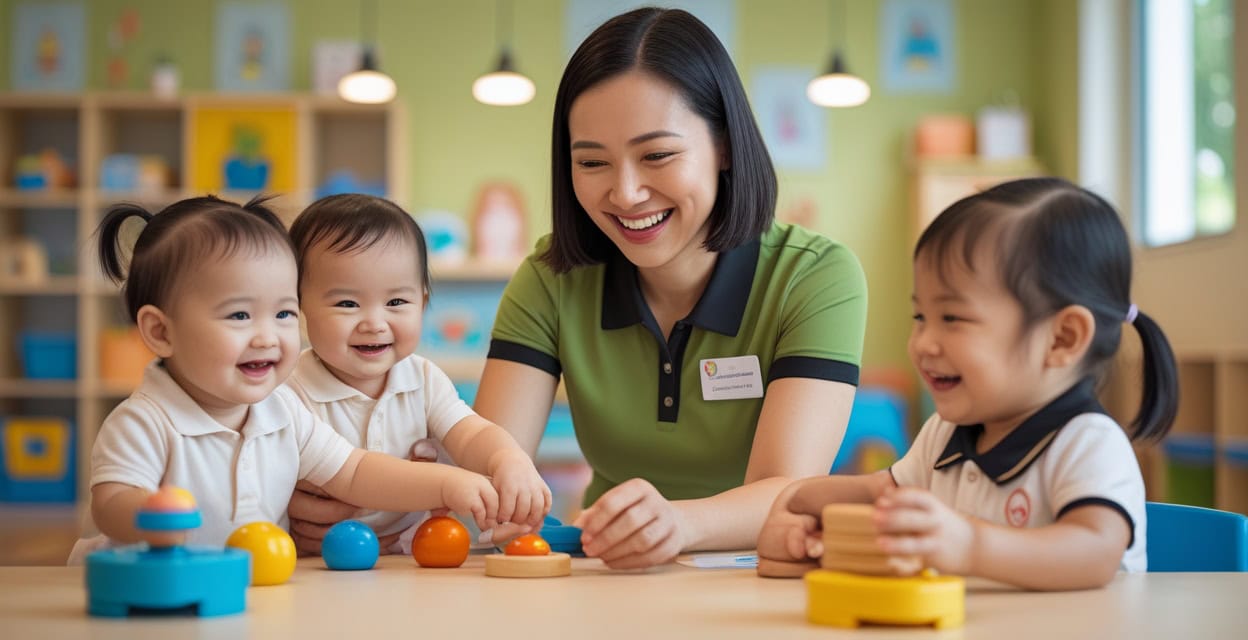
We believe the day’s ordinary moments form a child’s university. A nappy change becomes a language class; a bottle feed a social seminar; floor time a motor lab guided by Pikler principles; and gentle invitations to independence inspired by Montessori. We scaffold development with Vygotsky’s ideas—each moment offers a micro-provocation that nudges a child a little further beyond what they can do alone.

What you’ll see in EduNanny environments:

  • Micro-provocations: loose parts (silky scarves, wooden rings, safe rattles), textured fabrics, and low shelves with accessible choices.
  • Rich language: real-life images, diverse faces, bilingual moments in songs and routines.
  • Respect for self-initiated movement: infant-led sitting, rolling, and crawling before any adult-directed seating or walkers.

Parents can participate by:

  • Engaging in daily “talk-alouds” with your child when at the center—narrate actions and choices you see.
  • Providing a small set of safe, familiar objects at home to create a connected learning thread between home and EduNanny spaces.

Joy You Can Measure: Wellbeing as the Heart of Quality

Joy is a sign of a balanced nervous system. We monitor wellbeing with practical tools:

  • Settling Curve: Track how a baby moves from dysregulation to regulation, adjusting schedules and sensory inputs as needed.
  • Relationship Consistency: Maintain caregiver continuity to stabilize attachment.
  • Signals and Responses: Log infant cues and the speed and style of caregiver reactions for personalization.
  • Family Partnership: Updates via photos, notes, and brief videos; access to CCTV when privacy practices permit.

For caregivers, wellbeing means sustainable practice. EduNanny supports reflective supervision, reasonable caseloads, and ongoing professional development to keep the care-giving calm and capable.

The Purpose and Dignity of Childminders: A Profession That Builds a Nation

Great nations invest in those who nurture their youngest. EduNanny’s Maximum Employment Mandate supports dignified jobs, clear training pathways, and reflective practice that elevates caregiving from “helping hands” to high-skill professionals. Our approach aligns with the ECDA Childminding Pilot and a National Social Initiative to treat care work as essential public infrastructure.

Practical career ladders for caregivers include pathways from trainee to lead childminder to mentor, with stackable credentials in safety, infant development, special needs awareness, and family engagement. Retention improves when caregivers feel valued, and sustained attachment supports stronger child outcomes.


A Day in the EduNanny Way

A Day in the EduNanny Way

Visualize a typical day that blends space, rhythm, and relationship:

  • 7:15am: A parent arrives at a neighbourhood centre; the infant’s primary childminder greets at eye level, uses the baby’s name, and offers a familiar finger for a warm greeting. Health check and a quick shared plan for the day set a calm tone.
  • Mid-morning: The infant selects a basket of silky scarves and the caregiver narrates: “You found the blue one—so light!” A lullaby signals nap-time; the baby rests in a monitored, serene space.
  • Post-lunch: A sensory tray invites grasping and release; this is fine motor practice wrapped in wonder.
  • Late afternoon: Quiet reading with picture books showing Singapore’s neighbourhood scenes—identity blooming alongside language development.
  • Pick-up: A concise update and a note about a new cue that helped the baby settle after nap. Parents can view a short CCTV clip if privacy settings permit.

Home-based and Distance arrangements follow a similar rhythm: uncluttered spaces, consistent routines, and the same intentional pedagogy—supporting families who choose care at home or via remote guidance and coaching calls.


Why This Matters in Singapore Now

Why This Matters in Singapore Now

  • Work patterns are evolving, and families need reliable, flexible care options.
  • A 1:3 infant ratio is central to meaningful, relationship-rich care that supports secure attachment.
  • Affordability from $33/day and subsidies via CDA/Baby Bonus promote equity from birth.
  • Transparency through CCTV and digital logs builds trust and collaborative parenting.
  • Participation in ECDA’s pilot programs and National Social Initiatives elevates the caregiving profession and public value.

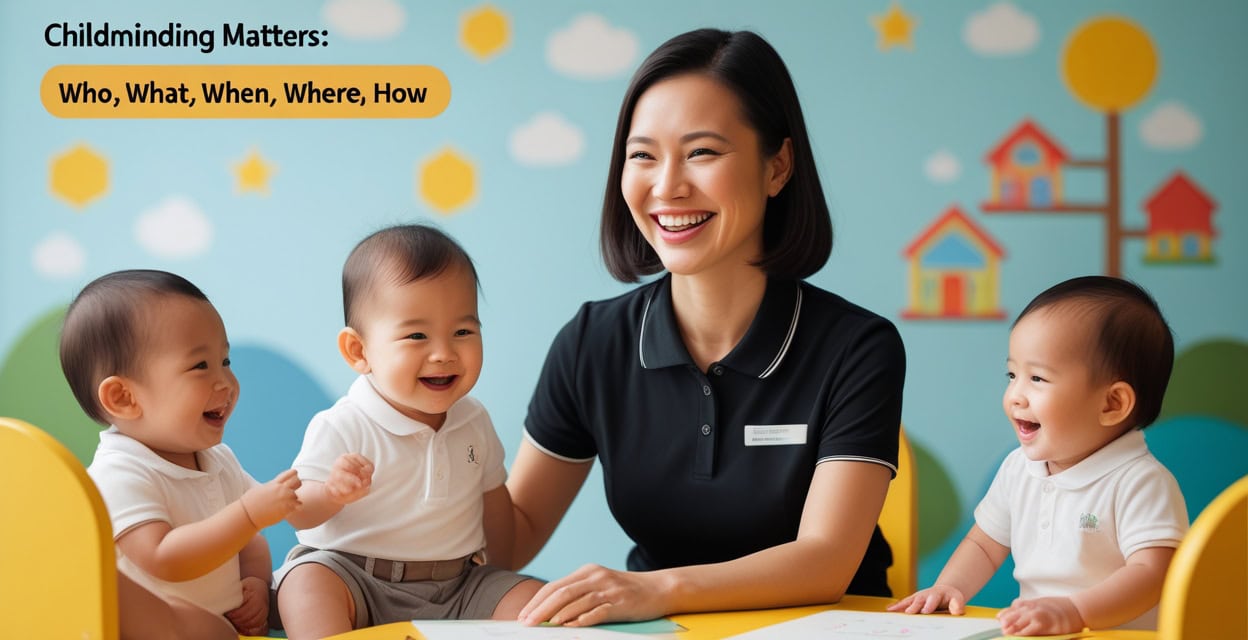
Childminding Matters: Who, What, When, Where, How

Childminding Matters: Who, What, When, Where, How

  • Who: Infants seeking secure attachments; parents seeking partnership; childminders delivering skilled, dignified care; communities benefiting from stable families.
  • What: Safe sleep, respectful routines, rich language, natural movement, joyful play, transparent communication integrated into every hour.
  • When: The first 1,000 days and the first 12 hours of each weekday, 7am to 7pm—critical windows for building foundations.
  • Where: Thoughtfully designed centres, warm home settings, and Distance supports that extend guidance into every household.
  • How: A 1:3 ratio; trained, supervised professionals; safety as a system; modern environments with CCTV; affordability via CDA/Baby Bonus; a public-spirited mandate to employ and uplift the caregiving workforce.

Practical Guidance for Parents: Turning Insights into Action

Practical Guidance for Parents: Turning Insights into Action

To help families translate EduNanny’s principles into daily life, here are concrete strategies you can implement today:

  • Creating Continuity at Home: Maintain a simple daily rhythm with a predictable sequence of mornings and evenings. Use the same caregiver-to-child handover ritual, even when you’re traveling or visiting family.
  • Language-Rich Routines: Narrate actions during diaper changes, feedings, and play. Use descriptive phrases that label feelings, body parts, and actions to accelerate language development.
  • Safe Sleep Habits: Place babies on their backs on firm, flat sleep surfaces; keep soft objects out of the sleep area; share a clear nap schedule with caregivers.
  • Observing and Sharing Cues: Keep a simple cue log for hunger, tiredness, overstimulation, or discomfort. Share observations with your childminder to tailor routines quickly.
  • Partnering with Caregivers: Ask about daily logs, photos, and videos. Discuss concerns openly and request access to learning highlights that show development progress.
  • Privacy and Safety: Understand CCTV usage policies and consent practices. Use CCTV insights for connection and reassurance, not surveillance without context.

Partnering with EduNanny: How to Get Involved

  • Explore Centre-Based, Home-Based, and Distance care options at EduNanny.com and Childminding.EduNanny.com.
  • Ask questions about the 1:3 infant ratio, primary caregiver continuity, safety protocols, and transparency tools.
  • Seek opportunities for caregiver training or mentorship programs if you are considering a career in childminding.
  • Join community discussions and workshops on early childhood development and safe, nurturing care practices.

Conclusion: Turning Everyday Care into Extraordinary Beginnings

Conclusion: Turning Everyday Care into Extraordinary Beginnings

EduNanny offers a practical, evidence-informed approach to infant care and childminding that centers safety, joy, and dignity. By treating care as curriculum, we transform daily routines into powerful developmental opportunities. Our five core ideas—attachment, safety as a system, everyday pedagogy, measurable wellbeing, and the dignity of care professionals—provide a holistic framework for families, caregivers, and partners alike. If you’re exploring next steps for your child, we invite you to visit EduNanny.com or Childminding.EduNanny.com to learn about Centre-Based, Home-Based, and Distance options, discover availability islandwide, and see how our 1:3 ratio, CCTV transparency, and affordable pricing can support your family’s thriving from the very first days.

We are building an ecosystem where care is recognised as the smartest investment we can make—for today and for the generations to come. Let us walk this path together: meet the teams, walk the spaces, and experience the calm clarity of EduNanny’s approach. Safe. Joyful. Holistic. Transparent. Affordable. Dignified.

Thank you.

SEO keywords: [#EduNannySingapore, #InfantCareSingapore, #AttachmentTheoryInCare, #SafeSleepSingapore, #EarlyChildhoodDevelopment]


edunanny-62cbfc16-916c-4643-872c-c685dcdb2d9b
August 19, 2025

From 7am to 7pm EduNanny Islandwide Blueprint for Safe Curious and Connected Infants in Singapore

Introduction: EduNanny’s Vision for Singapore’s Youngest Citizens

Introduction: EduNanny’s Vision for Singapore’s Youngest Citizens

EduNanny—EduNanny by BUTLER—emerges as Singapore’s new standard-bearer for infant care and childminding, rooted in a national social initiative and aligned with the ECDA Childminding Pilot. Our aim is to make quality care accessible to all families, supporting Singapore’s Maximum Employment Mandate while ensuring that every child experiences safety, connection, and curiosity each day. We operate islandwide, Monday to Friday, 7am to 7pm, offering centre-based, home-based, and distance-supported models so families can choose what works best. With a thoughtful 1:3 infant ratio, transparency through innovation CCTV, and modern, humane environments, EduNanny makes excellence affordable—from $33/day—supported by CDA/Baby Bonus. This article expands on our purpose and shares practical, actionable guidance for parents and caregivers on early childhood care and development.


The Five Core Ideas at the Heart of EduNanny

The Five Core Ideas at the Heart of EduNanny

First: The micro-science of everyday learning

Infancy is not a waiting room for childhood; it is a profound season of becoming. The infant brain forms millions of neural connections daily. Our pedagogy integrates the best of Emmi Pikler, Maria Montessori, Lev Vygotsky, and John Bowlby to meet this moment with intent.

  • Floor time and free movement: Provide safe, uncluttered spaces that invite babies to roll, crawl, and explore at their own pace—movement as the language of confidence.
  • Gentle, attuned routines: Use short, soothing rhythms during feeding and naptime with consistent cues and soft lighting to support nervous system safety and rest.
  • Conversation all day: Narrate, mirror sounds, and respond in real time. This serve-and-return approach nurtures language, trust, and thinking.
  • Schema play: Observe each child’s current curiosity (e.g., posting, transporting, rotating) and provide invitations that align with their “project,” keeping learning personalised and joyful.

Second: Safety by design—and by culture

Safety is both technique and moral posture. It requires thoughtful architecture, precise protocols, expert training, and a culture of humility and vigilance.

  • Environments: Modern layouts with clear sleep zones, firm flat cots, airway safety policies, and hazard-free spaces. We practice recommended safe sleep guidelines and monitor sleep quality as part of care.
  • Health and hygiene: Rigorous sanitisation, separate preparation areas, careful bottle and food handling, and symptom-based exclusion and return policies aligned to best practice.
  • Feeding safety: Individual feeding plans, upright positioning, paced bottle feeding, with recorded intake to support growth and comfort.
  • Allergies and medication: Individual plans, double-check protocols, and digital logs with time-stamped handovers.
  • Accountability and transparency: Innovation CCTV to strengthen partnerships, regular drills, and incident reviews focused on learning and improvement. Daily environment checks and weekly audits ensure ongoing safety.
  • Arrival and departure: Secure check-in/out with identity verification—small gates, big safeguards.

Third: Attachment and regulation—the engine of development

If safety is the ground, attachment is the air we breathe. A single, stable, responsive adult—the child’s primary carer—provides the anchor: a familiar voice, a reliable routine, and warm eyes that say, “You are safe. You are welcome. You are known.”

  • Co-regulation: Soothing touch, face-to-face mirroring, and gentle pacing help infants learn calm, focus, and self-regulation—the quiet birthplace of resilience.
  • Educator training: Our educators are trained to read subtle cues—hungry, tired, overstimulated, curious—and respond before stress becomes distress.
  • Ratio as covenant: The 1:3 ratio is more than a number; it is a pledge to see and respond to each child in time, fostering secure attachment and confident exploration.

Fourth: Parent partnership and the architecture of joy

No early childhood program succeeds without parents. You are your child’s first teachers; EduNanny is your co-pilot, building bridges, not silos.

  • Daily connection: Clear, human updates on sleep, feeds, play, milestones, and small stories that keep you connected even when you’re at work.
  • Transparency that reassures: Innovation CCTV invites trust and dialogue, used to strengthen practice and keep everyone aligned.
  • Flexible pathways: Centre-Based, Home Base, and Distance coaching let families choose what suits them best.
  • Accessibility and dignity: Islandwide service, 7am–7pm, from $33/day, with CDA/Baby Bonus accepted. Quality care should be a right, not a privilege.
  • Joy by design: Music circles, water play, texture baskets, high-contrast books, baby sign language, and quiet bonding corners—joy enhances attention, curiosity, and community bonds.

Fifth: Childminding as civic infrastructure

Childminding is more than supervision; it is civic work that supports employment, gender equity, family stability, and long-term outcomes for children. EduNanny aligns with a National Social Initiative to meet the elastic first thousand days with excellence and heart.

  • We hire, train, and grow local talent, honouring cultural heritage, multilingual exposure, and the kampung spirit.
  • We integrate with neighbourhood rhythms—HDB estates, community spaces, and everyday life where families live and work.
  • Measurable promise: safe, joyful, richly stimulating care that parents can count on and infants can trust with their whole bodies.

What makes EduNanny different in daily life?

  • Excellence and quality are built into the model from the start, not tacked on after the fact.
  • Centre-Based and Home-Based Childminding, plus distance coaching, to fit diverse family needs.
  • Islandwide operations with consistent hours for real-life planning.
  • 1:3 infant ratio—relationship-rich care as standard.
  • Innovation CCTV to foster transparency and continuous improvement.
  • Affordability from $33/day, with CDA/Baby Bonus accepted.
  • Part of the ECDA Childminding Pilot, contributing to Singapore’s national employment goals.

Let Me Make This Personal

Let Me Make This Personal

Imagine a Monday morning in Ang Mo Kio. A mother returns to work after maternity leave, arriving at 7:20am. Her child’s primary carer greets her, reviews the weekend rhythms, confirms feeding details, and invites a five-minute settling ritual. The cot is prepared, labeled, and safe; the play area awaits tummy time. Throughout the day, updates arrive: a video of first claps during music, a note about a longer nap after a calm transition, and a brief message after a feed: “We tried paced feeding; the baby responded beautifully.” At 6:00pm, a human handover and an honest conversation close the day. This is dignity in practice. This is care you can feel.


Five plain questions that matter to every family

Five plain questions that matter to every family

  1. Who does childminding serve? It serves infants—their families and the employers who value stability—as well as communities that want safe, confident, and kind children.
  2. What is great childminding? A daily choreography of safety, attachment, and curiosity—delivered by trained, attuned adults in well-prepared environments; measurable by restorative naps, soothing feeds, stimulating play, and signs of happiness.
  3. When does childminding matter most? Every day, but especially in the first thousand days when the brain is wiring for life; consistency becomes a lifeline.
  4. Where should great childminding happen? Where families need it—centre-based in communities, home-based in familiar surroundings, and distance-supported for in-home care guided by professionals. Islandwide, 7am–7pm.
  5. How do we make it accessible and excellent at once? By building excellence into the model from the ground up: 1:3 ratio, CCTV transparency, modern layouts, rigorous training, flexible delivery models, islandwide convenience, affordability from $33/day, and alignment with national initiatives to uplift families and the economy.

How do we make care accessible and excellent at once?

How do we make care accessible and excellent at once?

Key design principles drive both quality and affordability at EduNanny:

  • Relationship-rich ratios: 1:3 infant care to allow for deep attachment and responsive interactions.
  • Transparent practices: CCTV-enabled updates that are designed for learning and collaboration, not surveillance.
  • Thoughtful spaces: Modern, calm layouts that reduce overstimulation and promote safety.
  • Rigorous training: Ongoing professional development for educators to stay current with best practices in early childhood development.
  • Flexible delivery: Centre-Based, Home-Based, and Distance coaching to meet diverse family needs.
  • Islandwide accessibility: Services designed to reach families wherever they live and work.
  • Affordability and incentives: From $33/day with CDA/Baby Bonus support, ensuring quality care is accessible to more families.
  • National alignment: Part of ECDA initiatives to support Singapore’s employment goals and child development outcomes.

Conclusion

Conclusion

EduNanny stands for safety, attachment, curiosity, and joy—delivered with excellence, accessibility, and a deep sense of civic responsibility. Our approach integrates proven scientific principles with practical, everyday actions that parents can apply from day one. By partnering with families, communities, and national initiatives, we aim to raise a generation whose first lessons are safety, trust, curiosity, and joy. If this vision resonates, we invite you to experience it in action: visit EduNanny.com or Childminding.EduNanny.com, tour a centre, explore home-based options, or engage with our coaching programs. Your child deserves care that is not only excellent but deeply human—care that feels like family, and that builds the future one good day at a time.

Together, let us raise a generation whose first lessons are safety, trust, curiosity, and joy. That is how childminding matters. That is why EduNanny exists. And that is the Singapore we can build—one baby, one family, one good day at a time.

Thank you.

SEO keywords: [#infantcareSingapore, #childminding, #earlychildhooddevelopment, #EduNanny, #Singapore]


edunanny-e9cc44a7-2e6c-4dd4-88b1-7b8bb36e2b11
August 19, 2025

Presence, Pedagogy, and Promise EduNanny Centered Blueprint for Safe Joyful Infancy in Singapore

Introduction

Introduction

Good evening, parents, grandparents, caregivers, and partners in Singapore’s future. Welcome to EduNanny—a philosophy in action that begins in the first chapters of your child’s life. We are not merely a service; we are a framework for safe, joyful, and developmentally rich early years. Our approach honors the Piklerian ethic of respect, the Montessori spirit of independence, the Piaget and Vygotsky insights into development, Bowlby’s attachment wisdom, and Malaguzzi’s humanistic heart. In Singapore’s fast-paced urban landscape, EduNanny grounds families in presence, learning, and trust—delivered through care that is both rigorous and warm.


EduNanny: A Philosophy in Action

EduNanny: A Philosophy in Action

EduNanny by BUTLER stands as Singapore’s childminding standard-bearer. We participate in the ECDA Childminding Pilot and align with a National Social Initiative that supports a Maximum Employment Mandate. Our aim is to make exceptional infant care a social good and a family reality. We operate Monday to Friday, 7am to 7pm, islandwide, through both Home Base and Centre Based Childminding formats. Our design emphasizes transparency, safety, and accessibility—center-based and home-based care that respects the rhythms of family life and the realities of work in Singapore.


The Three Essentials That Shape EduNanny

The Three Essentials That Shape EduNanny

The Heart of Home

We center warm, consistent attachment that transforms routines into relationships. Practical strategies include:

  • Narrated care moments: “I’m lifting you now,” “Shall we wipe hands together?” to make every touch meaningful.
  • Home-like environment with predictable routines that promote a sense of security and belonging.
  • Caregivers trained to observe, respond, and engage with the child’s cues rather than imposing a rigid agenda.

The Science of Centres

Our spaces are designed for safe exploration, evidence-based pedagogy, and professional practice. Key elements include:

  • Safe layouts with clear sightlines, gated zones, and hazard-free play surfaces.
  • Age-appropriate materials that provoke curiosity, support concentration, and encourage mastery.
  • Structured professional development for carers, with ongoing observation, reflection, and coaching.

The Reach of Technology

Technology supports transparency, connection, and continuity of care while preserving the human heart of learning:

  • Secure CCTV and digital updates to keep families informed without intruding on the child’s moments.
  • Distance-enabled support for families during transitions, travel, or when on-site access is limited.
  • Data-driven practices that protect privacy, guide planning, and celebrate progress.

Five Pillars Guiding Our Daily Practice

Five Pillars Guiding Our Daily Practice

1) The Respectful Core: Care Moments Are the Curriculum

Infancy is learning; every caregiving moment contributes to agency and language. Practical application:

  • Pikler-inspired respect: narrate touch and transitions to keep the child an active participant.
  • Montessori-inspired independence: low shelves, open-ended materials, and clothing that supports movement.
  • Vygotsky-inspired serve-and-return: respond to cues, expand language, and build joint attention in real time.

2) Safety Without Shadows: Designed, Trained, and Transparent

Safety is a daily culture, not a checklist. Our practice includes:

  • Modern layouts with clear sightlines and safe sleep protocols.
  • Regular environment scans and disciplined hand hygiene routines.
  • Emergency readiness and infant-first-aid training reinforced through drills.
  • Innovation CCTV used to invite trust and accountability, with a strong emphasis on privacy and use of footage only for safety and improvement.
  • Ultra-low 1:3 infant ratio to ensure calm supervision and sensitive response.

3) Whole-Infant Rhythms: Development You Can Feel

Growth is a rhythm, not a race. Our programming blends movement, language, senses, and social-emotional growth:

  • Movement: generous floor time, free movement, and open space for rolling and crawling.
  • Language: naming emotions, storytelling, multicultural songs, and early book-sharing.
  • Sensory: natural textures, light and shadow play, water exploration, and sound experiments.
  • Social-emotional: consistent key carers who act as secure bases for infants’ exploration.

4) Joy as a Competency: Happiness Built on Belonging

Joy is a developmental asset. Practices include:

  • Predictable routines that calm the nervous system and fuel curiosity.
  • Outdoor moments when possible to connect with nature and fresh air.
  • Multicultural music and movement circles that reflect Singapore’s diverse identity.
  • “Shine moments” documented to show the concrete links between joy and learning.

5) The Profession With a Purpose: Dignity for Childminders, Stability for Families

Caregivers are developmental co-educators, not merely assistants. Our approach includes:

  • Structured training rooted in child development, safety, and respectful care.
  • Reflective practice sessions to translate observation into action and adjust plans accordingly.
  • Clear career pathways within EduNanny and across early years settings.
  • Community-building that elevates care work as civic work—integral to national wellbeing.

Practical Ways We Meet Families Where You Are

Practical Ways We Meet Families Where You Are

Centre-Based Childminding

Community hubs with modern layouts, strong peer oversight, and rich educational materials designed for group learning and socialization.

Home Base Childminding

Intimate, neighborhood care that preserves the home rhythm while maintaining the same safety and developmental standards as centres.

Distance-enabled Support

Virtual check-ins, coaching on routines, and continuity of care during transitions—bridging gaps when on-site access is limited.

Availability and Access

Operational hours from 7am to 7pm, islandwide deployment to harmonize work and child development without compromising family wellbeing.

Affordability Without Compromise

Quality care accessible to more families—fees from $33/day, with support via CDA/Baby Bonus when eligible.


What a Day Looks Like at EduNanny

What a Day Looks Like at EduNanny

While each child’s day is individualized, common rhythms bind the program:

  • Arrival routines with gentle check-ins and hands-on participation in the first meals and diurnal transitions.
  • Structured floor-time and guided play that centers on safe exploration and language development.
  • Small-group activities that foster social skills and turn-taking, followed by quiet moments for individual attention.
  • Experience-rich outdoor or nature-inspired moments when possible, with sensory-rich experiences tailored to age.
  • Evening transitions with family notes, progress updates, and planning for the next day.

Daily Practice: Safety, Transparency, and Professionalism

Daily Practice: Safety, Transparency, and Professionalism

We blend human warmth with disciplined practice to safeguard every child’s wellbeing and progress:

  • Transparent environments via secure CCTV and timely updates to families.
  • Dedicated caregivers who maintain consistent attachments and specialized training.
  • Routine documentation of development milestones, shared with families to keep care plans current.
  • Continuous quality improvement grounded in feedback from parents and staff alike.

Partnering With Families: Transitions, Tours, and Questions to Ask

Partnering With Families: Transitions, Tours, and Questions to Ask

Tour and Transition Planning

Plan visits with a checklist to maximize learning about how care feels, looks, and operates in practice:

  • Attend a live tour to observe caregiver-child interactions and safety routines.
  • Ask about caregiver-to-child ratios, rotation of staff, and consistency of key carers.
  • Request a transition day to ease the move from home to center or from one care setting to another.

Smart Questions to Ask Care Teams

Gather insights that help you compare offerings and set expectations:

  • How do you individualize care plans for each infant, and how is progress shared with families?
  • What training and certification do caregivers hold, and how often is ongoing training required?
  • How is safety managed across both home-based and centre-based environments?
  • What metrics do you track for development (language, motor, social-emotional) and how are concerns communicated?
  • What is your approach to transitions if a child experiences separation anxiety or routine changes?

Transition Day: A Practical Example

Before a child begins, schedule a two- to four-hour transition day with a familiar caregiver, allow gradual separation, and collect baseline routines and preferences. Provide families with a simple, daily communication sheet that notes feeding times, sleep patterns, and notable achievements. Maintain a play-based approach during this period to reduce stress and support continuity of care.


Our Promise to You

Our Promise to You

  • No infant is rushed through care; they are invited into it.
  • No parent must choose between quality and affordability; they receive both.
  • No childminder stands alone; they are trained, respected, and connected.

Our System: Excellence and Access That Work in Singapore

Our System: Excellence and Access That Work in Singapore

We blend best-in-class care with practical access to services. Highlights include:

  • Centre-Based, Home-Based, and Distance options to fit varying family rhythms.
  • Convenience that respects work schedules and child development alike.
  • Affordability from $33/day with CDA/Baby Bonus support where eligible.
  • Innovation CCTV, modern layouts, and a steadfast 1:3 infant ratio.
  • EduNanny by BUTLER as part of the ECDA Childminding Pilot and National Social Initiative, advancing a Maximum Employment Mandate with dignified roles for caregivers.

Parents: Planning for a Life-Long Relationship with Early Education

Parents: Planning for a Life-Long Relationship with Early Education

The first years shape neural architecture, character, and a lifelong lens on safety and belonging. When care is respectful, safe, and joyfully intentional, infants do more than grow—they thrive. They carry that vitality into classrooms, communities, and workplaces, shaping a resilient Singapore.


Conclusion

Conclusion

EduNanny is designed to meet families where you are—with presence, science, and transparency. We invite you to explore how a triad of heart, center, and technology can redefine early years care in Singapore. Visit our sites to tour a centre, meet a Home Base Childminder, or schedule a transition day. Let us plan your child’s rhythm together, so every day feels safe, joyful, and purposeful.

Call to action: Explore EduNanny’s programs, book a tour, and begin a conversation about your child’s earliest years—where safety, learning, and belonging are built in from day one.

SEO keywords: [#EduNannySingapore, #InfantCareSingapore, #EarlyChildhoodDevelopment, #CentreBasedChildminding, #HomeBasedChildminding]


edunanny-f5c61e29-012d-41d6-b369-3d1cc93f1f4d
August 19, 2025

From First Cries to First Confidence EduNanny Compass for Singaporean Children

From First Cries to First Confidence: EduNanny’s Compass for Singapore’s Youngest Citizens

From First Cries to First Confidence: EduNanny’s Compass for Singapore’s Youngest Citizens

Thank you for gathering to imagine something simple and radical at once: a Singapore where every baby is cradled by steady hands, clear science, and a community that refuses to leave early childhood to chance. This article expands the speech into a practical, editor-quality guide for parents, caregivers, and partners who want to bring EduNanny’s blueprint to life in everyday routines. Here you will find actionable strategies, real-world EduNanny insights, and concrete steps you can apply from day one.


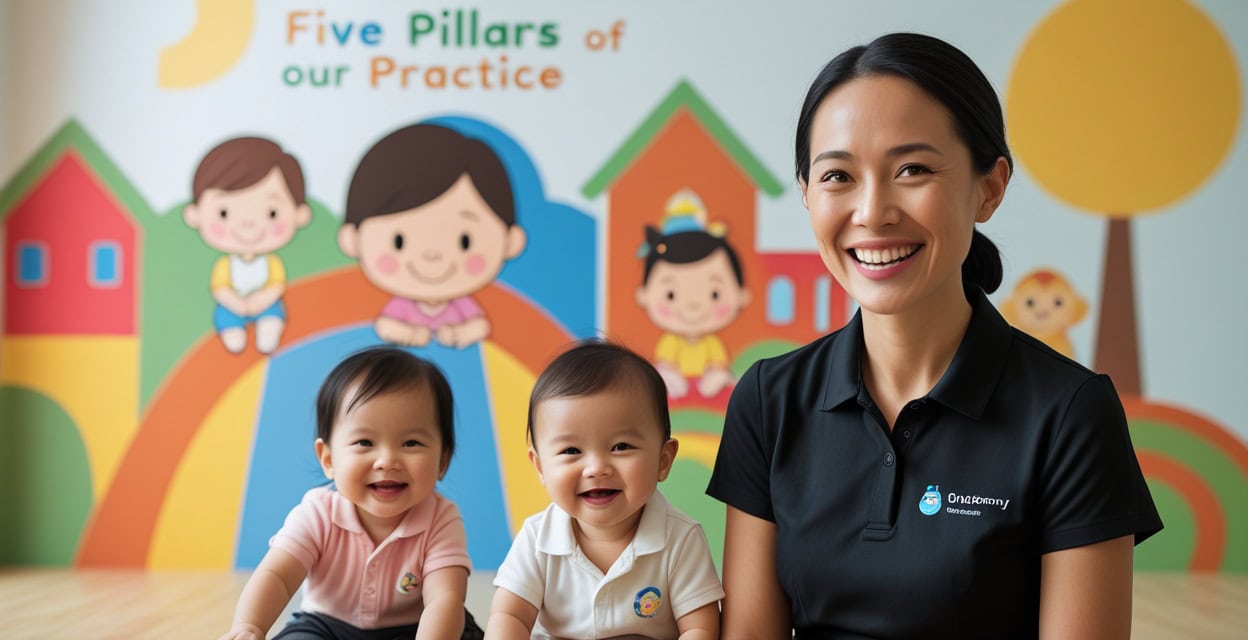
Five Pillars of EduNanny Practice

Five Pillars of EduNanny Practice

1) Attachment Architecture: One Caregiver, One Calm Baby, One Island of Trust

Infants grow in relationships, not in schedules. Security is the bridge to curiosity; slow, respectful touch is a curriculum; consistency is the oxygen of a thriving early life. Practical guidance you can use today:

  • Primary caregiver model: Each infant is assigned a primary caregiver who coordinates daily routines, feeding, and soothing. Parents should receive a brief daily handover note from the caregiver, highlighting smiles, attempts at new skills, and any calm-down strategies that worked.
  • Five-minute arrival ritual: Upon arrival, the caregiver greets the baby by name, makes brief eye contact, and offers a familiar object (a comfort blanket or tiny toy) to ease transition. Parents can observe a predictable sequence to reinforce attachment.
  • One-on-one moments: Care activities such as diapering or feeding are treated as dedicated “lessons in love.” Narrate softly, name sensations, and narrate progress to build language and trust.
  • Continuity of place: Centres boast calm, uncluttered spaces with clearly labeled zones for feeding, sleeping, and play. For home-based care, ensure a familiar setup with defined “areas” for different activities to minimize transitions that disrupt security.
  • Practical tip for parents: Maintain a simple “attachment log” for a week: note which caregiver was primary, the baby’s comfort level during key transitions, and any particularly successful soothing strategies. Share this with the care team to refine routines.

2) Safety as a Love Language: Systems that Let Parents Breathe

Safety is a cultural habit. When safety is visible, love becomes audible. Translate policy into practice with these steps:

  • Environment by design: Ensure slip-resistant floors, rounded furniture edges, secured cords and sockets, gated zones, and unobstructed sightlines so caregivers can monitor at a glance.
  • Sleep integrity: Use firm, flat mattresses; keep cots free of soft objects; place babies on their backs; maintain appropriate room temperature; implement dimming schedules to signal wind-down times.
  • Feeding precision: Document milk handling, temperature checks, and allergen awareness. Train caregivers in paced bottle-feeding and careful introduction to solids to reduce choking risk and support healthy digestion.
  • Health and hygiene: Establish consistent handwashing routines, cleaning schedules, and clear criteria for when a child should stay home. Require CPR and infant-first-aid certification for staff.
  • Transparent partnership: Real-time CCTV access, daily digital updates, and candid incident reporting with actionable follow-up steps help parents feel informed and secure.
  • Practical tip for parents: Create a simple safety checklist for your child’s space at home and at the centre. Review it monthly with your caregiver to catch new hazards and refine routines.

3) Developmental Precision with Joy: Play as the Engine, Observation as the Steering Wheel

Educational insights from Montessori, Piaget, Vygotsky, Froebel, Malaguzzi, and others are distilled into daily rhythms that feel like play and teach with purpose:

  • Tummy-time to world-time: Scaffold sensorimotor exploration with gradually increasing complexity—soft toys for reach-and-grasp, mirrors for self-recognition, and gentle obstacles to challenge crawling and fine motor skills.
  • Froebel-inspired materials: Provide open-ended, safe, natural textures and loose parts (soft blocks, wooden shapes, fabric scarves) that invite exploration and safe manipulation.
  • Malaguzzi’s hundred languages: Integrate music, light play, water play, finger painting, and multilingual everyday songs to support diverse expressive channels.
  • Vygotskian scaffolding: Caregivers model, imitate, and extend—support a task just beyond the child’s current capability and fade support as competence grows.
  • Observation cycles: Weekly milestone notes, micro-goals, and simple development graphs shared with parents create a transparent, collaborative growth plan.
  • Practical tip for parents: Keep a notebook of “one thing your child tried today.” Celebrate tiny advances at home and discuss observed progress with your caregiver to adjust play goals accordingly.

4) The Singapore We Want to Grow: Family, Culture, and Community on Purpose

Culture is competence. EduNanny embeds bilingual exposure, community values, and shared belonging into daily life:

  • Centre-based hubs and home-based care: Flexible options that respect family schedules and preferences while maintaining attachment security.
  • Distance support: Tele-coaching and virtual sleep and feeding consultations to reach families who need guidance remotely.
  • Intergenerational bridges: Short, meaningful interactions with seniors and neighbours to build social warmth and empathy.
  • Bilingual/multilingual exposure: Regular rhymes and picture-book read-alouds in English, Malay, Mandarin, and Tamil to seed future confidence and cultural pride.
  • Practical tip for parents: Create a weekly family heritage moment—share a song, a story, or a dish from your culture with your child and with the care team to reinforce identity and belonging.

5) Access and Dignity: Quality Must Be Affordable, Available, and Fair

Excellence must be attainable. EduNanny blends high standards with practical access:

  • Islandwide options: Centre-based, home-based, and distance-supported care, Monday–Friday, 7am–7pm.
  • Affordability: From $33/day with fees payable by CDA/Baby Bonus to ease family budgets.
  • National social initiative: A public commitment to the Maximum Employment Mandate—training and dignified work for professional childminders across Singapore.
  • Modern spaces and equipment: Layouts and tools that support safe, developmentally appropriate activity (the standard you expect from EduNanny by BUTLER).
  • Pathways for growth: Simple onboarding, smooth transitions between care modalities, and clear career progression for caregivers.
  • Practical tip for parents: When evaluating a care option, track total monthly cost, not just daily rate—include transport, fees, and any subsidies to compare true affordability and value.

Signature EduNanny Practices You’ll Notice from Day One

Signature EduNanny Practices You’ll Notice from Day One

  • The Four Anchors Routine: Rest, Nourish, Move, Bond—predictable cycles that help infants self-regulate and feel secure.
  • The Two-Minute Pause: Before each care act, a micro-moment to meet the child’s eyes, speak their name, and wait for their response. Early consent and agency-building.
  • The Tiny Triumphs Log: Caregivers capture one daily observation per infant to celebrate effort—grasping, babbling, rolling—fostering persistence and pride.
  • The Open Book Day: Weekly summaries for families—what was tried, what was seen, and what will be adjusted—parents as co-authors in learning journeys.

How Childminding Becomes a Public Good

How Childminding Becomes a Public Good

High-quality childminding extends families, sustains work, and invigorates communities. Excellent childminders act as translators between children’s needs and parents’ realities, bearing witness to small wonders, safeguarding safety, and co-designing daily learning. When childminding is strong, it creates a ripple effect—more families engaged in work, more diverse employment opportunities, and healthier developmental trajectories for the next generation.


Who, What, When, Where, and How Childminding Matters

Who, What, When, Where, and How Childminding Matters

  • Who: Every infant, every working parent, every caregiver seeking meaningful, professional work, every employer who values stable families, and every community aiming for resilience.
  • What: Trust-based, science-backed, heart-led childminding that honours attachment, safety, and development through play and responsive care.
  • When: From day one—particularly during the early years when neural pathways are planted and habits of calm and curiosity take root.
  • Where: In modern centres near daily life, at home with a trained childminder, and via distance guidance when needed.
  • How: Through a 1:3 infant ratio; CCTV transparency; safe, modern layouts; trained caregivers; observation-led pedagogy; predictable routines; affordability through CDA/Baby Bonus; and islandwide availability 7am–7pm, Monday–Friday.

The EduNanny Philosophy in One Promise

The EduNanny Philosophy in One Promise

We believe every baby deserves three certainties each day: someone delighted to see them, a place designed to protect them, and experiences tuned to grow them. When we deliver those certainties—reliably, affordably, and with pride—we shape the temperament of a future citizenry: secure, curious, kind.

Parents, you are not outsourcing love; you are extending it. Caregivers, you are not just minding children; you are building Singapore’s tomorrow, bottle by bottle, nap by nap, laugh by laugh.


Practical Guidance for Parents: Making EduNanny Principles Real at Home

Practical Guidance for Parents: Making EduNanny Principles Real at Home

Daily Routines That Support Attachment and Regulation

  • Establish a predictable day for your child with a simple rhythm: wake, feed, play, nap, snack, and a short wind-down period before transitions.
  • Use a two-minute pause before every interaction to greet your child by name, make eye contact, and invite a response. This builds early communication and consent sense.
  • Adopt a “Four Anchors” approach at home: a calm feeding routine, regular rest, safe movement play, and meaningful bonding moments (read alouds, songs, cuddle time).

Partnering with Your Childminder: Clear Communication and Co-Design

  • Share daily highlights and concerns in a brief, structured handover—one page with three points: mood, key milestones, and any questions for the next shift.
  • Review the Tiny Triumphs Log together each week to celebrate progress and adjust micro-goals.
  • Agree on a language plan: what phrases you want used at home versus in the centre to maintain consistency in language development.

Safety Checks You Can Do Today

  • Inspect the home environment for hazards: secure furniture, cords out of reach, safe sleep area, and age-appropriate toys.
  • Create a simple “emergency plan” with your caregiver, including who to call and how to respond in common scenarios (fever, choking, injury).
  • Ensure your childminder’s qualifications are up to date: CPR/infant first aid, basic food handling, and allergy management.

Nutrition, Feeding, and Sleep

  • Discuss feeding plans with your caregiver, including paced bottle-feeding techniques and gradual solids introduction tailored to your child’s cues.
  • Maintain consistent sleep routines, including nap schedules and age-appropriate sleep wear, to support healthy circadian rhythms.
  • Introduce multilingual daily routines (mealtimes with simple songs in multiple languages) to support language development and cultural exposure.

Language and Literacy from Infancy

  • Read aloud daily in multiple languages if possible. Point to pictures, name objects, and encourage babbling and vocal imitation.
  • Incorporate songs and finger-plays as a core part of playtime to build memory, rhythm, and pronunciation in early years.

Transitions and Transports

  • Plan gradual transitions during drop-off times to reduce distress—short, structured handovers and a familiar object can help.
  • Discuss with your centre the best drop-off routines if you have a long commute or variable work hours, ensuring continuity of attachment even on busy days.

Conclusion: From First Cries to First Confidence

Conclusion: From First Cries to First Confidence

EduNanny’s blueprint for Singaporean early childhood care emphasizes attachment, safety, development, culture, and accessibility. By embracing the Five Pillars, adopting signature practices, and partnering closely with caregivers, families can transform daily routines into powerful engines for growth. The goal is not merely care; it is the deliberate shaping of confident, curious, and compassionate citizens. We invite you to engage with EduNanny—explore centre-based, home-based, and distance options, understand subsidies, and join a community committed to dignity, clarity, and excellence in early childhood.

From first cries to first confidence—we’re here, 7am to 7pm, with a steady hand and a hopeful heart.

To learn more, visit EduNanny.com and Childminding.EduNanny.com. Explore centre-based, home-based, and distance options. Enrolments for our ECDA-aligned Childminding Pilot are open, with islandwide availability and fees payable by CDA/Baby Bonus. Excellence, quality, convenience, and affordability—crafted for Singapore, for your family, and for the future we share.

[#keyword1, #keyword2, #keyword3, #keyword4, #keyword5]

edunanny-79ae2219-e1dc-4495-8668-fae89040a579
August 18, 2025

Cradling the Future with EduNanny One to Three Infant Care Sparks Trust Joy and Leadership in Singapore

Introduction to EduNanny: Where Heart Meets Standard

Introduction to EduNanny: Where Heart Meets Standard

Good evening, parents, caregivers, partners, and friends. EduNanny by BUTLER is more than a service—it’s a movement that reframes the infant days as the opening chapter of leadership, empathy, and capability. When a baby gazes, yawns, or reaches for a toy, they are rehearsing the skills of trust, self-regulation, and curiosity. Our aim is to shape these moments into a lifelong architecture of learning, rooted in science and nourished by home warmth. In Singapore, EduNanny blends the rigor of developmental science with the tenderness of caregiving to ensure every child grows with security, wonder, and joy.

What EduNanny is designed to be: an ecosystem of care that integrates evidence-based principles with practical, family-centered delivery. We align with the best of Bowlby, Pikler, Froebel, Montessori, Vygotsky, Erikson, and Piaget—then bring those ideas to life in Singapore’s homes and community spaces through professionally trained, transparent, and affordable care.

  • Consistent 1:3 infant ratio for true responsiveness.
  • Islandwide availability in Singapore—centre-based, home-based, or distance support, Monday to Friday, 7am–7pm.
  • Modern, safe layouts designed for visibility, cleanability, and calm; transparent partnership with parents via responsible CCTV practices.
  • Affordability starting from $33/day, with fees payable by CDA/Baby Bonus for eligible families.
  • Centre Based and Home Base models that prioritize safety, attachment, and joyful routines.
  • Community-based delivery that respects neighbourhood rhythms and working family needs.
  • A national social initiative with a maximum employment mandate to elevate standards and dignify caregiving careers.
  • Designed to align with ECDA’s childminding pilot framework and Singapore’s commitment to the first thousand days.

EduNanny is here so your infant’s everyday moments—feeding, sleeping, cuddling, reaching, rolling, babbling—become a curriculum of safety, trust, and growth.


Five Essential Ideas Shaping EduNanny’s Infant Pedagogy, Safety, Development, and Joy

Five Essential Ideas Shaping EduNanny’s Infant Pedagogy, Safety, Development, and Joy

1) The Attachment Engine: a 1:3 ratio that powers trust

Babies learn the world through the people who respond to them. With a true 1:3 infant ratio, caregivers have the time and presence to notice cues, match rhythms, and build secure bonds. This is not a slogan; it’s a discipline. We structure every day around talk, touch, and time:

  • Serve-and-return conversations that grow language and social brain networks.
  • Respectful caregiving inspired by Pikler/RIE, where diapering, feeding, and settling are slowed, narrated, and cooperative.
  • Predictable routines that help infants anticipate what comes next, reducing stress and building self-regulation.

2) The Architecture of Safety: safety like oxygen—constant, uncompromised

Safety is a culture, not a checklist. Our spaces and routines are engineered for visibility, cleanliness, and fast response:

  • Safe sleep by design: firm mattresses, supine positioning, uncluttered cots, vigilant checks.
  • Hygiene protocols that keep hands, surfaces, bottles, and toys impeccably clean.
  • Emergency readiness with drills, first aid/CPR-trained teams, and clear escalation pathways.
  • Transparency through CCTV for secure, appropriate parent-caregiver visibility and trust.
  • Modern layouts that create uninterrupted sightlines and reduce hidden hazards.

3) The Pedagogy of Everyday Moments: small acts, big brain

Infant learning thrives in the ordinary. We transform daily care into a micro-curriculum:

  • Motor freedom and floor time for core strength and coordination.
  • Heuristic play with simple, safe objects that invite curiosity and problem-solving.
  • Rhythm and music, books and babble to seed phonemic awareness and joyful attention.
  • Outdoor moments when possible—natural light, air, and textures to expand sensory experience and reduce stress.
  • Gentle scaffolding (a nod to Vygotsky) that helps a baby do “just a little more than yesterday.”

4) Joy as a Learning Strategy: happiness is a safety feature

Infants learn best when they feel secure and delighted. Our approach treats joy as functional, not ornamental:

  • Warm humour, transitions with songs, and soft social games to make routines enjoyable.
  • Cohesive schedules tuned to each baby’s cues, prioritizing development over adult convenience.
  • Calm spaces with natural light and soothing colors to lower arousal and support rest.
  • Respect for temperament differences—happy, steady presence helps every infant feel seen and safe.

5) The Family Operating System: care that fits life, not the other way around

Parents deserve support that is practical, transparent, and close to home:

  • Islandwide availability—centre-based, home-based, or distance, with consistent hours.
  • Affordability from $33/day and CDA/Baby Bonus acceptance for eligible families.
  • Home Base and Centre Based models to suit personal routines and social needs.
  • Distance coaching with expert check-ins and routine design for home care.
  • Daily reports translating care into insight: sleep windows, feeds, notes, and next-day suggestions.
  • Employment pathways that grow skilled local caregiving jobs and strengthen community resilience.

How EduNanny Makes Childminding Exceptional in Singapore

How EduNanny Makes Childminding Exceptional in Singapore

  • Excellence and Quality: Professional standards, reflective supervision, and evidence-based training underpin every interaction.
  • Convenience and Choice: Centre, home, and distance options to fit your commute and baby’s needs.
  • Transparency and Trust: Innovative CCTV, clear policies, and consistent communication so you always know how your child is doing.
  • Community Roots: Care delivered across homes and community spaces—strengthening neighbourhood ties.
  • Accessible Value: Thoughtful pricing and CDA/Baby Bonus support to widen access without compromising standards.

Who, What, When, Where, and How—Why Childminding Matters

Who, What, When, Where, and How—Why Childminding Matters

Who does childminding serve?

  • Babies who need security to explore.
  • Parents who seek reliability, dignity, and partnership.
  • Communities that thrive when infants are safe, nurtured, and learning.

What is childminding at its best?

  • A professional, responsive relationship that turns care into development and development into delight.
  • A daily structure where attachment, safety, and discovery are non-negotiable.

When does it matter most?

  • In the first thousand days, when neural pathways are malleable, stress resilience forms, and trust-in-the-world is written in tiny moments.

Where should it happen?

  • Anywhere families need it—at home for personal comfort, in centres for social energy—supported islandwide by standards, tools, and training.

How is excellence delivered?

  • Through a 1:3 ratio, trained caregivers, modern safety design, rigorous hygiene, reflective practice, and transparent parent communication—applied consistently every day.

The Philosophy and Purpose Behind EduNanny Childminding

The Philosophy and Purpose Behind EduNanny Childminding

We believe dignity and wonder are a child’s birthright. Our purpose is to normalize excellence, expectation of joy, and the invisibility of safety—always-present in the background. We steward three sacred trusts:

  • A baby’s trust that the world is good.
  • A parent’s trust that help is competent and kind.
  • A society’s trust that investing early yields lifelong capability.

EduNanny stands at this intersection as a national social initiative—building employment pathways and strengthening care capacity while keeping quality within reach. This is how we honour families and the future—one routine at a time, one giggle at a time, one secure nap at a time.


A Closing Invitation

A Closing Invitation

If this vision resonates, come see it in action. Explore our modern, light-filled spaces. Observe a serve-and-return moment in real time. Feel the quiet confidence of a baby who knows a steady caregiver is there.

Explore how centre-based, home-based, or distance support could serve your family:

  • EduNanny.com
  • Childminding.EduNanny.com

From the first feed to the first step, from the first smile to the first word, EduNanny is here—reliable on weekdays from 7am to 7pm, affordable from $33/day, with CDA/Baby Bonus support, islandwide in Singapore. Because when care is excellent, consistent, and kind, babies do more than grow. They bloom.


Conclusion

Conclusion

EduNanny reimagines early care as a collaborative, science-informed practice that honours families while elevating the caregiving profession. The 1:3 ratio, safety-forward environments, and everyday learning moments together create secure attachments, robust language development, and resilient social skills. By delivering flexible, transparent, and affordable options—centre-based, home-based, and distance care—we empower parents to balance work and family with confidence. If you are seeking a partner to nurture your baby’s curiosity and trust, EduNanny invites you to join the movement, observe our spaces, and begin a conversation about your child’s first thousand days.

Call to action: Visit EduNanny to tour spaces, consult with trained caregivers, and design a personalized plan for your family. Your baby’s secure, joyful learning begins with a single step—today.

[#EduNannySingapore, #InfantCare, #EarlyChildhoodDevelopment, #SingaporeChildcare, #AttachmentTheory]

edunanny-b8a1a585-5c6e-4fe0-b272-54071a7582fa
August 18, 2025

EduNanny The Heartful Science Driving a New Era of Infant Care in Singapore

EduNanny: A New Standard for Infant Care in Singapore

EduNanny: A New Standard for Infant Care in Singapore

EduNanny is Singapore’s comprehensive standard for infant care and childminding, founded on heart, guided by science, and designed for the real lives of working families. As EduNanny by BUTLER participates in the ECDA Childminding Pilot, we join a national effort to expand quality access, uplift carers, and give every infant a safe, joyful, and dignified start. This is not merely care; it is a foundation for lifelong development.

Why Now: The Context for a National Childminding Movement

The Singaporean family landscape increasingly requires flexible, high-quality care options that are affordable and accessible islandwide. EduNanny responds with a model that blends attachment theory, safety culture, developmental support, and practical financing. By aligning with national pilots and social initiatives, EduNanny aims to normalize exceptional care as a public good—available to every family, not just a few.


Daily Realities: How EduNanny Works Day-to-Day

Daily Realities: How EduNanny Works Day-to-Day

  • Care that meets you where you are: centre-based, home-based, and distance support are all part of a flexible ecosystem designed to fit modern families.
  • Operating hours and coverage: open Monday to Friday, 7am to 7pm, islandwide across community centres and approved homes.
  • Ultra-low infant-to-educator ratio: a 1:3 ratio ensures immediate responsiveness, secure attachment, and tailored interaction.
  • Environment design and transparency: modern layouts with safety focus, safe sleep practices, and innovative CCTV for transparent oversight.
  • Accessible financing: practical fees from $33/day, payable by CDA/Baby Bonus, making high-quality care affordable for families.
  • Career growth and dignity: a clear pathway for local employment with professional development through our Maximum Employment Mandate.

The Five Essentials of EduNanny

The Five Essentials of EduNanny

The Attachment Curriculum: Small Ratios, Big Relationships

Infants thrive when care is predictable, warm, and responsive. With a 1:3 ratio, a primary caregiver becomes a baby’s steady compass—tuning into cues, pacing routines, and building trust through unhurried caregiving.

  • Care moments as learning moments: narrate diapering, feeding, and settling with consent cues (“I’m going to pick you up now”) so infants feel seen and safe.
  • Floor-time freedom: supervised exploration on safe floor spaces promotes postural control, sensory integration, and self-initiated movement.
  • Gentle transitions: rituals around drop-off, nap, and pick-up help children organize their day and emotions.
  • Secure base, brave heart: secure attachment supports curiosity, exploration, and regulation.

Safety by Design, Safety by Culture

Safety is a culture, not a checklist. EduNanny designs spaces and trains teams to prevent, notice, and respond effectively.

  • Design: gated micro-zones, clear sightlines, safe sleep layout, and hazard mapping across centres and approved homes.
  • Practice: health checks on entry, safe sleep audits, emergency simulations, and rigorous hygiene routines.
  • Technology: accountable CCTV access, digital safety logs, and clear incident reporting processes.
  • People: consistent training, supervision, and reflective practice to embed vigilance as habit.

Developmental Invitations: Learning Woven into the Day

Education for the youngest begins with invitations—not pressure. Everyday moments become opportunities for growth.

  • Sensory and motor: textured paths, soft ramps, and treasure baskets that invite reaching, rolling, and cause-and-effect play.
  • Language: high-quality talk, bilingual or multilingual exposure, and responsive serve-and-return exchanges to grow vocabulary and attachment.
  • Schema play: materials for filling, transporting, rotating, and hiding to satisfy natural curiosity and mastery.
  • Nature and neighbourhood: micro-outdoor time and daily naming of birds, colours, and clouds—Singapore as a living classroom.
  • Observation-led planning: care is continuously refined by what delights the child and what supports their next step.

The Science of Joy: Happiness as a Developmental Nutrient

Joy is essential to healthy brain development and emotional well-being. It is tracked, valued, and integrated into daily routines.

  • A “Joy Index”: monitoring smiles, engagement, coos, eye contact, and calm recoveries to shape routines and staffing.
  • Rituals that matter: welcoming songs, soft-landing corners, and kindness cues between infants to cultivate security.
  • Family culture: inviting lullabies, languages, and traditions to reinforce belonging and emotional safety.
  • Daily partnership: sharing photos, notes, and concise day summaries to keep families connected without information overload.

The Purpose of Childminding: A Community Good, Not a Private Scramble

Childminding is a public value in a compact city with big dreams. EduNanny treats care as a community investment that strengthens families and society.

  • Access and affordability: a continuum of care options—from centre-based to home-based to distance support—starting from $33/day with CDA/Baby Bonus accepted.
  • Professional dignity: rigorous training, supervision, and clear career pathways for childminders.
  • Maximum Employment Mandate: creating local jobs near where families live to boost neighbourhood resilience.
  • Distance support: tele-coaching, safety audits, video check-ins, and curated play kits for families preferring home-based care.

A Day in the EduNanny Way: Practical Story and Insights for Parents

A Day in the EduNanny Way: Practical Story and Insights for Parents

Imagine a typical morning: at 8:05am, a caregiver kneels to greet a baby with warm eye contact and a gentle greeting. A parent hands over a note about new teeth, and the caregiver responds by adjusting the teether basket and pacing feeds to soothe discomfort. Mid-morning, the infant discovers a sealed bottle filled with beans, discovering cause and effect through safe, supervised exploration. After a nap, a caregiver hums a lullaby from home, bridging home and centre through familiar language and song. At pick-up, the handover is honest and kind, with a photo capturing a triumphant grin. In EduNanny’s world, safety is constant, learning is subtle, and joy is unmistakable.

Practical takeaways for parents:

  • Ask about caregiver-to-child consistency and whether there is a designated primary carer who can build attachment over time.
  • Check how transitions are handled: what rituals help your child feel secure during drop-off and pick-up?
  • Inquire about language exposure and how daily conversation and responsive interactions are woven into routines.
  • Learn how safety is enacted day-to-day: staff training, sleep practices, hygiene, and incident reporting processes.
  • Discuss how families receive updates: how often, through what channels, and how your feedback influences routines.

What You Can Expect: Clear, Simple, Practical Foundations

What You Can Expect: Clear, Simple, Practical Foundations

  • Excellence you can see: modern spaces, thoughtful routines, and transparent communication.
  • Flexible options: Home-Based and Centre-Based Childminding across Singapore, Monday–Friday, 7am–7pm.
  • Safety front and centre: 1:3 ratio, advanced CCTV, trained teams, and evidence-based practice.
  • Islandwide accessibility: convenient locations with home-based options for families who prefer to stay close to home.
  • Practical financing: affordable from $33/day; CDA/Baby Bonus accepted to support families.
  • Where to find us: EduNanny.com and Childminding.EduNanny.com for tours, enrollments, and distance plans.

Closing: Who, What, When, Where, and How Childminding Matters

Closing: Who, What, When, Where, and How Childminding Matters

Who: Every infant in Singapore—and every adult who loves them—deserves care that is expert, tender, and trustworthy.

What: Dignified childminding that blends attachment, safety, and development into the ordinary grace of daily routines.

When: The first thousand days and every weekday from 7am to 7pm for families who work, travel, and strive.

Where: In centres designed for visibility and calm; in approved homes that feel familiar and safe; and at a distance for families who prefer to stay home but not go it alone.

How: Through an ultra-low 1:3 ratio, well-trained childminders, modern environments with innovative CCTV, observation-led pedagogy, honest parental partnership, and a national social initiative that keeps care accessible—affordable from $33/day, CDA/Baby Bonus welcomed.

EduNanny stands for a simple, transformative promise: when we raise the standard of everyday care, we raise the future—quietly, steadily, and for everyone. To parents seeking peace of mind, to caregivers seeking a meaningful profession, and to policymakers seeking lasting impact: the work is ready, the model is ready, and the children are waiting. Come see it for yourself. Book a tour, request a home visit, or start a distance plan at EduNanny.com or Childminding.EduNanny.com.

Because the smallest citizens deserve the greatest care—and because tomorrow’s Singapore is listening to the way we hold them today. Thank you.

SEO keywords: [#earlychildhoodcare, #infantcareSingapore, #childmindingSingapore, #attachmenttheoryinchildcare, #EduNannySingapore]
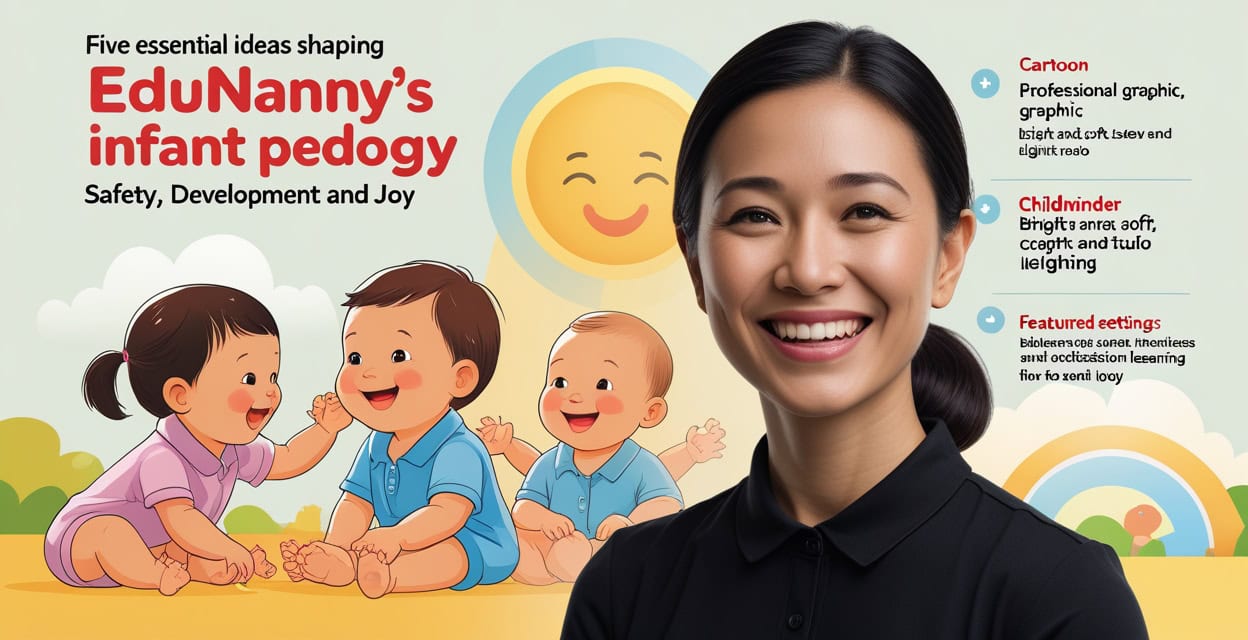

edunanny-fbde02aa-4f66-4a07-bb69-392f8c66fc86
August 18, 2025

Singapore First Thousand Days Redefined by EduNanny Five Pillars of Safe Joyful Early Care

EduNanny Singapore: Five Living Pillars of Early Care

EduNanny Singapore: Five Living Pillars of Early Care

Thank you for joining this conversation about the quiet power that shapes a nation—the first thousand days of life. In these days, attachment is laid, language begins, trust takes root, and curiosity becomes a habit. EduNanny by BUTLER is a purpose-built childminding movement that blends deep developmental science with daily tenderness, offered centre-based, home-based, and distance childminding across Singapore. This article expands on five living pillars of our approach, with practical guidance for parents and caregivers who want to put evidence-based care into everyday action.

Our goal is excellence without elitism, quality without compromise, and care without guesswork. The following sections translate theory into practical steps you can use today to support your child’s development, whether you’re choosing a centre, arranging home-based care, or seeking tele-support from distance coaching. All guidance is grounded in global best practice and adapted to Singapore’s heartbeat.


1) The Attachment Bridge: One secure relationship can change a lifetime

1) The Attachment Bridge: One secure relationship can change a lifetime

Attachment is the foundation of exploration, learning, and emotional security. We design care around a small constellation of trusted relationships—most notably a named caregiver who stays with the child across the day. A 1:3 infant-to-professional ratio ensures that caregivers can notice subtle cues and respond with calm, presence, and warmth.

  • Named caregiver, consistent presence: Each child has a primary caregiver who helps them feel safe to explore, try new words, and build trust over time.
  • Predictable routines: Predictability supports learning. Regular arrivals, handovers, and departures reduce distress and build a secure base.
  • Gentle transitions: Slow arrivals, thoughtful handovers, and mindful goodbyes help babies learn that departures are temporary and safe.
  • Floor-time for agency: Uninterrupted floor time and supported free movement let babies practice balance, reach, and exploration.
  • Environment prepared for learning: The space is arranged to invite safe curiosity, with cues and activities that align with the child’s stage.

Practical tips for parents

  • Request a care plan: work with the caregiver to document your baby’s cues, routines, and preferred soothing strategies.
  • Ask for a daily handover note or quick video/photo update that highlights a key moment of learning or a new word.
  • Discuss a gentle drop-off routine—consider a 3-minute kiss-and-stay approach or a goodbye ritual that you both agree to.
  • Observe floor-time activities: look for evidence of your child actively exploring, with a caregiver who follows the child’s lead without overwhelming them.

2) Safety Without Blind Spots: A culture, not a checklist

2) Safety Without Blind Spots: A culture, not a checklist

Safety is woven into the culture of EduNanny—from physical design to daily practices. We go beyond compliance to cultivate environments where safety is instinctive and reflective, not reactive.

  • Age-zoned spaces and thoughtful layouts: Children play and rest in zones that reduce risk (rounded edges, low shelving, clear sight lines).
  • Transparent protection: privacy-by-design CCTV: Encrypted, access-controlled cameras support coaching and accountability, while protecting family privacy.
  • Hygiene as ritual: Rigorous handwashing, clean-high-touch protocols, and evidence-based sleep practices are embedded in daily routines.
  • Hazard mapping and drills: Daily checks and calm drills—evacuation, medical response, allergy protocols—are practiced regularly and respectfully.

What to ask when evaluating a care setting

  • How is the space designed to reduce risk for infants and toddlers?
  • How is CCTV used, who has access, and how are updates shared with families?
  • What are the sleep policies and how do staff respond to sick children?
  • What routines exist for daily hygiene, diapering, feeding, and transitions?

3) The Curriculum of Care: Where joy is the pedagogy and the plan

3) The Curriculum of Care: Where joy is the pedagogy and the plan

Care routines are learning opportunities. By framing feeding, diapering, dressing, and settling as teachable moments, we cultivate language, self-regulation, and trust as everyday outcomes.

  • Developmentally grounded scaffolding: We utilise Piaget’s schemas and Vygotsky’s social learning to structure exploration with appropriate support.
  • Open-ended materials and treasure baskets: Sensory-rich, nondirective play invites children to make meaning at their own pace.
  • Language-rich environment: Bilingual songs, local stories, and cultural lullabies build identity and belonging from birth.
  • Outdoor time as brain-boosting practice: Fresh air, light exposure, and movement support vestibular and proprioceptive development.
  • Delight-focused observation: Daily notes capture not just milestones, but moments of calm, sustained eye contact, turn-taking, and joyful engagement.

Practical home ideas

  • Incorporate daily language-building routines: narrate actions, name emotions, and introduce simple concepts during routines like bathtime or dressing.
  • Use treasure baskets at home: a selection of safe, open-ended objects that encourage exploration and cause-and-effect understanding.
  • Provide outdoor time in small, predictable doses—short, deliberate sessions with supervision—to support curiosity and motor development.

4) Emotional Health is the Hidden Engine: Happiness, security, and the science of calm

4) Emotional Health is the Hidden Engine: Happiness, security, and the science of calm

Emotion regulation begins with regulated adults. We invest in caregiver well-being so they can provide the calm that littles need. Crying is seen as communication, not disruption, and routines are designed to support consistent soothing and growth.

  • Emotion coaching and reflective practice: Caregivers learn to name feelings, validate needs, and guide self-regulation with calm language and actions.
  • Crying with interpretation: Identify cues (hunger, tiredness, overstimulation, needs for closeness) and respond consistently to help infants feel safe.
  • Sleep as a core rhythm: Respect for each infant’s sleep rhythm, with cues-based wake windows and predictable routines to promote repose.
  • Happiness Index: A qualitative-agile approach combining time-to-soothe, duration of settled play, and appetite patterns to inform conversations with families.

Supporting families at home

  • Share simple self-regulation strategies during nap times and transitions—soft lighting, gentle music, and a consistent talk-down routine.
  • Use a calm-down corner at home with a few safe, familiar objects to teach self-soothing skills between activities.

5) The Purpose of Childminders: Dignity, mastery, and a national good

5) The Purpose of Childminders: Dignity, mastery, and a national good

Childminding is skilled work. We build career pathways with ongoing training, mentoring, and certification. A national framework connects meaningful jobs with meaningful outcomes—supporting families and strengthening Singapore’s caregiving profession.

  • Three modes to meet families where they are: Centre-based hubs, home-based neighbourhood settings, and distance coaching that brings expert guidance into homes.
  • Inclusive pricing: Fees designed for access and fairness—affordable from $33 per day—with CDA/Baby Bonus accepted.
  • Public purpose and policy alignment: Participation in ECDA Childminding Pilot and national initiatives that elevate the care sector as a public good.

In practice across Singapore

  • Centre-based days offer a structured environment with modern layouts, infant rooms, and community connection.
  • Home-based care provides intimate, neighbourhood-integrated settings that support attachment and convenience.
  • Distance support delivers tele-coaching, caregiver coaching, and guided routines for families who want expert guidance without leaving home.

A Brief Story

A Brief Story

A family joined EduNanny with a baby who struggled with transitions—short naps, restless feeds, and high startle responses. We started with attachment: one primary caregiver, unhurried handovers, softer lighting during wake windows, and shorter stimulation bursts. We narrated everything we did for the family. Within three weeks, naps lengthened; within six, the baby reached for the same caregiver at drop-off. Parents reported calmer evenings. This wasn’t magic; it was method—heart held in a reliable structure.


Our Commitments, Made Practical

Our Commitments, Made Practical

  • Excellence and Quality: Evidence-based care, reflective supervision, and continuous improvement.
  • Availability and Convenience: Monday to Friday, 7am–7pm, islandwide, across centre, home, and distance models.
  • Safety and Transparency: Modern layouts, rigorous hygiene, and innovation CCTV with privacy-by-design.
  • Human Scale: A 1:3 infant ratio to keep relationships at the center of every day.
  • Inclusion and Affordability: Fees from $33/day with CDA/Baby Bonus accepted.
  • Public Purpose: ECDA Childminding Pilot and a national initiative that elevates families and the caregiving profession together.
  • Simple next steps: EduNanny.com and Childminding.EduNanny.com for information, tours, enrolment, and careers.

Why Childminding Matters — And Why Now

Why Childminding Matters — And Why Now

Who: Every infant in Singapore, with emphasis on the first thousand days when brains are most plastic and trust habits take root.

What: Childminding that sees beyond supervision to development—attachment-rich, safety-assured, play-infused.

When: Daily, reliably 7am–7pm, to align with real working rhythms and babies’ needs.

Where: In centres, neighbourhood homes, and through distance support—meeting families where they are.

How: With heart married to science, and a community that refuses to choose between love and evidence.


Philosophy That Undergirds It All

Philosophy That Undergirds It All

  • Children deserve dignity: Every child is a full person, today, not merely a future one.
  • Care is curriculum: Every routine is a lesson; every response is a message about how the world works.
  • Safety is love made visible: We design it, practice it, and protect it.
  • Parents are partners: Transparency, dialogue, and cultural respect strengthen families and care partners alike.
  • Caregivers are nation-builders: Elevating the status of childminding lifts outcomes for every family and for Singapore’s future.

In Closing: Singapore’s Future in Quiet Rooms

In Closing: Singapore’s Future in Quiet Rooms

Singapore’s future is being cradled in quiet rooms, sunlit corners, and the relationships that form there. Our collective task is to make those rooms safe, those corners joyful, and those relationships unbreakably strong. If this vision resonates, consider embracing EduNanny’s approach—via centre visits, home-based discussions, or distance coaching—to see how love and science can meet in daily practice.

For more information, consider exploring EduNanny.com and Childminding.EduNanny.com to learn about tours, enrolment, and career opportunities. Ask hard questions. We welcome them.


Conclusion

Conclusion

In the first thousand days, relationships, safety, joyful learning, emotional health, and skilled caregiving converge to shape a nation. EduNanny’s five pillars offer a practical blueprint for families, educators, and policymakers to design care that is dignified, evidence-based, and universally accessible. By placing attachment, safety, curriculum, emotional health, and professional development at the heart of childminding, Singapore can nurture resilient, curious, and confident children—and a stronger future for all of us.

[#earlychildhood, #attachmenttheory, #safetypractices, #paedagogy, #Singaporeeducation]

edunanny-7d09cf7c-4683-4e6c-bb4f-11c31cfbc158
August 18, 2025

EduNanny Singapore Dec 2024 to Dec 2027 A National Leap in Infant Care Through Ultra Low Ratio and Dignified Childminding

Introduction: What is EduNanny Infant Childminding?

Introduction: What is EduNanny Infant Childminding?

EduNanny by BUTLER is an ECDA-appointed operator in Singapore’s three-year National Childminding Pilot for Infants (Dec 2024–Dec 2027). We offer an ultra-low-density, ultra-low-ratio model of infant care—1 childminder to a maximum of 3 infants—delivered in two settings across the island: warmly prepared home-based environments and community childminding hubs designed with modern, infant-safe layouts. Our purpose is straightforward and profound: to give every infant a secure base, every parent peace of mind, and every childminder a dignified profession of care.

Infancy is not a waiting room for learning; it is the learning. In the first months of life, brains wire at astonishing speed, attachment becomes the blueprint for trust, and everyday routines—feeding, bathing, sleeping—become the curriculum of human development. The EduNanny model makes this deeply personal, responsive, and affordable for working families, while building a national cadre of certified, background-checked professionals who elevate care to a vocation.


Why this matters for Singapore

Why this matters for Singapore

Infancy is a window of opportunity for long-term development. The first years shape emotional regulation, social connectedness, and cognitive foundations that influence later learning. A national, high-quality childminding system creates secure attachments, reduces illness transmission, and supports families in the workforce. By prioritising intimate, responsive care within a safe and affordable framework, Singapore builds resilience, equity, and lifelong well-being for its youngest citizens.


What makes EduNanny different

What makes EduNanny different

  • Ultra Low Ratio: 1:3 infant-to-childminder for meaningful attachment and meticulous attention.
  • Ultra Low Density: micro-groups, quiet spaces, unhurried routines—ideal for safety, sleep, and secure relationships.
  • CCTV for safety: provided in community hubs; in-home caregiving areas equipped where appropriate and agreed, in line with ECDA guidance.
  • Certified and background-checked childminders: infant first aid, hygiene, food safety, safe sleep, and respectful-care training, with regular supervision.
  • No Sick Child Policy: to protect all infants in micro-groups and minimise transmission.
  • Transparent operations: ECDA oversight, incident protocols, and adherence to industry standards.
  • Flexible, affordable care: Monday–Friday, 7am–7pm; half-day (5 hours) or full-day (10 hours) blocks; choose the days you need.
  • Subsidised fees under the ECDA Pilot: Half-day $16.50, Full-day $33.00 (before GST). CDA (Baby Bonus) can be used for subsidised hours.
  • Islandwide convenience: home-based and community hubs across Singapore, planned for short travel distances.
  • Modern environments: clean, safe, and designed for infant development—ample floor time, natural light, calm acoustics.

Five pillars of our practice

Five pillars of our practice

1) Attachment in Action: The Secure Base your Infant Deserves

We prioritise a single primary childminder for each infant’s day to sustain a secure attachment—an anchor for lifelong confidence and empathy as identified by Bowlby and Ainsworth. A 1:3 ratio enables real attunement: noticing hunger cues before distress, responding to early signals, and pacing routines to comfort. Emmi Pikler informs our respectful care—clear communication, gentle touch, and protecting the infant’s sense of agency even at six months.

  • Practical home practice: spend 2–3 minutes longer during feeding or soothing to read the infant’s cues and mirror their pace; narrate what you’re doing to support language development and sense of safety.
  • At-home tip: maintain a consistent daily routine for naps and feeds so your infant builds predictable expectations with a trusted caregiver.
  • What we do at EduNanny: one dedicated childminder, warm attunement, and conversations with the infant in mind—turning care routines into respectful, interactive moments.

2) Safety as a Whole System: People, Places, and Practice

Safety is a system: people, places, and practice working in harmony. All EduNanny childminders are certified and background-checked, including ECDA checks extended to household members who regularly access in-home settings. Environments—home-based or in hubs—are safety-audited for gates, sockets, cords, furniture stability, sleep zones, and sanitation flow. Our practice includes safe sleep protocols, precise bottle handling, rigorous hand hygiene, allergen awareness, and clear incident escalation plans. In hubs, CCTV provides transparency; in home settings we balance monitoring with privacy according to ECDA guidance.

3) The Curriculum of Care: Everyday Routines as Brain-Building

Montessori and Vygotsky meet infant neuroscience. We prepare spaces where infants can move freely, explore safely, and engage socially, with the adult providing scaffolding without over-direction. Pikler-inspired movement freedom means generous floor time, no proping into milestones, and opportunities to roll, reach, and crawl when ready. Language-rich routines—narrated diapering, feeding, and transitions—begin conversations long before words. Sensory modulation—gentle lighting, sound, and textures—prevents overstimulation and protects sleep. Observation-led planning means daily notes about cues, interests, and rhythms guide the next day’s care: your baby is unique, not average.

4) Happiness and Belonging: Measuring What Really Matters

We track well-being through quiet indicators: deep, untroubled sleep; relaxed feeding; a curious gaze; soft shoulders; spontaneous cooing; and smooth transitions with a trusted adult. Joy is cultivated through simple songs, mirror play, finger games, peekaboo, and predictable rituals that foster a felt sense of safety. Strong parent partnerships are essential: concise daily updates, transparent routines, and collaborative plans for naps, feeds, and soothing techniques ensure home and care align.

5) The Profession and Purpose of Childminding

EduNanny honours childminding as a skilled profession blending clinical safety with emotional literacy and cultural sensitivity. We invest in training, peer learning, and mentorship. Our national mission—Maximum Employment Mandate—uplifts meaningful jobs for caregivers and strengthens families and communities. Reflective practice sits at the core: childminders review cases, refine environments, and celebrate progress with humility and pride.


How the ECDA Childminding Pilot supports families

How the ECDA Childminding Pilot supports families

  • Singapore Citizen infants aged 2–18 months, not concurrently enrolled in ECDA-licensed infant care centres.
  • Monday–Friday, 7am–7pm (excluding public holidays); half-day (5 hours) or full-day (10 hours) blocks; choose the number of days per week you require.
  • Half-day $16.50; Full-day $33.00. Payable using the Child Development Account (CDA) under the Baby Bonus Scheme for subsidised hours.
  • home-based childminders and community spaces; CCTV provided in community spaces per Pilot requirements; monitoring encouraged in home caregiving zones with privacy respected.
  • ECDA conducts background checks and sets industry standards; EduNanny adheres to service requirements, safety guidelines, and incident protocols.

A day with EduNanny (what it feels like)

A day with EduNanny (what it feels like)

  • Gentle arrival and warm handover
  • Unhurried feed in the baby’s rhythm
  • Protected sleep in a tranquil, supervised space
  • Floor-time exploration with sensitive adult presence
  • Diapering as a conversation—eyes, voice, and consent
  • Fresh air or sensory strolls, weather permitting
  • Closing ritual and clear, kind handback to parents

Benefits at a glance

Benefits at a glance

  • Ultra Low Ratio 1:3 and Ultra Low Density groups
  • Certified EduNanny Childminders; background-checked; ECDA oversight
  • CCTV in community hubs; optional in-home monitoring by agreement
  • No Sick Child Policy
  • Modern, infant-safe layouts in hubs; calm, prepared home environments
  • Centre-based (community hubs) and home-based options
  • Islandwide convenience; short-distance access
  • Monday–Friday, 7am–7pm; choose half-day or full-day blocks
  • Affordable from $33/day full-day, $16.50 half-day (before GST)
  • Fees payable by CDA (Baby Bonus) for subsidised hours
  • National Social Initiative; ECDA Childminding Pilot; Maximum Employment Mandate
  • EduNanny.com and Childminding.EduNanny.com for information and locations

The sign-up process

The sign-up process

  • Visit the EduNanny ECDA Childminding Service page to register your interest, or message us via WhatsApp from the same page.
  • Our EduNanny Concierge Team will respond to understand your needs, your preferred location, and your infant’s routines.
  • Book a site visit to your chosen home-based setting or community hub to meet the childminder and see the environment.
  • Confirm your enrolment and start date. Due to our ultra-low ratio, places are limited.

Closing: Why childminding matters—who, what, when, where, how

Closing: Why childminding matters—who, what, when, where, how

Who: Singapore’s infants, your family, and the professionals who stand beside you.

What: Intimate, safety-first, development-rich care that treats daily routines as the canvas for brain, body, and heart growth.

When: The most sensitive phase—2 to 18 months—when secure attachment and responsive care seed lifelong resilience.

Where: In thoughtfully prepared homes and community hubs across Singapore, kept close to your neighborhood.

How: Through ultra-low ratios, certified childminders, safe environments, clear protocols, CCTV where appropriate, and a pedagogy that dignifies every moment of care.

And the why? Because the future doesn’t begin at primary school; it begins at first cuddle, first feed, first nap in a safe place, with a steady voice saying, “I’m here.” EduNanny exists to make that promise real—reliably, affordably, islandwide—so parents can work with confidence and infants can grow with joy.


Conclusion

Conclusion

EduNanny represents a deliberate, evidence-informed approach to infancy care that blends attachment theory, respectful care, and modern safety standards into a scalable national model. By prioritising ultra-low ratios, continuous coaching, transparent practices, and family partnerships, we create environments where infants feel seen, safe, and supported to explore—a foundation for lifelong resilience. If you’re a parent seeking trustworthy, development-forward care for your infant, start with a home or hub visit, ask about routines and cues, and imagine how your daily life could harmonise with a caregiver who truly knows your baby. Take the next step toward a secure start—with EduNanny, where small groups, safe hands, and big hearts shape the start of a beautiful life.

Enroll today: 1) Visit the EduNanny ECDA Childminding Service page; 2) Connect with our Concierge Team; 3) Schedule a site visit; 4) Confirm enrolment and start date.

SEO keywords: [#InfantCareSingapore, #UltraLowRatio, #ECDAPilot, #SecureAttachment, #EduNannySingapore]


edunanny-0e25910a-ec95-4fcd-9175-1afdd9418c42
August 18, 2025

Cradling the Future EduNanny Singapore 2024 through 2027 Pilot Redefining Ultra Low Ratio Infant Care in Safety and Attachment

EduNanny Infant Childminding: A Singapore Pilot for Early Care

EduNanny Infant Childminding: A Singapore Pilot for Early Care

Good morning, families, caregivers, and partners in Singapore’s future. This long-form article introduces EduNanny Infant Childminding—an ECDA-appointed operator of Singapore’s Childminding Pilot. The essence of EduNanny is simple: the smallest hands receive the greatest care, and early moments form the bedrock of a life well lived. This piece expands on how EduNanny translates a bold national initiative into practical, heartfelt care for infants aged 2 to 18 months, delivered in ultra-small groups with warmth, safety, and developmental focus.


What is EduNanny Infant Childminding?

What is EduNanny Infant Childminding?

EduNanny by BUTLER has been appointed by the Early Childhood Development Agency (ECDA) to provide infant childminding under the national Childminding Pilot running from 1 December 2024 to 31 December 2027. It is a national social initiative to expand affordable, safe, and reliable care for Singapore Citizen infants aged 2 to 18 months who are not concurrently enrolled in ECDA-licensed infant care centres.

Under the Pilot, each certified childminder cares for a maximum of three infants at any one time—an ultra-low 1:3 ratio that powers secure attachment, responsive routines, and deep individual attention. Care is provided Mondays to Fridays, 7am to 7pm, in 5-hour or 10-hour blocks, in either childminders’ homes or approved community spaces islandwide. Fees are simple and transparent: $16.50 for a half day (5 hours) or $33.00 for a full day (10 hours), before GST. Parents can tap Child Development Account (CDA) monies under the Baby Bonus scheme to defray subsidised hours of care. Families needing extended arrangements beyond subsidised hours can discuss options directly with our team.


How EduNanny Delivers Great Infant Care in Singapore

How EduNanny Delivers Great Infant Care in Singapore

EduNanny anchors on four pillars—Safety, Pedagogy, Relationship, and Access—so every infant’s day is calm, predictable, and rich with developmental possibility.

Safety that is designed, trained, and transparent

  • ECDA conducts thorough background checks on childminders and, for home-based care, household members who regularly access the premises.
  • EduNanny childminders complete mandatory training, including infant first aid and core infant-care competencies.
  • Community spaces feature CCTV as required; in homes, CCTV can be arranged in caregiving areas during care hours by agreement—balancing reassurance with privacy.
  • Environments are clean, hazard-mapped, and purposefully laid out with infant-safe zones, sanitisation routines, and emergency protocols.

Pedagogy that honours the infant as an active learner

  • We practise “observe, then serve”: careful observation, gentle cues, and responsive rhythms.
  • Inspired by Pikler, Vygotsky, Montessori, and Bowlby, we support free movement, rich language exchanges, and play invitations that respect each infant’s pace.
  • The micro-group setting amplifies peer mirroring, turn-taking, and early social curiosity without overstimulation.

Relationships that build secure attachment

  • The 1:3 ratio is our promise of presence. The same trusted adult learns each infant’s sleep signals, feeding rhythm, and ways of communicating.
  • This continuity of care nourishes emotional safety, a critical foundation for brain development, self-regulation, and future resilience.

Access that truly works for families

  • EduNanny operates islandwide in home and community settings, Monday to Friday, 7am to 7pm. Scheduling is flexible across half-day or full-day blocks.
  • It’s an affordable, nearby option for working parents, enabling participation in the workforce while ensuring infants receive excellent care.

Five Topics for the Future of Infant Care—and How EduNanny Lives Them

Five Topics for the Future of Infant Care—and How EduNanny Lives Them

EduNanny envisions an evolving landscape of infant care. Here are five critical topics and how EduNanny translates them into practice:

1) The Neurobiology of Smallness: Why Micro-Groups Matter

  • Babies are born ready to connect. In tiny “villages of three,” a childminder can meet each infant’s needs in real time—responding to cries, sharing eye contact, narrating actions, and offering safe exploration.
  • This “serve-and-return” interaction creates the secure wiring for language, social understanding, and emotional regulation. The result: calmer infants, richer learning, and fewer missed cues.
  • Ultra Low Density is not a luxury; it is a direct route to developmental excellence through intimate, timely caregiving.

2) Safety-by-Design: The Architecture of Calm Curiosity

  • Infants learn by moving, reaching, mouthing, and rolling. Our environments invite exploration without compromise.
  • Modern layouts place soft zones near natural light, secure fixtures at infant height, and clear crawling pathways. Community premises are CCTV-protected; in-home care may include CCTV by agreement in caregiving spaces during care hours.
  • Safety is a living culture, anchored in training, drills, and transparent communication with families.

3) Rhythm, Rest, and Responsive Care: The Daily Scaffold for Growth

  • A well-held day has a gentle arc—feeds, naps, sensory play, outdoor time where possible, music and language, quiet cuddles, and unhurried transitions.
  • We support family feeding preferences, including expressed milk handling and introducing solids according to parents’ guidance.
  • Consistency fosters early self-regulation, secure exploration, and predictable development for infants.

4) Joy as a Learning Strategy

  • Joy is the engine of infant learning. Our spaces are designed with delight: mirror play, texture baskets, songs rooted in Singaporean heritage, tummy-time explorations, and simple cause-and-effect materials.
  • Joyful experiences promote focused attention, which in turn supports neural network growth and lasting curiosity.

5) The Social Purpose of Childminders: Strengthening Families and Communities

  • Childminders are guardians of beginnings. They enable parents to work, care for elders, or study, knowing their babies are in expert hands.
  • They bring professional care into heartlands, knit neighbours into trusted networks, and create dignified employment pathways.
  • EduNanny commits to meaningful employment pathways, training, and certification—strengthening communities one family at a time.

A Day with EduNanny: What a Family Experience Looks Like

A Day with EduNanny: What a Family Experience Looks Like

You arrive to a warm greeting. Your infant’s caregiver knows today’s nap window, yesterday’s bottle volume, and the new sign your baby uses when full. The space is calm, sunlit, and thoughtfully arranged. Your baby is one of three—never lost in a crowd, never rushed. You receive updates that are meaningful, not noisy; you enjoy visibility without intrusion. The day ends with a brief handover and a shared smile—your baby reaching, babbling, and secure.

To make this real for more families, EduNanny provides regular updates, such as:

  • Daily notes on feeding, sleep, and notable cues.
  • Photo or short video glimpses that respect privacy and consent.
  • Transparent communication about any safety or health concerns.
  • Scheduled meetings to review development milestones and routines with parents.

Benefits at a Glance

Benefits at a Glance

  • Ultra Low Density, Ultra Low Ratio: 1 childminder to a maximum of 3 infants
  • CCTV provided in community premises; optional in homes by arrangement during care hours
  • Certified EduNanny Childminders: trained in infant first aid and core care
  • Certified and Background Checked: ECDA-led checks, including relevant household members for home care
  • National Initiative: Part of ECDA’s Childminding Pilot (Dec 2024–Dec 2027)
  • Excellence and Quality: Evidence-informed practice; modern, infant-safe layouts
  • Home-Based and Community-Based options under the Pilot; centre-inspired design principles guide spaces
  • Distance and Convenience: Islandwide availability near home or workplace
  • Affordable from $33/day (10-hour block before GST); $16.50 for 5 hours before GST
  • Monday–Friday, 7am–7pm service windows (excluding public holidays)
  • Innovation in CCTV and communication: reassurance with privacy
  • Fees payable using CDA funds under the Baby Bonus scheme for subsidised hours
  • Childminding Pilot flexibility: choose days per week and half-day/full-day blocks
  • EduNanny by BUTLER: information and enrolment at EduNanny.com and Childminding.EduNanny.com

Clarity on Where Care Happens

Clarity on Where Care Happens

Under the ECDA Childminding Pilot, EduNanny provides care in childminders’ homes and in approved community spaces. In community spaces, CCTVs are installed. For home settings, CCTVs can be arranged in caregiving areas during hours of care by agreement.

Families who prefer centre-based experiences may explore other offerings within the broader early childhood landscape; the Pilot itself focuses on home and community premises to keep groups intimate and services affordable.


Eligibility and Enrolment

Eligibility and Enrolment

  • Who: Singapore Citizen infants aged 2 to 18 months, not concurrently enrolled in ECDA-licensed infant care centres
  • When: Mondays to Fridays, 7am–7pm, in 5-hour or 10-hour blocks; Pilot runs from 1 Dec 2024 to 31 Dec 2027
  • Where: Islandwide childminders’ homes and approved community spaces
  • Fees: $16.50 (5 hours) or $33.00 (10 hours) before GST; CDA funds may be used for subsidised hours
  • How: Visit EduNanny.com or Childminding.EduNanny.com to register interest, match with a childminder, arrange a visit, and finalise your care plan

Why Childminding Matters—Who, What, When, Where, How

Why Childminding Matters—Who, What, When, Where, How

  • Who: Infants who need attunement beyond supervision; parents who deserve excellence; childminders seeking meaningful, professional roles within their communities.
  • What: A national social initiative that elevates infant care through ultra-small groups, rigorous safety, and heartfelt pedagogy—delivered in homes and community spaces you can trust.
  • When: In the precise window when the brain is most plastic and every responsive interaction shapes lifelong outcomes—the first 2 to 18 months.
  • Where: Near you—inside neighbourhood homes and community premises, thoughtfully designed for infants and made visible through training, standards, and, where applicable, CCTV.
  • How: Through certified, background-checked childminders; through routines that calm and rituals that teach; through play that delights and environments that protect; through pricing that is genuinely affordable and schedules that reflect how families live.

Our Philosophy and Purpose

Our Philosophy and Purpose

EduNanny exists to weave science and heart into the first chapters of life. We see every infant as a competent, curious learner; every caregiver as a trusted professional; every family as a partner. Our purpose is to make excellent infant care accessible—so that love, safety, joy, and growth are not privileges, but promises.


To Parents Wondering If Now Is the Right Time: A Note to Families

To Parents Wondering If Now Is the Right Time: A Note to Families

The first years never come again. For caregivers considering this vocation, your presence can change the trajectory of a life. To our partners across Singapore: thank you for believing that small groups and great care can move a nation. Join us. Tour a community space. Meet a childminder. Experience what ultra-low ratio care feels like. Because the future our children deserve begins with how we hold them today.


Join EduNanny: How to Begin

Join EduNanny: How to Begin

Start at EduNanny.com or Childminding.EduNanny.com to learn more, schedule a tour, and begin the enrolment process. EduNanny by BUTLER—where safety is visible, joy is intentional, and every baby is known by name.


Conclusion

Conclusion

EduNanny translates a national vision into intimate, scientifically-informed infant care. With ultra-low ratios, safety-first design, relationship-rich routines, and accessible scheduling, EduNanny offers a pragmatic path for families to balance work and parenthood without compromise for infants’ development. This is care that respects the pace of each child, supports families, and strengthens communities—one small group at a time.

[#keyword1, #keyword2, #keyword3, #keyword4, #keyword5]