Fraud Blocker edunanny.com
edunanny-52b97f3b-e8e4-4f32-952f-8a61f3feb095
October 5, 2025

The Attentive Minute and the Near Home Promise for Safe Joyful Infancy in Singapore
Introduction: A Clear Promise for Singapore’s Families, Caregivers, and Communities

Introduction: A Clear Promise for Singapore’s Families, Caregivers, and Communities

EduNanny is a project born from a simple, powerful belief: when an infant is cared for with
intelligence, consistency, and tenderness, families breathe easier, neighborhoods grow closer, and a nation grows stronger. This article expands on our vision, pedagogy, and public purpose—and offers practical, actionable guidance for parents, caregivers, and communities who want to partner with EduNanny to support the youngest learners in Singapore.


What is EduNanny?

What is EduNanny?

EduNanny operates as Singapore’s centre-based, home-based, and distance-support childminding service. Our hours run 7am to 7pm, Monday through Friday, islandwide, designed to keep care close to families while aligning with the latest science of early development. We uphold a three infants to one caregiver (1:3) ratio so every moment can be observed, interpreted, and responded to with precision and warmth. Our environments feature open sightlines, natural materials, and calm soundscapes, layered with transparent CCTV for trust with parents.

Key features include:

  • Centre-based, home-based, and distance-support options to fit diverse family needs
  • Open, evidence-informed environments designed for infant observation and safety
  • Transparency through CCTV for authorized parents; privacy-respecting practices
  • Participation in the ECDA Childminding Pilot; fees eligible for Baby Bonus/CDA
  • Maximum Employment Mandate to create quality, dignified jobs for trained childminders
  • Affordability with a starting price from $33/day

EduNanny is also a national social initiative—an ecosystem designed to be reliable, accountable, and accessible to all Singaporean families. Our aim is to embed high-quality childminding into the fabric of everyday life, so families can work with confidence and children can grow with consistency.


Topic One: The Attentive Minute—A Pedagogy of Micro-Moments

Topic One: The Attentive Minute—A Pedagogy of Micro-Moments

Development begins at birth and unfolds through micro-moments that build language, self-regulation, and secure attachment. Our pedagogy centers on attunement: reading the infant’s tiny cues—gaze, breath, finger splay, leg movement—and responding with just-enough support. This micro-attunement is only possible with a 1:3 ratio: it is not a luxury, it is the basic instrument of care.

What this looks like in practice

  • Pause before acting: A caregiver waits a beat to interpret the infant’s signal—eye contact, a smile, a gurgle—before lifting or guiding. Trust is reinforced in seconds, not hours.
  • Care episodes as learning labs: Feeding, diapering, and settling are designed as opportunities for language development, motor planning, and self-regulation rather than mere tasks.
  • Uninterrupted, meaningful play: Infants explore on safe, low surfaces; materials are chosen to invite discovery and self-directed time to maneuver, rather than placing infants in positions beyond their current abilities.

Practical guidance for parents at home

  • Set aside short, predictable routines (e.g., wake, feed, play, nap) and narrate what you’re doing to name actions and sensations for your child.
  • Use simple language during daily activities. For example, during diaper changes: “We’re wiping fresh and clean; you’re choosing which toy to hold.”
  • Offer a few open-ended play choices (two or three options) to invite initiative without overwhelm.
Topic Two: Safety as an Ecosystem—Not a Checklist

Topic Two: Safety as an Ecosystem—Not a Checklist

Safety is not a single policy; it is a culture practiced daily. It is the architecture of rooms, the choreography of routines, and the humility to stop, check, and correct when needed. Our safety ecosystem includes environments designed for infants, sleep practices by design, hygiene with intention, trained people, and privacy-respecting CCTV that builds trust.

Elements of the safety ecosystem

  • Infant-centric environments: rounded corners, secured furniture, quality air, non-toxic materials, soft color palettes, and natural light supporting circadian rhythms
  • Safe sleep by design: individual cots, firm mattresses, no loose bedding, consistent sleep logs, visual checks, and environment optimized for temperature and light
  • Hygiene with intention: explicit hand hygiene rituals, scheduled surface sanitation, proper milk handling, and clear illness-exclusion guidelines
  • Trained staff and practiced drills: CPR/first aid certification, child protection pathways, emergency egress plans, and timely incident reporting
  • Innovative CCTV: real-time visibility for authorized parents, reflective staff practice, and privacy-respecting use that strengthens trust

Safety insights families can apply at home

  • Establish a simple daily safety routine: check play areas for small hazards, ensure furniture is stable, and keep choking hazards out of reach.
  • Practice safe sleep habits consistent with professional guidelines: back-to-sleep, minimal bedding, and a quiet, dark room for naps.
  • Document and share concerns with your caregiver promptly—clear communication prevents risks from escalating and supports continuity of care.
Topic Three: The Arc of Development—From Sensation to Meaning

Topic Three: The Arc of Development—From Sensation to Meaning

Infant development follows a trajectory from sensation to meaning, interpreted through the lenses of Piaget, Vygotsky, Froebel, and Malaguzzi. At EduNanny, the caregiver’s role is to translate scientific insights into everyday practice, weaving together sensation, exploration, language, and social interaction into meaningful experiences.

Developmental framework in our settings

  • Sensory invitations: curated textures, weights, and sounds (wooden rings, cloth squares, soft rattles, culturally familiar objects) that encourage grasping, mouthing, shaking, and exploring.
  • Language in context: naming what the child sees and does, turning daily activities into language opportunities (e.g., “You’re lifting the cup with your left hand; the water is cool.”)
  • Scaffolding in the zone of proximal development: wait for initiation, then supply the next small step to sustain growth—slightly altering speed, distance, or material.
  • Documentation that dignifies early thought: photos, short notes, and transcripts that reveal infants’ choices; parents see patterns, caregivers refine practice, and the child’s competencies are honored from the start.

Practical activities for each setting

  • : Open studios and small nooks for movement and focus; guided exploration with safe, age-appropriate materials.
  • Home-based: Homelike routines with deliberate zoning for play, rest, and meals to reinforce security and predictability.
  • Distance support: Live coaching for families at home, with check-ins and individualized routines to maintain learning rhythms even when a child is not in our physical space.

Topic Four: Happiness, Belonging, and the Measures That Matter

Topic Four: Happiness, Belonging, and the Measures That Matter

Joy is not defined by noise or novelty; it is the felt sense of being understood and secure. Infants express happiness through relaxed bodies, alert eyes, social bids, and deep engagement. We measure wellbeing with the same seriousness as feeding and sleep, using simple, meaningful indicators.

How EduNanny cultivates happiness

  • Predictable daily cadence: unhurried arrivals, narrated caregiving, gentle transitions, and respectful departures.
  • Stable caregiving relationships: primary carer assignments within the 1:3 ratio to ensure familiar faces across the day.
  • Culture and belonging: songs, stories, and languages from the child’s world to make culture feel like home—Malay, Mandarin, Tamil, and English rhythms woven into daily life.
  • Simple wellbeing metrics: engagement spans, stress cues and recoveries, appetite consistency, sleep depth, initiations of play, and social referencing. Parents receive concise, meaningful updates that support understanding rather than overwhelm.

Practical guidance for fostering happiness at home

  • Maintain a predictable routine with gentle transitions—preview what’s coming next to reduce surprises.
  • Offer culturally resonant songs and stories to help your child feel seen and connected to their world.
  • Document moments of joy (e.g., a favorite toy, a smiling interaction) and share them with your caregiver to strengthen partnership.
Topic Five: The Civic Purpose of Childminders—A Promise Beyond the Doorstep

Topic Five: The Civic Purpose of Childminders—A Promise Beyond the Doorstep

A childminder is more than a caregiver in a room; she or he is a civic professional who enables parents to work with confidence, supports infants during their most impressionable years, and weaves safety and learning into ordinary hours. EduNanny views childminding as public infrastructure—reliable, respected, and ready when families need it.

EduNanny’s national commitment

  • Locate care near families across Singapore—centre-based, home-based, and distance support—to shrink commutes and grow family time.
  • Make high-quality care affordable from $33/day, with Baby Bonus/CDA eligibility to promote equity and access.
  • Provide dignified jobs with training, mentoring, and clear career ladders—the Maximum Employment Mandate for Singaporeans in this essential profession.
  • Set standards and invite transparent scrutiny—innovative CCTV, open communications, and a culture of continuous learning to sustain trust.

What families can do to partner effectively

  • Visit EduNanny facilities or rooms with your child; ask about the 1:3 ratio in practice, daily routines, and safety protocols.
  • Review daily updates and sample documentation to understand how learning is captured and shared.
  • Ask about the privacy protections around CCTV and how data is stored, accessed, and used.
  • Engage in distance-support check-ins to extend learning at home—co-create routines that reflect your child’s unique culture and needs.

What Families Can Expect—At a Glance

What Families Can Expect—At a Glance

EduNanny offers a clear, parent-facing package of care designed around reliability, learning, and accessibility. Here is what families can expect when they choose EduNanny:

  • as the baseline, not the upsell.
  • : modern layouts, curated materials, purpose-built infant rooms.
  • : intimate settings with careful zoning, consistent routines, and community roots.
  • : live coaching, secure digital check-ins, and personalized routines to extend learning at home.
  • : islandwide availability, Monday–Friday, 7am–7pm.
  • : CCTV for authorized parents, clear daily updates, and respectful data practices.
  • : trained carers, rehearsed emergency protocols, safe sleep routines, and hygienic operations.
  • : 1:3 infant ratio, attentive micro-moments, individualized play plans, and meaningful documentation.
  • : from $33/day; fees payable by CDA/Baby Bonus.
  • : part of the ECDA Childminding Pilot; advancing family stability and quality employment for Singaporeans.
Enrolling and Partnering with EduNanny: Practical Steps for Parents

Enrolling and Partnering with EduNanny: Practical Steps for Parents

Choosing childminding is a partnership. Here are practical steps to engage EduNanny effectively:

  • Schedule a guided visit to a centre-based site or a home-based minder to observe routines, safety practices, and caregiver-child interactions.
  • Ask to see sample daily notes and a typical weekly plan—look for consistency, language-rich interactions, and individualized play plans.
  • Request a home-distance coaching kickoff to align at-home routines with in-care practices for continuity.
  • Review safety policies, including safe sleep guidelines, hygiene rituals, and incident reporting processes.
  • Discuss payment options, subsidies, and how Baby Bonus/CDA can apply to your family’s needs.
Conclusion: Why Childminding Matters—Who, What, When, Where, and How

Conclusion: Why Childminding Matters—Who, What, When, Where, and How

Infants, families, and childminders together form a social fabric that underpins a thriving nation. The who is simple: infants, their families, and the trained professionals who translate need into nurture. The what is a precise, warm, and developmental practice—three infants to one caregiver, modern environments, safety rehearsed, and learning woven into every caregiving act. The when is every ordinary hour of the week—Monday through Friday, 7am to 7pm—because reliability is the quiet hero of family life. The where is close to home, islandwide—centre-based hubs, licensed home-based settings, and digital distance support—so every family can choose a blend that fits their season of life. The how is an ecosystem of safety, a pedagogy of micro-moments, a culture of transparency, and an ethic of public service—affordable, accessible, and accountable.

EduNanny’s philosophy is clear and ambitious: every infant deserves care worthy of their potential; every parent deserves partners they can trust; and every neighborhood deserves the dignity of reliable, high-quality childminding. We believe excellence belongs everywhere—in the centre and in the flat, in the morning feed and the afternoon nap, in the recorded observation and the shared smile. The first relationships a child experiences are not merely private blessings; they are public goods. If this vision resonates, we invite you to walk our rooms, meet our minders, and ask the hardest questions you have. Because in the attentive minute, futures are formed—and in Singapore, we intend to make every minute count.

Learn more or enroll at EduNanny.com and Childminding.EduNanny.com.


Conclusion: Why Childminding Matters—Who, What, When, Where, and How

Conclusion: Why Childminding Matters—Who, What, When, Where, and How

Infants, families, and childminders together form a social fabric that underpins a thriving nation. The who is simple: infants, their families, and the trained professionals who translate need into nurture. The what is a precise, warm, and developmental practice—three infants to one caregiver, modern environments, safety rehearsed, and learning woven into every caregiving act. The when is every ordinary hour of the week—Monday through Friday, 7am to 7pm—because reliability is the quiet hero of family life. The where is close to home, islandwide—centre-based hubs, licensed home-based settings, and digital distance support—so every family can choose a blend that fits their season of life. The how is an ecosystem of safety, a pedagogy of micro-moments, a culture of transparency, and an ethic of public service—affordable, accessible, and accountable.

The philosophy and purpose of EduNanny are simple and ambitious. We believe that every infant deserves care worthy of their potential; that every parent deserves partners they can trust; and that every neighborhood deserves the dignity of reliable, high-quality childminding. We believe that excellence belongs everywhere—in the centre and in the flat, in the morning feed and the afternoon nap, in the recorded observation and the shared smile. We believe that the first relationships a child experiences are not just private blessings; they are public goods. If this vision speaks to you—if you want your child to meet caregivers who see more, say less, and support exactly enough; if you want safety you can verify, learning you can witness, and joy you can feel—come talk to us. Walk our rooms. Meet our minders. Ask us the hardest questions you have. Because in the attentive minute, futures are formed. And in Singapore, we intend to make every minute count.

Learn more or enroll at EduNanny.com and Childminding.EduNanny.com.

SEO keywords: [#earlychildhood, #childminding, #Singapore, #infantdevelopment, #EduNanny]

edunanny-909bbc60-cab9-48a3-a862-d508325887c1
October 5, 2025

The Quiet Curriculum and the Near Home Promise Redefining Singapore First Thousand Days

Introduction: What EduNanny Is—and Why It Matters Now

Introduction: What EduNanny Is—and Why It Matters Now

Across Singapore, from HDB heartlands to city towers, parents are doing the bravest thing a society can ask of them: trusting someone else with their child’s first thousand days. EduNanny exists to make that trust reasonable, reliable, and radiant.

EduNanny by BUTLER is a centre-based and home-based childminding movement grounded in science, culture, and care. Under the ECDA Childminding Pilot, we operate as a national social initiative to bring high-quality infant care into neighborhoods, at an ultra-low 1:3 infant-to-caregiver ratio, Monday to Friday, 7am to 7pm, islandwide. We pair attuned pedagogy with safety-by-design, and we do it accessibly—fees payable by CDA/Baby Bonus and affordable from $33/day—so that dignity in the first thousand days is not a luxury but a public promise.

Our blueprint is simple to say and rigorous to execute:
– We keep infants safe, secure, and soothed.
– We respect infancy as a living curriculum, not a waiting room.
– We build trust through proximity, transparency, and partnership.
– We lift caregivers as professionals and citizens—because better jobs create better care.
– We make excellence convenient: near home, modern layouts, secure innovation CCTV, and flexible centre-based, home-based, and distance support.


Five Topics for a City That Cares

Five Topics for a City That Cares

1) The Quiet Curriculum: How Everyday Care Becomes Pedagogy

The infant’s classroom is not a worksheet; it is the choreography of caregiving. When a caregiver slows down to make eye contact during a diaper change, narrates a gentle hand-wash, or waits for the infant’s cue before offering the next spoon, learning is happening. This is the heartbeat of EduNanny’s pedagogy.

  • Attuned routines: Inspired by Pikler and Bowlby, caregiving rituals are predictable, present, and participatory. We narrate what we will do, pause for the infant’s signal, then respond. This builds trust and language together.
  • Play as inquiry: Montessori’s respect for independence meets Vygotsky’s idea of “just-right support.” We place simple, graspable objects within reach; we get down at eye level; we scaffold, then step back.
  • Language in layers: We speak to the baby—not over the baby. We label feelings, actions, cause-and-effect. Rich talk, songs, and turn-taking games drive vocabulary, attention, and attachment.
  • Environment as teacher: Calm palettes, soft light, reachable shelves, safe floor time, and open space for rolling, crawling, and cruising. The room cues exploration; the adult cues safety.

We call this the quiet curriculum: every caring act is an invitation to think, feel, and belong.

2) Safety Without Compromise: Design, Discipline, and Daily Practice

Love is a feeling; safety is a system. EduNanny’s safety model begins in design and never stops in practice.

  • 1:3 ratio: A real safeguard against missed cues and rushed decisions. Fewer infants per caregiver means better observation, calmer transitions, and faster response.
  • Secure spaces: Firm sleep surfaces, non-toxic materials, no loose bedding, clear cot checks, temperature-appropriate rooms, and hygienic food prep zones separated from play.
  • Evidence-based sleep: Back to sleep, face visible, no soft items, supervised naps, frequent checks. We train for safe sleep so families can rest easy.
  • Health and hygiene: Meticulous handwashing, surface sanitation, bottle and utensil protocols, and illness policies aligned with national guidance. Prevention isn’t glamorous; it is essential.
  • Practice for emergencies: Safety drills, infant first aid and CPR certification, incident reporting with learning loops, and clear evacuation routes. We practice so we never have to improvise.
  • Transparency with dignity: Innovation CCTV for parent reassurance, deployed with privacy safeguards and a clear ethical framework. Trust improves when families can see the care they feel.
  • Data care: We protect personal data and video access with secure systems. A child’s story is sacred; so is their data.

Safety is not a checkbox in our world—it is the architecture of confidence.

3) The Developmental Continuum: From Co-Regulation to Self-Regulation

Infancy is a river: attachment becomes curiosity; cooing becomes conversation; co-regulation becomes the first sparks of self-regulation. We guide that journey deliberately.

  • 0–6 months: Soothe, sense, and settle. Skin-to-voice connection, tummy time, gentle vestibular play, high-contrast visuals, and responsive feeding set the stage for secure attachment.
  • 6–12 months: Reach, roll, and relate. Object permanence games, safe cruising paths, peekaboo scaffolds for predictability, and sensory baskets for cause-and-effect.
  • 12–24 months: Words and will. Simple choices, parallel play with invitations to join, naming feelings, and modeling problem-solving in tiny doses.
  • 24–36 months: Autonomy with anchors. Toileting readiness support, cooperative clean-up, short story circles, early pretend play, and first friendships taught with gentle coaching.

Our caregivers map each child’s growth—not against the clock, but against their own arc—so transitions are timely, not forced.

4) Happiness as Daily Practice: Joy You Can Feel, Not Just Measure

An infant’s happiness isn’t noise and novelty; it’s safety, discovery, and warm arms when the world gets big. EduNanny treats joy like any serious craft: intentional and observable.

  • Predictable rhythms: When routines are steady, infants relax into exploration. Calm is the soil of curiosity.
  • Music, movement, and the outdoors: Soft rhythms, finger plays, stroller walks, balcony breezes, and shaded play when possible. Nature regulates; music bridges.
  • Emotional coaching: We validate distress, celebrate attempts, and cheer persistence. Our language—“You worked so hard to stack that!”—builds grit with kindness.
  • Belonging rituals: Family photos at infant eye level, multi-lingual lullabies, little celebrations for big firsts. A child deserves to see themselves in the room.

Happiness isn’t an outcome at the end of the day; it’s the tone of the day itself.

5) The Civic Craft of Childminding: Dignity, Professionalism, and Purpose

Childminding is not “helping out.” It is a profession, a vocation, and a public service. When we elevate caregivers, we elevate outcomes.

  • Professional pathways: Training in infant development, safety, responsive caregiving, and family partnership, with ongoing coaching and feedback loops.
  • Maximum Employment Mandate: As a national social initiative, we create meaningful jobs near home, especially for caregivers who bring lived wisdom and learnable skill. Better employment strengthens families and neighborhoods.
  • Community presence: Home-based micro settings and centre-based programs in community premises knit care into everyday life. Proximity is power—for drop-offs, for continuity, for social support.
  • Shared accountability: Clear standards, transparent reporting, and a culture that invites questions. Trust improves when everyone knows the playbook.

When childminders are respected, infants flourish, and parents breathe.


The Service Architecture: What Parents Can Count On

The Service Architecture: What Parents Can Count On

  • Hours and access: Monday–Friday, 7am–7pm, islandwide Singapore.
  • Models of care: Centre-Based Childminding and Home-Based Childminding, with Distance support for coaching, virtual check-ins, and continuity on days families need flexibility.
  • Ratios and rooms: A 1:3 infant-to-caregiver ratio; modern layouts that are calm, clean, and purpose-built for floor time and safe sleep.
  • Transparency and tech: Innovation CCTV with privacy safeguards, secure parent communication, and daily updates that show—not just tell—what your child experienced.
  • Affordability and support: Fees affordable from $33/day; payable by CDA/Baby Bonus.
  • A public mission: EduNanny by BUTLER participates in the ECDA Childminding Pilot as a National Social Initiative with a Maximum Employment Mandate, aligning quality care with job creation and community resilience.
  • How to explore: EduNanny.com and Childminding.EduNanny.com

What a Day Looks Like at EduNanny

What a Day Looks Like at EduNanny

Experience highlights that exemplify our approach and give families tangible reassurance.

  • Warm handover: Unhurried greetings, a health check, and a moment for parents to share the night’s sleep and morning mood.
  • Gentle start: Cosy floor time, mirror play, or a soft song as infants transition into the space.
  • Care rituals as learning: Nappy changes narrated, handwashing modeled hand-over-hand, bottle feeds with eye contact and respect for infant pacing.
  • Sleep with safety: Supervised naps on firm cot surfaces, back-lying, no loose items, and individual sleep logs.
  • Small-group play: Texture baskets, cause-and-effect toys, simple ramps for gross motor, and picture books that reflect the child’s world.
  • Family partnership: Photos and notes that connect the day’s moments with developmental goals—what we saw, what it means, and how home can continue the thread.

Who, What, When, Where, and How—Childminding That Truly Matters

Who, What, When, Where, and How—Childminding That Truly Matters

  • Who: Infants from birth to three, their families, and the professionals who choose caregiving as a calling. EduNanny’s teams are trained, attuned, and accountable; our parents are partners, not bystanders.
  • What: High-quality childminding that treats caregiving as curriculum and safety as system. We offer a continuum—centre-based, home-based, and distance supports—so families never have to choose between excellence and convenience.
  • When: The first thousand days, precisely when brains are most plastic, attachments are most formative, and family routines are taking root. We operate 7am–7pm to meet real working hours with real care.
  • Where: In neighborhoods across Singapore—community premises and home settings with modern layouts so infants learn where they live, and parents commute with confidence.
  • How: With a 1:3 ratio, attuned routines, safety-by-design, innovation CCTV with privacy principles, rigorous training, and an affordability model (from $33/day, CDA/Baby Bonus accepted) that democratizes quality.

Our Philosophy, Plainly Stated

Our Philosophy, Plainly Stated

  • Every infant deserves attentive eyes and unhurried hands.
  • Every act of care is an act of teaching.
  • Every caregiver deserves professional respect, training, and fair work.
  • Every parent deserves transparency, partnership, and peace of mind.
  • Every neighborhood deserves care that is excellent and near.

Closing: A Promise We Intend to Keep

Closing: A Promise We Intend to Keep

Singapore has always understood that infrastructure builds prosperity. Roads, rails, homes, and health. EduNanny asks our city to recognize one more piece of infrastructure: the small, steady circle where a caregiver and an infant meet at eye level and the world becomes safe enough to explore.

If we build that circle well—if we design for safety, train for attunement, pay for professionalism, and invite families to co-author the day—then we are not merely minding children. We are minding Singapore’s future.

Come see how we do it. Visit EduNanny.com or Childminding.EduNanny.com. Walk through our modern, calm rooms. Meet the caregivers who will know your child’s cues as well as you do. Ask every question you have. And leave knowing that in this city, the smallest citizens receive the greatest care.

Thank you—for your trust, for your partnership, and for believing, as we do, that excellence in infancy is the kindest way to shape tomorrow.

[#keyword1, #keyword2, #keyword3, #keyword4, #keyword5]

edunanny-abf84ea1-e970-41c6-9944-7d33b668308c
October 5, 2025

EduNanny Singapore The Centre and Home Based Model Delivering Ultra Low Ratio Safe Joyful Infancy for Zero to Three Islandwide

Introduction to EduNanny: A Standard for Singaporean Families

Introduction to EduNanny: A Standard for Singaporean Families

Good evening, parents, caregivers, neighbours, and partners in the making of childhood. Thank you for gathering to consider something both ordinary and profound: how a baby is held, fed, soothed, and seen—minute by minute—in the first seasons of life. EduNanny exists to make those everyday minutes count for Singaporean families, with excellence that is practical, visible, and close to where you live and work.

EduNanny by BUTLER is a Singapore-born childminding standard designed for infants and toddlers in the 0–3 window. We blend the precision of science with the warmth of home, and our model brings together:

  • Choice of settings: Centre-based childminding and home-based childminding, supported by distance options for parent coaching and at-home learning days.
  • Hours that match working families: Monday to Friday, 7am to 7pm, islandwide.
  • A true small-group experience: ultra-low 1:3 infant-to-carer ratio.
  • Spaces built for calm and learning: modern layouts, uncluttered spaces, natural light, floor-time zones, and safe sleep areas.
  • Transparency that builds trust: secure CCTV for oversight and parent visibility.
  • Access and affordability: fees from $33/day, with payments payable by CDA/Baby Bonus where applicable.
  • A national purpose: operating within Singapore’s childminding pilot framework, as part of a wider social initiative with a maximum employment mandate—creating meaningful, professional roles for caregivers while serving families across the island.

Our view is simple: when care is close, consistent, and expertly designed, babies flourish—and parents do too.


How EduNanny makes infant care and childminding great in Singapore

How EduNanny makes infant care and childminding great in Singapore

EduNanny brings high-quality infant care into the places families actually live. Here is how we translate philosophy into practical, observable impact for parents and children alike.

  • We place quality where families actually live. Community and home premises reduce commute stress, ease morning handovers, and create familiar routines that infants trust.
  • We keep groups tiny. A true 1:3 ratio supports responsive presence, a key factor in secure attachment and healthier development.
  • We turn routines into learning. Each bottle prep, diaper change, nap transition, and song is an opportunity for language growth and self-regulation—purposefully paced and respectful of the child’s tempo.
  • We design for calm. Thoughtful lighting, acoustics, floor materials, and cot placement reduce overstimulation and promote deep, restorative rest and joyful play.
  • We make trust visible. CCTV, daily notes, developmental snapshots, and clear policies turn parents from spectators into informed partners.
  • We support the whole economy of care. Reliable 7-to-7 hours, islandwide coverage, and CDA/Baby Bonus eligibility help parents work with peace of mind and help caregivers build respected careers.

Five Topics That Define Our Practice

Five Topics That Define Our Practice

1) Pedagogy of Everyday Moments: The Micro-Interaction Curriculum

Great infant pedagogy is unhurried attention applied many times a day. We draw on:

  • The prepared environments of Montessori;
  • Piaget’s exploratory drive;
  • Vygotsky’s guided participation;
  • Emmi Pikler’s observation-led care.

In practice, our carers apply a simple cycle daily:

  • Notice: Read signals—gaze, breath, hand reach, foot flex.
  • Name: Put words to experience—“You’re watching the fan spin,” “That sound surprised you.”
  • Nudge: Offer one small step—rotate a toy, slow a song, raise a mirror.
  • Nest: Pause and let the infant settle, integrate, and lead the next move.

Practical at home tips for parents:
– Create a gentle, predictable daily rhythm with small, connected steps (play, feeding, diapering, nap).
– Narrate what you observe during routine moments to boost language exposure.
– Use a simple object as a shared focus (a soft scarf, a rattle) to support joint attention.
– Record a brief daily highlight for your child’s developmental snapshot—this can be a short note or photo to discuss with your EduNanny carer.

2) Safety as Quiet Technology: Design, Discipline, and Daily Rituals

Safety is a rhythm, not a poster. Our approach integrates

  • Environment by design: Clear sightlines, cushioned floor zones, anchored furniture, non-toxic materials, and cot standards that exceed minimums.
  • Sleep discipline: Safe-sleep surfaces, back-lying, personal sleep sacks, and frequent checks logged digitally.
  • Feeding precision: Individual prep protocols for breast milk and formula, allergy-aware labeling, and carer certification in safe handling.
  • Cleanliness that protects: Regular sanitising, hand-wash rituals, pram and shoe protocols, and fresh-air ventilation standards.
  • Drill and skill: First aid and infant CPR training, emergency routing, and incident simulations per site.
  • Accountability: Secure CCTV, daily safety checklists, and prompt incident communication with families.

Practical tips for parents:
– Ask about a carer’s sleep safety protocols and how checks are logged.
– Inquire about hygiene routines after outdoor time or messy meals and how you’ll be updated.
– Review your home’s safety setup with your EduNanny team, including sleep space and play areas.

3) Development and Joy: Building Brains Without Breaking Pace

The best childhoods are attuned to the child’s natural tempo. Our day balances:

  • Floor freedom for rolling, crawling, and cruising;
  • Language bathing through songs, finger plays, naming games, and multilingual book baskets;
  • Social warmth in small circles to support turn-taking and mirroring;
  • Sensory right-sizing with soft light, textures, quiet corners, and outdoor time;
  • Rest as curriculum with protected nap windows that consolidate memory and mood;
  • Documentation that matters: brief daily notes and periodic snapshots to celebrate growth and gently set goals.

Actionable home strategies:
– Schedule short, frequent language moments during routine tasks (e.g., “Let’s name the colors of your blocks.”).
– Create cozy sensory corners at home with varied textures and soft lighting to help regulate arousal.
– Use a simple bedtime routine to support memory consolidation and secure attachment.

4) The Purpose of the Childminder: The First Teachers of Trust

Childminders are the first teachers of trust, shaping a child’s sense that the world is safe, predictable, and responsive. We invest in carers as professionals with:

  • A clear practice framework and ongoing coaching;
  • A career ladder with specialisations (sleep, nutrition, language play);
  • Reflective routines—five-minute end-of-day reviews that sharpen tomorrow’s care;
  • Community and dignity: fair scheduling, mentoring, and connection to a national mission of employment and service.

What parents can expect:
– Regular opportunities to observe care practices and discuss progress.
– Transparent feedback channels, including brief daily notes and longer periodic updates.
– A professional development path for carers that translates into consistent, high-quality care over time.

5) Family Partnership and Singaporean Practicalities: Logistics with Love

Singaporean families need reliability as well as philosophy. EduNanny delivers:

  • Hours that work: Monday–Friday, 7am–7pm; punctual handovers and backup plans.
  • Settings by choice: Centre-based for social vibrancy; home-based for intimate continuity; distance supports for at-home days or coaching.
  • Islandwide reach: Placement across neighbourhoods for true convenience.
  • Cost clarity: Options from $33/day, with CDA/Baby Bonus eligibility.
  • Radical transparency: Secure CCTV, simple policies, quick messaging, and face-to-face reviews.
  • A pathway for return-to-work parents: Predictable care that underwrites careers and wellbeing.

Practical guidance for families evaluating care options:
– Visit potential settings at different times of day to observe staff interactions and routines.
– Ask to see a safety checklist, incident log, and how you will receive daily updates on your child.
– Confirm the process for scheduling changes, backups, and holiday coverage to avoid gaps.


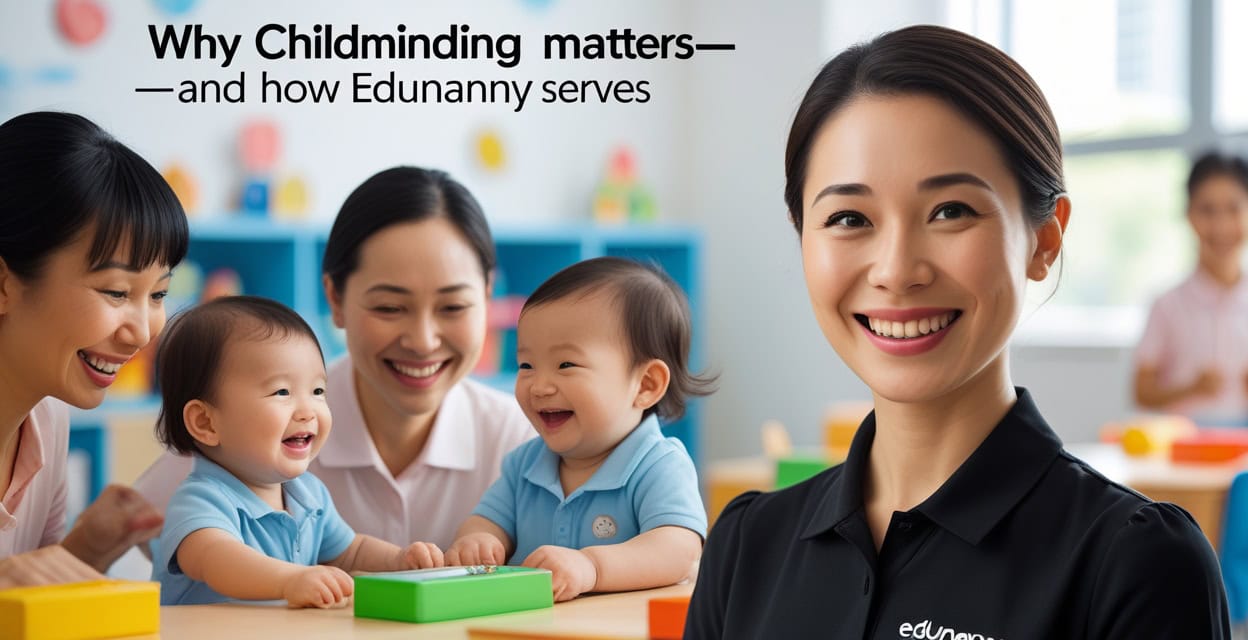
Concluding: Why Childminding Matters—and How EduNanny Serves

Concluding: Why Childminding Matters—and How EduNanny Serves

Who does childminding serve? Babies first—because their bodies and brains are building at astonishing speed. Parents—because work, rest, and family joy depend on trustworthy care. Carers—because meaningful employment should be skilled, respected, and supported. And Singapore—because today’s routines are tomorrow’s readiness.

What is childminding at its best? It is the art and science of turning ordinary care into secure attachment, language, motor mastery, and self-soothing—all inside a day that feels gentle and unhurried.

When does it matter? Every moment a baby reaches, looks, fusses, feeds, giggles, and sleeps. The 0–3 window is short; its effects are long.

Where should it happen? Where families can reach it easily—community settings and home premises across the island, with consistent standards and transparent practice.

How do we keep our promise? With ultra-low 1:3 ratios; trained, supported carers; modern, calm environments; secure CCTV; reliable 7am–7pm hours; clear safety systems; and a partnership mindset with parents.

EduNanny by BUTLER stands for excellence, quality, convenience, and affordability in Singaporean infant care—centre-based, home-based, and distance-supported—available islandwide, Monday to Friday, 7am to 7pm. We are proud to operate within Singapore’s childminding pilot framework as part of a national social initiative with a maximum employment mandate. Fees are payable by CDA/Baby Bonus where applicable. And because trust grows with clarity, you can learn more, compare settings, and begin your placement at EduNanny.com and Childminding.EduNanny.com.

Begin well. Be seen. Be safe. Be curious. This is what we owe our youngest, and this is what EduNanny is built to deliver—one tiny, thoughtful moment at a time.

Thank you.


Ready to Begin Your EduNanny Experience?

Ready to Begin Your EduNanny Experience?

Explore EduNanny options, compare settings, and start your placement today. Visit EduNanny.com and Childminding.EduNanny.com to view islandwide programmes, schedule visits, and access parent coaching resources. Join a nationwide effort that values trust, development, and the well-being of your child—and the professionals who care for them.

Key contact points for families:

  • Centre-based and home-based placements across Singapore
  • Distance-supported coaching and at-home learning days
  • Clear safety policies, CCTV visibility, and transparent communication
  • Fees, CDA/Baby Bonus eligibility, and flexible scheduling

EduNanny is committed to turning every ordinary moment into a moment of growth, safety, and connection. This is childhood—made thoughtful, supported, and within reach for all Singaporean families.

Learn more at: EduNanny.com and Childminding.EduNanny.com

[#keyword1, #keyword2, #keyword3, #keyword4, #keyword5]


edunanny-5d28f88e-cb25-48d6-b68e-4f6d580bf162
October 4, 2025

Trust at the Cradle The Five Streams Attunement Blueprint Redefining Singapore First Thousand Days

Opening the Circle: A Professional Vision for EduNanny Singapore

Opening the Circle: A Professional Vision for EduNanny Singapore

Good evening, friends, parents, caregivers, and partners in the work of human beginnings. We meet at a threshold that every nation must cross with reverence: the first thousand days of life. In those days, there is no such thing as “small.” A five‑second pause before a caregiver responds is not a delay—it is a lesson in trust. A gentle hand on a shoulder is not a gesture—it is a blueprint for belonging. Today we introduce EduNanny: a science‑led, heart‑forward childminding movement built in Singapore for Singapore, designed to make the ordinary acts of care extraordinary in their impact.


Who We Are: EduNanny by BUTLER

Who We Are: EduNanny by BUTLER

EduNanny is a centre-based and home-based childminding operator participating in the ECDA Childminding Pilot as part of a broader national social initiative. We exist to bring professional, affordable proximate infant care to families islandwide—Monday through Friday, 7 a.m. to 7 p.m.—with an ultra-low 1:3 infant ratio, modern spatial layouts, and live CCTV innovation embedded for transparency and partnership. We operate in communities and home premises. We support family budgets with fees payable by CDA/Baby Bonus. We make quality accessible, with options from $33/day. And we do all this while creating dignified jobs under a maximum employment mandate—because caring for children and caring for caregivers is the same work in two directions.


What Makes EduNanny Different: A Coherent Philosophy in Action

What Makes EduNanny Different: A Coherent Philosophy in Action

What makes EduNanny exceptional is not a single feature; it is a coherent philosophy put to work. We weave the wisdom of Montessori, Pikler, Bowlby, Piaget, Vygotsky, Froebel, Malaguzzi, Spock, and Erikson into a living practice tuned to Singapore’s rhythm, pace, and promise. Below are five vital lenses through which we design, train, and partner with families.

1) The Pedagogy of Attuned Learning

Development is not downloaded; it is co‑created. Our pedagogy rests on attunement: noticing, naming, and nurturing what an infant is already trying to do.

  • Respectful caregiving: slow, narrated routines that transform diapering, feeding, bathing, and settling into relationship‑rich micro‑lessons. Action: create a 10‑step routine log for each caregiver to use during transitions.
  • Design for discovery: low open shelves, soft light, safe mirrors, treasure baskets, heuristic play. Action: set up a monthly “discovery corner” with rotating materials tied to a theme (textures, sounds, shapes).
  • Language‑rich interaction: singing, parallel talk, rhymes, and mother‑tongue storytelling. Action: implement a daily 5‑minute language segment in the infant’s home language or a familiar language at home.
  • Individualized documentation: daily observation notes, photos, and mini‑learning stories. Action: maintain a child‑specific journal that parents review weekly with a short narrative and next steps.
  • Five‑second rule in practice: in moments of need, pause to read cues and respond appropriately. Action: provide a cue‑response checklist for caregivers and a short parent‑facing guide for common cues.

2) Safety as Architecture, Not Slogan

Safety is the floor, the walls, and the ceiling of trust—not an afterthought. We design spaces and routines that make safety visible and actionable.

  • Environment design: modern layouts to reduce blind corners, dedicated sleep, play, and caregiving zones, and clear lines of sight for staff and families. Action: deploy a quarterly safety walkthrough with a simple rating and quick fixes.
  • Evidence‑based sleep practices: independent cots, firm mattresses, no loose bedding, routine checks, temperature and noise control. Action: provide families with a safe sleep checklist for home transition.
  • Hygiene by habit: hand hygiene, sterilization, food safety, daily sanitation logs, and drills. Action: publish a weekly sanitation log for families to review online.
  • Competence and readiness: infant CPR/First Aid, safe sleep, choking response, and emergency protocols refreshed regularly. Action: implement a rotating quarterly certification calendar and mock drills.
  • Live transparency with privacy safeguards: CCTV provides audit visibility while protecting family privacy through consent, access controls, and data minimization. Action: offer families intermittent, consented live views during critical moments (drop-off, pick-up) with optional highlights when appropriate.
  • 1:3 infant ratio as a promise: more vigilant supervision and deeper relationships. Action: publish monthly staff‑to‑infant ratio reports and caregiver pairing strategies to ensure consistency.

3) A Developmental Continuum You Can See

Holistic development unfolds in braided streams. We track progress with a “Five‑Streams Passport” that is simple, shared, and humane.

  • Regulation and Rest: feeding rhythms, sleep patterns, soothing cues. Action: provide parents with a simple bedtime routine guide aligned with the child’s patterns.
  • Motor and Sensory: tummy time, reaching, grasping, rolling, crawling, cruising. Action: create a weekly “movement mini‑challenge” for caregivers and parents to try at home.
  • Communication and Language: cooing, babbling, joint attention, first signs, first words. Action: implement a daily language booster game in the home language with parents’ involvement.
  • Thinking and Problem‑Solving: cause‑and‑effect exploration, persistence, imitation, early categorization. Action: provide open‑ended toy sets and guided discovery prompts during care routines.
  • Belonging and Emotion: secure base behaviours, peer curiosity, joyful engagement. Action: schedule regular family‑involved activities and celebrate milestone moments with simple home activities.

Every infant receives a personal plan co‑created with parents. We do not compare children to each other; we compare each child to yesterday. Through daily notes, weekly reflections, and monthly mini‑conferences, families see growth as a story they co‑author.

4) Happiness as a Design Choice

Joy is built by routines that honor bodies, senses, and culture. Happiness is learned through safe, predictable, and culturally resonant environments.

  • Predictable, unhurried days: build in ample time for feeding, textures, naps, and warm hold. Action: create a daily rhythm map that families can reuse at home.
  • Warm, small communities: consistent carers, familiar routines, and known spaces. Action: implement a caregiver‑infant rotation plan that stabilizes attachments.
  • Culture‑forward caregiving: lullabies and stories in home languages, festival celebrations, familiar objects. Action: curate monthly culture moments and recommended home activities for families.
  • Practical partnerships with families: real‑time updates, photos, and carry‑over ideas. Action: provide a simple home activity kit with suggested daily slots for parent‑child interaction.
  • Caregivers cared for: reflective practice, supervision, and well‑being checks. Action: implement staff wellbeing huddles and professional development time as standard practice.

Happiness in infancy is expressed as soft eyes, steady breath, and curious exploration. We measure and nurture that daily in partnership with families.

5) The Purpose and Profession of Childminding

The word “childminder” carries the dignity of a craft. It is not casual work; it is a nation‑building vocation that shapes futures.

  • Professional pathways: recruitment, rigorous selection, mentorship, and ongoing certifications. Action: outline a clear career ladder and formal mentorship program for EduNanny staff.
  • Reflective culture: case reviews, peer learning, and practice labs. Action: implement monthly practice labs that address real‑life dilemmas with collective wisdom.
  • Ethical code: respect for families, transparent communication, and duty of care beyond the shift. Action: publish a family‑facing ethics charter and monthly transparency reports.
  • Local employment, national impact: a maximum employment mandate that widens entry points into meaningful care work. Action: partner with local training providers to create pathways for new carers and career progression for existing staff.
  • Community anchor: connecting families to resources, early intervention referrals, and neighbourhood networks. Action: establish a regional family support hub in each community served for quick referrals and guidance.

A Practical Tool: The Five‑Stream Passport

A Practical Tool: The Five‑Stream Passport

The Five‑Stream Passport is a simple, shareable framework to document, reflect, and celebrate a child’s development. Here is a practical example of how to implement it in a family setting:

  • Personalized plan: collaborate with parents to establish development goals across all five streams for the first 90 days.
  • Weekly snapshots: quick notes on progress in each stream, highlighted with a photo or short anecdote.
  • Monthly reviews: a short conference between caregiver and parents to adjust activities and expectations.
  • Home partnerships: provide a simple at‑home activity sheet aligned with the passport streams for consistency and carry‑over.

Quick Service Snapshot for Busy Parents

Quick Service Snapshot for Busy Parents

  • Delivery models: Centre‑Based Childminding and Home‑Based Childminding, with Distance support for guidance beyond the setting.
  • Hours and access: Monday to Friday, 7 a.m. to 7 p.m., islandwide Singapore, in community and home premises.
  • Ratios and rooms: ultra‑low 1:3 infant ratio; modern layouts designed to reduce stress and improve safety.
  • Transparency: innovative CCTV for compliance, training, and family partnership, with privacy safeguards.
  • Affordability: options from $33/day; fees payable by CDA/Baby Bonus; flexible scheduling within pilot guidelines.
  • Getting started: visit EduNanny.com and Childminding.EduNanny.com to learn more and arrange a tour or trial.

How EduNanny Makes Infantcare and Childminding Great in Singapore

How EduNanny Makes Infantcare and Childminding Great in Singapore

  • Proximity matters: care close to where families live and work reduces travel strain and keeps parent presence at critical edges of the day.
  • High standards, low barriers: trustworthy ratios, trained professionals, transparent environments, and practical pricing.
  • Science meets culture: a curriculum of attachment, exploration, and language that respects Singaporean rhythms and values.
  • Partnership with families: clear plans, daily visibility, and responsive support turn caregivers into trusted partners.
  • Investment in people: a national social initiative that dignifies caregiving work and multiplies employment while improving infant outcomes.

Getting Started: Who, What, When, Where, and How Childminding Matters

Getting Started: Who, What, When, Where, and How Childminding Matters

Who: Singapore’s youngest citizens, loving parents, and the childminders who stand watch and teach with presence.

What: Professional, transparent, and affordable childminding that turns routines into relationships and moments into milestones. EduNanny by BUTLER participates in the ECDA Childminding Pilot to bring a public‑spirited standard to everyday care.

When: Monday through Friday, 7 a.m. to 7 p.m.—with distance support and ongoing parent partnership beyond the clock.

Where: Across Singapore—centre‑based and home‑based pods in communities and homes, built with modern layouts that protect, soothe, and inspire.

How: With a 1:3 infant ratio; attunement‑led pedagogy; safety by design; innovative CCTV; trained, supported professionals; fees payable by CDA/Baby Bonus; and options from $33/day to keep quality within reach.


A Call to Action: Trust as the Child’s First Language

A Call to Action: Trust as the Child’s First Language

The philosophy and purpose of EduNanny, in one sentence, is this: to turn trust into the child’s first language. Trust that a caregiver will come. Trust that a need will be understood. Trust that the world is safe enough to explore and generous enough to welcome curiosity. From that trust flows everything else—attention, persistence, empathy, courage.

Singapore’s future is not waiting at the end of policy; it is blinking at the start of each day, in a cot, in a pod, in a caregiver’s arms. Let us make those first days worthy of the people we hope our children will become. Let us make excellence ordinary.

If you are a parent seeking a calm, competent beginning; a caregiver ready to grow a profession; or a partner who believes that infant care is nation‑building done softly and well—step into the circle with us.

Visit EduNanny.com or Childminding.EduNanny.com. Come see how five seconds of attuned care can open a lifetime of possibility.


Conclusion: A Reflective Ending and Call to Join

Conclusion: A Reflective Ending and Call to Join

In the first thousand days, trust becomes the foundation for lifelong learning. EduNanny exists to translate that trust into tangible routines, spaces, and relationships that nurture children, support families, and strengthen communities. By embracing attunement, safety as architecture, a clear developmental continuum, happiness as design, and the professionalcraft of childminding, we build a resilient system where high quality care is accessible, affordable, and inviting to every Singaporean family. Join us in creating a future where excellence is not a privilege but a standard woven into the daily rhythm of care.

Ready to engage? Explore tours, parent partnerships, and caregiver career pathways today.

Visit: EduNanny.com | Partner: Childminding.EduNanny.com


Key Ideas at a Glance

Key Ideas at a Glance

  • Attunement-led care improves trust and development
  • Safety by design protects children and provides transparency
  • A holistic five‑streams framework tracks development clearly
  • Joyful routines foster resilient, curious children
  • Professional, ethical, and community‑oriented childminding strengthens society

Note to readers: This article reflects EduNanny’s commitments to evidence‑based practice, cultural relevance, and the wellbeing of both children and caregivers within Singapore’s national context.

[#Education, #EarlyChildhoodCare, #SingaporeEducation, #InfantCareSingapore, #EduNannySingapore]
SEO Keywords

SEO Keywords

[#keyword1, #keyword2, #keyword3, #keyword4, #keyword5]

edunanny-f6c2fee7-6750-4ff0-877a-1508a61f5925
October 4, 2025

Designing Trust and Calm The EduNanny Blueprint for Safe Joyful Infancy in Singapore

EduNanny: A New Standard for Singapore’s Infants

EduNanny: A New Standard for Singapore’s Infants

Thank you for engaging with a vision that treats the first months of a child’s life as both a personal journey and a national responsibility. EduNanny is designed not merely as a service, but as a standard—an infrastructure of care that makes excellence visible, accessible, and worthy of trust. This long-form article expands on the EduNanny model, offering practical guidance, actionable steps for parents, and behind-the-scenes insights that illuminate how high-quality infant care can be delivered in today’s Singapore.


What is EduNanny? A Pedagogical, Safe, and Accessible Infant Care System

What is EduNanny? A Pedagogical, Safe, and Accessible Infant Care System

EduNanny is childminding reimagined for the level our infants deserve and our nation requires. It combines evidence-led pedagogy with human-centered practice, delivering centre-based care, home-based care, and distance-supported guidance islandwide. Operating from 7am to 7pm, Monday to Friday, it maintains an ultra-low 1:3 caregiver-to-infant ratio, ensuring vigilant supervision, meaningful interaction, and calm environments. The service is designed to be:

  • Centre-based, home-based, and distance-supported to meet family preferences;
  • Affordability without compromise and safety you can see;
  • Aligned with the ECDA Childminding Pilot and the Maximum Employment Mandate to dignify care work and expand opportunity;
  • Fees payable by CDA/Baby Bonus to simplify access; and
  • Described as care you would design for your own child, delivered near your own home.

Topic One: The Quiet Science of Care

Topic One: The Quiet Science of Care

Before language, infants communicate through cues. EduNanny translates foundational developmental science into daily practice. We draw on the work of Maria Montessori, Emmi Pikler, John Bowlby, Lev Vygotsky, Jean Piaget, and Erik Erikson to inform responsive routines rather than abstract theories.

Our daily practice follows a simple sequence: notice, wait, interpret, join. In a 1:3 setting, a caregiver can truly notice subtle cues—breath, gaze, muscle tone. Waiting creates a respectful pause that honors the infant’s initiative. Interpretation is calibrated by training in developmental science. Joining means matching rhythm and tone—posture, voice, tempo—so early experiences feel predictable and kind.

Practical implications for families:
– Observe during a visit: notice how caregivers respond to quiet cues (brief pauses, eye contact, soft touch) and how they pace activities to match an infant’s readiness.
– Expect a “rule of three”: interactions that avoid over-stimulation while providing consistent, meaningful engagement.
– Ask about professional development: how caregivers stay current with infant development research, and how observation notes feed into individualized care plans.


Topic Two: Safety as a System, Not a Slogan

Topic Two: Safety as a System, Not a Slogan

Safety in EduNanny is layered, systemic, and designed to be transparent. It is not a checklist to cross off; it is a living grid that supports every moment from arrival to departure.

  • Environment by design: Modern, uncluttered layouts guide safe movement and reduce risk. Sleep spaces follow safe-sleep guidelines—flat, firm mattresses; supine positioning; no soft bedding; temperature control; continuous visual checks.
  • The 1:3 advantage: Three infants with one professional ensures vigilant supervision without frantic overhead. Micro-groups reduce noise and stress hormones, enabling quick, calm interventions.
  • Prepared people: Every childminder is trained in infant CPR, choking response, hygiene protocols, bottle handling, diapering, and incident reporting. Safe handling of expressed breast milk is standard practice.
  • Daily diligence: Regular hazard scans, sanitation cycles, and secure daily reports track development and health observations, with privacy-respecting CCTV for oversight and audits.
  • Clear escalation: On-call senior educators or nurses, individualized care plans for allergies or medical needs, and practiced evacuation drills ensure preparedness for emergencies.
  • Transparency as trust: Optional parent access to CCTV and daily notes—shared, not surveilled—so families can see the care promises in action.

Topic Three: Development and the Shape of a Happy Infant

Topic Three: Development and the Shape of a Happy Infant

Happiness in infancy is a quiet, regulated state that emerges from secure relationships and predictable routines. EduNanny centers on routines that nurture nervous system regulation, curiosity, and confident self-regulation.

Nourish

Feeding is unhurried, responsive, and individualized. We respect breast milk and formula plans, paced feeding, and parental preferences. Caregivers log feeding cues, satiety signals, and fluid intake to support healthy growth without pressuring schedule-driven targets.

Rest

Sleep is protected by consistent routines, appropriate lighting, quiet environments, and proper sleeping posture. We learn each infant’s sleep-wake signature and tailor room conditions to support restful periods.

Move

Pikler-inspired free movement encourages infants to explore their bodies with safety and tempo. Tummy time is relational, with caregiver support beneath the elbow, fostering neck and core strength while respecting infant pace.

Sense and Say

Language development is supported through songs, narration, and bilingual exposure. Safe, natural materials aid sensory integration, and caregivers monitor for overstimulation, ensuring that joy remains restorative.

Track and Share

Daily summaries cover feeding, sleep, nappies, play, and meaningful moments. We celebrate micro-milestones and discuss opportunities for referral when needed, keeping families intimately informed without overwhelming detail.


Topic Four: The Civic Purpose of the Childminder

Topic Four: The Civic Purpose of the Childminder

  • Attachment at scale: One caregiver, three infants with consistent, warm interactions builds trust in real time.
  • Parental participation in the economy: Reliable care from 7am to 7pm reduces the mental tax on working parents and stabilizes household income.
  • Dignified care work: The Maximum Employment Mandate connects national initiatives to meaningful, local jobs with pathways for training and advancement.
  • Reduced childhood commute: Centre-based and home-based options in community spaces bring care closer to where families live and work.
  • Cultural continuity: Caregivers carry local language and traditions into daily care, embedding belonging and heritage from the earliest moments.

Topic Five: Choice Architecture That Respects Families

Topic Five: Choice Architecture That Respects Families

Families vary; a single rigid standard risks exclusion. EduNanny provides a flexible framework with consistency in quality and safety across formats.

  • Centre-based childminding: Purpose-built spaces with CCTV, predictable routines, socialization in micro-groups, and professional oversight.
  • Home-based childminding: Accredited homes with safety kits, environmental checks, and mobile quality audits—ideal for families seeking familiar surroundings.
  • Distance-supported guidance: For in-house care, educators offer virtual coaching, routines planning, and developmental check-ins—support wherever families are.
  • Operating envelope: Monday to Friday, 7am to 7pm, islandwide, with scalable hours as demand indicates.
  • Affordability: Transparent pricing from $33/day for qualifying arrangements, with CDA/Baby Bonus to ease access at point of need.
  • One constant standard: Regardless of model, every option adheres to the same safety system, 1:3 ratio, training pathways, and observation protocols.

A Day You Can Picture

A Day You Can Picture

A typical day begins at first light in a Jurong flat. A caregiver greets three infants by name, begins with handwashing and a calm hello. Bottles are logged, temperatures checked, and bags stowed. The room is calm—sunlight, tactile objects, and no screens in sight. Tummy time starts with support beneath the chest; a soft song matches each breath. The second infant feeds at a pace that respects cues, with expressed milk warmed safely. The third drifts to sleep after a short Mandarin story. A caregiver kneels at eye level to narrate a gentle roll and reach—no corrections, only encouragement. A daily note captures a new sound—ba-ba—sent to Mum at lunch. Afternoon sleep remains unhurried; the room cool and quiet. A sanitation cycle runs as naps begin. The day ends with a concise handover: food volumes, nappies, sleep windows, and a small victory—reduced startle responses to city clatter. A week later, the hawker cart’s noise is less startling. This is progress you can see and feel.


Why EduNanny Works in Singaporean Time

Why EduNanny Works in Singaporean Time

We built EduNanny around the realities of life in Singapore: long commutes, dense housing, multilingual households, and an economy that demands flexibility from parents. By offering centre-based and home-based care in community and home premises, by operating 7am to 7pm, by maintaining a 1:3 ratio, by using privacy-respecting CCTV for transparency, by enabling fees via CDA/Baby Bonus, and by aligning with ECDA’s Childminding Pilot as a national initiative with a Maximum Employment Mandate, we convert early care into everyday infrastructure.


Concluding: Who, What, When, Where, and How Childminding Matters

Concluding: Who, What, When, Where, and How Childminding Matters

  • Who: Infants in their first thousand days; parents who bring ambition and love; childminders who make care their vocation; and a nation that understands the moral math of beginnings.
  • What: Professional, developmentally aware childminding that merges pedagogy with protection—1 caregiver for 3 infants, trained and supervised, in modern spaces or accredited homes, with transparent systems and daily documentation.
  • When: Weekdays, 7am to 7pm, spanning the crucial first thousand days when brains are most plastic, habits most modifiable, and trust most learnable.
  • Where: Islandwide, near home, in community centers and residences; with distance-supported coaching meeting families wherever they are located.
  • How: A layered safety system; a developmentally intelligent routine; attachment-forward practice; privacy-respecting CCTV; rigorous training and audits; affordability starting at $33/day with CDA/Baby Bonus; and a public-spirited workforce policy that honours caregivers and expands jobs.

And the Why, the heartbeat: because every calm hand today becomes a confident step tomorrow. Infants who are responded to become children who can self-regulate; those children become adolescents who can learn and work; and those adolescents become adults who can love, lead, and build.


Practical Guidance for Parents: How to Choose and Work with EduNanny

Practical Guidance for Parents: How to Choose and Work with EduNanny

Choosing the right early care setting is a decision that shapes your child’s first experiences and your family’s daily rhythm. Here are practical steps, questions, and checklists to help families evaluate EduNanny options and make informed judgments.

  • Before you visit: List your top priorities (location, hours, language exposure, prenatal or postnatal support). Write down non-negotiables and nice-to-haves to compare options quickly.
  • During a tour – Centre-based: Observe layout, cleanliness, sleep spaces, and how caregivers greet infants. Note how micro-groups are organized (how many infants per caregiver in active times, and how transitions are managed).
  • During a tour – Home-based: Ask about the provider’s home safety checks, criminal background screening, environmental safety measures, and how visits are scheduled for consistency.
  • Distance-supported options: Clarify frequency and mode of coaching, how progress is documented, and what tools you will receive to support routines at home.
  • Key questions to ask caregivers:
    • What is your daily routine for infants in your care, and how flexible is it for individual cues?
    • How do you handle feedings, sleep, and soothing when an infant is unsettled?
    • What happens when there is a medical concern or allergy?
    • How is progress tracked and shared with families?
    • What training and ongoing professional development do caregivers receive?
    • How is privacy protected with CCTV and documentation?
  • Observation tips while at a centre: Look for calm, predictable routines; caregivers who speak softly and respond promptly; safe sleep practices observed; clean hands, and proper bottle handling protocols.
  • Observation tips for home-based care: Check safety measures (stairs, exits, smoke detectors), request a sample daily note to assess quality of documentation, and confirm access to audits or quality checks.
  • What to track at home: Friendly, redirections that preserve autonomy; consistency in routines; and open channels for daily or weekly updates from your EduNanny provider.
  • Budget and subsidies: Understand how CDA/Baby Bonus offsets costs and what the overall monthly expense will look like for your family.

Getting Involved: Tours, Tours, and Contact

Getting Involved: Tours, Tours, and Contact

Ready to experience EduNanny first-hand? Plan a guided tour of a centre, meet a qualified home-based childminder, or schedule distance-supported coaching to see how the model can fit your life. Engage with our team to design a week that aligns with your life and your child’s rhythm.


Ultimately, a Promise You Can Hold

Ultimately, a Promise You Can Hold

EduNanny is not merely a program; it is a public commitment to the earliest moments of life. It integrates research, practice, policy, and family partnership into a continuous cycle of improvement. By treating every micro-moment as curriculum, every caregiver as a professional, every parent as a partner, and every infant as a citizen in the making, EduNanny works toward a future where quality is affordable, safety is demonstrable, and joy is a daily reality for Singapore’s youngest learners.

Visit EduNanny.com and Childminding.EduNanny.com to learn more, tour a centre, meet an authentic home-based provider, or schedule distance-supported coaching. Let us design a week that fits your life and a start that fits your child.

[#keyword1, #keyword2, #keyword3, #keyword4, #keyword5]

edunanny-a9b85615-09b4-4137-819c-db2b603bbea8
October 4, 2025

Near Home 1 to 3 The EduNanny Blueprint for Safe Joyful Infancy and Civic Care in Singapore

Introduction: What is EduNanny?

Introduction: What is EduNanny?

EduNanny by BUTLER presents a vision of childminding and infant care that transcends traditional services. It rests on three clear convictions that guide every decision, every space, and every interaction with families and infants:

  • Care must be close, wise, and dependable. Proximity and consistency matter most when children are forming early patterns of safety and curiosity.
  • Safety must be designed into every second, not added as a signboard. Safe environments are created through thoughtful planning, training, and continuous improvement.
  • Development must be joyful, culturally rooted, and guided by evidence. Learning thrives when exploration is supported by relationships, language, and meaningful experiences.

EduNanny operates islandwide in Singapore from Monday to Friday, 7am–7pm, offering both center-based and home-based care in community and home premises. Our model features an ultra-low infant ratio of 1:3, modern layouts engineered for calm and safety, and innovative CCTV that strengthens trust and partnership with families. It is accessible and affordable—from $33/day—and eligible fees may be covered by CDA or Baby Bonus. As a national social initiative participating in the ECDA Childminding Pilot, EduNanny aligns with a Maximum Employment Mandate that uplifts good jobs and dignified work in caregiving across neighborhoods. EduNanny is care as public spirit—a nation-building effort one safe, attuned, and curious infant at a time.

Four Fresh Lenses on Infant Care: Pedagogy, Safety, Development, and the Purpose of Childminding


1. Pedagogy for the Smallest Learners: A Practice of Attentive Science

1. Pedagogy for the Smallest Learners: A Practice of Attentive Science

First learning experiences are quiet, relational, and deeply respectful. Our pedagogy blends the best of established approaches—Montessori’s freedom-within-limits, Vygotsky’s guided discovery, Bowlby’s secure attachment, Pikler’s respect for autonomous movement, and Erikson’s emotional foundations. At EduNanny, this becomes a daily practice we call Attend–Name–Nudge:

  • Attend: Notice the child’s gaze, breath, and body—clues to emerging schemas as Piaget described.
  • Name: Put words to feelings and actions; language becomes a bridge, not just a subject.
  • Nudge: Offer the next small challenge inside the child’s zone of proximal development; scaffolding invites growth without rushing.

Floor-level practice includes infants exploring low, open shelves designed for safe choice. Caregivers sit on the ground to be eye-to-eye, responding with warmth and precision. Movement is never rushed; rolling, reaching, pivoting, and cruising are celebrated when bodies are ready. Expect soft narration, careful hands, and rooms paced to infant breath, not adult schedules. This is how curiosity grows with calm rather than haste.


2. Safety by Design: The Tranquility of Good Systems

2. Safety by Design: The Tranquility of Good Systems

Safety that depends on luck is not safety; it’s hope. EduNanny embeds safeguarding from the floorplan to the final handover:

  • People: 1:3 infant ratio, rigorous vetting, ongoing training, reflective supervision, and escalation protocols. We coach for composure because a calm adult creates a safe environment.
  • Place: Modern layouts with clear sightlines, gated zones, firm sleep surfaces, and stable, rounded, accessible furniture. Every item has a purpose and a place.
  • Process: Sleep safety the ABC way (Alone on the Back in a Crib), bottle hygiene, nappy and hand-wash routines, temperature checks, safe baby-wearing, and outdoor guidelines tailored to Singapore’s climate.
  • Transparency: Innovative CCTV supports professional accountability and parent partnership, with clear data governance and privacy standards.
  • Preparedness: Regular emergency drills, incident-prevention audits, and a culture that treats near-misses as lessons, not secrets.

Good safety feels like tranquility, not tension. When safety becomes a rhythm, children and adults can relax—and true learning begins.


3. Development and Happiness: Joy as a Developmental Outcome

3. Development and Happiness: Joy as a Developmental Outcome

Happiness is not a luxury; it is a measurable condition for healthy brain development. We cultivate joy through rhythm, relationship, and rich experience:

  • Rhythm: Predictable flows—feed, play, sleep—that reduce stress chemistry and prime attention.
  • Relationship: Warm, attuned caregiving that fosters secure attachment—the bedrock of resilience and exploration.
  • Rich Experience: Sensory play with natural materials, bilingual songs and stories connected to multicultural identity, tummy-time zones for strength, mirror corners for self-awareness, and open-ended play that invites discovery.

We track development through careful observation and meaningful conversation, not only checklists. Parents receive updates that explain what was tried, what took hold, and what we’ll try next—so home and care environments sing the same song. When infants feel safe and seen, they take cognitive risks, expand motor skills, babble boldly, and laugh with their whole bodies. This is joy with purpose.


4. The Purpose and Profession of Childminding: A Civic Craft

4. The Purpose and Profession of Childminding: A Civic Craft

Childminders are not merely stopgaps in the labor market; they are culture bearers of care. EduNanny invests in the profession with training, reflective practice, and community recognition:

  • Craft and Career: Clear pathways for growth—from trainee to lead caregiver to mentor. Training covers attunement, infant mental health basics, observation, documentation, and family partnership.
  • Community and Employment: A Maximum Employment Mandate that elevates care into good jobs near home, stabilizing families and neighborhoods.
  • Ethical Practice: Boundaries, confidentiality, and shared decision-making with parents. Each caregiver learns to be a steady base—present, patient, and purposeful.

When care is respected and resourced, the child receives the best self. That is not a slogan; it is a daily pattern we see in classrooms, homes, and neighborhoods.


How EduNanny Makes Childminding Great in Singapore

How EduNanny Makes Childminding Great in Singapore

  • Islandwide convenience with center-based and home-based options near where families live and work.
  • Monday–Friday, 7am–7pm coverage that aligns with modern work-life needs.
  • Affordability starting at $33/day, with eligible fees supported by CDA/Baby Bonus.
  • Ultra-low 1:3 infant ratio for safety and individualized attention.
  • Innovative CCTV for trust and transparency alongside privacy safeguards.
  • Modern layouts designed to be calm, uncluttered, and conducive to safe exploration.
  • Participation in the ECDA Childminding Pilot as a national social initiative and contributor to a better caregiving ecosystem.
  • Maximum Employment Mandate creating dignified, local caregiving jobs.
  • Strong family partnership through daily notes, milestone conversations, and responsive adjustments.
  • Distance support—consults, check-ins, and guidance that strengthen home routines.

A Day in the Life: What Families Can Expect

A Day in the Life: What Families Can Expect

A typical day centers on calm, connection, and scaffolding development. Here is a model sequence families can reference when planning daily routines at home and in EduNanny care:

  • Morning welcome: Unrushed greetings, health check, and a gentle handover that honors parental insight.
  • Feeding with attunement: Paced bottle feeds or breastfeeding support; hygiene and timing adapted to the child’s needs.
  • Floor-level exploration: Safe, open-ended play that respects developmental readiness and curiosity.
  • Sensory learning: Textures, music, and light play tailored to the child’s sensory profile.
  • Language and culture: Multilingual songs and stories that reflect home cultures and identities.
  • Outdoor time when weather permits: Shade, hydration, and movement anchors that support physical development.
  • Sleep with dignity: Quiet rooms, safe cribs, individual soothing strategies, and vigilant supervision.
  • Afternoon connection: A second wave of exploration aligned to energy levels and winding-down patterns.
  • Evening handover: Clear notes on progress, next steps, and insight that informs tomorrow’s plan.

Why This Matters Now

Why This Matters Now

Singapore families face growing demands: grandparents assisting longer, parents balancing hybrid work, and infants needing steady care grounded in science and culture. A nation that cultivates creativity and character demands belonging and curiosity from infancy. EduNanny makes that design practical—near home, easily accessible, reliable, and deeply human.


The Practical Promise: Benefits at a Glance

The Practical Promise: Benefits at a Glance

  • Excellence and quality embedded in training, supervision, and everyday routines.
  • Centre-based and home-based options across the island for true proximity.
  • Monday–Friday, 7am–7pm availability to match real working hours.
  • Affordability from $33/day; CDA/Baby Bonus eligibility supported.
  • 1:3 infant ratio for safety and individual developmental attention.
  • Innovative CCTV promoting trust and transparent communication.
  • Calm, modern layouts designed for safe exploration and restful spaces.
  • EduNanny by BUTLER as part of a National Social Initiative under the ECDA Childminding Pilot.
  • Maximum Employment Mandate to create dignified local caregiving jobs.
  • Simple next steps at EduNanny.com and Childminding.EduNanny.com.

Closing: Who, What, When, Where, and How Childminding Matters—and EduNanny’s Purpose

Closing: Who, What, When, Where, and How Childminding Matters—and EduNanny’s Purpose

Who matters? Every infant, every caregiver, every parent—because early care is a civic ecosystem, not a private errand.

What matters? Safety that’s felt, learning that’s lived, and relationships strong enough to carry a child’s courage into tomorrow.

When does it matter? Now—during working hours, throughout nap times that reset the nervous system, and in the tiny triumphs that signal readiness for more.

Where does it matter? Near home, in centers, in community rooms, and in the everyday spaces where life actually happens.

How does it matter? Through low ratios, thoughtful design, trained and trusted caregivers, transparent systems, and a respectful partnership with families that says, “We see your child as you do: a whole human, ready for wonder.”

EduNanny exists to turn these convictions into daily practice. Our philosophy is simple and ambitious: if we get infancy right—if we align safety, joy, and development with community employment and family convenience—we build not only better childhoods, but a wiser, more gracious Singapore.

So let us keep bending the city down to hear a baby’s breath—and let the infant feel the city answer back: “You are safe. You are seen. You can grow.”

To learn more, visit EduNanny.com and Childminding.EduNanny.com. To enroll, to work with us, or to partner as a community host location, we welcome you. The door is open, the floor is clear, the ratio is low, and the future is wide.


Conclusion

Conclusion

EduNanny is more than a care program; it is a framework for nurturing trust, curiosity, and resilience from the very first months of life. By combining a low 1:3 infant ratio, safety designed into every corner, development-centered pedagogy, and a civic-minded profession, EduNanny creates environments where babies grow with dignity, parents feel supported, and communities benefit from a stable, caring infrastructure. If you are a parent, caregiver, or community partner, consider how these practices translate to your daily routines—from home routines that honor a child’s pace to center experiences that model calm, inquiry, and multilingual roots. The invitation is simple: engage in the conversation, explore EduNanny options near you, and join us in shaping Singapore’s future by investing in its youngest citizens today. The city’s future depends on how gently we hold its youngest hearts—and how boldly we listen to their breath.

Visit EduNanny.com and Childminding.EduNanny.com to learn more, ask questions, and begin a partnership that respects both science and culture.

[#keyword1, #keyword2, #keyword3, #keyword4, #keyword5]

edunanny-c0ae99bb-e30a-44a1-85a2-bf76b4e13493
October 4, 2025

The Living Promise of the First Thousand Days in Singapore

Introduction: A Welcome to Singapore’s First Thousand Days

Introduction: A Welcome to Singapore’s First Thousand Days

Thank you for lending your ears and your hopes to a subject that deserves both: the first thousand days of life. EduNanny—born in Singapore, powered by BUTLER, shaped by science, and sustained by community—stands on the shoulders of giants in early education. Montessori’s respect for the child, Pikler’s trust in self-initiated movement, Piaget’s discovery through play, Vygotsky’s social learning, Bowlby’s attachment, and Erikson’s stages of trust inform our daily care. We translate that wisdom into a calm, safe, and deeply human approach to care that supports confidence, language, empathy, and curiosity from the very start.

We offer a promise to families: every tiny moment in care is a building block. The sound of a caregiver’s voice, the steadiness of a hand at diaper change, the rhythm of naps and feeds, and a room designed for crawling and reaching—all become the curriculum of life. This is how a child’s world learns to respond, and how a child learns to trust the world.


What is EduNanny?

What is EduNanny?

  • Centre-based settings with modern, purpose-built layouts designed for safe exploration and visible learning.
  • Home-based childminding for neighbourhood convenience without compromising quality or oversight.
  • Distance support for parents—tele-consultation, daily updates, and guidance that travels with you.

EduNanny operates Monday to Friday, 7am to 7pm, islandwide across Singapore. We welcome infants at an exceptional 1:3 ratio to safeguard attention, co-regulation, and learning. Our plans are flexible and affordable—from $33/day—with fees payable by CDA or Baby Bonus, subject to prevailing guidelines. We integrate parent-view CCTV with privacy-by-design safeguards and a transparent daily record. We participate in the ECDA childminding pilot (Dec 2024–Dec 2027) as a national social initiative aligned to strengthen early years care and meaningful employment. Through our Maximum Employment Mandate, we professionalise caregiving careers—training, certifying, and uplifting the people who nurture our nation’s youngest citizens.


How EduNanny Makes Infant Care and Childminding Truly Work for Singapore

How EduNanny Makes Infant Care and Childminding Truly Work for Singapore

Care Models That Meet Real Lives

  • Centre-based care brings robust routines, safety systems, and collaborative learning in a guided environment.
  • Home-based childminding places care in familiar neighbourhoods, with the same standards and supervision.
  • Distance support keeps families connected during travel, illness, or busy seasons, with timely updates and expert guidance.

Safety, Ratios, and Design

  • 1:3 infant ratio ensures every child is truly seen and soothed, enabling responsive care and secure attachment.
  • Modern layouts, clear sightlines, safe sleep practices, and clean air and sanitation routines support physical safety and calm exploration.
  • Transparent daily records and parent-view options provide real-time insight and trust.

Safety, Privacy, and Verification

  • Privacy-by-design CCTV and data protections protect families while enabling meaningful observation for safety and development.
  • Double-verification handovers, medication controls, allergy plans, and emergency drills create reliable, repeatable safety routines.
  • Continuous quality improvement cycles ensure care evolves with science and family feedback.

Five Ideas That Shape Our Practice

Five Ideas That Shape Our Practice

1) The Dialogic Minute: Care as Conversation

Every routine is an opportunity to wire the brain for trust and language. Our caregivers follow a simple, evidence-informed sequence:

  • Notice: “I see you’re rubbing your eyes.”
  • Name: “You look sleepy. It’s time to rest.”
  • Nurture: “I’m here. I’ll hold you while we zip your sleep-sack.”
  • Navigate: “We’re placing you on your back in your cot, lights dim. I’ll be right here.”

In a 1:3 environment, these micro-exchanges happen often and intentionally. This is Vygotsky’s social learning in the nursery, Montessori’s respect in routine, and Bowlby’s secure base in action. Over time, infants learn that the world responds, language has meaning, bodies are safe, and calm can be found with another person.

2) Four Rings of Safety: People, Place, Process, Proof

Safety is a system, not a sign on the wall.

  • People: Certified caregivers trained in infant CPR/FA, safe sleep, hygiene, and responsive care; ongoing mentoring, reflective supervision, and structured debriefs after incidents.
  • Place: Floor plans with clear sightlines, anchored furniture, cot areas separated, air quality routines, temperature checks, and secure entries/exits.
  • Process: Double-verification for handovers and medications; safe sleep checks; bottle labelling; allergy plans; emergency drills; incident reporting within defined timeframes.
  • Proof: Parent-view CCTV with robust data protection; daily logs; internal audits; continuous improvement cycles.

3) The “Tiny Lab of Life”: A Micro-Curriculum for Whole-Child Development

In the sensorimotor stage, purposeful exploration is learning. Our day is a gentle arc that respects sleep science, feeding rhythms, and the infant’s natural curiosity:

  • Morning: Warm arrival ritual; floor time for tummy-to-side-to-back transitions; mirror play and object permanence baskets; songs that scaffold turn-taking and sound discrimination.
  • Midday: Unhurried feeds with serve-and-return conversation; tactile play with textures; infant-led gross motor practice (Pikler-inspired principles—no forced sitting or walking).
  • Afternoon: Outdoor strolls or sensory balcony time; peekaboo and simple finger plays; reading routines; co-regulation toward rest.

For older infants, we add social imitation games, early gesture vocabulary, and simple problem-solving trays. This is a practical application of the Zone of Proximal Development (ZPD): just enough support to stretch a new skill, just enough freedom to discover it.

4) Joy as a Safety Signal: The Emotional Climate of Care

Happiness is a sign of nervous system safety. Our caregivers attune to infants’ cues with predictable rhythms, warm tone, and playful invitations to sustain curiosity and reduce stress. We support caregiver well-being through fair shift design, breaks, and peer support—recognizing that regulated adults co-regulate infants. Family rituals—arrival songs, comforting items from home, and a shared family notebook—weave a continuous world for the child and strengthen home-care connections.

5) The Purpose of Childminding: A Civic Engine

High-quality childminding is essential infrastructure. When care is reliable, safe, and nearby, parents work with confidence and infants form secure attachments in stable groups. Our Maximum Employment Mandate expands dignified jobs, professional pathways, and ongoing development for caregivers, supporting both the care economy and family stability. Childminding is not a fallback; it is a frontline investment in a nation’s future.


A Day in the Life: What Families Can Expect

A Day in the Life: What Families Can Expect

Below is a typical day designed to balance routine, learning, and caregiver attention. Adjustments are expected with each child’s needs and family schedules.

  • 7:30am: A gentle hello; quick health check; care plan review; a familiar song. Parent-view update posted after settling.
  • Morning window: Floor play with guided reach-and-roll; caregiver narrates actions and feelings; short, responsive reading moments.
  • Nap: Back-to-sleep in a firm cot; no loose bedding; quiet checks; logged sleep patterns.
  • Feed: Hygiene protocols; paced bottle or supported breastfeeding; eye contact, pauses, and coos to make feeding relational.
  • Afternoon: Sensory exploration (textures, soft brushes, gentle music), outdoor time when possible, and a slow wind-down with familiarity.
  • Evening handover: What we noticed, what we celebrated, and what we’ll try tomorrow—tiny threads that connect home and care.

The EduNanny Advantages—Clear and Practical

The EduNanny Advantages—Clear and Practical

  • Excellence and Quality: A living practice guided by science, refined by reflective supervision, and measured by visible outcomes in calm, curiosity, and growth.
  • Centre-Based and Home-Based: Two high-standard settings supervised to the same rigorous benchmarks.
  • Distance Support: Daily digital updates, parent coaching, tele-consults, and continuity plans for travel or illness.
  • Convenience: Weekdays 7am–7pm, islandwide coverage, neighbourhood options to shorten travel and preserve family life.
  • Affordability: From $33/day, with CDA/Baby Bonus eligibility per policy.
  • Real 1:3 Infant Ratio: Visible, measurable attention and care that families can feel.
  • Parent-View CCTV: Transparent, secure viewing paired with strong data protections.
  • Modern Layouts: Safe sleep zones, sensory corners, movement-friendly floors, and gentle lighting and sound design.
  • EduNanny by BUTLER: Singapore-built platform with professional service standards and a family-centered heart.
  • ECDA Childminding Pilot: Participation within the national framework to raise standards and access.
  • National Social Initiative: Expanding quality care while advancing caregiver employment opportunities.
  • Easy Next Steps: Visit EduNanny.com and Childminding.EduNanny.com to tour spaces, meet caregivers, and review plans.

Why Pedagogy Matters to Safety—and to the Future

Why Pedagogy Matters to Safety—and to the Future

Infants learn first through their bodies and their relationships. When a caregiver narrates a nappy change, the brain links words to actions; when a baby is given unhurried time to roll, balance and confidence develop; when two infants share a caregiver’s rhythm, empathy grows. Repeated with consistency and skill, these moments become the architecture of resilience, laying a foundation for lifelong learning, social competence, and well-being.


What Parents Often Ask—and Our Answers

What Parents Often Ask—and Our Answers

  • “Will my child be safe?” Yes—through systems, not slogans: trained people, designed places, tight processes, and visible proof.
  • “Will my child be happy?” Joy is a sign of nervous system safety. We protect rhythm, relationship, and play so happiness becomes a climate, not just a moment.
  • “Will my child learn?” Absolutely. In infancy, learning looks like curiosity, purposeful movement, shared attention, and secure exploration. Our micro-curriculum is built for precisely that.

Closing: Who, What, When, Where, and How—Why Childminding Matters Now

Closing: Who, What, When, Where, and How—Why Childminding Matters Now

  • Who: Infants, parents, and professional caregivers—each indispensable.
  • What: Childminding that honours attachment, play, and safety as daily practice, not just marketing language.
  • When: The first thousand days—when brains are most plastic, habits are most shapeable, and help matters most.
  • Where: In neighbourhood homes and centres, 7am–7pm, Monday to Friday, islandwide across Singapore.
  • How: With a genuine 1:3 ratio; trained, supervised caregivers; safe-by-design environments; transparent operations; and a curriculum woven into care.
  • Why: A calm, secure start compounds over days to become a confident child, a resilient adult, and a society that trusts itself.

Conclusion: A Practical Vision for Every Family

Conclusion: A Practical Vision for Every Family

Our philosophy is simple: presence before programming; relationship before routine; curiosity before content. Our purpose is sturdy: to give every family a safe hand to hold and every infant a confident beginning worthy of their potential—while lifting up caregiving as a respected, well-supported profession. If this vision matches your hopes, we invite you to see it up close. Visit EduNanny.com or Childminding.EduNanny.com to tour a space, speak with a caregiver, read a daily log, and observe five minutes of care before you decide whether this feels like the world you want your child to greet.

On behalf of every EduNanny caregiver and family we serve, thank you for believing with us that the future is built—quietly, carefully, joyfully—in the cradle. Let’s build it together.

SEO keywords: [#keyword1, #keyword2, #keyword3, #keyword4, #keyword5]


edunanny-70408195-8686-49df-9c28-bbe07ec286a4
October 4, 2025

Near Home, Safe Start EduNanny and the Public Promise of Singaporean Infancy

Introduction: A Subject Close to Home

Introduction: A Subject Close to Home

Thank you for gathering for a subject that is both intimate and immense: how we hold a child at the start, and how that start holds a country together. EduNanny is a Singapore-built, research-led, family-hearted effort delivered by BUTLER, designed to meet the real rhythms of life in Singapore. We exist to ensure that infant care is not merely a service but a public good—center-based, home-based, and distance-enabled care that is excellent, affordable, and close enough to trust. This article expands on our philosophy, practical models, and actionable insights every parent and caregiver can use today.


EduNanny: A Singapore-Built, Research-Led Approach

EduNanny: A Singapore-Built, Research-Led Approach

Our Promise

  • That every infant’s day can be both safe and alive with meaning.
  • That every caregiver can be trained, supported, and dignified as a professional.
  • That every parent can feel both present and unburdened.
  • That a city can be measured by the quality of its quietest rooms—the rooms where babies nap, stretch, gaze, and begin to belong.

Practical Implications for Families

Our promise translates into real, day-to-day practice. Parents can expect transparent safety measures, predictable daily rhythms, and meaningful moments of growth—even within busy schedules. For caregivers, we provide clear career pathways, ongoing training, and a culture of reflective practice. For policymakers and employers, EduNanny demonstrates a scalable model where care quality and employment dignity rise together.


How EduNanny Makes Childminding Great for Singapore

How EduNanny Makes Childminding Great for Singapore

  • Proximity without compromise: Islandwide care from Monday to Friday, 7am–7pm, in community centers and trusted home premises—reducing long commutes and preserving family time.
  • Tiny groups, deep attention: An ultra-low 1:3 infant ratio to ensure every child is seen, understood, and supported as an individual.
  • Safety you can see: Innovation CCTV with privacy-by-design and secure parent access, turning trust into a deliberate system rather than a slogan.
  • Spaces that teach calm: Sleep-safe rooms, soft lighting, and sensory-aware materials designed to educate the environment itself.
  • Excellence that families can afford: Fees from $33/day, with CDA/Baby Bonus support to make high-quality care accessible.
  • A public mission: Participation in the ECDA Childminding Pilot, aligned with national social initiatives and a Maximum Employment Mandate to lift families and create dignified caregiving jobs.

Five Fresh Ideas Shaping Our Care

Five Fresh Ideas Shaping Our Care

1) Micro-Attention as Pedagogy: The Quiet Science of Noticing

Infancy is not about rushing to milestones; it is about being well-met in small, consistent moments. Our educators practice micro-attention—short, frequent cycles of notice, name, and nurture.

  • Notice: Observe cues such as a blink, hand splay, or foot flex to identify readiness or fullness.
  • Name: Label the moment: “You’re turning toward the rattle; you’re curious about sound.”
  • Nurture: Respond with the next right activity—gentle repetition, a restful pause, or a fresh sightline.

These micro-encounters build secure attention, memory, and early language precursors. In a 1:3 setting, practitioners can sustain this all day—five seconds at a time—laying the groundwork for confident learning.

2) Safety That Learns: Anticipatory Design and Transparent Systems

Safety is a living discipline, not a checklist. We embed anticipatory design and transparent systems so families can trust the day-by-day routine.

  • Anticipatory design: Floor-level scanning every hour, safe sleep checks every 10–15 minutes, color-coded zones, and allergen/medication logs verified by two staff.
  • Transparent systems: Encrypted CCTV access for parents, privacy-occluded toileting zones, proactive incident reporting that prioritizes families.
  • People first: Every childminder trained in infant CPR and choking response; daily readiness huddles and reflective debriefs to improve care continuously.

3) Rhythm Builds the Brain: The Architecture of a Trustworthy Day

Predictable days create courageous children. Our daily arc is simple, protective, and developmentally attuned.

  • Arrival Ritual: Warm handover, three questions (sleep, feeding, new observations), wellness checks, and a short sensory greeting.
  • Play Bout, Rest Bout: Short cycles of exploration and recovery—learning happens in waves, not in marathon sessions.
  • Feed With Relationship: Responsive feeding with posture, eye contact, and pacing—whether breastmilk, formula, or early solids.
  • Outdoors or Nature Moments: Fresh air and nature-inspired play—indoors or outdoors depending on weather and space.
  • Unbusy Afternoons: Quiet reading, gentle music, and transitional activities that ease evening routines at home.

Rhythms provide a secure base from which curiosity can grow, and a secure base supports lifelong learning.

4) Joy Is Serious Work: Play-Inquiry for Growing Brains and Brave Hearts

Play is how infants practice life with discovery and without fear. We curate play to cultivate sensory literacy, agency, and social empathy.

  • Sensory literacy: Rattles, fabrics, and textured tools that help the brain file exteroceptive information accurately.
  • Cause and effect: Simple mechanisms (pulleys, boxes, water play) that reveal agency and consequences in safe ways.
  • Social mirroring: Face-to-face games, cooing duets, and peekaboo to rehearse early empathy.
  • Singapore in miniature: Local music, bilingual lullabies, and everyday objects used safely to reflect culture from day one.

5) The Childminder’s Charter: Purpose, Professionalism, Partnership

EduNanny’s childminders are not casual helpers; they are early-years professionals with a clear charter.

  • Purpose: Be a secure base and a skilled guide, not a substitute parent or a screen-only experience.
  • Professionalism: Ongoing training, supervision, reflective practice, and transparent career pathways.
  • Partnership: Daily updates, development snapshots, and coaching for families to align sleep, feeding, and soothing with a family culture.

The Service Blueprint Parents Asked Us to Build—and We Did

The Service Blueprint Parents Asked Us to Build—and We Did

  • Models of care: Centre-based childminding in bright spaces; home-based care in vetted, safety-proofed homes; distance care via virtual coaching, digital diaries, and secure video check-ins.
  • Availability: Weekdays, 7am–7pm, islandwide, with flexible drop-off windows and extended wrap for commuting families.
  • Ratio: Consistent 1:3 infant-to-minder ratio across models.
  • Affordability: From $33/day, with CDA/Baby Bonus support.
  • Technology with a conscience: Dignity-first privacy controls, encrypted storage, and need-to-know access for caregivers and families.
  • Modern layouts: Sleep rooms separated from active play; ergonomic feeding zones; pram parking; safe nappy stations; and quiet reading corners.
  • Public mission: ECDA Childminding Pilot participation and alignment with national social initiatives to raise standards and create local employment.

What This Means for Your Child Today and for Our Society Tomorrow

What This Means for Your Child Today and for Our Society Tomorrow

  • A safer start: Sleep safety, clean air, hygiene rituals, and responsive handling reduce avoidable risk.
  • Faster settling: Predictable care with familiar adults and gentle transitions shorten separation stress.
  • Stronger development: Fine and gross motor skills, language foundations, and social curiosity flourish in micro-groups.
  • Happier homes: A well-supported child returns home ready to engage, feed, and sleep more easily.
  • Stronger communities: Reliable care enables parents to work, caregivers to thrive, and neighborhoods to value their youngest members.

The Promise Behind the Price

The Promise Behind the Price

From $33/day is not a marketing hook; it is a civic decision. Excellence should be accessible to all, not gated by privilege. CDA/Baby Bonus support, aligned hours, and islandwide presence make high-quality care a feasible choice for families across Singapore. When excellence is reachable, families breathe easier, and children grow with confidence in the future.


The Who, What, When, Where, and How of Why Childminding Matters—and How EduNanny Serves

The Who, What, When, Where, and How of Why Childminding Matters—and How EduNanny Serves

  • Who: Infants from birth through the first years, their families, and professional childminders committed to this craft.
  • What: Relationship-centered childminding blending safety, science, and joy across centre-based, home-based, and distance formats with a 1:3 ratio.
  • When: Weekdays, 7am–7pm, with daily rhythms designed to support regulation and growth.
  • Where: Islandwide Singapore—safe, modern spaces and approved homes close to work and community life.
  • How: Trained professionals, anticipatory safety, micro-attention pedagogy, privacy-conscious transparency (CCTV), and strong family partnership—backed by a national pilot and employment mandate.

Our Philosophy and Purpose in One Breath

Our Philosophy and Purpose in One Breath

A baby is not a task to be managed but a person to be met. Meet them well—and they meet the world well. EduNanny exists so that meeting can happen every hour of every weekday, across Singapore, in places designed for tiny bodies and generous beginnings. We do this with excellence because your child deserves it; with affordability because society needs it; with transparency because trust requires it; and with joy because learning loves it.


To Parents, To Childminders, To Employers and Policymakers

To Parents, To Childminders, To Employers and Policymakers

To parents: May you feel both supported and central. Trust that your child’s day is being observed with warmth, expertise, and attention to the smallest cues. Build routines that you can sustain at home and in care, and engage with us as a true partner in development.

To childminders: You are culture-makers. We will train you, protect your time, and celebrate your craft. You deserve professional growth, reflective practice, and a career with meaning.

To employers and policymakers: When care is strong, participation grows and futures brighten. Invest in quality, accessibility, and pathways that lift families and workers alike.

To the infants asleep as we speak: We are building rooms worthy of your dreams—safe, calm, and rich with possibility.


Getting Started: How to Begin with EduNanny

Getting Started: How to Begin with EduNanny

  • Explore programs and enrolment at EduNanny.com.
  • Learn about community childminding at Childminding.EduNanny.com.
  • Ask for centre-based, home-based, or distance options near you.
  • Use your CDA/Baby Bonus to make excellence affordable.
  • Visit a site; meet a childminder; watch safety work in plain sight.

Conclusion

Conclusion

EduNanny stands for a simple, nation-shaping belief: give every child a steady start, and you give every family, every workplace, and every neighbourhood a steadier tomorrow. Let’s hold the beginning with both hands—carefully, confidently, and together. If you are ready to begin, we are ready to welcome you.

SEO keywords: [#keyword1, #keyword2, #keyword3, #keyword4, #keyword5]


edunanny-755023b8-968c-440b-9b5c-222d4b2f1f41
October 4, 2025

The Gentle Architecture of Beginnings A Near Home Civic Care Vision for Singapore First Thousand Days

Introduction: The Gentle Architecture of Beginnings

Introduction: The Gentle Architecture of Beginnings

Good evening to parents, grandparents, childminders, community leaders, and friends of the first thousand days. This article amplifies EduNanny’s vision—a civic-minded promise that begins long before formal schooling and continues through the daily rhythms of care. In Singapore, where the first thousand days shape lifelong well-being, the quiet rooms at dawn, the unhurried gaze between a baby and a carer, and the trust established in micro-moments are not mere routines but a foundation for possibility. EduNanny by BUTLER exists to elevate infantcare and childminding from a service to a shared public good—safe, joyful, affordable, and deeply connected to home and community.


EduNanny: Near-Home Care as Civic Infrastructure

EduNanny: Near-Home Care as Civic Infrastructure

EduNanny is both a practical service and a civic movement. We operate Centre-Based and Home-Based childminding, Monday to Friday, 7am to 7pm, islandwide. We maintain an ultra-low 1:3 infant ratio, design modern, safe spaces, and offer parent-authorized CCTV for transparency. We accept CDA/Baby Bonus and strive to make quality care accessible—from $33 per day. We are part of the ECDA Childminding Pilot and contribute to a National Social Initiative with a Maximum Employment Mandate—creating good jobs while laying the groundwork for strong beginnings. This is the EduNanny difference: a near-home network of human-centered care that turns daily routines into a living curriculum—so infants feel safe, families feel supported, and communities feel proud.


The Four Essentials that Elevate Infantcare and Childminding

The Four Essentials that Elevate Infantcare and Childminding

Proximity: Near-Home, Near-Heart

Proximity is more than geography; it is a design principle for trust and seamless transition. Practical actions for families and caregivers include:

  • Map your day with a near-home base: identify two to three nearby hubs (home-based, community centre, or faith-based spaces) that align with your routines.
  • Plan short handovers: a predictable routine where parents arrive, share a quick health cue, and a caregiver begins a familiar activity—reducing cortisol and easing adaptation.
  • Choose space with clear sightlines and infant-height organization: essential for safety and easy supervision during transitions.

Ultra-Low Ratios: Seeing Every Cue

At 1:3, educators can attend to each infant’s cues with warmth and precision. Practical tips for families and providers:

  • Document daily cues and responses: a simple log helps caregivers celebrate incremental progress and informs home routines.
  • Train carers to observe first, respond second, scaffold third: this creates a reliable loop that strengthens attachment and supports executive function from day one.
  • Design room layouts that encourage independent exploration while ensuring a quick, gentle hand when needed.

Science-Led Pedagogy: Respectful, Singapore-Relevant Practice

Our approach blends globally recognized theories with Singapore’s diverse cultural landscape:

  • Montessori-inspired respect for self-directed exploration within safe boundaries.
  • Vygotsky’s guided participation to scaffold learning through social interaction and caregiver support.
  • Bowlby’s attachment theory to build secure bases that encourage curiosity and resilience.
  • Pikler’s respectful caregiving to honor the infant’s pace and autonomy.
  • Practical adaptation for multilingual and multicultural Singaporean families, including language-rich daily interactions and culturally familiar routines.

Safety by Design: Prevention-Centered Environments and Digital Trust

Safety is proactive, not reactive, and is woven into every layer of EduNanny’s model:

  • Environment: modern layouts, clear sightlines, infant-height organization, and hazard elimination at design stage.
  • Routine: consistent handovers, robust identity verification, regulated ratios, emergency drills, and hygienic protocols tailored to Singapore’s climate.
  • Technology and trust: parent-authorized CCTV, secure digital records for attendance and health, and ongoing training to prevent incidents before they occur.
  • People: rigorous vetting, continuous supervision, reflective practice, and coaching—because safety lives in the calm, competent adult in the room.

Five Fresh Lenses that Define Our Practice

Five Fresh Lenses that Define Our Practice

1) The Attuned Micro-Interactions Method: Pedagogy You Can Feel

Infants learn through relationships before formal curricula. EduNanny’s approach centers on attunement—every serve-and-return exchange is a teachable moment.

  • Observe first, respond second, scaffold third: turning curiosity into competence.
  • Promote uninterrupted, self-directed movement to support motor, sensory, and cognitive growth.
  • Contextual language: name feelings, actions, objects, and intentions to build vocabulary and trust.
  • Invitations to explore: soft materials, open-ended objects, and gentle challenges to foster executive function from day one.

Actionable home application: set aside daily “observation moments” where caregivers narrate your child’s actions during play, then pause to listen for cues and respond with phrases that name feelings and intentions.

2) Safety by Intention, Not Just Inspection

Safety as culture, not a checklist:

  • Environment: infant-height storage, clear sightlines, safe sleep spaces aligned with evidence-based practices.
  • Routine: disciplined handovers, identity checks, regulated ratios, and drills designed to reduce error and promote dignity during diapering and feeding.
  • Technology and trust: CCTV with strong privacy controls; transparent health checks and care notes; ongoing incident-prevention training.
  • People: continuous coaching, reflective practice, and careful supervision to sustain calm, capable caregivers.

Actionable home application: discuss emergency procedures with your caregiver, review daily health checks, and request periodical safety refreshers for all staff.

3) Whole-Child Development: Pathways from Body to Mind to Heart

Movement, attachment, language, and emotion are interconnected pathways, not separate boxes to tick:

  • Movement matters: daily floor time, tummy time as tolerated, reaching, grasping, rolling, cruising—documented as a tapestry of growth.
  • Attachment first: predictable, sensitive caregiving builds a sense of safety that invites exploration.
  • Language and music: songs, rhymes, and responsive talk build neural connections for later literacy.
  • Emotional literacy: co-regulation practices help caregivers share calm through voice, breath, and presence.
  • Outdoor and nature contact: supervised outdoor experiences expand sensory worlds and resilience.

Actionable home application: integrate daily routines that combine movement with language—narrate every action you take and offer choices to promote autonomy within a secure relationship.

4) Joy as a Condition for Learning: Happiness as a Foundational Habit

Joy is not a reward; it is the soil in which learning grows:

  • Measure delight: smiles, playful vocalizations, and engagement with familiar caregivers signal healthy development.
  • Choreograph a balanced day: energizing exploration, restorative rest, warm snuggles, and quiet moments foster sustainable curiosity.
  • Culture matters: multilingual lullabies, cultural festivals, familiar foods, and stories support identity and belonging.
  • Screens: prioritize human interaction; keep screens away in infancy to preserve face-to-face connection as primary learning material.

Actionable home application: create a daily “delight log” that notes moments of joy and what triggered them, then plan future activities around those triggers to sustain enthusiasm.

5) Childminders as Civic Professionals: The Profession as Public Good

Childminding is a dignified, professional vocation that contributes to the nation’s well-being:

  • Structured training, live coaching, and observation feedback create a pathway for continuous growth.
  • Carer well-being matters: regulated, supportive environments sustain calm, confident care for children.
  • Maximum Employment Mandate alignment: secure, meaningful work that strengthens families and communities.
  • Partnership with families: daily notes, photos, and open conversations ensure home and care environments reinforce each other.

Actionable home application: engage with caregivers as co-educators—request weekly summaries, ask questions about the child’s day, and share home experiences to align strategies.


What Parents Can Expect, Every Day

What Parents Can Expect, Every Day

A Predictable Day: Rhythms that Align with Home Life

EduNanny structures days to mirror home routines—feeds, naps, and play in harmonious cycles. Practical tips for smooth days:

  • Ask for a consistent daily timetable that outlines feeding, nap, and play blocks.
  • Request advance notice of handovers to prepare your infant emotionally for transitions.
  • Encourage caregivers to document notable moments and share a short day-end summary to reinforce home routines.

The 1:3 Promise: Attended Cues, Attentive Care

Three infants per caregiver ensures no cue goes unnoticed. How to leverage this in daily life:

  • Discuss signs of fatigue, hunger, or discomfort with your caregiver so responses are timely and consistent.
  • Provide a small set of comfort items and a familiar routine from home to ease transitions.
  • Use the caregiver’s notes to anticipate infant needs before they escalate into distress.

Transparent Partnership: Visibility, Updates, and Escalation

Partnership is built on clear communication and trusted channels:

  • Innovation CCTV with parent authorization provides transparency; review footage as needed, respecting privacy.
  • Regular updates via notes, photos, and brief video clips help families stay connected.
  • A defined escalation pathway ensures questions or concerns are addressed promptly and respectfully.

Formats to Meet Your Family: Centre-Based, Home Base, and Distance Support

EduNanny provides flexible formats to fit varied needs:

  • Centre-Based Childminding: communal spaces for social development, peer modeling, and structured routines.
  • Home Base Childminding: near-home care that respects local culture and neighborhood rhythms.
  • Distance Support: tele-consults and coaching that extend guidance to families with flexible schedules or remote locations.

Practical Accessibility: Hours, Affordability, and Enrollment

Key practicals to plan around:

  • Hours: Monday–Friday, 7am–7pm, islandwide coverage.
  • Affordability: care from $33/day, with fees payable via CDA/Baby Bonus where applicable.
  • Enrollment: straightforward pathways through EduNanny.com and Childminding.EduNanny.com, with clear expectations for intake.

A Day in the EduNanny Way

A Day in the EduNanny Way

A typical day is designed to balance safety, learning, and joy:

  • Arrival: Warm greetings, quick health check, and a respectful handover honoring your infant’s mood.
  • Settling: Familiar songs, preferred comfort items, and a predictable series of floor-time activities aligned with today’s developmental interests.
  • Exploration: Simple, open-ended play with opportunities for fine motor, gross motor, language, and sensory invitations.
  • Co-regulated Rest: Quiet, dimmed sleep spaces with individualized soothing strategies and safe positioning.
  • Connection and Close: Key highlights of the day shared with families, including feeds, naps, and notable discoveries.

Standards, Ethics, and the Singapore Promise

Standards, Ethics, and the Singapore Promise

EduNanny operates by a clear compass designed to protect, uplift, and include every child and family:

  • Excellence and quality as non-negotiable standards across all settings.
  • Proactive safety—visible, ongoing efforts to prevent risks before they arise.
  • Joy as an integral design feature—every activity invites wonder and warmth.
  • Inclusion, dignity, and cultural celebration—every family’s heritage is honored in daily practice.
  • Affordability and access—ensuring that high-quality care is within reach for Singaporean families.

Who, What, When, Where, and How: The Singapore Promise in Practice

Who, What, When, Where, and How: The Singapore Promise in Practice

Who

Infants, families, and the childminders who anchor them. The investment in the adult-in-relationship is an investment in every child touched by that relationship.

What

Attuned, evidence-informed care—relationship-rich, safe by design, and developmentally wise.

When

Now, and every weekday from 7am to 7pm, because reliability is love made practical.

Where

Near home and across Singapore—Home Base Childminding, Centre Based Childminding, and Distance support to meet families where they are.

How

Training, reflection, and transparent systems—supported by innovation CCTV, modern layouts, a 1:3 ratio, CDA/Baby Bonus acceptance, and affordability from $33/day.


Philosophy and Purpose That Guide Us

Philosophy and Purpose That Guide Us

EduNanny’s core beliefs shape every decision and action:

  • We believe the infant’s body is their first classroom; movement and rest are equally valued as learning experiences.
  • We believe attachment is the original safety system; predictable, warm relationships come first, and everything else follows.
  • We believe community is curriculum; the songs, foods, languages, and stories of Singapore belong in our pods and centres.
  • We believe employment is social good; professionalizing childminding dignifies work and stabilizes families.
  • We believe parents are partners; full transparency in how and why, not just what, to support shared goals for children.

A Closing Invitation: Building a Nation from the First Thousand Days

A Closing Invitation: Building a Nation from the First Thousand Days

If you remember only one line tonight, let it be this: the strongest nations are built in the arms of steady adults. EduNanny exists to train, support, and multiply those steady adults—so every infant in Singapore has a safe place to unfold, a joyful day to look forward to, and a trusted hand to hold.

To learn more, enrol, or explore opportunities to become a childminder, visit EduNanny.com and Childminding.EduNanny.com. We invite you—parents, carers, employers, and neighbours—to help us build this gentle architecture of beginnings.


Conclusion

Conclusion

EduNanny envisions a Singapore where the first thousand days are grounded in proximity, trusted relationships, and developmentally wise care. By combining near-home access, ultra-low infant ratios, science-informed pedagogy, and safety-by-design—supported by human warmth and transparent collaboration—we shape daily experiences into durable foundations for lifelong learning. Parents and childminders are partners in a shared mission: to nurture curious, resilient, and confident children who grow within a community that values dignity, culture, and safety. This is not merely childcare; it is a public investment in Singapore’s future and a humane model for families everywhere.

Join us in this mission. Engage with EduNanny, participate in the dialogue, and be part of the gentle architecture that turns ordinary days into extraordinary beginnings.

[#earlychildhood, #infantcare Singapore, #nearhomecare, #1to3ratio, #safecare] [#keyword1, #keyword2, #keyword3, #keyword4, #keyword5]

edunanny-36e265e7-de2c-4bb0-a1ad-a32f2b20e910
October 3, 2025

Presence Pause Read Respond The EduNanny Way to Safe Joyful Infancy Across Singapore

EduNanny: A Modern, Human-Centered Approach to Childminding in Singapore

EduNanny: A Modern, Human-Centered Approach to Childminding in Singapore

Distinguished parents, neighbours, partners, and friends, thank you for gathering to consider something both ordinary and extraordinary: the way a baby is held, greeted, fed, changed, and soothed—minute by minute—across Singapore. In those minutes, futures are formed. That is the work of EduNanny. EduNanny is a Singapore-born, science-led, heart-forward childminding movement by BUTLER. We operate centre-based, home-based, and distance-support models, Monday to Friday, 7am to 7pm, islandwide. We serve families where they live—in community premises and in carefully prepared homes—so that infants experience consistency, safety, and joy close to the rhythms of their family life. We honour parents with transparency, affordability, and choice: a modern infrastructure made human.


Our Pedagogy: Presence, Pause, Read, Respond

Our Pedagogy: Presence, Pause, Read, Respond

Pause: Presence as Safety

Educators begin with a deliberate breath and a stable posture before approaching the infant. This steadiness communicates safety and prepares the environment for focused listening. Practical steps you can observe in EduNanny spaces include: quiet transitions between activities, low voices, and a calm, unhurried approach to feeds and nappy changes. For parents, the takeaway is to model a calm cadence at drop-off and to notice how your child responds to a steady, predictable routine.

Read: Reading Cues That Speak Before Words

Infants convey readiness, discomfort, curiosity, and need through cues—gaze, hand splay, foot flex, and vocal tone. Our teams train to interpret these signals as a language in itself. Practical examples: long looks signaling curiosity during floor play, a pause in movement when overwhelmed, or a soft whimper indicating a need for gentle touch. For families, this means keeping a brief observational journal at home, noting the infant’s cues and the moments when comfort or challenge arises.

Respond: Thoughtful, Timed Action as Curriculum

Response means matching the child’s state with action—slowing the feed, rolling the toy closer, narrating the nappy change. A 10-minute nappy change becomes language development (“I’m lifting your leg now”), consent (“I’m going to wipe; are you ready?”), and trust (predictable sequence, warm tone). A tummy-time moment becomes agency when we wait an extra beat and let the infant reach rather than rush to fix. Care becomes curriculum when every ordinary care moment holds intentional learning.

Implementation in Daily Practice

  • We document small, meaningful moments to share growth with families—photos, concise observations, and short notes that map the infant’s arc.
  • Staff training emphasises consistency across Centre-Based, Home-Based, and Distance Support models.
  • Parents are invited to participate in reflective conversations about cues and responses, strengthening the home–caregiver partnership.

Safety by Choreography: Designing Safe Routines and Environments

Safety by Choreography: Designing Safe Routines and Environments

Spaces that Sense and Support

Safety is engineered, not merely checked. Our environments prioritise low shelves, rounded edges, breathable sleep surfaces, and floor-based movement zones that encourage exploration while maintaining clear line-of-sight supervision.

Protocols that Travel with the Child

Safe sleep with firm mattresses, feet-to-foot positioning, and face-clear checks; bottle preparation by two-step verification; illness and sanitation routines guided by evidence. These are not static rules but rehearsed routines that staff refine over time.

Technology with Purpose

Innovation CCTV provides secure, consent-based access for families, and time-stamped incident reporting ensures transparency and swift action when needed. This is about trust, not surveillance—allowing families to verify safety while preserving a calm caregiving environment.

People as the Core

  • Aultra-low 1:3 infant ratio enables real supervision, attunement, and timely intervention.
  • Calm-handling training, choking response, and respectful restraint of adult urgency are standard competencies.
  • Continuous coaching supports staff growth, ensuring consistent quality across all EduNanny models.

Development as a Gentle Ascent

Development as a Gentle Ascent

Motor: Movement Before Restriction

Daily floor time with soft obstacles and unlimited safe exploration promotes motor milestones. We celebrate the “almosts”—the near-roll or near-crawl—recognising that each tiny achievement builds the brain’s circuitry for later learning.

Language: Multilingual Start, Identity Through Rhythm

We talk to infants in the languages that shape Singapore—English, Mandarin, Malay, Tamil—so rhythm carries meaning and identity. Home–caregiver interactions reinforce language cues, expanding vocabulary through songs, storytelling, and responsive turn-taking.

Social & Emotional: Co-Regulation as Foundation

Co-regulation is the precursor to self-regulation. A caregiver’s steady face, soft voice, and predictable responses teach infants to return to calm after a moment of arousal. This is the core of early emotional literacy.

Thinking: Play as the Work of Learning

From peekaboo to working memory, object permanence to early logic, and simple choice-making to autonomy, play is the method of learning. We weave small, meaningful challenges into daily routines to illuminate cognitive development without sacrificing joy.

Documentation as Feedback

Progress is visible through quiet documentation: photos, brief notes, and narrative summaries that respect families’ time while keeping parents informed about their child’s arc.


Joy as a Vital Sign

Joy as a Vital Sign

Rhythm: Predictable, Adaptable Days

Infants thrive when their days follow a consistent rhythm—feed–play–rest–outdoor time—adapted to each child’s cues. Predictability reduces stress and supports healthy development.

Sensory Nourishment: A Balanced Sensory Diet

Sunlight, gentle music, and textured experiences nourish senses without overstimulation. Screens are minimised in favour of human connection and hands-on exploration.

Outdoor Time: Fresh Air as Learning Time

Where possible, short neighbourhood walks and courtyard visits provide real-world stimulus and opportunities for language-rich commentary about nature, people, and objects.

Caregiver Wellbeing: The Foundation of Safety

A peaceful, supported caregiver is the best safety device. EduNanny employs staff-supervision models that ensure caregivers are present, attentive, and supported by coaching and reasonable workloads.

From Joy to Routine

Joy is not an occasional moment; it is embedded in daily conditions that invite curiosity, warmth, and trust. We design environments and interactions that invite joy to visit often and linger.


Childminders as Community Weavers

Childminders as Community Weavers

A Public Purpose in a National Context

As part of the ECDA Childminding Pilot, EduNanny advances a National Social Initiative that strengthens families and unlocks employment—creating dignified, professional roles for caregivers while delivering the standard of care families deserve.

Dignified Profession, Clear Pathways

Education, observation-led coaching, and reflective practice underpin career development for childminders. By formalising pathways, we attract skilled individuals who bring heart and expertise to the daily routine of care.

Inclusive and Culturally Attuned

Partnering with families of differing needs and abilities, liaising with allied health professionals, and building a shared language of care across home and service ensure a consistent, inclusive experience. Cultural continuity—songs, stories, and festivals—supports infants’ sense of belonging from day one.

Community-Centric Neighbourhood Care

EduNanny’s design situates care near the home, strengthening trust within families and enhancing neighbourhood resilience. When care is local, connections deepen, and communities grow stronger.


What Families Can Expect from EduNanny

What Families Can Expect from EduNanny

  • Excellence and quality you can feel in the first five minutes of a visit: calm rooms, purposeful caregivers, attentive leadership.
  • Centre-Based Childminding for families seeking a communal, modern space; Home-Based Childminding in carefully prepared homes near you; and Distance Support for families working from home with scheduled check-ins, guidance, and safety planning.
  • Monday to Friday, 7am to 7pm availability across the island, in community and residential premises.
  • An ultra-low 1:3 infant ratio that is non-negotiable.
  • Innovation CCTV for transparent, secure access by families, with PDPA-compliant protections.
  • Modern layouts prioritising natural light, line-of-sight supervision, and floor-based exploration.
  • Affordability from $33/day, with CDA/Baby Bonus support to keep quality within reach.
  • A simple route to start: EduNanny.com and Childminding.EduNanny.com.

Starting with EduNanny: Practical Steps for Parents

Starting with EduNanny: Practical Steps for Parents

  • Visit EduNanny.com or Childminding.EduNanny.com to explore options across Centre-Based, Home-Based, and Distance Support models.
  • Book a tour of a nearby space to experience the environment, observe caregiver interactions, and assess safety features firsthand.
  • Discuss your child’s routine, language needs, and any allergies or health considerations with EduNanny’s team to design a personalised plan.
  • Consider a home-based setup in your estate as a practical choice for continuity of care, while understanding Centre-Based options for social development.
  • Prepare a list of questions for caregivers: daily routine, training, emergency procedures, use of CCTV, and how progress is communicated to you.

Conclusion

Conclusion

EduNanny’s philosophy is both modest and ambitious: to make the smallest gestures—calm greetings, careful feeding, and mindful play—into the bedrock of a flourishing Singapore. We provide excellence close to home, with transparent technology, rigorous training, and a public purpose that elevates families and employment together. If this vision resonates, visit EduNanny.com or Childminding.EduNanny.com, tour a nearby space, or speak with us about preparing a home-based setting in your estate. Let us begin, humbly and resolutely, at the cradle—where the minutes are small and the future is large.

On behalf of EduNanny by BUTLER, thank you for trusting us with your child, your workday, and your hopes. We will meet them with care worthy of Singapore.

[#keyword1, #keyword2, #keyword3, #keyword4, #keyword5]