
EduNanny Singapore Near Home Infant Care A Public Standard for Safe Joyful Development and Civic Trust

EduNanny Singapore: Near-Home, Developmentally Rich Infant and Toddler Care
Good evening to parents, grandparents, childminders, neighbours, and all who believe a city is judged by how it greets its youngest. This article translates a powerful vision into practical guidance for families, workplaces, and communities across Singapore. EduNanny is designed to bring safe, joyful, developmentally rich care as close as possible to where families live and work. The goal is simple: change the daily life of a parent, shape the lifetime arc of a child, and strengthen the moral rhythm of our nation by making high-quality early care accessible, transparent, and trusted.
EduNanny is Singapore’s near-home network for infants and toddlers—a human-centred, science-guided approach that blends the intimacy of a trusted home with the rigor of a well-run centre. It offers Centre Based Childminding and Home Base Childminding, with modern layouts, quiet sleep corners, natural-light play areas, hygienic food preparation, and an exceptionally attentive 1:3 infant ratio so every child is genuinely seen. We operate Monday to Friday, 7am to 7pm, islandwide, with innovation CCTV to give parents a living window into care. This is excellence you can feel, convenience you can reach, and affordability you can plan for—affordable from $33/day, with fees payable by CDA/Baby Bonus.
EduNanny sits within Singapore’s national landscape as part of the ECDA Childminding Pilot, a National Social Initiative delivered by EduNanny by BUTLER. The program is designed with a Maximum Employment Mandate that uplifts caregivers while uplifting children. We operate in community and home premises, and we support distance needs—secure digital updates, tele-check-ins, and family conferencing—so connection never has to be traded for proximity. Learn more at EduNanny.com and Childminding.EduNanny.com.

The Five Pillars of Great Infant Care
Beyond what you see, truly great infant care rests on how a child feels. Here are five pillars—each a promise to your child, grounded in the wisdom of Montessori, Vygotsky, Pikler, and Bowlby, adapted for Singapore’s families, neighbourhoods, and work realities.
First: Pedagogy as the Art of Noticing
The finest curriculum for the first seasons of life is presence. A child’s brain builds at the speed of relationship. Our pedagogy is quiet, attentive, and purposeful:
- Match-and-meet moments: Tune into a baby’s gaze, breath, and gesture; then meet it with words, rhythm, and gentle touch. This is Vygotsky’s scaffolding scaled to seconds. It strengthens secure attachment, language pathways, and self-regulation.
- Pikler-inspired movement freedom: Low, stable furniture; safe floor time; uninterrupted exploration—to allow infants to initiate action, not just receive it. The message: you are competent, your body is yours, your curiosity is welcome.
- Montessori-inspired independence: Tiny routines where infants participate—holding the bottle, patting a bib, choosing between two board books. Autonomy is a daily tone, not a milestone only.
- Micro-dialogues: Describe, pause, wait—so babies learn that sounds have meaning and their cues matter. Conversation precedes vocabulary; trust precedes talk.
Actionable ideas for families:
- At home, set a “noticing time” for two minutes each day: sit with your baby, watch their gaze, name emotions or sensations (“That’s a calm breath”).
- Offer two choices for play items (two rattles, two books) and wait briefly for a response, then follow their lead.
- In daily routines, narrate actions in short phrases and pause to invite the child’s reaction (e.g., “We’re washing hands now. Your turn to splash with the water.”).
Second: Safety That Lives in People, Place, and Process
Safety is not a poster; it is a system. Parents entrust us with their child’s body and daily life, and we respond with design, discipline, and transparency:
- People: Every childminder is trained in infant CPR, choking response, safe sleep, bottle handling, and positive guidance. Daily briefings and end-of-day debriefs ensure continuity. Two-adult integrity checks are standard for outdoor transitions and medication administration.
- Place: Modern layouts with clear sightlines, hazard-free furniture, tool-free gates, separate food-prep areas, and sleep environments aligned to safe sleep standards. Weekly hazard mapping and audits keep environments evolving in safety.
- Process: Electronic sign-in/out, daily health checks, allergy flags, hygiene protocols for hands, toys, and surfaces, plus emergency drills. Innovation CCTV provides parent view as a quality assurance tool. Incidents are rare, but when they occur, we report promptly, learn openly, and improve concretely.
Practical guidance for families selecting a centre:
- Ask for staff certifications and a sample safety protocol book. Inquire how often safety drills occur and how incidents are communicated.
- Request a tour of sleep areas and play spaces to observe sightlines, sleep routines, and toy hygiene practices.
- Check how the centre manages sign-in/out, health checks, and allergies; ask to see a recent incident report and follow-up actions.
Third: Development as a Daily Rhythm
Infant development is a rhythm of rest, nourishment, movement, and wonder. EduNanny structures the day to support that rhythm:
- Sleep with respect: Consistent nap windows, darkened rooms, and unhurried wake-ups. Sleep is protected because it underpins development and mood regulation.
- Feeding as relationship: Breastfeeding support, expressed milk, or formula are treated as conversations—paced, responsive, hygienic, and logged for parent clarity.
- Movement and senses: Keyboard of progression—grasp, roll, crawl, cruise, climb—offered with safe space and intentional challenge. Sensory play uses fabric, wood, and water to refine attention without overstimulation.
- Language and social: Songs, finger plays, picture books, and infant-friendly Mandarin and Malay phrases build cultural resonance and phonemic play. Turn-taking games seed empathy.
- Observation and partnership: Educators document micro-milestones and share secure daily journals. When concerns arise, we coordinate with parents for early screening and referrals as needed.
Actionable tips for parents to reinforce development at home:
- Maintain a regular sleep schedule aligned with your child’s cues; dim lights and consistent bedtime rituals help regulate melatonin.
- Create daily “language moments” during caregiving tasks; describe actions, label objects, and pause for responses.
- Offer safe, varied textures and simple problem-solving toys to encourage exploration and persistence.
- Document milestones at home with brief notes and photos to share with your caregiver—this strengthens the partnership with educators.
Fourth: Happiness as a Right, Not a Reward
A happy infant is not a “good” infant; happiness reflects safety, predictability, and meaningful interaction. EduNanny treats joy as a right and a product of a well-designed day:
- Gentle transitions: Near-home care reduces commute stress, enabling calmer arrivals and paced separations. Repetitive rituals and familiar words ease handovers.
- Culture and community: Family languages, lullabies, and celebrations are honoured in care spaces, deepening belonging and identity.
- Outdoors and nature: Daily fresh air, courtyard play, and nature-inspired exploration calm cortisol and spark curiosity. Singapore’s green spaces become an extension of learning.
- Caregiver wellbeing: Joy is contagious, burnout is real. A Maximum Employment Mandate ensures fair schedules, robust training, and supportive supervision. Healthy caregivers deliver consistent warmth and boundaries.
How to assess happiness in a care setting:
- Observe caregiver interactions—are they responsive, patient, and smiling? Do they notice and name feelings?
- Look for pace and predictability in daily routines; are transitions smooth or chaotic?
- Ask about rest periods and quiet times; does the day include space for self-regulation and quiet play?
Fifth: The Civic Purpose of Childminding
Great childminding is not babysitting—it is a civic practice of welcoming new citizens. In Singapore, where family, work, and community intersect, childminders hold a public trust:
- Work-family harmony: Hours from 7am to 7pm align with real jobs, reducing travel time and enabling more time for family life.
- Employment with dignity: The National Social Initiative and the Maximum Employment Mandate elevate caregivers as skilled professionals. A career lattice—mentorship, competency pathways, leadership opportunities—ensures quality scales with pride, not turnover.
- Equity and access: Options for Centre Based and Home Base Childminding with affordable pricing widen access while maintaining standards. Quality becomes a shared baseline, not a luxury.
- Transparency and trust: Parent-view CCTV, daily digital updates, and open communication foster genuine partnerships. Trust grows when information flows.
Practical implications for families and communities:
- Advocate for near-home options in your neighbourhood that balance proximity with rigorous safety and active educator support.
- Encourage employers to support flexible childcare policies that align with 7am–7pm coverage and allow parents to participate in handovers and daily routines.
- Join or form parent groups to share best practices for at-home routines that complement centre-based learning and development.

How EduNanny Makes Infant Care and Childminding Great in Singapore
- Proximity with purpose: Islandwide coverage designed to fit blocks, schedules, and cultural contexts, bringing care within reach and reducing travel stress.
- Ratios that respect childhood: An excellent 1:3 infant ratio and small groups ensure meaningful interaction, floor time, and individual attention.
- Design that defends safety: Modern layouts, hazard mapping, and disciplined processes turn safety into muscle memory.
- Technology that humanises: Innovation CCTV, secure e-journals, and distance check-ins maintain connection without replacing warmth.
- Economics that include: Affordable pricing from $33/day with CDA/Baby Bonus support reduces financial stress while sustaining high standards.
- Hours that match life: Monday–Friday, 7am–7pm, enabling realistic work-life integration.
- A public mission: As part of the ECDA Childminding Pilot, EduNanny by BUTLER aims to raise standards through evidence-based practices and community feedback, aligning with national goals.

A Day in the Life: What Parents Can Expect
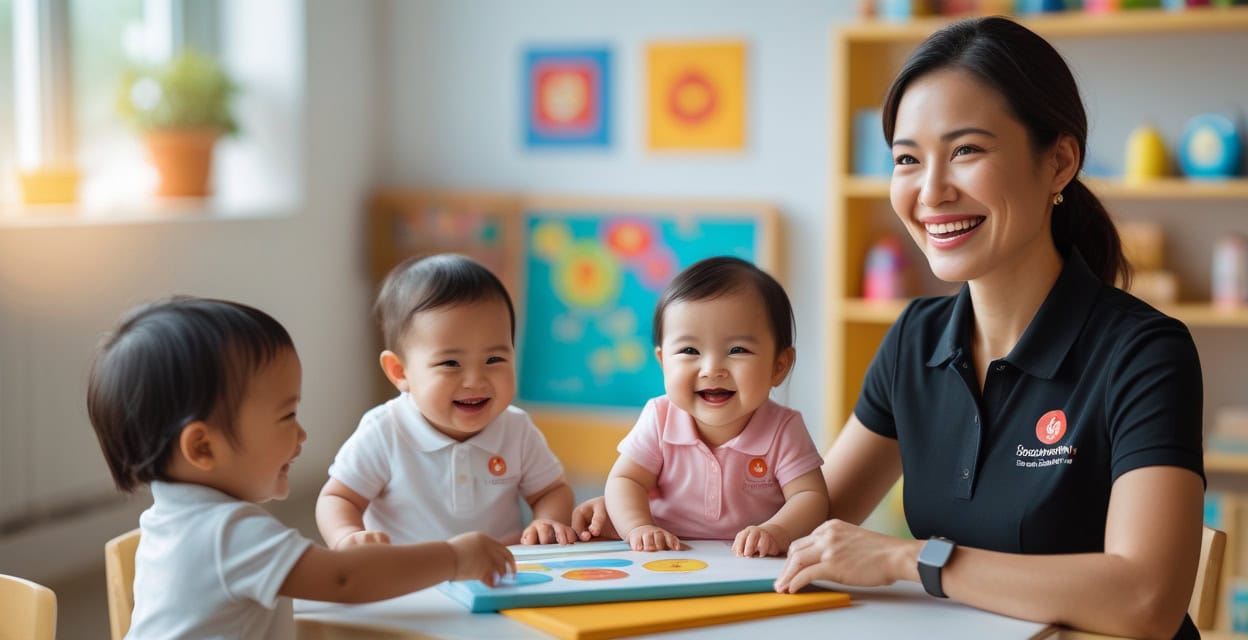
Imagine arriving to a familiar greeting, with your child welcomed by name and their comfort object respected. A caregiver reviews overnight sleep and morning mood, then co-plans the day with you in under two minutes—clear, specific, useful. Throughout the day, your child explores on safe floors, is narrated through discoveries, naps in a quiet, regulated space, and plays with peers in open-ended, low-stress activities. Meals are paced; diapers are changed hygienically; bottles are logged; and temperatures are checked as needed. You receive photos and notes that show what your child did and learned, not merely what happened. At pick-up, your child is calm, curious, and happy to go home. You might even watch a CCTV highlight clip of a tummy time moment or a first roll, smile, and share with loved ones. Near-home care becomes near-heart family life.

Training and Quality Assurance
EduNanny trains childminders to balance three core disciplines: protection (safety and hygiene), connection (attachment and communication), and progression (developmental invitation). Training modules include:
- Responsive caregiving: Reading cues, timing pauses, modelling calm behavior.
- Safe sleep and safe feeding: Evidence-based protocols, room setups, daily checks.
- Developmental observation: Noticing patterns, documenting concisely, sharing clearly.
- Positive guidance: Designing environments to prevent challenging behavior; guiding with empathy and clarity when it appears.
- Professional ethics: Confidentiality, escalation pathways, and duty of care.
Supervisors conduct routine observations and quarterly audits. Quality is a daily practice, not a single inspection moment. The system learns together so every home and centre rises in tandem.
Practical Guidance for Parents: How to Engage with EduNanny and Childminding
- Before you enroll: Ask for a formal safety plan, a sample daily schedule, and a staff roster with qualifications.
- During enrollment: Request a parent orientation that explains routines, communication channels, and how milestones are tracked.
- Ongoing engagement: Maintain short daily updates, share your child’s cues, and participate in quarterly developmental conversations.
- Partnership practices: Co-plan daily plans with educators, note any concerns in a timely manner, and seek referrals for early screening if needed.
- Home reinforcement: Mirror home routines when possible (naptime rituals, language exposure, and safe sensory play) to reinforce trust and continuity.

Conclusion: Why This Matters—and How to Get Involved
The rhythm of a nation is set by the way it greets its youngest citizens. If we make every handover humane, every routine respectful, and every play invitation purposeful, we raise children who carry Singapore’s strengths—resilience, harmony, and curiosity—without the hidden costs of hurry or fear.
Parents deserve days that are both safe and full of song. Childminders deserve a profession with esteem, training, and community support. Employers deserve childcare that meets real hours and life demands. Neighbours and policymakers deserve a city that invests in early care as a public good. EduNanny’s philosophy is to put excellence within reach, trust within sight, and joy within the ordinary minute—so infants thrive, parents breathe, and Singapore’s future enters the world already welcomed.
If this vision speaks to you, consider enrolling or partnering with us at EduNanny.com and Childminding.EduNanny.com. Let’s build the care our children will remember—in their bodies, in their confidence, and in their kindness.
The first seasons of life do not last long. Their effects do. Let us make them count—together, near home, with heart, with science, with Singaporean pride. Thank you.

Conclusion Summary and Call to Action
EduNanny reframes infant and toddler care as a civic, community-centered practice grounded in research, professional preparation, and near-home accessibility. By embracing the five pillars—pedagogy as noticing, safety as a system, development as a rhythm, happiness as a right, and care as civic duty—families can experience calmer mornings, more engaged caregiving, and a stronger foundation for their children’s lifelong growth. If you are a parent, employer, neighbour, or policymaker seeking a rigorous, compassionate, and practical approach to early childhood care in Singapore, explore EduNanny’s Centre Based and Home Base options, ask informed questions, and join a movement that treats early care as a public good and a personal trust.
Enrol or partner with EduNanny today at EduNanny.com and Childminding.EduNanny.com.
[#keyword1, #keyword2, #keyword3, #keyword4, #keyword5]