Fraud Blocker edunanny.com
edunanny-061cade8e05f513198d2849615e38fe6
April 2, 2026

Inside the Hidden World of Quality Childcare in Singapore

The Quiet of Drop-Off: What You Cannot See

There is a particular kind of quiet that settles over a parent in the car after drop-off. You have walked your child through the door, handed them to someone you have decided to trust, and then you step back into the world — and for the next eight or nine hours, you cannot see them. You cannot hear them. You cannot know, with the immediacy that a parent needs to know, what is happening where your child is.

You tell yourself it is fine. You tell yourself you chose well. You look at your phone during meetings, half-expecting a message that says everything is okay. Mostly, nothing arrives. And so you wait, and you wonder, and you do the only thing you can do: you trust the absence of bad news as evidence of a good day.

This is not an easy way to love someone. And yet millions of parents in Singapore do it every single morning.

The hours between drop-off and pickup carry a weight that no tour, no orientation pack, no certificate on the wall can fully lift. You are asked to believe in something you cannot see. To trust a process you have not witnessed. To release your child into a world that is, for those hours, as hidden from you as the other side of the moon.

This article is about what lives inside those hidden hours. Not as an answer to every anxiety — because some of that worry comes with the territory of loving someone this much — but as a map. Once you understand what a quality childcare day actually contains, once you can see the architecture beneath the surface, the invisibility shifts. It stops being an empty space filled with imagination and dread, and it starts becoming something you can hold in your mind with clarity and confidence.


What Quality Childcare Actually Looks Like

For busy parents, here are the key elements that distinguish a high-quality childcare day from basic supervision:

Element What It Looks Like in Practice
Arrival and Transition Caregivers greet children by name, with warm handoffs that acknowledge both child and parent
Intentional Rhythm Activities follow a developmental sequence — alert morning windows for learning, structured rest after
Language-Rich Interaction Caregivers use dialogic reading and open questions to stretch language naturally
Peer Learning Social moments are facilitated, not left to chance; conflicts are coached, not simply resolved
Responsive Attunement Caregivers read signals and adapt — behaviour is treated as communication
Physical Environment Deliberate sensory design; natural materials; space for movement and exploration
Outdoor and Movement Time Genuine, unhurried time outside; movement woven throughout the day
Quiet and Rest Respect for sleep needs; nap time handled with consistency and care

Read on for the full picture of what your child’s day contains — and how to recognise quality when you see it.


The Arrival: A Bridge, Not a Breach

When a child arrives at a quality childcare environment, something significant is already underway. Not the learning — not yet. The first thing that happens is a transition, and how that transition is handled tells you almost everything you need to know about the rest of the day.

The caregiver is already expecting your child. Not in a perfunctory way, not in a checklist sense, but with genuine recognition of this particular person. They know your child’s name. They know, or are learning, whether this child is a slow-morning riser who needs a few minutes of quiet before engaging, or a child who bounds in looking for the next thing immediately.

They know whether your child is comforted by a specific song, a particular spot in the room, or the presence of a familiar toy brought from home. This is not guesswork. It is the result of trained observation and genuine attunement — the caregiver’s ability to read a child’s signals and adapt in real time.

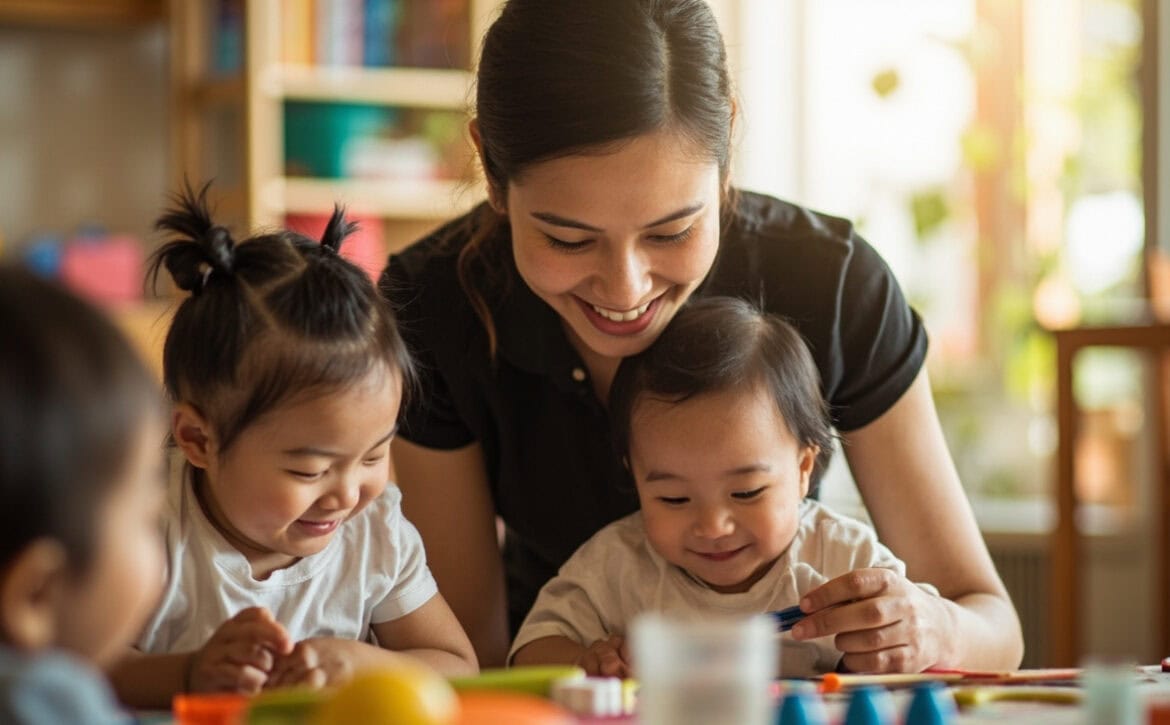
In the best childcare environments, a trained caregiver will greet your child at eye level, not looming over them, not rushing the moment. They will acknowledge the parent’s presence, offer a warm and specific handoff — something like, “Good morning, we have her favourite activities set up near the window today” — and then gently turn their attention to your child. The handoff is not abrupt. It is a bridge.

And here is what matters about that bridge: it teaches your child something foundational about the world. It teaches them that transitions are survivable. That a parent can leave and another caring person can be present. That the world has a predictable rhythm, and within that rhythm, there is safety.

For a child in the first thousand days of life, this lesson — that the world is reliable, that people return, that the morning goodbye is not an ending — is one of the most important things they will learn all day.


The Architecture of a Quality Day

Once your child has settled, the day begins to take shape. And this is where the architecture becomes visible.

A quality childcare day is not a sequence of activities dropped in at random. It is a carefully considered rhythm — a pattern that reflects how young children actually develop and what their minds and bodies need across the course of a single day. There is a reason for the order of things. There is a reason meals and naps, active play and quiet moments, group activities and individual exploration are spaced and sequenced the way they are. This is not accident. This is design.

The Morning Window: When the Mind Is Most Ready

The morning is often when children are most alert, most receptive, most ready to engage with the world in a focused way. In a quality childcare environment, this window is treated as precious. It is when caregivers introduce new concepts, facilitate meaningful peer interaction, engage children in language-rich conversation, and set up activities that challenge thinking in gentle, age-appropriate ways.

Not worksheets. Not drilling. But thoughtful provocations — a tray of natural objects to feel and sort, a sensory bin that invites exploration, a story that draws out questions, a construction activity that requires patience and collaboration.

When a caregiver sits with a small group of children and introduces a picture book, what is actually happening? The caregiver is not simply reading. They are pausing at key moments and asking open questions — “What do you think happens next?” “Why do you think the character feels that way?” “Have you ever felt like that?”

They are expanding on what children say, taking a short sentence from a two-year-old and echoing it back in a richer, more complex form. A child says, “Dog.” The caregiver responds, “Yes, a big brown dog. He looks like he’s running to the park, doesn’t he? What do you think he wants to do at the park?”

This technique — called dialogic reading — is one of the most well-documented tools in early childhood development. It takes their current level of language and gently stretches it forward. It shows children that words connect to pictures, pictures connect to feelings, and feelings connect to their own lived experience. It builds the neural pathways for comprehension, for empathy, for the ability to think in abstractions.

This is the difference between supervision and thoughtful developmental care. Supervision is keeping children safe. That is necessary, and it is the floor, not the ceiling. Thoughtful developmental care is the deliberate use of every moment — every transition, every question, every shared silence — to help a child grow. The best childcare days contain both: safety as foundation, development as purpose.

What Children Learn From Each Other

And then there are the peers. The other children in the room. This is one of the most undervalued dimensions of a quality childcare day, and it is one that parents rarely see unless they are told to look for it.

Young children learn an enormous amount from other young children. Not because they are formally taught by them, but because peers offer something that adults cannot replicate: a mirror of themselves.

A two-year-old watching another two-year-old attempt to build a tower and fail and try again is absorbing a lesson about persistence, about trial and error, about the fact that making mistakes is a normal and even productive part of learning.

A three-year-old navigating a disagreement over a toy is developing skills in negotiation, in perspective-taking, in the understanding that other people have wants and feelings that may be different from their own.

In a quality childcare environment, these peer interactions are not left to chance. Caregivers create conditions that support positive social experiences — appropriate group sizes, activities that lend themselves to collaboration, and thoughtful supervision that steps in not to solve every conflict but to coach children through them. “I see you both want the red truck. What could we do?” That is a question a skilled caregiver might pose, facilitating resolution rather than imposing it.

Movement, Rest, and the Physical Environment

Movement is not a break from learning. In quality childcare, it is woven throughout the day. Children are not expected to sit still for long stretches. They are not corralled into chairs for extended periods. They are allowed and encouraged to move, because movement and cognitive development are not separate processes in a young child’s brain. They are the same process.

Outdoor time, in particular, is non-negotiable in a well-designed childcare day. Not a token five minutes in a fenced yard, but genuine, unhurried time in the open air — in Singapore’s gardens, in green spaces where children can run and climb and feel the texture of grass or sand beneath their feet.

Outdoor play is where the body tests its limits, where gross motor skills are refined, where the immune system is strengthened, where sunlight regulates sleep and mood, where the sheer scale of the sky reminds a small person that the world is large and full of wonder.

The physical environment of a quality childcare setting is also doing work. The colours on the walls are chosen deliberately — warm, calming tones in rest areas, bright but not overwhelming tones in active zones. The materials available to children are organized with intention: open shelving that invites choice, natural objects that invite sensory exploration, a variety of textures and weights and sizes that invite curiosity.

The space is clean, but it is not sterile. It feels like a place where things can happen. Where a child can make marks, spill things, build and knock down and build again. A room with natural materials, appropriate challenge, and space to move tells a child that their curiosity is valid, that their body is capable, that the world is interesting and worth investigating.

And then, woven between the active stretches, there are the quiet moments. The times when the room softens. When the lights dim. When a caregiver reads a story in a low, unhurried voice, and the children settle into the particular stillness that comes from being genuinely engaged, genuinely held by language and imagination.

Rest is not the absence of learning. It is a part of it. Sleep restores the brain. It consolidates the learning that has happened during waking hours. It regulates the nervous system. A quality childcare day respects the need for rest — it builds nap time into the rhythm not as downtime but as an essential biological and developmental requirement. And it handles rest with care: a darkened room, a consistent routine, a familiar song or story, the physical presence of a caregiver who stays nearby as children drift off.


Attunement: Reading the Child Behind the Behaviour

This is where we arrive at the heart of what quality care actually looks like in practice: attunement. The caregiver’s ability to read a child, respond to what they need, and adjust in real time.

Attunement is not a soft concept. It is a set of observable, learnable skills that distinguish trained caregivers from those who are merely well-intentioned.

An attuned caregiver notices when a child’s play shifts from engaged to frantic and reads that as a signal of overwhelm — not bad behaviour, not defiance, but a nervous system that needs support.

An attuned caregiver notices when a child who usually joins group activities hangs back, and instead of forcing participation, quietly sits near them and invites their presence without pressure.

This is what responsive caregiving looks like. It is the caregiver who does not follow the plan when the plan is no longer what the child needs. It is the adult in the room who understands that behaviour is communication, and who has the training to listen.

The Small Upsets: Where Connection Happens

When a child has a small upset — a scraped knee, a conflict over a toy, a moment of frustration they cannot yet name — an attuned caregiver does not rush to fix it. They slow down. They get on the child’s level. They name what they observe:

“You look sad. The block tower fell and that made you feel frustrated.”

Naming the emotion is not coddling. It is the beginning of emotional literacy. It teaches children that feelings are information, that they are safe to feel, and that a trusted adult can help them navigate the intensity of the moment.

This is one of the most profound gifts a caregiver can give a child, and it happens not in dramatic moments but in dozens of small, ordinary ones throughout every single day.

For Infants: The Beginning of Social Awareness

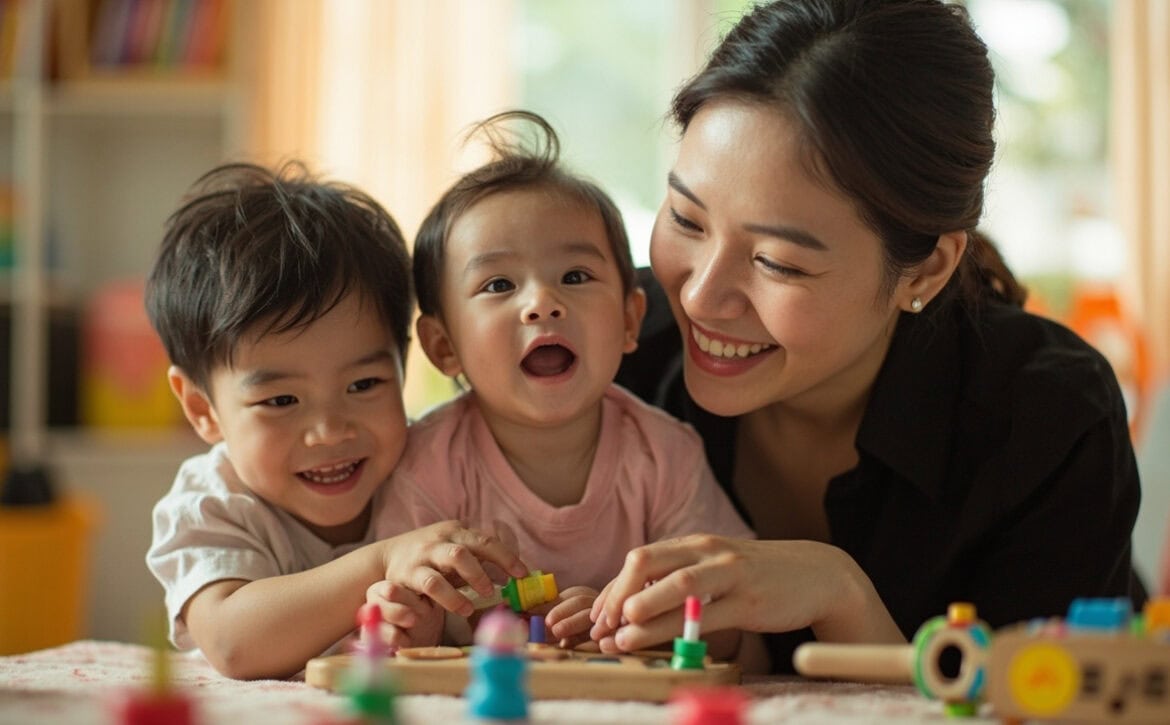
For the youngest children in care, attunement looks different in its expressions, but it is just as essential. Peer interaction for infants is not about sharing toys or resolving conflict. It is about proximity. It is about the infant who watches another infant from across the mat and then mimics a sound, or reaches out, or simply takes note.

The beginning of social awareness. The first recognition that other small humans exist and behave in the world.

In a high-quality infant room, the caregiver ratio supports this. With one caregiver for every three infants, there is space to notice these small, sacred moments — to narrate them, to honour them, to give them room to breathe. That ratio — one to three for infants — is not an administrative detail. It is a statement of values. It means that in the room where your child is learning to trust the world, there are enough attentive eyes, enough attuned voices, enough responsive hands to go around.


Reading the Evidence at Pickup

All of this — the arrival, the learning, the peer interaction, the attunement, the movement, the rest — is what fills the hours you cannot see. It is not chaos with a friendly face on it. It is not a holding pattern. It is a living, responsive, intentional environment designed around the developmental needs of young children.

But how do you know? How do you, as a parent, read the evidence of what happened during the hours you were not there?

You read it at pickup. Not in grand gestures. Not in fireworks. You read it in the small, specific ways your child returns to you:

  • In the way they move through the door — confidently, not dragging or reluctant
  • In the fact that they look up and recognise their caregiver as a familiar, safe person — not as a stranger they have merely tolerated for the day
  • In the language they bring home — new words, new questions, observations that could only have come from genuine engagement: “Today we saw a caterpillar.” “The teacher said the sky is blue because of something called scattering.” “My friend shared his snack with me.”
  • In their mood. A child who has spent the day in a responsive, attuned environment tends to come home settled — not depleted, not overstimulated, not acting out from exhaustion and dysregulation, but in a state that suggests their needs were met in proportion throughout the day

A child who is consistently coming home melting down, who resists going to childcare, who seems consistently unhappy — that is also evidence. It is evidence that something in the environment is not meeting that child’s needs. And a quality childcare provider will welcome that conversation. They will ask, and listen, and adjust.

Communication That Keeps You Connected

You also read it in the relationship you are able to build with your child’s caregivers over time. In the daily updates — and here, the approach matters.

A quality childcare provider does not leave parents guessing. They communicate. They tell you what your child ate, how they slept, what they enjoyed, what challenged them. In the best environments, this is not a generic note copied and pasted. It is a specific observation about your specific child.

In environments where technology supports transparency, there may be additional tools — real-time updates, photographs, even visual confirmation systems that let you feel, even from a distance, that you are connected to your child’s day.


Why These Hours Matter: The First Thousand Days

There is something worth sitting with here. Something about the deeper purpose of all of this.

The early years — what neuroscientists call the first thousand days, from conception to roughly age three — are the years in which the architecture of the human brain is most rapidly and most durably formed. The neural connections that will underpin a child’s capacity for learning, for emotional regulation, for relationship, for resilience, for curiosity — these are not waiting passively to be activated later. They are being built now.

Every interaction. Every responsive moment. Every time a caregiver meets a child’s need with warmth and accuracy, a neural pathway is strengthened. And every time a child’s signals are ignored, dismissed, or misinterpreted, another pathway is left unused or, worse, replaced by pathways that connect stress and threat to the environment.

This is not an argument for perfection. Parents are not perfect. Caregivers are not perfect. No environment can be without flaw. But it is an argument for intention. For the recognition that the hours in which your child is in care are not filler hours. They are developmental hours. They are hours that are, in the most literal sense, shaping the person your child will become.

And so the question is not merely, “Is my child safe?” That is the starting point, not the endpoint. The question is: Is my child in an environment that sees them? That responds to them? That is designed around their development, not just around logistics and supervision?

Is the person caring for my child trained to notice what I would notice if I were there — and to act on it with skill and warmth?


Where Quality Care Becomes Possible: EduNanny by BUTLER

And this is where EduNanny by BUTLER enters the picture — not as a destination but as an answer to something real. Because EduNanny was built with the full picture of the parent experience in mind. Not just what happens inside the childcare day, but what the parent needs to feel genuinely supported in the decision to entrust their child to someone else’s care.

EduNanny operates within the ECDA Childminding Pilot, which means it is part of a government-recognised framework designed to expand quality childcare options for Singapore families. This matters because it brings oversight, structure, and accountability to an area where the need is enormous and the options have not always matched the demand.

Whether families choose the home-based pathway — where a trained childminder cares for a small group of children in a home setting, offering intimacy and individualised attention — or the community or centre-based pathway, which provides structured group environments with the benefit of peer learning, EduNanny ensures that the standards inside those doors are consistent with what we have been describing today.

The infant-to-caregiver ratio of up to one to three means your youngest child is not one of fifteen. They are one of three. Their cries are heard. Their signals are read. Their developmental trajectory is tracked, not just monitored for safety but actively supported through responsive caregiving.

The fee structures within the pilot are designed with affordability in mind, understanding that quality care should not be the exclusive privilege of families with significant financial resources. And the practical supports — the ability to use the Child Development Account and Baby Bonus funds — remove real administrative friction from a process that already asks families to navigate a great deal of emotional and logistical complexity.

Monday to Friday care blocks give working parents the consistent, reliable rhythm they need to plan their own professional and family lives with confidence. And the communication infrastructure — including tools like the Thomas AI Chatbot, which serves as a real-time support resource for parents navigating questions about their child’s care, development, and wellbeing — means that the partnership between family and childcare provider does not pause when you walk out the door.

All of these details — the ratio, the pilot framework, the financial accessibility, the communication tools — are not selling points. They are the conditions that make quality care possible. They are what allows the day we have been describing to actually happen, consistently, day after day, for every child enrolled.


What to Look For: A Parent’s Checklist

If you are currently researching childcare options in Singapore, here are the questions worth asking — and the things worth observing:

  • At arrival: Does the caregiver greet your child by name? Do they get down to eye level? Do they acknowledge you and offer a warm transition?
  • In conversation: Can they describe your child’s temperament, preferences, and patterns? Or do they give generic, scripted answers?
  • During a visit: Do the children appear engaged and settled, not just contained? Is there a rhythm to the day you can observe?
  • In the environment: Are there natural materials? Open shelving? Space for movement? Is it clean but not sterile?
  • About ratios: What is the caregiver-to-child ratio, especially for infants? This is not a detail — it determines whether your child can be truly seen.
  • At pickup: What kind of update do you receive? Is it specific to your child, or a template?
  • When concerns arise: How does the caregiver or provider respond when you raise an issue? Do they listen, or deflect?

Trusting the Invisible Day

We began with a parent’s experience of the invisible day. The quiet that settles over you after drop-off. The trust you extend into a space you cannot see. The hope that you carry, alongside the worry, that your child is okay.

Here is what we want you to hold onto, in those quiet hours: the day is not invisible because it is empty. The day is invisible because you are not in it.

But the day is full. It is full of small, significant moments — moments of learning and laughter, moments of frustration and resolution, moments of connection between your child and a caregiver who has been trained to meet them where they are.

It is full of children discovering what their bodies can do, what their voices can say, what other children are like, what it feels like to be part of a group. It is full of the particular, irreplaceable work of early development, happening quietly, consistently, and with genuine purpose.

What we are asking you to trust is not blind faith. We are asking you to trust the evidence of an intentional, well-designed day. We are asking you to trust the training of the caregivers, the structure of the environment, the ratio that ensures your child is seen, the communication that keeps you connected, and the philosophy that sits at the centre of it all — the belief that every child in those hours deserves to be held in an environment that is as warm, as thoughtful, and as developmentally rich as the one you would build for them yourself.

EduNanny by BUTLER was built for this — not as a service alone, but as a conviction that Singapore’s children deserve quality care, that Singapore’s families deserve transparency and trust, and that the hours between drop-off and pickup deserve to be seen, understood, and honoured for what they are: the hours in which your child’s future is being quietly, purposefully built.

You chose this. You looked at your options, you weighed the evidence, and you made a decision out of love and a desire to give your child the best start you possibly can.

That decision was an act of courage. And the invisible day you worried about this morning? It was not empty. It was a world — carefully constructed, deeply intentional, and full of people who were, in that moment, giving your child exactly what you would have given them if you were there.

You can see it at pickup. Look for it. And trust what you find.

Explore how EduNanny by BUTLER brings this quality childcare experience to life for Singapore families. Speak with our team to learn more about the ECDA Childminding Pilot and find the right care arrangement for your child.

#qualitychildcare #singaporechildminding #infantcareSG #earlychildhooddevelopment #ECDAChildmindingPilot


edunanny-061ca9f4396dd88a2ed8543cb980c30c
April 2, 2026

What Actually Transforms in Your Baby’s First Year of Childcare

The First Year in Childcare: What Actually Changes Inside Your Child

This is the story of your child’s first year in childcare. Not the story of your peace of mind, though that matters. Not the story of whether you made the right choice, though we understand why that question lives in you. This is the story of what actually changes inside your child, month by month, and what you might begin to recognize if you know what to look for.

Quick Summary: Your Child’s First Year in Childcare

  • Months 1–3: Building an internal map of safety—learning that leaving and returning follow a reliable pattern
  • Months 4–5: Social curiosity awakening—noticing other children and understanding they are not alone in the world
  • Month 6: Early emotional regulation emerging—the capacity to manage feelings rather than being overwhelmed by them
  • Months 7–9: Language precursors blooming; confidence shifting; a new sense of competence in the world outside home
  • Months 10–11: Peer awareness developing; sense of belonging to a community beyond caregivers
  • Month 12 and beyond: A child fundamentally transformed—one who waves goodbye with enthusiasm and points to childcare as the place where their friends are

Building the Foundation: Months One Through Three

In the earliest weeks, your child is doing something profound and invisible: they are building an internal map of safety. Research tells us that infants and young children are biologically wired to assess whether their environment is trustworthy, whether the adults present will respond when they call, whether the world outside home is a place where their needs will be heard and met.

They cannot articulate this. They do not have words for it. But their nervous systems are taking notes.

When you walk through the door of a childcare setting for the first time with your infant, your child is watching everything. They are watching how you speak to the caregiver, whether your shoulders soften or tighten, whether you make eye contact with the person who will hold them when you leave.

In those moments, your child is not just experiencing separation. They are making a judgment about whether this place is safe enough to return to. And then they return, again and again, and each return adds data to that internal map.

By the second and third months, something shifts that many parents describe as a turning point. The morning goodbye, which may have been difficult, begins to transform. There is a trust that has been earned not through your words but through repeated experience.

They have learned that the caregiver responds when they are hungry. They have learned that someone wipes their face after a spill. They have learned that when they cry, someone comes. This is the foundation upon which everything else will be built.

Social Curiosity and Emotional Growth: Months Four Through Nine

As your child moves into the fourth and fifth months, you may notice a new quality in the way they engage with the world. There is curiosity emerging now—not just in response to you, but in relation to the space itself. The other children moving through the room. The textures of toys they are not used to.

This is social curiosity awakening, and it is one of the most meaningful developmental milestones of the first year. Your child is beginning to understand that they are not alone in the world. There are other small beings like them, with their own sounds and movements and needs.

By six months, many children in quality childcare environments have begun to develop emotional regulation—the capacity to manage their own emotional states rather than being completely overwhelmed by them. Your child is learning this in relationship with caregivers and peers. They are watching how the caregiver calms a crying child. They are beginning to internalize that strong feelings pass, that comfort is available.

Between months seven and nine, you will notice language emerging—not just the first words, which may come later, but the precursors to language. The gestures. The meaningful babbling. The way your child points at things and looks to see if you noticed.

You may notice, one day, that your child is saying a word you have never taught them directly—perhaps the name of a toy they love at childcare, or a song they have learned in circle time. This is the evidence of an invisible process. Your child’s mind has been working while you were apart.

Something else shifts during this period: your child’s growing sense of competence. The child who once seemed fragile and dependent at pickup now has a different quality in their body. They might move more confidently toward the toys. They might point to the caregiver with a kind of easy recognition, as if to say, “This is my person here. I know this place.”

This is confidence. It is the internal experience of a child who has learned, through repeated success, that they are capable of navigating the world outside home. This does not mean they do not need you. It means they are beginning to understand that love and security can exist in more than one place.

Belonging and Expansion: Months Ten Through Twelve and Beyond

By the tenth and eleventh months, something deeper often emerges: a sense of belonging that extends beyond a single caregiver to a community. Your child may begin to notice the other children in ways that feel more intentional. They might reach for a toy that another child is holding, not with frustration but with curiosity about the social dynamic.

They may show preferences—running toward a particular friend, or protesting when a familiar child is not present. These are the early signs of peer awareness, and they matter more than we sometimes realize. Your child is learning that they are part of something larger than themselves.

And then there is the twelfth month, and beyond. This is when many parents describe a child who seems fundamentally transformed from the one they first brought through the door. The child who now runs to the caregiver without looking back. The child who waves goodbye with genuine enthusiasm. The child who, when asked where their friends are, points to the childcare building.

This is not your child forgetting you. This is your child expanding. And the expansion does not diminish your place in their heart. It confirms that you have given them something strong enough to build upon.

Month-by-Month Overview

Phase What Is Happening Inside Your Child What You Might Notice
Months 1–3 Building internal map of safety; learning trust through consistent caregiver response Easier settling at pickup; more alert and curious upon arrival; beginning to feel that leaving and returning follow a pattern
Months 4–5 Social curiosity awakening; noticing other children as separate beings with their own needs Greater interest in the childcare environment; watching other children; responding to peers’ sounds and movements
Month 6 Early emotional regulation; learning that strong feelings pass and comfort is available Better recovery from minor upsets; beginning to self-soothe; watching caregivers calm others
Months 7–9 Language precursors blooming; growing sense of competence and confidence New gestures and babbling; new words (especially from childcare); more confident movement toward toys and people
Months 10–11 Peer awareness developing; sense of belonging to a community Showing preferences for certain friends; noticing when familiar children are absent; more intentional social engagement
Month 12+ Expanded sense of self; confident navigation of multiple environments Waving goodbye enthusiastically; mentioning friends by name; pointing to childcare as “their” place

Reading Your Child’s Evening Cues

Here is what we want you to carry with you, because it is perhaps the most important thing we can offer. You cannot see most of this. You will not be there for the small victories, the moments of breakthrough, the instances when your child’s understanding of the world deepens in ways that will shape them for years.

This is the nature of the invisible distance. And it can feel unbearable, if you let it. So let us offer you something instead—a new way of reading the evidence that is available to you.

The most important data about your child’s internal experience does not come from the childcare setting itself. It comes from the hours after pickup. It comes from the way your child settles in the evening, the quality of their play, the ease or difficulty of their transitions.

When your child comes home and is genuinely glad to see you—not just because they are tired or hungry, but because your presence brings them joy—that is meaningful data. When they fall asleep relatively easily at night, their body still carrying the residue of a day that felt safe enough—that is meaningful data. When they speak about the caregiver with warmth, or mention a friend by name, or hum a song you have never taught them—that is meaningful data.

These evening cues are not trivial. They are your window into the world you cannot see.


What Quality Childcare Actually Looks Like

We want to speak directly about what makes this kind of internal development possible, because not all childcare settings are created equal in this regard, and you deserve to understand the difference.

The kind of deep, healthy development we have been describing does not happen in crowded rooms with overwhelmed caregivers. It does not happen when children are simply supervised but not truly seen.

It happens when the ratio of adults to children is small enough that each child can be known. It happens when caregivers have the time and capacity to notice the small moments—the way a child’s brow furrows before a meltdown, the way another child’s face lights up when they master a new skill. It happens when consistency is prioritized, so that the child knows who will be there to meet them, day after day.

Quality is the ratio of attention your child receives. Quality is the trust your child develops over months of consistent, responsive care. Quality is the difference between a child who merely survives childcare and a child who thrives inside it.

Finding the Right Fit for Your Family

Whether through home-based childminding or community-based pathways, the structure should be designed around the same principle: each child deserves to be known, each child deserves a caregiver who has the capacity to notice them.

In a home-based childminding setting, your child receives care in a smaller, more predictable environment. The caregiver knows your child’s rhythms, their preferences, the cues that signal hunger or fatigue or the need for connection. This continuity matters deeply in the first year, when trust is being built one consistent experience at a time.

In community-based pathways, your child benefits from rich peer interaction while still receiving the individual attention that young children need. The ratio of caregivers to children remains low enough that each child can be seen, heard, and responded to throughout the day.


Questions to Ask When Choosing Infant Care in Singapore

If you are in the process of researching childcare options, here are some questions worth asking—not as checklist items, but as windows into what your child’s experience will actually be:

  • What is the ratio of caregivers to children? Smaller ratios mean more individual attention, more responsiveness, more capacity to notice and respond to your child’s cues.
  • How consistent is the caregiver arrangement? Will your child see the same faces day after day, or will different people rotate through? Consistency is foundational to the trust your child is building.
  • How do caregivers communicate with parents? Is there a system for daily updates? Can you ask questions and receive genuine answers? Is there openness about both the good moments and the challenging ones?
  • What does a typical day look like? Are children given space for free play and exploration, or is the schedule rigid? Young children learn through self-directed interaction as much as through structured activities.
  • How do caregivers respond to distress? When your child is upset, what happens? You want a setting where distress is met with comfort, not dismissal.
  • What training do caregivers have? Not just certifications, but an understanding of early child development and a philosophy of care that aligns with your values.

You also need to feel that the door between you and your child’s day is not completely closed. When you can ask how your child’s day went and receive a genuine answer, when you can hear about the small moment that mattered, when the caregiver knows your child well enough to notice what others might miss—this is what we mean when we talk about quality.


The Bridge Between Worlds

We want to close by returning to where we began: the invisible distance.

You will never fully close it. You were never meant to. The distance between your experience and your child’s experience is the space in which they grow. It is the distance that allows them to become a person in their own right—not an extension of you, but a full human being with their own internal world, their own relationships, their own sense of what it means to be safe and curious and capable.

But the distance need not be a source of anxiety. It can be a source of trust. Trust in your child’s capacity to navigate this world. Trust in the caregivers you have chosen to partner with you. Trust in the process of development, which unfolds over months and years, not in single moments or single days.

Your child is not simply waiting for you. They are becoming someone in your absence, and that someone will come home to you at the end of each day, carrying new pieces of themselves that they will offer to you like small gifts. A new word. A new gesture. A new way of looking at the world.

This is what childcare makes possible. Not just supervision. Not just safety. But the quiet, profound work of a child learning to be human in a world that is larger than home.

And you, in your uncertainty and your love and your persistent showing up, are part of that work. Every pickup. Every evening. Every moment you offer your attention to the cues your child is sending you. You are building the bridge between the world they are learning to inhabit and the love that will always be their home base.

That is not a small thing. That is everything.


Ready to Explore Your Options?

If you are researching infant care or childminding in Singapore and want to learn more about an approach built around small ratios, consistent caregivers, and genuine transparency, we invite you to explore what EduNanny has to offer.

EduNanny by BUTLER is an ECDA-approved childminding pilot committed to thoughtful, development-oriented care. You can learn more about our approach or get in touch to discuss what might be right for your family.

Your child’s internal world matters. And so does yours.

edunanny-061ca68f81188dadf7e322bdfc3fa556
April 2, 2026

From Doubt to Discernment: The Singapore Parent’s Childcare Choice

The Morning That Every Singapore Parent Knows

There is a particular kind of morning that every Singapore parent knows. You sit with your phone, your laptop, or a notebook filled with half-formed comparisons, trying to answer one question: where should my child go? It is a simple question. It is also, somehow, an impossible one.

You have toured centres. You have read reviews. You have asked friends, colleagues, and that one friend-of-a-friend who seems to have it all figured out. You have spreadsheets. You have pros and cons lists. And yet, when someone asks if you have made a decision, the answer is still no.

Not because you have not tried. Because you care too much to settle. Because every option feels like it carries a piece of your child’s future, and that is not a weight you are willing to lift carelessly.

If this is where you are right now, you are not lost. You are not indecisive. You are doing exactly what a deeply attentive parent does when the stakes feel genuinely high. The fact that this decision keeps you up at night is not evidence of your uncertainty. It is evidence of your love.


Why Research Alone Does Not Lead to Clarity

Singapore parents approach decisions like this with a rigour that is both admirable and, frankly, exhausting. We read. We compare. We research infant-to-caregiver ratios, pedagogical frameworks, accreditations, centre philosophies. We want to know everything.

There is a quiet, persistent belief underneath all of that research: that if we just gather enough information, the right answer will emerge. That the perfect amount of data will produce the perfect decision.

But here is what we rarely acknowledge: more information does not create more clarity. It creates more noise.

There is a point in every significant decision—and certainly in the decision of who will care for your infant—where additional research stops illuminating and starts overwhelming. You reach a place where every centre looks slightly different in ways that do not feel meaningfully distinguishable. Where the five-star reviews feel suspicious and the critical reviews feel like they could have been written about any childcare setting in the world. Where you are not gathering evidence anymore. You are gathering anxiety in the disguise of diligence.

This is not a failure of intelligence. It is the nature of high-stakes decision-making in a complex, information-rich world. Psychologists call it analysis paralysis. Parents call it Tuesday afternoon with a search engine open and a cup of tea that has gone cold.

Doubt vs. Discernment

The decision about who will care for your infant is not primarily an intellectual puzzle. It is an act of trust. That yes does not come from a spreadsheet. It comes from something more interior—a feeling that is quieter than confidence and more grounded than certainty.

Here is the distinction that can change how you see this whole experience:

  • Doubt is the endless loop that keeps you searching. It asks: what if there is something better? What if I am missing a crucial piece of information? It is restless. It keeps moving because staying still feels dangerous.
  • Discernment is quiet confidence built through genuine research and honest reflection. It says: I have seen enough. I have listened carefully. I have weighed what matters most. And now I am ready to trust my judgment. It is still. It has done its work, and it can rest.

Most parents in the research phase believe they are experiencing doubt. Many are actually developing discernment but cannot tell the difference, because the feeling is unfamiliar and uncomfortable in a culture that tells us we should always be more certain, more prepared, more informed.

We mistake the discomfort of discernment for the restlessness of doubt, and so we keep searching when we have already found what we need. The shift happens when you stop waiting for certainty to arrive and start trusting the judgment you have already built. When you recognize that your instinct, informed by careful research and shaped by love, is actually a reliable guide. When you give yourself permission to choose not because you have found all the answers, but because you have found enough.


Singapore’s Childcare Landscape: Why Context Shapes the Decision

The complexity of choosing childcare in Singapore deserves to be understood honestly, because it directly contributes to the overwhelm parents feel.

We have a strong network of early childhood education centres, each with its own philosophy, curriculum, and culture. We have home-based care, which has been thoughtfully developed through the ECDA Childminding Pilot, offering families a different pathway that may suit some children and circumstances more naturally. We have regulatory frameworks—ECDA, quality frameworks—that exist to protect our children but can add another layer of complexity to the decision.

And on top of all of that, there is the financial reality. Singapore is an expensive city to raise a family in, and the cost of quality childcare is a legitimate consideration that parents hold alongside everything else.

When you are trying to choose the right setting for your infant, you are not choosing in a vacuum. You are choosing with your heart and your budget and your calendar and your identity as a parent, all at the same time. That is not easy. It is not supposed to be easy.

But here is what I want you to hear: the complexity of the landscape does not mean the right choice is impossible to find. It means the right choice is personal. The question is not where is the objectively best childcare in Singapore, because that question has no answer. The question is: where is the right fit for this child, this family, this season of life?

And that question, unlike the first one, can actually be answered. Not with perfect certainty, but with quiet conviction.


What Quality Infant Care Actually Looks Like

Before you can move toward a decision, it helps to know what you are actually looking for. In the sea of options, what separates quality care from adequate care? Here are the indicators that matter most when you tour a centre or meet a childminder:

Caregiver Consistency

Your infant does not form attachments to institutions. They form attachments to people. Consistent, familiar caregivers mean your child can build the secure foundation that neuroscience tells us shapes healthy development. Ask: will my child see the same faces most days?

Attention Ratios

In infant care, ratios are not just numbers. They determine whether every cry is noticed, whether every milestone is tracked, whether your child’s individual needs can be met. Smaller ratios mean more individual presence in your child’s day.

Communication Transparency

If you have ever dropped your infant at a centre and spent the rest of the day wondering how they are, whether they are safe, whether the transition was hard—you know that this wondering is real and it is heavy. Quality care providers understand this and build communication into their daily operations.

Environment and Safety

Infant spaces should be warm, clean, and designed for small bodies and curious minds. Safety standards matter, but so does the feeling of the space. Does it feel like a place where your child could thrive?

Caregiver Respect and Training

The role of the childminder or infant care educator deserves to be understood with dignity. It is not a subordinate position. It is one of the most consequential roles in a child’s early life, and it requires skill, patience, emotional intelligence, and genuine care. Ask about training, about ongoing development, about how caregivers are supported.


How EduNanny Singapore Approaches the Decision

Now let me speak about what EduNanny Singapore does, because philosophy alone does not help you make a decision. You need a real, grounded answer that you can act on. I want to describe this in a way that feels honest rather than promotional, because the last thing you need right now is another overpromised solution.

A Government-Supported Framework

EduNanny is part of the ECDA Childminding Pilot, which means it operates within a government-supported framework designed to expand the range of quality childcare options available to Singapore families. This is not a small thing. It means there is an infrastructure of accountability, of training standards, of oversight that exists not to burden the service but to protect the children in it.

Pathways That Fit Real Families

EduNanny offers both home-based and centre-based pathways, because families are not all the same. Some children thrive in the intimacy of a home environment, with smaller groups, familiar routines, and individualised attention. Some families prefer the community and structure of a centre setting. Neither is inherently superior. The right choice depends on your child, your family rhythm, and what you sense your child needs in this season.

Ratios That Matter

Where EduNanny stands apart is in the care ratios it maintains. With up to one to three infants in its infant care settings, the level of individual attention your child receives is simply not comparable to larger group environments. When an infant is in a space with three caregivers for every three infants, every cry is noticed. Every milestone is tracked. Every feeding, every nap, every moment of wonder is held with presence. This is a structural commitment that shapes the entire quality of the experience.

Accessibility and Affordability

Within the pilot fee structures, EduNanny has worked to make quality care accessible to families across Singapore, not only those at certain income levels. When you combine this with the usability of CDA funds and Baby Bonus contributions, quality infant care is not as far out of reach as it might first appear.

Communication You Can Trust

EduNanny has built transparency into its operations, with communication measures and, where deployed, CCTV access that allows parents to feel connected to their child’s day. This is not about surveillance. It is about trust—your trust in them, and their commitment to being worthy of it.

Addressing Your Concerns

Let me speak directly to some of the worries that live underneath the research paralysis. These are real concerns, and they deserve honest answers.

“What if I choose wrong and something happens to my child?”
No choice eliminates all risk. This is true of everything in parenting, from the car seat you choose to the route you walk to school. What matters is not eliminating risk but choosing a setting where your child will be safe, nurtured, and seen. That choice exists. It may not be perfect, but it is real.

“How do I know if the caregivers will really care about my child?”
The caregiver is not just a service provider. They are, for the hours your child is with them, a primary attachment figure. They are someone your infant will look to for comfort, for stimulation, for the consistent, warm presence that builds the architecture of the developing brain. When EduNanny selects and supports its caregivers, it is building a relationship on your behalf—a relationship that your infant will experience as real, as safe, and as nurturing as the one they have with you.

“I have not seen enough centres yet. What if I am missing something better?”
You have seen enough. The question is whether you will trust what you have seen. The right question is not is there something better out there? but rather is this setting good enough for my child, in this season of our lives? Good enough, chosen with commitment and trust, is more powerful than perfect, chosen with doubt.

“What if I cannot afford quality care?”
The financial reality is real, and EduNanny has built its fee structures with accessibility in mind. CDA funds and Baby Bonus contributions can be used, which meaningfully reduces the burden. Quality infant care should not be a privilege reserved for high-income families. The pilot framework exists to make this possible for more families.


Moving From Research to Conviction: A Practical Path

If you are ready to move from overwhelmed research to quiet conviction, here is a path forward that I hope helps:

  1. Acknowledge what you have done. Before you make any new decision, pause and recognise how much work you have already done. The tours, the reviews, the conversations, the late-night research sessions. You have not been idle. You have been building the foundation for a decision.
  2. Name your non-negotiables. What truly matters to you? Write down three things that are essential in your childcare choice. These might be proximity to home or work, specific caregiver qualifications, a particular philosophy of care, or a ratio that feels safe. Narrowing your focus to non-negotiables cuts through the noise.
  3. Look for the feeling, not just the facts. During your next centre visit, pay attention to how you feel. Do you feel welcomed? Do the caregivers seem warm and present? Does the space feel alive and safe? Your emotional response is data. Trust it.
  4. Recognise the shift from doubt to discernment. When you feel the restless urge to keep searching, pause and ask yourself: am I looking for new information, or am I looking for reassurance? If you have genuinely seen enough options, the restlessness may be discernment asking to be trusted.
  5. Give yourself permission to choose. The research has served its purpose. It has informed you. It has sharpened your instincts. It has shown you what matters most. Now it is time to trust what you know. You do not need more information. You need permission to decide.

The Decision You Have Been Working Toward

You are sitting with your phone, or your notebook, or the weight of a decision you have not quite made yet. And I want you to know that this moment—this feeling of searching, of caring so much that it hurts, of wanting to get it right—is not an obstacle to the decision. It is part of the decision. It is evidence that you are the kind of parent your child needs you to be.

Someone who takes this seriously. Someone who does not settle. Someone who is willing to sit in the discomfort of not knowing until the knowing is real.

But I also want to tell you that at some point, the searching has to end. Not because you have found the perfect answer. Because you have found an answer that is good, that is grounded, that you can commit to with your whole heart.

And that commitment—that quiet, certain yes—is itself a gift to your child. It tells them that their parent can move through uncertainty. That their parent can choose, and stand by that choice, and trust the people who are helping to care for them.

That is not a small thing. That is modelling resilience. That is showing your child what it looks like to live with conviction rather than constant hesitation.

EduNanny Singapore exists for parents like you—not parents who have everything figured out, but parents who are in the middle of figuring it out and who want a partner who understands that journey. We know that choosing childcare is not just a logistical decision. It is an emotional one. It is a statement about what you believe your child deserves and what you believe you are capable of providing.

And we believe you are capable of providing a great deal.

What EduNanny offers, within the framework of the ECDA Childminding Pilot, is a pathway that is grounded in real care, real ratios, real communication, and real accessibility. It is a pathway that respects your intelligence as a parent, that does not require you to compromise between quality and affordability, and that sees your child as the singular, unrepeatable person they are.

If you are ready to move from research to conviction—not because the searching has failed, but because it has done its work—we would welcome the conversation. We would welcome the chance to show you what we do, to answer your questions honestly, and to be the kind of presence in your family’s life that you can trust with something irreplaceable.

This is the decision you have been working toward. You have already done the hardest part. You loved your child enough to take it this seriously.

Now let yourself choose. Let yourself trust. And let yourself rest in the knowledge that you are exactly the parent your child needs.

EduNanny Singapore is here. We are ready when you are.


EduNanny Singapore is a development-oriented childcare and childminding service operating within the ECDA Childminding Pilot. We support families across Singapore with attentive, quality infant care that honours the trust you are placing in us. Get in touch to learn more, or visit our About Us page to understand our approach.

edunanny-061ca35cff17de93d5adaf2d9a218977
April 2, 2026

Quality Childcare Helps You Show Up Fully for Your Child

The Quiet Fear Every Working Parent in Singapore Carries

There is a quiet fear that lives in the chest of nearly every working parent in Singapore. It does not announce itself loudly. It surfaces in the smallest moments—a glance at a photo on your phone during a meeting, a pause before you pick up your child from care, a sudden tightness when a colleague mentions being home for dinner again.

It is the fear that by choosing to work, by choosing the career you have built, by choosing the financial stability your family needs, you are quietly choosing to matter less to your own child.

If you have ever felt this, I want to speak directly to you today. Because this fear deserves to be acknowledged. And because it is not true.


What the Science Actually Tells Us About Attachment and Hours

Before we go further, here is what decades of attachment and developmental psychology research have consistently shown:

  • The quantity of hours you spend with your child matters far less than the quality of presence you bring to those hours.
  • Quality childcare does not take time away from your relationship with your child. It gives time back to it.
  • What children need is emotional presence—not physical presence alone.
  • When parents are restored rather than depleted, they become the emotionally available, attuned caregivers their children need.

Attachment research—from John Bowlby’s foundational work to contemporary longitudinal studies—has consistently shown that what predicts a child’s security of attachment is not the number of hours spent with a caregiver but the quality of responsiveness and attunement within those hours.

Consider what this means in practice:

  • A child can develop a secure attachment to a parent who works full time if the parent, when present, is emotionally available.
  • A child can develop attachment difficulties with a parent who is physically present all day but emotionally unresponsive.

This is not a platitude. It is rooted in neurochemistry, attachment science, and the lived experience of families who have walked through this same door of fear and come out the other side whole.


The Parent Depletion Cycle: Why Hours Alone Are Not the Problem

Here is a truth that no one tells you before you become a parent: the end of a workday is often the worst time to be emotionally available.

You have given everything. You have sat in meetings, navigated commutes on the MRT, handled the thousand small demands that Singapore working life places on you. You come home, and your child runs to you with the full force of their need, their joy, their longing for connection.

And you—you are running on empty.

This is what I call the parent depletion cycle, and it is one of the most quietly devastating experiences of modern parenting:

  1. You spend the day at work feeling guilty about being away.
  2. You come home and spend the evening feeling guilty about not being present enough.
  3. You go to bed wondering whether your child would be better off if you just had more to give.
  4. You wake up and do it again.

The irony is that the very love you feel for your child—the depth of your desire to be a good parent—is what makes the depletion so painful. You are not failing because you do not love them enough. You are struggling because you do not have the resources to express that love the way you want to.

Physical presence is the baseline. Any parent can be in the same room as their child while mentally elsewhere, while anxiety hums beneath the surface, while fatigue has dulled every nerve. What children need—what actually builds the secure attachment that protects them—is emotional presence: the parent who notices the small shift in mood before it becomes a meltdown, who can sit with frustration without needing to fix it immediately, who can listen fully without checking their phone.


How Quality Childcare Breaks the Cycle and Restores Your Capacity to Parent

When your child is in care that is excellent—where feeding is handled with attention to developmental readiness, where sleep routines are consistent and nurturing, where stimulation is appropriate and responsive to individual temperament—you are receiving something profound. You are receiving the restoration of your own capacity.

The daily logistics of infant care are genuinely exhausting. The multiple feedings, the nap transitions, the constant attunement to cues you may not even consciously register. When that work is handled with excellence by trained caregivers in a warm, consistent environment, you are freed from the burden of survival.

When parents are no longer operating in survival mode—when they have not been up three times in the night, when someone has managed the fussy feeding, when the developmental leap that left their baby clingy has been navigated—they come home with something in reserve. They have attention to give. They have patience to offer. They have the emotional bandwidth to engage in the way they always wished they could.

When you are depleted, dinner can become a battleground. The child’s need for engagement collides with your need for five minutes of peace. The request for one more story at bedtime feels impossible to meet when you have been running since six in the morning.

Now imagine walking through your door after a workday, knowing that your child has been fed well, has slept well, has been engaged by caregivers who are warm and attentive. Imagine sitting down to dinner and having genuine attention to give—to the silly face your child makes, to the story they want to tell you, to the simple pleasure of eating together.

Imagine bedtime becoming the highlight of your day rather than the part you dread, because you are not running on empty. You can read the extra story. You can linger a little longer. You can be the parent who notices the small details and responds to them, because you have something left to give.

When you are no longer running on empty, the entire family system shifts. Your relationship with your partner improves because you are less irritable, more present, more capable of collaboration. The grandparent who worried about the childcare decision sees a parent who is engaged and warm and joyful with their child, and the worry transforms into gratitude.


What Quality Childcare Actually Looks Like

How do you distinguish quality care from care that merely keeps your child safe? Here are the markers of care that genuinely restores parental capacity:

Responsive and Attuned Caregiving

Caregivers who notice the small shifts before they become big problems. Who can read a baby’s cues—not just hunger and sleep, but the subtle signs of overstimulation, understimulation, unease, or contentment. Who respond with consistency but also sensitivity to each child’s individual temperament.

Developmentally Appropriate Engagement

Stimulation that meets your child where they are—not too much, not too little. Routines that support healthy development. Activities that are purposeful rather than merely time-filling. An environment that feels warm and safe, where your child can explore and rest according to their needs.

Consistent Relationships

Your child knows their caregivers. The caregivers know your child. There is continuity rather than constant turnover, which means your child’s routines are understood, their preferences are respected, and their development is tracked over time.

Transparent Communication

You know how your child’s day is unfolding. You receive updates that help you feel connected even while you are apart. When you pick up your child, you can simply be present rather than trying to catch up on what you missed.

Respect for the Parent-Caregiver Partnership

Excellent childcare does not try to replace you. It creates the conditions for you to be fully, unmistakably you when you are with your child. It removes the fog of depletion so that your presence lands the way you intend it to.


How EduNanny Singapore Approaches This

EduNanny Singapore operates within the ECDA Childminding Pilot, offering both home-based and community-based pathways that reflect the diverse needs of Singapore families. What is consistent across all our pathways is the recognition that childcare is not a service delivered to a child in isolation. It is a support system for an entire family, and its ultimate measure of success is whether it makes the parents who come home more available, more joyful, more deeply connected to their children.

With up to one to three infants per caregiver, our caregivers can notice the small things, communicate transparently with families, and provide the kind of updates and insight that help you feel connected to your child’s day even while you are apart.

Where deployed, our communication measures, including CCTV access, are not about surveillance. They are about trust—about the assurance that comes from knowing exactly how your child’s day is unfolding, so that when you come home, you can simply be present.

Our care operates Monday through Friday, in blocks designed around the rhythm of Singapore working life. We know that pickup time is sacred. That the walk home or the car ride is often where the best conversations happen, and we structure our care to protect that transition.

We also know that affordability matters—that the stress of childcare costs can undermine the very restoration we are trying to create. Our pilot fee structures are designed to be accessible, and we work with CDA and Baby Bonus where applicable, because financial pressure should not be another source of parental depletion.

Beyond the daily rhythms of care, we have developed Thomas, our AI chatbot, to support parents with questions about child development, routine, and care at any hour. Thomas is there for the midnight uncertainties and the small anxieties that can compound into depletion. It is one more way we work to give parents their peace of mind back.


Addressing the Concerns You Actually Have

I want to speak directly to some of the specific fears I hear from parents who are considering childcare enrollment, because these concerns are real and they deserve honest answers.

“Will my child forget me?”

Your child will not forget you. A secure attachment to a primary caregiver is not erased by hours spent in quality care. What your child is forming is not an either-or relationship—it is a network of trust. Your child learns that the world is safe, that responsive adults exist, that needs are met. And when you come home—restored, present, emotionally available—that relationship deepens rather than competes with what happened during the day.

“I should be the one doing this. I am their parent.”

You are their parent, and nothing changes that. No matter how excellent a caregiver is, your voice, your particular way of laughing, the specific rhythm of your heartbeat when they rest against your chest—these are irreplaceable. What quality childcare does is create the conditions for you to be fully, unmistakably you when you are with your child. It removes the fog of depletion so that your presence can land the way you intend it to.

“What if I regret this decision?”

This is a decision you can revisit. You are not signing away your relationship with your child forever. You are making a choice based on the resources and information you have now. Quality care means you are making this choice from a place of understanding: that your child’s need for a secure attachment is met through emotional presence, not physical presence alone; that your own restoration is not a luxury but a prerequisite for the parenting you want to do; that you are not abandoning your role but investing in it.

Practical Guidance for Choosing Infant Care in Singapore

If you are beginning to research infant care options in Singapore, here are some questions that can help you distinguish between care that merely keeps your child safe and care that genuinely supports your family:

  • What is the caregiver-to-infant ratio? (Lower numbers allow for more individual attention.)
  • How do caregivers handle feeding, sleep, and developmental transitions? (Look for responsiveness and consistency.)
  • What is the turnover rate for caregivers? (Continuity matters for your child’s sense of security.)
  • How will you receive updates about your child’s day? (Transparent communication supports your connection.)
  • How does the care support your own wellbeing as a parent? (This is often overlooked but is essential.)
  • What are the fee structures, and are CDA or Baby Bonus schemes applicable? (Affordability affects family wellbeing.)
  • Does the programme feel aligned with your values and your understanding of what your child needs?

Your Child Deserves a Fully Present Parent—and So Do You

If you are a working parent in Singapore carrying the quiet fear that your time away is harming your child, I want you to hear this:

The love you have for your child is not diminished by the hours you spend at work. The bond you share with your child is not being eroded while you are apart. What is being eroded, what is being worn down day after day, is your capacity to express that love the way you want to. And that is something we can fix.

The decision to enroll your child in quality childcare is not a compromise. It is not a surrender of your role as a parent. It is an investment in the parent your family needs you to be.

The decision you are making is not between your career and your child. It is between a version of yourself that is depleted and a version of yourself that is whole.

This is what EduNanny Singapore offers. Not just childcare. A restored parent. A family that functions better. A child who feels your presence even more deeply because of the care you have chosen to put in place.

We are here to help you become the parent you came back as—the parent your child needs, the parent your family needs, the parent you have always been capable of being.

When you choose quality care, you are not choosing less time with your child. You are choosing more of yourself to give.

Because your child deserves a parent who is fully present. And so do you.


Learn more about the EduNanny ECDA Childminding Pilot or get in touch with our team to explore what quality, development-oriented childminding can look like for your family.

edunanny-061c9f5f0647110a47b38fabb764205f
April 2, 2026

What Siblings Teach Each Other in the Right Childcare Environment

The Quiet Intelligence of Siblings in Care

We talk so much about what children learn from adults—from caregivers, from teachers, from the careful scaffolding of skilled professionals who understand child development. And that is real. That matters enormously.

But what children learn from each other—from the particular, irreducible dynamic of being siblings in the same care environment—is something we have not given enough language to, and that silence matters.

Because parents in Singapore are making decisions right now about whether to have more than one child, whether to enrol siblings together, whether the childcare they choose will genuinely serve the relationship between their children or merely house it.

And they deserve to understand what is actually at stake.

Mutual Regulation: The Foundation of Emotional Resilience

When siblings share a quality childcare environment, they are not just spending their days in proximity. They are building something together that no curriculum can design and no adult can replicate.

They are learning mutual regulation—that extraordinary capacity to calm another human being not through instruction but through presence.

You have seen a toddler in distress quiet almost instantly when an older sibling sits beside them. That is not magic. That is neurobiologically meaningful. The younger child’s nervous system registers the sibling’s calm as information. It says, in the language that predates words: this space is safe, this person is here, you can come back.

That is the foundation of emotional resilience, and it is being built in care settings across Singapore, between children who have not yet learned to read, between children who will carry that capacity into every difficult room they ever enter.

Collaborative Intelligence: Building a World Together

Siblings in shared care develop a collaborative intelligence that is entirely their own. They develop shared language—not just words, but the private grammar of how they negotiate, how they signal, how they divide the work of play.

An older sibling will adjust their pace without being asked, will wait without being reminded, will find a way to include that no adult would have designed.

A younger sibling will stretch toward challenges they would never attempt alone, simply because the model is right there, warm and familiar and within reach.

This is not imitation in the simple sense. It is something more alive—two minds noticing each other and building a world that belongs to both of them.

The Developmental Architecture of Age-Appropriate Roles

In any mixed-age group of children in care, older children take on what researchers sometimes call quasi-caregiver roles. They comfort, they guide, they demonstrate.

And the developmental research here is consistent and underappreciated: the child who gives the comfort grows as much as the child who receives it.

The older sibling who learns to notice a younger one’s hunger or fatigue or frustration is building executive function, building empathy, building the capacity to read another person’s inner life.

Sibling relationships in a rich care environment are a genuine developmental system—a living architecture that both children are constructing together, every day. Quality childcare does not manufacture this. What it does is create the conditions where it can unfold.


For Families With One Child

There are families in Singapore for whom this picture looks different. Families with one child. Families who have chosen one child, or who are still deciding, or who have not been given the option they hoped for.

The only-child question deserves a real answer, not a deflection.

The truth is that quality childcare addresses this directly—not by pretending siblings exist but by building something structurally similar.

In a mixed-age care environment, a child without a sibling at home encounters the same developmental dynamics: the older child who models, the younger child who stretches, the peer who negotiates and shares and conflicts and resolves.

The peer village that quality childcare creates is not a consolation prize for the only child. It is a genuine developmental analogue.

Children in these settings develop sibling-like bonds with peers across age ranges. They learn mutual regulation with children who are not their siblings by blood but who occupy a similar cognitive and emotional space.

Any parent who has watched their only child form a deep, protective bond with an older peer in care knows exactly what this looks like. It is the same intelligence finding a different path to the same destination.


What Quality Childminding Looks Like

Not all childcare environments are created equal when it comes to sibling development. Here is what to look for—and what to ask about.

Small Ratios and Attentive Observation

When a care environment is too large or too crowded, sibling dynamics get compressed. There is not enough space, enough time, enough attention from caregivers to witness what children are building together.

Small ratios matter because they allow caregivers to do something essential: observe, name, and protect the sibling relationship as it unfolds.

An older child can hand a block to a younger one, and a caregiver can witness it, name it, and protect the conditions that allow it to keep happening.

Continuity and Predictability

Sibling intelligence requires time to develop. It requires consistent faces, consistent spaces, consistent rhythms. Children need to know that tomorrow will look enough like today that they can build on what they built yesterday.

Ask about caregiver consistency. Ask about how long children typically remain in the same care group. These are not secondary details—they are the conditions under which sibling bonds deepen.

Physical Environment

Quality childminding environments are designed for sibling interaction, not just supervision. Look for:

  • Open spaces where children can work alongside each other
  • Materials that invite collaboration—blocks, art supplies, dramatic play resources
  • Quiet corners where siblings can retreat together
  • Outdoor spaces that allow mixed-age play

Questions to Ask Any Provider

Beyond the tour, beyond the brochure, here are questions worth asking:

  1. How do you think about sibling relationships? Listen for whether they see siblings as a dynamic to nurture or a logistics to manage.
  2. What are your caregiver-to-child ratios? Smaller ratios mean more room for sibling interaction to be witnessed and supported.
  3. How consistent is the care team? Consistency builds the predictability that sibling bonds need to deepen.
  4. What does a typical day look like? Look for environments that allow mixed-age collaboration, not just parallel play.
  5. How do you handle conflicts between children? The best caregivers know when to step back and let siblings work things out.

The best childcare settings do not just manage children. They witness them. Caregivers who understand sibling development know how to step back at the right moment—to let the older sibling work out a conflict without intervening, to let the younger sibling struggle productively before stepping in.


What EduNanny Was Built For

EduNanny was built to be the kind of care environment where sibling relationships—and sibling-like relationships—have room to become what they actually are.

We are part of the ECDA Childminding Pilot, and that is not simply a regulatory designation. It reflects a commitment to a particular vision of what early childhood care can be: small, relational, intentional.

Our Model

In our home-based pathways, the ratios matter enormously—up to one to three infants in our care, which means every child is known. Not observed. Not managed. Known.

In that kind of environment, sibling dynamics have space to breathe.

Practical Clarity for Singapore Families

We understand that Singapore parents need more than a philosophy. They need practical clarity:

  • Monday to Friday care blocks
  • Fees within the pilot structure designed to be accessible
  • Community Development Authority subsidies apply
  • Baby Bonus can be used

For families navigating the real arithmetic of childcare—and every family in Singapore is navigating that arithmetic—these are not secondary details. They are the conditions under which a good decision becomes possible.

Communication and Transparency

We take communication seriously, because parents in this city are making decisions about their children’s inner lives based on what they can observe and trust.

Where CCTV measures are deployed, they are deployed not as surveillance infrastructure but as transparency infrastructure. You should know what your child’s day looks like. You should have windows into the moments that matter—the block being handed over, the younger one reaching, the older one responding.

Not because you need proof, but because what is happening in good childcare deserves to be seen.


The Lasting Imprint: Why the Early Years Matter Beyond the Early Years

When siblings share a quality childcare environment, they are building relational intelligence that stays with them. Not just through primary school. Not just through adolescence. But into the adult they become.

The capacity to notice another person’s need. The instinct to adjust, to wait, to include. The quiet knowledge that another human being’s distress is information, not an inconvenience.

These are not soft skills. These are the hardest and most valuable capacities a person can develop, and they are being built in the early years—in the spaces between blocks and mat time and lunch, in the moments when no adult is narrating what is happening and two children simply are together.

Quality childcare does not just supervise that. It gives it the conditions it needs to become what it truly is.


Walking This Decision With You

For many Singapore families, the question of childcare is entangled with larger questions: Should we have another child? Is our family complete? What kind of relationship do we want our children to have?

These are profound questions, and they deserve more than logistics. They deserve an understanding of what is actually at stake developmentally.

Sibling relationships in quality childcare are not a logistical convenience. They are a genuine developmental environment—one of the most consequential environments a young child will ever inhabit.

And sibling relationships within that environment deserve to be understood, protected, and intentional. Not as an afterthought. Not as a bonus feature. As the living curriculum it actually is.

If you are a family in this city deciding how to care for your children, or whether to grow your family, or what kind of care environment will serve the people your children are becoming—we would like to walk that decision with you.

Not as a vendor. As a partner who has watched what children build together, and who takes that watching seriously enough to have built something designed for it.

If you would like to explore what EduNanny can offer your family—learn about our home-based childminding approach, understand how siblings thrive in our small-ratio environments, or simply talk through what kind of care might best serve your children’s relationship—we invite you to reach out.

We would be glad to walk this decision with you.


If you found this article helpful, you might also enjoy learning more about how EduNanny approaches childminding through the ECDA Pilot, or reading about our philosophy and the team behind our care.

edunanny-061c9c036b1ddf192f819161ac3bcdc5
April 2, 2026

Presence Is Not a Body in a Room

Understanding the Weight You Carry

There is a particular silence that lives in the homes of Singapore parents who are trying so hard to do this right. It is not the silence of peace. It is the silence of someone who has been running on four hours of sleep, managing back-to-back meetings, squeezing in pumping sessions between calls, and then coming home to a child and feeling the weight of being everything, always, for everyone.

It is the silence of a parent who loves their child so deeply that they have convinced themselves that exhaustion is proof of devotion, that overwhelm is evidence of commitment, and that asking for help is somehow a betrayal of the sacred responsibility they feel they alone must carry.

If you recognize that silence, I want you to know something: you are not a bad parent. You are a parent who loves so much that you have forgotten that love is not measured in the depletion of yourself.

And today, I want to talk to you about what becomes possible when we stop confusing sacrifice with care, and start understanding that choosing well—for your child, for your family, and yes, for yourself—is one of the most loving acts of parenting you will ever perform.

What This Article Covers

  • Why the guilt you feel about seeking childcare is actually evidence of how deeply you love
  • What presence really means—and why showing up fully matters more than showing up constantly
  • Why self-sacrifice and good parenting are not the same thing
  • How quality childminding supports your entire family
  • How EduNanny Singapore fits within the ECDA Childminding Pilot
  • Real answers to the concerns that keep parents up at night

Presence Is Not a Body in a Room

I have sat with many parents in Singapore, in moments of quiet honesty, and I have heard the same confession over and over. They tell me they feel guilty even thinking about childcare. They feel guilty about wanting a break. They feel guilty about the idea of someone else holding their baby, feeding their toddler, being part of those early hours that feel so precious and so irreplaceable.

They worry that wanting support means wanting to escape. They worry that choosing quality care means choosing themselves over their child.

And so they stay stuck in a cycle of overextension—running on empty, showing up physically but not really being there. They are present but not present. They are there but not all there. And somewhere deep down, they know it, and it breaks their heart a little more each day.

Here is what I have learned from listening to these parents, and what I believe with my whole being: that guilt you feel is not evidence that you are a bad parent. It is evidence of how profoundly you love your child. It is the echo of a belief so deeply held that if you are not the one doing the hardest parts, you are somehow failing the hardest part.

Guilt is not a compass. It is an emotion. And emotions, however real, are not always pointing us toward truth.

We have built an entire cultural narrative around presence as a measure of love. If you are there, physically, constantly, you must love your child. If you are the one doing the feeding, the bathing, the comforting, the settling to sleep, then you are doing motherhood or fatherhood correctly.

But I want to ask you something, gently. When you are in the room with your child but your mind is on the work deadline, the unfinished laundry, the mounting to-do list, or simply the bone-deep tiredness that no amount of coffee can fix—are you truly present? Are you giving your child the gift of you, or are you giving them the attendance of a body whose heart and mind are elsewhere?

Presence is not a body in a room. Presence is a quality of showing up.

It is the warmth in your eyes when your toddler brings you a picture. It is the patience in your voice when your baby is frustrated and cannot yet tell you why. It is the laugh that comes easily because you have had even just a moment to breathe, and you can meet your child’s joy with genuine joy.

Your child does not need you to exhaust yourself. Your child needs you to be there when you are there—the version of you who can listen without distraction, respond with patience, play with genuine presence, and hold them with arms that are not trembling from fatigue.


Self-Sacrifice Is Not the Same as Good Parenting

In Singapore, we are sometimes told that asking for help with childcare is a compromise. That the ideal is the parent at home, always, forever, doing it all.

But I want to say to you, with gentleness but also with clarity: this is a myth, and a harmful one.

Consider the narratives we often accept without question:

  • The myth that childcare choice equals parental absence
  • The myth that the more you do alone, the more you love
  • The myth that self-sacrifice is the same as good parenting

Self-sacrifice and good parenting feel similar sometimes. They both involve the parent giving something up. But there is a profound difference:

Self-sacrifice says: “I will give up myself so that my child has everything, even if I have nothing left to give them.”

Good parenting says: “I will give my child the version of me that is whole, rested, emotionally available, and genuinely present.”

One depletes the parent until there is nothing left. The other preserves the parent so that there is always something to give.

I know which parent I would want to come home to. I know which parent can meet a child’s cry with comfort rather than irritation. I know which parent can play on the floor without checking their phone because they have had ten minutes to themselves and can actually be present now. I know which parent can handle the 2 a.m. wake-up without falling apart because they are not already shattered from the day before.

When a parent is supported—when they have help that is trusted, dignified, and excellent—something remarkable happens. They rest. They breathe. They become themselves again, even just for a few hours. And when they return to their child, they return with more to give.

They are more patient because they are not running on fumes. They are more emotionally available because they have had a moment to process their own feelings. They are more present because they have been allowed to be absent, in the best possible way.

The parent who rests is not a lesser parent but a more present one.

What Children Learn From Watching You Choose

Children learn so much more than we realize from watching their parents choose.

  • They learn that adults ask for help when they need it
  • They learn that families are built with love and with support, not with martyrdom
  • They learn that their parent can be human—tired, imperfect, in need of rest—and still love them deeply and show up fully
  • They learn that choosing well is not about doing everything alone, but about knowing what matters most and investing there

Children who grow up seeing their parents choose quality care, trust caregivers, and build village relationships are learning resilience. They are learning that love is not about one person carrying everything alone. They are learning that asking for help is a strength, not a failure.

And they are learning, in their cells and their hearts, that they too are allowed to ask for what they need, to build the support they deserve, to understand that being loved does not require the destruction of the one who loves.


What Quality Childminding Looks Like in Practice

If we are going to talk honestly about choosing quality childcare, we need to talk about what quality actually means—not in abstract terms, but in the specifics that matter for your child’s daily experience.

Small Ratios, Individualised Attention

In infant settings, the ratio of caregivers to children directly affects the quality of attention your child receives. When ratios are structured to ensure that every child receives attentive, individualized care, your baby is not one of ten or fifteen in a room. They are seen. They are known. They are held by someone who has the capacity to truly attend to them.

Consistent, Trained Caregivers

Quality childminding is not about finding just anyone to watch your child. It is about finding caregivers who are trained, supported, and treated with the dignity that their work deserves. When a caregiver is valued—when they are properly trained and compensated, when they feel part of something rather than invisible and alone—they bring that quality of care to your child.

The village is only as strong as the people in it.

Transparency and Communication

Trust cannot exist without transparency. Quality care means open channels of communication—the ability to check in throughout the day, to receive regular updates, to know what is happening in your child’s world even when you are not there. For parents learning to trust someone else with their child, this transparency is not a luxury. It is a necessity for peace of mind.

Environments Designed for Development

Whether home-based or centre-based, quality care happens in environments that are safe, stimulating, and designed with your child’s development in mind. This might mean a caregiver in your home offering continuity and comfort in familiar surroundings, or it might mean a dedicated space built for learning and growth. Both have their place. Both can be excellent.

Accessible and Realistic Costs

Guilt sometimes disguises itself as economics. We tell ourselves we cannot afford help, when really we are telling ourselves we do not deserve it.

Quality childminding within structured programs like the ECDA Childminding Pilot has been designed with accessibility in mind. The use of the Child Development Account and Baby Bonus for eligible families further reduces the financial weight. This is not about luxury. This is about making the village accessible to families across Singapore, not just those with significant means.

Questions to Ask When Choosing

  • Start with your values. What do you believe about parenting, family, and support? Let your values guide your search, not just logistics.
  • Ask about ratios. In infant care, lower ratios mean more individual attention. Know what you are signing up for.
  • Visit the space. Whether home-based or centre-based, visit. Notice how it feels. Notice how caregivers interact with children.
  • Ask about communication. How will you receive updates? How can you check in? What does transparency look like in practice?
  • Ask about training. Are caregivers trained? Supported? Valued? The quality of the caregiver experience affects the quality of your child’s experience.
  • Trust your instincts. After your research, after your visits, after your questions—trust what feels right. You know your family better than anyone.

EduNanny Singapore: Built for Parents Who Want to Choose Well

Making the choice to seek childcare support in Singapore can feel complicated. There are practical considerations, financial questions, concerns about quality, about trust, about whether the people caring for your child will love them the way you would. These are not small concerns. They are the concerns of every parent who has ever left their child in someone else’s arms, and they deserve real answers.

EduNanny by BUTLER has built something that addresses not just the practical needs of Singapore parents but the emotional ones as well.

Part of the ECDA Childminding Pilot

EduNanny operates within the ECDA Childminding Pilot, and this matters. The pilot reflects a recognition at the national level that families need support, that childcare is infrastructure, and that the village model deserves investment and structure. When you choose a service that is part of this pilot, you are choosing something that has been designed with intention, with oversight, and with the goal of making quality care accessible.

Pathways for Different Family Needs

EduNanny offers pathways that recognize families have different needs. There is the home-based pathway, where a trained caregiver comes to your home, offering continuity and comfort in familiar surroundings. There is the community and centre-based pathway, where your child benefits from a dedicated environment designed for their development. In both cases, the ratios are structured to ensure that every child receives the attentive, individualized care they deserve.

Trust Through Transparency

The question of trust is one that EduNanny takes seriously, because they understand that parents cannot rest if they do not trust where they are resting their child. Communication and transparency are built into how they operate. Where deployed, CCTV measures provide an additional layer of assurance—not because caregivers are untrustworthy, but because parents deserve peace of mind.

Regular updates, open channels of communication, the ability to check in throughout the day—these are not luxuries. They are necessities for a parent who is trying to learn how to let go and trust.

Caregivers as Partners in Your Village

In the EduNanny model, childminders are not just workers. They are partners in your village. They are trained, supported, and treated with the dignity that their work deserves. When a caregiver is valued and feels part of something rather than invisible and alone, they bring that quality of care to your child.

Support That Meets You Where You Are

EduNanny has also invested in tools that make the experience smoother for parents. The Thomas AI Chatbot offers a way to get answers, guidance, and support at any hour—because parenting does not stop at convenient times, and neither does the support you need to navigate it.

Whether you have a question about your child’s development, need guidance on a routine, or simply want reassurance in the middle of the night, there is a resource there for you. This is how technology, used well, becomes an extension of care rather than a replacement for it.


The Permission to Choose Fully

Before you can fully embrace the idea of quality childcare, you need honest answers to the questions that keep you awake at night.

“Will my child feel abandoned?”
Your child will not only be cared for in your absence. They will be learning, all the while, that love is something to be built together, that asking for help is how strong families are made. Children who are loved at home and supported in care are building exactly what they need: a parent who shows up fully and additional adults who love them, care for them, and expand their world with safety and warmth.

“How do I know I can trust someone else with my child?”
Trust is built gradually, and it is built through transparency. Look for services that prioritize open communication, allow regular check-ins, and invest in caregiver training and support. Trust is also built on evidence—watching how your child responds to their caregiver over time, seeing the reports and updates, and noticing the difference in yourself when you return home more present than you left.

“Am I being selfish for wanting a break?”
No. You are being human. You are being wise. You are recognizing that your well-being is not separate from your child’s well-being—it is connected to it. Permission is a parenting act. Giving yourself permission to choose support, to trust others with your child, to stop confusing your exhaustion with your love—this is not permissive parenting. This is courageous parenting. This is the kind of parenting that breaks cycles and builds families that are strong because they are built on honesty and togetherness.

“What if the care isn’t good enough?”
Not all childcare is created equal, and this is why choosing carefully matters. Look for structured programs with trained caregivers, appropriate ratios, transparent communication practices, and oversight. Services operating within recognized frameworks like the ECDA Childminding Pilot have been designed with quality standards in mind. Ask questions. Visit spaces. Trust your instincts.

I want to close by speaking directly to you, if you are a parent in Singapore who has been carrying this weight alone.

I see you in the mornings when you are rushing to get ready while managing a toddler who wants to be held, and you feel guilty for the screen you turn on just to get ten minutes to yourself.

I see you in the afternoons when you are at work but your mind is at home, and you feel pulled in two, and you wonder if you are failing everyone.

I see you in the evenings when you are so tired that you snap at your child for something small, and the guilt is immediate and crushing.

I see you in the nights when you lie awake, wondering if you are enough, if you are doing this right, if choosing what you need will somehow damage the one thing you love most in this world.

I want to tell you that you are not failing. You are trying. And trying, when you are exhausted and unsupported and filled with guilt, is extraordinary.

You are doing something incredibly difficult without the tools you need. You have been trying to build a house with your bare hands when there are tools available, and there is no shame in picking them up.

Choosing quality childcare is not a betrayal of your child. It is an investment in your child. It is an investment in the parent who comes home to them, in the moments you will share when you are fully there, in the patience you will have because you have been allowed to rest, in the love you will give because you have been allowed to refill.

You are allowed to choose fully. You are allowed to invest with confidence. You are allowed to trust that the child who is loved at home and supported in care is building exactly what they need.

The village is waiting for you. The village does not replace you. The village holds your child while you gather yourself, so that when you return, you return whole.

If you are ready to explore what support could look like for your family, EduNanny Singapore is here to answer your questions honestly. Not to pressure you, not to promise perfection, but to walk alongside you as you build the family you have always wanted to be.

Go home to your child tonight, and be present. Not perfectly present, because that does not exist. Just present.

And tomorrow, if you are ready, take one step toward building the support you need. You will not regret it. And neither will your child.


EduNanny Singapore supports families through the ECDA Childminding Pilot, offering trusted, development-focused childcare pathways designed around your family’s needs. Speak with our team when you are ready to explore your options, or learn more about what we do.

edunanny-061c987da9228ceef09217d94500a242
April 2, 2026

The Science Behind Why Your Child Thrives in Quality Childcare

The Quiet Fear Every Parent Carries

Every parent who enrolls their child in childcare carries a complex emotional landscape. There is relief, often tinged with guilt, about the logistics of returning to work. There is trust, placed carefully in caregivers who will hold enormous responsibility. There is hope that this choice will be good for the child.

But beneath all of this, there is a quieter, less examined fear that rarely gets named in parenting forums or brochures.

The fear is this: that institutional care will make my child into someone I do not recognize.

It is not a rational fear, and most parents know that intellectually. They understand that children are resilient, that they adapt, that quality environments support development. But the emotional truth is more visceral.

The child who has been rocked to sleep by a grandparent, who has learned to ask for milk in the specific cadence that only a parent understands, whose quirks and preferences have been mapped by family over months and years—that child feels deeply known.

The idea of that knowledge being diluted, of the child softening their edges to fit a group, of family influence giving way to institutional conformity—this carries real weight.

If you have felt it, you are not being irrational. You are being a parent. The attachment you have to your child’s uniqueness is one of the most beautiful things about the bond you share.


Why Your Child’s Different Behavior Is a Developmental Feature

There is a moment that happens quietly, without announcement. You arrive at the childcare door. Your child looks up from what they are doing, and for just a breath, you see someone you know—your child, your own child—but also someone slightly, unexpectedly different.

Perhaps they speak in full sentences to the caregiver, a fluency they have not yet reached at home. Perhaps they move through the room with a confidence that surprises you. Perhaps they show you a preference you did not know they had, an interest that emerged from somewhere you could not have provided alone.

And in that moment, something in you tenses. It is not guilt, exactly. It is something more complex—a flicker of recognition mixed with uncertainty. You wonder: is this who they are when they are with someone else? Is this who they are becoming?

I want to tell you something that may reframe what you are feeling in that moment. That version of your child—the one who appears somewhere else, in a trusted environment, among children and capable caregivers—is not a betrayal of who you have been building together. It is not a sign that you have been doing something wrong, or that your child is slipping away from you.

It is a sign that your child is doing exactly what children are neurologically and developmentally designed to do. They are exploring, expanding, and becoming more fully themselves in the presence of safety.

What you witnessed at pickup was not your child becoming someone else. It was your child finally having enough room to show you who they already are.

The Psychology of the Plural Self

Developmental psychologists have long understood that children, like adults, do not have a single fixed self that travels unchanged from environment to environment. Consider these patterns:

  • The child who is reserved at home may be gregarious at childcare
  • The child who resists sharing at the playground may demonstrate remarkable turn-taking skills in a structured setting with familiar peers
  • The toddler who melts down during family meals may navigate the lunch routine at childcare with poise and contentment

This is not inconsistency. It is adaptation. And it is healthy.

Children are not passive recipients of environmental influence. They are active, meaning-making beings who carry temperament, preference, and personality from the moment they arrive. What they need—and what the right environment provides—is not protection from outside influence, but safety within it.

When a caregiver notices that a child is particularly fascinated by the way sand flows through their fingers, that caregiver is not changing the child. They are naming something that was already there and, in naming it, giving the child a framework for understanding themselves.

What Temperament Research Tells Us

The research on temperament, pioneered by scholars like Alexander Thomas and Stella Chess, established something crucial: children are born with distinct temperamental profiles. Some are flexible and easy; some are more reactive; some are slow to warm. These traits are not blank slates waiting for environment to write upon. They are the substrate, the raw material, the starting point of identity.

What environment does—what quality caregiving does—is either support or stifle that substrate:

  • A rigid, one-size-fits-all approach may suppress the child’s natural inclinations in favor of group compliance
  • A responsive, individualized approach creates space for temperament to become personality, for preference to become passion, for curiosity to become competency

The Neuroscience of Secure Base Behavior

If the psychology gives us the framework, the neuroscience gives us the mechanism.

The brain systems involved in identity formation and exploratory behavior are intimately tied to the attachment system. When a child feels securely attached—when they have a reliable caregiver who responds to their needs consistently and sensitively—the brain’s stress response system downregulates.

When this secure base is present:

  • The amygdala, the brain’s threat detector, is less reactive
  • The prefrontal cortex, responsible for executive function, curiosity, and flexible thinking, is more available
  • The child can explore, experiment, and express because they are not in survival mode

The pioneering work of Mary Ainsworth, John Bowlby, and later researchers established that secure attachment is not about constant physical proximity. It is about emotional availability, consistency, and responsiveness.

A child can have a secure base with a parent at home and develop another secure base with a trained caregiver in a childcare setting. These are not competing attachments. They are complementary ones, each enriching the child’s sense of safety and expanding their capacity to explore.

Why Caregiver Ratios Matter

The neuroscientist Allan Schore has written extensively about how early relational experiences shape the development of the right brain—the seat of emotional regulation, self-awareness, and social engagement. When caregivers attune to a child’s emotional states, when they mirror, validate, and respond to what the child is expressing, they are contributing to the actual wiring of the child’s brain.

This is why the ratio of caregivers to infants matters so much. When an infant or toddler has one, two, or at most three caregivers who know them well—who have observed them over weeks and months, who recognize their signals, who understand their rhythms—that child has the conditions for secure base behavior to develop.

When ratios are high and caregivers are stretched across many children, the conditions for individual attunement erode. The child does not have the space to be fully seen, because the system cannot accommodate seeing.


What Quality Infant Care Actually Looks Like

Let me be specific about what developmental attunement means in practice, because it is easy for the phrase to remain abstract.

Quality childminding is built on observation. Caregivers who are trained to notice—not just to manage, but to truly observe—begin to see patterns that would otherwise remain invisible. They notice when a child is repeatedly drawn to water play and incorporate more sensory experiences. They notice when a child communicates frustration nonverbally and work to expand that child’s vocabulary for emotional expression. They notice the child who watches before joining and make space for that child’s observational style rather than pressuring them into premature social engagement.

Quality childminding is built on naming. When a caregiver reflects back to a child what they are doing, feeling, and experiencing, they are helping that child construct a coherent sense of self. They are saying, in a thousand small ways: I see you. Who you are matters. What you are interested in is worth noticing. Your feelings are real and they will be met with respect.

Quality childminding is built on partnership with parents. A caregiver may name your child’s emerging leadership style before you have seen it. They may notice that your child is particularly sensitive to noise and suggest environmental adjustments. They may observe that your child has a gift for comforting other children and help you see that this is not just random behavior but a nascent aspect of character.

This is what partnership means in the context of quality infant care. It means that you, as a parent, are not outsourcing your child’s development to a stranger. You are expanding your own capacity to see, understand, and nurture your child.

The Dignity of the Work

The work of observing, attuning to, and nurturing an infant’s developing sense of self requires extraordinary skill. It requires patience, knowledge of developmental milestones, the capacity to manage one’s own emotional responses under pressure, the ability to slow down and truly see rather than simply react. It requires warmth without possessiveness, attentiveness without intrusion, presence without hovering.

When caregivers are treated with dignity, given appropriate compensation, supported with continuing education, and embedded in a reflective practice model, they do better work. And when they do better work, children flourish.


EduNanny: Built for This Purpose

In Singapore, where the childcare landscape is evolving rapidly, where parents navigate dual-income pressures and a complex web of options, the conversation around infant care has long centered on safety and logistics. But there is something deeper worth exploring: what quality childcare does to your child’s sense of self.

EduNanny is built for exactly this purpose—not just to supervise, but to witness. Not just to care for, but to attune. Not just to keep children safe, but to help them become.

How EduNanny Works

EduNanny operates within the ECDA Childminding Pilot, which recognizes something that parents have long intuited: that young children, especially infants and toddlers, often thrive in smaller, more relational environments where one or two consistent caregivers come to know them as individuals rather than as part of a group.

Within this framework, EduNanny maintains infant ratios of up to one to three, creating the conditions for genuine responsiveness rather than just supervision. This is not an accident of design. It is a deliberate architectural choice rooted in what developmental science tells us about how identity forms.

The culture of observation and attunement shapes every interaction. Caregivers within the EduNanny model are trained not merely to feed, change, and soothe, but to notice. They are expected to see each child as an individual rather than a unit in a group. They are expected to be partners with parents rather than service providers in a transaction.

Accessibility and Transparency

For families within the pilot, the pathway offers not only individualized attention but also affordability through the pilot fee structures. For all families, EduNanny’s approach is designed to be accessible in another important sense: the use of CDA funds and Baby Bonus where applicable helps to remove financial barriers that have historically pushed quality care out of reach for many Singapore households.

Monday to Friday care blocks provide the consistency that young children need to form secure attachments and develop trust. Consistency is not just a convenience for working parents. It is a developmental requirement.

When communication is regular and detailed—daily updates, observations, photographs, narratives of the child’s day—it is because EduNanny understands that parents need to feel connected to what is happening in their child’s day, not as overseers, but as partners. You are both tending to the same child. The more you know about what happens in the childcare setting, the better you can integrate that knowledge with what you observe at home, building a more complete picture of who your child is becoming.


Questions to Ask When Choosing Infant Care

If you are evaluating childcare options in Singapore, here are the questions that matter most:

  1. What are the caregiver-to-infant ratios? The research is clear: lower ratios create conditions for individual attunement. Ask specifically how many infants each caregiver is responsible for at any given time.
  2. How do caregivers observe and document? Quality care is built on observation. Ask whether caregivers keep records, share observations with parents, and use what they see to adapt their approach to your child.
  3. What does a typical day look like? Is the schedule rigid or flexible? Does it serve the convenience of the facility or the needs of the children? Quality care bends to meet the child, not the other way around.
  4. How do caregivers handle individual differences? Ask how they support a child who is slow to warm versus one who dives in. Ask how they adapt when a child is having a difficult day. Their answers will tell you whether they see children as individuals or as a group.
  5. What is the communication model? How will you know what happened in your child’s day? Is there regular reporting, or do you have to ask? Transparency is not just about trust. It is about partnership.
  6. How is the relationship between caregiver and parent structured? Is it transactional, or collaborative? Do they view you as the expert on your child, or as a client to be managed?

The Invitation

So let me return to where we began.

You arrive at pickup. Your child looks up. You see something new—not because they have changed, but because they have had the space to show you more.

This is not a moment to fear. It is a moment to understand. It is evidence that your child is healthy, adaptive, and engaged in the work of becoming. It is evidence that the environment you chose is doing something right—not flattening your child into a group, not diluting what makes them unique, but creating the conditions for their individuality to emerge.

Your child’s authentic self is not fragile. It does not need to be protected from the world by isolating it from all other contexts. It needs to be witnessed, named, supported, and given room to grow. That is what quality care does.

When you choose childcare that sees your child—not just supervises them, but truly sees them—you are not choosing between family and outside care. You are choosing to expand the contexts in which your child can discover and practice who they are. You are choosing to have another set of trained, attentive eyes helping you understand your own child better.

The child you are raising is not a blank slate being filled by whoever holds them. They are a person with temperament, with preference, with curiosity, with a beginning of identity that is already visible in their first smiles, their first reaching hands, their first moments of delight.

That child deserves to be seen. That child deserves care that honors who they are, not who a system wants them to be.

You know your child. You love your child. You are the expert on your child in ways no caregiver can ever be. But perhaps, with the right partner, you can come to know them even better. You can see aspects of them that only emerge in certain conditions. You can understand their patterns more deeply, support their growth more confidently, and marvel at the unfolding person they are becoming.

The right childcare does not take your child from you. It gives your child back to you, more fully realized, more completely known, more authentically themselves.

When you are ready to learn more about what this looks like in practice, EduNanny is here to answer your questions and help you explore whether this approach is the right fit for your family.

We warmly invite you to connect with us.

edunanny-061c9524e8f99835faf1d140999f3b25
April 2, 2026

The Skills Your Child Is Building in Singapore Childcare Right Now

What Singapore Parents Are Really Choosing When They Choose Childcare

There is a moment every parent in Singapore knows. You are watching your child at the playground, at a playdate, or in those first tentative weeks of childcare, and something stops you. Your child reaches for a toy another child is holding. A small hand hovers. And then comes the look—the one that seems to ask, “What do I do with this feeling inside me when I want something and someone else has it?”

You see the frustration. The uncertainty. And somewhere underneath, the beginning of something that will matter for the rest of your child’s life.

That moment was not incidental. It was the lesson.

If you have ever wondered whether childcare is truly doing something meaningful for your child beyond keeping them safe and occupied, the answer lives in moments like these. The answer is in what your child is learning about people, about relationships, and about themselves when you are not in the room.

This is the curriculum no one talks about. The social-emotional hidden curriculum running through every quality childcare day—shaping your child in ways that will determine how they walk into a classroom, how they make their first friend, how they handle the inevitable disappointments of growing up, and how they come to understand who they are in relation to others.

What Singapore Parents Need to Know

  • Emotional vocabulary is a skill that must be taught—not soft or sentimental, but structural to your child’s development
  • Conflict over toys is not a problem to stop but an opportunity to facilitate; trained caregivers guide children through negotiation, waiting, and sharing
  • Friendship formation is a learnable skill—approaching peers, entering play, taking turns—practiced daily in structured environments
  • Resilience is built by being supported through disappointment, not by hardening children against it
  • Empathy develops through guided peer interactions, not by accident
  • Children with strong social-emotional skills thrive in school because they can manage frustration, read social cues, and build relationships

The Social-Emotional Competencies Your Child Is Building

The social world inside quality childcare is not peripheral to care. It is the care itself. Understanding this is the key to understanding what you are really choosing when you choose where your child spends their earliest, most formative years.

Consider what happens in a single morning at a quality childcare setting. Your child arrives. There is the transition—the familiar hello. But then something else begins. Your child enters a room of peers, other small humans with their own needs, their own desires, their own ways of seeing the world.

From that moment forward, they are in the most complex, most demanding, most transformative learning environment they will ever encounter. Because people, it turns out, are the hardest thing to learn about. And children are learning about people all day long.

1. Emotional Vocabulary: Naming What They Feel

You might think children simply feel things and express them. But emotional vocabulary is a skill—one that must be taught, practiced, and reinforced.

In quality childcare, caregivers do not just manage behaviour. They narrate emotions:

  • “I see that you are feeling frustrated because the tower fell down.”
  • “You look sad that Aarav took the book you wanted.”

This labelling is not soft or sentimental. It is structural. Children who can name their emotions have access to them, can think about them, can eventually regulate them. A child who can say “I am angry” is already further along than a child who only knows how to hit.

This foundational skill of emotional intelligence is being built in your child every single day, through patient, intentional interaction with caregivers who have been trained to see the emotional landscape of the room.

2. Conflict Resolution: The Crucible of Growth

Now watch what happens when two children want the same toy. This is the crucible. This is where so much of what matters in human development actually happens.

In a quality childcare setting, this moment is not ignored or simply stopped. It is facilitated. A trained caregiver steps in—not to solve the problem for the children, but to hold the space, to help each child articulate what they feel and what they want, to model negotiation, to suggest solutions, to be present without taking over.

One child learns to wait. Another learns to share. A third learns that the world does not always give them what they want immediately, and that this is survivable, even manageable.

These are not small lessons. These are the lessons that will determine:

  • Whether your child can sit in a classroom and not disrupt it when they are frustrated
  • Whether your child can navigate the thousand small negotiations of adult life
  • Whether your child can handle sibling rivalry at home with growing maturity

Conflict resolution is not a soft skill. It is the skill.

3. Friendship Formation: Learning to Belong

Watch your child in those early months of childcare and you will see something beautiful and awkward and painfully human. A child approaches another child. They hover. They offer a toy. They copy what the other child is doing. They make sounds, faces, extend their hand.

Some of these attempts succeed. Many do not. But each attempt is practice. Each attempt is your child building the neural pathways that will allow them, in a few years, to walk into a schoolyard, find their people, and belong.

Friendship formation is a skill, and like all skills, it must be learned through practice, through failure, through the patient guidance of adults who understand that the social child is just as real and just as deserving of support as the cognitive child.

Caregivers create the conditions for connection. They notice when a child is isolated and gently invite others in. They model how to approach a peer, how to enter play, how to take turns being the leader and being the follower. This is not supervision. This is teaching in its purest form.

4. Resilience: Recovering from Disappointment

Singapore parents worry about this more than they will sometimes admit. They worry that their child is too sensitive, too easily upset, too fragile for the world that awaits them.

But resilience is not something you build by hardening a child. You build it by being there when they fall and then letting them get back up. You build it by allowing frustration in a safe space, by not removing every obstacle, by trusting that a child who has been supported through small disappointments will be better equipped for large ones.

In quality childcare, your child will be frustrated. They will be disappointed. A friend will reject them. A plan will fall through. Someone will take their favourite toy.

These moments are not failures of care. They are the care itself.

Because in those moments, with a caregiver nearby who can name the feeling, who can comfort without rescuing, who can say “that hurt, didn’t it? I know. It’s okay to feel sad. And look, you are still here, and the morning is still going, and you are still you”—in those moments your child is learning the most important lesson of all.

That feelings are not dangerous. That disappointment is survivable. That they are capable.

5. Empathy: Seeing Through Another’s Eyes

Empathy is perhaps the most important thing your child will ever learn. It is the ability to look at another person and understand, at some level, what they are feeling. It is the foundation of every healthy relationship, every functional team, every compassionate community.

And empathy is not innate. It must be taught, practiced, and modelled.

In quality childcare, your child encounters other children’s emotions every day. They see a peer cry and they see how the caregiver responds. They are guided to notice, to ask, to comfort:

  • “Ishaan is sad because he dropped his snack. What do you think we could do?”

Through these small, daily, structured interactions, children begin to develop the capacity to hold another person’s experience in mind. This is not a soft outcome. It is the foundation of moral development, of social cohesion, of the kind of person your child will grow up to be.


What Quality Childcare Looks Like in Practice

Understanding the social-emotional hidden curriculum is one thing. Seeing what it looks like in practice is another.

Quality childcare is not about keeping children busy or preventing all conflict. It is about intentional facilitation—creating conditions where social-emotional learning can happen naturally, supported by trained adults who understand child development.

The Caregiver as Emotional Facilitator

A trained caregiver in a quality setting is not just supervising. They are:

  • Attuning to each child’s emotional state throughout the day
  • Scaffolding conflict resolution by holding space without taking over
  • Modelling the skills children need—how to negotiate, how to comfort, how to wait
  • Narrating emotions to build vocabulary and self-awareness
  • Creating conditions for connection rather than forcing it
  • Supporting children through disappointment without removing the experience

They know that when a child is frustrated, the lesson is not in stopping the frustration but in being present with it. They know that when a child is isolated, the intervention is not to force connection but to create the conditions for it. They know that every interaction is an opportunity for your child to learn something essential about being human.

A Day in Quality Childcare

A day in quality childcare is full of small, meaningful moments:

  • A caregiver noticing that Mei Ling is about to push when frustrated and gently naming what she sees: “I can see you really want that truck. Your body is feeling big. Let’s take a breath.”
  • A caregiver stepping into a toy dispute not to resolve it but to guide: “Ravi had it first. How might we solve this so both friends can play?”
  • A caregiver noticing that Xin Yi is playing alone and inviting another child to join: “I saw you building that amazing tower. Would you like to show Zhi Wei?”
  • A caregiver helping a child process loss: “Aarav moved away. That makes you sad. Missing someone is hard. What do you remember about playing with Aarav?”

These are not coincidences. They are the curriculum—delivered with skill, patience, and genuine care for your child’s social-emotional development.


How to Reinforce This Learning at Home

You are your child’s first teacher in relationships. The social-emotional curriculum does not end when you pick your child up. Here is how you can reinforce what is being built at childcare:

Build Emotional Vocabulary

  • Name emotions throughout your day: “You look frustrated that the puzzle piece won’t fit.”
  • Read books about feelings and discuss characters’ emotions together.
  • Ask your child to tell you about their day and specifically about how they felt during different moments.

Practice Conflict Resolution

  • When siblings conflict, facilitate rather than adjudicate: “Both of you want the same toy. What are some ways we could solve this?”
  • Model negotiation yourself: “I want to watch this show, but you want that one. How about we take turns choosing?”
  • Name the skill after they work it out: “You solved that problem by taking turns. That was really helpful.”

Support Resilience

  • Allow small disappointments without rushing to fix them.
  • When your child is upset, attune first: “You’re feeling really sad about that. I can see it in your face.”
  • After they recover, reflect: “You felt really disappointed, but you bounced back. You handled that.”

Develop Empathy

  • Talk about other people’s feelings when you encounter them: “That boy looks like he might be scared of the dog.”
  • Ask your child to consider perspectives: “How do you think your sister felt when you said that?”
  • Model compassion: “I noticed Mama was tired today. Let’s do something kind for her.”

Addressing Common Concerns

“Will my child feel overwhelmed by being with other children all day?”

Some children do find the transition to group care challenging. Quality childcare understands this. Caregivers are trained to read signals of overwhelm and provide calm, regulated presence. The social environment is structured, not chaotic—allowing children to engage at their own pace with support nearby.

“How do I know the caregivers are actually doing this work and not just managing behaviour?”

Ask specific questions about how conflicts are handled, how emotions are supported, how peer interactions are facilitated. Quality providers will be able to describe their approach in concrete terms—not just “we support your child’s development” but “we narrate emotions, we scaffold conflicts, we create conditions for peer connection.”

“My child is only an infant. Is this really relevant for them?”

Social-emotional development begins at birth. Infants are learning about trust, about being responded to, about the rhythms of relationship. The foundations of later social-emotional competence are laid in these earliest months through secure, attuned care. This curriculum is not for older children only—it begins from day one.

“What about the ECDA Childminding Pilot?”

The ECDA Childminding Pilot offers pathways that serve the real needs of Singapore families. Whether through home-based or centre-based care, quality is maintained through proper ratios that allow for genuine attunement—the kind of intentional facilitation we have been describing requires time, attention, and genuine relationship. Fees are structured to be accessible within the pilot framework, and families can utilise CDA and Baby Bonus where applicable.

A Note on Trust and Communication

We know that you, as a parent, need to trust what is happening when you are not in the room. This is why communication and transparency matter.

Where deployed, CCTV measures are not about distrust—they are about connection. Parents need to feel linked to their child’s day, and transparency builds the kind of trust that supports everyone’s wellbeing.

Regular updates, shared moments, and open communication between caregiver and parent are themselves part of the social-emotional ecosystem your child is growing in. The relationship between caregiver and parent models for your child what healthy communication looks like. That is a responsibility worth taking seriously.


The Choice You Are Really Making

When you choose childcare, you are not just choosing supervision. You are not just choosing safety, though that matters. You are not just choosing convenience, though we understand you need that too.

You are choosing a world for your child.

A world where they will learn, every single day, how to be in relationship with others. They will learn how to share, how to negotiate, how to lose, how to win, how to feel frustration and recover from it, how to see another child’s sadness and respond to it, how to approach a peer and say “can I play too?”

These are not small things. These are the things that will determine:

  • The quality of your child’s inner life
  • The health of their future relationships
  • Their capacity to navigate the world with confidence and compassion

So when you watch your child struggle with that toy in the playground, or hesitate at the classroom door, or cry when a friend moves away—know this.

Those moments are not signs of failure. They are signs of growth.

The place where your child spends their days is not just keeping them occupied. It is teaching them the most important curriculum they will ever follow. It is teaching them to be human.

The hidden curriculum is not hidden because it is unimportant. It is hidden because it is so fundamental, so woven into the fabric of the day, that it is easy to overlook.


Ready to Choose Childcare That Sees the Whole Child?

If you are researching infant care and childminding in Singapore, you deserve to understand what is really happening in the place where your child will spend their days. The social-emotional hidden curriculum is real, it is profound, and it is what separates quality care from mere supervision.

At EduNanny, we understand that your child is not just a mind to be filled. They are a whole person—a relational being—someone who is learning every moment how to be in the world with others.

We have built our approach around this understanding. Our caregivers are trained in the science and art of social-emotional development, not just in safety and logistics. Our ratios allow for the kind of attunement and facilitation we have described. Our caregivers know how to attune to a child’s emotional state, how to scaffold conflict resolution, how to model the skills your child needs.

Consistency matters for young children. The relationships and routines they build are the foundation of their security. This is why we offer Monday to Friday care blocks—so your child can develop the deep, trusting relationships that enable real social-emotional growth.

We invite you to visit EduNanny and see this curriculum in action. Ask about how caregivers support emotional development, how conflicts are facilitated, how friendships are nurtured. Watch how your child responds to the environment. Trust your observations.

Because your child is not just learning facts and skills when you are not in the room. They are learning how to be in the world with others.

That is the education that matters most.


Explore EduNanny’s approach to infant care and childminding in Singapore. Discover how our trained caregivers nurture your child’s social-emotional development through intentional, relationship-based care.

Learn more about the ECDA Childminding Pilot and how EduNanny supports Singapore families through quality, development-focused childcare.

edunanny-061c918fcc7ab3112ef0425f7c170f5b
April 2, 2026

How to Leave Well: The Morning Goodbye Your Child Needs

Standing at the Threshold: Understanding the Morning Goodbye

There is a moment, most mornings, when you stand at a threshold.

The bag is on your shoulder. The shoes are on. And for a second—just a second—you hesitate. Not because you don’t trust where you’re leaving your child. Not because you’ve made the wrong choice. But because something in you, something ancient and tender, doesn’t want to walk away while your child’s eyes are still adjusting to the sight of yours leaving theirs.

You look back. They look back. And in that look lives everything: trust, and doubt, and love, and the quiet courage it takes to be the one who goes.

If you know this moment, I want you to hear me clearly: you are not doing it wrong. You are doing something that matters enormously. And today, I want to talk about why that morning goodbye deserves to be understood—not as a difficulty to endure, but as a lesson to recognise.

We live in a city that moves quickly. We are a community of working parents navigating the practical architecture of modern life—dual incomes, long commutes, the particular pressures of raising children in one of the world’s most demanding urban environments.

We make decisions about childcare while half-awake. We pack bags in the dark. We run through school gates with our own hearts racing, hoping our children won’t notice that we are, too.

And yet, in the midst of all that urgency, there is this: the morning goodbye. A small ritual. Sometimes a chaos of dropped water bottles and forgotten soft toys. Sometimes a quiet, wordless look across a room. But always, always, a moment that carries weight.

Most of us have never been taught what to do with that weight.


Leaving as a Skill: What Your Child Is Learning at the Door

Leaving your child is a skill. Not a skill in the way we usually mean—not something you learn from a manual or a training module. But a skill in the deeper sense: an art of attunement, of timing, of emotional precision. A skill that parents develop, if they are given the chance to understand what they are actually doing.

When you hand your child to a caregiver in the morning, you are not simply transferring custody. You are communicating something. You are telling your child, through your posture, your voice, your eye contact, your timing of departure, whether this place is safe. Whether this person is trustworthy. Whether you, yourself, believe in the choice you have made.

Children are not passive in this exchange. They are reading everything.

Watch a toddler at the door of a familiar childcare setting on a difficult morning. The arms reaching up. The hesitation at the threshold. The way they press their face into your shoulder and then, moments later, crane their neck to watch where you went.

That is not misbehaviour. That is communication.

Here is what quality caregivers understand, even when parents sometimes do not: the child is not simply upset about being left. They are learning, in real time, how to be left well.

What Does “Left Well” Actually Mean?

Think about that phrase for a moment. It sounds strange. Perhaps even a little painful. But consider what it actually means:

  • To be left well is to be left by someone who trusts the place and the person they are leaving you with
  • To be left well is to be given a clear goodbye—not a sneak-away, not a distracted wave over the shoulder, but a deliberate, present parting
  • To be left well is to have your caregiver receive you warmly in that moment of transition, to be met with warmth and occupied with something engaging before the parent’s car has even turned the corner

When a child is left well, something extraordinary happens. The crying that seemed unbearable at the door begins to settle within minutes. The child turns toward the blocks, the books, the other children. They begin to explore.

Not because they have forgotten their parent—that ache is real and valid—but because they have been given the gift of trust. They have seen, with their own eyes, that the person they love most has confidence in this place.

That is not a small thing. That is the beginning of security. That is the foundation on which a child’s willingness to explore, to learn, to form relationships, to take intellectual and social risks—all of it rests on this: the belief that the people they love will come back, and that the places they go in between are safe.

Reading Your Child’s Signals

Children speak in signals. Before they have words, and even after they have words, their truest communications often come through body and behaviour. At the morning transition, a child might be:

  • Clinging—physically, desperately—telling you that separation is hard and that they need to know you will go and come back
  • Frozen, still, watching—a child who is often trying to process a lot of feeling and does not yet have the words
  • Running away toward the toys—showing you that they have already begun to trust the space; their body is moving toward it because something in them knows it is safe, even if their voice has not caught up yet
  • Unusually quiet, more watchful than usual—processing the transition with extra care

Each of these is information. None of them is a behavioural problem to solve.

Quality caregivers read these signals. They do not dismiss the clinging child or force the quiet child to perform sociability. They receive each child exactly where they are. They crouch down to eye level. They use the child’s name. They offer a simple sentence: “Mummy is going to work now, and I am here.”


The Rituals That Hold You Both

Rituals are not decoration. In moments of emotional complexity, they are load-bearing structures.

A transition ritual is simply a small, predictable sequence of actions you repeat every morning. It does not need to be elaborate. In fact, it should not be. Simplicity is its own power.

Words That Anchor

Some families have a special phrase—a few words they say at the door that only they share. “See you after the sun goes down,” or “I’ll be back before you know it.” Something that belongs to the two of you. Children find enormous comfort in the familiar, and that phrase becomes a kind of anchor. Even before they fully understand the words, they feel the rhythm of it.

Gestures That Signify

Some families have a small gesture—a specific high-five, a particular way of squeezing hands, a kiss on a particular spot. Something that feels like a signature. It says: this is how we say goodbye, and we will say it again tomorrow in exactly this way.

Objects That Bridge

Some families use a transition object—a small photograph tucked in a pocket, a piece of Mama’s clothing that smells like home, a soft toy that goes to childcare and back. These are not crutches. They are bridges. They help the child’s internal sense of security extend across the distance of the hours.

The Gift of Time

And some families simply need the ritual of time. Five minutes of genuine presence before the goodbye. No phone. No distracted conversation with the caregiver while the child tugs at your sleeve. Just you and your child, together, for those few minutes.

Then a clear, unhurried farewell. A wave. A smile. And you go.

That sounds simple. Mornings in Singapore can be compressed, frantic, barely enough time to find the right shoes. But even thirty seconds of genuine, undistracted connection before the handover can change the texture of the goodbye.


The Person Who Needs Preparation Most

Here is something that may seem counterintuitive, but it is one of the most powerful truths about the morning goodbye: the person who needs the most preparation for that transition is often not the child. It is you.

When you arrive at the childcare door feeling hurried, anxious, or emotionally unregulated, your child feels it. Not intellectually—they cannot name it—but somatically, in their nervous system, in the mirror neurons that make human beings exquisitely sensitive to each other’s emotional states.

Your child reads your body before they read your words. If you are tense, they tense. If you are rushing, they feel the urgency. If you are projecting anxiety about the day ahead, they absorb that energy and carry it into the transition.

This is not blame. It is biology. And it is also an invitation.

The invitation is this: to treat your own emotional preparation as part of your parenting work. To arrive, if you can, a few minutes early. To take one breath before you walk through the door. To centre yourself, even briefly, and remind yourself that this place has been chosen with care. That this caregiver has been vetted, has been trained, has been trusted. That your child is in good hands. That your child is going to be fine.

And that you are going to be fine, too.

When you can walk through that door from a place of genuine confidence—not performed confidence, not forced calm, but the real thing—the transaction between you and your child shifts. They may still cry. They may still cling. But beneath that, they will feel something that reassures them at a level deeper than words. They will feel that you believe in this. And that belief is one of the greatest gifts you can give them at the start of their day.


What Quality Care Looks Like—and How to Find It

Quality childminding begins at the door. It looks like a caregiver who does not merely receive your child but receives your child—who meets them at their level, who names what is happening, who offers warmth before activity. It looks like a setting where your child’s signals are read and respected, where no child is rushed through a transition because the schedule demands it.

Quality childminding means low infant ratios. When a caregiver is responsible for fewer infants, there is space for attunement. There is time to crouch down, to make eye contact, to say the sentence that makes the transition legible: “Mummy is going to work now, and I am here.”

Quality childminding means communication that flows both ways. You should hear about your child’s morning—not just that they ate and slept, but how the transition went, how they settled, what brought them comfort. This is not an added luxury. It is evidence that your child is being seen.

Questions Worth Sitting With

  • How does the caregiver receive my child at the door? Do they crouch down to eye level? Do they use my child’s name? Do they name what is happening? Or is the handover hurried, administrative, focused on the exchange of items rather than the exchange of trust?
  • What are the infant ratios? How many infants is each caregiver responsible for? More bodies means less attunement. This is not a minor detail.
  • How is the transition handled when my child is distressed? Is the child allowed to arrive at comfort in their own time, or are they redirected quickly to activity before they are ready?
  • What does communication look like during the day? Will I hear about my child’s morning—not just logistics, but how they are?
  • Does this feel like a partnership? Do I feel heard when I share concerns? Does the caregiver have a philosophy that aligns with what I want for my child in these early years?

The answers to these questions will not be found in brochures or websites. They will be found in the quality of the conversation you have when you visit, and in the instincts you bring as a parent who knows your child better than anyone.


The Goodbye as an Act of Love

There is a particular kind of guilt that lives in the morning goodbye. It is not the guilt of having made the wrong choice—that is a different conversation, and a legitimate one. This is something more subtle.

It is the guilt of being someone who wants to leave. Of feeling, in the midst of the morning rush, a flicker of relief when the handover is done and you can breathe again. Of wondering whether that relief makes you a less devoted parent. Of wondering whether your child’s tears are your fault.

Let me be gentle, but clear, about this.

Wanting to return to your work, your identity, your adult world, your own purpose—this does not make you a lesser parent. It makes you a whole human being. And the ability to acknowledge that wholeness, even in the presence of your child’s distress, is itself a form of integrity that your child will eventually benefit from.

What you are modelling, when you say a confident goodbye and walk away with steady resolve, is that adults can hold multiple feelings at once. That you can love your child enormously and still walk through a door toward something else that matters to you. That life contains both presence and departure, and both can be good.

When you leave your child at a quality childcare arrangement, you are not abandoning them. You are entrusting them. There is a difference. One is a failure of love. The other is an act of trust extended—toward your child, toward their caregiver, and toward the process of growing up.

When you say a clear, unhurried goodbye, you are not being cruel. You are being kind in a larger sense—kind enough to let your child learn that departures are survivable, that the people they love come back, that the world contains safe places and warm hands that are not only yours.

The goal is not to eliminate your child’s natural response to separation. The goal is to help them move through it, toward confidence, toward trust, toward the place where they can look up from their play and realise they forgot to keep watching the door.

Every morning, you are building the architecture of your child’s inner security. Grain by grain, morning by morning, you are laying the foundation on which their capacity to explore, to learn, to form healthy relationships, to take risks, to become a person who can be away from those they love and still feel whole—this is what you are building.

Not in some distant, abstract future. Right now. In the next few minutes. In the goodbye you are about to give.

A Note on What EduNanny Brings to This Moment

When we designed our approach to infant care and childminding, we built it around the recognition that parents need more than a checklist of credentials. They need a partner who understands the morning goodbye from the inside—who has witnessed hundreds of them, who knows that the handover is not just administrative, it is emotional, and who trains caregivers to receive that moment with the seriousness it deserves.

EduNanny operates as part of the ECDA Childminding Pilot, which means our model has been developed in alignment with national standards for quality childminding. We offer home-based care pathways alongside community-based options, because Singapore families are not all the same, and the right arrangement for one household may not be the right arrangement for another.

Our infant ratios are kept low—up to one to three infants—so that every child receives the individual attention that the morning transition, and every hour that follows, requires. Communication is built into every layer of our operation. We know that the morning goodbye is easier when you trust that you will hear from your child’s caregiver during the day.

For families navigating the costs of quality care, our fee structures are designed to be accessible within the pilot framework. The Child Development Account and Baby Bonus schemes remain usable within our structure, because we believe that financial accessibility and quality care should not be in opposition. Monday to Friday care blocks provide the consistency that children need to build trust in their routines. And for families across Singapore—whether you are in the heart of the city or in the heartlands—our model is designed to be relevant to the full breadth of Singapore family life.


Leave Well

The next time you stand at that threshold, and you feel the weight of the goodbye, I want you to remember this: you are not doing it wrong.

You are doing something ancient and necessary. You are teaching your child the most important lesson of the early years: that love is strong enough to survive distance. That trust is something you do, not just something you feel. That the people who leave are the same people who come back.

Your child is watching. Your child is learning. And the lesson you are teaching, in the way you say goodbye each morning, is one they will carry for the rest of their lives.

If you are considering infant care or childminding in Singapore and would like to speak with our team about your family’s needs, we welcome the conversation. Reach out to EduNanny to learn more about our approach. Go well. Leave well. And come back well.

Your child will be ready.


EduNanny is a Singapore childminding and infant care service built on trust, developmental value, and the belief that every family deserves thoughtful, professional care. Learn more about our approach or explore our care pathways.

edunanny-061c8df48685074774a744f9f741d682
April 2, 2026

What Smart Singapore Parents Know About Childcare Returns

The Number Every Singapore Parent Thinks About

There is a number that lives in the minds of every Singapore parent considering childcare. It appears when the enrollment forms arrive, when the fee structure is laid out, when the family budget is reviewed for the third time that month. That number is the monthly cost of care — and it is, without question, significant.

But what most parents do not say aloud, what they carry quietly in the back of their minds, is the full calculation that number belongs to. It is not simply a subtraction from household income. It is a mental equation that runs like this:

What am I paying? What am I gaining? And does the ledger balance?

Am I losing something irreplaceable, or am I investing in something that will return to me in ways I cannot yet measure? And underneath all of that, the question that no one writes on a spreadsheet:

Am I doing the right thing for my child?

This is the unspoken calculation of Singapore parenthood. And it deserves a more honest answer than it usually gets.


Most Conversations About Childcare Miss the Point

Most conversations about childcare begin with cost and end with peace of mind. They reassure parents that the decision is understandable, that the caregiver will be kind, that the environment will be safe. These are not wrong things to say.

But they miss the full weight of what Singapore parents are actually weighing. They are not merely asking, “Will my child be okay?” They are asking:

  • Is this the right allocation of our family’s resources?
  • Is the return proportional to what we are spending?
  • Will we look back on this decision as one that served our whole family — not just our logistics?

The answer to those questions, approached with honesty and the right framework, is not the answer most parents expect. Quality childcare does not simply cover a logistical gap. It generates returns — real, compounding, multi-dimensional returns that show up in your child’s development, your own capacity as a parent and professional, and the overall health of your family.


The Foundation Years: Where Returns Begin

The early years of a child’s life are not simply a waiting period before the real work begins. They are the foundation.

From birth to age three, a child’s brain forms more than one million new neural connections every second — a pace of development that will never be repeated. The quality of care a child receives during this window does not just affect how they feel in the moment. It shapes the architecture of their minds.

It influences:

  • How they learn to regulate their emotions
  • How they build trust in the world around them
  • How they develop the curiosity and confidence that will carry them into school and beyond

When a child receives consistent, responsive, high-quality care, they are not merely being kept safe. They are building the neurological infrastructure for every skill that comes after.

When a child is in an environment where their cues are noticed, their attempts at communication are mirrored back, and their need for connection is met with warmth — they are laying down patterns of security and exploration that compound over years.

This is not a soft, aspirational claim. It is the established understanding of early childhood development. And it is the reason that quality in the first thousand days is not a luxury — it is the highest-leverage investment a family can make.


Returns That Flow Beyond the Nursery

The returns of quality childcare do not stay contained within the nursery walls. They flow outward into the rest of your family’s life.

When parents know — genuinely know, not just hope — that their child is in an attentive, responsive, and developmentally rich environment, something shifts. The mental load lightens. The background hum of parental anxiety quiets. The cognitive and emotional space that was being spent on worry and distraction becomes available for something else.

For work, yes. But also for presence. For patience. For the kind of attention that turns ordinary evenings into moments of genuine connection rather than exhausted transactions.

The Paradox of Better Time

Parents who have reliable, quality childcare often describe a counterintuitive experience: they become better parents, not because they are spending more time with their children in raw hours, but because the time they do spend is fuller.

They are not bringing fragmented attention, divided between the report they did not finish and the guilt they cannot quite name. They are there.

And that presence — earned through the confidence that comes from knowing their child is thriving in capable hands — is a return that no salary increase can replicate.

Your Professional Confidence

Singapore parents, particularly those in dual-income households, operate in an environment that demands sustained professional presence and output. When a parent is confident in their child’s care, they show up differently.

They think more clearly. They take on the project that requires focus. They speak up in the room that requires conviction. They make the decision that requires risk.

A parent who is not spending half their meeting wrestling with whether their infant is crying, whether the caregiver is attentive, whether today is the day something goes wrong — that parent brings their full capacity to the work that sustains the household and, often, the identity they have built.


Why the Conversation Almost Always Stops at Cost

So why do so many parents still feel uncertain? Why does the guilt persist, even when the logic seems clear?

Because the returns of quality childcare are diffuse. They arrive gradually, across years and dimensions, rather than all at once on a monthly paystub. The cost is immediate and visible. The returns are longer-term and cumulative.

Human beings are not wired to discount the present with ease. And Singapore parents, navigating one of the world’s most expensive cities, are particularly attuned to the weight of monthly obligations.

When the fee is due, the number is real. When your child says their first word or walks confidently into a new room or greets a caregiver with visible joy, the return is real too — but it does not come with a receipt.

This is precisely why the decision deserves a different framework. It deserves to be understood not as an expense line but as an investment decision — one where the question is not “Can we afford this?” but “Can we afford not to invest here, given what is at stake?”

Singapore families are, in many ways, uniquely positioned to understand this kind of thinking. You plan for housing. For education. For retirement. You understand compounding interest and long-term strategy. You know that the highest-return decisions are often the ones that require upfront conviction before the returns become obvious.


The Hidden Cost of Settling for Adequate

This is not a call to spend recklessly or to pursue prestige for its own sake. It is a call to be deliberate — to distinguish between the cost of adequate care and the return on quality care.

The gap between them is not just financial. It is developmental. It is emotional. It is:

  • The difference between a child who is watched and a child who is seen
  • The difference between a parent who is managing and a parent who is present
  • The difference between a family that is coping and a family that is growing

There is a concept in family economics that is rarely applied to childcare: opportunity cost. The opportunity cost of settling for adequate care is not merely the difference in monthly fees. It is the return you did not get.

Consider what might be lost:

  • The child who might have developed stronger language if every babble had been met with intentional response
  • The parent who might have taken the promotion if the background anxiety about care had not been quietly present
  • The family rhythm that might have been more settled, more spacious, more connected — if the foundation of daily care had been a source of confidence rather than quiet compromise

These are not small things. They are the things that compound.


What Quality Actually Looks Like

Small advantages in the early years, sustained over time, produce outcomes that are not proportional to the initial difference. They are disproportionate. They are transformative.

But this only happens when care is genuinely quality — not merely adequate. So what does quality actually look like?

Responsive Ratio

In infant care, the number of caregivers relative to the number of children is not a bureaucratic technicality. It is the difference between attention and distraction.

When an infant is in a setting with a low ratio — one caregiver for every small number of infants — every cry is noticed. Every developmental leap is observed. Every moment of curiosity is met with a response rather than a wait.

This is the mechanism through which quality becomes possible. It is why quality infant care is not about keeping children occupied. It is about giving them the responsive, individualized attention that shapes their development at the deepest level.

Intentional Environment

Quality care is designed, not accidental. It is resourced and maintained through training, through structure, through accountability, and through a genuine understanding of what infants and young children actually need to thrive in their earliest years.

It is the kind of attention that sees the child as a whole person in process, not a set of needs to be met in rotation. The kind of environment that is designed around development, not merely around supervision.

Transparent Partnership

Quality care also means transparency. The question that shadows every parent who leaves their infant in someone else’s care is not simply, “Is my child safe?” It is also:

  • What is my child’s day like?
  • What are they learning?
  • Who are they becoming while I am not in the room?

When parents can answer these questions with confidence — through clear communication, regular updates, and visible partnership with caregivers — the foundation of trust transforms everything. Not as surveillance, but as presence. Not as hovering, but as knowing.


EduNanny: Built for This Decision

EduNanny by BUTLER was built on the recognition that quality care is not accidental. It operates within the ECDA Childminding Pilot, bringing standards, structure, and genuine professional depth to an area that Singapore families have long needed more support in.

EduNanny’s approach addresses the real dimensions that make quality possible:

  • Ratio that enables responsiveness — Caregiver-to-infant ratios designed so that every child’s cues are noticed and responded to with intention
  • Pathways that fit diverse family lives — Whether through home-based care, community-based settings, or centre-based options, families can choose what fits their circumstances — with quality standards that remain consistent across all pathways
  • Accessible fee structures — Designed so that families do not have to choose between quality and affordability, especially when the stakes of the early years are this high
  • Support for existing resources — The ability to use CDA and Baby Bonus funds acknowledges that investing in the early years is a recognized family priority, one the system itself is structured to support
  • Monday to Friday consistency — The reliable rhythm that children and families need to build security, trust, and a stable foundation for daily life

This is not about prestige. It is about the conditions that make quality possible — and making those conditions accessible to more Singapore families.

Questions Worth Asking

If you are evaluating childcare options, these are the questions that matter most:

  1. What is the caregiver-to-child ratio? Lower ratios mean more responsive attention. For infants, this matters enormously.
  2. What is the training and background of the caregivers? Quality care requires knowledge — of child development, of responsive caregiving, of safety and health standards.
  3. How is the environment designed? Is it organized around children’s developmental needs, or primarily around adult convenience?
  4. How does the programme communicate with parents? Transparency is not optional. You should be able to know what your child’s day looks like.
  5. Is there consistency in scheduling? Predictable, reliable care builds the security that children need to explore and grow.
  6. How does the cost structure work, and what supports are available? Understanding CDA, Baby Bonus, and other subsidies can make quality more accessible than it first appears.

The Full Equation

When quality elements come together — thoughtful ratio, intentional pedagogy, accessible fees, flexible pathways, transparent communication, and consistent scheduling — the result is not merely adequate supervision. It is a system designed to generate returns.

Not just for the child, though the child’s returns are the most profound. But also for:

  • The parent, who gains capacity
  • The family, which gains stability
  • The household economy, which benefits from professional confidence and sustained earning
  • The child starting primary school, who arrives with a foundation of security and curiosity that serves them for years

These returns compound over time. They feed each other. They create conditions for a family that is not just managing, but flourishing.

Addressing What You Actually Carry

“I feel guilty spending this much money.”
Guilt often arrives when we frame something as spending rather than investing. The monthly fee is the visible cost. The returns — your child’s neurological architecture, your professional confidence, your family’s daily quality — are the invisible architecture of a life shaped well. Reframing the question changes the guilt.

“What if I’m not making the right choice?”
Choosing quality — intentional, responsive, developmentally-informed care — is not about perfection. It is about the highest-probability path toward the outcomes you want for your child and family. When you choose care that is designed around development rather than merely supervision, you are making a decision grounded in evidence and intention.

“Can we even afford this?”
The question worth asking is: Can we afford to underinvest here, given what is at stake? When you consider the compounding returns — to your child’s development, your professional capacity, your family’s wellbeing — the equation looks different than it does when you only see the monthly number.


Ready to See It Differently?

The question is no longer, “Is childcare worth what we pay?”

The question is:

What are we optimizing for, and what are we willing to invest to get there?

Quality childcare is not the expense you are trying to minimize. It is the investment you are choosing to make — in your child’s brain architecture, in your own professional presence, in your family’s daily rhythm and long-term capacity.

The monthly fee is the visible cost. The returns are the invisible architecture of a life shaped well.

At EduNanny, families find the conditions that make quality possible — thoughtful caregiver ratios, developmentally-informed care, and the kind of consistent, attentive support that lets parents show up fully for both their work and their children.

That is what this investment returns. That is what quality childcare makes possible. And that is why, for Singapore families who see the early years for what they truly are, the choice is not about spending less.

It is about investing where it matters most — and trusting that the returns show up in every dimension of family life, for years to come.


If you are ready to explore what quality care looks like for your family, we welcome the conversation. You can also learn more about EduNanny’s approach and the standards we hold ourselves to.