What Meaningful Signs of Development Actually Look Like in Childcare
When You Leave Your Child in Someone Else’s Care — What Do You Actually Want to Know?
You want to know they are safe. That is the first, non-negotiable thing. But once safety is established — once you have checked the credentials and toured the space and felt the general warmth of the place — something else lingers. Something harder to name.
You want to know that your child is not simply being kept. You want to know they are growing. And more specifically, you want to know how you would recognize that growth if you saw it.
This is the question that sits quietly in the back of every parent’s mind when they drop their child at childcare. It is not dramatic. It is simply honest. And it is, I think, the question that most parenting advice and most childcare marketing quietly fails to answer.
Here in Singapore, we are extraordinarily well-served by information. We can read reviews, compare curricula, tour facilities, check ratios, verify certifications. And all of that matters. But something important gets lost when the conversation about quality childcare stays entirely at the level of features and frameworks — because a features-and-frameworks conversation tells you what a childcare programme promises. It does not tell you what your child is actually developing during the hours they spend there.
Singapore parents know this. They sense that the most meaningful signs of quality are not found in a brochure. This article is about those signs — what genuine child development actually looks like, not in a textbook sense, but in the way a parent might observe it, in the small moments, over days and weeks and months.
Quick Summary: Signs of Quality Childcare
- Emotional security — Your child begins to treat the care environment as theirs, not just a place they go
- Genuine curiosity — They lean in, reach, and share discoveries with caregivers
- Communication growth — You hear back-and-forth conversation, not just instruction
- Physical confidence — They try new movements with willing, supported independence
- Social awareness — They begin to understand the social world beyond themselves
If you take nothing else from this article, carry these five signs. They are what quality care produces — and once you know what to look for, you will see them everywhere.
The Foundation: Emotional Security in Quality Childcare
I want to begin with something foundational. And I choose the word carefully, because what I am about to describe is the single most important thing that quality care produces — and the thing most invisible on a checklist.
That is emotional security.
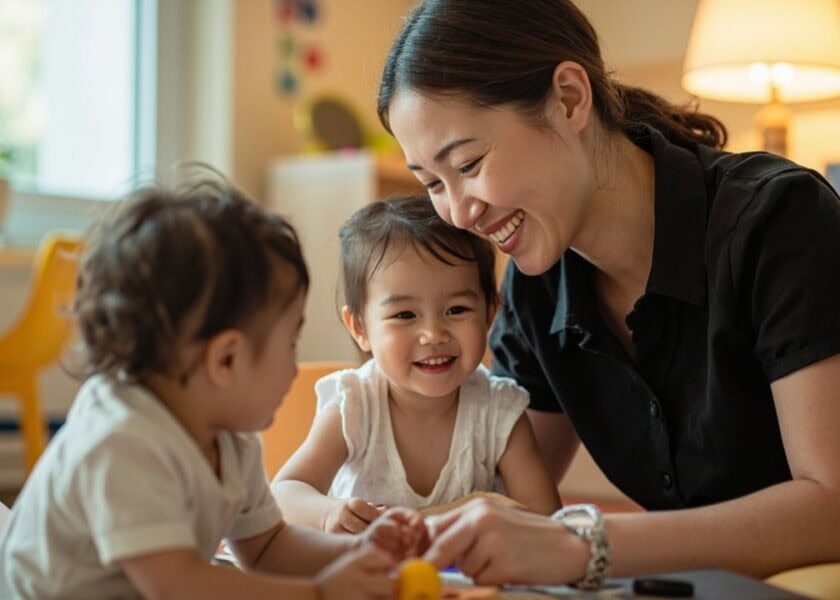
Here is what it looks like in practice. Your child has been in care for a few months. At first, drop-off was hard. The crying, the clinging, the weight in your chest as you walked away. But somewhere around the second or third month, something shifted. Not dramatically. Not overnight. But you started to notice that when you arrived to collect your child, they did not just look up — they smiled. They pointed. They showed you something.
And in that moment, you understood something that no curriculum audit could capture: your child has begun to feel that this place is theirs. That these people are safe. That they can go out into the world and come back to someone who knows them.
That is not a soft outcome. That is the psychological foundation on which every other form of development is built.
When a child feels emotionally secure, they explore. When they explore, they learn. When they learn, they grow. This is not theory. It is the architecture of early human development, and it happens in the small, daily, unscripted moments of quality care — the caregiver who responds to a child’s distress with consistency rather than urgency, who narrates the day in a calm voice, who remembers that this particular child loves watching the ceiling fan turn and brings them to that spot without being asked.
What This Looks Like When Choosing Childcare
When you visit a potential childcare arrangement, pause for a moment — not during the guided tour, but when things are settling. Watch how children move through the space. Do they hesitate at the edges, uncertain? Or do they move with a quiet familiarity, picking up a toy they have played with before, going to a caregiver they recognize?
That ease is not accidental. It is evidence of emotional security — and it is one of the clearest signals that your child is in an environment that is working for them.
Curiosity and Engagement: Where Quality Care Becomes Genuinely Visible
A child in a high-quality environment does not just occupy space. They lean in. They reach. They bring you things and wait to see what you will do with them.
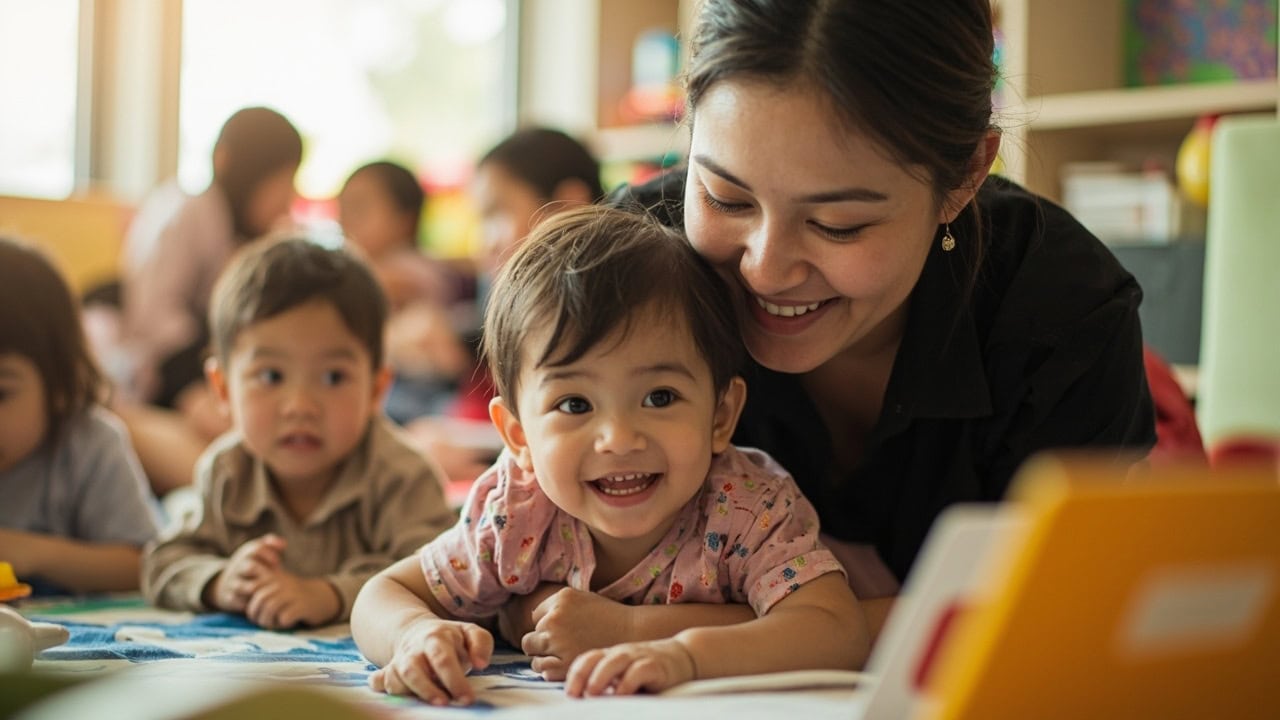
They point at a bug on the window and look back at a caregiver — not to be told what it is, but to share the experience of noticing it together. That back-and-forth look — the one that says, I saw something interesting, and I want you to see it too — that is not incidental. That is communication. That is the beginning of shared attention, which is one of the building blocks of cognitive development.
And here is what is worth noticing: it happens not because a curriculum mandated a bug-watching activity, but because a skilled caregiver was paying attention to what this particular child was drawn to, in this particular moment, and honoured that pull.
This is what distinguishes a genuinely responsive environment from one that merely runs a programme. The programme tells you what activities are happening. Responsiveness tells you what your child is actually engaged by.
Questions to Ask Yourself When Observing
- Do children seem genuinely interested in what they are doing, or are they waiting for the next instruction?
- Do caregivers follow the children’s lead, or does everything run on a fixed schedule?
- When a child shows something to an adult, how does the adult respond?
Communication Development: More Than Words
Let me go further, because I think this is where parents are most hungry for clarity. What does communication development look like in quality infant care?
It begins long before words.
A child learning to communicate in a rich care environment will progress through a series of observable stages:
- Coos and gurgles — a caregiver who matches them back
- Gestures — pointing, waving, reaching
- Approximations — sounds that almost mean something
- First words — the real thing, often surprising in its clarity
- Word combinations — the remarkable moment when a child strings words together not because they were taught to, but because the environment gave them something worth saying about
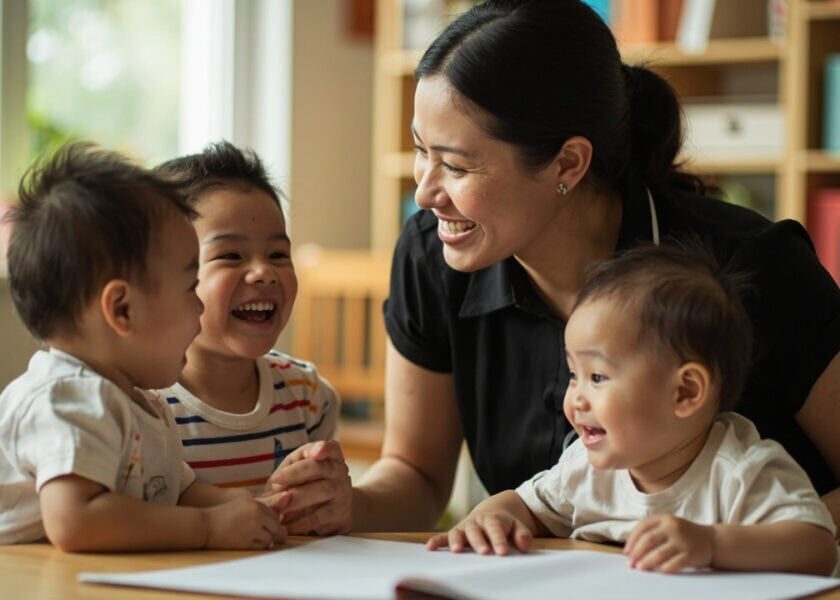
If you are selecting childcare and you walk in and hear adults talking to the children — not at them, not over them, but with them, in a genuine back-and-forth, even with the youngest infants — that is a communication-rich environment. That is where language grows.
You can hear it. You do not need a developmental checklist to recognize it. You know, when you hear it, that it is right.
This is the kind of thing I mean when I talk about developmental evidence versus administrative features. The credential on the wall tells you something. The ratio on the brochure tells you something. But the quality of adult-child conversation in the room tells you something deeper — something that is actually producing the growth you are looking for.
Physical Confidence: Motor Development in Quality Care
Physical development is another domain where quality care produces results that parents can see, often quite quickly.
Motor skills — both gross and fine — develop rapidly in the first years of life, and they develop best when a child has space to move, freedom to practice, and encouragement that is specific and real.
In quality care, you will see a child who arrived barely able to sit independently and, within months, is pulling to stand, cruising along furniture, maybe even taking those wobbly, triumphant first steps.
Fine motor development shows up in smaller ways — the pincer grasp, the ability to stack blocks, the fascination with dropping something and watching where it goes and picking it back up and doing it again. Which sounds maddening. But it is, in fact, the very essence of cause-and-effect learning.
What you want to notice is not just that these skills are emerging, but that the child is confident in their body. That they are willing to try. That a caregiver is nearby — close enough to catch a fall but far enough to let the attempt happen.
That balance, that attunement, is what physical development in quality care actually looks like.
Signs of Physical Confidence in Quality Care
- Children attempt new movements even if they have fallen before
- Caregivers are physically present but not hovering
- The environment is safe enough to allow real exploration
- Children show pride in physical achievements, big and small
Social Awareness: The Beginning of Understanding Others
Now I want to address something that Singapore parents feel but do not always have permission to name: social confidence. The ability to be near other children. The willingness to notice someone else and want to be near them. The beginning of sharing — not as a rule that was taught, but as a feeling that emerged because the environment modelled generosity and patience in small, repeated ways.
You can see social development in how a toddler responds when another child takes a toy.
In a low-quality environment, the response is panic or aggression. In a high-quality environment, you begin to see something more interesting — a child who hesitates, looks at the caregiver, looks at the other child, and begins, slowly, to understand that there is a social world out there that has rules — and that those rules are not punishments but agreements.
That takes time. It does not happen on a schedule. But in quality care, you will see the process beginning. And that is a remarkable thing to witness.
What Distinguishes Genuine Quality: Programme Features vs Professional Skills
All of these things I have described — emotional security, curiosity, communication, motor confidence, social development — they do not happen on a poster. They happen in the texture of daily care.
They happen when the caregiver:
- Notices that your child is tired before they become overtired
- Adjusts the activity because they see the child’s focus drifting
- Talks your child through a moment of frustration instead of simply intervening
- Remembers the song your child loves and sings it when they need comfort
These are not programme features. They are professional skills. They are the signs of a caregiver who understands child development at a level that goes beyond certification and into genuine attunement.
This distinction matters enormously when you are making a decision about childcare. A centre may have excellent credentials on the wall and still deliver care that is more custodial than developmental. Conversely, a smaller, home-based arrangement may operate with less fanfare but with caregivers whose professional intuition is precisely tuned to what children need.
The question is not: What does this programme offer?
The question is: What is actually happening to my child during the hours they spend here?
A Closer Look at Home-Based Childminding in Singapore
The question Singapore parents are asking — how do I know my child is really growing — deserves more than a slogan. It deserves an answer that is structural, intentional, and grounded in real professional practice.
EduNanny operates under the ECDA Childminding Pilot, which means it is part of a deliberate, government-supported effort to expand quality home-based and community-based childcare pathways across Singapore.
This is not an accident. It is recognition that childcare is not one-size-fits-all, and that families deserve real options — including models where the ratio of caregivers to infants can be far lower than what a large centre might manage, where the environment is a home rather than an institution, and where consistency of caregiver is built into the model itself.
What This Means in Practice
- Care is offered in structured blocks, Monday through Friday
- Ratios allow for genuine individual attention
- Fees within the pilot are structured to be affordable
- Where families have access to the Child Development Account or Baby Bonus schemes, those can be applied
- Where CCTV measures are deployed, families have visibility into the daily life of their child’s care
- Communication is structured and ongoing — not the occasional photo or update, but a genuine practice of keeping parents informed
Because thoughtful, quality care understands that parental peace of mind is not separate from quality care. It is part of it.
When Home-Based Care May Be Especially Well-Suited
- For infants in their first year who benefit most from strong individual attachments
- For children who are more introverted or sensitive to overstimulation
- For families who value a smaller, more personal environment
- When a lower caregiver-to-child ratio is a priority
Questions to Ask When Choosing Infant Care in Singapore
Whether you are considering a home-based arrangement, a childcare centre, or another arrangement entirely, these questions can help you see past the features and into what actually matters:
- When I observe, do I see children who seem emotionally at ease? Not just quiet, but genuinely comfortable in the space.
- Do caregivers talk with the children, not just at them? Listen for back-and-forth conversation, even with the youngest.
- Are children engaged or just occupied? There is a difference between children who are waiting for instructions and children who are pursuing their own interests.
- Do caregivers follow the children’s lead? A responsive environment adapts to the child. A rigid one expects the child to adapt to it.
- Can I imagine my specific child thriving here? Every child is different. The best childcare is the one that fits your child, not the one with the most impressive brochure.
Trust What You See — Your Observation Skills Are a Tool
Here is something worth naming directly: your ability to observe your own child is a skill. It develops. The more you look, the more you see. The more you see, the better you become at reading what is working and what is not.
I want to encourage you — whether your child is in home-based care, centre-based care, or a different arrangement entirely — to trust that growing capacity. You know your child better than anyone. You will learn to recognize the signals of genuine growth that I have described today, not because someone taught you a checklist, but because you are paying attention, because you love that child, and because your attention is one of the most powerful developmental tools they have.
Quality childcare does not replace your role as a parent. It works alongside you. And the best childcare — the kind that produces the outcomes I have described — will not make you feel like a visitor in your child’s development. It will invite you in. It will show you what your child is learning. It will say, here — look. See this? This is growth. And this is why it matters that we are all here, doing this work together.
Every child deserves to be known — not just minded, not just supervised, not just kept — known.
Known by adults who notice when they are tired before they are cranky. Known by caregivers who remember that they love the water play and that they need an extra minute to warm up to new situations. Known by a system that sees them not as a slot in a programme but as a whole, developing human being who deserves our best thinking, our deepest attention, and our most professional care.
That is what quality, thoughtful childcare is working toward. And I believe it is worth it. I believe your child is worth it.
And I believe that when you walk into a childcare arrangement — however it is structured, whatever it is called — and you see your child reaching toward the world with confidence, speaking with joy, moving with physical certainty, and looking at the adults around them with trust — you will know.
Not because someone told you to look for those things. Because you will feel it. And that feeling, grounded in what your eyes are actually seeing, is the surest guide you have.
Trust it. You are paying attention in exactly the right way.
Ready to Learn More?
If this resonates with you and you would like to explore whether a home-based childminding approach is right for your family, we invite you to reach out for a conversation. No pressure. Just a genuine discussion about what you are looking for and how we might be able to help.
Get in touch with EduNanny Singapore
To learn more about who we are and the standards we hold ourselves to, visit our About Us page, or return to the EduNanny homepage.