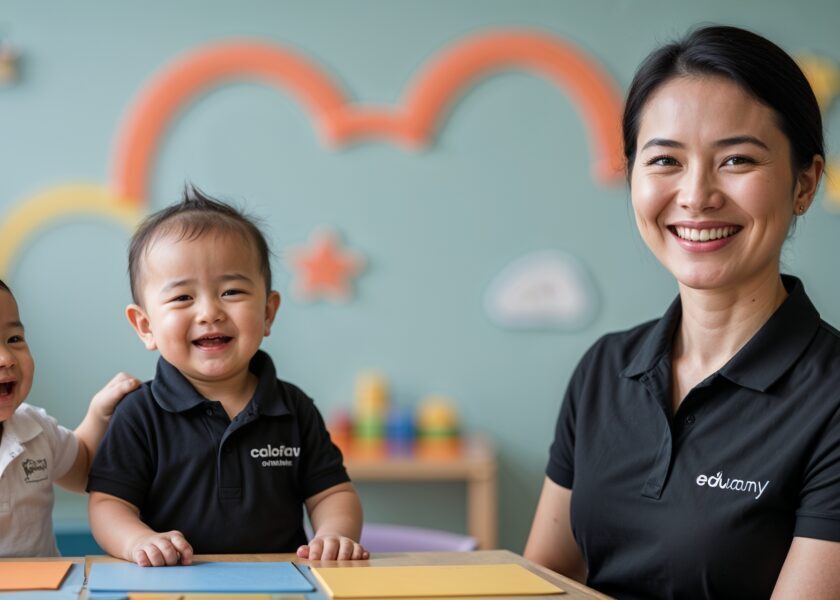
Beyond Instinct: How Singapore’s Savviest Parents Choose Childcare
The Prepared Parent’s Paradox: Why Your Intelligence Doesn’t Make Choosing Childcare Easier
There is a particular kind of modern parent in Singapore who has earned a university degree, navigated career decisions with precision, managed household finances with discipline, and approached the entire journey of raising a child with research, intention, and care. This parent reads the articles, attends the webinars, asks thoughtful questions in parenting forums. They are some of the most prepared, most invested parents in the world.
And then, at some point, that same parent walks into a childcare environment and suddenly feels uncertain.
Not because they lack intelligence. Not because they lack love for their child. But because they have been asked to evaluate something they have never been trained to see. They look around a childcare centre or meet a childminder for the first time and want to trust what they see. They want to trust their instincts. But they wonder whether their instincts are enough.
This is the paradox we see again and again among Singapore parents. And here is what we want you to know: your instincts are valuable, but they are also trainable.
Quality in childcare is not mysterious. It is not something that only insiders can detect or that you must simply hope to feel. Quality follows patterns. It shows itself in specific, observable ways. The parent who learns to see those patterns makes a fundamentally different kind of decision than the parent who relies on general impressions alone.
This article is about giving you that eye. Not reassurance. Not sentiment. Something more useful than that. We want you to leave not with a feeling but with a judgment. A real one. One you can trust.
Learning to See: What Quality Looks Like When You Know Where to Look
When you walk into any childcare environment, you are receiving information whether you realise it or not. The temperature of the room. The smell. The noise level. The way materials are arranged. These details are not decorative. They are communicative. They tell you something about the philosophy operating behind the walls, even when no one has said a word.
The Environment Speaks Before Anyone Does
A high-quality infant or toddler environment is not simply clean and safe, though it is certainly those things. It is arranged with intentionality. Ask yourself:
- Are materials within reach of the children who are meant to use them?
- Are there different textures, different lighting, different spaces that offer both activity and retreat?
- Is the furniture scaled to small bodies, or are children expected to adapt to an adult space?
These are not aesthetic choices. They are pedagogical choices. They reveal whether the programme has thought carefully about how young children move, explore, and develop—or whether they have simply arranged a room that looks like a childcare setting should look.
Watch What Children Do With the Environment
The environment sets a stage. But quality lives in how the space is actually used. When a child picks something up and explores it in an unexpected way, what happens? Is curiosity welcomed or redirected? The relationship between a child and the learning environment tells you a great deal about whether the programme is child-centred in principle or merely in name.
The Caregiver Relationship Is the Core
If the environment sets the stage, the quality of a childcare experience lives in the interactions that happen within it. When you observe caregivers with children, do not look only at what they are doing. Look at how they are doing it.
Notice whether the caregiver is positioned at the child’s level. Whether eye contact is frequent. Whether the adult responds to the child’s communications—even the small ones, the gestures and sounds and expressions that very young children use before they have words.
A caregiver who notices these communications and responds to them is engaged in what researchers call contingent interaction: the back-and-forth rhythm that builds a child’s sense of security and language development in the earliest years.
Is the language you hear primarily directives and corrections? Or do you hear narration, commentary, conversation? When a caregiver describes what a child is doing, asks questions that invite response, and acknowledges feelings by name—you are listening to someone who understands that language development is constructed, day by day, conversation by conversation.
Notice warmth without performance. Genuine warmth is different from the kind of animated cheerfulness that can sometimes mask a more detached underlying relationship. Watch for the moments when a caregiver is simply present with a child, not performing care but practising it. These moments are quiet, and they are revealing.
Children as Honest Feedback Systems
In infant and toddler care especially, you can often read the quality of interaction in the children’s responses themselves. Older children have learned to mask their discomfort or perform compliance. Very young children have not yet developed those skills.
Watch whether the children appear at ease:
- Do they move freely and confidently?
- Do they approach their caregivers?
- When they are distressed, does a caregiver respond promptly and gently?
- When they are engaged in play, does a caregiver support that engagement rather than interrupt it?
Children are honest feedback systems. They will show you, in ways that cannot be easily faked, whether they feel safe and stimulated in a particular environment.
Asking the Right Questions: How to Learn What You Cannot See
There is a practice that separates evaluation from guesswork. It is the practice of asking questions, but not just any questions. The right questions.
Most parents ask questions that are designed to elicit reassurance. They ask whether the centre is safe, whether staff are trained, whether children are happy. These are not wrong questions. But they are questions that experienced childcare providers have learned to answer in ways that feel satisfying without revealing very much.
The question is not what to ask. The question is how to ask so that the answer actually tells you something.
General Questions vs. Specific Questions
Consider the difference between a general question and a specific one:
| Instead of asking… | Ask this instead: |
|---|---|
| How do you handle separation anxiety? | What does the process look like in the first thirty minutes after a child arrives? |
| What is the daily schedule? | What does a typical morning look like from the moment a parent enters with their child? |
| Do you communicate with parents? | What information does a parent receive on a typical day, and in what form? |
Ask about the moments you cannot observe during a single visit. Ask what happens when a child is unwell, when a staff member is absent, when an activity does not go as planned. These questions reveal the systems and decision-making processes that operate behind the polished surface of a site visit.
Read the Response, Not Just the Answer
Notice what happens when you ask. A programme that welcomes scrutiny will not deflect or redirect. They will answer specifically. They will invite follow-up questions. They will show you documentation when asked. They will explain not just what they do but why.
The programmes that are less comfortable with detailed inquiry may redirect to general statements, change the subject, or become vague. You do not need to interpret this uncharitably. Simply note it. It is information.
What You Cannot See During a Single Visit
Observe whether staff speak about the children respectfully, knowledgeably, and with genuine interest. Listen to how they describe what children are learning. Notice whether they seem proud of their practice or simply completing a job.
Observe whether the director or programme leader is present and engaged, or whether the programme runs on a set of procedures that operate independently of leadership.
A programme that invests in ongoing training, that gives staff time to reflect on their practice, that discusses child development as a living discipline rather than a fixed checklist, tends to have a different quality than one that simply ensures compliance with minimum standards. You can often sense this in the way staff talk about their work and about the children in their care.
Singapore Benchmarks and Practical Considerations
Singapore parents are thoughtful about standards. You want to know not just whether something looks good but whether it meets real benchmarks. Here is what to look for—and what you need to know before you commit.
Developmental Appropriateness in Infant and Toddler Care
Developmental appropriateness is the lens through which quality should be evaluated. This means:
- Responsive caregiving
- Consistency
- Rich language exposure
- Appropriate stimulation for motor and cognitive development
- Respect for each child’s individual rhythms and needs
Ask whether the programme has a documented curriculum or framework for infant and toddler development. Ask how they assess individual progress. Ask what training the caregivers have specifically in this age group, because the skills required to care for a newborn are different from those required for a preschooler, and the best programmes ensure that staff are specialists, not generalists.
Understand what ratios apply in practice. In quality infant care, you should expect low ratios—meaning fewer infants per caregiver—not just on paper but in the room throughout the day. This is not a luxury. It is the structural condition that makes responsive, individualised care possible.
The ECDA Childminding Pilot Framework
At EduNanny Singapore, we are committed to meeting and exceeding these standards within the ECDA Childminding Pilot framework, which was designed specifically to ensure that home-based and centre-based pathways both uphold the quality benchmarks that Singapore families deserve.
This framework matters because it represents a structured approach to quality assurance—not just compliance with minimum standards, but active commitment to practices that support your child’s development.
Hours, Costs, and Financial Support
What are the care hours and how do they fit your family’s rhythm? What is included in the fee structure, and where are the potential additional costs? What payment mechanisms are available?
Many families find that CDA and Baby Bonus funds can be applied, which helps make quality care more accessible. These are not small considerations. They are part of how a programme respects the real financial pressures that Singapore families navigate.
Communication as a Quality Signal
Before you enrol, before you commit, ask how the programme communicates with parents on a daily basis:
- What information do you receive?
- In what form?
- How quickly can you reach someone if you have a concern?
- What is the protocol for sharing updates about your child’s day, development, and wellbeing?
A programme that takes communication seriously will have clear, consistent practices. They will not leave you guessing. If a programme is open about transparency practices and documentation access, understand that this openness is itself a signal. Quality does not hide. It invites examination.
EduNanny Singapore: Built for Parents Who Look Closely
We believe that parents who scrutinise carefully make better choices. Not because scrutiny reveals that we are perfect—no programme is. But because scrutiny reveals whether a programme knows what it is doing and why, whether its quality is structural and genuine, or whether it is surface and performative.
We want parents to look closely. We want you to ask the hard questions, to request the documentation, to observe the interactions you were not supposed to observe, to compare what you are told against what you see. We have built our programme within the ECDA Childminding Pilot framework precisely because we believe that standards matter and that they should be visible, not hidden behind marketing language.
Pathways for Every Family
EduNanny offers pathways that reflect the diversity of Singapore families. Whether you are looking for home-based childminding or community-based or centre-based arrangements, whether you need care on weekdays or specific blocks of time, we have designed options that are flexible and practical.
The pilot fee structures are designed to make quality care accessible. And our approach to communication is simple: we will tell you what we do, show you when asked, and give you the information you need to feel genuinely confident, not merely temporarily reassured.
Why the First Thousand Days Matter
We know that choosing childcare is not simply a logistical decision. It is a decision that shapes, in concrete ways, the early experiences of your child during a window of development that will not come again.
The first thousand days of a child’s life carry extraordinary significance for brain development, for emotional regulation, for language acquisition, for the foundational patterns of trust and security that will influence relationships for a lifetime. When you choose childcare, you are making a decision about what your child’s daily world feels like—who responds to their cries, who notices their first words, who holds them when they need comfort.
This is not a responsibility to take lightly, and we do not take it lightly either.
What Our Childminders Offer
Our childminders are not simply care providers in a transactional sense. They are partners in your child’s early development, trained and supported to offer the kind of responsive, individualised attention that young children need.
We believe that the childminder profession deserves recognition and dignity, because what a skilled, caring childminder does in the early years is genuinely important work. And we believe that parents deserve to find that quality without navigating confusion, without paying for marketing instead of substance, without guessing whether the person caring for their child truly understands what they are doing.
Your Search Is Itself an Act of Care
If you are feeling anxious about this decision, that is entirely understandable. You are making a choice about who will care for your child during some of the most important developmental years of their life. That weight is real.
But here is what we want you to know: the uncertainty you feel is not a weakness. It is attention. It means you understand the stakes.
The fear of making the wrong choice is what drives many parents to delay decisions or rely on surface impressions. But the framework we have shared here gives you something more reliable than a feeling: it gives you a method.
Every site visit is an education. Every question you ask teaches you something. Every observation you make sharpens your capacity to see what is genuinely there. The parent who leaves a site visit feeling uncertain has not failed. They simply have not yet developed the framework to interpret what they saw. Now you have that framework.
Polished presentation and genuine quality are not the same thing. A beautiful space can mask undertrained staff. An impressive website can obscure unclear practices. That is why specific questions matter. That is why watching children in the environment matters. That is why noticing whether staff speak about children with genuine knowledge and warmth matters.
Quality that is structural will welcome your scrutiny because it has nothing to hide.
When you take the time to learn how to evaluate quality, when you refuse to be satisfied with surface impressions, when you develop the discipline to ask the questions that matter and to listen for answers that are specific rather than reassuring—you are doing something profound.
You are paying attention to a decision that will shape your child’s daily experience during the most formative years of their life.
That is not anxiety. That is love in its most practical form.
You are some of the most prepared, most invested parents in the world. You deserve to approach this decision as the capable, intelligent, discerning people that you are. Not as consumers to be reassured, but as partners to be trusted.
When you find a programme that welcomes your scrutiny, that answers your questions with specifics, that shows you documentation without deflection, that speaks about the children in their care with knowledge and genuine warmth, that maintains ratios and training and communication practices that you can verify—you will know.
Not because someone told you to trust them. Because you looked. Because you asked. Because you saw.
That kind of confidence is not the absence of doubt. It is the presence of clarity. It is the confidence that comes from informed evaluation, and it is available to every parent who is willing to approach this decision with the same thoughtfulness they bring to everything else in their lives.
EduNanny Singapore was built for parents who look closely. We welcome your scrutiny. We believe that when you see what we have built, you will recognise it for what it is: quality care that invites examination rather than relying on reassurance.
Begin your search with clarity. Connect with EduNanny Singapore to learn more about what thoughtful, development-oriented childcare looks like in practice.