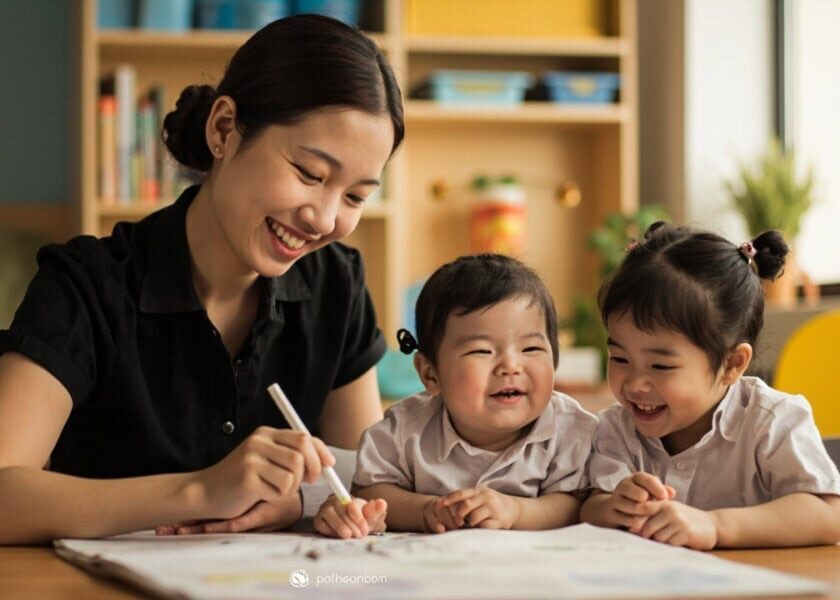
What Singapore Parents Are Building Instead of the Village
The Silence at Six O’Clock: Finding Your Village in Singapore’s Modern Family Life
There is a particular kind of silence that fills a Singapore flat at six in the evening. The day’s drop-off is done, the commute home is complete, and there is that brief, honest moment where you stand in your kitchen—perhaps still in work clothes—and notice how quiet it is. Your child is in someone else’s arms. Someone you chose.
In that moment of quiet, a question surfaces. One many of us have learned to push down rather than sit with: Is this what it was supposed to feel like to raise a child?
If that question lives in you, you are not alone. And more than that, it is not a sign that something is wrong with you or your choices. It is a sign that something in the architecture of modern family life has quietly shifted, and no one handed you a map for navigating it.
This article is about that map. Not a perfect one, but an honest one. It is about the village that has not come to you—and what you can build instead.
- Why the “village ache” is a legitimate grief, not a parenting failure
- How intentional relationships become the village infrastructure your child needs
- What quality childminding looks like in practice
- How to choose care that builds community, not just manages it
- A reframe that transforms guilt into agency
The Story We Internalized (and Why It Was Never True)
You are a parent in Singapore. Perhaps both you and your partner work. Perhaps your parents are in Johor, or Kuala Lumpur, or somewhere in the northern part of the island where visits happen on weekends when energy allows. Perhaps they are still working themselves, or retired but not quite equipped for the relentlessness of infant care. Perhaps they are in excellent health and deeply present, but you live forty minutes away, and the logistics of daily life make that presence more theoretical than real.
You love your child. You are not negligent. You are not absent. You are navigating the exact conditions that define modern Singapore parenthood: dual-income households, extended families who are geographically scattered or emotionally unavailable in the ways you need, and a city that moves so quickly that the rhythms of early childhood can feel almost impossible to protect.
And somewhere along the way, you internalized a story. That story says raising a child is primarily your responsibility, and that responsibility—done correctly—should feel manageable, guiltless, and seamless. That the right school, the right curriculum, the right caregiver will resolve the tension you feel. That if you have chosen well, the ache should quiet down.
But here is what hundreds of Singapore families have taught us in moments of real honesty: the ache does not come from choosing wrong. It comes from something deeper. It comes from the quiet recognition that humans were never meant to raise children in isolation.
Your grandmother had seventeen relatives within walking distance. Your great-aunt knew your name before you could walk. The village your child was supposed to inherit dissolved somewhere between three-generation households becoming rare, mortgages requiring two incomes, and a city that optimizes for productivity over presence.
You are living in the gap that dissolution left behind.
And here is the reframe that changes everything: this is not a problem you can solve by finding the perfect infant care centre. It is not a problem that a longer checklist will resolve. Because the problem is not fundamentally about quality—though quality matters enormously.
The problem is about belonging. The question is not: Have I found the best service? The question is: Have I found my village?
What Village Infrastructure Actually Means
When we speak about building a village, we are describing an architecture of belonging. We are describing what it looks like to build village infrastructure for your family in a city where that infrastructure does not exist by default.
The Caregiver Relationship: Not a Transaction, But an Anchor
It means beginning with the caregiver—not as a transaction, but as a relationship. The person who spends eight hours a day with your infant, who knows how they take their bottle, who recognizes when they are about to teethe, who has watched them take their first steps or say their first word—this person is not interchangeable.
This person is an anchor.
The way caregivers are selected, trained, and supported reflects that truth. When arrangements allow for ratios of up to one to three infants in certain configurations, that is not just a safety specification. It is a deliberate choice to ensure that the caregiver can truly know your child. That your child is not a number in a room, but a person who is seen.
The Network: Your Family, Your Caregiver, and Other Families
And that seeing extends beyond your family. Because a village is not a dyad. A village is a network. It is:
- Your family
- Your caregiver
- Other families who are on the same journey
Families who may become friends. Who may become trusted emergency contacts. Who may become the people you text at seven in the morning when your child spikes a fever and you need to know you are not the only ones in this.
The village grows horizontally too. It builds community among parents who understand the particular exhaustion of infant care, the particular joy of watching another person’s child grow, the particular relief of being in a space where you do not have to explain why you are still breastfeeding a toddler or why you cried in the drop-off lane today.
The Trap to Avoid: Passive Consumption
Building a village takes intention. It requires showing up, being present, allowing relationships to form over time. It requires resisting the very easy pull toward passive consumption—the tendency to treat childcare as a service you purchase and collect rather than a community you contribute to.
The families who find genuine village connections through childcare arrangements are not families who arrived looking for the best product. They arrived looking for the best people to walk alongside them. And they stayed because they found that.
Why This Matters: The ECDA Childminding Pilot
The ECDA Childminding Pilot represents something important: the recognition that infant care in Singapore cannot look the same as it looked twenty years ago, because Singapore families do not look the same.
The pilot opens pathways—both home-based arrangements and community or centre-based options—that are designed to be flexible enough to serve real families in real circumstances. These arrangements are designed to support the relational depth that village-building requires: not just to provide a service, but to create the conditions for genuine attachment and community.
Speaking to the Guilt
Singapore parents carry guilt the way the air carries humidity—sometimes visible, sometimes oppressive, often unacknowledged.
- The guilt of working
- The guilt of not being present
- The guilt of choosing care that someone else provides
- The guilt of sometimes wishing you had a day alone, and then feeling monstrous for wishing it
Here is what I want you to hear: guilt is the wrong signal responding to the wrong story.
The story that produces this guilt says your child’s village must come from you alone. That if you were a better parent, a more present parent, a parent who had made different choices, your child would not need this. That needing help is a failure.
But that story is a lie. And it is a lie that has been sold to a generation of parents who were set up to fail, because the conditions of modern life make the version of parenting it describes impossible.
The Truth: You Are Building
The truth is simpler and, I think, more liberating: you are building your village.
- Every time you choose a caregiver with care and intention
- Every time you show up to a playdate or a parent session and invest in the relationships there
- Every time you allow yourself to be known by the people who are caring for your child, instead of keeping them at professional arm’s length
You are building something. You are constructing, brick by brick, the infrastructure your child needs to thrive.
This is not consolation. This is agency.
You are not failing. You are building. And the act of building is, in its own way, one of the most profound expressions of love available to a parent in this moment in Singapore.
What Quality Childminding Looks Like in Practice
When you are evaluating childcare options, it is tempting to focus on amenities, accreditation checklists, or curriculum promises. But if we are serious about building villages, we need to look for something different.
Signs of a Village-Oriented Approach
- Transparency: When communication is consistent and honest, when you know what is happening in your child’s day—not because you were promised a live feed, but because your caregiver calls you by name and tells you about the book your child requested three times this morning—that transparency is what allows the village to function. You can relax into belonging when you know you are not being kept at arm’s length.
- Caregiver continuity: Look for arrangements where your child will have consistent primary caregivers over time—not a rotating cast of strangers. Your child needs someone who knows them deeply, not someone who is always learning their name.
- Community integration: Are there opportunities to connect with other families? Are there structured or organic moments where parents can meet, share, and build relationships? Is there space for the village to grow horizontally?
- Communication rhythm: How does the caregiver communicate with you? Is it transactional reporting, or relational sharing? The way your caregiver speaks about your child’s day reveals whether they see your child as a responsibility or as a person they genuinely know.
The Cost Question
Singapore families are price-conscious for good reason. The early years are expensive, and the temptation is to minimize where you can.
Here is what I would offer: the village you build is not a luxury. It is infrastructure.
The question is not whether you can afford to invest in your village—it is whether you can afford not to. The ripple effects of a secure early attachment, of a child who knows they are loved not just by their parents but by a consistent web of caring adults, extend into emotional regulation, social confidence, and the capacity for relationship that will define their lives far beyond these early years.
Explore whether your care arrangement is eligible for Child Development Account and Baby Bonus support. These are not incidental benefits—they are intentional design features meant to make village-building accessible to more families, not only to those with significant financial resources.
The Long View: How Your Village Grows
As your child grows, the village evolves. The infant who needed physical holding and sensory exploration becomes the toddler who needs language, who needs peers, who needs to practice sharing and negotiating and being disappointed and recovering.
The village that served them at six months must stretch to serve them at three years.
This is one of the most underappreciated aspects of childcare continuity: the relationships your child forms in the early years do not simply end when a phase ends. They grow. They deepen. The caregiver who knew your child as an infant carries a different but equally significant relationship with them as a preschooler.
And the families you met in those early months become the families whose children yours will grow up alongside—not just in school, but in the deeper sense of knowing each other across contexts, across years, across the ordinary dramas of childhood.
Practical support—whether resources, caregiver communication, or ongoing guidance—reflects a commitment to staying present in your journey, not just during care hours. These are the questions that define the texture of early family life: lying awake at three in the morning wondering if your child’s development is on track, whether that rash is worth a clinic visit, or simply how to explain to your toddler that today is a workday and you will be back.
Having a trusted, consistent resource to turn to is itself a form of village—remote but real, digital but human.
A Different Question
So if you are standing in that quiet flat at six in the evening, and the silence feels heavy, and the question surfaces again—Is this what it was supposed to feel like?—I want to offer you a different question.
What would it feel like to know that the quiet was not emptiness, but space?
- Space for someone else to love your child while you refill your own cup
- Space for relationships to form that will surprise you with their depth
- Space for a village to grow in the gap where you expected to find only loss
Your child will be known here. Not as a roll number or a checkbox. As a whole person whose laugh your caregiver will imitate to make them giggle. Whose struggles your fellow parents will understand because their children have the same ones. Whose first friendships may form in the rooms where families gather, and whose sense of safety in the world will be built on the foundation of knowing that there are people beyond you who delight in their existence.
That is what the village means.
The village is not coming to you. But it is not lost, either. It is something you are building. And it is something you do not have to build alone.
EduNanny Singapore exists to be part of that build. Not to replace you, and not to be the village you should have had. But to be the anchor around which your village can form—the consistent, trained, deeply committed caregivers who know your child as a whole person; the community of families walking the same path; the transparency and trust that allows you to relax into belonging; the practical supports that make the daily logistics survivable.
We do not pretend to replicate the village your grandparents knew. That village is gone, and mourning it is legitimate. But we believe something equally good can grow in its place—something built with intention, maintained with care, and rooted in the understanding that children belong to communities, not just parents.
We would be honored to be part of yours.
Learn more about EduNanny Singapore and our approach to development-oriented childminding. If you have questions about whether we might be the right fit for your family, we would welcome the conversation.