The Science That Gives Working Parents Permission to Trust
The Fear Singapore Parents Rarely Talk About
There is a weight that many Singapore parents carry, and they carry it quietly. It lives in the early morning hours before the commute, in the brief moment when you hand your child to someone else, in the small voice that asks whether your child will still reach for you the same way when you return.
You may not have said it aloud, even to yourself, because it feels unreasonable. You know you need to work. You know your child is in good hands. And yet, that quiet fear persists.
It is the fear that love is a finite resource. That every hour spent away is an hour your child spends wondering whether you will return. That somewhere between drop-off and homecoming, something essential might shift or soften in the bond you have worked so hard to build.
If this resonates with you, you are not alone. And more importantly, you are not right to fear what you fear—not in the way you fear it.
Where This Fear Comes From and What Research Shows
This fear is not irrational. It is ancient.
It is written into the very architecture of parenthood: the belief that security must be hoarded, that attachment is a single thread connecting parent to child, and that any other hand touching that thread risks fraying it. For generations, this belief went largely unchallenged.
We understood attachment as a singular bond, and we feared dilution. We believed that if someone else was caring for our child, some invisible piece of our connection to them might diminish.
But the science has been telling us something different for decades now.
Modern attachment research offers profound relief for every working parent: children do not form attachments to one person. They form attachments to many people.
What matters is not the number of hands that hold your child, but the quality of holding those hands provide. When caregivers respond to a child’s cues with consistency, warmth, and genuine attunement, the child does not become divided in their security. The child becomes more expansive in it.
Consider what your child is actually learning when they experience quality care:
- That the world contains reliable people beyond their parents
- That crying brings comfort from multiple sources
- That exploration can be followed by return
- That love is not a single flame that must be protected from the wind, but a warmth that can be carried and shared and still remain
The Attachment Paradox: A Reassuring Truth
This is the attachment paradox, and it is one of the most encouraging findings in developmental psychology: the very act of choosing quality care, of entrusting your child to a trained and devoted caregiver, can deepen rather than diminish the bond you share.
Not because you are stepping back, but because you are stepping forward into a choice made from clarity rather than anxiety, from understanding rather than guilt.
The difference between these two modes of choosing cannot be overstated.
Anxiety-Driven Choices vs. Clarity-Driven Choices
An anxiety-driven choice is made from fear. It stems from the belief that you must do everything yourself or risk losing something irreplaceable. It is reactive, guilt-laden, and often leads to suboptimal decisions because the parent is operating from a place of scarcity.
A clarity-driven choice is made from confidence. It comes from the understanding that your child benefits from the village you are building around them, that their emotional world can hold more than one trusted person, that your love does not diminish through sharing but actually grows stronger when it is held by others who share your commitment to your child’s wellbeing.
Ask yourself: what do you actually want for your child? Not the abstract answer, not the ideal answer, but the real one.
- You want a child who runs toward you with joy when you return.
- You want a child who is curious about the world and confident in exploring it.
- You want a child who knows, in their bones, that they are loved and that they are safe.
- You want a child who will one day move through the world with secure hearts, able to love deeply because they learned early that love is reliable and consistent.
Quality childcare does not threaten this. Quality childcare builds it.
What Secure Attachment Actually Looks Like
Here is what security in action looks like in daily practice:
- You see it in a child who waves goodbye at the gate without tears because they trust the rhythm of your return.
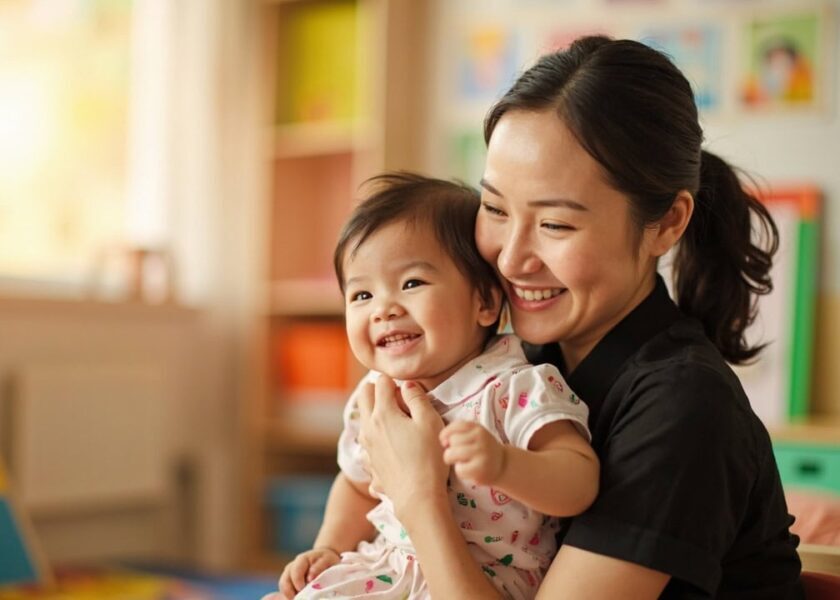
- You see it in a child who explores a new play space confidently, glancing back periodically not because they doubt you will come back, but because they have learned that connection survives distance.
- You see it in a child who has two names they call for comfort, two sets of arms that feel like home, two sources of warmth that have never let them down.
- You see it in a child who is not clingy because they are insecure, but rather a child who has such solid internal ground beneath them that they can reach out to the world without fear.
This is the child who has learned that attachment is something that survives separation. This is the child whose security has been expanded rather than threatened by quality care.
What Quality Childminding Looks Like
Not all childcare is created equal. The difference between adequate supervision and genuine attunement-based care is profound. Here is what to look for when evaluating infant care options in Singapore:
Caregiver Responsiveness
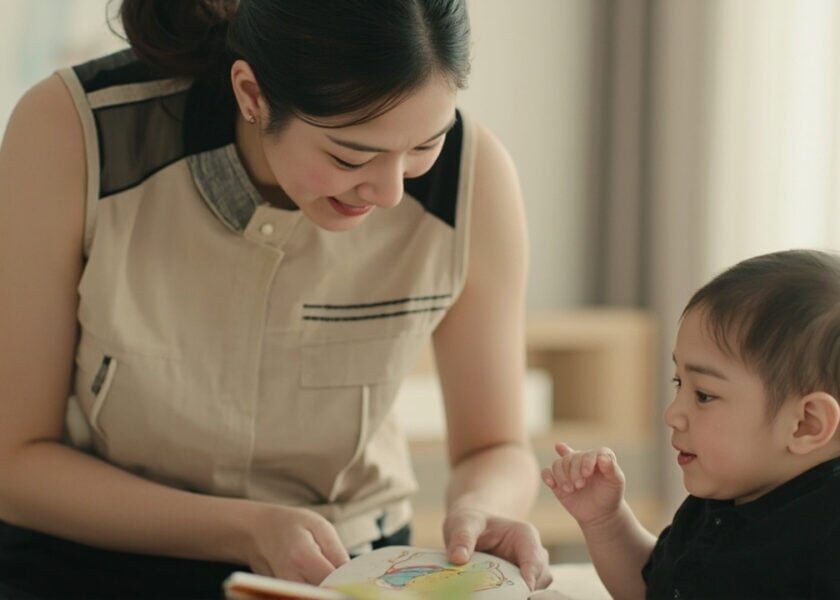
Quality care begins with responsiveness. When a caregiver meets your child’s gaze with genuine interest, names what they see, and reflects it back, they are teaching your child that the world is full of people who can be trusted.
Every feeding, every diaper change, every moment of soothing is an opportunity to build or reinforce a child’s sense of security. In quality care, these are not seen as tasks to be completed but as relational moments to be honored.
Small Ratios, Focused Attention
One of the most reliable indicators of care quality is the ratio of caregivers to children. With smaller ratios, genuine attunement becomes possible. There is no来不及 response to crying, no diffuse care that leaves a child wondering whether they were heard.
Instead, there is the steady, consistent presence of someone who has been trained to treat your child’s emotional world with the same seriousness you do.
Modelled Warmth
Your child learns security not just from what is done for them, but from how it is done. A quality caregiver models the same warmth, the same attentiveness, the same belief that your child’s needs deserve immediate and thoughtful response.
When a caregiver follows your child’s lead in play and responds with joy to your child’s discoveries, they are reinforcing everything you have already begun at home.
Transparent Communication
Quality care extends to the parent as well. You should know how your child’s day unfolded. You should see the rhythms, hear the sounds, understand the small victories and the tender moments. Where measures are in place, you should be able to witness the care yourself.
This is not surveillance for reassurance’s sake. It is the simple human need to know that when we cannot be somewhere, the people who are there are people we can trust completely.
EduNanny Singapore: Quality Care Made Real
When you bring your child to an EduNanny caregiver, you are not handing over responsibility. You are entering into a partnership.
The caregiver becomes part of your child’s emotional foundation, not a replacement for you, but an extension of the secure base you have already established. At EduNanny, this is not left to chance.
Trained in Attunement
EduNanny caregivers are trained in responsive caregiving, in reading the subtle cues of infant communication, in understanding that every moment with your child is an opportunity to build or reinforce their sense of security. This is not babysitting. This is attachment building.
Small Ratios for Genuine Connection
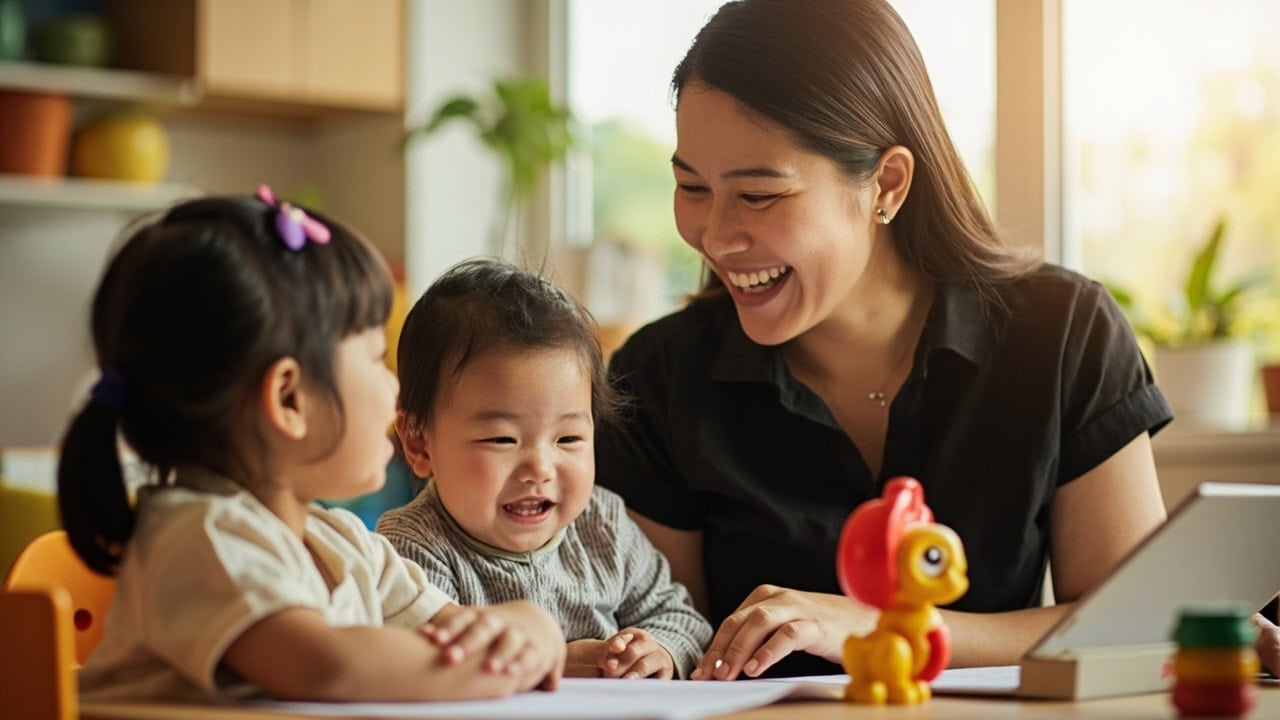
With ratios of up to one to three for infants, your child receives the focused attention that allows genuine attunement to happen. There is no herd mentality, no overwhelming environment, no diffuse care that leaves your child feeling like just another number.
Recognized Quality
EduNanny by BUTLER is part of the ECDA Childminding Pilot, which means their approach has been recognized and supported at a national level as a model for what quality infant care can look like in Singapore.
Pathways That Fit Your Family
EduNanny offers both home-based and community or centre-based pathways, recognizing that every family’s situation is different. Some children thrive in the familiarity of their own homes. Others benefit from the social environment of a centre. What remains constant across all pathways is the commitment to caregiver training, to small ratios, to responsive and attunement-based practice.
Accessible to Singapore Families
Within the pilot, fee structures are designed to be accessible. Payment options include CDA and Baby Bonus, making quality care available to more families across Singapore. Monday to Friday care blocks provide the predictability that working parents need, the reliable rhythm that children thrive on.
Addressing Common Worries
Let us speak directly to the fears you may still be carrying.
“Am I failing my child by returning to work?”
You are not failing your child by returning to work. You are making a clarity-driven choice to expand your child’s world, to build a village, to trust that love multiplies rather than divides.
“Will my child still be attached to me if they form a bond with their caregiver?”
Your child is not less attached to you because they have formed a warm relationship with their caregiver. Your child is more attached to you because they have learned that attachment is something that survives distance, that travel, that time apart.
“Will my child miss me in a devastating way when I am gone?”
Your child is not missing you in some devastating way when you are gone. Your child is carrying you inside them, the way a secure base is carried, the way a foundation works even when no one is standing on it. They are secure not because of your constant presence, but because of the internal working model of trust you have helped them build.
“Is choosing childcare a compromise?”
Choosing quality childcare alongside active parenting is not a compromise. It is an expansion of the love and security your child receives. It is the knowledge that while you are building your career, supporting your family, pursuing your purpose, your child is not simply being minded but is being deeply cared for by people who understand that their work matters.
What to Look For When Choosing Infant Care
If you are evaluating childcare options in Singapore, here are the questions that matter most:
- How does the caregiver respond to your child’s cues? Do they notice and respond to subtle signals, or only react to loud crying?
- What is the caregiver-to-child ratio? Smaller ratios enable deeper attunement.
- Is the caregiver trained in attachment-informed practice? This goes beyond basic childcare certification.
- How does the environment feel? Is it warm, responsive, and calm, or chaotic and reactive?
- How transparent is communication? Can you understand how your child’s day unfolds?
- Does the arrangement feel like a partnership? Are you welcomed as a collaborator in your child’s care, or treated as a client to be managed?
- How does your child respond over time? A secure child may show temporary separation distress but should otherwise show increasing confidence and exploration.
The Village You Are Building
Every parent who returns to work carries some version of the weight we have been discussing. The weight of wanting to be present, of needing to be productive, of loving your child so fiercely that the thought of any moment in which they might feel uncertain is almost unbearable.
But here is what the research confirms and what thoughtful, quality-focused childminding reflects: you are doing something brave and loving when you choose clarity over guilt, when you trust the evidence, when you believe that your bond with your child is not a fragile thing that cannot survive distance but a strong and secure thing that can hold space for others.
Your child’s security expands when the village grows. Your child’s bond with you deepens when they learn that love is not scarce but abundant. Your child’s future is being shaped right now, not just by what you do when you are with them, but by what you choose for them when you are apart.
You do not have to choose between your purpose and your child. You do not have to carry the weight of believing you are failing them. You do not have to make decisions from anxiety when clarity is available to you.
EduNanny Singapore exists because Singapore parents deserve permission to trust their own judgment. They deserve to know that the village they are building is not a compromise but a gift. They deserve care that is attunement-based, responsive, and rooted in the science of secure attachment.
When you choose EduNanny, you are not outsourcing your parenting. You are inviting a partner into the most important work of your life. You are trusting trained hands to hold what you hold with the same seriousness, the same devotion, the same belief that your child deserves the very best.
The fear you carry is understandable. It is ancient and deep and it comes from a place of profound love.
But it is not the truth.
The truth is that your child is more resilient than you fear, more capable of secure attachment than you imagine, more ready to receive the gift of quality care than your anxiety allows you to see.
The truth is that you are doing something brave and loving when you choose clarity over guilt.
Explore EduNanny Singapore’s childminding services and discover how we support secure attachment from the very beginning.
You can also learn more about the EduNanny approach or get in touch to begin a conversation about your family’s needs.