The Weight Singapore Parents Carry That No One Names
The Silence in the Car: What Singapore Parents Carry That No One Talks About
There is a particular kind of silence that lives in the car on the way to work. It is not the silence of peace. It is the silence of a parent who has just dropped their child at someone else’s arms, and is driving away, and is thinking about it the entire journey.
That silence is more common in Singapore than anyone talks about. It is the silence of a thousand small griefs that modern parents in this city carry alone, because no one quite names them in the daylight.
We want to talk about that silence today. Not to solve it — because it is not a problem to be solved — but to sit with it, to see it clearly, and to tell you something we believe with all our professional conviction: the fact that you feel it at all is one of the most important things we can know about you.
Because the parents who come to us are not looking for a service. They are looking for someone who understands. They are not failing. They are carrying something vast and largely invisible, and they have been carrying it without a map, without a community, and without the honest language to name what it is.
This article is that language. It is for every parent in Singapore who has wondered, in the quiet space between dropping their child at childcare and arriving at the office, whether they are doing this right.
What Singapore Parents Actually Carry
It begins earlier than most people expect. Long before a child takes their first step or speaks their first word, the weight is already there. It arrives in the ultrasound room, in the quiet terror of becoming responsible for an entirely new human being. It settles in during maternity leave, in the middle of the night, when a parent wakes to check on a sleeping infant and wonders if they are doing this right — if they are enough.
And then the leave ends. And then work resumes. And then the real negotiation begins — not between parent and employer, though that is hard enough, but between two versions of the same person, living inside one body.
The parent who wants to be present, who aches for those hours spent away. And the parent who is trying to build a life, a home, a future — who knows that the money set aside for a preschool centre, or the fees for an infant sitter, is real money drawn from real dreams, and who carries the weight of that arithmetic quietly, without complaint.
The Financial Weight
Singapore has one of the highest costs of raising a child in the world. Not in the abstract — in the specific. In the spreadsheet that families quietly maintain. In the conversation that couples have late at night, weighing whether one income can stretch, whether the second career needs to wait, whether the flat needs to be bigger, whether the school fees are really that much for Montessori and then again that much for enrichment.
These are not hypothetical anxieties. They are the daily mathematics of Singapore parenthood, and they leave very little room for a parent to simply breathe.
The Cultural Weight
Then there is the pressure that has no price tag, but every parent feels it. The grandparent who says, “In my day, we raised five children without any of this,” and the well-meaning aunt who asks, “Why is he not talking yet? My daughter was speaking in full sentences at his age.” The family expectations that can feel less like support and more like surveillance.
The intergenerational divide between a generation that raised children in a Singapore that was poorer but simpler, and a generation raising children in one that is richer but infinitely more complicated, can leave parents feeling caught between worlds that do not quite understand each other.
The Comparison Trap
Above all of this, there is the comparison culture that social media has turned into an art form. The curated posts of organic meal prep, the thoughtfully arranged Montessori shelf, the well-traveled toddler with the perfectly chosen books. The parenting group chat where everyone’s child seems to be meeting milestones faster, sleeping through the night more peacefully, and thriving in ways that make a parent quietly wonder if they are the only one who is exhausted, confused, and making this up as they go.
The Most Invested Parents Feel the Worst
There is a paradox at the centre of modern parenting that we see again and again, and it breaks our hearts a little every time: the parents who feel the worst about their choices are almost always the parents who are trying the hardest.
The parent who lies awake at night second-guessing whether the infant care centre was the right choice is the parent who cares so much that every option feels insufficient. The parent who feels guilty about working is the parent who would give anything to be there and also knows, with painful honesty, that the life they are building requires their presence elsewhere.
The guilt does not mean you are doing something wrong. It means you have very high standards for what right should look like, and you live in a world where no choice fully satisfies them.
We have a generation of Singapore parents who are genuinely doing everything they can — working long hours, planning carefully, reading the research, attending the enrichment classes, saving every dollar — and who feel, more often than not, that it is not enough. That they are not enough.
When the truth is far simpler and far more human: they are navigating a set of pressures that no previous generation of parents in Singapore has faced in quite this way.
The Grief and Identity Shift That No One Warns You About
We need to talk about the grief, too, because it is real and it deserves to be named.
There is a grief that comes with parenthood that no one prepares you for. It is the grief of the old life — the spontaneity, the sleep, the identity that was yours alone, the dreams that used to fit neatly into a calendar. It is not that you would trade it. Almost no parent would. But grief does not care about whether the trade was worth it.
Grief is the honest response to a profound change, and it deserves to be named and held, not dismissed with the well-meaning reassurance that you should be happy because your child is healthy and beautiful and a miracle.
In Singapore’s High-Achievement Culture
The identity shift that accompanies becoming a parent in Singapore is particularly acute. In a society that prizes achievement, productivity, and trajectory, the choice to slow down, to prioritise, to reframe success around a small child’s wellbeing — that choice can feel like a kind of surrender.
Parents in Singapore often speak to us about the strange loneliness of being highly ambitious people who have chosen to make their children the centre of their world, and finding that the world around them does not always validate that choice. That the career-focused norm still carries an invisible prestige that the stay-at-home parent or the parent who leaves early for school pick-up does not quite receive.
This is not about one path being better than another. It is about the pain of a society that has not yet built full, generous language for the kind of love that a parent pours into raising the next generation — a love that does not produce a payslip but produces something that no payslip can replace.
Quality Childcare Is an Act of Love
Choosing childcare for your child is not a compromise. It is not an admission of defeat. It is not a failure of love.
Choosing childcare is an act of love that comes from a parent who recognises that their child thrives when they are in an environment of warmth, safety, and intentional care — and who has the courage to build that environment even when it means entrusting their most precious person to someone else’s hands.
We know what it costs to make that choice. We know the sleepless night before the first day. We know the way a parent stands at the gate of a centre and looks back one more time. We know because we have seen it thousands of times, across thousands of families, and we have never once mistaken it for indifference. We have only ever seen it as the most profound act of trust that one human being can offer another.
What Research Tells Us About Quality Care
Research spanning decades — across developmental psychology and neuroscience — consistently points to the quality of the caregiving environment in the early years as one of the most significant factors in a child’s emotional, cognitive, and social development. Not because parents do not matter. But because the first thousand days of a child’s life are a period of extraordinary neuroplasticity, and the environment in which that brain is wiring itself matters enormously.
Quality caregiving is not a substitute for a parent. It is an extension of the love that the parent has already begun.
When evaluating childcare options, the evidence points to several factors that genuinely matter:
- Caregiver-to-child ratios — smaller groups mean more individual attention, more responsiveness, more safety
- Caregiver consistency — children develop trust and security through predictable, stable relationships
- Communication with parents — transparent, regular updates that help parents feel connected to their child’s day
- Environment safety and intentionality — spaces designed for exploration, not just supervision
- Caregiver training and support — professionals who are valued, trained, and treated as experts in early childhood
These are not luxuries. They are the foundations of care that truly supports both the child and the parent.
The EduNanny Approach: Supporting the Whole Family
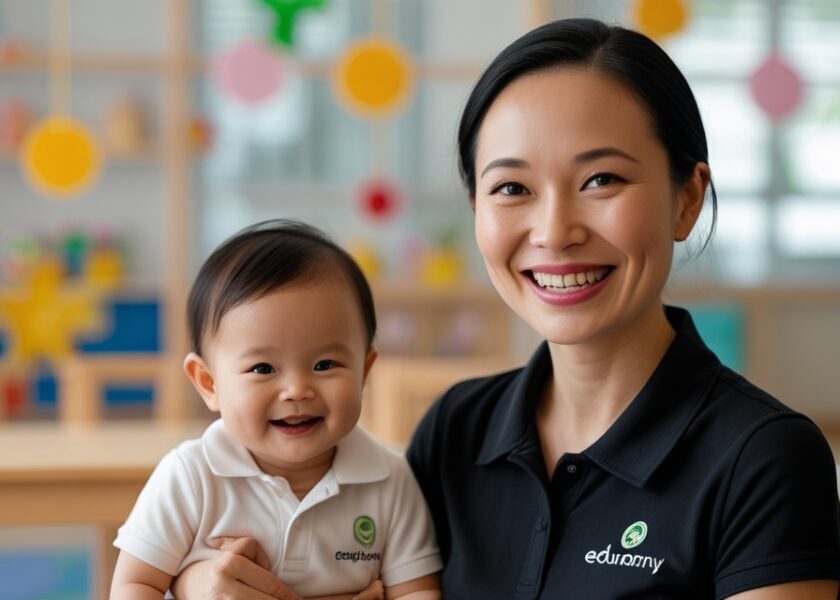
What we have built through the EduNanny by BUTLER programme — in partnership with the ECDA Childminding Pilot — is a model of care designed not just to look after your child, but to look after the whole architecture of your family.
This means care built on ratios that allow for genuine attention — small group settings with ratios of up to one caregiver to three infants, so that every child is known, seen, and held with intention. It means home-based care pathways and community and centre-based options, because families in Singapore are not all the same shape, and the care you need may not look like the care the family next door needs.
It means care blocks designed around the working week, Monday through Friday, because we understand the rhythm of a Singapore family’s life. And it means a fee structure within the pilot framework that was designed to be accessible — because we believe that quality care should not be a luxury that only some families can reach.
The Caregiver as Professional
There is something else that we hold as non-negotiable, and it goes beyond the logistics. It is the belief that the caregiver — the childminder — is a professional of profound dignity and purpose.
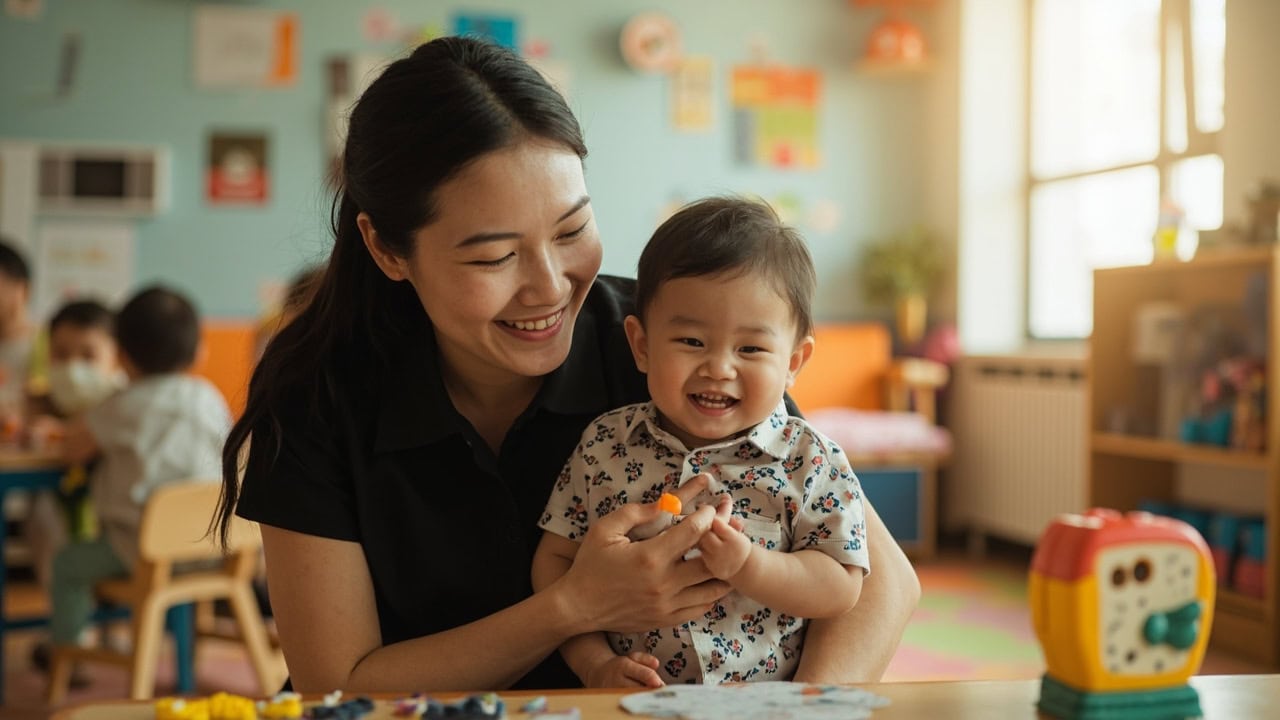
She is not a stopgap between school runs. She is not a domestic helper with an added responsibility. She is an educator, an observer, a nurturer, and a partner to you as a parent. In our model, she is trained, supported, and treated as a professional whose expertise in early childhood development deserves to be honoured.
Communication as a Philosophy
When a family comes to EduNanny, we ask: what does this family need? What are the pressures they are navigating? Where are they feeling unsupported? Is it the morning transition? The communication gap? The uncertainty about whether their child is thriving in the way they hope? Is it the guilt they carry, day after day, that no one in their life has sat with and acknowledged?
We want to know all of it, because all of it matters.
Parents in Singapore are not able to be present during the workday. They cannot see what their child is doing, how they are responding to the caregiver, whether they are eating well, whether they are engaged, whether something is worrying them. And the not-knowing — that informational vacuum — is one of the most anxiety-producing aspects of returning to work after maternity or paternity leave.
We take that seriously. Depending on the service pathway, this includes structured updates, transparent communication channels, and where deployed, measures that give parents an additional layer of reassurance. These are not gimmicks. They are tools that serve a genuine emotional need — the need to feel connected to your child’s day even when you are not in the room.
Working Within Singapore’s Financial Reality
The EduNanny by BUTLER programme works within the ECDA Childminding Pilot framework, which means eligible families can access subsidy structures that make quality care more affordable. The Baby Bonus Cash Gift and Child Development Account — tools that the government has thoughtfully put in place to support Singaporean families — are usable within our service model.
We designed our model to fit within the real financial landscape of Singapore parenthood. Because the last thing a parent needs, alongside all the emotional weight, is to feel that the care their child deserves is simply out of reach.
Common Questions from Singapore Parents
“Am I failing my child by going back to work?”
No. The research does not support this fear. What children need is not a specific arrangement — a stay-at-home parent versus a working parent versus a childcare centre. What children need is a consistent, warm, responsive environment where they feel secure and where their development is actively supported.
If that environment includes quality childcare alongside your love at home, your child can and will thrive. The question is not whether you are present every single hour. The question is whether the hours you are present are full, and whether the hours you are not are handled with the same care and intentionality.
“How do I know if the caregiver is really good?”
Look for evidence of genuine engagement, not just supervision. A good caregiver observes, responds, and adapts to your child. She can tell you something specific about your child’s day — not just that they ate and slept, but how they were, what they were interested in, what made them laugh. She welcomes your questions and sees your involvement as a partnership, not an intrusion.
Ask yourself: does this person treat my child as a complete human being worthy of attention? Or as a task to be managed?
“What if my child cries every time I drop them off?”
Separation anxiety is a sign of secure attachment, not a sign that something is wrong. Your child cries because they love you and you are leaving. This is developmentally normal, often peaking between 8 and 14 months.
What matters is what happens after you leave. A quality caregiver will help your child regulate this distress, comfort them, and gradually help them settle. The tears at drop-off should shorten over time as trust builds — trust in you, and trust in the caregiver.
“Will my child remember this time?”
Your child may not remember the specific details of these early years. But the quality of these early experiences shapes the architecture of their brain — their sense of security, their ability to regulate emotion, their capacity for relationship. The investment you are making now, in quality care, is not visible but it is profound.
Letting Go of Perfect
There is a version of parenting that the internet sells you: the parent who never loses their patience, who serves only organic meals, who has the perfectly curated Montessori shelf, who never lets their child watch screens, who is always present, always intentional, always calm.
That parent does not exist. Or rather, if she does exist somewhere, she is likely exhausted, isolated, and performing a version of parenting that was never meant to be sustained.
Evidence-based parenting is not the same as chasing impossible perfection. Evidence-based parenting means understanding what research tells us actually matters — attachment, consistency, warmth, safety — and letting go of the rest. It means accepting that good enough parenting, done with love and self-awareness, is more than enough for your child to flourish.
You Are Enough
The invisible load that Singapore parents carry is real. It is heavy. And it is time it was named, honoured, and held with the seriousness it deserves.
We see you getting up before dawn to get everything ready so that the morning does not become a race. We see you on the MRT with the diaper bag and the stroller and the sideways glances from commuters who do not know that you are doing the most exhausting and the most important work a human being can do.
We see you in the office at three in the afternoon, checking your phone for the morning update from the caregiver, reading it three times, and then putting it away with a small exhale of something that is half relief and half longing. We see you in the evenings when your child finally sleeps and you sit in the dark kitchen for ten minutes, just sitting, because you have finally stopped moving and the silence is so loud that it feels like the only thing that is truly yours.
You are not failing. You are doing something extraordinarily difficult in one of the most demanding cities in the world, and you are doing it with love as your primary language.
The guilt you feel is not a warning sign. It is a compass. It is pointing you toward the people and the places and the choices that will serve your child well. Trust it, and then act on it, and then let it go enough to rest.
We know that choosing a caregiver — choosing us — is not a decision you make lightly. We know that it requires trust that must be earned, day after day, in small moments of reliability and honesty and genuine care for your child. We know that no amount of marketing language can replace the quiet, incremental proof that comes from watching your child come home happy, safe, and thriving.
If you would like to learn more about how EduNanny can walk alongside your family, we invite you to reach out. Not to make a decision today, but to have a conversation — about what you need, what you fear, and what you hope for. We are here to listen before we are here to serve.
Because quality care is not a luxury. It is not a compromise. It is an extension of the love you already carry. And you, the parent carrying it — you deserve to be seen, supported, and understood.
To learn more about EduNanny and our approach to development-oriented childminding, visit our website or read about the ECDA Childminding Pilot programme. You can also read our story and understand the standards and values behind our work with families in Singapore.