The Security Paradox Why Your Child Thrives When You Choose Childcare
“`html
Understanding What You Are Really Afraid Of
Before we can address the fear, we need to name it clearly.
Singapore parents are not choosing childcare because they do not love their children. They are choosing childcare because they love them so much that they want to provide for them, protect them, and build something stable for their futures. They are choosing childcare because the rent does not pay itself, and because their career matters—not just as income, but as identity, as contribution, as the example they want their children to see of what it means to be a whole person with purpose and ambition and capability.
You are choosing childcare because you know that a child who sees their parents engaged, purposeful, and alive is a child who learns something invaluable about what it means to live fully.
And yet, even knowing all of this, the fear remains.
The fear says: I am choosing distance. I am choosing someone else over my child. I am letting go of something I will never get back.
Here is what I want you to hear: the fear is real. The guilt, when it comes, is not evidence of failure. It is evidence of love that has nowhere else to go. It is love misdirected, love turned inward, love that says: I want to be enough and I am afraid that I am not.
This fear is understandable. It is also, as you will come to see, based on a misunderstanding of how connection actually works between parents and children.
The Paradox of Presence: How Connection Really Works
Here is the counterintuitive truth that I have seen confirmed again and again in the families who come to us at EduNanny: the very act of choosing childcare with intention, with care, with the same love and deliberation you bring to everything else in your child’s life, can restore the closeness you fear you are losing. It does not replace the bond between you and your child. It protects it—and, in ways that may surprise you, it deepens.
Most parents operate from an assumption that sounds logical on the surface: connection is a bank account. Hours deposited equal connection earned. When you are away, the account drains. When you return, you make withdrawals. The more hours you spend with your child, the stronger the bond. The fewer hours, the weaker it becomes.
But this is not how human connection works. It is not how attachment develops. And believing this—truly believing this—is what makes the goodbye at the gate feel so heavy.
A child’s sense of connection to their parent is built on a single foundation above all others: security.
When a child feels secure, they do not spend their emotional energy worrying about whether their parent will come back, whether the world is safe, whether they are truly loved. They are free to explore, to play, to learn, to grow. And crucially, they are free to reach out.
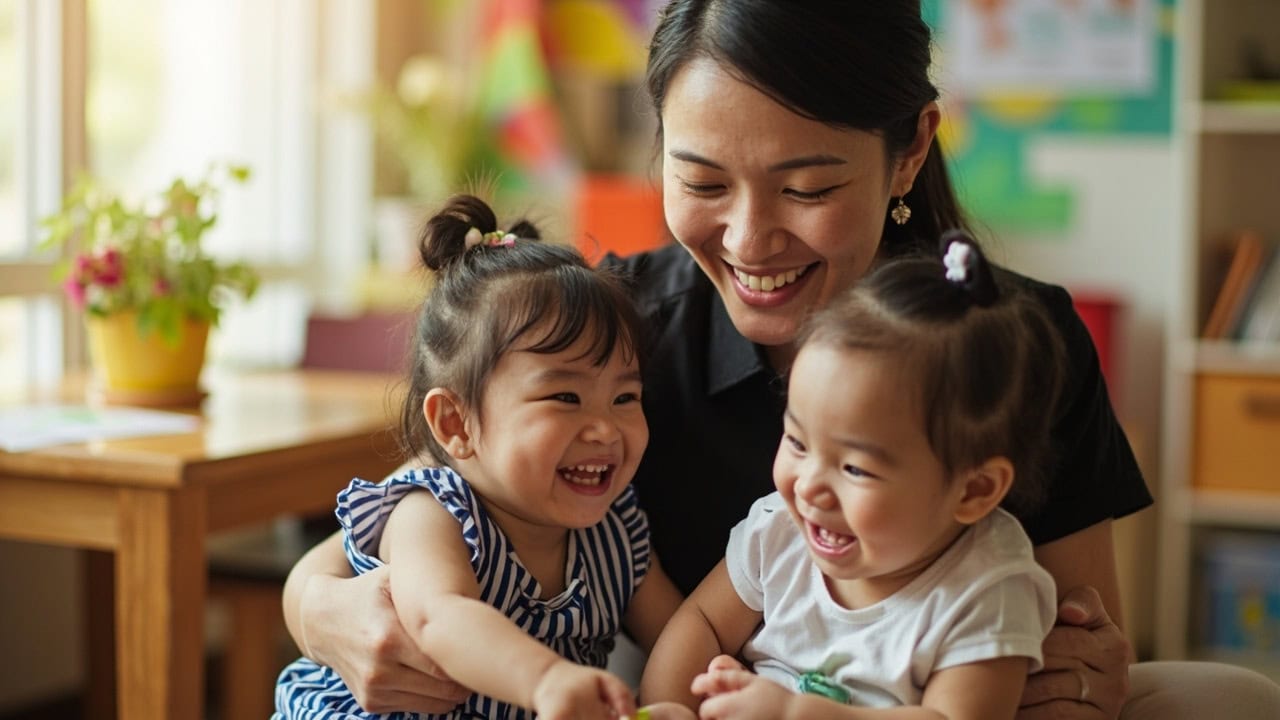
The child who feels secure runs to you at the gate, arms open, face alight. They have spent their day in a world that felt trustworthy. They have been seen, held, responded to. And now they are ready—truly ready—to come home and be with you.
The child who feels insecure hesitates, clings, looks at you with something like accusation because they have spent the day holding themselves together in a world that did not feel entirely safe. They have not been free to explore. They have been conserving energy, waiting, bracing. And when they come home, they are not ready to connect. They are ready to demand.
This is the difference that quality care makes. Not in some abstract, philosophical way. In a real, observable, developmental way.
What This Means for Your Evenings Together
When your child is in an environment where they feel genuinely secure—where the caregiver is responsive, warm, trained, and consistent—they are not drifting away from you. They are building the emotional foundation that allows them to stay connected to you even when you are not in the room.
They are learning that the world can be trusted. They are learning that adults keep promises. They are learning that love does not disappear when it goes out of sight.
This changes the quality of your time together. The first hour at home, which might have felt tense and strained—your child unpredictable, you exhausted, both of you circling each other like unfamiliar animals—begins to soften. Your child is not holding onto their anxiety anymore. They are not asking you to make up for a day of loss. They are ready to be present. They are ready to connect.
The care your child receives during the day is not a substitute for your love. It is a support for it. It is the thing that allows you to come home as the parent you want to be: not depleted, not running on empty, but genuinely present. Emotionally available. Capable of giving your child the quality of attention that matters more than any number of hours.
What Quality Childminding Actually Looks Like
Understanding the principle is important. But you may be wondering: what does this look like in practice? How do I know if the care my child is receiving is the kind that builds security rather than eroding it?
Here are the qualities that matter most:
Responsiveness
When your child cries, do they receive a response? When they reach out, is there someone there? The ability of a caregiver to attune to a child’s signals—to notice, to respond, to attune—is the foundation of secure care. Your child is not looking for perfection. They are looking for consistency.
Warmth
Can you feel the warmth in the interactions? Does the caregiver engage with genuine warmth, not just mechanical competence? Your child can tell the difference. They are reading faces and tones long before they can read words.
Consistency
Children need predictability. They need to know that the same caregiver will be there tomorrow, that the routines will be familiar, that the world operates according to reliable rules. Inconsistency is destabilizing. It is the enemy of security.
Trained Attention
This matters especially for infants and young toddlers. The youngest children need unhurried attention. They need to be seen. They need a caregiver who is not juggling six other children, but who can be fully present to this one, this moment, this need. This is not a luxury. It is a developmental necessity.
Transparency
You should know your child’s day. Not just what they ate or how long they slept, but what made them laugh, what they were curious about, who they played with. Trust cannot be demanded. It must be built through openness.
The Fear That Is Really About You
There is another dimension to this that I want to speak to directly, because I know it lives in many of you.
The fear is not just about your child. It is about you.
It is about the fear that you are becoming less important in your child’s life. That as someone else spends more hours in your child’s day, your role diminishes. That your child will look at you one day and see a visitor, not a parent. That the person who cares for them will become the person they truly belong to, and you will become the person they go home to.
This fear is understandable. But I want to offer you a different understanding of what a parent’s role is.
A parent’s role is not, and has never been, defined by the number of hours spent in proximity to a child.
A parent’s role is to be the anchor. The steady point. The person who knows your child deeply because you made them. The person your child returns to not because you were there every moment, but because you are the person who matters most in a way that has nothing to do with time.
When your child is in quality care, something remarkable happens. Your child’s world expands safely. They form relationships with other caring adults. They learn to trust, to separate, to explore. And when they come home to you, they come home more whole than they would have been otherwise. More capable of being in relationship. More ready to receive what you have to give.
Your role does not shrink when your child is in quality care. It shifts. It deepens. The evenings and weekends and holidays and early mornings take on a different texture. They are not the recovery time after a day of loss. They are the time when your child shows you who they are becoming. When your love meets their growing self, not their anxiety.
Moving Past the Guilt: A Story of Transformation
There is something I want to name clearly: the guilt that often comes after the choice.
You have made your decision. Your child is in care. And still the guilt does not leave. It finds new ways to surface. You see a mother at the park who is there on a weekday and you wonder if you should be too. You read an article about the importance of parental presence and you feel a pang of inadequacy. Your child has a meltdown at the end of the day and you wonder if it is your fault, if you are the reason they are struggling, if you have broken something by choosing to work.
Here is what I want you to hear: guilt is love’s misdirection. It is love that has no productive outlet, so it turns inward and calls itself failure. It is the energy you have for your child, redirected into doubt. It is not evidence of what you have done wrong. It is evidence of how much you care.
The answer to guilt is not more sacrifice. It is not giving up your work or your self or your purpose in the name of being enough. The answer to guilt is confidence in your choice—and confidence comes from knowing that you have made it thoughtfully, intentionally, with your child’s wellbeing at the centre.
You have done that. You are doing that.
When guilt still comes—and it will—let it remind you of what matters to you. Then let it pass. Let it pass because you know, in the part of yourself that is more honest than the fear, that you are doing something hard and doing it with love.
Wei Lin’s Story
Let me tell you about a mother I will call Wei Lin. She is a marketing director with a three-year-old daughter named Anya. When Anya was eighteen months old, Wei Lin returned to work after her maternity leave ended. She had prepared for this. She had researched centres, visited four of them, asked the questions that mattered, and eventually chosen one that felt right. She had done everything a thoughtful parent could do.
And still, every morning, the goodbye was hard.
Not because Anya cried, though sometimes she did. But because Wei Lin felt something shift inside her each time she walked away. She describes it as a kind of shrinking. A sense that her daughter was slipping further from her reach, even as she stood at the gate.
What changed for Wei Lin was not a new childcare arrangement. What changed was a shift in how she understood what was happening—inside her and inside her daughter.
Wei Lin began to notice something shift in the evenings. The first hour at home, which had always felt tense and strained, began to soften. Anya was not holding onto her anxiety anymore. She was not asking Wei Lin to make up for a day of loss. She was ready to be present. She was ready to connect.
A year after Anya started at her EduNanny arrangement, Wei Lin told me something she had not expected to feel. She said: I think I am a better mother now than I was before.
She did not mean before she went back to work. She meant before she made the choice she had been so afraid of. Before she chose care with intention. Before she learned to understand what was really happening when she said goodbye at the gate each morning.
Wei Lin said she had expected to feel like she was losing her daughter. Instead, she felt like she was finally getting to know her. And when Anya looked at her, there was something in her daughter’s eyes that Wei Lin had not expected: trust. Not just the trust of a child who loves their parent. The deeper trust of a child who knows that the world is safe, that adults keep promises, that love does not vanish when it goes away for a while.
Anya reached for her mother not because she was desperate, but because she was free to.
Your Next Steps: Choosing With Confidence
Whether or not EduNanny is the right fit for your family, I want to offer you a framework for choosing any form of childcare with confidence.
Ask About the Caregiver’s Training and Approach
How do they respond when a child is upset? What is their philosophy on routines versus flexibility? What happens when a child is sick? The answers to these questions will tell you more than any brochure.
Observe the Environment
Is it warm? Is it organized? Is there evidence of children’s work on the walls? Do the children look engaged, not just occupied? Do the adults appear calm and present?
Ask About Ratios
How many children per caregiver? For infants, this matters enormously. Lower ratios mean more individual attention, more responsiveness, more security.
Request Transparency
Can you see pictures of your child’s day? Will you receive regular updates? Can you visit unannounced? Trust is built through openness.
Trust Your Instincts
You know your child better than anyone. If something feels off, pay attention to that feeling. If something feels right, trust that too.
What EduNanny Offers
We are part of the ECDA Childminding Pilot, bringing quality, accessible childminding to Singapore families through both home-based and community-based pathways. In our infant care settings, we maintain ratios of up to one to three, because the youngest children need unhurried attention. They need to be seen. They need a caregiver who can be fully present to this one, this moment, this need.
We believe in transparency because trust must be built, not demanded. Where deployed, we have CCTV measures in place. We communicate daily—sharing not just what your child ate or how long they slept, but what made them laugh, what they were curious about, who they played with. We want you to know your child’s day because it is not separate from your life together. It is part of it.
We believe in affordability within the pilot fee structures, because quality care should not only be available to those who can pay premium prices. CDA and Baby Bonus funds are usable with us, and we will help you navigate the practical details so that logistics never become a barrier to the care you want for your child.
We offer Monday to Friday care blocks because consistency is foundational. And we are available to families across Singapore because the need does not live only in certain neighbourhoods or certain income brackets.
This is what EduNanny is. We are not here to take your place. We are here to protect what you are building.
The Truth at the Heart of This
You are not choosing distance when you choose quality childcare. You are choosing to be present in the way that truly counts.
You are choosing to be the parent who comes home without depletion, without resentment, without the quiet anger that builds when ambition and love feel like they are at war. You are choosing to give your child a world that is safe and consistent and full of warm, trained, responsive care.
And you are choosing to come home and do the most important work there is: being with your child. Not as a caretaker. Not as a schedule manager. As their parent. As the person they belong to. As the anchor.
The fear you feel at the gate is not your weakness. It is your love, asking to be directed somewhere productive. So direct it. Choose the best care you can find. Choose it with intention. Choose it with confidence. And then come home and be what only you can be.
Your love is not in question. The bond between you and your child is stronger than the hours you spend apart. That is not a promise we make lightly. It is a promise we see fulfilled every day in the families who trust us.
You have already made the hardest part of the decision. You decided to love your child enough to provide for them, to build for them, to be an example of what it means to live fully. Everything else is just the shape that love takes.
Choose it thoughtfully. Choose it confidently. And trust that what you are protecting is bigger than any single day. It is your child’s whole life. It is your whole life together.
If this article has resonated with you, and if you would like to learn more about how EduNanny approaches infant care and childminding within the ECDA Childminding Pilot, we invite you to reach out. There is no obligation. There is only the conversation.
Because you are already doing the most important thing: you are paying attention. You are researching. You are feeling the weight of it and showing up anyway.
That matters. That is everything. Let us walk this road with you.
#EduNannySG #SingaporeChildcare #InfantCareSingapore #ChildmindingSG #WorkingParentsSingapore
“`