What Your Child Is Really Telling You at Morning Drop-Off
The Morning Ritual: What Your Child’s Body Tells You
Consider, for a moment, the morning ritual that millions of Singapore parents perform each weekday. The waking, the feeding, the packing of bags. The walk through a childcare centre corridor or the arrival of a caregiver at your home. And then the moment of parting—the hand-off, the brief words exchanged, the closing of a door.
How does your child meet that moment?
This is not a rhetorical question. I am asking you to remember, specifically, what your child’s body does in the minutes before and after you leave. Because the body keeps score, and in young children especially, the body is not yet sophisticated enough to hide what it feels.
A child who is merely tolerating their childcare environment will show it. Their shoulders will be tense. They will hang back, or cling, or cry with a desperation that does not resolve into comfort even after you have gone. There is a particular quality to the cry of a child who is not at ease—not the protest of a brief separation, which is normal and healthy, but the deeper distress of a child who does not feel held in their environment.
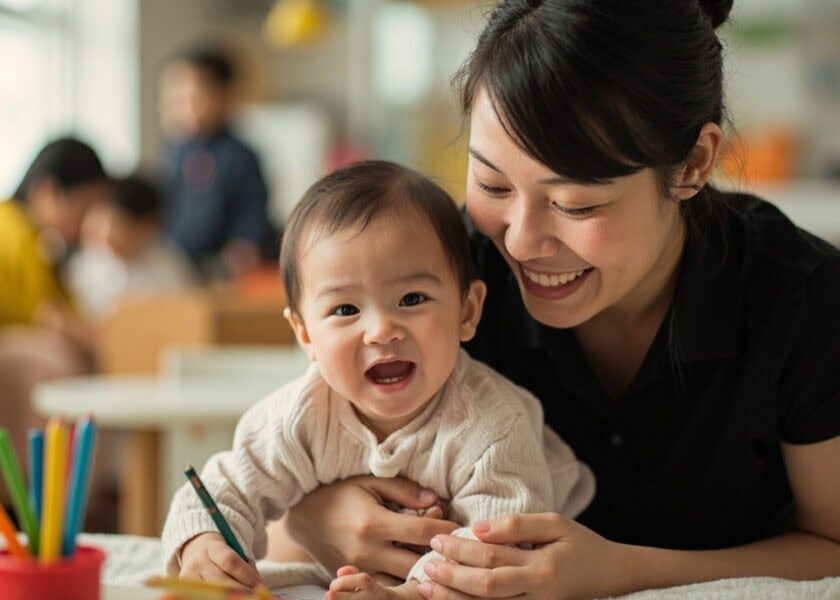
A child who is thriving, a child who has found their footing in a space of genuine care, will show you something different. Their body will have a looseness to it even as they wave goodbye. They may glance back once or twice, but there is no panic in the glance. They are not watching to see if you will come back—they are confident you will, and more importantly, they are confident that what they are returning to is good. They settle into the arms of their caregiver with a particular kind of surrender, the way a child settles into a familiar story they have heard many times and love.
This is the first language of your child’s interior world: the language of the body in the morning. Start noticing. Not to judge yourself or your choices, but simply to observe.
After Pickup: Reading the Hours That Follow
Move forward in time, to the afternoon, to the hours after you have reunited. This is where many parents feel most uncertain. They have been apart from their child for eight or nine or ten hours. They arrive to collect them, and they scan the small face for clues. Is this child happy? Did they have a good day? Are they glad to see me?
Here is what matters to understand: your child’s response to you at pickup is not the whole story. In fact, it is often the least revealing part of the equation. Children are adaptable. They have missed you. They are relieved to see you. That reunion energy can mask what has been happening in the hours before.
So where do you look instead? You look at what happens in the hours after. You look at what emerges when the pressure of reunion has passed and your child is simply themselves again, in the comfortable space of home.
What Your Child’s Play Reveals
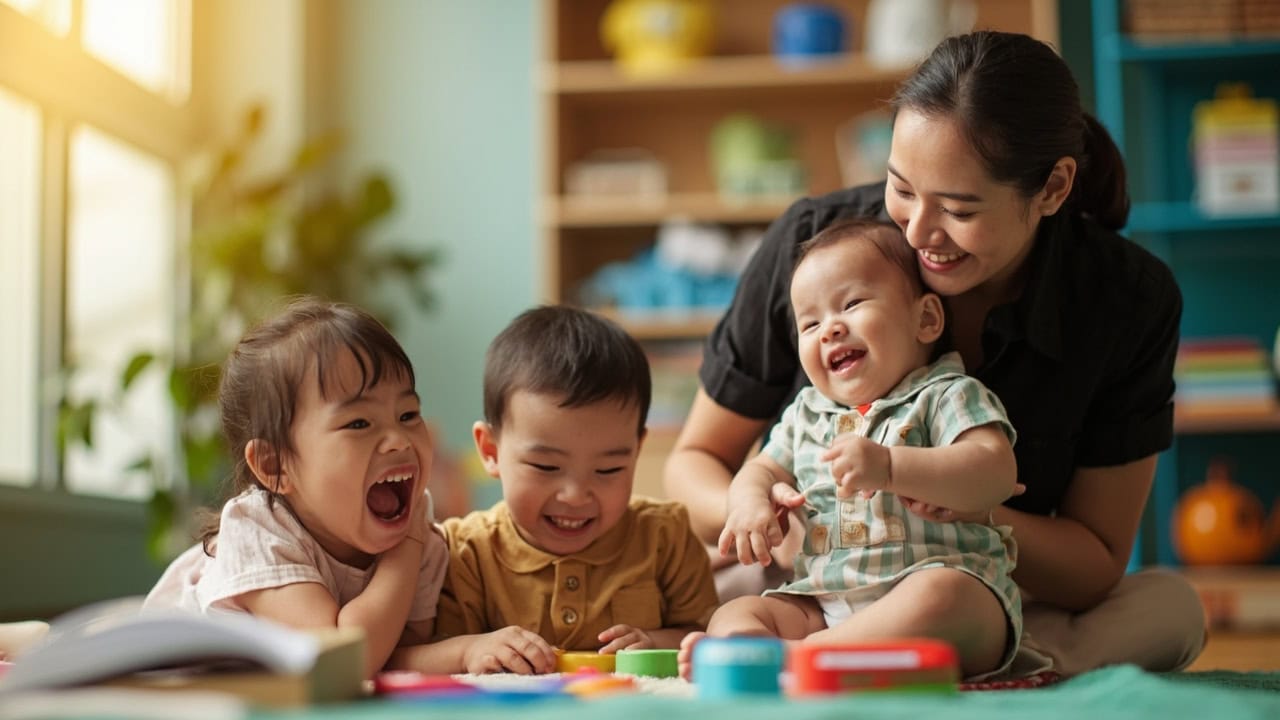
The content of your child’s play is not random. When children feel safe, when they feel held in an environment of genuine attunement, their play takes on a particular quality. It becomes exploratory. It becomes imaginative. It starts to include others—their caregiver, their friends, the routines and rhythms of their day—not as obligations or anxieties, but as characters in stories they are beginning to tell about themselves.
A child who has spent the day in a space where they felt known will often reproduce that feeling in play. They will be the caregiver. They will care for dolls or stuffed animals with a tenderness that mirrors what they have received. They will create scenarios of comfort, of closeness, of problem-solving.
A child who has been merely supervised, who has been cared for but not truly seen, will often show something different. Their play may be more repetitive, more solitary, more focused on physical sensation than imaginative elaboration. This does not mean anything is irreversibly wrong. But it is information. It is your child telling you something about the quality of their inner experience, encoded in the stories they are telling themselves through play.
The Language Children Use About Their Caregiver
Language, even the limited language of a one-year-old or a two-year-old, is a powerful window. Children begin to name the important people in their lives long before they can articulate complex emotions. And when a child begins to speak about their caregiver—spontaneously, without prompting, in the middle of ordinary moments—a parent should pay attention.
Not all mentions are equal. There is a difference between a child who says their caregiver’s name because it is a familiar sound in their environment and a child who speaks of their caregiver with a quality of warmth, of anticipation, of recognition.
When a child volunteers that their caregiver does something—when they say, “Miss Lim gives me crackers,” or “Auntie Sarah reads books,” with the particular emphasis that means this matters to them—you are hearing evidence of a relationship that has meaning.
Children in quality care environments often begin to use their caregiver as a secure base, even in the parent’s presence. They may show their caregiver a toy, or run to them for comfort in a small distress, or look to them for reassurance in a new situation. This is not a betrayal of your bond with your child. This is a sign of health—a sign that your child has learned how to generalize security, how to trust, how to attach flexibly to the good enough figures in their life.
Comfortable or Thriving? Understanding the Difference
What we are describing is not a checklist. It is your child’s felt sense of their world—what safety feels like from the inside when you are two years old, or three, or four. And it is this felt sense, more than any external marker, that determines whether a child is merely comfortable or truly thriving.
There is a difference between these two states, and it is more significant than many parents realize.
A child who is comfortable is not unhappy. They are not suffering. But they are also not fully themselves. They are getting through their days. They are compliant, often, because compliance is easier than resistance when you do not feel secure enough to be known.
A child who is thriving, on the other hand, is a child who is growing in every sense—emotionally, cognitively, creatively, socially. They are not just being cared for. They are being seen. And the evidence of this seeing shows up everywhere: in the body and the play and the language and the way they move through their days.
Signs Your Child Is Thriving in Care
- Physical ease at drop-off, not just tolerance
- Imaginative play that includes caregivers and routines
- Spontaneous mention of caregiver with warmth
- Ability to use caregiver as a secondary secure base
- Curiosity and exploration in their environment
- Confidence that parents will return—not anxiety, but certainty
Signs Your Child May Be Merely Comfortable
- Compliant behavior that lacks genuine enthusiasm
- Relief-focused reunion rather than balanced connection
- Play that is repetitive or solitary without imaginative depth
- Physical tension that persists after the morning handoff
- Reluctance to go that feels deeper than normal separation anxiety
What Quality Childminding Looks Like in Singapore
For parents researching infant care and childminding options across Singapore, understanding what quality looks like from the inside makes the decision less about abstract credentials and more about what your child actually shows you.
Quality childminding is attunement in action. It is a caregiver who notices when a child’s energy shifts, who understands that a tantrum might be about hunger rather than manipulation, who can read the difference between a child who is testing boundaries and a child who is feeling overwhelmed.
It is the small moments—a hand on a shoulder at the right time, a story told with genuine engagement, the patience to let a child finish their thought even when it takes longer than expected.
When choosing, ask yourself: Does this caregiver kneel down to meet my child at their level? Do children seek them out? Ask how they would respond to a child who is struggling. Listen for whether they see behavior as communication rather than something to simply manage.
In Singapore’s context, quality care also means respecting the realities of working parents. It means transparent communication that helps you understand your child’s day without hovering. It means reasonable hours that fit actual work lives. Fee structures that make sense, and the ability to use available schemes like the Child Development Account and Baby Bonus.
If you notice signs that concern you—a difficult pattern over weeks, not just a difficult day—talk to your caregiver. Not from a place of accusation, but from genuine curiosity. A quality caregiver will welcome this conversation. And trust your gut: you know your child better than anyone. If something feels wrong, it deserves attention.
How EduNanny Singapore Approaches Your Child’s Interior Experience
EduNanny by BUTLER is built on a premise that guides every aspect of how they work: the child’s interior experience is not a mystery to be wondered about, but a reality to be honored.
When childcare is designed from the inside out—from what a child actually feels, actually needs, actually shows us—rather than from the outside in, something shifts. It shifts the caregiver-to-child ratio, making attunement possible. It shifts the training, which focuses not just on safety protocols and developmental milestones, but on the finer textures of a child’s emotional life: how to read a child’s signals, how to respond to a child’s inner state, how to create an environment where a child feels not just supervised but known.
What makes this approach meaningful for parents in Singapore is that it creates conditions where your child’s interior world becomes visible to you. Not through constant monitoring, not through cameras or daily reports alone—though communication and transparency are part of how trust is built with families. But because when a child is truly thriving in care, it shows. It shows in the body at the morning drop-off. It shows in the play after pickup. It shows in the language your child uses and the security your child carries.
When parents learn to read these signals, something shifts in the childcare decision itself. It stops feeling like an act of blind faith and becomes something else entirely. It becomes an act of recognition.
EduNanny participates in the ECDA Childminding Pilot, offering pathways that work for real Singapore families. Whether through home-based care, where a caregiver comes to you and your child’s environment is honored and extended, or through community and centre-based options that offer connection and structure, EduNanny is committed to making quality childcare accessible. The pilot fee structures, the usability of CDA and Baby Bonus, the Monday to Friday care blocks that fit real Singapore working lives—these are deliberate design choices that reflect a belief that every child deserves to be seen, and every family should be able to access that.
The Gift of Seeing Your Child Clearly
When you learn to read your child’s interior world, you begin to recognize yourself reflected in them. You begin to see your own love, your own care, your own intention, answered and amplified in the life your child is living when you are not there.
You see your child thriving—not just surviving, not just comfortable, but thriving—and you understand that this is not separate from you. This is what your trust has made possible. This is what your choices have built.
So let me return to where we began. To the morning silence after you have handed your child to someone else. To the walk, the drive, the commute. To the space where your imagination fills in what you cannot see.
I want to offer you something different for that space now. Not anxiety. Not uncertainty. But a kind of quiet confidence—not the confidence that comes from knowing everything will be fine, because parenting is never that simple, but the confidence that comes from knowing you have learned to listen.
You are beginning to hear what your child has been telling you all along. When you collect them at the end of the day, you will know how to look—not just at their face, but at their body, their play, their language, the whole texture of who they are in that moment. And when you see what you see, you will trust it. You will trust what your child is showing you, because you have learned to understand what it means.
EduNanny Singapore stands for not the removal of your role as a parent, but its expansion. Not the outsourcing of your child’s care, but its deepening. They are here to walk alongside you in this extraordinary, demanding, beautiful work of raising a child—to be the ones your child runs to, the ones your child trusts, the ones who help them grow into the person they are becoming.
And to give you, in return, the greatest gift a childcare provider can offer: the ability to see your child clearly. To know, in your bones, that they are thriving.
Because they are. And once you learn to read the language they are already speaking, you will know it too.
Explore EduNanny Singapore
If you are searching for infant care or childminding in Singapore and want to learn how EduNanny creates conditions where your child’s thriving becomes visible, start a conversation with them.
Discover more about how EduNanny approaches quality childcare, or explore the full range of services available for your family.
#childmindingSingapore #infantcareSingapore #qualitychildcare #EduNanny #Singaporeparents