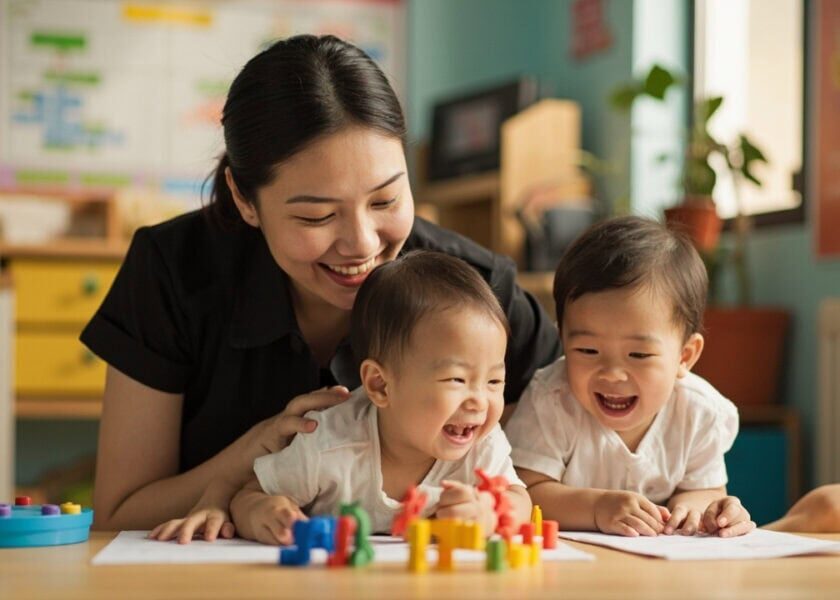
Your Child Is Not Yours Alone
The Quiet Moment Before the Search Begins
There is a moment, before you begin your search, before you read your first review or tour your first facility, when you sit quietly with a feeling you cannot quite name.
It is not excitement. It is not relief. It is something closer to sorrow—a quiet, persistent ache that tells you something is about to change, something you cannot take back.
Your child will spend their days with someone else. Your days will look different from the ones you imagined when you first held them. And in that moment, you wonder if you are failing them before you have even begun.
I want to start by telling you this: you are not failing. What you are feeling is not weakness, and it is certainly not evidence that you should stay home. What you are feeling is love, doing what love does when it is asked to make space for something it did not expect to share.
This is the part of childcare no one talks about. Not the checklists. Not the ratios. Not the curriculum frameworks or the facility tours. The quiet, interior journey that begins long before you make a single phone call—the journey of a parent learning to live inside a new kind of question: How do I be enough when I cannot be everywhere?
What you are about to read offers validation for the emotions you are carrying, clarity on what children actually need for healthy attachment, and practical guidance for choosing quality care with confidence. What matters most is this: choosing with intention is what good parents do.
Understanding What You’re Feeling
Singapore holds its parents to a particular standard. There is an unspoken architecture of expectation here, built from generations of family closeness, from the pride of the kampong spirit, from a culture that values a mother’s presence in ways that can feel both beautiful and suffocating.
When you express doubt about returning to work, you may hear words of understanding. But beneath them, perhaps, a quieter message: Shouldn’t you want to stay? Isn’t that what good mothers do?
And so you carry two burdens instead of one. The legitimate grief of a transition that is genuinely hard, layered atop the guilt of wondering whether you are supposed to feel this way at all.
The Guilt Is Not a Warning
The guilt you feel is not a signal pointing you back home. It is the sound of your heart learning to expand. It is what happens when someone you love more than your own life is ready to need more than you alone can give.
The guilt is real, but it is not a warning. It is a witness to how much you care.
And caring—this fierce, sometimes overwhelming caring—is exactly what will make you a better parent, not only today, but through every choice you make from here.
The Grief of Letting Go
There is grief here, too, that we do not name enough. The mornings you will not see. The first steps you might not catch. The particular way your child says their first word, their first sentence, to someone else.
You imagined those moments as yours—treasures you would hold and remember and retell at birthdays and weddings. And now you understand that the village will be there for some of them, and that the village is not stealing anything from you.
This grief is not melodrama. It is the appropriate response to a profound shift: you are no longer the only one. Your child is becoming a person who belongs to the world, and you are the one who must let them.
That letting go begins not when they start school, but long before—when you make the choice to trust someone else with what matters most.
Living Between Two Worlds
In Singapore, this letting go carries particular weight. We are a society that values the extended family, that speaks of grandparents and cousins and neighbors as essential threads in a child’s life. But we are also, increasingly, a society of parents who have built our lives around careers and cities and apartments where the village exists mostly in group chats and occasional visits.
The distance between what we believe about family and where we actually live creates a tension that is uniquely Singaporean, and uniquely painful. You may feel this as a failure of your own.
Consider a different possibility: perhaps the life you have built is exactly the one your child needs you to build. Perhaps your career, your growth, your mental health, your financial stability—these are not things you protect at the expense of your child, but things you protect because your child needs you whole, needs you fulfilled, needs you to model what it looks like to live a full human life.
Releasing the Fantasy of Sacrifice
This is not a comfortable idea for every parent to sit with. It asks us to release the fantasy of sacrifice as the primary expression of love. It asks us to believe that a parent who returns to work, who trusts a caregiver, who takes time to be something other than a mother or a father—that this parent may, in fact, be giving their child something irreplaceable.
Not the absence of presence, but the gift of a model: a person who grows, who contributes, who finds meaning beyond the four walls of home.
Think about what you want your child to learn about adulthood. You want them to understand that people can build lives of purpose, that work can be meaningful, that identities can have many dimensions. How do they learn this? By watching you live it.
What Children Actually Need
The research on this is clear, even if the headlines rarely capture its nuance. Children do not need their parents to be present in every moment. They need their parents to be present in a different way—a way that is emotional, responsive, and consistent.
They need caregivers who are warm, attentive, and attuned. They need environments that are safe enough to explore. And they need parents who are not depleted, not drowning, not so overwhelmed by the weight of doing it all that they cannot breathe.
Secure attachment is not built through hours of proximity. It is built through the quality of responsiveness, the consistency of presence, and the emotional availability you offer in the time you do share.
What undermines a child’s sense of security is not separation itself, but the anxiety of a caregiver who is conflicted, guilt-ridden, and emotionally unavailable. When you choose with clarity and peace—when you trust your decision—you offer your child something no amount of physical proximity can match: the gift of a parent who is growing alongside them.
Choosing Care That Sees You Both
Here is what this means for your childcare search: you are not looking for someone to replace you. You are looking for someone to partner with you.
The caregiver who holds your child each day is not a lesser version of you. They are an extension of the circle of care you are building around your family—a circle that includes you, yes, but also includes others who will love your child in their own way, who will teach them something you cannot, who will be part of the village that raises them.
This is not compromise. This is not settling. This is what humans have always done, what every generation before us has done, what we are only now in danger of forgetting because we have built our lives around nuclear families in a world designed for extended ones.
Signs of Care That Honors You Both
Choosing childcare is not a failure of your love. It is a declaration of it. It says: I love you enough to build you a world bigger than just me.
What does it mean to choose well? Not perfectly—perfect is not available to any of us—but well, with intention and care and the understanding that you will not always get it right, but you will keep showing up.
It means choosing care where your child is safe. Where the ratios allow for attention—one to three for infants, because in those early months and years, attention is not a luxury but a necessity. Where the environment is warm, not just clean. Where the caregivers are not just trained, but called to this work.
It means choosing care that honors the relationship you have with your child. That sends you photos not because it is protocol, but because they know you are thinking of your child right now, that you wonder what they are doing, that the distance is hard for you. That tells you the truth, even when the truth is that your child had a hard morning, or that they did not eat well, or that something happened that you need to know about.
Transparency is not a feature. It is the minimum expression of respect.
It means choosing care that sees you. That understands that the parent standing at the gate with red eyes is not weak, but wounded in the particular way that love wounds us when it asks us to expand. That does not judge your choice to work, or your choice to find support, or your choice to need something outside of motherhood or fatherhood.
Questions to Ask Any Caregiver or Service
As you begin comparing options, here are the questions worth asking—not as a checklist to panic over, but as guides toward clarity.
- What is the caregiver-to-child ratio, especially for infants?
- How would you describe your approach to comfort when a child is distressed?
- How do you communicate with parents during the day?
- What does a typical day look like for the children?
- How do you handle feeding, sleeping, and developmental milestones?
- What happens if my child is unwell?
- How do you support parents during the adjustment period?
Look for caregivers who ask about your child’s routines, who want to know your family’s values, who speak about your child as an individual with their own temperament and needs. Look for environments where children seem curious and at ease, not just quiet. Look for communication that feels generous rather than minimal—updates that come not just when requested but because someone understood you needed them.
The right fit will not make the transition easy. There will still be hard mornings. But you will feel, even through the difficulty, that your child is seen. That you are seen. That this partnership is one of mutual respect.
How EduNanny Understands This
EduNanny was built with this understanding at its center. Not as a slogan, but as a practice. The caregivers who work with EduNanny are not just vetted for qualifications and experience, though they have both. They are vetted for something harder to measure: the capacity to hold both the child and the parent in mind at the same time.
To understand that behind every inquiry is a person in the middle of one of the most difficult decisions of their life. To treat that person with the gentleness they deserve.
EduNanny is part of the ECDA Childminding Pilot, which means it operates within a framework designed to make quality care accessible. The fees are structured to be within reach for families who are making this choice not out of convenience, but out of necessity and love.
The pathways available—home-based care, community options where applicable—mean that your family can find the arrangement that fits your life, not the other way around. Monday through Friday care blocks. CDA and Baby Bonus usability, because every dollar matters when you are planning a budget around a new human. Singapore-wide relevance, because the need for this kind of support does not respect neighborhoods or districts.
Where CCTV is deployed, it is not because we do not trust the caregivers. It is because we trust the parents, and we know that trust is built through transparency, not promises. Where communication is regular and open, it is because we know you are not just dropping your child off—you are entrusting them with your whole heart, and you deserve to know how that heart is being held.
This Is What We Understand
EduNanny understands that you are not a problem to be solved. You are a person in the middle of something enormous. The childcare search is not just logistics—it is the external expression of an internal reckoning:
- Who am I now that I am a parent?
- What do I owe my child?
- What do I owe myself?
- How do I reconcile the life I want to live with the life my child needs me to model?
These questions do not have clean answers. But they deserve to be held by people who take them seriously. By a service that sees the full human in front of them—the parent who is scared, and hopeful, and doubting, and loving, and trying so hard to get it right.
If you choose us, we will earn your trust every day. We will send you the photos because we know you need them. We will tell you the truth because you deserve it. We will care for your child the way you would, with warmth and attention and the understanding that every child is a world unto themselves.
And if you choose someone else, we hope you find what you are looking for. Because this was never about us. It was always about you—about your family, your child, your heart.
Permission to Choose
Here is what I want you to carry with you, whether you choose EduNanny or choose somewhere else entirely.
You are not failing. The doubt you feel is not evidence of your inadequacy—it is the sound of your conscience, working as it should. The guilt you carry is not a burden to be eliminated but a reminder of what you are capable of feeling. The grief of this transition is not weakness. It is the appropriate response to a life that is changing, a child who is growing, a self that is being remade.
The question is not whether you love your child enough to stay home. The question is whether you love your child enough to be honest about what you need to thrive, and to build a life around that honesty. Whether you can release the fantasy of the perfect parent—the one who is always there, always present, always enough—and embrace the more complicated, more human version: the parent who works, who trusts, who needs help, who sometimes feels like they are failing, and who shows up anyway.
Your Well-Being Is Not Separate
Your child does not need you to be there for every moment. They need you to be there, period—present, consistent, loving, and real. They need you to be a whole person. And a whole person, by definition, is a person with a life outside of parenthood.
A depleted parent cannot offer what a fulfilled one can. A resentful mother, staying home out of guilt, gives her child something very different than a mother who returns to work with clarity and peace. A father who is fulfilled by his career comes home differently than one who is counting the days until he can leave.
Your well-being is not separate from your child’s. It is the foundation on which their security is built.
Welcome to the Journey
And so I want to close by offering you something I hope you will accept: permission.
Permission to choose what you need. Permission to trust someone else with your child, knowing that this trust is an act of love, not a failure of it. Permission to grieve the days at home that you will not have, and to still choose the days you will have, full of meaning and purpose and growth. Permission to be the parent you actually are, not the parent you think you are supposed to be.
You are not supposed to be anything. You are figuring it out, as every parent before you has done, as every parent after you will do. The difference is that you are doing it in a city that does not always make it easy, with a culture that does not always give you permission, with a sense of responsibility that sometimes feels like it might crush you.
And still, you are here. Searching. Thinking. Feeling. Asking the hard questions.
That is not the behavior of a failing parent. That is the behavior of someone who loves so much that they cannot turn away from the weight of it.
The village is not a threat to your family. It is the thing that makes your family possible. You are not failing by asking for help. You are joining a tradition older than nations, a practice as old as human time: parents raising children together, with others, for each other.
You are not alone. You never were.
Welcome to the search. And more importantly, welcome to the journey—messy and hard and full of doubt and love and all the things that make it worth living.
If you are ready to explore what partnered, compassionate childminding looks like in Singapore, we invite you to begin a conversation with EduNanny. We will meet you exactly where you are.
At EduNanny, we believe that trusted, development-oriented childcare begins with understanding. Learn more about our approach to compassionate childminding across Singapore.