Stacking Cups at 13 to 18 Months: A Three Round Play Activity
A calm home activity shows how to start with two pieces, repeat a familiar setup and introduce one change only when your toddler remains engaged.
For toddlers aged 13 to 18 months, make stacking play an invitation rather than a test of building a tower. We suggest starting with two easy pieces, leaving your toddler to choose what happens next and repeating the setup while it still seems welcome. If another round may be useful, change just one feature instead of rebuilding the whole activity.
This guide stays with toddlers aged 13 to 18 months. For children aged 12 months to 2 years, UNICEF suggests stacking simple objects such as empty food containers and plastic cups. UNICEF’s stacking play guidance HealthHub gives stacking two blocks high as one example of suitable physical play for toddlers aged 13 to 18 months in a safe, supervised setting. HealthHub’s guide for this age
Begin with two easy pieces
Clear a space on the floor and place two clean, empty plastic cups within your toddler’s reach. Leave one upright and the other beside it or on its side. Choose clean, undamaged play pieces that are suitable for your toddler and large enough to reduce the risk of choking. Stay close enough to respond without taking over. UNICEF advises choosing safe, clean toys that are large enough not to choke on. UNICEF’s play safety advice
Your toddler may put one cup inside the other, knock them apart, carry one away or show little interest at first. These choices are part of the play. You do not need to correct the arrangement or demonstrate the result you had in mind. If your toddler moves away or loses interest, let the round end.
When an action catches your toddler’s attention, name it once in a few simple words. If they place one cup inside the other, you might say, “You put one cup in the other.” UNICEF suggests naming what a child is doing during stacking play. UNICEF’s communication tip
Change one feature at a time
If your toddler returns to the cups and another round still seems welcome, keep most of the setup familiar. Change one feature so that the activity remains easy to enter. For example, add one block as a possible destination, offer one empty food container or place the same pieces in a slightly different position on the floor. Leave the rest of the setup unchanged and do not show your toddler exactly what to build.
After making the change, pause and watch. Your toddler may try the new element, return to a familiar action or move on. Do not add another piece simply because the first change received no response. Moving away, becoming tired or showing frustration is enough information to simplify the activity or stop.
Try three short rounds
This home demonstration uses two wide, empty plastic cups, one empty food container and two clean, undamaged wooden or plastic blocks chosen as safe, age-appropriate play pieces and large enough to reduce the risk of choking. Prepare everything before beginning, but place only the cups within reach at first. Keep the other pieces out of reach so that you can introduce them one at a time.
Round one: try the familiar pair
Set the two cups on the clear floor in front of your seated toddler. Leave one upright and one beside it. Stay within sight and reach, but do not give an instruction for every movement. If your toddler explores the cups, describe one action when it seems useful. For example, say, “You put the cup down.” If the cups remain untouched, let the round end when their interest shifts.
Round two: repeat the same setup
If your toddler is still engaged, bring the same two cups back into roughly the same arrangement. Keep the food container and both blocks out of reach. Notice the actions your toddler repeats, such as turning a cup over, grasping both or placing one inside the other. There is no final arrangement to complete.
Round three: add one new element
Bring back the same two cups and place one of those blocks beside them. Stay within reach and allow your toddler to decide what to do. They may rest a cup on the block, move the block or ignore it. If they place a cup on the block, you might say, “The cup is on the block.” Keep the food container and second block aside for now.
If your toddler ignores the block, leave the setup simple. Adding the container or another block in the same round would add more than one change to the setup. End the activity when your toddler becomes tired, frustrated or consistently uninterested. You can also stop while they still want to continue, because the aim is a short period of enjoyable play rather than a completed stacking exercise.
Treat this as play, not a milestone test. HealthHub notes that toddlers develop at different rates and advises seeking professional advice for a specific concern about a toddler’s development. HealthHub’s toddler development guidance
Sources and further reading
- The power of play – from the moment your baby is born | UNICEF Asia Pacific · www.unicef.org
- The Beginner’s Guide To Taking Care of Your Toddler: 13 to 18 Months · www.healthhub.sg
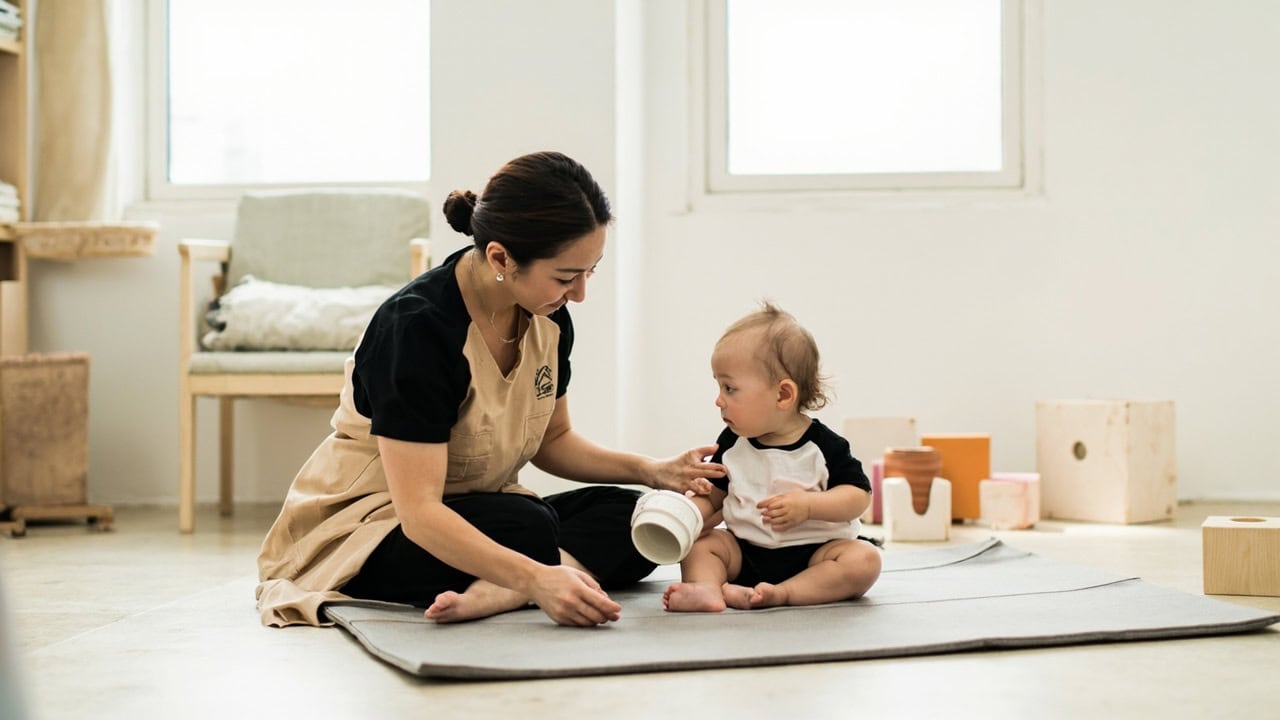
The image in this article was generated with AI for illustration. It does not show an actual EduNanny staff member, child or facility.
For the next round, begin with the action your toddler returned to, then change one feature only if play still seems welcome.