How to Connect With a Baby Who Is Not Making Eye Contact
Use one safe everyday object to follow your baby’s focus, respond briefly to a sound, look or movement, and leave room for their next contribution, even without direct eye contact.
A baby aged 7 to 12 months can take part in a two-way exchange without looking at your face. If your baby looks at a soft ball instead, notice the shared focus, give one brief response, then pause to see what comes next. Direct eye contact may happen naturally, but you do not need to make it happen before you respond.
Our simple rhythm is to notice, respond and pause. Harvard’s discussion of responsive interactions describes “serve and return” as beginning with what a child is exploring or vocalising and an adult returning that contribution. It also notes that these exchanges can happen in seconds within ordinary routines.
Start with what your baby notices
You can share attention around an object, sound or action. If your baby looks at a ball, join their focus and say “ball” once. If they turn towards a sound, a nod or brief “um hmm” can acknowledge what you noticed. Harvard’s panel explains that an adult can name what a child is attending to or use nonverbal acknowledgement such as a nod.
When your baby does look at you, respond to the look as you would to a sound or movement. You do not need to bring their attention back to your face before continuing.
For babies aged 7 to 12 months, a sound or short word can be enough. HealthHub’s guide to infants aged 7 to 12 months notes that infants at 7 to 9 months may copy lip movements and produce word-like sounds with conversational intonation. At 11 to 12 months, infants may imitate words or word-like sounds, and unclear pronunciation is acceptable when the aim is to encourage imitation. These are possibilities within the age range, not deadlines.
Match one contribution, then pause
Make your response fit the contribution your baby has already made:
- For a sound, return one similar sound or brief acknowledgement.
- For a look or reach, name the object or, if it is safe and available, bring it within easy reach.
- For a gesture, nod, make a simple gesture or offer a relevant object.
Choose one response rather than adding a long explanation. Then pause. UNICEF’s take turns guidance specifically recommends pausing after responding to a baby’s babble so there is time for another response. If another sound or movement comes, notice it and respond once more. The pause is room for your baby, not a test that needs completing.
Responsive does not mean uninterrupted. Harvard’s discussion also notes that children need some time to process without adult interaction all the time.
Try a side-by-side ball exchange
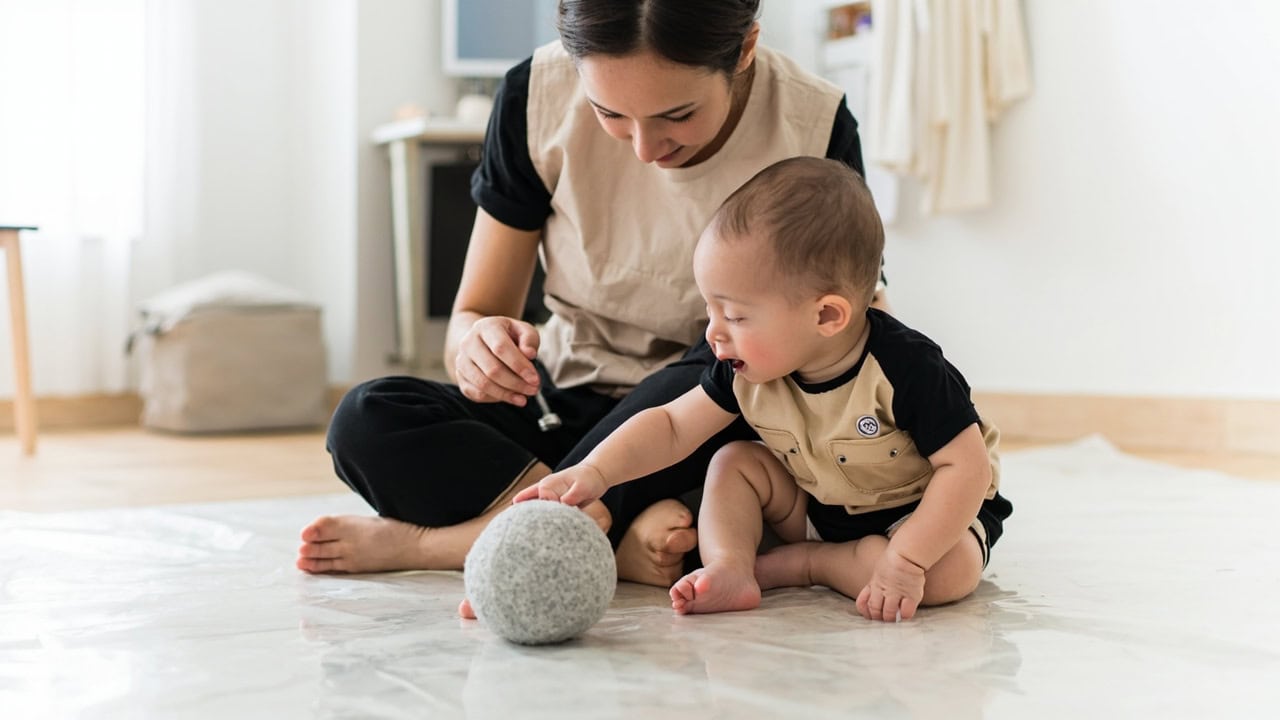
For a worked example, choose one large, intact soft cloth ball with no small or detachable pieces. Support your awake baby in a stable seated position on a clear mat beside you and stay within arm’s reach. Put the ball where you can both see it. HealthHub advises larger toys for grasping infants and toys that are intact, without small pieces that could break off.
Use the following as a set of possible branches, not a sequence to complete:
| What you notice | One brief response | What you leave room for |
|---|---|---|
| Looks towards the ball and makes a sound | Join the shared focus and say “ball” once | Another sound, reach, glance or shift elsewhere |
| Reaches towards the ball | Place it within easy reach, then pause | A grasp, tap, push, sound or movement |
| Makes another sound | Return one similar sound or short word | The baby’s next sound or movement |
| Turns attention elsewhere | Acknowledge the new focus briefly if it is safe, or let the exchange end | The baby’s choice to rejoin or move on |
Afterwards, if you want to remember the moment, make one factual note: “Looked towards the ball and made a sound. I said ‘ball’ and paused.” If your baby reached, turned away or stayed quiet, record only what happened. The note describes an exchange without assigning a developmental score.
Follow attention without making it a test
Following attention means noticing a shift and joining it when it is safe, not allowing your baby to decide essential safety matters. Harvard’s discussion notes that adults can follow the attention of children under three, while retaining adult direction for necessary transitions such as leaving home, using a car seat or crossing a street.
A turn away or quiet finish during one exchange is an observation, not a developmental assessment. Separately, HealthHub advises consulting a doctor if an infant is not making baby talk or babbling by 12 months, because a hearing test may be needed. This guidance concerns babbling over time, not eye contact during one play moment.
The exchange can end without another word, look or action. It simply marks the natural end of this moment.
Sources and further reading
- Podcast: Serve and Return – Center on the Developing Child at Harvard University · developingchild.harvard.edu
- 21 learning activities for babies and toddlers · www.unicef.org
- The Beginner’s Guide To Taking Care of Your Infant: 7 to 12 Months · www.healthhub.sg
The image in this article was generated with AI for illustration. It does not show an actual EduNanny staff member, child or facility.
At your next ordinary moment, notice what your baby offers, return one matching response, then pause long enough to notice what follows.