How to Make a Screen-Free Care Plan for a Baby Under 18 Months
A clear caregiver plan does more than name a screen preference. It offers a baby under 18 months familiar next steps and gives parents a useful note to discuss after care.
If your baby is under 18 months and your family wants care without screens apart from live interactive video chats, “please avoid screens” can still leave the practical part unclear. What should the caregiver offer when your baby is restless, when an activity no longer interests them, or when a nappy change, feed or rest needs attention?
The answer is a short family agreement with three parts: one precise rule, two or three familiar alternatives and a way to check what happened during care. This gives the adult a clear starting point while leaving room to respond to your baby’s comfort and cues. The guide applies to babies under 18 months and sets out a family preference, not a claim that every caregiver or setting follows the same policy.
Turn the preference into one clear rule
Singapore guidance gives families a precise starting point for this age group. HealthHub advises no screen use for children under 18 months except for interactive video chatting, and says not to leave the television on in the background. HealthHub’s under-18-month guidance defines passive viewing as screen viewing without an adult co-viewing and interacting, so the exception is for a live exchange rather than a video left playing.
HealthHub explains that babies at this age learn best from experiences in the real world, including physical play, reading and social interaction. It also says unstructured free play is more valuable than electronic media. HealthHub’s play guidance In the care plan, that becomes concrete: give the caregiver a familiar interaction to offer and leave room to follow the baby’s attention.
Before care begins, separate your family preference from the caregiver’s or setting’s own arrangements. HealthHub advises families using infant care to ask about the setting’s screen policy and controls. For a babysitter, it says to make sure the person knows and follows the family’s rules. HealthHub’s advice for care outside the home Ask which devices are usually visible to the baby, when an agreed live video chat will happen, and who will make sure they are put away afterwards. The answers will depend on the particular caregiver and setting, so confirm them before care begins.
Your written rule should name the baby’s age, the interactive video chat exception and the background television setting. Those details remove the need for the caregiver to interpret “screen-free” on their own.
Offer choices the caregiver already knows
HealthHub points to movement, floor play, books, music and social interaction as screen-free ways to engage a young child. HealthHub’s screen-free activity ideas Choose options that already have a place in your baby’s routine, rather than asking a caregiver to invent something new during an unsettled moment.
- Book: Bring out one familiar board book. Point to a clear image and name it. Let the baby look, reach or turn away; shared reading can be brief.
- Song and movement: Use one familiar song with gentle movement. Follow the baby’s attention and stop if the movement is unwelcome.
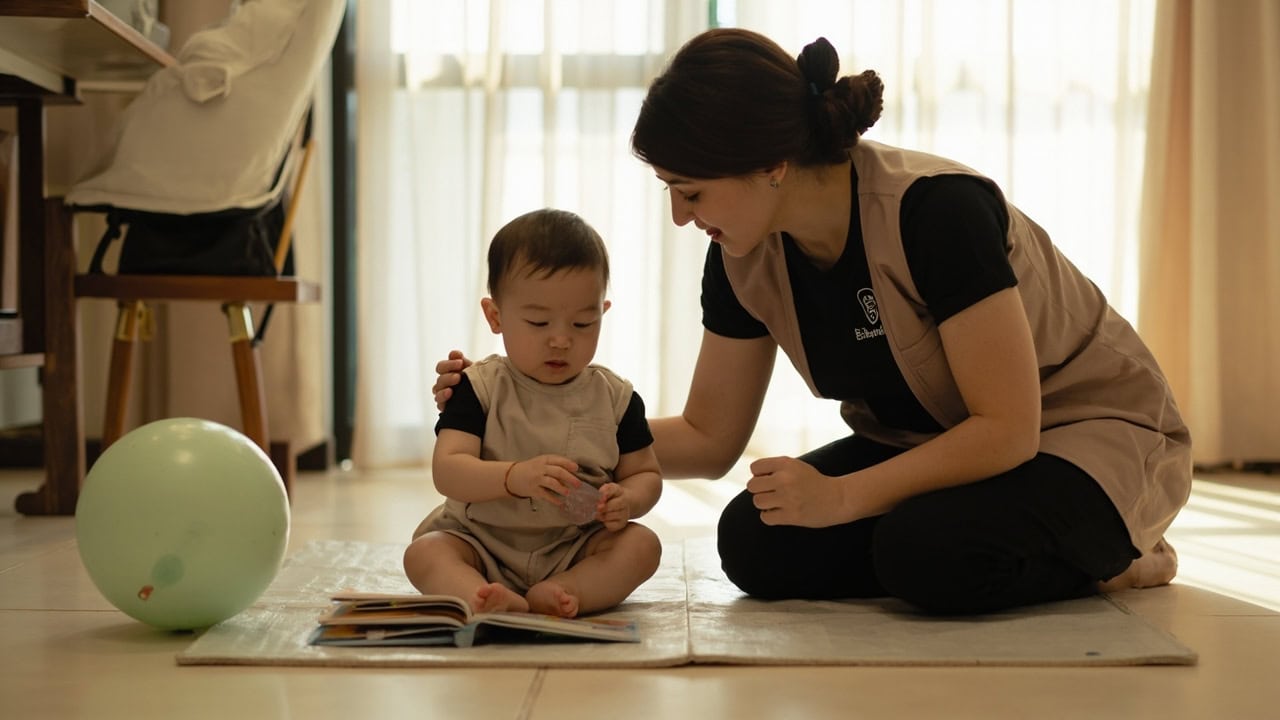
- Floor play and talk: Stay within arm’s reach for supported floor play with one large soft ball. Name what the baby looks at or reaches for, or move to a short conversation about the same object.
Use a clear floor area, avoid small loose pieces and support the baby if seated. This menu is a set of options, not a quota. If the baby becomes uncomfortable, distressed, needs changing, or is ready to feed or rest, respond to that need instead of asking the activity to work.
In this illustrative moment, the caregiver places the large soft ball within reach and says, “Blue ball.” If the baby looks towards it, the caregiver can let the baby explore it briefly. If the baby’s attention shifts, they bring over the agreed book. If the baby needs changing or appears uncomfortable, the caregiver responds to that need instead. The sequence stays flexible and follows the baby’s response.
Write the plan and agree how it will be checked
If you are arranging EduNanny care, include this preference when you shape the care brief. We talk through feeding, rest, family preferences and communication, then review the details before care begins. EduNanny’s care-brief process The final wording should still fit the particular caregiver, service and setting rather than assume that every arrangement will work in the same way.
Use this as a starting point and replace the examples with choices your baby already knows:
- Rule: “For our baby under 18 months, please use no screen except for interactive video chatting, and keep the television off in the background.”
- Alternatives: Start with our familiar board book. If the baby turns away from the book, offer one familiar song or supported floor play with our large soft ball. If the baby needs changing, a feed, rest or comfort, respond to that need instead.
- Check-in: “At handover, please tell us which option you offered first, what the baby looked towards, reached for or turned away from, and what you offered next.”
For example, a parent might begin:
Parent: “Our first choice is the familiar board book. If the baby turns away from it, what would you try next?”
Caregiver: “I would try the familiar song or supported floor play, stay nearby and follow the baby’s cues. If the baby needs changing, a feed, rest or comfort, I would respond to that need.”
Parent: “Please tell us what you offered and what happened next. We can compare that with home and adjust the choices together.”
A useful handover note records one event: what the baby looked towards, reached for or turned away from, what the caregiver offered and what happened next. Treat it as information about one interaction in one setting, not as a basis for labelling the baby or judging development. It helps the family and caregiver decide whether the order or choices need adjusting.
Sources and further reading
- Parent Hub: 0-2 Years – Screen Time · www.healthhub.sg
- Home · EduNanny
The image in this article was generated with AI for illustration. It does not show an actual EduNanny staff member, child or facility.
Before care begins, copy the three-part plan into your care brief and ask the caregiver to say back the rule and first alternative.