How to Share Infant Cues Without a Fixed Script
A shared care brief works best as a starting point, not a set of instructions. Learn how to record one infant cue, the response that helped and what another caregiver should notice next.
When another person cares for your infant, you may want to share everything you know: how they settle, which voices and books they enjoy, what brings comfort and how they show interest. Yet a long list of rules can make ordinary care feel like a performance. A caregiver following every instruction may miss the infant looking towards them, changing their mind or turning away.
A more useful starting point is a short cue, response and review rhythm. Record what you can observe, describe what helped in that moment and decide what another caregiver should notice next. The adult can then respond to the infant as they are now, rather than trying to recreate yesterday’s interaction perfectly.
This guide is for infants in shared care. The worked example uses an awake four-month-old because UNICEF provides age-specific guidance for that stage. It is an illustration, not a milestone test or a rule to apply unchanged to every infant.
Start with what your infant is showing
Begin with an observable cue rather than a fixed interpretation. “Looks towards the book and reaches” gives another adult something concrete to notice. “Needs stimulation” or “does not like the book” asks them to make a judgement without enough context. A pause, a change in gaze, a vocalisation, a movement towards an object or a turn away can all be recorded.
UNICEF’s Care for Child Development approach describes responsive caregiving as observing a child’s signals, interpreting them and responding appropriately during play and communication. For a parent sharing infant care, this offers a practical sequence. Notice what the infant does, consider what may be happening, offer a suitable response and observe what changes next.
Keep the response specific enough to help while leaving room for the infant’s next contribution. Instead of “always show the book until they finish”, you could write: “When they look towards the book and reach, bring it close, name one familiar object and pause for their response.” The note gives the caregiver an action without claiming that it will work in the same way every time.
UNICEF’s framework supports the general principle of responsive caregiving. It does not establish a measured outcome for this particular note-taking method. The card is a communication aid that helps adults begin from the same information and return to the infant’s response later.
Worked example: one supported floor-play moment
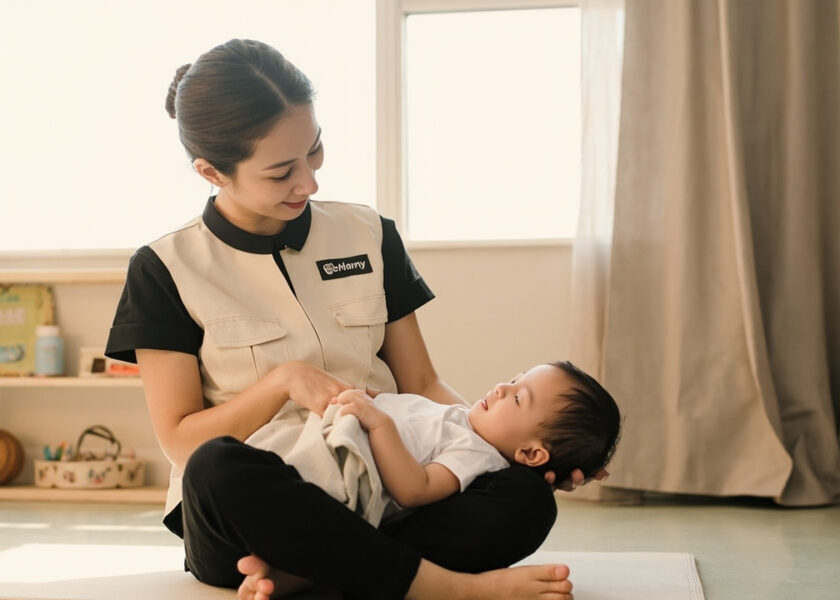
Imagine an awake four-month-old supported in a comfortable seated position on a clean floor mat, with a caregiver close by and a small fabric activity toy within reach. The adult watches the infant, brings the toy closer when the infant shows interest and pauses before adding anything else. The infant remains supported and supervised throughout the moment.
UNICEF’s four-month examples suggest sharing a baby’s interest by looking and pointing, speaking in a kind voice and leaving toys nearby so the baby can reach. The same page notes that babies develop differently, so these examples should not become a checklist that every four-month-old must complete. Your baby’s developmental milestones at 4 months provides the age-specific guidance used in this illustration.
Here is how the completed note could look:
| Part | What to record |
|---|---|
| Cue | Looks towards the fabric activity toy, reaches and then pauses or turns away. |
| Response | Bring the toy within reach, use one simple word, pause and follow the infant’s next response. |
| Review | At the next handover, note whether the infant initiated the interaction, how they responded and whether the activity should stay the same or become simpler. |
The caregiver now has a sequence rather than a prediction. If the infant reaches again, the adult might keep the toy close and name it. If the infant turns away, the adult might pause, simplify the activity or offer a quieter moment. A turn away provides information about this interaction. It is not a verdict on the infant or a prediction about development.
Keep the play age appropriate and closely supervised. The infant should be awake, the floor should be clear and the caregiver should remain within arm’s reach. A fabric activity toy can support the moment, but there is no exercise to complete and no performance to assess. Follow the infant’s comfort and readiness.
Turn the note into a shared conversation
Adapt the method to settling, feeding or shared books. Keep the same three-part structure, but write only what another caregiver can observe and use:
Cue: [What did the infant do?]
Response: [What did the caregiver try?]
Review: [What should the next caregiver notice?]
You can add one short flexibility note when it matters. For example: “Yesterday’s settling response may not fit today. Check the current cue first.” This tells the caregiver that the shared routine is a starting point, not an order to repeat something after the infant has disengaged.
At handover, ask about the exchange rather than whether the caregiver followed the note perfectly. Useful questions include:
- What did you notice first?
- What did the infant do after you responded?
- Did the activity seem comfortable and engaging?
- What would you keep, soften or try differently next time?
A short report can follow the same order: “Today, the infant [observable cue]. When this happened, the caregiver [response]. Next time, notice [one question or adjustment].” Specific details make feedback easier to use than a broad comment such as “they were fine” or “they were restless”.
Agree in advance when updates will happen, what information matters and who will share the next note. In our childminding care, we agree update and contact arrangements before care begins. Our pilot uses daily care updates and routine communication, while other services follow the communication plan agreed with the family or organiser. Our Frequently Asked Questions explain these arrangements and how care briefs are shaped around a child’s routines, comfort cues and interests.
A useful brief therefore gives another adult a fair starting point. It records enough for them to begin well while leaving the next response open to the infant in front of them.
Sources and further reading
- Care for Child Development | UNICEF · www.unicef.org
- Your baby's developmental milestones at 4 months | UNICEF Parenting · www.unicef.org
- Frequently Asked Questions · EduNanny
The image in this article was generated with AI for illustration. It does not show an actual EduNanny staff member, child or facility.
Before the next care period, write one cue, response and review sentence for an ordinary moment your infant enjoys, then use it as a starting point at the next handover.