Fraud Blocker edunanny.com

Category: Childminding

edunanny-062ef1927d2a75e8a4529cac98e4d913
April 16, 2026

The Relational Lessons Your Child Absorbs Before Primary School

The Question No One Asks When You Choose Childcare

There is a moment, familiar to every parent in Singapore, when you stand at the threshold of a childcare centre and your child reaches for the hand of a caregiver you have met perhaps only twice. In that small, unremarkable instant, something significant is happening. Your child is not simply being handed over to a stranger. Your child is making a choice, however tentative, to extend the circle of trust beyond the people who have always been there.

And you are left standing in that corridor, carrying with you a question that very few people in the childcare industry ever take the time to ask:

What kind of relationship is my child entering into in the hours I am not there?

You have thought carefully about safety. You have read the reviews, toured the premises, checked the credentials. You have weighed the curriculum and asked about the meals. These are the right things to do, and they matter. But there is something else happening in those hours, something quieter and more formative, and it has almost nothing to do with the checklist you so carefully assembled.

Your child is learning what it means to be in partnership with another human being.


The Curriculum No One Prints on a Brochure

This is the curriculum that no one prints on a brochure. It does not appear in the daily schedule or the activity wall. But it is happening in every interaction your child has with a responsive caregiver, in every moment of back-and-forth with another small person, in every instance where someone waits for your child to signal a need and then responds with something other than impatience or dismissal.

And here is what is both beautiful and underappreciated about the years before your child ever steps into a primary school classroom: this is where the capacity for partnership is not taught, but absorbed. Your child is not sitting in a lesson about collaboration. Your child is inside a living, breathing example of it, hour after hour, day after day.

What Partnership Looks Like From the Inside

Watch a young child in a quality childcare environment and you will see something remarkable.

You will see a two-year-old offer a toy to another child and wait. Not throw it, not grab it back. Wait, with a kind of held breath, to see what will happen. That waiting is not passive. That waiting is the most sophisticated social behaviour your child will learn before the age of five. That waiting is the foundation of every negotiation, every friendship, every collaboration your child will ever attempt.

Or watch a caregiver kneel down to a child’s level when the child is frustrated, not to fix the problem, but to name what the child is feeling. “You wanted the red cup. The red cup is with Mei Lin right now. You feel upset.”

In that small exchange, your child is learning something that cannot be measured in any assessment but will show up in every relationship your child ever has: that their inner world is intelligible to another person, that their emotions are not too big or too strange, that someone will stay with them in the hard moment and not simply tell them to calm down.

This is what partnership looks like from the inside. It is not dramatic. It is not performed. It is the accumulated weight of hundreds of small moments where your child experiences what it feels like to be with someone who is genuinely interested in who they are.


Why the Relational Template Matters More Than You Think

Here is the truth that most parents arrive at only later, when they begin to see the effects: this relational template, absorbed in those early years, becomes the internal working model your child carries into every new social situation.

When your child walks into a primary school classroom for the first time, your child is not just carrying vocabulary and motor skills and the ability to hold a pencil. Your child is carrying an implicit understanding of whether other people can be trusted to show up, whether their needs will be heard, whether it is safe to reach out and try.

Children who have experienced genuine partnership in their early childcare are not necessarily smarter or more academically prepared. But they arrive with something that is harder to teach and more consequential to miss: they arrive with the belief that they are worth responding to, and that the people around them are worth responding to in return.

What This Means for Your Child’s Future

When your child walks into primary school, your child will not be the only one who knows how to sit still and follow instructions. But your child will be the one who knows how to reach out. Who knows how to read a room and understand that other people have inner lives too. Who has an intuitive sense of when to wait or act, when to speak and when to listen.

These are the skills that will serve your child in every classroom, every friendship, every team, every relationship that is yet to come. And these skills are being developed right now, in the hours you have entrusted to a caregiver who is building something with your child that you cannot build alone.

That is not a reflection of any failure on your part. It is simply the truth about how children learn partnership. They learn it in the presence of more than one reliable, responsive, genuinely interested adult. They learn it alongside other children who are also learning. They learn it in the texture of daily life, in the unhurried moments, in the small negotiations and the big feelings and the ordinary miracle of being with people who are glad to be with them.


How Quality Partnership Is Built

Here is what is worth understanding about how this kind of partnership is built. It does not happen by accident. It requires conditions.

It requires a ratio of children to caregivers that allows for genuine individual attention. It requires caregivers who are not simply managing a room but are genuinely present to each child as a person. It requires a physical and emotional environment where the pace is not rushed, where there is space for a child’s own rhythms and preferences, where the child’s developing sense of agency is respected rather than overridden.

The Observable Signs of Quality Partnership

If you want to recognise healthy partnership dynamics in your child’s day, look for these signs:

  • Reciprocity: Your child offers things to you, shares moments, includes you in their play, even if only imaginatively. Your child is beginning to understand that relationships involve giving and taking.
  • Agency: Your child is beginning to articulate preferences, to assert themselves, to feel safe enough to say “no” or “I want this” or “I don’t like that.” Your child is developing a sense of ownership over their own choices.
  • Secure base behaviour: Your child can explore confidently because they trust that someone will be there when they return. Your child checks in, seeks reassurance, and then goes back to playing or exploring.
  • Communication attempts: Your child tries to tell you about their day, shows you things they made, wants to share experiences. Your child believes their voice matters to you.

These are the fruits of quality partnership in early childcare. They do not appear overnight. They accumulate. They build. And they prepare your child for something that no curriculum can teach and no amount of academic drilling can substitute: the capacity to be in genuine relationship with other people.


EduNanny: Where Partnership Is Structural, Not Incidental

At EduNanny, these are not aspirations. They are the conditions that define how care is structured.

In the EduNanny programme, your child is not one face in a crowded room. With ratios designed to support genuine attentiveness, caregivers have the capacity to know your child as an individual. They notice the things that calm your child. They notice what makes your child laugh, what makes your child hesitant, what your child is working on in this season of growth.

This is not an accident of personality or luck. This is design. The programme is built around the understanding that partnership requires presence, and presence requires the conditions that allow it to exist.

Rooted in Thoughtful Practice

The EduNanny approach draws from the ECDA Childminding Pilot, reflecting a thoughtful evolution in how Singapore thinks about care for the youngest children. The programme offers pathways that recognise different families have different needs, whether that is home-based care where the caregiver comes to your child, or community and centre-based environments that offer different textures of interaction and community.

What remains constant across these pathways is the fundamental commitment: that the relational experience your child has in those hours is not incidental to the care. It is the care.

Transparency and Accessibility as Principle

You will also find, in the EduNanny model, an emphasis on transparency that reflects a genuine respect for you as a parent. You are not meant to be kept at a distance, wondering what is happening behind closed doors.

Where measures such as CCTV are in place, they are there not because of suspicion but because you deserve to feel connected to your child’s day, even when you are not in the room. Communication is built into the programme’s design, not as a box to check but as an expression of the same partnership values that guide your child’s experience inside.

And because this is Singapore, and because EduNanny understands what it means to make thoughtful decisions here, the programme is structured to be genuinely accessible. Pilot fee structures are designed with affordability in mind. Monday to Friday care blocks fit the rhythms of working family life. Your Child Development Account and Baby Bonus can be used in meaningful ways.

This is not charity or compromise. This is recognition that the partnership your child deserves should not be priced out of reach.


Your Role: You Are Not a Passive Decision-Maker

Now, here is the part that often surprises parents, because it asks something of you.

You are not merely the decision-maker who selected a programme and pays the monthly invoice. You are not an evaluator who shows up at pickup to assess whether the day was good enough. You are, in the deepest and most meaningful sense, a partner in your child’s developmental architecture.

The Partnership at Home and at Care Are in Conversation

The partnership your child experiences at EduNanny does not exist in isolation from the partnership you are building at home. These experiences are not parallel. They are in conversation.

When your child’s caregiver has spent the day responding to your child’s attempts to communicate, when your child has learned that their voice matters and that another person will listen, that learning shows up in how your child comes home to you.

And when you, in turn, are genuinely curious about your child’s day, when you slow down enough to notice what they are noticing, when you name their feelings and wait for their response, you are not just being a good parent. You are reinforcing the relational template your child is building. You are telling your child that what they are learning about partnership is true in this room too.

Practical Ways to Strengthen Partnership at Home

  • Slow down at pickup and let your child show you one thing from their day.
  • Name what your child seems to be feeling before you try to fix it.
  • Wait for your child’s response instead of filling every silence.
  • Let your child see that you are genuinely curious, not just responsible.

What to Actually Look For When Choosing Infant Care

If you are beginning to search for infant care or childminding in Singapore, here is a practical framework that goes beyond the checklist most parents start with.

  • Questions About the Relational Environment: How many children are there per caregiver? Is the ratio designed for genuine attention or for compliance with minimum standards? Do caregivers stay with the same children over time, or does the assignment change frequently? What does a typical day look like in terms of pace? Is there space for unhurried interaction, or is the schedule packed front to back?
  • Questions About Transparency: Will you receive regular updates about your child’s day, not just in emergencies? Can you visit or observe at unusual times, or only during scheduled sessions? Is there a system for two-way communication between caregivers and parents?
  • Questions About Values Alignment: Does the programme describe itself primarily as a service, or as an environment for your child’s development? Do they talk about partnership with parents, or just about keeping children safe and busy? Do they seem interested in your child’s individual personality, preferences, and rhythms?

The Real Reason to Choose EduNanny

Let me be clear about something. The best reason to choose EduNanny is not the logistics. It is not even the ratio or the training or the facilities, though these matter.

The best reason is what your child will be inside of, hour by hour, while you are at work or in a meeting or simply taking the space you need to be the parent you want to be.

Your child will be inside a place where someone is curious about them. Where their small attempts at communication are met with genuine interest. Where the pace slows down enough for your child to be a child, to follow a beetle across the courtyard, to sit in someone’s lap and be read to, to experience the profound satisfaction of handing something to another person and having that person receive it with delight.

This is what EduNanny offers. Not supervision. Not babysitting. Not a holding pen until you are available again.

It offers your child a sustained experience of what it means to be in relationship with someone who is genuinely glad they are there.

You have already shown, by the seriousness with which you have considered this decision, that you understand what is at stake. You understand that these years are not a gap to be filled before school begins. They are the foundation on which everything else will rest.

And you understand, even if you could not have articulated it before, that what your child needs is not just safety or supervision or a well-designed curriculum. Your child needs to learn, in the most primal and important way, what it means to be a good partner.

That is exactly what EduNanny is here to teach.

This is not a service. This is not a product. This is a partnership — with your child, who deserves to be seen; with you, who deserves to be trusted and included; and with the caregivers who bring to this work not just qualifications but genuine love for the children in their care.

Discover how EduNanny is designed around the partnership your child deserves. Connect with a caregiver who will be glad to meet you both.


To learn more, visit EduNanny Singapore.
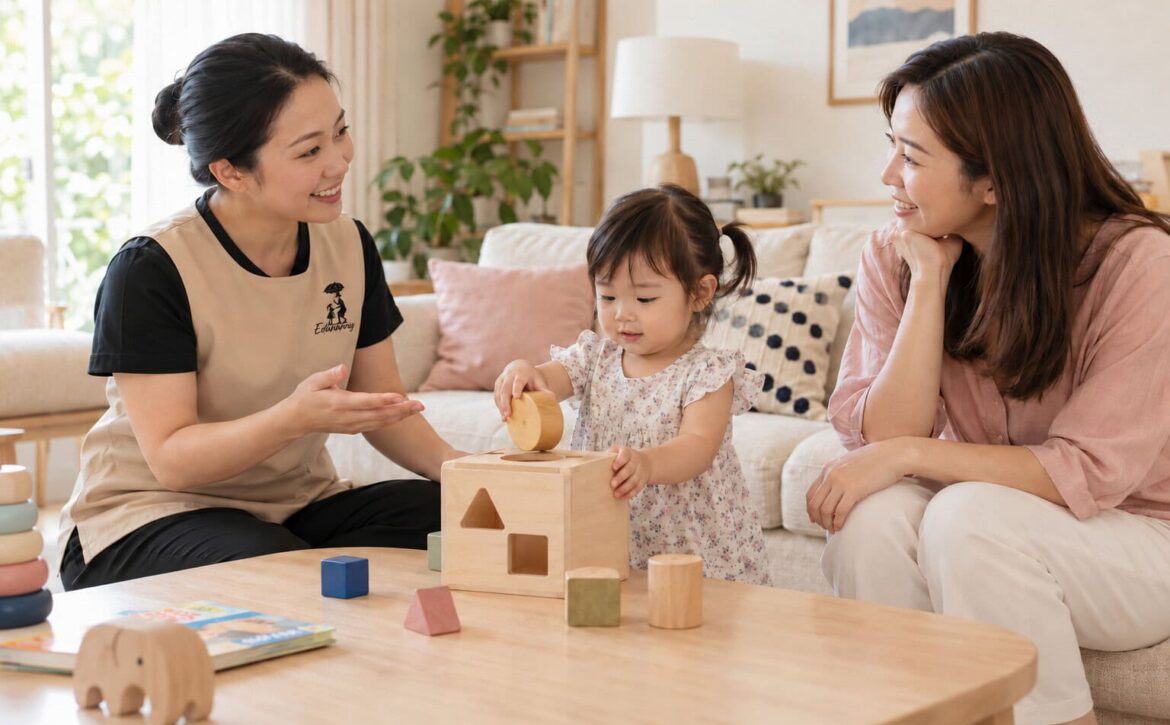
Illustrative scene of an EduNanny private nanny speaking with a parent while a toddler plays
April 16, 2026

Singapore Childcare Options: A Practical Guide for Families

Compare centres, childminding, private nannies and family care in Singapore, with practical questions on safety, schedules, fees and finding the right fit.

edunanny-062eeae4164eac87df8b375c3b294204
April 16, 2026

The Architecture of a Quality Childcare Day in Singapore

The Moment Every Parent in Singapore Knows

You pull up to the childcare centre. You unbuckle your child from the car seat. You walk through the door, and for a brief stretch of minutes, you are inside the world your child inhabits while you are not there. Then the handoff happens. A caregiver reaches out, your child turns toward the familiar room, and you step back into the corridor, out into the heat, back to your day.

You get into the car. You sit for a moment, sometimes longer than you planned. And a thousand questions form — some small, some large — about what the hours between now and pickup will actually hold.

Not to dismiss those questions. Not to paper over them with reassurances that sound warm but tell you nothing. But to walk alongside you, honestly and specifically, through what a quality childcare day is actually built to do — and what it looks like when it is working.

Because what happens in those hours is not a mystery. It is not luck. It is design. And once you understand the architecture of a well-designed day, you gain something that no amount of generic reassurance can give you. You gain the ability to see.


Arrival, Environment, and the Ratio That Shapes Everything

The First Transition

When you bring your child to a quality childcare environment, the transition is not merely logistical. It is developmental. The way a child enters a space sets the tone for everything that follows.

In the best childcare environments, this transition is handled with intention. Your child is greeted by name, not just acknowledged as a number in a register. There is a brief exchange with your child directly — acknowledging them as an individual. A transition object from home might be acknowledged — a favourite soft toy, a comfort blanket. A small ritual marks the crossing — hanging up a bag, removing shoes, washing hands — moving from the outside world into the learning world.

Young children do not experience time the way adults do. They experience it through sequences and sensory anchors. When the beginning of the day follows a reliable rhythm, your child’s nervous system can settle. They know, at a deep level, that the world is organized, that people are reliable, that what happens next can be anticipated. That sense of predictability is not a soft idea. It is the foundation of security. And security is the neurological condition that makes learning possible.

The Physical Environment: What You May Not Notice

Walk into a well-designed infant and toddler space, and something happens before you even consciously register it. The sensory experience is calibrated: warm, even lighting rather than harsh fluorescent flicker; distinct zones for calm play and active exploration; materials within reach but organized, the floor clean and warm enough for a child to sit on without complaint.

The physical environment of a childcare setting is not decoration. It is curriculum. Every open shelf, every accessible material, every carefully considered detail is a decision about what the environment is communicating to the child.

In an environment where materials are locked away and accessed only by adults, children learn that their agency is limited. In an environment where materials are accessible, organized, and inviting, children learn that they are capable — that the world responds to their curiosity, that they can act upon it. When you visit a quality setting, notice how your child moves through the space. Notice whether they can reach things. Notice whether the environment seems to say, “You belong here.”

The Ratio That Determines Whether Your Child Can Be Known

There is a number that matters more than almost any other in infant and toddler care. That number is ratio — the number of caregivers to children.

Setting Type Quality Ratio Standard What This Means for Your Child
Infant Care Up to 1:3 Your child can be noticed, anticipated, understood as an individual
Toddler Care 1:4 to 1:5 Responsiveness remains possible; individual needs can be met
Large Group Settings 1:10 or higher Individual attunement becomes structurally difficult

When a child in a group of twelve has two caregivers, a moment of distress can be addressed with patience and attunement. When a child is in a group of twenty with two caregivers, the same moment may have to be managed quickly, efficiently, with less space for the individual calibration that young children need. This is not a criticism of any individual caregiver. It is arithmetic.

At EduNanny, ratio structures are designed to make attunement possible. This means your child does not merely exist in the group — they are noticed. When your child is hungry, a caregiver who knows them will anticipate it before the crying begins. When your child is frustrated, a caregiver who has observed them over days and weeks will understand the specific texture of that frustration and know how to respond. This is not magic. It is the product of small groups, consistent caregivers, and a philosophy that treats responsiveness as non-negotiable.


Mealtimes, Rest, and Free Play: The Work You Do Not See

The Meal as a Classroom

Watch a good caregiver with a group of toddlers at lunch, and you will see something quietly remarkable. The caregiver sits with the children, eats with them, models behavior of eating, conversation, patience. Children are permitted — encouraged, even — to feed themselves, to make a mess, to explore texture and taste without anxiety from a hovering adult. The pace is unhurried.

Here is what is happening developmentally in that unhurried meal: your child is learning to trust their own hunger and fullness cues — a skill linked across a lifetime to healthy relationship with food. They are learning social codes: sitting together, sharing space, passing things, saying please. They are encountering new tastes and textures in a context of safety and enjoyment. They are exercising the fine motor control that self-feeding demands.

Rest Is Not a Pause

When your child sleeps at childcare, something profound is happening in their brain. Sleep in the early years is not merely restorative in the way adult sleep is. It is active. Neural connections are being formed, strengthened, and organized. Memory consolidation occurs. The emotional experiences of the day are processed and filed.

A quality rest environment honours this. It is not a room where children are put down in shifts. It is a calm, dimmed, consistent space where each child rests according to their own rhythms. Caregivers do not force sleep — they create the conditions for sleep, then respect what each child’s body needs. A child who does not fall asleep is not treated as a problem. They are given quiet alternatives, because rest does not always look like sleep.

Free Play: The Engine of Everything

If mealtimes and rest are the structured pillars of the childcare day, then free play is the engine that drives everything else.

There is a misconception — widespread, persistent, and harmful — that learning begins when a teacher stands at the front of a room and delivers instruction. For infants and toddlers, this could not be further from the truth. Learning begins in play. Not any play, but rich, unhurried, child-directed play, supported by an environment that invites exploration and a caregiver who knows when to intervene and when to step back.

Watch a two-year-old engaged in block play. They are not merely stacking rectangles. They are developing spatial reasoning — understanding how objects relate to each other in three-dimensional space. They are experiencing causality — what happens when I place this block here, and this one on top? They are exercising persistence — it keeps falling, but I am going to try again. They are building fine motor strength, hand-eye coordination, and vocabulary as they narrate or ask about what they are doing. They are, in the truest sense of the word, thinking.

Now watch what happens when two children are playing together with those blocks. A dispute arises. Someone wants the same block. Here — in this small, ordinary, completely unremarkable moment — is one of the most important developmental opportunities your child will have all day: How do I assert my need? How do I listen to someone else’s need? What can we do when we both want the same thing?

These are not problems that an adult solves for children. These are problems that children, given safe boundaries and calm support, learn to solve themselves. The learning that happens in that moment — social learning, emotional learning, cognitive learning — cannot be replicated by any worksheet, screen, or adult-directed activity. This is why quality childcare does not fill every moment with instruction. It protects time for play, and it trusts that play is doing its work.


The Pickup Window and Building Transparency

We have walked through the morning and into the afternoon, and now it is time for pickup. This is the moment you have been preparing for all day, and perhaps the moment you have been most anxious about.

Here is what we want you to understand: the pickup moment is diagnostic, but not in the way most parents fear. A tired child, a clingy child, a child who resists leaving — none of these are signals that something went wrong. In fact, the opposite is often true.

A child who is deeply engaged in the childcare environment — who has invested themselves fully in the day’s play and learning — often experiences the transition of pickup as a disruption to something they were fully present in. The resistance is not evidence of suffering. It is evidence of involvement.

What you are actually looking for at pickup is harder to articulate but easier to feel:

  • A child who is settled, not sedated.
  • A child who has been in an environment that challenged and delighted them, not one that merely kept them occupied.
  • A child who runs to you not because they are desperate to escape but because they have been waiting to share their world with you.

Look at their hands. Look at the state of their clothes, their hair, the crumbs on their face. Look at the caregiver’s interaction with your child in those final minutes. Is it warm? Is it genuine? Does the caregiver know your child’s name, their routine word, their current interest? Does the caregiver make eye contact with your child — not just with you — when they hand them over? These small details tell you everything about whether the day your child experienced was one of connection or mere containment.

Trust Infrastructure

EduNanny’s commitment to transparency becomes tangible for parents in practical ways. Where CCTV measures are deployed, parents have an additional window into the day. Where daily updates are provided, they offer narrative texture — not just that your child ate and slept, but how, and what the mood was, and what captured their attention.

Technology, when used with restraint and purpose, can be a bridge between the home and the childcare world. Tools like EduNanny’s direct communication channels give parents responsive access to information about their child’s day — a line of communication that does not require you to wait until pickup to ask the question burning in your mind at two in the afternoon.


The ECDA Childminding Pilot: Making Quality Visible

EduNanny operates within the ECDA Childminding Pilot, and that distinction matters. The pilot was designed with a clear understanding of a problem that many Singapore families live with every weekday: quality childcare is not uniformly available, and the gap between what parents need and what they can access with confidence has been too wide for too long.

EduNanny is part of the answer to that gap. It offers both home-based and centre-based pathways, because families are not uniform, and neither should their options be. But the thread that runs through both pathways is the same commitment: to make the invisible hours visible, to make quality observable, and to ensure that every parent can understand, with specificity, what their child’s day contains.

The pilot structure — with its emphasis on caregiver training, ratio compliance, environment standards, and parent communication — is not red tape. It is the scaffolding that makes quality possible at scale. And the affordability built into the pilot fee structures, together with the usability of CDA and Baby Bonus, means that this quality is not reserved for families who can pay premium rates. It is designed to reach the families who need it most.


Choosing With Open Eyes

There is something every parent feels but few are encouraged to name: the anxiety of the unseen hours is not a sign that something is wrong with your parenting. It is a sign that you care deeply about your child’s experience, and that you are paying attention. That instinct — the desire to understand what is happening when your child is out of your sight — is one of the most important instincts you bring to this decision.

What quality childcare offers you is not the promise that you will never worry again. It is something more honest, and more valuable: the invitation to understand. To walk into the day with your eyes open. To see what quality looks like when you know what to look for.

If you are researching infant care or childminding in Singapore, here is what we hope you carry away from this guide:

  • Visit and observe. Notice the transition at drop-off. Is your child greeted as an individual? Is there a predictable sequence?
  • Ask about ratios. The number of caregivers to children is not a minor detail. It determines whether your child can be truly known.
  • Read the environment. Can your child reach the materials? Is the space sensory-calibrated? Does it invite exploration?
  • Notice the adults. Do caregivers sit with children at meals? Are they on the floor at eye level? Do they seem present?
  • Trust your observations at pickup. A settled, engaged child who is reluctant to leave may be telling you something positive.
  • Ask for transparency. Daily updates, communication channels, and openness to questions are not extras — they are indicators of a quality culture.

An Invisible Architecture That Is Very Real

Every ordinary day at quality childcare — every arrival, every meal, every nap, every act of block-building and disagreement and resolution and wonder — is part of an invisible developmental architecture that neuroscience is only beginning to fully map.

The connections being formed in your child’s brain right now, in this room, with these peers, under the care of this specific caregiver, are not metaphor. They are biology. They are the actual physical structure of your child’s future capacity — for thinking, for feeling, for relating, for learning.

This is why quality childcare does not treat early years care as warehousing. This is why EduNanny’s approach to infant care and childminding in Singapore is built on a foundation that is simultaneously practical and profoundly purposeful.

Monday to Friday, across Singapore — in HDB estates and private residential areas, in centre settings and home-based settings — this work is happening. Not because the work was not happening before, but because no one had built the infrastructure to make it legible, transparent, and trustworthy. That is what the ECDA Childminding Pilot is doing. That is what EduNanny represents.

The hours in between drop-off and pickup are not lost hours. They are not a gap in your child’s life that you simply have to trust will be okay. They are, in the best childcare environments, hours that are designed — thoughtfully, knowledgeably, and with deep respect for your child’s developmental journey — to be among the most consequential of their early years.

The work of raising a child in Singapore is shared work. It has always been shared work, across generations, across families, across communities. What EduNanny is building, within the framework of the ECDA Childminding Pilot, is a modern expression of that shared work — one that honours the complexity of contemporary family life, that makes quality visible, that keeps ratios low and standards high, that communicates with parents not as customers to be reassured but as partners to be trusted.

Your child’s day is full. It is rich. It is structured, and purposeful, and full of the small, ordinary miracles of early childhood that happen when knowledgeable, caring adults create the conditions for a child to grow.

And now, when you drive away after drop-off, you can carry that understanding with you — and the questions that remain, the ones without easy answers, you can bring to us. Because EduNanny is not here to silence your questions. We are here to answer them, honestly, specifically, and with the same care we bring to every hour your child spends with us.


Ready to see what quality childcare looks like when you know what to look for?

Speak with the EduNanny team about centre-based and home-based childminding pathways available under the ECDA Childminding Pilot. We welcome your questions, your observations, and your need to understand.

edunanny-062ee744fd9bc515c48be260e2d3f571
April 15, 2026

How Singapore Parents Know Their Child Is Thriving at Childcare

The Question Every Singapore Parent Carries After Drop-Off

There is a moment, familiar to every parent who has left their child in care, that happens after the goodbyes have been said and the door has closed. It is the moment when you stand outside—on the sidewalk, in the car park, on the train platform—and you wonder.

Not about curriculum frameworks or teacher qualifications or activity schedules. You wonder whether your child is okay. Whether they are settled. Whether the space they have entered feels safe to them in some way that you cannot see, cannot measure, cannot know for certain.

This question lives beneath the surface of every drop-off. It is the question that parents in Singapore carry quietly, sometimes for months, sometimes for years. And it is a question that almost no one gives them the language to ask—let alone answer.


The Landscape of Your Child’s Experience

The world your child lives in during the hours they spend in childcare is not the world you experience when you visit for a birthday celebration or attend a parent observation session. It is a world filtered through senses that are far more acute than yours, interpreted by a nervous system that is still learning to separate threat from safety, comfort from discomfort.

For a young child, the childcare environment is not a backdrop. It is the entire landscape of their experience. And in that landscape, every detail matters.

Light: The Environment That Shapes the Nervous System

Light is not neutral. The quality of illumination in a space shapes how the nervous system settles or strains. Harsh fluorescent glare creates a low-grade physiological stress response that a child cannot name but certainly feels. Warm, natural light—or light that has been thoughtfully designed to mimic it—creates conditions for the body to rest.

When you enter a childcare space, notice how the light feels against your own skin. Then consider how much more sensitive your child is to it. A room bathed in gentle, diffused light is not a luxury aesthetic choice. It is a physiological gift to the developing brain.

Texture: The Vocabulary of the Body

Consider, too, the texture of the environment. The surfaces your child touches, the materials they mouth and manipulate, the ground beneath their feet as they learn to walk—these are the vocabulary through which they read a space.

In a quality childcare environment, textures are chosen deliberately: natural wood instead of cold plastic, soft textiles in quiet corners, rounded edges rather than hard corners. These are not merely safety precautions. They are an invitation to the body to relax, to explore, to feel at home in a space that is, in truth, another kind of home.

Sound: The Most Overlooked Quality Indicator

The acoustic environment of a childcare setting is one of the most overlooked quality indicators in the field. Young children hear differently than adults. Their middle ears are still developing, their auditory processing still forming. A room that feels merely noisy to you may be genuinely overwhelming to them.

The sound environment in a well-designed childcare space is considered—not silent, because children need to hear human voices and the joyful chaos of play—but regulated. The surfaces absorb sharp sounds. The activities are paced so that children are not barraged by competing noises. The adult voices are warm in pitch, calm in rhythm, present without being intrusive.

When a child can hear clearly—when the sound environment is one they can tolerate and thrive within—their body shows it. They are not flinching. They are not crying without apparent cause. They are listening, responding, learning. A regulated acoustic environment is one of the quietest indicators of genuine quality.


Rhythm: The Gift of Predictability

Children live in their bodies in a way that adults have largely forgotten. They do not experience time as an abstract concept. They experience it as hunger, as tiredness, as the need for sameness and the terror of surprise.

A child whose body is regulated by a predictable rhythm—consistent mealtimes, rest periods, transition cues, and a clear beginning and end to the day—is a child whose nervous system can settle into safety.

This is not about rigid scheduling. It is about the gift of predictability. When a child knows, in their body, that the morning will flow into rest, and rest will flow into lunch, and lunch will flow into the arrival of parents—they develop what might be called an internal compass. They know where they are in time. They know what comes next. And this knowing is a profound form of safety.

A quality childcare environment respects the child’s temporal experience. Transitions are announced before they happen. Changes are prepared for, not sudden. The rhythm of the day is visible not just in a schedule posted on the wall but in the lived experience of the children themselves.

When your child comes home and can tell you what they did, when they did it, and what comes next at childcare—they are telling you that they have internalized the rhythm. They are telling you they have settled. Settled children are the truest measure of quality there is.


Is My Child Emotionally Safe?

There is a question that lies deeper than rhythm, deeper than light and sound and texture. It is the question that keeps parents awake at night, the question that surfaces in whispered conversations between partners, the question that mothers and fathers carry into every drop-off with a bravery they may not recognize in themselves.

Not physically safe—we assume that. Not fed and napped and changed—we hope for that. But emotionally safe. Held. Seen. Cared for in the way that only a human being can care for another human being. Safe in the knowledge that when they cry, someone will come. When they need comfort, someone will provide it. When they are overwhelmed, someone will hold them until the overwhelm passes.

How Children Read Their World

Young children are not blank slates. They are extraordinarily perceptive. They read faces before they read words. They feel the emotional temperature of a room long before they can articulate what they are feeling. They know—not in the way adults know, but in the deep cellular way that children know—whether the adults around them are truly present, truly attentive, truly caring.

In a quality childcare environment, this reading happens both ways. The caregivers are reading the children—their cues, their cries, their half-formed expressions of need. But the children are also reading the caregivers. And what they are looking for is not perfection. It is presence. Warmth. The willingness to be interrupted, to be needed, to say “I am here” in a hundred small ways throughout the day.

Presence in Practice

When a caregiver sits on the floor and enters a child’s play—not directing, not teaching, just being present—the child notices. When a caregiver names what a child is feeling before the child has the words for it—”You are feeling frustrated that the block keeps falling”—the child is being seen.

When a caregiver holds a crying toddler with patient steadiness, neither rushing to silence them nor matching their distress, but simply offering the steady presence of another human being—the child is being soothed at the deepest level of their nervous system.

These moments are not visible on any quality checklist. They are not captured in any curriculum framework. But they are the emotional curriculum of quality childcare—the hidden syllabus that shapes a child’s sense of whether the world is a safe place to be. And it is this curriculum, more than any activity or lesson, that determines whether a child arrives home drained or restored, closed or open, stretched thin or growing into themselves.

Questions Parents Often Ask

“How will I know if my child is really okay?”

You will know by watching your child. By noticing their body, their behavior, their play. By paying attention to whether they come home like themselves or depleted from pretending to cope. Open, ongoing communication between caregivers and families is essential—no parent should have to guess.

“What if my child cries every morning at drop-off?”

Some separation anxiety is developmentally normal, especially in the first weeks. What matters is what happens after. Does your child settle within minutes? Does the caregiver respond with warmth and patience? Does your child eventually engage in play? A child who cries at drop-off but settles quickly is communicating something very different from a child who cries all morning. Trust your instinct. Ask questions. Watch closely.

“Is home-based or center-based better?”

There is no single answer. What matters is fit for your family. Smaller home-based settings offer intimacy and a homelike feel. Center-based environments offer structure and peer interaction. Both can be excellent. Both require the same underlying qualities: sensitive caregivers, appropriate rhythm, sensory consideration, emotional warmth. The ECDA Childminding Pilot allows families to explore both pathways, and we are happy to help you consider what might suit your child best.


What Your Child Is Already Telling You

Here is a truth that may change how you think about choosing childcare: your child has been communicating the quality of their experience all along. Not in words, but in the language of their body, their behavior, their play.

A child who runs to their caregiver at drop-off without looking back is telling you something. A child who clings and cries, day after day, is telling you something else. Neither message is simple, but both are important.

Reading Your Child’s Body

The child who settles quickly, who is able to engage in play, who rests when rest is offered, who approaches new experiences with curiosity rather than fear—these children are communicating that the environment is working. Their bodies are telling the truth.

Watch your child in the moments after pickup:

  • Notice whether they are depleted or restored. A child who comes home spent may have been holding themselves together all day in an environment that did not match their needs.
  • Notice the quality of their eye contact. Children who feel safe can look at you fully. Children who are struggling may look away or seem distant.
  • Notice the relaxation in their shoulders and the ease in their movement. Tense bodies carry the residue of tense environments.
  • Notice whether they are eager to share or withdrawn. A settled child often wants to tell you about their day. An overwhelmed child may need a period of decompression first.

The Language of Play

Watch, too, what your child plays. Play is not frivolous. It is the child’s laboratory for understanding their experience.

  • When a toddler acts out the drop-off and pickup, they are processing the day’s most significant events.
  • When a child builds elaborate structures and then gently knocks them down, they may be expressing something about control, about order, about the day’s rhythms.
  • When a child chooses to play alone after a day of community, they may be telling you they need quiet after intensity.

All of this is information. All of this is your child speaking. Learning to hear this language is not a special skill reserved for experts. It is what parents do. It is what parents have always done. The childcare environment simply offers a new set of contexts in which to listen.


EduNanny Singapore: Designed Around Your Child’s Inner World

EduNanny Singapore was built with this understanding at its center. We believe that quality childcare begins not with what we teach, but with what children feel. With the sensory world they inhabit. With the emotional safety they need. With the deep, quiet work of creating environments where children can settle, explore, and grow into themselves.

We are proud to be part of the ECDA Childminding Pilot, offering pathways that include home-based and community-based options alongside our center-based services. This means that wherever your family feels most comfortable—your child’s home, a caregiver’s home, or one of our centers—there is a pathway that fits.

What We Offer

  • Infant-to-caregiver ratios that ensure every child receives the attention and attunement they deserve.
  • Team training not only in early childhood development, but in the art of being present—reading cues, responding with warmth, creating the emotional conditions for genuine safety.
  • Open communication between caregivers and families, with clear visibility into the daily experience of your child.
  • Accessible fee structures designed with Singapore families in mind, including CDA and Baby Bonus usability where applicable.

We know that trust is earned through transparency. We want you to see what we see. We want you to know what your child knows.

The hours your child spends in our care are not just hours. They are the hours in which they are forming their sense of the world, their trust in others, their capacity for wonder and connection. We do not take that responsibility lightly.

Every decision we make—about light and sound, about rhythm and routine, about the warmth of our caregivers and the design of our spaces—is made with your child’s inner experience in mind.

Begin the Conversation

Here is what we want you to carry with you from this article: the question you have been asking—”Is my child okay?”—is not a question you need to stop asking. It is a question that reveals your love, your attentiveness, your deep parental instinct.

Perhaps you can ask it with a new set of eyes:

  • Not “Is the checklist complete?” but “How does my child seem?”
  • Not “Are the standards met?” but “What is my child’s body telling me?”
  • Not “Are they safe?” but “Are they settled?”

Your child has been answering you all along. They have been telling you through the ease in their shoulders and the curiosity in their eyes and the way they run toward the door on weekday mornings. They have been telling you through their play and their sleep and the way they reach for you at pickup with a smile that says, “I was okay. I am okay. And now I am glad to be home.”

That smile is the answer. That relaxed body is the answer. That willingness to return, to explore, to grow—that is the quality you have been looking for.

We are here to help you listen. If you are exploring infant care or childminding options in Singapore, we invite you to connect with us and experience what it feels like when childcare is designed around your child’s inner world.


EduNanny Singapore is part of the ECDA Childminding Pilot, offering home-based, community-based, and center-based pathways for families across Singapore. Contact us to learn more about our approach and how we support your child’s sensory, emotional, and developmental wellbeing. You can also read about our story.

edunanny-062ee3659df44fda6e9c120c4cf97efc
April 15, 2026

The Village Your Child Needs Is Waiting to Be Chosen

The Village That Used to Exist

There is a particular silence that every parent in Singapore knows. It is the silence of the morning hand-off—the moment you place your child into someone else’s arms and walk away. It is the silence of trust made visible, of love expressed as letting go, even when every instinct pulls you back.

If you have stood in that silence, you already understand something that most childcare conversations never name: the decision you are making is not about enrollment. It is about whom you are inviting into your family’s life.

The village that once raised children was never accidental. It was built into the architecture of families—grandparents in the next room or the next village, older cousins who watched the younger ones, neighbours who knew your child’s name before they could say it themselves.

That village did not require a decision. It simply existed, passed down through generations like language, like the way you hold a baby or the songs you hum without thinking. It was the inheritance of proximity, and for a long time, it was enough.

But Singapore changed. Singapore changes everything.

In a single generation, we became a city of nuclear families, of dual-income households, of parents who moved across borders for opportunities their parents never had. The flat that once held three generations now holds one. The grandmother who once spent her mornings teaching a toddler to use a spoon now sends voice messages from another timezone—wonderful and insufficient all at once.

This is not a complaint. This is simply the shape of modern life, full of its own particular blessings: independence, education, horizons wide enough to hold ambition. But there is a cost that no policy document has adequately named: the dissolution of the village.

The moment a Singapore child is born today, they enter a world that is smaller than the one their parents knew. They are loved fiercely, held tightly, surrounded by photographs of relatives they see twice a year. But the daily village—the one that catches a child when a parent stumbles, that knows the difference between a tired cry and a hungry one—that village is gone.


The Crossroads Every Modern Parent Faces

And so modern parents find themselves at a crossroads that their own parents never faced. They must work. They must build. They must provide. And yet they must also protect, nurture, and be present.

The tension is not a failure of will. It is a structural reality of our time, and it asks a question that deserves a true answer: what happens to a child’s world when the village they were born into no longer exists?

Here is what thoughtful parents in Singapore are discovering: the village can be rebuilt. Not by accident, not by default, not by the convenience of proximity—but by deliberate, intentional, fierce choice.

When you choose where your child spends their earliest years, you are not outsourcing a responsibility. You are constructing an environment. You are saying: here, in this place, among these people, my child will feel what they feel with me. Here, my child will learn the world is safe. Here, my child will be known the way I know them.

This is not a small thing. This is an act of creation—building the village your child needs, assembled not from blood ties but from intention, not from obligation but from love.


What Quality Childcare Actually Means

The language we use around childcare—enrollment, programmes, ratios, curricula—tells only half the story. The other half is the one that matters most: quality childcare, at its best, is not a service you purchase. It is a trust you extend.

Think for a moment about what it means to have an extended family. The grandparents who spoil and also correct. The aunt who knows which foods your child refuses before you even mention it. The cousin who sits with them during thunderstorms because they remember being afraid once too.

The extended family does not replace the parents. It enlarges the circle of belonging. It means that wherever the child goes, there is someone who holds them with familiarity, with history, with love.

Now imagine finding that—choosing that—on purpose. This is what the best childcare can offer: not a replacement for parental presence, but an extension of it. A place where your child’s routines continue, where their comfort objects are respected, where the way you have chosen to raise them is honored rather than overwritten.

The Small Moments That Shape Everything

In infant care, there are no small moments. Consider what happens in a single morning:

  • The way a caregiver responds to a child’s first separation anxiety teaches that child something about the world
  • The way a child’s name is spoken teaches them something about their worth
  • The way lunch is shared teaches them something about trust
  • The way a caregiver notices a child’s changing mood before a meltdown teaches them they are seen and understood

These are not trivial details. In the first thousand days, when a child’s brain is forming faster than it ever will again, when the architecture of attachment is being laid down in ways that will echo through their entire life, every interaction matters.

The Caregiver Who Becomes Family

There is another dimension to this that we should name: the dignity of the caregiver.

In a world that speaks easily about ratios and regulations, it is easy to forget that behind every quality childcare arrangement is a person—trained, committed, choosing this work with open eyes.

The caregiver in a quality programme is not merely a supervisor. They are a developmental figure. They are the person who celebrates a child’s first steps or first words before anyone else outside the family. They are the steady presence that makes the unfamiliar familiar. They are the one who notices when something is wrong and has the relationship to respond.

The best caregivers understand this. They understand that they are not doing a job; they are doing a trust. They are holding someone’s entire world and treating it with the reverence it deserves.


The Modern Infrastructure of Trust

In Singapore, there are signs that this understanding is growing. The ECDA Childminding Pilot represents a thoughtful approach to formalizing home-based care—recognizing that the intimacy of a smaller setting can offer something that larger centres cannot, while still maintaining standards that parents can trust.

The pilot fee structures are designed to make quality care accessible. The option to use CDA and Baby Bonus funds removes one layer of financial anxiety from a decision that already carries emotional weight.

These are not small things. They are the infrastructure of trust, made visible.


How EduNanny Builds Your Village

At EduNanny by BUTLER, we have built our work on a simple conviction: that every child deserves to belong somewhere warm and consistent, and that every parent deserves to walk away from that hand-off feeling peace instead of guilt.

In our infant care arrangements, we maintain ratios that allow for genuine attentiveness. Small numbers. Known faces. The kind of environment where a caregiver can truly learn a child rather than simply manage them.

We know that communication is not a feature. It is a necessity. Parents in Singapore carry enough anxiety without adding the burden of not knowing. That is why we build transparency into our model—not because it is a selling point, but because you should never have to wonder what your child’s day looked like. Whether through daily updates, direct channels, or the monitoring measures we have put in place, we believe you deserve to know.

And perhaps most importantly, we understand that our role is to extend your family, not to replace it. We do not seek to become the centre of your child’s world. We seek to be a warm, trusted place within it—one that reflects your values, honors your routines, and communicates with you as partners rather than as service providers.

This is what the village looks like when you build it on purpose.


Your Child Has One Childhood

If you are a parent in Singapore today, you are doing something extraordinary and difficult. You are building a family in a world that has dismantled the old structures of family support. You are working, because work is necessary, and you are caring, because care is in your bones, and sometimes the two pull in directions that feel impossible to reconcile.

The childcare decision you face is not small. The hours your child will spend in care will number in the thousands. The people who care for them will shape how they understand the world. This is not an exaggeration. It is a recognition of what early childhood actually is: a period of profound formation, when every experience writes itself into the architecture of a human being.

So the question you are asking is not really about programmes or facilities. It is larger than that. It is: am I building something good for my child? Am I creating a place where they will thrive? Am I choosing the extended family my child deserves?

Here is what we believe, in closing.

The village your child needs is not gone. It is waiting to be chosen.

It is not found in accident or proximity or the luck of geography. It is constructed deliberately by parents who refuse to accept that their children must simply adapt to a world that offers less than they deserve. It is built by caregivers who understand that every feeding, every nappy change, every moment of soothing is an act of relationship.

Your child has one childhood. It is happening now, in thousands of small moments that you will never get back.

Make those moments count. Build your village. Choose it with your whole heart.

And trust that you are not alone in this.


EduNanny by BUTLER is a premium infant care and childminding service in Singapore, built on the conviction that every child deserves a warm, consistent place to belong—and every parent deserves the peace of knowing their child is in trusted, capable hands.

If you are exploring your options and would like to begin a conversation about what quality care looks like for your family, we would be glad to hear from you.

Because the village your child needs is not gone. It is waiting to be chosen.

edunanny-062ee02478309bf2df43715a1a53ed84
April 15, 2026

What Your Child Learns in Singapore’s Premium Childcare

The Hours You Cannot See: Understanding What Premium Childcare Actually Does for Your Child

There is a particular kind of silence that lives in the hours between dropping your child at childcare and the moment you pick them up again. It is not the silence of peace. It is the silence of a parent who is present in body but absent in proximity — going through meetings, answering emails, navigating the ordinary machinery of the workday, while somewhere across the city, your child is learning to stack blocks, or crying for a comfort you cannot provide, or discovering that the world has textures they have never touched before.

This silence is made of love and uncertainty braided together. It is the silence of wanting to trust but needing something to hold onto. And it is the silence that premium childcare is designed, at every level, to fill.

That is not a marketing claim. It is an architectural reality — one that most parents never see but that shapes their child’s entire experience of the workday. This article walks you through what actually happens in those hours, so that when you drop your child at the door tomorrow morning, you carry something more than crossed fingers and hope.

Quick Summary: What Quality Childcare Builds While You Are Away

  • The space is designed. Every element — lighting, acoustics, materials at a child’s eye level — is a deliberate choice made on behalf of your child’s development.
  • The relationships are professional. Caregiver attunement is a trained skill, not a personality trait. Your child is not supervised randomly; they are known intentionally.
  • The routines are scaffolding. Diaper changes, snack time, hand washing — each moment carries language, turn-taking, and developmental support.
  • The transitions are teaching tools. How a child moves between activities teaches them self-regulation and builds trust in their world.
  • The systems are load-bearing. Staff training, ratio standards, observation, and documentation are not bureaucratic overhead — they are what makes everything else possible.

The Sensory Environment: Why the Room Is a Teacher

When you walk into a well-designed infant or toddler room, your eye catches the soft colours, the low shelves, the small chairs. What your eye does not immediately register is that every one of those design choices is a decision made on behalf of your child.

The lighting is calibrated to be gentle, not fluorescent-harsh, because young eyes and developing nervous systems need softness. The acoustics are considered, because a room that echoes is a room that overstimulates — and an overstimulated toddler is a toddler who cannot regulate. The materials available at a child’s eye level are chosen not randomly but purposefully — each one offering a different sensory experience, a different problem to solve, a different invitation to explore.

This is what we mean when we talk about the sensory environment as architecture. The room is not a backdrop. It is a teacher. In premium Singapore childcare, the space is designed to meet the developmental needs of the children within it — to calm where calmness is needed, to stimulate where curiosity is ready, to protect where little bodies and minds are still learning their edges.

When your child walks toward a carefully arranged play corner in the morning, they are entering a world that someone has thought about deeply — in the way a good architect thinks about how a building will feel to the people inside it.


The Relational Architecture: How Caregiver Attunement Works

Space alone is not enough. Architecture needs its builders. And in childcare, the builders are the caregivers — the people who inhabit the room with your child, who respond to their needs, who notice when a child is about to lose coherence and step in before the fall.

Relational architecture is not a soft concept. It is a precise professional practice. When we talk about caregiver attunement — the ability of a caregiver to read a child’s emotional and physical state and respond appropriately — we are talking about a skill that is trained, refined, and held to standard.

In quality childcare settings, caregivers learn to read the signals that children send before language arrives. They learn to distinguish:

  • A cry of hunger from a cry of overstimulation
  • A cry of loneliness from a cry of fatigue
  • A cry of frustration from a cry of genuine pain

They learn to approach a frustrated child in a way that teaches rather than suppresses. They learn to be present without being intrusive, to scaffold rather than rescue, to hold the emotional temperature of a room the way a conductor holds the tempo of an orchestra.

In well-structured childminding programs — including those participating in the ECDA Childminding Pilot — this relational work is treated with the seriousness it deserves. Ratios reflect it. With up to one caregiver to three infants, each child receives genuine attention, genuine relationship, genuine knowing.

This is how secure attachment happens in group care. When a child has enough face time with consistent caregivers, they begin to internalize a sense of safety. They begin to trust that their world is reliable. And that internalization — that quiet, invisible work — is the foundation on which every other development is built.


The Daily Scaffolding: How Routine Moments Become Developmental Ones

The hours your child spends with an attuned caregiver are not simply hours of babysitting. They are hours of scaffolding.

Every routine — feeding, diaper changing, nap time, hand washing — is an opportunity for language, for turn-taking, for the gentle negotiation of needs, for the experience of being heard and responded to.

When a caregiver narrates what they are doing during a diaper change — “Now we are going to clean your hands. Feel the cool wipe? You are doing so well holding still” — they are not simply passing time. They are:

  • Building neural pathways in language development
  • Teaching your child that words carry meaning
  • Showing your child that their body is worthy of gentle description
  • Demonstrating that they are a person who deserves to be spoken to with respect

The snack table becomes a lesson in patience and sharing. The transition from indoor play to outdoor time becomes a lesson in anticipation and regulation. The caregiver who kneels to a child’s level and says, “I see you are feeling frustrated. The tower fell. Would you like to try again together?” — that caregiver is teaching your child that emotions are safe, that adults can be trusted with big feelings, and that setbacks are not endings.

Why Transitions Matter

The move from one activity to another is neurologically demanding for a young child. Their system is oriented toward the present moment, and asking them to close one experience and open another is asking them to do real cognitive work.

In well-designed care settings, transitions are softened. They are announced. They are given rituals:

  • A song before handwashing
  • A visual schedule on the wall that children can reference
  • A consistent goodbye routine at pickup

These are not administrative conveniences. They are developmental supports that teach children something essential: how to move through the world with predictability, with trust, with a sense that the adults around them have an architecture for the day that includes them.


The Professional Infrastructure: The Load-Bearing Walls

All of this relational and developmental work depends on something that parents do not always think to ask about: the professional infrastructure that makes it possible.

Staff Training

When you entrust your child to a childcare setting, you want to know that the people caring for them have been trained not just in feeding and naps, but in child development milestones, safety protocols and emergency response, recognizing developmental delays, de-escalation techniques, paediatric first aid, and the legal and ethical responsibilities of care.

In quality settings, this training is ongoing. Caregivers do not simply arrive qualified and stay static. They attend workshops. They receive supervision. They reflect on their practice. They are observed, and they observe. This professional culture — of continuous learning, of accountability, of care for the caregiver — is what sustains quality over time.

Why Ratios Matter

Ratios matter too, though they are often misunderstood. A ratio of one caregiver to three infants is not simply a number. It is a commitment to proximity.

It means that in any given moment, your child is not lost in a crowd. It means that when your child falls and skins their knee, there is someone right there — not across the room, not occupied with three other children — but right there, able to respond with the immediacy that a frightened toddler needs. It means that the caregiver-to-child relationship has room to breathe, to deepen, to become something your child can rely on.

Observation and Documentation

Then there is observation and documentation — a practice that is central to premium childcare but rarely visible to parents.

Every day, in quality settings, caregivers are noticing. They are tracking which children gravitate toward which activities, which social configurations are emerging, which developmental milestones are approaching or being reached. They are documenting not for bureaucracy but for understanding.

Because a child who is observed carefully is a child whose needs can be met precisely. Documentation allows caregivers to see patterns — to notice if a child who was engaging socially is now withdrawn, if a child who was sleeping well is now fighting naps, if a child’s language is blossoming in one direction while motor skills lag in another. This is not surveillance of your child. It is the professional practice of knowing them deeply, so that every interaction can be calibrated to where they actually are.


What This Looks Like in Practice

In childcare arrangements that take professional standards seriously — including those operating within the ECDA Childminding Pilot framework — these elements are not aspirational. They are operational.

The pilot brings home-based care into conversation with centre-based pathways, offering families in Singapore genuine choice about the kind of environment that fits their child and their life. Fee structures are designed to be accessible, and CDA and Baby Bonus funds can typically be applied, which simplifies the financial architecture for families who are already managing enough complexity.

Monday to Friday care blocks are structured around the realities of working parents, because premium childcare is not only about what happens in the hours — it is also about how those hours fit into the rhythm of a family’s week.

Where deployed, measures such as CCTV provide an additional layer of reassurance — not as surveillance of caregivers but as a window for parents into the life their child is living during the workday. Communication is not an afterthought at pickup. It is a commitment, because parents deserve to know not just that their child was safe but how their day unfolded, what they discovered, who they played with, what made them laugh.


How to Evaluate What You Cannot Directly Observe

Premium childcare does not ask you to blindly trust. It asks you to become an informed participant in your child’s care — someone who understands what to look for, what to ask, and what to expect.

Read Your Child

You read your child’s state when they are picked up — the ease or tension in their body, the openness or guardedness in their face. A child who resists going to childcare in the morning is communicating something. A child who runs in excitedly is communicating something else. Both messages deserve to be heard.

Read the Caregivers

You read the caregivers’ language — whether they speak about your child as an individual with preferences and patterns, or whether your child is discussed as one of a generic group. “Aiden has been really interested in the water table this week” is different from “The babies played today.” Specificity is a sign of attention.

Read the Environment

You read the space — whether it feels designed or merely filled, whether it smells clean and alive, whether the children in it look engaged or merely occupied.

Read the Communication

You read the updates you receive — whether they reflect genuine observation or pro forma reporting. Ask questions not because you do not trust, but because asking is an act of engagement. Ask about the daily rhythm. Ask about how transitions are handled. Ask what your child gravitates toward. Ask how the caregivers describe your child’s relationships with other children.

What to Observe What It Tells You
Your child’s body language at pickup Whether the environment feels safe and regulating
Caregiver specificity about your child Whether your child is truly known as an individual
Children’s activity level and engagement Whether the environment is designed or just filled
Transition smoothness Whether the program is professionally managed
Update quality and detail Whether observation is genuine or performative

Making the Decision with Confidence

You cannot be there every moment. No parent can. But that is precisely why the professional architecture matters — because it steps into the space where you cannot be, and it holds it with the same devotion you would bring yourself.

When you are evaluating infant care or childminding options in Singapore, we encourage you to visit. To observe. To ask. To read the space and the people and your own child’s response. Premium childcare welcomes this scrutiny because it has nothing to hide.

If what you find aligns with what you have read here — with intentional environments, professional attunement, honest communication, and ratios that protect genuine relationship — then you have found something worth trusting.

We would be glad to speak with you about what thoughtful, development-oriented childcare can look like for your family.

Because your child deserves a world that has been made for them. And you deserve the peace of knowing it.


EduNanny is a participant in the ECDA Childminding Pilot, providing development-oriented childminding and childcare for families across Singapore. Learn more about our approach.

edunanny-062edcb81a6217629b8258574e1c984b
April 15, 2026

Smart Infrastructure for Singapore Families: Why Childcare Is Your Strategic Foundation

Why Singapore Families Are Structurally Different Now

Singapore has one of the highest rates of dual-income households in the world. Both parents working is not a lifestyle choice here—it is often an economic necessity and, for many, a professional identity built through years of dedication. Singapore is a society of ambitious, thoughtful, educated parents who want to do right by their children and right by themselves.

And yet, somewhere between the school gate and the office, between the second job and the second child, between making ends meet and making memories, many families find themselves running on fumes. Not because they are failing, but because the systems around them were never designed with the full picture of family life in mind.

Modern Singapore families are, by necessity, structurally different from those of previous generations in ways that are both liberating and quietly demanding. We have mobility. We have careers. We have choices about where we live and how we work.

What we have largely lost is the village. The grandmother down the street. The aunt who lived three houses away. The cousin who would come by on Tuesday afternoons. In one generation, we have redistributed ourselves across a city-state where commute times are measured in hours, not minutes, and where “family support” often means a weekly phone call or a WhatsApp photo of what the children are eating for dinner.

This is not a complaint. It is a diagnosis. And a diagnosis matters because it allows us to prescribe the right treatment.


Childcare as Family Infrastructure

Here is what most childcare conversations miss: they begin with the child. What does the child need? How do we choose the right programme? What signs of quality should we look for?

These are important questions. But they are incomplete questions. Because a family is not a single unit with a single need—it is an ecosystem. And when you improve one part of that ecosystem, the ripples should reach every other part. The parents. The siblings. The rhythm of the household. The sustainability of the marriage. The capacity of the adults to show up at work and at home with something left in the tank.

When we frame childcare as infrastructure for your family, something shifts. The guilt does not disappear entirely—parenting always carries some weight—but it redistributes. Because you begin to see that the decision you are making is not about choosing between your child and your career. It is about choosing the right architecture that allows both to flourish.

What Singapore families need now are intentional structures of support that replicate, as best as possible, what the village once provided. Not just supervision. Not just education. But a reliable, quality ecosystem that parents can genuinely trust with the people they love most.

There is a paradox at the centre of this decision that surprises many families until they see it for themselves: when you have a reliable, trustworthy care partner, you are more present during the hours you have together. You are not exhausted. You are not resentful. You are not carrying the weight of having been your child’s entertainer, educator, and emotional regulator for sixteen consecutive hours.

You arrive at the evening meal as yourself—patient, curious, warm—because you have had the chance to be someone other than “parent” for part of the day. This is not about quality time versus quantity time. That framing is tired and often unhelpful. It is about the quality of your presence. And your quality of presence is directly tied to your own reserves.


What Quality Childcare Does for Your Family

When childcare is infrastructure, it does something different for your family than when it is merely a service. Consider what it gives at every level:

For Your Child

Your toddler receives not just a caregiver but a consistent, warm presence who becomes part of the texture of their early life. Your infant receives the rich social exposure that helps them learn the rhythms of being with others before they can even walk. Your older child receives the space to develop autonomy in a structured, nurturing environment.

These are real developmental benefits that extend beyond what most parents can provide in isolation, no matter how dedicated they are.

For You and Your Marriage

Quality childcare gives you—the parents—the room to breathe, to grow, to sustain yourselves. Here is a truth that does not get said enough: parental sustainability is not selfish. It is not a luxury. It is the precondition for everything else.

When parents are running on empty, they are not showing up as the mothers and fathers they want to be. They are managing. There is a profound difference between managing and flourishing, and that difference is felt by every member of the family, even the youngest ones, even in ways they cannot articulate.

For Your Siblings

Children in the same family are shaped not only by their parents but by each other. Sibling relationships are some of the longest-lasting relationships any of us will ever have. And how siblings grow together in a household where parents are stretched thin matters enormously.

Quality childcare creates space for siblings to be siblings rather than co-dependents or rivals for parental attention. It gives them shared experiences, shared social worlds, and often genuine friendships with the same children over time. Older children develop nurturing instincts by watching younger ones cared for. Younger children develop ambition and language from observing what the older ones are doing. The sibling unit itself becomes more resilient, more cohesive, more capable of growing together rather than in parallel isolation.

For Your Household Rhythm

Singapore family life can feel chaotic. Calendars overflow. Weekends are filled with structured activities. Parents shuttle between school, enrichment classes, and work events, with precious little breathing room.

When childcare is well-designed, it becomes the backbone of that rhythm. It creates predictability. It creates the kind of reliable structure within which children can actually relax and explore, because they know what comes next. It gives the household a heartbeat, a cadence that everyone can feel and rely on.


How Your Family’s Needs Change Across the Phases

The needs of your family evolve as your children evolve. Understanding this shift helps you choose care that grows with you rather than care that fits only today.

The Infant Phase: Security First

When your child is an infant, the paramount need is security. That warm, consistent bond with a primary caregiver who knows your baby’s rhythms, their cues, their particular way of expressing hunger or tiredness or the need for comfort.

Quality infant care in this phase is about creating that secure base from which your baby can begin to explore the world, confident that their needs will be met. It is not about replacing you as a parent. It is about extending the circle of trusted care in a way that reinforces the security you have established.

The Toddler Phase: Room to Grow

As your child moves into toddlerhood, something shifts. The drive for autonomy emerges—fierce, determined, sometimes exhausting. Toddlers need space to test boundaries, to do things themselves, to feel competent.

Good childcare during this phase creates environments that support that autonomy while maintaining safety and warmth. It gives your toddler peers to navigate, to share with, to learn from. It gives them adults who are not so depleted by the demands of full-time solo parenting that they lose patience with the hundredth insistence on putting on their own shoes.

And it gives you, the parent, the grace to meet that toddler at home with something still left to give.

The Preschool Phase: Building Readiness

By the time your child is in the preschool years, childcare takes on another dimension again. School readiness is sometimes framed as academic readiness, and that is part of it—but it is only a small part.

Real school readiness is social readiness. It is the ability to regulate emotions, to follow group routines, to persist at a task, to navigate disappointment. These capabilities are built over years, in environments that are warm and structured and intellectually alive. And they are built in partnership between the family and the care environment.

At each of these phases, the right childcare partnership does not just serve the child. It serves the whole family. It gives parents information, not anxiety. It gives siblings room to grow. It gives the household a sustainable rhythm. It gives everyone the chance to show up as their best self more often than not.


What to Look For: Choosing the Right Childcare Partner

Trust in childcare must be earned through real foundations—transparency, communication, consistency. These are not optional extras. They are the price of admission. When you begin evaluating your options, keep these principles in mind:

  • Think ecosystem, not transaction. Choose a care arrangement that serves your whole family, not just your child’s hours during the workday.
  • Prioritise ratios. In infant care contexts, lower ratios mean more individualised attention. Look for arrangements where caregivers are not stretched too thin.
  • Value communication. You should have genuine visibility into your child’s day—not surveillance, but a reliable window that gives you peace of mind.
  • Look for consistency. Children thrive with predictable routines and consistent caregivers, not a rotating cast of strangers.
  • Assess the environment. Is it warm? Structured? Intellectually alive? Does it give your child room to explore safely?
  • Trust your instincts. If something feels off, it probably is. You know your child better than anyone.
  • Consider the long arc. Choose a partner who can evolve with your family across phases, not just serve your immediate need.

Research and lived experience both tell us that children whose parents are sustainably present—not merely physically present but emotionally available—develop stronger attachments than children with constantly exhausted, depleted parents. The care partner does not replace you. They create the conditions under which your presence, when it happens, is most valuable.

Framing childcare as parental convenience misses the point entirely. When parents can sustain their professional ambitions, maintain their marriage, preserve their individual identity, and show up at home with energy and patience, every member of the family benefits—including your child. Self-care for parents is not selfish. It is infrastructure for your child’s future.

Singapore has built thoughtful mechanisms to support families through this stage of life. The Child Development Account and Baby Bonus schemes exist precisely to help families access quality care without bearing the full cost alone. When you frame childcare as infrastructure for your family’s future capability, it becomes clear that using these tools is not just financially sensible. It is strategically aligned with what you are actually trying to build.


Built for the Full Picture of Family Life

What does it mean to approach childcare with the full picture in mind? Not just the child’s day. Not just the parent’s convenience. The entire ecosystem of the family, across time, across phases, across the long arc of raising capable, whole, emotionally healthy children.

Whether your family accesses care through a home-based pathway or a community or centre-based setting, frameworks like the ECDA Childminding Pilot provide a regulated, quality-assured model that prioritises trust. With ratios that allow for genuine attention and care blocks structured across the working week, families gain the predictability they need to plan their lives with confidence.

For families seeking that kind of thoughtful, development-oriented care—where communication is built into the foundation and caregivers are supported to be warm, consistent presences—exploring options like EduNanny can be a meaningful step. The aspiration behind quality childcare is not just a service for your child. It is a partnership that extends your family’s emotional and practical reach.


The Invitation

We have been talking about childcare as family infrastructure, as capability-building for the whole household, as a partnership that evolves across your children’s phases and serves your family’s capacity to thrive. These are not abstract ideas. They are practical realities that shape how families experience their daily lives over years.

When you choose childcare well, you are not outsourcing your parenting. You are extending your family’s reach. You are giving your child richer social worlds than you could provide alone. You are giving your marriage the chance to be a marriage rather than a co-management arrangement of exhausted roommates. You are giving yourself the right to remain whole—to have professional ambitions, personal interests, friendships, rest—without guilt, without apology, without the sense that you are failing at the one job that matters most.

And you are giving your family something that is almost impossible to quantify but enormously valuable: resilience. The ability to weather the ordinary stresses of modern life without cracking. The capacity to absorb a work crisis or a child’s illness or a period of particular intensity and come out the other side still whole.

Quality childcare, chosen well, is one of the most consequential investments a Singapore family can make in that resilience. Not because it removes difficulty—parenting always involves difficulty—but because it builds the infrastructure that allows families to move through difficulty rather than being flattened by it.

The families that thrive are not the ones who have it easiest. They are the ones who build deliberately. Who choose their support structures with intention. Who refuse to accept the narrative that raising a family and living fully are somehow incompatible. Who understand that the same years that ask everything of you are also the years in which your family is being formed—and that formation is worth every thoughtful, strategic investment you choose to make.

So if you are standing at this decision point, carrying the weight we named at the beginning—the weight of wanting to be present and needing to work, of loving your child fiercely and loving your ambition fiercely too—let us offer you this permission: you do not have to choose between your family’s wellbeing and your own. They are not in competition. The right infrastructure makes them partners.

For families ready to explore what that partnership looks like in practice, we welcome the conversation. Not just for your child. For your whole family. For the marriage, the siblings, the individual people you and your partner still are underneath the roles of “mother” and “father.” For the life you are trying to build together, with intention and love and the quiet, consistent hope that the years of raising small children might actually make your family stronger, not weaker.

That is not a small thing. It might be one of the most important things you ever choose. And we would be honoured to be part of it.

edunanny-062ed5660dedeea8f2114f21d7c05d6e
April 15, 2026

The Long Game: Childcare Partnerships That Grow With Your Child

The Partnership That Grows With Your Child

There is a moment, after the enrollment forms are signed and the first drop-off is complete, when a quiet question settles in. Not as worry, not quite as doubt, but as something more honest than either—as curiosity. What happens now?

You made the decision. You toured the options. You weighed the ratios and the routines, the qualifications and the warmth in a caregiver’s eyes when she greeted your child for the first time. You chose well.

But choosing was never the end of the story. It was the opening chapter of a relationship that would require as much attention, as much intention, as much care as the one you have with your own child.

The day you enroll your child is the day your work together truly begins.

Here is what many parents do not anticipate: the childcare partnership that served your family beautifully in one phase will not serve you the same way in the next. Your infant will become a toddler. Your toddler will become a preschooler. And the caregiver who was perfectly attuned to your six-month-old may need to grow alongside your eighteen-month-old—learning new skills, adjusting her approach, meeting a child who is testing boundaries rather than simply crying for comfort.

This is not a failure. This is an evolution. The families who navigate it most successfully are the ones who understood, from the very beginning, that the best childcare relationships are not static. They deepen. They require tending.

Infant Care: Trust in the Details

When your child is an infant, the childcare relationship is intimate in a way that feels almost physical. You are handing over someone who cannot yet speak, who cannot tell you if they are cold or hungry or frightened.

The trust required in those early months is profound. It lives in the details—in knowing that the caregiver will respond to a cry within seconds, that she will hold your child with the same tenderness you hold them at home, that she will learn the particular rhythms of your infant’s sleep and feeding and fussing as if they were her own.

This is why infant care ratios matter. When a caregiver has three infants in her care, she can still give each one the responsiveness they need. When the ratio climbs, something essential is lost. For a parent handing over their six-month-old for the first time, that difference is not abstract. It is the difference between worry and peace.

Toddler Transitions: A Different Kind of Partnership

But then your infant becomes a toddler. And when that happens, the childcare relationship must transform.

The toddler does not want to be held the way the infant did. The toddler wants to climb, to explore, to assert. They are beginning to understand that they are a separate person—and they are testing that discovery every single day.

Your toddler may resist the morning drop-off. Or perhaps they run in eagerly but struggle with transitions. Maybe the caregiver who was so attuned to your infant’s physical needs seems uncertain about how to respond to your toddler’s emerging willfulness.

The families who weather this transition successfully are the ones who stay in conversation. They notice the shifts. They ask questions—not accusations, but genuine curiosity about what their child is like in the hours they are not present.

Preschool Years: The Value of Continuity

By the time your child reaches preschool age, something remarkable happens. The relationship you have built with your caregiver—through years of daily communication, through the adjustments and the conversations and the shared investment in your child’s growth—becomes a stabilizing force.

Your preschooler knows this person. They know her routines, her expectations, her warmth. They have history together.

For many families, this is the phase when they realize how much they underestimated the value of continuity. In those early years, it can feel tempting to second-guess the arrangement—to wonder if another option might offer something more.

But as your child matures, you begin to see the fruits of that sustained partnership. Your child enters preschool with a foundation of security that allows them to take risks, to explore, to engage. The caregiver who has known them since infancy understands their cues, their fears, their joys. She can read them in ways that a new caregiver simply cannot.

This is why stability becomes more valuable, not less, as your child approaches primary school. The child who is P1-ready is not just academically prepared. They are emotionally prepared. They understand how to navigate relationships with adults who are not their parents. They know how to trust.


How Quality Childminding Adapts to Each Stage

The toddler phase is when communication begins to change in important ways. Your child is developing language, and the childcare partnership must grow alongside that development.

The daily update that once consisted of feeding and sleeping records begins to include observations about social interactions, emerging interests, moments of frustration and moments of delight. The caregiver who can articulate these observations—who can tell you not just what your child did but what your child’s experience seemed to be—has become a true developmental partner.

Quality childminding means recognizing that each developmental phase requires a different approach:

  • For infants: Attunement to physical needs, responsive caregiving, learning individual rhythms and cues
  • For toddlers: Supporting autonomy while maintaining security, guidance through frustration, fostering exploration within safe boundaries
  • For preschoolers: Facilitating social learning, encouraging complex play, supporting emerging independence and emotional fluency
  • For pre-primary children: Preparing for the academic and social demands of primary school, building confidence and resilience

The same caregiver who excelled with your infant is being asked to embody a different role as your child matures. A quality childcare relationship includes space for this growth—yours and the caregiver’s.

Signs Your Childcare Arrangement Is Keeping Pace

Not sure whether your current arrangement is evolving with your child’s needs? Look for these indicators:

  • Your caregiver initiates observations about your child’s emerging skills and interests
  • Daily communication has evolved beyond routine updates to include developmental insights
  • Your caregiver adapts her approach when you share changes you’ve noticed at home
  • Drop-off and pickup feel calm rather than fraught (most days)
  • You receive thoughtful answers when you ask specific questions about your child’s day
  • Your child speaks positively about their caregiver and the care environment

When Your Care Arrangement Needs Attention

Even in a phase of relative stability, the partnership must continue to evolve. By four, your child is asking questions about the world that require thoughtful answers. They are beginning to understand concepts like fairness and friendship and consequence. They are ready for more sophisticated forms of play and learning.

The childcare arrangement that served them at three may need gentle recalibration to serve them well at four and a half.

How do you know when that recalibration is needed? There are signs:

  • Your child stops talking about their day with enthusiasm—or begins talking about it with unusual intensity
  • You notice gaps between what they seem to be learning and what you hoped they would be learning
  • The communication from your caregiver feels routine rather than reflective
  • You find yourself wondering, more often than you would like, whether this arrangement still fits

These are not reasons to panic. They are reasons to initiate a conversation.

Let me speak to something that sits in the hearts of many Singapore parents, even if they do not always voice it: the fear that by choosing childcare outside the home, you are somehow diminishing your role as a parent.

Your role as a parent does not diminish when you share your child’s care. It evolves. You become not just the person who feeds and baths and tucks in at night, but the steward of a broader relationship—one that includes the trusted adults who also hold your child in their heart.

The caregiver becomes a mirror in which you see your child more clearly. Her observations inform yours. Her expertise complements your love. And the conversations you have about your child’s development—these daily exchanges that gradually become rich discussions about milestones and challenges—become a thread that connects you to your child’s life even when you are not physically present.


How to Have Conversations About Changing Needs

The best childcare partnerships include space for these conversations. They are not uncomfortable. They are not an expression of failure. They are an expression of the maturity of the relationship—the recognition that both you and your caregiver are invested in your child’s growth and willing to adjust in service of that growth.

Initiating such a conversation might sound like:

“I’ve noticed that Ethan seems ready for more complex activities. What are you seeing on your end? How might we work together to support that?”

“I feel like our daily check-ins have become a bit routine. I would love to hear more about how Suling is developing socially. What do you think would be a good way for us to share that information?”

“Aiden has been really fascinated by numbers lately. Are there ways we could incorporate more of that into his day?”

These conversations require vulnerability. They require you to acknowledge that you do not have all the answers and that your caregiver may see things you cannot see. But they also require your caregiver to be someone who welcomes this kind of partnership—who sees your involvement not as interference but as collaboration.

Partners like this ask: “How does Mira handle frustration when she cannot do something herself?” and listen to the answer without judgment. They share what they observe at home and invite the caregiver to share what she observes in her care. They begin to see themselves not as clients receiving a service but as partners in a shared effort.


The Reality for Singapore Families

There is also something deeply practical about this partnership. Singapore parents face real pressures—long work hours, demanding careers, the high cost of living in a city that asks much of its residents.

Affordable, quality childcare is not a luxury. It is an infrastructure that allows families to thrive.

When families access pathways designed to be accessible within realistic fee structures—through initiatives like the ECDA Childminding Pilot—they are not simply finding childcare. They are finding a support system that removes one more layer of stress from parents who are already carrying a great deal.

When families can navigate the use of CDA funds and Baby Bonus contributions thoughtfully, they gain clarity instead of confusion. The families who are most supported are the families who can show up most fully for their children.

This matters because parenting in Singapore is hard in ways that deserve acknowledgment, not dismissal.


How EduNanny Supports This Journey

What EduNanny has understood about quality childminding is this: when families engage with us, they are not simply accessing care. They are entering into a relationship designed to adapt.

Our caregivers are trained to recognize developmental transitions and to adjust their approach accordingly. They understand that an infant needs one kind of attunement and a toddler needs another, and that both are expressions of the same fundamental commitment to the child’s wellbeing.

EduNanny offers pathways that reflect this understanding:

  • Home-based pathway: Care comes to you in your own familiar environment, offering consistency and comfort for your child while integrating into your family’s daily rhythms
  • Community-based options: Small, consistent groups where children begin to learn what it means to be part of a community, with caregivers who provide the same attentiveness you would expect in home-based care

The pathways may differ, but the philosophy is the same: the childcare relationship must grow with the child.

Our communication practices—including transparency tools where families can see what their child is experiencing during the day—are designed not because we doubt our caregivers, but because we believe that visibility strengthens partnership. It gives parents information that deepens their ability to engage, and it gives caregivers feedback that enhances their ability to serve.

Our caregivers are not simply watching children. They are observing them, documenting their development, and engaging in ongoing dialogue with families. This is the standard we hold ourselves to: a structure designed to support the long arc of the partnership rather than just the initial enrollment.


Growing Together: Your Next Chapter

Now, you tend the relationship. You communicate with curiosity rather than suspicion. You notice the shifts and you name them. You ask your caregiver what she sees and you share what you see.

You treat the partnership as a living thing that requires attention—not because something is wrong, but because you understand that growth always requires attention.

The stability you chose in those early months is not a static achievement but a dynamic commitment. Every day, in small ways, you are either strengthening or neglecting the foundation you built.

The families who look back, five years later, at a child who is confident and curious and ready for the demands of primary school are often the families who never stopped tending the partnership. They showed up for it the way they showed up for their child.

Your child’s development is not a checklist to be completed but a story to be witnessed. And in that story, the childcare partnership is not a supporting character. It is a co-author.

EduNanny was built for exactly this journey. We know that choosing childcare was not easy. We know that the decision you made was made with love and care and a good deal of anxiety. And we know that the decision, however well-made, was only the beginning.

So let us walk this path together. Let us celebrate the infant you brought to us and the toddler they became and the preschooler and the child who will one day step through the doors of a primary school with confidence and joy.

The story you are writing with your child is one of the most important stories you will ever tell. We would be honored to be part of it—not just at the beginning, but at every chapter that follows.


If you are exploring childcare options for your family, learn more about EduNanny and our approach to developmental childminding under the ECDA Childminding Pilot. We welcome conversations with families at every stage of their journey.

#ChildcareInSingapore #EduNannySG #ChildmindingPilot #InfantCareSingapore #PrimarySchoolReadiness

edunanny-062ed25e267a1bbb02da2477c1757246
April 15, 2026

The Four Seasons of Your Child’s Early Years

The Question That Lives in the Back of Every Parent’s Mind

You have been told, quite rightly, that the early years matter. You have read about attachment and brain development and the architecture of the young mind. You have been encouraged to choose carefully, to visit and observe, to trust your instincts while also educating yourself. All of that is true, and all of that is necessary.

But here is what rarely gets said aloud: choosing well is not the end of the journey. It is only the beginning of a far longer story.

The real question is not whether your childcare is right for your child today. The real question is whether it will remain right as your child changes — as weeks become months become years, as your infant becomes a toddler, as the toddler becomes a preschooler with opinions and friendships and a growing sense of self.

Understanding why this matters requires understanding what your child actually needs at each stage of these precious, fleeting years.

The First Season: Infancy and the Foundation of Security

When your child is weeks or months old, what they need from childcare is not curriculum. It is not early literacy programs or structured activities. What your infant needs is the feeling of being held — not only physically, but emotionally. They need a voice that responds when they cry. They need eyes that watch them with attention and care. They need the slow, patient work of trust, which is built not in days but in the accumulation of consistent, responsive presence.

In quality infant care, the ratios matter enormously. When a caregiver is responsible for three or fewer infants, each child receives the attention their developing brain and nervous system require. This is not a luxury. This is the foundation upon which all future security is built.

When an infant feels that their needs are noticed and met, they begin to understand the world as a place that is predictable, safe, and worthy of exploration. This understanding — this earliest sense of security — becomes the internal working model that shapes how your child relates to the world for years to come.

For parents, this season is often accompanied by a particular kind of guilt — the sense that being absent during these early months means missing something irreplaceable. This guilt is real, and it deserves to be acknowledged rather than dismissed.

The home-based and community pathways offered through the ECDA Childminding Pilot are designed not merely to provide care but to provide it in an environment where your child is not one of twelve or twenty, but one of very few. Where the caregiver knows your child’s rhythms, your child’s preferences, the way your child likes to be rocked or the sound that quiets them. This is not about replacing you. It is about extending the quality of care you would choose for your own child, in your own home, by someone who sees your child as an individual, not a slot in a schedule.

Communication matters here too. When you are away from your infant, you need to know what is happening — to see photographs, to receive updates, to feel that the distance between you and your child is bridged by transparency rather than anxiety. Where additional reassurance measures are in place, they offer parents an extra measure of confidence during these early months.

The Second Season: Toddlerhood and the Emergence of Self

But infants do not remain infants.

Within months, sometimes before you are ready, the season changes. Your child begins to crawl, to pull themselves up, to reach for things deliberately. They develop preferences. They start to resist. They look at you with a new kind of awareness — the dawning recognition that they are separate from you, that they have a will, that the world responds to their actions.

This is toddlerhood, and it is a season of profound transformation.

What your toddler needs from childcare shifts dramatically. The infant who needed to be held now needs room to move, to explore, to make mistakes and try again. The caregiver who was a source of comfort must now become a guide — someone who sets gentle boundaries, who redirects without crushing, who celebrates the emerging self while keeping the world safe enough for a child who does not yet understand danger.

This is where many childcare arrangements begin to strain. A program that was perfect for your infant may not have the flexibility to support your toddler’s new needs. The same room, the same routine, the same approach — it worked when your child was small and undemanding, but now your toddler is asking questions with their whole body. They want to do things themselves. They want to choose. They want to be seen as capable, even when they are still learning.

EduNanny’s approach adapts. The caregiver who knew your child as an infant now knows them as a toddler — their emerging language, their favorite activities, the way they react when frustrated, the way they light up when they master something new. This continuity is not incidental. It is the advantage of a partnership that deepens over time rather than resetting at every age boundary.

In toddler care, the focus shifts from pure responsiveness to guided independence. The caregiver begins to offer choices, to encourage self-help skills, to structure the environment so that your toddler can practice being competent. This is not about rushing development. It is about meeting your toddler where they are — which is a very different place from where your infant was — and giving them the support they need to grow into the person they are becoming.

For parents, this season can feel chaotic. Toddlers are exhausting in ways that infants are not. They test limits. They have meltdowns. They wake at night with the weight of new emotions they do not yet have words for.

And yet there is something extraordinary about watching your child become a person — stubborn and sweet, determined and tender, entirely themselves.

The Third Season: The Social Explosion of the Preschool Years

And then, almost before you notice it, another season arrives.

Preschool. Your child is no longer a baby. They are a person with friends, with interests, with opinions they will share at great length if given the opportunity. They ask why. They negotiate. They create entire worlds in their play and invite others to join them, or refuse entry to those who will not follow the rules they have invented.

Social development explodes in these years — not because it was absent before, but because your child now has the language, the cognition, and the emotional range to navigate relationships with intention and feeling.

In preschool care, the emphasis changes again. Now your child needs peers. They need group experiences where they learn to share, to resolve conflict, to understand that other people have needs and feelings that may differ from their own. They need educators who can extend their thinking, who can pose questions that make them wonder, who can build on their natural curiosity rather than replacing it with rote instruction.

The child who needed a caregiver who would simply hold them now needs a caregiver who will challenge them — who will read to them with engaged questions, who will set up provocations that invite investigation, who will celebrate their discoveries with genuine interest. The child who needed consistency now needs a balance of consistency and variety — new experiences, new challenges, new opportunities to grow beyond what they already know.

EduNanny’s approach continues to evolve. The caregiver who has known your child since infancy carries that knowledge forward. They understand your child’s learning style, your child’s sensitivities, your child’s strengths. They do not abandon what they have built. They build upon it.

The trust that was established in infancy becomes the foundation for the curiosity that flourishes in the preschool years. The caregiver does not start over. They deepen.

The Fourth Season: Primary One Readiness — Redefined

For parents, this season brings its own particular anxiety — the approaching transition to primary school. You begin to hear about readiness. You wonder if your child can sit still long enough, if they can follow instructions, if they can cope with the structure and demands of formal education. You worry that you have not done enough, or that you have pushed too hard. You wonder whether the childcare you chose has prepared them — or whether you should have chosen something different, something more academic, something with worksheets and drills and a curriculum that promises to check every box on the readiness checklist.

This fear is real, and it is worth addressing honestly.

Primary One readiness is not about worksheets. It is not about whether your child can recite the alphabet or perform arithmetic. It is about whether your child is curious, whether they can engage with learning, whether they can regulate their emotions enough to be present in a classroom. It is about whether they have the social confidence to ask for help, to make friends, to recover from the inevitable disappointments of a new environment.

These are the things that real readiness looks like, and these are the things that quality early care cultivates — not by drilling, but by providing the rich, responsive, emotionally attuned environment in which children develop the capacities they will need.

EduNanny’s approach to the preschool years is precisely this. It is about nurturing the whole child — the curious mind, the confident social self, the emotional resilience that will carry your child through the transition to primary school and beyond. When your child arrives at Primary One, they will not be ahead on every measure. But they will be ready in the ways that matter most. They will want to learn. They will know how to be part of a group. They will trust that adults can be allies, and they will believe, deep in their bones, that they are capable.

The Living Partnership: What Sets EduNanny Apart

You could choose a childcare arrangement that is perfect for today — an infant program with excellent ratios, caring staff, warm environments. But if that arrangement cannot grow with your child, you will find yourself at a crossroads in eighteen months, or two years, or three. You will begin the search again. You will second-guess. You will wonder if the new stage demands a new choice, or if your current arrangement can stretch to meet your child’s changing needs.

EduNanny is designed to prevent that crossroads — not by offering a single static program, but by offering a living partnership that adapts. The caregivers learn your child over time. They remember. They build. They do not reset at arbitrary age boundaries or force your child into a new box because the calendar says so. They follow your child’s development, and they meet each new season with an approach that reflects where your child actually is.

This is the alternative to the rigid, age-banded programs that dominate so much of the childcare landscape. Those programs are not wrong — many of them are well-designed and well-run. But they are built on the assumption that a three-year-old is interchangeable with every other three-year-old, that development follows a fixed schedule, that what worked in the toddler room should be replaced wholesale when the child turns four.

EduNanny rejects that assumption. EduNanny sees your child as an individual, and it builds its care around the child rather than around the category.

For parents, this has a practical dimension that goes beyond philosophy. When your child is in the ECDA Childminding Pilot, you are part of a framework designed to be flexible — home-based and community pathways that adapt to your family’s schedule, your child’s temperament, your evolving needs. The Monday to Friday care blocks are structured around the reality of working parents in Singapore, and the use of CDA and Baby Bonus funds is seamlessly integrated, so that the financial logistics do not add to the emotional weight of an already demanding season of life.

This is not just childcare. This is infrastructure for the growing years — practical, emotional, and relational infrastructure that supports your family as your child transforms, season by season, into the person they will become.

Your Questions, Answered

Will I feel guilty about being away from my infant?

You might. Many parents do. This guilt is not a sign that you are doing something wrong — it is a sign that you care deeply about your child. Quality infant care does not erase this feeling, but it can transform it. When you see photographs of your child being held with attention, when you receive updates that show your child is settled and secure, when the caregiver knows your child’s rhythms and responds to them — the guilt softens into something more bearable. You are not absent from your child’s life. You are present in a different way, and the care your child receives extends rather than replaces your love.

What if my child’s needs change and the care arrangement cannot keep up?

This is precisely the question EduNanny was designed to answer. The longitudinal approach means that the caregiver builds knowledge of your child over time — knowledge that informs how they respond to emerging needs, new challenges, changing temperaments. Rather than a rigid program that treats every child the same at every age, EduNanny adapts. The partnership deepens. The care evolves.

Is home-based care really as good as centre-based care?

What matters is not the setting but the quality of the relationship and the ratio of caregivers to children. In the ECDA Childminding Pilot, home-based care with small ratios and a known caregiver can offer something that large centres often cannot: individual attention, deep familiarity, and a consistency that allows your child to build trust without disruption.

How do I know my child is actually ready for primary school?

Watch for these signs: your child is curious and wants to learn; your child can regulate their emotions enough to be present in a group; your child can communicate their needs and ask for help; your child can navigate friendships and recover from conflict; your child believes, in their bones, that they are capable. These are the capacities that Primary One truly requires, and these are the capacities that quality early care cultivates over time.

What should I look for when choosing infant care in Singapore?

  • Caregiver-to-infant ratio: Smaller is better for infants who need responsive, individual attention.
  • Communication: Look for real-time updates, photographs, and narrative updates about your child’s day.
  • Continuity: Ask whether your infant will have a primary caregiver or multiple caregivers. Consistency matters enormously in the first year.
  • Growth potential: Will you need to find new care when your child becomes a toddler, or will the same arrangement adapt?
  • Daily rhythm: Infants need predictability, but that rhythm should evolve as they develop.
  • Fees and subsidies: In Singapore, CDA and Baby Bonus funds can often be used, and subsidies are available through the ECDA framework.

For the Growing Years

Parents in Singapore are told, constantly, that they must choose well. That the early years are critical. That the decisions they make now will shape everything that follows. This is true, and it is heavy.

What is less often said — what this article is trying to say — is that choosing well is not enough. You must also choose a childcare arrangement that can grow with your child, that can meet each new season without forcing your child to meet it alone. You must choose a partnership that deepens over time rather than one that resets at arbitrary intervals. You must choose people who will remember your child, who will carry the knowledge of who they were into who they are becoming.

EduNanny is that choice. It is not the only choice. There are many good childcare arrangements in Singapore, and many dedicated professionals who love the children in their care. But EduNanny is built on a conviction that childcare should not be static. It should be alive. It should evolve as your child evolves. It should be a living partnership, not a fixed service.

When you choose EduNanny, you are not choosing a program for your infant. You are choosing a relationship that will carry your child from the first cuddle to the first day of primary school — and beyond, into all the seasons that follow, the ones you cannot yet imagine but will navigate with the same steadiness you are navigating now.

You have already done so much. You have held your child and worried over them and made decisions that felt too large for any single person to make. You have returned to work while carrying the weight of wanting to be home. You have Googled questions at two in the morning and wondered if you are doing enough. You have loved your child with an intensity that sometimes feels like it might break you.

That love — that fierce, tender, sometimes terrifying love — is the same love that EduNanny brings to every day your child is in its care. It is not just a service. It is a commitment to your child, to your family, to the person your child is becoming across all the seasons that lie ahead.

The choice you make now will still be right tomorrow. Not because the world will stop changing, and not because your child will stop growing, but because EduNanny is designed to grow with them. To adapt. To meet each new season with the same care, the same attention, the same genuine investment in who your child is and who they will become.

You have done the hardest part. You have chosen. Now let that choice carry you forward — through toddlerhood and the preschool years and the first day of primary school and all the seasons beyond — knowing that the partner you chose will grow alongside you.

EduNanny is here for the growing years.


Ready to learn how EduNanny supports Singapore families through every stage of the early years? Visit our homepage to explore our approach, or connect with our team to begin a conversation about your family’s needs.

edunanny-062ece629fdefb9c09f7c926da72b39a
April 15, 2026

How Singapore Childcare Centers See Your Whole Family

Understanding the Sibling Equation

Here is what we do not say often enough: siblings share more than genetics and a home. They share a childcare history. The experiences your children have in their early years are not happening in isolation from each other. They are happening in relationship to each other, and that relationship is being shaped whether you intend it or not.

The toddler who protests when her older brother leaves for school while she stays behind is not simply experiencing separation anxiety. She is experiencing something more specific and more interesting: she is experiencing the reality that her brother has a life she has not yet reached, that he is moving through the world in a way she has not accessed, and that the people she loves are somehow more his than hers at certain moments of the day.

That is a developmental wound if it is left unnamed. It is also a developmental opportunity if someone understands what is actually happening.

The Specific Guilt of Differential Investment

Perhaps your first child needed more structure, and you gave it. Perhaps your first child needed more freedom, and you did not yet understand how to offer it. Perhaps your second child is receiving something your first child needed but never received, and the recognition of that lands on you with a weight that is hard to name.

There is a specific guilt that lives here. It is not the guilt of using childcare—that guilt has been written about. This is the guilt of differential investment. The worry that you are making different mistakes with each child, that your second child is getting something your first child needed but never received, and that you cannot go back and undo what was done.

This guilt is real, and it is rarely addressed, because it requires us to think about childcare not as a service for individual children but as a system that holds relationships between children. And that is a harder thing to think about, which is precisely why we need to think about it.


When Siblings Are in Different Rooms

When siblings are placed in different rooms, different programmes, or different stages of a centre, something shifts in the family system. This is not necessarily wrong—children do need different things at different ages, and progressive childcare honours the reality that a six-month-old and a two-year-old require fundamentally different environments.

But the way a centre handles this separation tells you everything about whether they understand what they are actually managing.

A centre that keeps siblings in different rooms without any thought to the emotional texture of that separation is a centre that is managing logistics, not family dynamics.

A centre that understands that when one child moves up, the sibling who stays behind needs something specific—that they need to know the transition is not a rejection, that they are not being left behind in some way that matters—that centre is holding something much more important than curriculum.

The Question Most Parents Forget to Ask

There is a question that very few parents know to pose during a centre tour, but it is perhaps the most revealing:

When a sibling moves from one programme to another within this centre, what happens? Is there a transition period? Are both children given language to understand what is happening? Is the sibling who stays given any special acknowledgment that they are not being replaced or superseded?

If the answer is something like, “We handle it case by case,” that is a signal worth sitting with. It may mean the centre is responsive and individual in its approach. It may also mean there is no actual framework for holding the sibling relationship through transitions, and that the emotional weight of those transitions falls entirely on the family.


What Quality Childcare Actually Looks Like

This is what we mean when we talk about quality childcare that supports the whole family system. We are not talking about sibling-specific programmes or forcing children to stay together when they genuinely need different environments. We are talking about a centre that has thought carefully about what happens to the relationship between children when they are in different rooms, at different stages, under different teachers.

A centre that has not thought about this is a centre that is providing individual care. A centre that has thought about it is a centre that is providing family care.

And this distinction matters more than we tend to acknowledge, because parents with multiple children are not simply looking for childcare. They are looking for a place that can hold the complexity of their whole family, and they know, even if they cannot articulate it, when they have found it.

Four Things to Look For During Your Centre Tour

1. How the centre speaks about siblings

Not whether they have a sibling discount or a sibling enrolment programme—though those are practical considerations—but whether the language they use when discussing your children treats them as individuals who happen to share a family, or whether they speak about your family as a unit with its own dynamics.

There is a difference between:

  • “Your daughter will be in the infant room and your son will be in the toddler room”
  • “We’d love to understand how your children relate to each other so we can support them both through their time here.”

One is administrative placement. The other is relational care.

2. How transitions are handled when siblings move at different rates

If your children are moving through the programme at different speeds—which is entirely natural, since children develop on their own timelines—the centre should have a considered approach to what that means for your family.

  • Do they proactively communicate about both children, or do you have to piece together the narrative from separate teacher updates?
  • Is there any thought given to how the child who is moving up experiences the sibling who is staying?
  • Is there any acknowledgment that this might be emotionally complex for both children and for you?

3. Whether the centre understands the sibling relationship as a developmental asset

This is different from simply keeping siblings together, which is not always developmentally appropriate. What we are talking about is whether the centre understands that the sibling relationship is itself something that needs to be protected and nurtured—that siblings can be each other’s first teachers and earliest social-emotional curriculum, and that how a centre manages the separation and reunion of siblings is actually part of the care it provides.

A centre that understands this will find ways to honour the sibling bond even when the children are in different rooms—through shared activities, transition rituals, and language that connects their experiences.

4. Whether the centre communicates with you about your whole family

Not just updates about what your individual child ate or how they slept, but a genuine interest in how your children are relating to each other, how transitions are affecting them, whether there are dynamics at home that might be showing up in the centre.

This kind of communication requires trust, and it requires time, and it is not something every centre can offer. But it is the hallmark of a centre that understands it is caring for a family system, not just individual children.


The EduNanny Approach to the Sibling Equation

EduNanny by BUTLER was built on a philosophy that takes the sibling equation seriously. We understand that when a family comes to us with two children or three children, they are not simply looking for multiple slots in a programme. They are looking for a childcare relationship that can hold the complexity of their whole family.

We are part of the ECDA Childminding Pilot, which means our approach is grounded in a framework thoughtfully developed to address the real needs of Singapore families.

Whether families choose home-based childminding—where a trusted caregiver comes to your home and holds the sibling dynamic in the environment where your children are most themselves—or community-based or centre-based care, the principle is the same: we are caring for the whole family, not just optimising individual child slots.

What Distinguishes Our Approach

One of the things that distinguishes our approach is the infant ratio. In our infant care programme, we maintain a ratio of up to one to three, which means every infant receives genuinely attentive care. But it also means that when siblings are in the same programme or moving between programmes, there is actually capacity to notice what is happening between them.

There is space for the teacher to observe how an older sibling’s transition affects the younger one. There is attention to the emotional texture of the classroom when one child has moved on and another has stayed.

This is not an accident of small class sizes. It is a deliberate design choice, because we believe that the sibling relationship is important enough to be held carefully.

Affordability and Communication

We also understand that families in Singapore face real financial pressures, and we believe that quality childcare should not only be available to families with significant disposable income. Within the pilot fee structures, our services are designed to be affordable, and families can utilise the Child Development Account and Baby Bonus schemes to manage costs.

This matters, because the sibling equation does not resolve itself with one child. It extends across the entire period of childcare use, and families who have multiple children need childcare solutions that remain accessible across that full duration.

Our communication approach is designed to give parents transparency without overwhelming them. Where deployed, our CCTV measures provide an additional layer of trust, because we know that seeing is believing, and parents need to feel they can trust what is happening when they are not in the room.

Our Thomas AI Chatbot is available to make parenting and childminding easier—answering questions, providing guidance, and helping families navigate the practical and emotional complexities of childcare at any hour.


Finding the Right Fit for Your Family

What if my children need completely different things?

This is not an either-or situation. Children genuinely do need different environments at different developmental stages, and a centre that understands the sibling equation will not force siblings together when separation is developmentally appropriate. What they will do is handle that separation with intention—with language, rituals, and attention that helps both children understand what is happening and why.

How do I know if a centre truly understands family dynamics?

Ask the questions above, especially the one about transitions. Notice whether the centre’s language treats your children as individuals who happen to share a home, or as a family unit with its own dynamics. Notice whether they ask about how your children relate to each other, or only about what each child needs individually.

Trust your instinct. If you feel like something is missing when you walk through the doors, it probably is. If you feel seen and understood, pay attention to that too.

Is it really that important?

The reason this conversation matters is because the sibling relationship is one of the most important relationships your children will ever have, and it is being shaped in the years when they are also being shaped by childcare.

The experiences your children have in their early years are not just forming them as individuals. They are forming the bond between them.

  • The sibling who protests when her brother leaves for school is learning something about how she relates to absence, to difference, to the reality that other people have lives she does not share.
  • The sibling who moves up to a new room while his sister stays behind is learning something about growth, about continuity, about whether moving forward means leaving people behind.

These are foundational experiences, and they are happening whether we pay attention to them or not.


Begin the Conversation

Quality childcare does not just care for children. It cares for the relationships between children. When a centre understands this—when it has genuinely thought about what it means to hold the sibling relationship through transitions and separations and different developmental stages—it is offering your family a system of support that sees what you see and worries about what you worry about.

There is a particular relief that settles in when a centre demonstrates that it understands what you are actually worried about. It is the relief of being understood in a way you did not expect to be understood. It is the relief of discovering that your worry has a name, and that the place you are considering has already been thinking about the thing that kept you up at night.

And if you have been carrying the weight of the sibling equation without anyone naming it, what you are feeling is legitimate. The worry that you are making different mistakes with each child is not a sign that you are failing. It is a sign that you are paying attention to something real.

EduNanny by BUTLER was built for families like yours. For families who know that childcare is not just about keeping children safe and stimulated. It is about caring for the whole family as it grows.

We invite you to speak with us about your family’s unique situation—however many children you have, whatever stages they are at, whatever questions or concerns are weighing on you. We would be honoured to hold that conversation with you.

Speak with EduNanny about your family’s childcare needs

The sibling equation does not have a perfect solution. But it does have a more thoughtful one—and that begins with finding a childcare partner who is willing to see your whole family, not just the children in front of them.


At EduNanny, we believe that great childcare holds the whole family. Learn more about our approach or read about our team.