What Your Child Learns in Singapore’s Premium Childcare
The Hours You Cannot See: Understanding What Premium Childcare Actually Does for Your Child
There is a particular kind of silence that lives in the hours between dropping your child at childcare and the moment you pick them up again. It is not the silence of peace. It is the silence of a parent who is present in body but absent in proximity — going through meetings, answering emails, navigating the ordinary machinery of the workday, while somewhere across the city, your child is learning to stack blocks, or crying for a comfort you cannot provide, or discovering that the world has textures they have never touched before.
This silence is made of love and uncertainty braided together. It is the silence of wanting to trust but needing something to hold onto. And it is the silence that premium childcare is designed, at every level, to fill.
That is not a marketing claim. It is an architectural reality — one that most parents never see but that shapes their child’s entire experience of the workday. This article walks you through what actually happens in those hours, so that when you drop your child at the door tomorrow morning, you carry something more than crossed fingers and hope.
Quick Summary: What Quality Childcare Builds While You Are Away
- The space is designed. Every element — lighting, acoustics, materials at a child’s eye level — is a deliberate choice made on behalf of your child’s development.
- The relationships are professional. Caregiver attunement is a trained skill, not a personality trait. Your child is not supervised randomly; they are known intentionally.
- The routines are scaffolding. Diaper changes, snack time, hand washing — each moment carries language, turn-taking, and developmental support.
- The transitions are teaching tools. How a child moves between activities teaches them self-regulation and builds trust in their world.
- The systems are load-bearing. Staff training, ratio standards, observation, and documentation are not bureaucratic overhead — they are what makes everything else possible.
The Sensory Environment: Why the Room Is a Teacher
When you walk into a well-designed infant or toddler room, your eye catches the soft colours, the low shelves, the small chairs. What your eye does not immediately register is that every one of those design choices is a decision made on behalf of your child.
The lighting is calibrated to be gentle, not fluorescent-harsh, because young eyes and developing nervous systems need softness. The acoustics are considered, because a room that echoes is a room that overstimulates — and an overstimulated toddler is a toddler who cannot regulate. The materials available at a child’s eye level are chosen not randomly but purposefully — each one offering a different sensory experience, a different problem to solve, a different invitation to explore.
This is what we mean when we talk about the sensory environment as architecture. The room is not a backdrop. It is a teacher. In premium Singapore childcare, the space is designed to meet the developmental needs of the children within it — to calm where calmness is needed, to stimulate where curiosity is ready, to protect where little bodies and minds are still learning their edges.
When your child walks toward a carefully arranged play corner in the morning, they are entering a world that someone has thought about deeply — in the way a good architect thinks about how a building will feel to the people inside it.
The Relational Architecture: How Caregiver Attunement Works
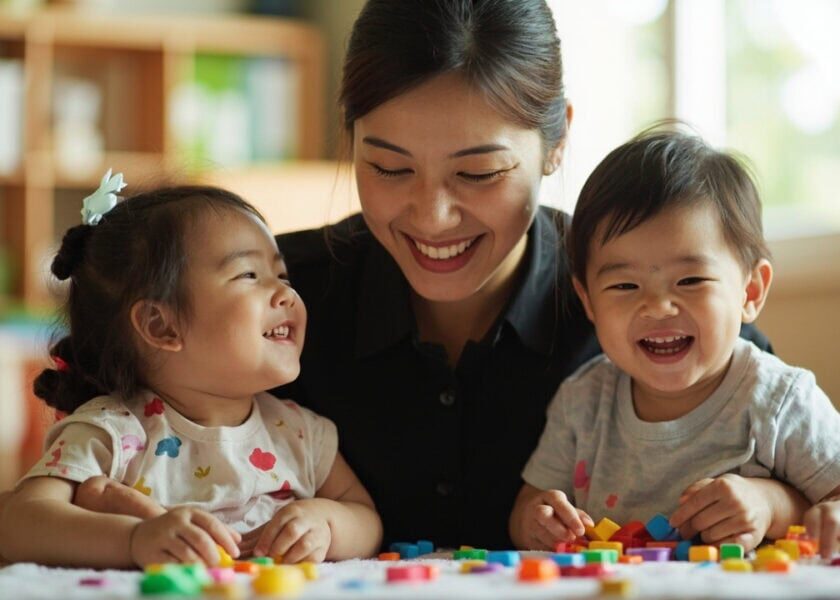
Space alone is not enough. Architecture needs its builders. And in childcare, the builders are the caregivers — the people who inhabit the room with your child, who respond to their needs, who notice when a child is about to lose coherence and step in before the fall.
Relational architecture is not a soft concept. It is a precise professional practice. When we talk about caregiver attunement — the ability of a caregiver to read a child’s emotional and physical state and respond appropriately — we are talking about a skill that is trained, refined, and held to standard.
In quality childcare settings, caregivers learn to read the signals that children send before language arrives. They learn to distinguish:
- A cry of hunger from a cry of overstimulation
- A cry of loneliness from a cry of fatigue
- A cry of frustration from a cry of genuine pain
They learn to approach a frustrated child in a way that teaches rather than suppresses. They learn to be present without being intrusive, to scaffold rather than rescue, to hold the emotional temperature of a room the way a conductor holds the tempo of an orchestra.
In well-structured childminding programs — including those participating in the ECDA Childminding Pilot — this relational work is treated with the seriousness it deserves. Ratios reflect it. With up to one caregiver to three infants, each child receives genuine attention, genuine relationship, genuine knowing.
This is how secure attachment happens in group care. When a child has enough face time with consistent caregivers, they begin to internalize a sense of safety. They begin to trust that their world is reliable. And that internalization — that quiet, invisible work — is the foundation on which every other development is built.
The Daily Scaffolding: How Routine Moments Become Developmental Ones
The hours your child spends with an attuned caregiver are not simply hours of babysitting. They are hours of scaffolding.
Every routine — feeding, diaper changing, nap time, hand washing — is an opportunity for language, for turn-taking, for the gentle negotiation of needs, for the experience of being heard and responded to.
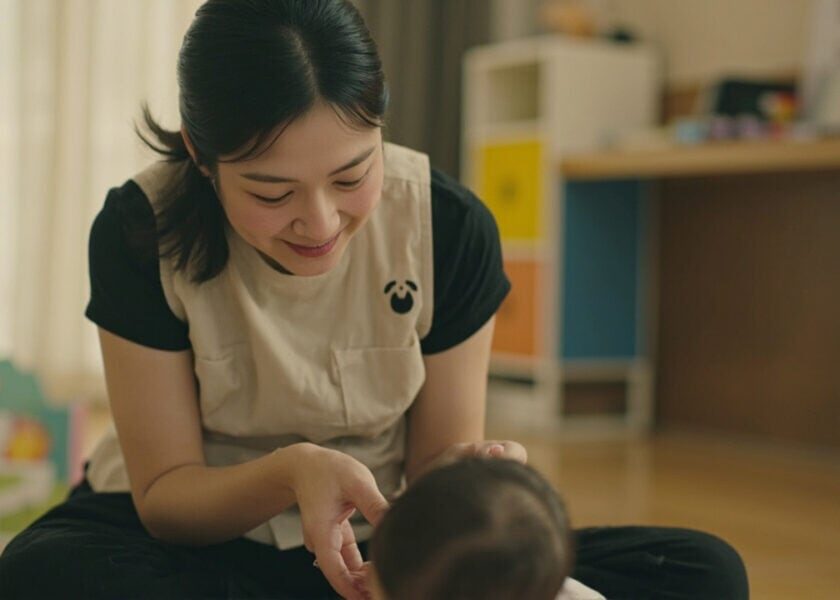
When a caregiver narrates what they are doing during a diaper change — “Now we are going to clean your hands. Feel the cool wipe? You are doing so well holding still” — they are not simply passing time. They are:
- Building neural pathways in language development
- Teaching your child that words carry meaning
- Showing your child that their body is worthy of gentle description
- Demonstrating that they are a person who deserves to be spoken to with respect
The snack table becomes a lesson in patience and sharing. The transition from indoor play to outdoor time becomes a lesson in anticipation and regulation. The caregiver who kneels to a child’s level and says, “I see you are feeling frustrated. The tower fell. Would you like to try again together?” — that caregiver is teaching your child that emotions are safe, that adults can be trusted with big feelings, and that setbacks are not endings.
Why Transitions Matter
The move from one activity to another is neurologically demanding for a young child. Their system is oriented toward the present moment, and asking them to close one experience and open another is asking them to do real cognitive work.
In well-designed care settings, transitions are softened. They are announced. They are given rituals:
- A song before handwashing
- A visual schedule on the wall that children can reference
- A consistent goodbye routine at pickup
These are not administrative conveniences. They are developmental supports that teach children something essential: how to move through the world with predictability, with trust, with a sense that the adults around them have an architecture for the day that includes them.
The Professional Infrastructure: The Load-Bearing Walls
All of this relational and developmental work depends on something that parents do not always think to ask about: the professional infrastructure that makes it possible.
Staff Training
When you entrust your child to a childcare setting, you want to know that the people caring for them have been trained not just in feeding and naps, but in child development milestones, safety protocols and emergency response, recognizing developmental delays, de-escalation techniques, paediatric first aid, and the legal and ethical responsibilities of care.
In quality settings, this training is ongoing. Caregivers do not simply arrive qualified and stay static. They attend workshops. They receive supervision. They reflect on their practice. They are observed, and they observe. This professional culture — of continuous learning, of accountability, of care for the caregiver — is what sustains quality over time.
Why Ratios Matter
Ratios matter too, though they are often misunderstood. A ratio of one caregiver to three infants is not simply a number. It is a commitment to proximity.
It means that in any given moment, your child is not lost in a crowd. It means that when your child falls and skins their knee, there is someone right there — not across the room, not occupied with three other children — but right there, able to respond with the immediacy that a frightened toddler needs. It means that the caregiver-to-child relationship has room to breathe, to deepen, to become something your child can rely on.
Observation and Documentation
Then there is observation and documentation — a practice that is central to premium childcare but rarely visible to parents.
Every day, in quality settings, caregivers are noticing. They are tracking which children gravitate toward which activities, which social configurations are emerging, which developmental milestones are approaching or being reached. They are documenting not for bureaucracy but for understanding.
Because a child who is observed carefully is a child whose needs can be met precisely. Documentation allows caregivers to see patterns — to notice if a child who was engaging socially is now withdrawn, if a child who was sleeping well is now fighting naps, if a child’s language is blossoming in one direction while motor skills lag in another. This is not surveillance of your child. It is the professional practice of knowing them deeply, so that every interaction can be calibrated to where they actually are.
What This Looks Like in Practice
In childcare arrangements that take professional standards seriously — including those operating within the ECDA Childminding Pilot framework — these elements are not aspirational. They are operational.
The pilot brings home-based care into conversation with centre-based pathways, offering families in Singapore genuine choice about the kind of environment that fits their child and their life. Fee structures are designed to be accessible, and CDA and Baby Bonus funds can typically be applied, which simplifies the financial architecture for families who are already managing enough complexity.
Monday to Friday care blocks are structured around the realities of working parents, because premium childcare is not only about what happens in the hours — it is also about how those hours fit into the rhythm of a family’s week.
Where deployed, measures such as CCTV provide an additional layer of reassurance — not as surveillance of caregivers but as a window for parents into the life their child is living during the workday. Communication is not an afterthought at pickup. It is a commitment, because parents deserve to know not just that their child was safe but how their day unfolded, what they discovered, who they played with, what made them laugh.
How to Evaluate What You Cannot Directly Observe
Premium childcare does not ask you to blindly trust. It asks you to become an informed participant in your child’s care — someone who understands what to look for, what to ask, and what to expect.
Read Your Child
You read your child’s state when they are picked up — the ease or tension in their body, the openness or guardedness in their face. A child who resists going to childcare in the morning is communicating something. A child who runs in excitedly is communicating something else. Both messages deserve to be heard.
Read the Caregivers
You read the caregivers’ language — whether they speak about your child as an individual with preferences and patterns, or whether your child is discussed as one of a generic group. “Aiden has been really interested in the water table this week” is different from “The babies played today.” Specificity is a sign of attention.
Read the Environment
You read the space — whether it feels designed or merely filled, whether it smells clean and alive, whether the children in it look engaged or merely occupied.
Read the Communication
You read the updates you receive — whether they reflect genuine observation or pro forma reporting. Ask questions not because you do not trust, but because asking is an act of engagement. Ask about the daily rhythm. Ask about how transitions are handled. Ask what your child gravitates toward. Ask how the caregivers describe your child’s relationships with other children.
| What to Observe | What It Tells You |
|---|---|
| Your child’s body language at pickup | Whether the environment feels safe and regulating |
| Caregiver specificity about your child | Whether your child is truly known as an individual |
| Children’s activity level and engagement | Whether the environment is designed or just filled |
| Transition smoothness | Whether the program is professionally managed |
| Update quality and detail | Whether observation is genuine or performative |
Making the Decision with Confidence
You cannot be there every moment. No parent can. But that is precisely why the professional architecture matters — because it steps into the space where you cannot be, and it holds it with the same devotion you would bring yourself.
When you are evaluating infant care or childminding options in Singapore, we encourage you to visit. To observe. To ask. To read the space and the people and your own child’s response. Premium childcare welcomes this scrutiny because it has nothing to hide.
If what you find aligns with what you have read here — with intentional environments, professional attunement, honest communication, and ratios that protect genuine relationship — then you have found something worth trusting.
We would be glad to speak with you about what thoughtful, development-oriented childcare can look like for your family.
Because your child deserves a world that has been made for them. And you deserve the peace of knowing it.
EduNanny is a participant in the ECDA Childminding Pilot, providing development-oriented childminding and childcare for families across Singapore. Learn more about our approach.