Fraud Blocker edunanny.com

Category: Childminding

edunanny-062f14fc4bf5dc0508ab18897bfa6fe4
April 16, 2026

Beyond the Gate: How Your Child Lives When You’re Apart

The Quiet Hours: What Your Child Experiences While You’re Apart

There is a particular silence that falls over a parent in the late afternoon. It arrives somewhere between the commute home and the moment of arrival — a silence made not of absence but of imagination. You begin to wonder what your child is doing right now. Whether the morning’s goodbye has settled into something gentler. Whether she found a friend. Whether he ate enough. Whether anyone noticed when he reached for the blue cup instead of the green.

This wondering is not weakness. It is love in its most attentive form — the ache of a parent who cannot be in two places at once, who has chosen to trust another with the most precious hours of their child’s life, and who feels the enormous weight of that trust every single day.

And that ache — that is exactly where this guide begins. Because the hours apart matter more than you think, and understanding what happens in them can transform how you feel about the choice you have made.


The Sensory World of Early Childhood

Imagine, for a moment, that you are very small. Not metaphorically small, but three feet tall, perhaps less.

Your face is at the level of adult knees and tabletops. The ceiling above you is closer than it has ever been in your short life. The sounds around you arrive differently — footsteps on tile, the clatter of a spoon, a child’s laughter that seems to come from everywhere at once because, at your height, acoustics behave differently. The light is different too.

In a quality childcare setting, someone has thought about this. The windows are placed where morning light falls softly across the floor, not glaring into the eyes of a crawling infant. The artificial lighting is warm and even, not the harsh buzz of environments that treat children as tasks to be managed.

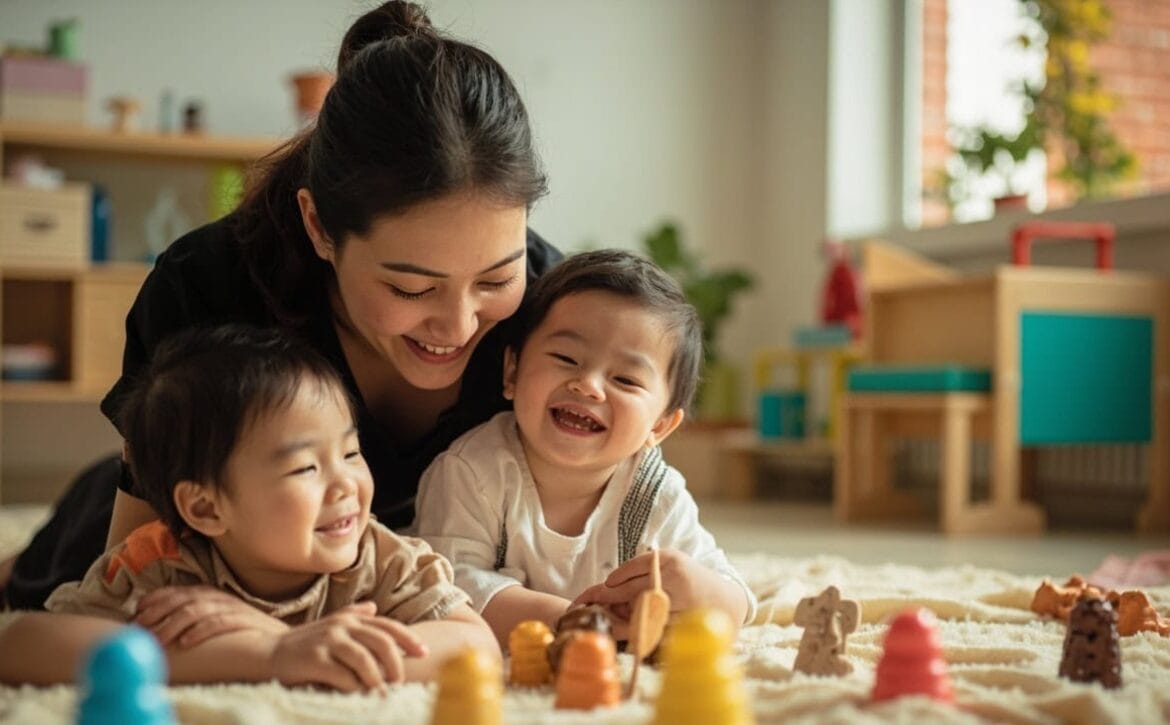
There is a texture to everything your hands find. Wooden toys feel different from plastic ones. Fabric books have a weight that board books do not. The carpet where you sit has a specific softness, and the caregiver who sits with you there has noticed that you prefer the corner by the window, where the light pools. She has not written this down as a milestone. She has simply seen you, and she has let you stay.

The Rhythm That Speaks Before Words Do

Children are not born with clocks. They are born with bodies that hunger for consistency, and a well-structured day offers exactly that — predictable sequences of activity and rest, meal and movement, social time and solitude, held within a gentle framework that the child learns to trust.

When a child knows that rest comes after music, and music comes after outdoor play, something in her nervous system begins to settle. She does not need to ask what happens next. She begins to feel, without words for it, that the world is ordered and that she is safe within that order.

This is not rigidity. The best childcare environments breathe. They adapt when a child needs something different, when the morning has been harder than expected, when a developmental leap calls for more patience or more challenge. But beneath the flexibility, there is a steady pulse — a reliability that says, quietly, over and over: you are safe here. The world makes sense here. You are held.

In Singapore, where dual-income families are the norm and young children often spend significant hours in care, this rhythmic consistency becomes even more important. A child who can trust the shape of her day carries that trust into her play, her relationships, and eventually into her ability to explore the world with confidence.


The Caregiver-Child Bond: Why It Matters More Than You Think

And then there are the people.

The caregiver in a quality setting is not merely a supervisor. She is something more difficult and more important: she is a student of your child. She has learned, through training and through the particular patience that comes from choosing this work, to read the language beneath the language.

She notices when a toddler’s play becomes frantic and understands that this is not misbehavior but overwhelm — a small body that has taken in too much and needs help processing it. She notices when a baby turns her face away and knows that this is not rejection but the earliest form of setting a boundary, and she honors it.

What Science Tells Us About Early Attachment

When a child forms a bond with a caregiver who is warm, consistent, and attuned, something profound takes root. The child learns, in the most fundamental sense, that people can be trusted. That the world outside the family can be safe. That when he is upset or afraid or overwhelmed, there is someone who will come.

Research in early childhood development consistently shows that the quality of early attachments influences how children relate to teachers, to friends, to future partners, and to you. The relationship your child forms with her caregiver in these early years is not a replacement for you — it is an extension of the trust you are teaching her to build in the world.

Why Ratios Matter

In settings like EduNanny, which operates within the ECDA Childminding Pilot framework, the ratio of caregivers to infants is kept intentionally low — up to one to three, depending on the age and configuration of the group. This is not an accident. This number exists because someone understands that attunement cannot happen at scale. That a caregiver cannot truly know a child if she is responsible for six or eight at once. That the invisible work of noticing, responding, and connecting requires time and space and, above all, presence.

When you drop your child in the morning, the caregiver meets you at the door. She has already been thinking about your child since the last pickup — about the change in appetite she noticed yesterday, about the way he has been seeking more independence at the sensory table, about the small bruise on his knee that he didn’t seem to notice but that she cleaned and watched carefully.

She does not need to report all of this. But she holds it, and she brings it to the day ahead. This is the difference between care that merely manages and care that truly knows.


Play as Your Child’s Language

Watch a child at play and you are watching the most serious work of early childhood. This is not filler between diaper changes and nap times. This is the medium through which children understand their world, process their emotions, build their thinking, and practice being human.

When a toddler fills a bucket with water and tips it out again, watching the pour with absolute fascination, she is not merely playing. She is conducting experiments in gravity, cause and effect, and the properties of matter. When she builds a tower of blocks and knocks it down, she is learning about structural integrity, about failure and iteration, about the satisfaction of mastery. When she places two small figures together and makes them talk to each other, she is processing something she observed at home — a conversation between her parents, perhaps, or a moment of sibling tension — and making sense of it through the safe distance of play.

The Messages Children Send Through Play

  • A child who chooses to play alone in a corner may not be shy — she may be a deep thinker who needs solitude to process the morning
  • A child who insists on the same song every day may not be rigid — she may be building mastery and comfort through repetition, gathering the courage to move on
  • A child who takes your hand and leads you to the corner to show you what she made may not simply be proud — she may be testing whether you see her, whether your attention is truly on her

In quality childcare, caregivers understand play as the child’s language and they speak it back. They do not interrupt a child’s deep concentration to redirect toward a “learning activity.” They do not schedule every moment of the day with curriculum outcomes in mind. They understand that the richest learning often happens in the unscripted moments — the pretend cooking in the play kitchen, the negotiation over who gets the red truck, the meltdown over a cracker that broke in half.

These are not problems to be solved. They are the work of childhood, and a skilled caregiver holds space for them, guides when guidance is needed, and steps back when the child is capable of figuring things out.


Reading Your Child at Pickup: What the Reunion Tells You

So how do you know? How do you know whether your child is not merely safe and supervised but truly thriving in those hours apart from you?

You look at pickup. And I mean really look.

Signs of Security, Belonging, and Being Known

A child who runs to you with open arms and then, after the first flush of reunion, settles back into himself — checking whether you are truly here, whether the reunion is real — this child has been secure. The temporary absence has not damaged the bond. The world has held him well enough that he can leave it and return to you without fracture.

A child who is reluctant to leave, who lingers at the gate, who seems more interested in the play continuing than in being with you — this is not rejection of you. This is a compliment to the environment. This child has found a place he loves, people who know him, activities that absorb him. He does not need you less. He simply trusts the world enough to want to stay in it a little longer.

A child who comes to you with something to show — a painting, a leaf, a small treasure found in the garden — this child feels seen in his childcare setting. He has been noticed. He has had experiences worth sharing. He is not merely waiting for pickup. He is living a life while he waits.

The Language of the Day

And then there is the language — not just the words but the quality of engagement. A child who tells you about her day, who narrates her experiences, who asks questions that suggest she has been thinking — this child has been in an environment where language is valued, where her voice is heard, where conversation is part of the culture.

A child who is quiet, who does not yet have words for what happened — this child may still be processing, and that is fine. Quiet is not the same as empty.

What you are looking for, in these small moments of reunion, is evidence that your child has been known. That she has been seen as a full person — not a body to be fed and diapered, not a slot to be filled in a daily schedule, but a child with preferences and fears and joys and rhythms, all of which have been noticed and honored by the adults in her life during those hours.


What Quality Childcare Looks Like: A Singapore Parent’s Guide

For parents navigating Singapore’s childcare landscape — whether considering centre-based care, home-based childminding, or family child care — understanding what quality looks like in practice can feel overwhelming. Here is a framework grounded in what children actually need.

Environmental Markers of Quality

What to Notice Why It Matters
Natural light, warm artificial lighting Children perceive light differently than adults; harsh environments create subtle stress
Low child-to-caregiver ratios Attunement requires time and attention that is impossible at scale
Predictable daily rhythm Consistency helps children feel safe and regulates their nervous systems
Variety of textures and materials Sensory exploration is the foundation of early learning
Space scaled to a child’s perspective Children experience environments differently; what looks fine to adults may feel overwhelming

Relational Markers of Quality

  • The caregiver knows your child’s name and uses it warmly and consistently
  • The caregiver notices preferences — where your child likes to sit, which toy he reaches for first, how she responds to being tired
  • The caregiver narrates and reflects your child’s actions back to her, helping her make sense of her world
  • The caregiver holds boundaries with warmth — she does not allow harmful behavior but she does not shame children for having big feelings
  • The caregiver speaks to you — not just at drop-off and pickup, but throughout the day when relevant

Practical Questions to Ask

  1. Visit more than once. Return at different times of day — during drop-off, at pickup, during a mid-morning activity. Observe how caregivers interact with children when they know they are not being evaluated.
  2. Ask about ratios. For infants and toddlers, lower is better. Ask how many children each caregiver is responsible for, and how that changes throughout the day.
  3. Notice the sensory environment. Is the light warm or harsh? Are there varied textures and materials? Is the space scaled to a child’s perspective?
  4. Ask how they handle conflict and big emotions. Listen to the language they use. You want caregivers who treat emotional moments as opportunities for connection, not as disruptions to be managed.
  5. Trust your observations at pickup. Pay attention to how the children look when their parents arrive. Are they settled? Engaged? Do caregivers greet parents warmly and share genuine observations about the child’s day?
  6. Ask about communication. How will you know what your child’s day looked like? What is their approach to daily updates? How accessible is the caregiver to questions and concerns?

EduNanny’s Approach: Where Philosophy Meets Practice

When I speak with parents who have chosen EduNanny, a word that comes up again and again is transparency. Not as a policy document or a checklist of features, but as a felt experience — the sense that they are connected to their child’s day, that they understand what is happening, that the childcare setting is not a black box but a space they can trust because they can, in some meaningful way, see inside it.

EduNanny operates under the ECDA Childminding Pilot framework, which reflects a philosophy that is rare in early childhood care: that the quality of the relationship between caregiver and child is the engine of everything else. Not the curriculum. Not the facility. Not the marketing materials. The relationship.

The pilot framework’s attention to caregiver ratios, training requirements, and ongoing support creates the conditions for the kind of attunement described above. In a home-based or community-based setting, a child is not surrounded by dozens of peers and competing demands. The environment is scaled to human perception. The caregiver can know each child deeply. The routines are predictable not because they are written on a chart but because they are lived daily, felt in the bones of everyone present.

Where observation measures are deployed, parents have the option to stay connected. Communication is ongoing — not just the daily log or the incident report, but the quiet, consistent exchange of information that keeps parents feeling connected to the rhythm of their child’s day. This is not about surveillance. It is about partnership. When a parent can see, even in small ways, what the day looks like, the imagination that fills the afternoon hours becomes less anxious and more curious.

Making Quality Care Accessible

For parents in Singapore, the practical dimensions of quality care matter. Monday to Friday blocks, affordable pilot fee structures, the usability of CDA and Baby Bonus funds — these are not incidental. They are the conditions that make quality care accessible.

Because the truth is that no philosophy, however beautiful, reaches a child if the family cannot afford to access it. EduNanny has designed its approach with this reality in mind: not as an afterthought, but as a foundation.


The Partnership Worth Building

When you find the right environment — the one where the light falls softly, where the rhythm is steady, where the caregiver knows your child’s name and what it means when she reaches for the blue cup — you will know it not because of a brochure or a tour or a list of features. You will know it because your child comes home whole. Curious. Secure. Ready to tell you about her day.

That is what quality childcare makes possible. Not just a place where your child is kept. A place where your child is known.

You are not a lesser parent for needing childcare. You are not a lesser parent for feeling the ache of those afternoon hours, for wondering, for wishing you could be in two places at once. The love that drives that ache is the same love that will guide every important decision you make for your child, including this one.

Your child is not defined by the hours you are apart. Your child is shaped by the love you bring to those hours — the care with which you chose her care, the attention you bring to pickup, the curiosity you cultivate about her inner life. You are not absent from her experience of childcare. You are the reason it matters.

Trust that. Choose from that place. And know that the right environment is out there — one where your child is not merely supervised but known, not merely safe but seen.

That is what quality childcare makes possible. And that is what EduNanny is here to walk alongside you toward.


To learn more about EduNanny’s approach to development-focused childminding in Singapore, visit our homepage or read about our participation in the ECDA Childminding Pilot. We welcome questions from families who are considering their options — reach out to us anytime.


edunanny-062f11290af6e7f3261f70d8e9b428ac
April 16, 2026

**Quality Childcare Means Your Child Is Truly Known**

What Quality Childcare Actually Does

For parents researching their options, here is what matters most:

  • It observes, not just supervises. Caregivers trained in attunement read your child’s signals — not to manage behaviour, but to understand it.
  • Small ratios matter. Fewer children per caregiver means more space for noticing, for reading faces before a cry begins, for genuine knowing.
  • Technology documents. Attunement understands. Apps, logs, and photo updates tell you what happened. They cannot tell you who your child is becoming.
  • The parent-caregiver relationship is a partnership. You know your child at home. Caregivers know your child in the social world. Together, you build a fuller picture.
  • EduNanny embeds these principles within the ECDA Childminding Pilot, with ratios designed to protect genuine attunement and communication structures that keep you connected.

The Difference Between Watching and Witnessing

When you walk through the doors of a quality infant care setting, what is happening may not look dramatic from the outside. A caregiver sits on the floor. A child approaches with a block in hand. The caregiver watches — not with a distracted glance, but with the particular quality of attention that comes from training and from genuine interest.

This is the difference between observation and supervision, between watching and witnessing. Supervision keeps children safe. Observation, the kind that matters, keeps children understood.

What Attunement Actually Means

There is a concept in early childhood education that speaks directly to this — attunement. It is the caregiver’s capacity to read a child’s signals, to interpret their behaviour not as noise to be managed but as language to be understood.

It is the practiced art of noticing that one child grows calmer when given space to observe before joining, while another brightens immediately at the invitation to move. It is understanding that a particular frown before lunch is not defiance but hunger, and that the child who suddenly becomes still is not being good but is signalling something that needs gentle attention.

Attunement is the invisible architecture of quality care. It is built slowly, through thousands of small observations gathered over weeks and months.

The Internal Map

The attuned caregiver builds something over time — an internal map of each child in their care. This map is drawn from patterns: the rhythm of a child’s sleep, the foods they approach eagerly and the ones they approach cautiously, the way they greet other children, the sensory experiences that soothe them and the ones that overstimulate.

It is knowing that one child needs a quiet corner after a busy morning, while another is soothed precisely by the energy of a group. This internal map is not filed away in a report or captured in a photograph. It lives in the caregiver’s awareness and informs every interaction — the way a question is posed, the timing of a transition, the tone used when offering comfort.

This is what separates quality from adequacy. Adequate care ensures that children are fed, changed, kept safe. Quality care goes further — it reads the child and responds in a way that says, I see you. I understand you. Your inner experience matters to me.

What Your Child’s Play Is Telling You

Consider play. When your child builds a tower and knocks it down, they are not simply amusing themselves. They are working through something — the pleasure of creation and destruction, the physics of cause and effect, perhaps a tension they felt earlier in the morning when you left.

When a caregiver watches this play with an attuned eye, they are reading a kind of language that your child speaks before words are fully formed. They notice that this child always returns to stacking after moments of transition, that another child’s play grows more elaborate when they feel secure, that a third child uses dolls to rehearse the goodbyes they encounter daily.

For many families in Singapore, the morning drop-off is a significant moment. A child who hesitates at the door is not simply being difficult — they may be processing a real emotion that deserves acknowledgment. A caregiver who understands this does not rush the moment or dismiss it. They recognise it, name it gently, and offer the reassurance that return is inevitable and that the hours ahead will hold good things.


Observation vs Supervision: What Actually Changes

Supervision (Watching) Observation (Witnessing)
Ensures physical safety Understands emotional and developmental signals
Counts children, manages groups Notices individual patterns and temperaments
Responds to incidents Anticipates needs before they become urgent
Documents for compliance Notices for understanding
Maintains order Reads the child behind the behaviour

Can Technology Replace Attunement?

There is a question that often arises, and it is worth naming directly: can technology serve this function? Can an app, a daily log, a photograph, a video update tell you what you need to know about your child’s day?

These tools have their place. Transparency matters. Knowing that your child ate well, that they napped on schedule, that they played outside — this offers genuine reassurance, and quality care providers understand this. A commitment to open communication, including measures such as CCTV where deployed, reflects a respect for the parent’s need to feel connected to their child’s day.

But here is what an app cannot do: it cannot catch the moment when your child’s play shifts from hesitant to confident. It cannot notice the way their shoulders drop when they finally relax into the morning. It cannot read the quality of their engagement with another child and wonder what that interaction is teaching them about friendship.

Technology can document. It cannot attune.

Documentation captures data. Attunement creates understanding. One tells you what happened. The other tells you who your child is becoming in your absence.


The Parent-Caregiver Partnership and Why the Early Years Matter

The relationship between parent and caregiver matters deeply, and it should be understood not as a handover of responsibility but as a partnership. The parent knows the child at home — their particular rhythms, their fears, their joys, the way they sleep, the foods they love. The caregiver knows the child in the social world — how they engage with peers, how they respond to new situations, how they grow when they are among other children.

Neither knowledge is complete without the other. When these two sources of understanding are shared respectfully and regularly, they form something powerful: a co-authored understanding of the child. You bring the home story. The caregiver brings the group story. Together, you build a fuller picture than either could create alone.

When it works well, parents report something remarkable — they feel not that they have handed over their child to strangers, but that they have gained an ally in understanding their child. They return from a day’s work to a caregiver who speaks of their child with genuine familiarity, who notices the same things they notice, who cares about the same small victories and worries about the same small struggles.

What the Early Years Actually Need

What happens in the first thousand days of a child’s life shapes the architecture of who they will become. Neural pathways are formed at a remarkable pace. Social capacities are emerging. The child’s understanding of safety, of trust, of their own worth, is being written in real time.

In this context, infant care is not a placeholder between parental leaves. It is a formative environment, and the quality of attention within it matters profoundly. When a caregiver is attuned — when they respond to a child’s signals consistently, when they create an environment that feels safe enough for exploration, when they celebrate a child’s small discoveries with genuine delight — they are contributing something essential to the child’s development.

They are teaching the child, through repeated experience, that they are worthy of attention, that their communications matter, that the world can be trusted to respond to them. This is not a small thing. It is the foundation upon which a child’s confidence and curiosity will rest.


How EduNanny Approaches Quality Care

For parents in Singapore navigating these decisions, the landscape can feel overwhelming. There are centre-based options and home-based arrangements. There are government-supported programmes, such as the ECDA Childminding Pilot, which offer pathways designed to make quality care more accessible and affordable. There are fee structures that can feel puzzling, and funding mechanisms that require understanding to navigate.

The practical realities of childcare in Singapore are real, and they deserve thoughtful consideration. But beneath the logistics, the question remains the same: Where will my child be known?

What EduNanny Offers

EduNanny has built its approach around this question. Within the ECDA Childminding Pilot, EduNanny offers home-based care with small ratios — up to one to three infants in childminding settings — that protect the conditions for genuine attunement. This is not incidental. It reflects a conviction that knowing a child well requires the conditions that make knowing possible: time, space, and the absence of crowding.

EduNanny offers both home-based and centre-based pathways, understanding that different families have different needs and that the best care is one that fits the rhythms of a particular family’s life. The Monday to Friday care blocks align with the reality of working parents, and the fee structures within the pilot have been designed with accessibility in mind.

The Culture Behind the Structure

Beyond the structure, what EduNanny has sought to build is a culture of care — one where caregivers are not just trained in safety protocols and developmental milestones, but in the art of paying attention. Where communication with parents is not an afterthought but a commitment. Where the child’s inner experience is treated as something worthy of careful observation and gentle response.

This is what sets quality apart. Not the brochure, not the facilities, not the promises — but the daily, quiet, sustained attention that a caregiver brings to knowing the particular child in front of them.


What to Look For When Choosing Infant Care

If you are evaluating infant care options in Singapore, here are the questions that matter most:

  • How many children are in the caregiver’s care at one time? Small ratios create space for noticing. Ask about infant-to-caregiver ratios and understand what they mean in practice.
  • How does the caregiver describe your child? After a settling period, the right caregiver should speak about your child with specificity — particular details that show they are truly seeing your child.
  • What does the communication look like? Transparency matters, but ask what it looks like beyond logs and photographs. How do they share observations? How do they invite your input?
  • How does the caregiver handle transitions? Morning drop-offs, nap times, and pickups are revealing moments. Notice how the caregiver relates to your child during these times.
  • Does the approach feel relational or transactional? Quality care feels like a partnership. You should feel like an expert on your child, not like a client being served.

The Promise

When a caregiver truly attunes to a child, they are doing something that extends beyond professional competence. They are saying, with every careful observation and responsive interaction: You are not one of many to me. You are this one. I see your particular way of being in the world, and it matters.

This is what children need most — to be known, to be seen, to have their inner experience reflected back to them as something real and valuable.

And for parents, this is the deepest answer to the question that wakes you in the night, the question that lingers at drop-off, the question you may not even have fully articulated: Is my child okay? Is my child known?

Yes. In quality care, the answer is yes. Not perfectly, not completely — children remain mysterious, and caregiving remains human — but yes in the ways that matter. Your child is being read, not just watched. Your child is being understood, not just managed.

So if you are standing at that threshold, in that morning moment, feeling the weight of what you are entrusting — know this: the right care will not replace you. It will stand beside you. It will watch your child with the same attention you bring at home. It will notice the same things, celebrate the same small victories, and hold the same tender concern for the same small struggles.

Your child will be seen. Your child will be known. And you, as their parent, will never be alone in the work of raising them.


If you would like to learn more about how EduNanny approaches quality childminding and the pathways available through the ECDA Childminding Pilot, we welcome the opportunity to speak with you. You can also read more about our approach and what we believe about the work of caring for young children.

edunanny-062f0d90080d4b2c3c9cde953013a044
April 16, 2026

What Singapore Parents Sense in Quality Childcare but Cannot Name

What You Sense Is Real — And Now You Can Name It

You’ve dropped your child at a childcare centre, and something feels right. The space feels calm. The caregivers seem present. Your child settles more quickly than you expected.

Then you visit another, equally clean, equally well-staffed — and the feeling is different. You cannot explain why.

This is the quiet question many Singapore parents carry. Not whether they can identify quality when they encounter it — they can. But whether they can explain it. Articulate it. Defend their choice with more than “it just felt right.”

The truth is, most parents cannot. Not because they are not thoughtful or discerning. But because the most important things about quality childcare are invisible. They happen in the noticing of a caregiver, in the reasoning behind a routine, in the design of a day that looks deceptively simple from the outside.

Today, we want to make visible what you have always sensed. Not to make you doubt your instincts — your instincts are valuable. But to give your instincts a framework. So that when you choose childcare, you choose with both heart and understanding.


The Invisible Framework: What You Cannot See Matters Most

Walk into any childcare centre in Singapore, and you will see children playing. Blocks, puzzles, sand tables, circle time. It looks like play because it is play.

But for trained caregivers, that same scene is something else entirely: a continuous stream of developmental data.

A caregiver trained in early childhood observation does not simply watch children build towers. She notices how a two-year-old holds a crayon — the grip pattern revealing fine motor development, the pressure indicating strength readiness. She notices how a toddler navigates social conflict — whether the child negotiates, deflects, or withdraws.

These are not random behaviours. They are signals that tell a trained eye where a child is in their development, what skills are emerging, what supports might help.

This is not the same as supervision. Supervision keeps children safe. Observation interprets what it sees and acts on that interpretation.

The Difference That Changes Everything

When a caregiver notices that a child consistently reaches for objects in a specific order, or that a toddler’s frustration at block stacking follows a pattern she has seen before, she is building a mental map of this child’s developmental trajectory.

From that map, she makes decisions: whether to introduce a more challenging activity, whether to offer support, whether to simply observe and let a struggle resolve on its own.

A supervisor notices that a child is upset. A trained caregiver notices why — and what that upset is teaching her about the child.

The difference is not visible in a photograph. But it changes everything about what your child receives each day.


Curriculum That Responds to Your Child’s Development

Consider the curriculum. Not the one printed on a laminated weekly plan, but the one that actually unfolds.

In a generic programme, you might see “Monday: Art activity” and “Wednesday: Music and movement.” These are fine. They are structured. But they are also fixed — the same activity offered to every child regardless of where they are developmentally, regardless of what they might need that particular morning.

Intentional curriculum design looks different. It begins not with a plan but with observation:

  • What is this child working on right now?
  • What developmental milestone is within reach, with the right kind of support?

An activity is not chosen because it is Tuesday and Tuesdays are for sensory play. It is chosen because the caregiver has observed that a specific child is developing categorical thinking — the ability to sort, group, and classify — and the sensory bin has been designed with variables that challenge and extend that emerging skill.

The same activity. Different purpose. Different scaffolding. Different outcome.

Questions That Reveal Professional Design

When parents understand this, their questions change. They stop asking, “What curriculum do you follow?” and start asking:

  • “How do you know what my child needs?”
  • “How do you document what you observe?”
  • “How does observation become the next day’s plan?”

These are the questions that reveal whether curriculum is genuinely responsive or simply pre-packaged.


The Architecture of a Quality Childcare Day

Here is something else most parents do not see: the architecture of the day itself. The transitions. The routines. The rhythm.

When a child moves from free play to circle time, you might see a simple sequence — a song, a signal, a gathering of children on a mat. It looks easy. It looks natural. But it is designed.

Young children — especially infants and toddlers — do not transition well without support. Their developing brains do not yet have the executive function to simply stop an engaging activity and shift attention on command. A poorly managed transition is not just chaotic; it is developmentally frustrating. Children who are rushed through transitions spend cognitive energy on managing their own distress rather than on learning.

Why Structure Serves Development

Thoughtful transitions do something different. They prepare children. They signal change in advance. They offer a ritual — a familiar sequence that the child can predict, participate in, and eventually internalize.

A child who knows that three verses of a clean-up song means playtime is ending is a child who can begin to self-regulate. The transition itself becomes a learning opportunity.

The same intentionality applies to mealtimes, to rest, to outdoor play. When a child rests in a room designed for rest — with attention to lighting, to noise levels, to the spacing of sleeping mats, to the ratio of children to caregivers — that rest is genuinely restorative. It is sleep architecture, calibrated to support a child’s developing circadian rhythms and neurological regulation.

When you see a childcare day that feels calm, that moves with a gentle but predictable rhythm, you are seeing design. Not accident. Not mere routine. Professional design, built on an understanding of how young children experience time and transition.


Why Caregiver Ratios and Emotional Attunement Matter

You might have seen caregiver ratios mentioned in Singapore childcare regulations without understanding why the numbers matter.

In infant care, the ratio might be one caregiver to three infants. This is not arbitrary. It is the threshold below which a caregiver can function as an observer and interpreter. Above it, she becomes a manager of safety, focused on preventing harm rather than noticing development.

What Ratios Enable

With three infants, a caregiver can observe feeding patterns, note emerging communication signals, respond to distress with genuine presence. She can notice that one infant is fussy in a way that suggests teething discomfort while another is fussy in a way that suggests hunger or overstimulation. She can interpret the difference. She can act accordingly.

With six infants, she can keep them safe. She can feed them on schedule. But she cannot observe. She cannot notice the subtle variations that make each infant a distinct person with distinct needs.

When you visit a childcare setting, observe the caregivers. Do they seem hurried? Rushed? Reactive? Or do they seem present — genuinely available to notice what is happening in front of them?

Emotional Attunement as Professional Skill

You might think emotional attunement is simply being warm, being caring, being kind to children. And it is those things. But it is also something more.

Professional emotional attunement is the capacity to read a child’s emotional state accurately, to understand what that state communicates about their developmental experience, and to respond in a way that supports emotional development — not just comfort.

When a toddler has a meltdown because a tower collapsed, a trained caregiver does not simply say, “It’s okay, let’s build another.” She notices what kind of frustration this is:

  • Is this a child who is learning to manage disappointment?
  • Is this a child who is testing cause and effect?
  • Is this a child whose tower collapse triggered something larger — separation anxiety that has been building all morning?

The response differs based on the interpretation. Sometimes mirroring — “You worked so hard on that. You are upset it fell” — is the right approach. Sometimes redirection. Sometimes physical comfort first, then language.

The skill is in reading the situation accurately and choosing a response that helps the child develop emotional regulation, not just stop crying.

This is professional expertise applied throughout every day of your child’s care. It is not just love, though love is essential. It is trained love — love that observes, interprets, and responds with intention.

Parents often sense this without being able to name it. They say, “The caregiver really gets my child.” What they are sensing is professional attunement — the result of training, observation, and a programme that values the emotional work of caregiving as much as the physical care.


What to Look For When You Visit a Childcare Centre

You now have a vocabulary for what you could not see before. When you walk through those doors with your child, you will see differently.

Signs of Trained Observation

  • Caregivers describe children as individuals, with specific patterns and needs — not just as a group
  • They can articulate the thinking behind a routine, not just say “This is how we do things”
  • A child’s distress is met with a trained response, not a generic one

Questions That Reveal Quality

Replace surface questions with ones that probe professional reasoning:

  • “How do you know what my child needs this week?” instead of “Do you have a curriculum?”
  • “What are you observing about my child’s development, and what does that tell you?” instead of “Is my child happy?”
  • “How does observation become the next day’s plan?” instead of “What activities do you do?”
  • “How does the ratio allow caregivers to notice individual patterns?” instead of “What are your ratios?”

A programme with professional design will have thoughtful answers. One without it will offer generic responses.

Addressing What Parents Really Wonder

“How do I know if I’m making the right choice?”
The right choice creates conditions for development that compound over time. A child who is observed, who is responded to with understanding, who experiences a day designed around their needs — that child is building a foundation you will never fully see but will always benefit from.

“What if I can’t afford premium childcare?”
Quality should not be reserved for families with significant means. The ECDA Childminding Pilot reflects a commitment to making professionally designed care accessible, with fee structures and CDA/Baby Bonus support that reduce financial barriers.


Seeing What You Could Not See Before — And Choosing With Confidence

You now have a vocabulary for what you could not see before:

  • Observation is not the same as supervision
  • Curriculum should emerge from understanding, not from a fixed weekly plan
  • Transitions, mealtimes, rest periods — all of it is designed
  • Ratios matter because they determine whether caregivers can notice or merely manage
  • Emotional attunement is a skill, not just a disposition

The choice you make about childcare is one of the most consequential choices you will make in these early years. Not because the wrong choice causes immediate, visible harm — usually it does not. But because the right choice creates conditions for development that compound over time.

And now, when you look at childcare, you will see more than you saw before. You will see the intentional transitions. The responsive curriculum. The ratios that allow genuine attention. The emotional attunement that goes beyond kindness. You will see the professional design that separates quality from mere adequacy.

And when you choose, you will choose with clarity. With confidence. With both heart and understanding.

That is what you deserve. That is what your child deserves.


EduNanny by BUTLER was built on this belief: that quality childcare is professionally designed, expertly staffed, and intentionally structured around the developmental needs of each child in their care. Through the ECDA Childminding Pilot, EduNanny offers Singapore families a pathway to this kind of care — with ratios that allow genuine observation, transparent partnership with parents, and a calm environment that reflects professional design, not accident.

If you are exploring infant care or childminding options in Singapore, we welcome the conversation at EduNanny.

edunanny-062f0a23d727effdaad3c59380449a95
April 16, 2026

What Your Child Teaches You About Quality Care After Enrollment

The Silence After You Choose

The silence is precisely where EduNanny begins. Not at enrollment. Not at the decision point that every other resource treats as the climax of the story. But here, in this quiet apartment, on the morning after you have chosen, and the morning after that.

Because the truth about quality childcare is that it is not a product you purchase and evaluate. It is a relationship that unfolds over time. And like all relationships that matter, it asks something of you.

It asks you to trust what you cannot see. To recognize quality through indirect signals. To understand that your role as a parent does not end at the school gate—it transforms.

The Adjustment Period Is Yours Too

The moment you walk away from that drop-off, there is a physiological response that is entirely normal and entirely uncomfortable: a low-grade anxiety that persists through the morning, a checking of your phone that becomes compulsive, a mental rehearsal of every worst-case scenario your mind can conjure.

This is not weakness. This is the normal human response to placing something precious in the care of another. It is, in fact, the beginning of trust—not its enemy, but its birthplace.

Your child is undergoing their own transition. The first few days may bring protest, resistance, clinginess. Or they may bring an unsettling ease that makes you wonder whether your child even noticed you left. Both responses are normal.

What you are watching for in these weeks is not a single dramatic moment of bonding but a gradual arc: small signs that the unfamiliar is becoming familiar, that the new environment is beginning to feel like a place.

Perhaps your child begins to mention a caregiver by name. Perhaps they pick up a routine—the hand-washing before snack, the song before nap—that suggests they are learning the rhythms of this new world. Perhaps they come home tired in a way that feels purposeful rather than distressed, the tiredness of a child who has been engaged and stimulated, not merely kept occupied.


Reading Quality Through Your Child’s Behavior

As the weeks progress, you will begin to notice patterns that matter more than any photograph or daily report could convey.

Consider the evening routine, that liminal space between pick-up and bedtime when your child is no longer performing for caregivers but also not yet asleep. How does your child behave in these hours?

A child who is genuinely thriving in their care environment will often show a particular quality of presence. They may be tired, yes, but their tiredness has texture—the kind that comes from genuine engagement. They may be hungry in a way that speaks to active play and learning, not passive waiting. They may be more themselves, not less.

The child who is merely being minded may come home flat, compliant, oddly disconnected. The child who is being nurtured will often return to you more alive, more regulated, more curious about the world they have re-entered.

Adjustment is not linear. But the trajectory over weeks and months will tell you something profound: whether this environment is one that is helping your child to grow, or simply one that is keeping them safe.

Signs of Genuine Thriving

  • Language development: New words, richer vocabulary, emerging ability to name emotions
  • Play complexity: Greater imagination, more sophisticated pretend play, willingness to explore
  • Emotional regulation: Improved capacity to manage frustration, faster recovery from upset
  • Relationship security: When a child feels secure outside your arms, they do not cling more tightly to you when you return. They come to you with a fullness of experience to share, a self that has been expanded rather than diminished by the hours apart.

Why Small Ratios Create the Conditions for Trust

This is where the ratio matters more than any marketing claim. When an infant or toddler is in a setting with a small number of children, the caregiver has the capacity to truly know each child—not just their name and schedule, but their temperament, their fears, their joys, the particular thing that makes them laugh versus the particular thing that makes them crumble.

You may notice it at pick-up when your child runs to their caregiver with the same ease they run to you. You may notice it in the way your child mentions this person in everyday conversation.

“Miss Anisha says the ants have six legs.”

“Miss Anisha showed me how to fold the napkin.”

These small references are evidence of a genuine attachment, earned through consistent presence and thousands of small moments of attunement. When your child speaks of their caregiver as a real person with real knowledge, you are witnessing the formation of something that cannot be manufactured on the first day or documented in a single report.


Your Role Transforms: From Monitor to Partner

There is a pivot that every parent must eventually make: from the role you played in choosing, which was active, evaluative, decisive, to the role you play now, which is quieter and in some ways more demanding.

You must become a partner rather than a monitor.

This does not mean abdicating your responsibility to understand what is happening in your child’s day. It means understanding that the most important information will not come to you in the form of updates or photographs, but in the form of your child’s own development, expressed through their behavior, their speech, their play, their relationships.

What Partnership Looks Like in Practice

  • Trusting the rhythm of communication: Your questions will be answered not in real-time but in the regular rhythms of check-ins, summaries, those moments at pick-up when the caregiver shares something specific about your child’s day
  • Resisting compulsive checking: Not because your anxiety is invalid, but because the relationship works best when it is allowed to breathe
  • Bringing your observations from home: Your child has been working on a new word, has been struggling with a particular transition—weave these into the conversation so both environments reinforce each other

This is not passive acceptance. This is active collaboration, conducted over months and years rather than days and weeks.


What Quality Childminding Looks Like in Practice

Quality childcare is not a single dramatic feature. It is the accumulation of consistent, daily moments. Here is what to look for over time:

In Your Child’s Daily Life

  • Predictable routines that create security
  • Caregivers who respond to your child’s individual temperament, not just schedules
  • Activities that match developmental stage, not just fill time
  • Physical environment that allows for exploration within safe boundaries

In the Partnership Itself

  • Caregivers who notice and mention specific details about your child
  • Communication that flows both ways—your observations matter
  • Consistency in who cares for your child day to day
  • Transparency about concerns, not just highlights

EduNanny’s Approach: Built for the Long Arc

EduNanny was designed with this long arc in mind. As part of the ECDA Childminding Pilot, it operates on a principle that distinguishes it from the transactional model of childcare that has dominated for too long.

The pilot offers both home-based and community-based pathways, recognizing that families in Singapore have different needs, different rhythms, different configurations of work and life. Whether care happens in your own home with a dedicated caregiver, or in a centre-based setting within your neighbourhood, the structure supports consistency.

The Monday-to-Friday care blocks provide the routine that young children depend upon, the predictability that allows them to flourish. And the small ratios—the intimate numbers that allow for genuine attunement—create the conditions for the kind of care that you can feel, even when you cannot see it.

Addressing Real Concerns Singapore Parents Have

“How do I know what’s actually happening during the day?”

You cannot know every moment, and that is not the goal. The goal is to build enough trust over time that you can read your child’s signals and feel confident in the environment. The evidence accumulates in your child’s development, their evening demeanour, the way they speak about their day. Trust is earned through months of consistent signals, not verified through real-time surveillance.

“What if something goes wrong?”

Partnership means your voice matters throughout the journey, not just at enrollment. Concerns are welcomed and addressed. Your observations are taken seriously. The relationship between your family and your child’s caregivers is one of genuine collaboration—and that includes the difficult conversations as well as the easy ones.

“Is quality care accessible for Singapore families?”

Within the EduNanny pilot fee framework, the program is designed to be accessible. The use of CDA and Baby Bonus funds where applicable helps to ease the financial reality many families face. These are not afterthoughts. They are expressions of a belief that every child deserves the kind of start that allows them to flourish.

The Question of Visibility

Singapore parents often raise a practical concern: You cannot be inside the classroom. You cannot witness every moment.

This is a reality of modern childcare, and EduNanny does not pretend otherwise. What it does offer is a framework for trust that does not depend on surveillance alone.

Communication structures keep you informed without creating dependency. Transparency measures are deployed where they add genuine value. And most importantly, an approach that makes your child’s behavior the ultimate report card.

If the care is excellent, you will know it—not from photographs, but from the way your child comes home. From the milestones reached. From the security that radiates outward. From the fact that your child, who once clung to you at the gate, now walks in with a kind of confidence that tells you: I know this place. I know these people. I am held here.


For Parents Researching Infant Care in Singapore

If you are currently comparing options, here is what the research suggests looking for beyond the tour and the brochure:

  • Consistency of caregiver: Who will actually be caring for your child day to day, and how often does that change?
  • Ratio and group size: Small numbers matter for the depth of attention your child receives
  • Communication philosophy: How does the program balance keeping you informed with allowing the relationship to breathe?
  • Adjustment support: How do they handle the transition period—for your child and for you?
  • Developmental focus: Is the language about keeping children occupied, or about genuine growth and learning?

But remember: the most important evaluation happens after enrollment, not before. The decision to enroll is the beginning of a relationship, not its conclusion. Choose with care, yes. But then commit to the process of watching, learning, and building trust over time.


The Beginning Was Always Meant to Lead Somewhere Good

As the months accumulate, you will notice something shifting in yourself as well. The gratitude you feel will not be naive. It will be earned—the fruit of a relationship that has been allowed to deepen over time.

You will be grateful not just for the break, though that matters. You will be grateful for the partnership itself—for the fact that there are people in your child’s life who know them, who see them, who contribute to the person they are becoming.

EduNanny is here for that. For all of it. The first week and the fifty-first. The adjustment and the belonging. The questions and the confidence that grows when the evidence mounts and the trust deepens.

This is the promise that the pilot makes, and it is a promise rooted not in words alone but in structures—small ratios, consistent caregivers, open communication, accessible pathways—that make sustained quality possible.

You have already made the hardest step. You chose. Now comes the part that is quieter but no less important: you stay, you trust, you observe, you partner.

And slowly, over the weeks and months that follow, you will come to know what every parent who has walked this path before you has eventually come to know—that the decision you made was not an ending.

It was a beginning.

And the beginning was always meant to lead somewhere good.


Explore EduNanny Singapore’s Childminding Pilot—a sustained developmental partnership designed for the long arc of your child’s early years.

Learn more about enrollment pathways or schedule a conversation with our team to discuss what quality care looks like for your family.

You can also read more about EduNanny’s approach and the values that guide everything we do.

edunanny-062f075fd9ef04afcc0da70d8c4d217f
April 16, 2026

What Smart Singapore Parents Look for in Childcare

The Literacy You Were Never Taught

There is a moment every Singapore parent eventually faces. You walk into a childcare centre or childminding home, your child beside you or perhaps already ahead, drawn by the colour and movement. You see small tables and chairs scaled to tiny bodies. You see shelves lined with toys. You see teachers or caregivers kneeling to a child’s level, their mouths moving, hands gesturing.

You take notes on your phone. You ask the questions you prepared. You leave with a brochure, a brochure rack’s worth of information, and a feeling that persists long after the door closes behind you.

That feeling is uncertainty. Not about whether you love your child—you know that with absolute certainty. But about whether what you just saw was good. Whether the warmth you sensed was genuine or performed. Whether the activities you observed were meaningful or merely occupying. Whether the space you walked through was designed with intention or assembled on a budget.

You leave not knowing what you observed, what mattered, and what to ask next.

This is not a failure of your instincts. It is a gap in your vocabulary. And that gap is precisely what this article is designed to help you close.

Here is what Singapore parents are rarely told: the ability to assess quality in a childcare setting is not an innate talent. It is a literacy. And like any literacy, it can be learned.

When we talk about childcare in Singapore, we talk endlessly about choosing. We compare curricula. We read reviews. We visit multiple centres, sometimes five or six, comparing waitlists and fee structures and proximity to home or work. We agonise over the decision because we understand, with the full weight of our adult intelligence, that this choice matters.

In those early years, when neural pathways are forming at a speed they will never again reach, when attachment patterns are being written into a child’s sense of security, when the architecture of learning itself is being constructed—what we choose matters profoundly.

But here is the strange thing. We prepare so carefully for so many other decisions. We research cars for safety ratings. We read ingredient labels. We seek second opinions for medical diagnoses. Yet for childcare, a decision that will shape our children’s daily experience for years, we often rely on intuition alone—on how a place felt, on whether we trusted the people we met, on whether we walked away reassured.

And those things matter. They matter enormously. But they are not enough. Because reassurance and confidence are not the same thing. Reassurance is a temporary easing of anxiety. Confidence is the quiet certainty that comes from understanding what you are looking at.

The parent who knows how to read a classroom does not simply feel better about their choice. They know why that choice is right. They can articulate it. They can return to the classroom six months later and see progress. They can notice if something changes. They can ask the questions that matter.

Reading the Space: What Environmental Design Reveals

Walk into any quality childcare environment, whether it is a centre-based classroom or a home-based childminding setting, and pause before you look at anything else. Look at the room itself. Not what is in it, but how it is arranged.

This sounds simple, almost too simple, but the spatial design of a childcare environment reveals philosophy in ways that brochures cannot.

A room where everything is neatly arranged, where surfaces are bare and orderly, where children move through clearly delineated zones—this room tells you something about the adults who designed it. It tells you that order matters to them. That the aesthetics of control are priorities. This is not inherently wrong, but it is worth noticing.

Now consider a different room. Perhaps toys are accessible on low shelves, arranged with intention—wooden blocks beside a mirror because a teacher understands that toddlers discover themselves through stacking and seeing their reflection at the same time. Perhaps the reading corner has a small couch, sized for a caregiver and two children, because the adults who designed it imagined themselves using it. Perhaps there are quiet spaces and active spaces, visible from each other but separated enough to offer genuine variety.

This room tells you something different. It tells you that the adults imagined the children’s experience from the inside. That they thought about how a two-year-old feels in that space, not just how the space looks from adult height.

When you walk into any quality childcare setting, look for evidence that someone asked this question: what does this feel like to a child whose world is small, whose body is still learning its own dimensions, whose sense of safety depends on whether the room feels calm or chaotic?

What to Look For in a Physical Space

  • Low, accessible shelves rather than locked cabinets
  • Materials arranged with visible intention—not randomly placed
  • Distinct zones for different types of activity, visible and reachable
  • Furniture sized for children, including in adult interaction spaces
  • Natural light and warm artificial lighting
  • Evidence that the space is used, not just displayed

Reading the Interaction: Where Quality Becomes Most Visible

Space is only the first chapter. The most important thing you will ever observe in a childcare setting is not a toy or a wall display. It is an interaction. Specifically, a moment when a caregiver responds to a child.

This is where developmental observation becomes most powerful, and most invisible to the untrained eye.

Watch closely. A child approaches a caregiver with a toy that has stopped working, or a question about why the sky is blue, or simply a need to be noticed. The caregiver’s response—its timing, its tone, its content—tells you almost everything you need to know about that environment’s quality.

A responsive caregiver will kneel or sit so their face is level with the child’s. Their voice will match the child’s emotional register first—acknowledging the feeling before addressing the situation. “You seem frustrated that the train won’t go,” they might say, before offering help. This is not a script. It is a habit of attunement. And it is measurable, observable, real.

With smaller ratios, there is simply more room to respond. A caregiver who is responsible for six children is making six sets of trade-offs every minute. A caregiver responsible for three can afford the thirty seconds of kneeling, of matching, of truly seeing. That ratio is not just a regulatory number. It is the architecture of attention.

Watch also for language. Not vocabulary, though that matters too, but the quality of language exchange. A low-quality environment may speak at children frequently but not with them. “Don’t touch that.” “Sit down.” “It’s time for snack.” Commands. Instructions. The child’s language development is being addressed but not engaged.

A quality environment treats language as a conversation, even with children who are not yet verbal. Watch for this: a caregiver narrating what a toddler is doing. “You found the blue cup. You put it in the basket.” The child is not being talked at. They are being given language for their own experience.

Research consistently shows that children who hear more varied, responsive language in their early years develop stronger communication foundations. And this happens in interaction, not in front of a screen or a wall chart.

When you observe a classroom or a childminding home, count the moments when you see this kind of exchange. Not scripted circle time, not instructional commands—genuine back-and-forth, the kind where the adult is following the child’s lead as much as leading it.

Signs of Responsive Caregiver-Child Interaction

  • Caregivers kneel or sit to meet a child’s eye level
  • Emotional tone is matched before the situation is addressed
  • Language is used to label the child’s experience, not just direct it
  • Back-and-forth exchanges are common, not rare
  • Children are listened to, not just managed

A Note for Parents of Infants

If your child is still an infant, the stakes feel different. They cannot tell you if something was wrong. They cannot report on their day or notice if a caregiver seems distracted. For infants, your observational skills matter even more, because your child cannot yet advocate for themselves.

For infants, prioritise environments with ratios that allow genuine responsiveness—one caregiver for every two or three infants is markedly different from one caregiver for every five or six. Consistent caregivers matter too; infants build attachment with specific people, and high turnover means your child is constantly adapting rather than settling.

You should also expect observational transparency: photos, notes, developmental updates—evidence that someone is paying attention to your child’s unique experience.

Reading the Play: Where Philosophy Becomes Visible

In Singapore, where academic achievement is deeply cultural and deeply felt, there is a persistent anxiety that childcare should be preparing children for school. That play, somehow, is not enough. That if children are not being taught letters and numbers, they are falling behind.

This anxiety is understandable. It is also, in many ways, misplaced.

The most sophisticated learning happening in quality childcare settings often looks nothing like school. It looks like children building towers and knocking them down. It looks like dramatic play with scarves and boxes. It looks like children arguing over who gets to be the doctor.

This is not idle time. This is the work of childhood.

When a toddler builds a tower and knocks it down, repeatedly, they are not just playing. They are testing hypotheses about gravity, causality, control. They are learning that their actions have effects. They are developing persistence, and also learning when to quit and try again. When a group of preschoolers negotiate who will be the doctor, they are practicing social cognition, perspective-taking, language negotiation, and emotional regulation all at once.

Watch for play that is allowed to extend. In a lower-quality environment, you might see play cut short by schedule. “Okay children, it’s time to clean up.” The children are in the middle of something meaningful, but the clock says otherwise.

In a quality environment, you will see caregivers watching play, noticing where it is going, and asking questions that extend it rather than interrupt it. “I wonder what will happen to the tower next.” “Do you think the doctor has everything she needs?”

Intentional play design means that activities are not random. They are chosen because of what they offer developmentally. But the choice is in the preparation, not in the forcing. A well-prepared environment has materials available that invite certain kinds of exploration. What happens next is led by the child.

This is the balance that separates intentional play from either unstructured chaos or adult-directed compliance.

Ask to see a classroom during free play, not just during a scheduled activity. Watch what you see. If children are engaged, if they are making choices, if the caregiver is nearby and responsive, you are likely seeing quality. If children are waiting, wandering, or engaged in screens or passive entertainment, you are seeing something else.

What to Observe During Free Play

  • Are children genuinely engaged, or merely occupied?
  • Do caregivers observe and extend, or simply supervise?
  • Is play allowed to flow naturally, or constantly interrupted by schedules?
  • Are materials genuinely accessible, or locked away “for special occasions”?
  • Do children have meaningful choices about what and how they play?

Feeling the Emotional Climate: The Invisible Assessment

There is one more dimension of observation that most parents never learn to name, but almost all can feel. It is the emotional climate of a room.

This is harder to articulate than space or interaction or play, because it operates below the level of conscious analysis. You feel it in your body. You might feel calm in one environment and tension in another, without being able to explain why.

The emotional climate of a childcare setting is the product of many small things. The voice tones used by adults. The pace of the day—does it feel rushed or spacious? The way crying is handled, both the child’s and the caregiver’s. Whether you see laughter, and what kind. Whether the adults seem tense or easeful. Whether children are moving with freedom or being frequently redirected.

Emotional climate is not fluffy. It is not the soft stuff beside the hard stuff of learning. It is foundational.

A child who feels safe has a nervous system available for exploration. A child who is chronically anxious, even mildly, even in ways adults do not register, is spending metabolic energy on vigilance that should be spent on building.

When you walk into an environment, pause and notice what your body feels. If you feel your shoulders relax, that is meaningful data. If you feel tightness, that is also meaningful data, though it might be subtle. Notice whether the children you see look settled, not just busy. Notice whether the room sounds like a place where joy is permitted.

The emotional climate should feel like somewhere you would be comfortable leaving your child for eight hours a day. Because that is exactly what you are doing.

Questions That Expose Quality, Not Performance

Quality has a signature. It reveals itself in specifics, not generalities.

The difference between a genuine quality environment and a polished performance is often found in the details that are hardest to fake. A brochure can say “play-based learning.” A tour can include a beautiful activity station. But can you observe that play is actually child-led, not just labelled as such? Can you see whether the caregiver is genuinely responsive or performing responsiveness while children are actually waiting?

Here are the questions that expose the difference.

Questions to Ask During a Childcare Visit

  1. “Can I observe a classroom during free play time?”
    If the answer is deflection—schedules that don’t allow it, classes that are always structured—pay attention. Quality environments are usually comfortable with observation because they trust what you will see.
  2. “How do you handle a child who is having a difficult moment?”
    Listen not just for the answer, but for the tone. Is it scripted? “We use positive reinforcement and redirection.” Or is it human? “It depends on the child and what they need in that moment. Sometimes they just need someone to sit with them until they feel ready.” The second answer is not a better script. It is a different relationship with the work.
  3. “What does a typical morning look like?”
    A quality environment will describe a rhythm, not just a schedule. Rhythm means flexibility within structure. Schedule means rigid adherence to time blocks. Children thrive with rhythm. They become anxious with rigidity.
  4. “How do you communicate with parents about what children experience during the day?”
    What matters is not the method—apps, journals, daily conversations—but the transparency. A quality setting wants you to know what your child is experiencing. It does not hide.
  5. “What training do your caregivers receive?”
    And listen for whether the answer reveals genuine professional development or generic compliance training. Ask about specific approaches to language development, emotional regulation, or infant care.

These are not trick questions. They are invitations for the setting to show you who they are. Quality reveals itself. It does not need to hide.

Understanding Singapore’s Childcare Landscape

Singapore offers parents a range of childcare pathways that many other countries do not. Context matters when you are assessing your options.

Option Key Features Best For
Centre-Based Care Larger groups, structured curriculum, licensed facilities Families seeking structured schedules and socialisation opportunities
Home-Based Childminding Smaller groups, domestic setting, higher caregiver ratios Infants and toddlers who benefit from individualised attention
ECDA Childminding Pilot Approved home-based settings, regulated quality standards Parents seeking an alternative to centre-based care with assurance of oversight

For infants especially, whose immune systems are still developing and whose need for individual attention is acute, home-based care often offers advantages that larger centres cannot replicate. Smaller settings. Higher ratios. Care in domestic environments that can feel more like family than institution.

This is not about one option being universally better. It is about understanding what each pathway offers, and developing the eyes to recognise quality within whichever option you choose.

What Quality Looks Like in Practice

EduNanny was built with a specific understanding of Singapore’s reality—not as a market insight, but as a genuine design constraint.

Singapore parents carry a particular weight. The cost of living. The expectations of academic achievement, sometimes arriving earlier than children are developmentally ready. The distances between family, the smaller family units, the reality that raising children in a high-functioning urban environment is both logistically complex and socially isolating in ways it might not be elsewhere.

EduNanny’s model addresses these realities directly. Home-based childminding through vetted, trained caregivers sits alongside connections to partner centres for families who prefer centre-based pathways. The choice is not between quality and accessibility. It can be both.

What does quality look like in practice with EduNanny?

  • Up to one caregiver for every three infants in childminding settings—the ratio that makes genuine responsiveness possible
  • Caregivers trained in attunement and responsive interaction, not just supervision
  • Environments designed with the question: what does this feel like to a child whose world is small?
  • Regular parent communication so you know what your child is experiencing, not just that they are safe
  • Transparent access and, where in place, visible monitoring—because trust must be earned daily
  • Accessible fee structures with applicable subsidies, including Baby Bonus and Child Development Accounts

This is not a company that discovered childcare as a market gap. It is an organisation that understood that parents need not just care but understanding, not just supervision but partnership, not just safety but development.

The Moment That Tells You Everything

There is a moment, in quality childcare, when a caregiver kneels to a child’s level and says something like: “I see you built something very tall. I wonder how you feel about it.”

And the child, even a toddler, even one still forming words, looks up. And something passes between them that is not words, not even thought, but recognition. Understanding. Connection.

That moment is what good childcare looks like from the inside.

Now you know how to see it from the outside.

When you find it—when you walk into a room and your body relaxes, when you watch an interaction and you can name exactly why it is right, when you ask a question and receive an answer that reveals depth rather than deflection—you will know. Not because someone told you to trust. But because you have learned to see.

That is the literacy that matters.

And that is what thoughtful childcare is here to offer: not just care, but the confidence that comes from understanding what quality actually is.

Your child deserves to be seen. And now, so do you.

Your Next Steps

If you are beginning your search for childcare in Singapore, here is a simple path forward:

  1. Trust your instincts, but verify with your eyes. Use the framework in this article to observe what you felt during visits.
  2. Ask the questions that matter. Request to observe during free play. Ask how difficult moments are handled. Notice whether the answers reveal depth or deflection.
  3. Consider your child’s needs. Infants and toddlers often benefit from smaller settings with higher ratios. Preschoolers may thrive with more social interaction. There is no universal right answer—only what is right for your child.
  4. Explore your options. Centre-based care, home-based childminding, pilot programmes—each offers different advantages. Understanding what quality looks like helps you choose well regardless of pathway.

If you would like to learn more about EduNanny’s approach to quality childminding, visit the about page or connect with the team to arrange a visit to a home-based setting or discuss centre-based options. Their Thomas AI Chatbot is also available to answer questions at any time—even late at night, when questions do not wait.

You are doing something important. Not just choosing childcare—though that matters—but caring. You are trying to get this right. That effort is itself a form of love.

Now you have the eyes to see quality when it is in front of you. Use them.


edunanny-062f02eb32154118a026259c497a9b95
April 16, 2026

What Singapore Parents Actually Look for in Quality Childcare

Why Evaluating Childcare in Singapore Feels So Hard

The centre that has heard “how do you handle separation anxiety?” a hundred times has an answer ready. The centre that has been asked about teacher qualifications knows exactly how to phrase the response. This is not cynicism. It is simply the nature of a competitive marketplace where impression management is a professional skill.

For Singapore parents, this creates a particular dilemma. You know you need to evaluate childcare options. You know you need to ask questions and observe carefully. But you lack the specific framework, visit protocol, and question guide to do so confidently. You are left relying on brochures, first impressions, and intuition rather than structured assessment.

A good feeling is a start. But a framework is what carries you through the months and years ahead, through the ordinary mornings and the inevitable difficult days, when you need to trust that the place you chose was chosen well.

That framework is what this guide offers. Not a checklist that reduces a complex decision to a scorecard, but a way of seeing—systematic, grounded, practical—that helps you look closely at what is really happening in a childcare space.


Before You Visit: Write Down What Actually Matters

Most parents enter a tour knowing they want their child safe, happy, and well-cared for. These are not wrong priorities. They are simply incomplete. Abstract values do not help you observe.

What you need is concrete specificity. Before you visit a single centre, write down the particular, observable things that would tell you those abstract values are actually true.

Examples of specific criteria:

  • A child who runs to a caregiver without hesitation—not because they were told to, but because they wanted to
  • A teacher who kneels to a child’s level rather than bending down from above
  • A room where the children are visibly doing something—not just being kept occupied
  • A caregiver who looks genuinely pleased when a child approaches
  • Children who appear engaged rather than merely compliant
  • Teachers who are present in the moment, not frantically managing tasks

These specifics matter more than any mission statement. When you have written them down, you have something to look for. You have transformed vague hope into observable criteria.


During the Visit: What to Watch and Listen For

When you arrive for a visit, give yourself permission to slow down. The guided tour will move you through the highlight spaces—the art corner, the reading nook, the outdoor play area. Those are designed to impress.

The more revealing moments happen in the margins:

  • What is happening near the nappy-changing station when you walk past?
  • How does the teacher respond when a child drops something and cries out?
  • Do the children you see look engaged or merely compliant?
  • Are there children who seem listless or checked out?
  • What does the room sound like—is there a quality of ease or tension?

Watch the Teachers Themselves

Watch for how teachers move through the room. The best caregivers have a quality of presence—they are not frantically managing, but neither are they detached. They are there, fully, in the moment with the children.

Signs of genuine presence:

  • When a child approaches, do the teachers’ faces change?
  • Do they acknowledge the child, or are they too occupied with tasks?
  • Does a teacher look genuinely pleased when a child approaches?
  • Are teachers kneeling, sitting, or moving to children’s level?
  • Do you see warm, responsive interactions or mechanical compliance?

Notice What You Are Not Told

Every centre will tell you about their safety measures, their learning frameworks, their qualified staff. What they may not tell you unprompted reveals equally important information.

Questions worth asking:

  • What is the staff turnover rate?
  • How long has the longest-serving teacher been there?
  • What happens when a teacher is sick?
  • How do they handle children who are struggling emotionally?
  • What does a typical day look like when things do not go smoothly?

These gaps are not necessarily sinister—time is limited, and tour guides move quickly. But the questions you have to ask are often more revealing than the answers you receive.

You Are Not Looking for Perfection

You are looking for authenticity. A room where children are genuinely at ease will not look like a catalogue. It will look like children living their actual lives—with transitions, moments of boredom, ordinary childhood friction.

Sustained listlessness, however, is a signal worth noting. Children who are genuinely engaged, even in calm activities, have a quality of aliveness. Children who are merely managed do not.

Trust your read of the children themselves. You know what a child who is genuinely comfortable looks like. You have seen it in the faces of your own child’s friends. That recognition is not unsophisticated. It is one of the most reliable instruments you have.


The Questions That Reveal Real Practice

In infant care especially, the number of children per caregiver tells you something fundamental about what is possible in any given moment. When an infant ratio is low—one caregiver to three infants, for example—every child has a reasonable chance of being noticed, comforted, engaged. When that number climbs, it is not that caregivers care less. It is simply mathematics. One person can only respond to so many needs at once.

Ask about ratios directly. But ask specifically:

  • “What is the ratio in the infant room?”
  • “What does the ratio look like on a typical Tuesday morning, not just during a scheduled activity?”
  • “How is care handled if a teacher is absent?”

Daily reality is the only reality that matters. A centre that quotes official Ministry guidelines without acknowledging how ratios actually fluctuate during staff absences or lunch coverage may not be giving you the full picture.

Replace Surface Questions with Specific Ones

Instead of asking… Ask this instead…
How do you handle separation anxiety? What does a typical morning drop-off look like for a child who is still adjusting?
How do you communicate with parents? Can you walk me through how you would tell me if my child had a difficult day?
What is your curriculum? What does a three-year-old actually do from nine to twelve on a Thursday?
Are your teachers qualified? How long has the longest-serving teacher been here? What is your turnover rate?
How do you ensure safety? What happens when a teacher is sick? Who covers? How do children respond to that change?

Vague answers about holistic development and individualised learning are not wrong, but they do not tell you much. Specific answers—a description of a concrete activity, a particular approach to a particular situation—tell you a great deal.

These questions do not have polished answers prepared. They require teachers and directors to tell you something real.


What Genuine Quality Looks Like

There is a question you are really asking when you visit a childcare centre, even if you do not phrase it this way: Is this place real?

Is the warmth I am being shown during the tour the same warmth my child will receive on a rainy Thursday in March when I drop them off and they are tired and clingy and do not want to let go of my leg? Is the calm I am seeing genuine, or is it the performance of a well-rehearsed demonstration?

Five Signs of Genuine Quality

  1. Responsive caregivers—teachers who notice children before children need to signal, who respond to distress without delay, who seem genuinely pleased by a child’s approach
  2. Engaged children—children who are visibly doing something, who have a quality of aliveness, who are not merely managed or kept occupied
  3. Transparent communication—updates that include difficulty as well as delight, honest reporting about the whole day, not just the highlight moments
  4. Staff consistency—relationships built over months and years, caregivers who know children well enough to read their moods and anticipate their needs
  5. Presence over performance—a space that does not require careful curation to look impressive, because the quality shows up in ordinary moments

Questions for After Your Visit

Not on the presentation—the carefully arranged rooms and prepared responses—but on the moments that surprised you, intrigued you, or gave you pause.

  • What moment during the visit felt most revealing?
  • Was there anything that felt inconsistent or performed?
  • Did the children appear genuinely at ease or merely compliant?
  • Did the answers feel specific and grounded or vague and rehearsed?
  • What did the centre show you without being asked?
  • What gaps remained in your understanding?

The centre that showed you the quiet room where a child goes when overwhelmed tells you something real about their philosophy. The centre that mentioned how they stay in close communication with parents throughout the day—including sharing moments of difficulty as well as delight—is offering you something rarer than it might seem.

Many centres communicate well when things are going smoothly. The ones who communicate honestly when things are hard are the ones you can truly partner with.


EduNanny: Built for Honest Assessment

EduNanny does not ask you to trust that the answer is yes. EduNanny asks you to look.

Operated by BUTLER and participating in the ECDA Childminding Pilot, EduNanny offers both home-based and centre-based pathways designed to respond to the real lives of Singapore families.

What This Looks Like in Practice

  • Infant ratios structured for genuine attentiveness—one caregiver to three infants, designed so every child has a reasonable chance of being noticed and engaged
  • Care arrangements that match reality—Monday through Friday, because the reality of working parents in Singapore does not follow a neat schedule
  • Fee structures designed for accessibility—CDA and Baby Bonus funds can be used, because financial clarity matters when you are making a decision that will shape your family’s daily life for years

Communication Built on Honesty

Parents in the EduNanny programme receive regular, honest updates—not just photographs of smiling children, but real information about how the day went, what the child was engaged in, where they struggled and how the caregivers responded.

Where CCTV measures are in place, they are available to parents, because transparency is not a concession EduNanny makes. It is a practice the programme was built around.

Staff Consistency as Foundation

In childminding, relationships are the work. A caregiver who knows a child across months and years can read their moods, anticipate their needs, understand what a particular cry means on a particular tired afternoon.

That knowledge is not substitutable. It cannot be replaced by training alone, however excellent the training. EduNanny’s approach to staffing is designed to build and preserve those relationships because they are not an incidental feature of good care. They are the foundation of it.

The quality EduNanny offers is not fragile. It does not require soft lighting and careful curation to look impressive. It shows up in the details—in the way a caregiver speaks to a child, in the responsiveness of the environment, in the genuine engagement you can see in the children’s faces when you walk through the door unannounced, not just during a scheduled tour.


Your Evaluation Checklist

Prepare Before You Go

  • Write down three specific, observable things that would tell you your child is well-cared for
  • List questions that cannot be answered with rehearsed confidence
  • Note what gaps you want to fill—what you were not told at previous visits

Observe During the Visit

  • What is happening near the nappy-changing station?
  • How do teachers respond when a child is upset or needs attention?
  • Do the children look engaged or merely compliant?
  • Are teachers kneeling to children’s level?
  • Do teachers’ faces change when a child approaches?
  • What does the room sound like?
  • Are there quiet spaces for overwhelmed children?

Ask These Questions

  • What does a typical morning drop-off look like for a child still adjusting?
  • How would you tell me if my child had a difficult day?
  • What does a three-year-old actually do from nine to twelve on a Thursday?
  • What is your staff turnover rate?
  • What happens when a teacher is sick?
  • How long has the longest-serving teacher been here?
  • How do you handle children who are struggling emotionally?

Addressing Common Concerns

“How do I know if what I see on tour is real?”
You cannot know for certain from a single visit. But you can increase your chances by looking at margins, not just highlights. Ask about ordinary mornings, not just impressive activities. Watch how teachers respond to unprompted moments, not just scheduled interactions.

“What if I feel pressured to decide quickly?”
A centre that creates urgency is not necessarily wrong, but urgency is a reason to slow down, not speed up. This decision deserves careful thought. Any centre worth choosing will understand that.

“What if I still feel uncertain after the visit?”
Uncertainty is appropriate. You are making a consequential decision with incomplete information. What structured observation gives you is not certainty—it is a clearer sense of what you are looking for, a sharper language for describing quality, a more grounded understanding of what matters. That clarity is valuable regardless of the choice you make.

“Is it normal to feel this overwhelmed?”
Yes. The exhaustion you feel is not weakness or indecision. It is the appropriate response to a decision that matters enormously and offers insufficient transparent signal. The pressure you feel is love, taking its responsibility seriously.


Looking Closely Before You Choose

Choosing childcare is one of the most consequential decisions a family makes in the early years. Not because a single choice determines everything—there is no such thing, and the anxiety that tells us otherwise is worth releasing—but because the early years deserve careful attention, and the people who care for our children in those years deserve to be chosen with genuine knowledge, not blind faith.

We do not believe every family who visits will choose EduNanny, and that is all right. What we believe is that every family who visits should leave knowing more than they did when they arrived.

Should leave with a clearer sense of what they are looking for, a sharper language for describing quality, a more grounded understanding of what matters in this decision.

That clarity is valuable regardless of the choice you make. It is the kind of clarity that comes from systematic observation, from asking the right questions, from refusing to be satisfied with a brochure when you can have the room itself.

You are right to be thorough. You are right to look closely. You are right to ask the questions that do not have easy answers. That is not distrust. That is love, taking its responsibility seriously.

And when you have looked, and asked, and observed, and found something that holds up under the scrutiny you applied—you will know.

Not because the marketing said the right things, but because what you saw was real. Because the children you observed were genuinely at ease. Because the caregivers responded with the kind of presence that cannot be faked for ninety minutes. Because the communication you were offered was honest and specific and gave you a real picture of what you could expect.

That is what EduNanny has built itself to offer. Not a promise, not a guarantee, not a flawless performance—but a genuine practice, visible to anyone who cares to look.

Come to a visit prepared with your questions. Watch the things that matter to you. Ask about ratios, about training, about what happens when a teacher is absent, about how they would handle a situation that is specific to your child. Bring your own observations. Bring your own criteria.

The quality EduNanny offers is ready for your scrutiny. Not because we have something to hide, but because we believe what is real should be easy to see.

Come look.


EduNanny is a Singapore childcare and childminding service operating as part of the ECDA Childminding Pilot. Learn more about EduNanny or get in touch to arrange a visit.

edunanny-062effa9e99a60c74f4932834180c877
April 16, 2026

What Really Happens on Your Child’s First Day at Childcare

The First Morning: What Actually Happens on Day One

You wake up before your child does. You may not admit this to anyone, but you have been half-awake for hours, running through the morning routine in your mind, rehearsing the goodbye, wondering how it will feel to walk away.

You have packed the bag. You have laid out the change of clothes. You have done everything you can do. And still, you do not feel ready.

Your child wakes up, and to them, it is simply another morning. They do not know that today is different. They do not know that in a few hours, you will hand them to someone else and leave.

This asymmetry is the first thing you need to understand about the first day. Your child is not yet afraid because they do not yet have a reason to be afraid. The fear comes later, often in waves, often in the days after the first morning.

The First Goodbye: Less Than You Fear, More Than You Know

You arrive. You meet the caregiver. You see the space where your child will spend their days. And then comes the moment you have been dreading.

Here is what every parent needs to understand: it matters less than you think, and more than you know.

It matters less than you think because your child will recover. Children are extraordinarily resilient, and a tearful goodbye does not mean you have made a wrong choice. It does not mean the centre is wrong for your child. It means your child is experiencing the entirely normal, entirely human response to separation from a primary attachment figure. Crying at goodbye is not a failure. It is an acknowledgment of love.

It matters more than you know because how you leave matters. Not the length of time you linger, not the elaborate rituals of reassurance you construct, but the quality of your own departure. If you are anxious, your child feels it. If you are hurried, your child notices. If you are uncertain, your child absorbs that uncertainty.

This is not about being perfectly calm. It is about being honest with yourself about what you are feeling and doing your best to manage it, because your child will take their cues from you.

The most important thing you can do on the first day is to leave with confidence. Not because you are certain everything will be fine, but because uncertainty is part of this process, and your willingness to move through it signals to your child that this is survivable, that you trust the people you are leaving them with, and that you will return.

Quality caregivers know this. They will not rush you out the door, but they will gently guide you toward a clean, confident exit. They will understand that your goodbye is as much about you as it is about your child.


Your First Day Too: Navigating the Parent’s Adjustment

Because the first day is not just your child’s first day. It is your first day too.

You will go to work, or you will go home, or you will go somewhere that is not the childcare centre. And you will feel strange. You may feel relief, and then guilt about the relief. You may feel doubt, and then shame about the doubt.

You may find yourself checking your phone compulsively, waiting for a message, a photo, any sign that your child is alright. You may replay the goodbye in your mind, wondering if you should have said something differently, stayed a little longer, kissed them one more time.

This is normal. All of it is normal.

The emotional experience of the parent during the settling-in period is not a weakness to be overcome. It is a legitimate, significant, entirely understandable response to one of the most profound transitions in family life. You are not simply dropping your child off at childcare. You are renegotiating the terms of your daily relationship with your child, sharing them with others for the first time, and learning to trust that your child is safe, happy, and cared for in your absence.

That is enormous. It deserves acknowledgment, not dismissal.

The parents who navigate this period best are not the ones who feel no doubt. They are the ones who expect the doubt, give it space, and find a way to stay engaged without becoming paralyzed. They ask questions. They observe. They communicate. But they also breathe. They remind themselves that the settling-in period is exactly that, a period, not a permanent state. It has a shape. It has a duration. And it ends.


What Quality Settling-In Looks Like

Most parents know what to look for in a centre tour. What they do not know is what to look for during the settling-in period itself. Here is what quality practice actually looks like from the inside.

Before the First Day: The Visit That Sets the Foundation

At a centre that takes settling-in seriously, the process begins before the first day. There is usually a visit—a chance for your child to see the space, meet the caregiver, and play for a short time in the environment where they will soon spend their days.

This is not a formality. It is the first thread in the attachment that will develop between your child and their caregiver.

A good settling-in visit is relaxed, exploratory, and free of pressure. Your child should be allowed to wander, to touch, to engage at their own pace. The caregiver should be warm but not intrusive, present but not hovering. You should leave feeling that the caregiver noticed your child, not just politely but genuinely.

The First Week: A Graduated Plan

On the first day itself, a quality centre will have a clear plan. There is usually a shorter day initially, a graduated schedule that allows your child to build tolerance for the experience gradually.

  • First session: perhaps one hour
  • Second session: perhaps two hours
  • By the end of the first week: a full session
  • By the end of the second week: a full day, if appropriate

This pacing is not arbitrary. It is responsive. A centre that pays attention to how your child is adjusting will modify the schedule based on what they observe. They will tell you. They will ask you questions. They will treat settling-in as a collaborative process between your family and the centre.

Signs That Settling Is Going Well

You will start to see signs in the first two weeks. Some will be easy to read. Some will be ambiguous.

  • Your child comes home tired in a good way—not depleted and inconsolable, but satisfyingly fatigued from engagement
  • Your child mentions the caregiver’s name, references something that happened during the day, shows interest in an activity from the centre
  • The crying at goodbye diminishes over time, or it may persist for a while and then suddenly ease as your child begins to trust that you will always come back
  • Moments of contentment appear between the difficult moments

Signs That Warrant a Conversation

These are not necessarily warnings of failure, but they deserve attention and dialogue:

  • Your child consistently comes home genuinely distressed in a way that seems to linger—not just tired but upset
  • The caregiver cannot tell you anything meaningful about your child’s day, not because you did not ask, but because they genuinely do not know
  • Your concerns feel dismissed or minimized
  • You visit unexpectedly and find an environment that feels cold or chaotic, where children are not being actively engaged

A quality centre will welcome these conversations. They will see your engagement as a sign of investment, not criticism. They will respond with specifics, not general reassurances. And they will take action where action is needed.


Building the Caregiver Partnership

Attachment forms in real time. It is not a metaphor or an abstraction. It is a biological process, observable and measurable, and it happens in the small moments of daily care.

A caregiver who is consistently warm, who responds to your child’s cries promptly, who picks them up when they reach up, who speaks to them in a voice that matches their emotional state—this caregiver is building something. They are giving your child evidence that the world is reliable, that adults can be trusted, that distress has an end.

This is not a bonus or an added benefit. This is the core of what quality infant care provides.

How to See Attachment Forming

You can see this attachment forming if you know what to look for:

  • Your child may start to show preference for a particular caregiver
  • They may reach for them, seek them out, show recognition when they enter the room
  • They may develop little rituals with the caregiver—a song they like to hear, a game they like to play, a comfort object they have learned to rely on

These are not signs that your child is replacing you. They are signs that your child is learning to generalize trust, to believe that good care exists in the world beyond your immediate presence. This is a developmental milestone. It is something to celebrate.

What Caregiver Warmth Looks Like in Practice

Warmth is not a personality type. It is a practice. In observable terms, it looks like this:

  • The caregiver meets your child’s eyes and responds to their expressions, not just their cries
  • They explain what they are doing in a calm voice before they do it
  • They learn your child’s rhythms—how your child prefers to be held, what soothes them, what unsettles them
  • They remember details from previous days and reference them naturally
  • When your child is upset, they seek to understand the distress before managing it

What to Expect in Daily Communication

Effective daily reporting goes beyond the checklist. It documents not just what happened, but how your child seemed. You should expect to hear something meaningful every day—not just that your child ate well and slept well, but:

  • What did they enjoy?
  • What was difficult?
  • How did they respond to separation?
  • What strategies seemed to help?

A quality centre will be specific. They will tell you that your child was upset for fifteen minutes after you left but settled well after a song and a cuddle. They will tell you that your child was hesitant at first but joined the group activity by the end of the morning. They will tell you things you could not know unless someone was paying close attention.

When you know what is happening during the day, you worry less. When you worry less, you are more present at home. And when you are more present at home, your child feels it. The communication loop is not just administrative. It is developmental.


When Settling Gets Hard: Regressions and Concerns

The settling-in period is not linear. There will be regressions. There will be days when your child seems fine in the morning and falls apart at goodbye. There will be days when they seem perfectly adjusted and then come home irritable and clingy for no apparent reason.

This is not a sign that something is wrong. It is the nature of the process.

Children settle in waves. They test the new environment, pull back, test it again, push forward. Each iteration teaches them something new about safety and predictability. A good centre understands this and does not interpret fluctuation as failure. They interpret it as information. They adjust their approach. They communicate with you about what they are seeing and ask questions about what you are seeing at home.

How to Engage the Centre Constructively

The settling-in period is not a performance where the centre shows you what you want to see and you pretend everything is fine. It is a relationship where both parties are honest about what is working and what needs adjustment.

  • Ask specific questions about what you observed at pickup, not just “How was my child today?”
  • Share information from home that might help the caregiver understand your child’s cues
  • Bring concerns forward promptly, framed as collaborative questions rather than accusations
  • Notice whether the centre’s responses are specific and grounded or general and deflective
  • Trust your instincts. If something feels off, it is worth exploring

When to Raise Concerns More Urgently

Some situations warrant more immediate attention:

  • Your child shows physical signs of distress that do not resolve—unexplained marks, changes in feeding or sleeping patterns that persist beyond a few days
  • The caregiver’s account of the day does not match what you observe in your child’s behavior at home
  • You feel that your questions are being redirected or that information is being withheld
  • You have requested a conversation and it has not happened, or has been repeatedly postponed

A quality centre will take these concerns seriously, investigate promptly, and return to you with an honest assessment. If they cannot, that is important information.


The Third Week and Beyond: When Adjustment Takes Root

As the first three weeks progress, you will begin to notice something shifting. The morning goodbye becomes less fraught. The messages from the caregiver become more detailed and more natural. Your child starts to mention things that happened during the day with something that resembles enthusiasm.

You start to trust that the centre is what it claimed to be.

And somewhere around the end of the third week, often without fanfare, you realize that something has settled. Not everything—there are still adjustments ahead as your child grows and the programme evolves. But the acute phase of the settling-in period is behind you. The partnership has taken root.

What This Foundation Makes Possible

The communication norms established in the first weeks become the texture of your ongoing relationship with the centre. The caregiver attachment formed in the early days becomes a stable element in your child’s emotional world. The trust, or the doubt, that accumulates during the first month sets the tone for how you engage with the centre going forward.

If the settling-in period is done well, you emerge from it not just with a child who is comfortable in their care setting, but with a genuine partnership. A sense that you and the caregiver are working together toward the same goal. A belief that the centre has your child’s development at heart. A willingness to bring concerns forward and trust that they will be received constructively.

These are not soft outcomes. They are the conditions that make early childhood care truly effective.


Questions to Ask Before You Enroll

If you are still considering your childcare options, this article can serve as a guide for conversations with prospective centres. Not just about curriculum or facilities, but about their settling-in process itself.

  • How does your settling-in programme work? Walk me through the timeline.
  • Who will be my child’s primary caregiver, and how will they introduce themselves?
  • What will the first day look like? The first week?
  • How will you communicate with me during the settling-in period?
  • What happens if my child struggles? How do you adjust?
  • What should I expect in terms of daily updates?

A centre that can answer these questions specifically and thoughtfully is a centre that has thought deeply about the experience of the families it serves. That thoughtfulness is a signal worth attending to.


Closing: The Village Your Child Needs

The uncertainty you are feeling is not a sign of weakness. It is a sign of love. You care about your child. You are paying attention. And that attention is exactly what your child needs from you, not just in these first weeks but in all the weeks and years ahead.

The partnership you build with your childcare provider in these first weeks can become one of the most meaningful relationships in your child’s early life. Not a replacement for you. Not a rival to your family. But an extension of the village that every child needs to thrive. A stable, warm, responsive presence that teaches your child what trust feels like. That shows your child that the world can be safe, that adults can be kind, that learning is joyful.

If you have already enrolled your child and are in the thick of settling-in, take a breath. This period has a shape. It has a duration. And you are not navigating it alone if you have chosen a centre that understands what this transition means for your family.

If you are still exploring your options, we welcome the conversation. Speak with our team to learn more about our approach to settling-in, or visit our about page to understand what EduNanny stands for. We are part of the ECDA Childminding Pilot because we believe in expanding quality childcare options for Singapore families—with the ratios, communication, and developmental support that make genuine attunement possible.

We are here to walk alongside you through this transition, whenever you are ready.

edunanny-062efc120c0dc8aa217b95e795f9832d
April 16, 2026

How Singapore Parents Read Their Childcare Before Learning to Trust It

Reading the Room Before You Know You Are Reading It

There is a particular weight to the morning you bring your child to someone else’s care. You feel it before you even leave home. The diaper bag seems heavier than it did yesterday. The checklist in your mind runs faster: nappy changed, bottle packed, spare clothes accounted for, lovey tucked in.

And beneath all of that, quieter but no less present, a question you may not have named until now: How will they know my child today? How will my child know them?

This is the question every parent in Singapore carries into those first minutes at childcare. Not because they don’t want to trust, but because trust, when it concerns your infant, your toddler, your whole heart walking on small legs into someone else’s room, is not an abstraction. It is something you feel in your hands. It is something you read in a caregiver’s face before she says a single word.

Here is what we want you to understand: you are already perceiving more than you know. Those five minutes you spend at drop-off each morning are not a ritual of anxious separation but a window into something real. And what you sense in those moments, if you know how to trust it, tells you almost everything you need to know.

The Environment Speaks Before Anyone Does

You arrive. Perhaps the corridor is narrow, lined with children’s drawings, the colours still bright against walls that have been freshly painted. Perhaps the room opens up and there is warmth in it — not just temperature but feeling, the kind of atmosphere that does not announce itself but settles around you like a familiar hand.

The light matters. Whether the room smells of cleaning product or of something living — bread, maybe, or cedar blocks and clean cotton. Whether the sound that reaches you is a television’s flat murmur or children’s voices in active conversation with a caregiver. Whether the space feels organized in a way that serves children or organized in a way that serves inspection.

The smell of a room is not accidental. The sound of a room is not neutral. The way light falls on a play area tells you something about whether children are meant to move freely or sit still. You are reading the room the way you would read a person, and your instincts, when you slow down enough to trust them, are rarely wrong.

The Caregiver’s Gaze: Your First Signal

She looks up when you enter. In that first second, before she speaks, before she performs warmth or efficiency or professional courtesy, there is just her face and what it reveals.

Is she pleased to see you? Not politely pleased. Not professionally pleased. Is she genuinely pleased to see your child?

Does her attention land on your child first, before the paperwork, before the handover of information, before anything else? This matters more than most parents realize. A caregiver who is genuinely relationship-oriented will orient first toward the child. Her gaze will follow, not precede, her words. She will kneel or bend or crouch — not to be theatrical about it, but because she understands that a child at eye level is a child who can be truly seen.

Ask yourself this: in those first seconds, does she reach for the tablet in one hand while gesturing with the other? Or does she bring both hands, and both eyes, to this moment?

  • Does she acknowledge my child before she acknowledges me?
  • Does her body position change when my child enters — does she come down to their level?
  • Does her face register genuine recognition of my child as a specific person, not just a task?

What Your Child Is Telling You in Those First Moments

And your child. What does your child do in those first seconds? This is perhaps the most important thing you will observe all morning, and it is the thing most likely to be dismissed as unreliable.

“Oh, children cry all the time.”

“Oh, she’s just tired today.”

“Oh, he always does this at drop-off.”

But listen. Not to the crying. To what the crying sounds like. There are distinct registers, and each one communicates something different.

The Three Types of Drop-Off Crying

Type What It Sounds Like What It May Communicate
Panicky High-pitched, escalating, without pause. The child does not seem to be processing; they are in distress. The child may have learned to expect abandonment or inconsistency. Worth raising directly with the caregiver.
Performative Loud at first, then tapering quickly the moment you turn the corner. The child seems to be making a point. A ritual protest, not a rupture. The child has learned that drop-off is hard but temporary.
Ordinary Transition Distressed but not escalating. Fading as the child settles into the room’s rhythm over several minutes. Healthy and expected. The child is learning to trust a new environment — and doing so.

Beyond the Crying: Reading Your Child’s Movement

What is your child’s posture when she walks in? Does she move toward something, someone? Does she pause at the door as if orienting herself, searching for a familiar face, a beloved toy, a consistent structure? Or does she move directly to a caregiver she seems to know?

That movement, or its absence, tells you something real about what the weeks and months of enrollment have built. You have been reading body language since before you became a parent. Now you are reading it about the most important person in your life, and so the reading feels high-stakes. But it is still reading. It is still observation. And you are better at it than you think.


The Handover: Where Trust Is Transferred or Not

This is where many parents feel the most uncertain. What should the handover feel like? What should be exchanged?

The practical information, yes: sleep times, feeding, any notes from home. But beyond the logistics, there is an emotional transfer that either happens or does not.

A quality caregiver receives your child the way she would receive a gift. Not casually. Not with one hand while the other reaches for the tablet. With her whole attention, even if just for those thirty seconds. She receives your child, and in doing so, she receives you. She acknowledges that this moment is significant. She does not rush it.

What a Quality Handover Should Include

  • A moment of genuine eye contact and warm acknowledgment of your child
  • Space for you to share any relevant information about how your child is feeling that morning
  • A reciprocal question from the caregiver — not just “did she sleep well?” but “is there anything we should know today? Anything she’s working through?”
  • A brief but unhurried transition where your child is guided into the room’s rhythm before you’re encouraged to leave

This question — is there anything I should know today? — asked genuinely, is a window into the culture of the programme. Because a caregiver who asks is a caregiver who understands that she is not caring for your child in isolation. She is caring for your child in relationship with you. And the quality of that relationship is inseparable from the quality of care your child receives.


The Art of Leaving: Knowing When You Are Ready

Now comes the settling. And here, perhaps, is where patience is most required from you.

You do not need to see immediate happiness. You do not need to see your child laughing and running into a caregiver’s arms. That kind of drop-off is rare and, honestly, somewhat suspicious. What you need to see is something quieter and more durable.

You need to see your child begin to settle into the rhythm of the room.

Maybe she joins an activity already in progress. Maybe a caregiver sits beside her and does not demand engagement but simply offers presence — the way a warm body beside you makes the room feel safe even before you fall asleep. Maybe the room itself is structured in a way that guides your child toward comfort without forcing it, the way a well-designed space invites rest rather than prescribing it.

And eventually — not immediately, but eventually — your child is engaged. Not perfectly. Not without some residue of the morning’s transition. But engaged. And that is when you know it is safe to leave.

Not because a caregiver waved goodbye and smiled. Not because your child did not cry. But because your child is there, in that room, and the room is holding her. You can feel it. You have been watching it. And your trust, which has been accumulating observation by observation, moment by moment, is now solid enough to carry you out the door and into your day.

Addressing the Concerns You May Still Have

How do I know if my child is truly comfortable and not just temporarily distracted?

Watch for the quality of settling, not the speed of it. A child who is genuinely comfortable will not necessarily run to a caregiver with joy — that expectation is unfair to both child and caregiver. What you want to see is unhurried engagement: your child joining an activity, accepting comfort from a caregiver, moving through the room with the ease of someone who feels held rather than supervised.

What if I sense something is off but I can’t explain it?

Your unexplained discomfort is data. You may not yet have the language to articulate what you are perceiving, but the fact that you are perceiving it means something is registering. Do not dismiss it. Ask a question. Request a longer observation. A quality programme will welcome your curiosity. If a centre is defensive when you raise questions, that defensiveness is itself information.

Is it normal to feel anxious every morning?

Yes. The anxiety is not a sign that something is wrong with you or your childcare. It is a sign that you care enormously about your child’s wellbeing. The goal is not to eliminate this feeling but to let it become a form of attention — the same attentiveness that helps you read your child’s cues at home. Over time, as your observations accumulate and the drop-off consistently goes well, the anxiety softens into something more like vigilance: purposeful, calm, and informed.


What Quality Childminding Actually Looks Like in Singapore

In a city with no shortage of childcare options, where almost every centre can present itself well in photographs and pitch documents, the honest question for any parent is: how do I tell the difference between quality and performance?

Notice Whether the Warmth Is Directed at You or at Your Child

A centre that is performing quality will invest in making parents feel impressed — polished lobbies, articulate staff, comprehensive orientation packs. These are not wrong signals, but they are not the deepest ones.

A centre that is living quality will invest in what happens after you leave. In the ratio of caregivers to children. In the sound of the room at midmorning. In whether your child is known by name, by temperament, by current fascination. The warmth in a quality centre is not for your benefit. It is for your child’s.

Notice What Happens in the Unobserved Moments

If you arrive early or linger at the window, do the caregivers’ demeanour and interactions with children change? A programme built on authentic warmth does not need an audience to be warm.

Ratios That Allow Genuine Attention

A caregiver who holds one infant differently than she holds three is not a caregiver who is performing. She is a caregiver who is genuinely present. Low ratios mean that when your infant cries, someone responds — not out of protocol, but out of attunement. The research on infant responsiveness is consistent: children who experience consistent, attuned caregiving in the first three years develop stronger emotional regulation, more secure attachment, and better language outcomes.

Consistency as a Foundation

Children, especially in the first thousand days, need predictability. The same caregivers in the same room on the same days, with rhythms that feel reliable. When your child can predict the sequence of the morning, when they know that drop-off leads to the same room with the same faces, the transition from home to childcare becomes something the body learns to trust.

Communication That Keeps You Connected

Quality programmes do not leave parents guessing. They offer regular, meaningful updates — not just “napped well, ate well” but observations that show your child was known today. A photo that captures your child’s concentration. A note that mentions a new word or a moment of generosity. These details are not extras. They are evidence that your child was held in mind while you were apart.


Five Things You Can Do Today to Read Your Childcare More Confidently

  1. Arrive five minutes early and simply observe. Before you hand over your child, stand at the edge of the room and listen. What do you hear? Whose voice do you hear most? What are the children doing?
  2. Notice the caregiver’s face before she notices you. What is her expression when she is not yet greeting a parent? Is she engaged with the children or with the administration?
  3. Pay attention to how your child responds to the room itself. Does she move toward a familiar space, a specific toy, a consistent routine she recognizes?
  4. Ask one specific question at handover. Not “how was her day?” but “did anything happen today that I should know about?” Specific questions invite specific answers.
  5. Notice how you feel when you leave. Not just relief — but the quality of that relief. Is it the lightness of genuine confidence, or the tension of something suppressed? Your emotional state after drop-off is one of the most honest indicators of whether the arrangement is working.

The Moment You Look Back: Partnership in the First Thousand Days

There is a moment, toward the end of the drop-off, when you look back.

You have handed over your child. You have received a brief report, a warm acknowledgment, a genuine smile. Your child has begun to settle, is reaching for a toy or following a caregiver’s voice, and the room has absorbed you both into its rhythm. And you turn toward the door.

This is the moment we want for you. Not the moment of leaving despite worry. The moment of leaving because you are ready. Because you have seen enough. Because your observation has given you data, and the data has given you confidence, and the confidence has given you the ability to walk out that door and go to work or to appointments or simply to breathe, knowing that your child is in a place that deserves your trust.

That feeling, if it recurs, day after day, is not a lucky accident. It is the product of a programme that has been designed to be trustworthy, observed, and genuinely good. And it is the feeling that compounds into something even more valuable than reassurance: partnership.

Because when you trust your childcare, truly trust it, you stop being a client and become a partner. You start sharing observations from home. You start receiving insights from caregivers that enrich your understanding of your child. You start feeling that the people caring for your child are not strangers with credentials but collaborators in the most important work of your life.

This is what EduNanny by BUTLER represents. Not just care. Not just education. Partnership. In the first thousand days. In the daily ritual of drop-off. In the long, extraordinary, terrifying, beautiful project of raising a human being.

We believe that parents deserve to witness what they are trusting. We believe in small ratios, because a caregiver who can be genuinely present to your infant is doing something that shapes the developing brain — not metaphorically, but literally. The early years are not preparation for learning. They are learning itself.

We believe in what we call the transfer of relationship. That moment at the door when your child goes from your arms to another’s — it should not feel like a rupture. It should feel like a bridge. And a bridge requires both sides to be held steady.

Our programme is part of the ECDA Childminding Pilot, which means we are committed to standards that go beyond regulatory minimums. We work with the tools you already have — CDA and Baby Bonus — so that quality care is genuinely within reach for families across Singapore.

The Door Is Always Open

You are already paying attention. You are already reading the room, the face, the body language. You are already perceiving more than you know.

Trust that. Trust yourself.

And know that when you bring your child to EduNanny, we are paying attention too. We are reading your child the way you read the room. We are noticing. We are receiving your child as a gift. And we are holding that gift with everything we have.

Come in. Look around. Watch.

And when you leave, we want you to leave lighter than you came. Because that lightness is not just your feeling. It is the evidence. It is the proof that what you sense is real.

To arrange a visit to an EduNanny by BUTLER centre, or to learn more about our infant care and childminding programme, we welcome you to reach out. We would be glad to walk through the programme with you — and to show you exactly what we mean when we say the door is always open.


edunanny-062ef88b244ff2d8a73d8655780b76bb
April 16, 2026

The Real Question Every Singapore Parent Asks After Enrollment

The Question Every Singapore Parent Asks After Enrollment

There is a moment that every parent in Singapore knows. It comes after the enrollment paperwork is signed, the school bag is bought, the first settling sessions are complete. Your child has stopped crying at the door. The caregiver waves as you leave. And in the quiet of your commute, your office, the kitchen at home, a question surfaces—one quieter than your initial worries about safety, ratios, or credentials.

This question is harder to name, and so it often stays unspoken:

Is this place genuinely growing my child?

Not just keeping them safe. Not just keeping them busy, fed, or entertained. But growing them—in the ways that matter most to you, in the ways you hope will show up years from now when your child walks into a new classroom, meets a challenge, or reaches for something they are not yet sure they can do.

If that question has ever visited you, you are not alone. And you are not wrong to ask it.

Most childcare options will tell you what they offer—their curriculum frameworks, daily schedules, learning corners. What they rarely tell you is what they are doing for your child’s inner life: their confidence, their security, their growing belief that the world is a place where they can matter and belong.

This is the distinction that matters most.


Supervision vs. Development: What Quality Care Actually Does

Most parents who come to us have already done their research. They have visited centres, compared ratios, asked about qualifications. They know what questions to ask about hygiene, nutrition, and screen time policies. What they are really asking, underneath all of those practical questions, is something deeper:

Will my child be known here?

Not just supervised. Known.

That distinction sounds simple, but its implications are profound. Supervision means keeping a child safe and occupied—managing risk and filling time. A child who is supervised is watched over.

A child who is known is seen—understood as an individual with their own temperament, their own pace, their own way of making sense of the world.

Quality childcare does not merely supervise. It reads your child. It notices when they are frustrated but trying, curious but hanging back, when they need comfort versus when they are ready for challenge. The children who flourish in childcare settings are not the ones with the most structured activities or elaborate learning materials. They are the ones who felt that someone noticed them.


What That Partnership Looks Like in Practice

Consider a toddler who hesitates at the edge of a playgroup, unsure whether to join. A supervisor notices, but does not intervene. A few days later, the caregiver sits nearby during free play—not directing, just present. She mirrors the toddler’s careful exploration with her own calm attention, showing without words that this space is safe, that hesitation is permitted.

Within a week, that same child is initiating play with other children.

That is not luck. That is responsive care—reading a child’s emotional tempo and creating the conditions for growth, not by pushing, but by being present in exactly the way that child needed.

Or consider an infant in their first weeks with us. Crying at drop-off, unsettled in a new environment. The caregiver does not just soothe—she learns. She notices what calms this particular child: a specific holding position, a particular voice rhythm, the way this infant’s body relaxes when held facing outward. Within days, the infant begins to anticipate comfort rather than just experience it.

That is emotional security taking root. That is a child beginning to understand that the world can respond to them.

These moments may look small. In the daily rhythm of childcare, they can easily be overlooked or underestimated. But these are the moments that build a child’s inner architecture.

Emotional resilience is not a skill you teach in a lesson. It is a capacity that grows in relationship—with caregivers who are attuned, consistent, and genuinely present.

The child who knows they will be responded to becomes the child who can later reach out to others. The child who feels secure becomes the child who can take safe risks, try new things, sit with the discomfort of not knowing and still believe they can learn.


How to Recognize Quality Care

Parents sometimes ask us how they can tell whether their childcare is doing this kind of work. It is a fair question, and it deserves an honest answer.

You cannot always see it in a photo. You cannot always measure it in a daily report. The developmental partnership that grows your child’s confidence does its most important work in moments that are quiet, incremental, and deeply individual.

But there are signs. Real ones.

How Your Child Talks About Their Caregiver

Watch not just the caregiver’s name, but the way your child describes her. “She makes me feel happy.” “She knows I like the blue cup.” These are not trivial things. They are evidence that your child feels known.

How Your Child Seems at Home

Watch your child’s behaviour at home after a day of childcare—not whether they are tired (children are often tired after a full day), but whether they seem settled. Whether they are curious and engaged at home, or withdrawn and anxious. The quality of a child’s inner security shows up in how they move through the world when they are not in childcare.

How Your Child Handles Small Frustrations

Not big ones, not tantrums, but the everyday friction of sharing a toy, of waiting for a turn, of being told no. The children who can tolerate these small frustrations without collapsing are the children who have been learning, day by day, that they can survive disappointment. That is emotional regulation. And it does not develop in a single lesson. It develops in hundreds of small moments, with caregivers who stay calm, who set limits with warmth, who help children name and move through their feelings.

If you see these signs—in the way your child talks about their care, in the way they seem settled and curious at home, in the way they are beginning to manage their own big feelings—then you are likely in the presence of quality care. You are likely in a developmental partnership, not just a childcare arrangement.


Why Singapore Parents Need a Developmental Ally

We understand that this is a significant thing to entrust to anyone outside your family. Singapore parents carry a deep sense of responsibility. You want your child to do well—not just academically, but in life. You want them to be capable, to be kind, to be resilient, to find their place in a world that is increasingly complex and demanding.

Singapore’s approach to early childhood education reflects this ambition. The Early Childhood Development Agency (ECDA) has invested significantly in raising standards across the sector, recognising that the early years are not simply a prelude to Primary One, but a foundational period that shapes how a child approaches learning for years to come.

You chose childcare because you had to. Or because you wanted your child to have rich social experiences. Or because you believe that early socialisation and structured learning environments have something valuable to offer. All of these reasons are valid.

But here is what we want you to consider: The childcare you choose now is not a placeholder. It is not a gap you are filling until your child is old enough for school. It is a developmental environment that is shaping your child’s relationship with learning, with other people, with their own capabilities—right now, in these years when the architecture of that relationship is being laid down.

When we think about what children carry with them into Primary One and beyond, it is rarely about what they learned in terms of content. It is about who they have become.

  • The child who feels capable will approach Primary One with curiosity rather than fear. Not because they learned more words or more numbers than other children, but because they learned, in a hundred small daily moments, that they could try something hard and not collapse.
  • The child who feels secure will enter a new classroom and look around for the friends they can make, rather than shrink into the corners.
  • The child who has genuine curiosity—not just compliance, but real, active, self-directed interest in the world—will be the child who asks questions at home, who notices things on walks, who brings you a bug or a leaf not because they were told to, but because something inside them is genuinely alive and curious.

These are the outcomes that matter. And they do not happen by accident. They happen in the context of a relationship—a developmental partnership—with caregivers who are trained, attentive, and committed to your child’s whole self.


EduNanny Singapore: Built for This Work

This is why EduNanny was designed the way it was. Not as a conventional childcare service, but as a developmental partnership designed to grow with your child through the years that matter most.

We are part of the ECDA Childminding Pilot, which means we are committed to standards that go beyond minimum requirements. Our caregivers maintain ratios that allow for genuine attention—up to one caregiver for every three infants in our infant care programme. That is not a marketing figure. It is a practical reality that allows a caregiver to truly see your child, to learn their rhythms, to respond to their individual needs rather than simply managing a group.

We offer both home-based and centre-based pathways, because Singapore families are not all the same. Some children thrive in the intimacy of a home setting, with familiar surroundings and small, consistent routines. Others benefit from the richer social environment of a community or centre-based programme. We do not believe there is one right answer for every family. We believe there is a right fit for your child, and part of our work is helping you find it.

None of the responsiveness and attunement we have described is possible without the structures that make it possible:

What We Maintain Why It Matters
Small caregiver-to-child ratios Allows caregivers to learn each child’s rhythms, needs, and cues—not just manage a group
Trained, consistent caregivers Continuity of relationship builds the trust that lets children explore and take safe risks
Honest, ongoing communication Informed parents are better partners in their child’s development
Transparent operations CCTV where deployed supports accountability—not surveillance—giving parents real insight

Our fees are structured to be accessible within the pilot framework, and we work with CDA and Baby Bonus schemes so that quality care is not only available to families with significant resources. Every child deserves to be known.


Questions to Ask and Where to Begin

If you are currently researching childcare in Singapore, here are some questions worth asking—not just about programmes and schedules, but about the philosophy of care:

  • How does the caregiver respond when a child is frustrated or struggling?
  • What does a typical day look like beyond the schedule—is there space for child-led exploration?
  • How does the programme support children who are shy, cautious, or slower to warm up?
  • How will I know how my child is progressing—not just academically, but socially and emotionally?
  • What training do caregivers receive in child development and responsive care?

Look not just for confidence in programming, but for genuine understanding of your child as an individual. The best childcare settings will ask about your child—their temperament, their preferences, what comforts them, what challenges them. That is the beginning of knowing your child, and that is where quality begins.

When you are evaluating your options, or when you are wondering whether the choice you have already made is the right one, ask the real question:

  • Is this place growing my child’s confidence?
  • Is someone here reading my child?
  • Is someone here helping my child believe in themselves?

If the answer is yes—if you see the signs, if your child seems settled and curious and capable of being challenged—then you have found something rare and valuable. You have found a developmental ally.

And if you are looking for that ally, we invite you to come and see what EduNanny Singapore offers. Not because we are the only option, but because we believe deeply in this work—in the quiet, daily, transformative work of being the kind of presence in a child’s life that helps them grow.

We are not here to supervise your child. We are here to walk alongside them, and you, through the years that will shape who they become.

That is the partnership we are building. And we would be honoured to build it with you.


EduNanny Singapore offers infant care and childminding services under the ECDA Childminding Pilot. We provide both home-based and centre-based pathways designed to grow with your child from their earliest months through the early primary years.

To learn more about how we support your child’s development, speak with our team.

edunanny-062ef540f16841ba58ed0e49eb514db2
April 16, 2026

The Quiet Trust That Makes Leaving Your Child Possible

The Silence Before You Leave: What Every Singapore Parent Carries Into Childcare

There is a particular kind of silence that settles in the moments before you leave your child for the first time. It is not the silence of peace. It is the silence of a thousand unspoken questions pressed into the space between your chest and the door you are about to walk through.

You have made the choice—or perhaps the choice has been made for you. By the demands of work. By the rhythm of life in this city. By the quiet recognition that your child needs more than you alone can give right now.

In that silence, a question surfaces that you may not even fully acknowledge to yourself: How do I know this will still be right?

That question lives beneath the surface of every parent who walks through the doors of a childcare centre or welcomes a childminder into their home. It is not a question about today. It is a question about tomorrow, and the tomorrow after that, and all the tomorrows that will arrive faster than you can prepare for.

Your infant will become a toddler. Your toddler will become a preschooler with opinions and fears and a whole inner world that keeps expanding. And somewhere in the midst of all that change, you need to know that the people caring for your child are still the right people.

We talk about quality childcare. We talk about infant care programmes and developmental milestones and primary school readiness. But beneath all of that, the real question parents carry is simpler and more tender: will this still matter? Will this still be enough?


Childcare Is Not a Service. It Is a Relationship.

Here is the truth that most childcare conversations miss: choosing care for your child is not a one-time logistical decision. It is the beginning of a relationship—one that will ask as much of you as it asks of the people caring for your child.

And here is what most parents figure out too late: waiting to see if a childcare arrangement works is not a strategy. Every transition means your child starting over—building new trust, adjusting to new routines, learning new faces. The question you actually need answered is not “Is this childcare good?” but “Will this childcare still be right for us as we change?”

In the beginning, that relationship is fragile. It is built on hope and observation and the slow, patient work of learning whether you can truly entrust your most precious person to someone else’s hands.

Every parent remembers those early days. The anxiety of the first morning. The guilt that surfaces even when you know intellectually that you are doing what is right for your family. The relief mixed with strange sadness when your child reaches for their caregiver instead of you—not because they love you less, but because they have learned to love someone else too.

That is supposed to happen. It is a sign of healthy attachment, of a child who is learning that the world contains other trustworthy people. But it can also feel disorienting, this gentle shift in your child’s universe that says, I am becoming someone who belongs in more than one place.

So in those first weeks and months, you are watching. You are watching how your child responds when you arrive, and how they respond when you leave. You are watching the caregivers for signs of genuine warmth, for patience that does not thin under pressure, for the small moments of attunement that tell you your child is being seen as an individual and not just managed as a task.

You are watching for the things that cannot be put into a brochure: the way a caregiver kneels to meet your baby’s eye level, the way they narrate what they are doing as they change a diaper, the quiet confidence that comes not from scripts but from genuine care.

Trust is not a decision you make once. It is a relationship you build over time, through repeated evidence that the people caring for your child are worthy of the responsibility you have given them.


The Five Seasons of Your Early Childhood Partnership

There is a way of thinking about early childhood that divides time into seasons—the infant stage, the toddler stage, the preschool stage, each with its own characteristics, challenges, and wonders. But here is a different way of understanding those seasons: not as your child’s development alone, but as your development as a parent alongside your child.

Because these years do not only change your child. They change you. And the right childcare arrangement does not just care for your child—it walks alongside you through your own transformation.

Season One: Learning to Trust

Consider what happens in that first season. The season when your child is still an infant, still so new to the world that everything is sensation and response, crying and comfort, the slow discovery that there are people beyond yourself who will meet your needs.

In this season, your primary task as a parent is learning to trust. Learning to leave your child in someone else’s arms and believe that they will be safe, that they will be loved, that they will be known.

This is not easy. It requires a kind of surrender that goes against every protective instinct you have. But it is also the foundation upon which everything else is built.

And when it works—when you find caregivers who earn that trust through consistent, attentive care—you begin to feel something shift inside yourself. The anxiety softens. The guilt, though it may never fully disappear, becomes more manageable. You start to believe, with evidence accumulating beneath you, that you have made the right choice.

Season Two: Seeing Patterns Emerge

Now watch what happens in the second season. Your child is moving. They are discovering that they have a body, that they can reach and grasp and crawl toward the things that interest them. They are beginning to assert preferences, to resist, to express displeasure with a vehemence that can be both alarming and, if you are honest, a little bit wonderful.

In this season, you begin to see patterns. You start to notice what calms your child and what agitates them, what makes them laugh and what makes them cry.

And if your childcare arrangement is truly working—if the relationship has been allowed to deepen—you find that you are learning these things not just from your own observations at home but from the observations of the people who spend their days with your child.

You are beginning to receive something precious: insight. Not just updates, but genuine understanding. The caregiver who can tell you that your child has been working on a new physical skill, that they have discovered a fascination with a particular texture, that they have been more clingy than usual and might be approaching a growth spurt.

Season Three: Finding Your Voice as a Parent

By the third season, something has shifted again. Your child is talking now, or nearly so. They are beginning to make sense of their world in new ways, to ask questions, to test boundaries with language as well as action.

And you—you are becoming someone who has language for what you observe. You can articulate your child’s growth in ways you could not have done a year ago. You can look at a piece of artwork your child brought home and see not just a scribble but evidence of developing fine motor control, of cognitive growth, of emerging aesthetic awareness.

You are becoming fluent in your child’s development.

And if your childcare arrangement has kept pace with you, you are finding that the people who care for your child are not just maintaining them—they are understanding them. They are partners in your growing comprehension of who your child is and who they are becoming.

Season Four: From Receiver to Partner

In the fourth season, the relationship transforms. You are no longer simply receiving information about your child. You are contributing to their understanding. You are sharing observations from home that add context to what the caregivers have noticed. You are asking questions that matter and receiving answers that go deeper.

This is what partnership actually looks like in practice: two-way communication that makes both you and the caregiver more effective in supporting your child’s growth.

Your childcare provider is no longer someone who cares for your child while you are away. They are someone you care alongside. The lines of information and insight flow in both directions. And your child benefits from this convergence of attention, this shared commitment to understanding who they are becoming.

Season Five: Quiet Pride

Then comes the fifth season—the one that leads toward primary school. And you can look back and see how far you have come.

You remember Season One: the anxiety, the guilt, the fear. You remember thinking, How do I know this will still be right?

And now you know. Not because the future is certain—it never is—but because you have lived it. Because the relationship you built has proven itself, season after season, through transitions and challenges and small daily victories.

Quiet pride is not a loud pride. It is the kind of pride that comes from knowing that you navigated something hard well. That you made a decision in uncertainty and it turned out to be right. That you learned, over time, how to read your child’s development, how to partner with the people caring for them, how to trust process rather than control outcomes.


What Quality Childcare Looks Like in Singapore

Let me be specific about what this kind of partnership requires. Because partnership is not just a feeling. It is a structure built on specific decisions and practices that either support trust or undermine it.

When you choose childcare for your infant in Singapore, you are navigating a landscape that has its own particular pressures. The pace of life here is relentless. The demands on parents are immense. Many families are managing two careers, extended family at a distance, and the particular kind of exhaustion that comes from living in one of the most expensive cities in the world.

You do not have time for childcare that requires constant reassurance-seeking. You need to leave your child in the morning and go to work knowing that they are exactly where they should be—not just physically safe, but genuinely well-cared for.

Here is what to look for:

  • Thoughtful caregiver ratios—up to one caregiver for every three infants in the early months makes a real difference. It means your child is not lost in a crowd. It means their cries are heard and responded to, that their individual rhythms are respected.
  • Genuine observation, not guesswork—when you receive communication about your child’s day, it should come from someone who actually spent time with your child, not from a template.
  • Consistent presence—caregivers who know your child deeply are not replaced frequently without thoughtful transition. Continuity matters.
  • Transparent practices—you should feel confident asking questions, visiting unannounced where appropriate, and receiving honest answers.

The things that make you feel secure as a parent are not luxuries. They are not add-ons. They are the basic infrastructure of trust.

In a city where families move, where jobs change, where grandparents may live in other countries and the rhythms of family life are shaped by forces beyond any one person’s control, continuity is a genuine challenge. Your child may begin infant care with one caregiver and transition to another as they grow.

But continuity is not only about staying in the same place. It is about staying in the same relationship. It is about having a childcare framework that understands who your child was six months ago and who they are today and who they are becoming, and that can carry that understanding across transitions.


A Partnership Built to Grow With Your Family

EduNanny operates as part of the ECDA Childminding Pilot, a deliberate, structured effort to expand quality childcare options for Singapore families. That matters. It means the programme is designed, resourced, and held to standards that are meaningful.

What sets quality childcare apart is not just the intention, but the structure that makes that intention real:

Designed for Singapore Family Realities

  • Fee structures aligned with Singapore family budgets
  • Child Development Account (CDA) and Baby Bonus funds can be applied
  • Care blocks structured for working family life: Monday through Friday, aligned with typical workday rhythms

Pathways That Match Your Family

EduNanny offers both home-based and centre-based pathways, recognising that different families have different needs. What remains constant across pathways is the philosophy: every child deserves to be known. Every parent deserves to be partnered with. And the relationship between caregiver and family is the essential unit of good early childhood care.

Communication That Builds Trust

The communication structures—regular updates, transparent practices, practical tools that help parents stay connected to their child’s day—are not extras. They are the connective tissue of trust. They are the evidence you receive that allows you to leave your child in the morning and go to work with something other than anxiety in your chest.

Accountability Where It Matters

EduNanny uses accountability measures where deployed, including CCTV in applicable settings, so parents can have confidence in the transparency of the care their children receive. This is not about surveillance. It is about trust made tangible. It is about saying to parents: we have nothing to hide, because we are proud of what we do.


Addressing the Concerns Singapore Parents Actually Have

“What if it works now but not later?”

This is the right fear to have—and it is why choosing childcare designed to evolve with your child matters. A relationship that has proven itself across seasons is not the same as one that simply worked for the infant stage. Ask potential providers how they handle transitions: from infant care to toddler care, from one caregiver arrangement to another. The answer should include continuity planning, thoughtful handoffs, and evidence that your child’s history is preserved and built upon.

“What if I can’t afford quality care?”

Quality and affordability are not opposites. EduNanny’s fee structures are designed with Singapore family realities in mind, and CDA and Baby Bonus funds can be applied. The real question is not whether you can afford quality care, but whether you can afford the cost of care that does not work—transitions, instability, relationships that have to be rebuilt.

“Am I being too demanding if I ask questions?”

No. The parents who ask the most thoughtful questions are often the parents who end up with the strongest partnerships. Because they are not just accepting a service. They are participating in a relationship. And relationships require engagement from both sides. A childcare provider that welcomes your questions is a provider that is confident in what it offers.

“How do I know the caregivers really care?”

You cannot know right away, and that is honest. But you can watch for signs: Do they kneel to meet your baby’s eye level? Do they narrate what they are doing during routine care? Do they speak about your child as an individual, not a task? Do they remember details from previous conversations? These are the things that cannot be scripted. They come from genuine care or they do not come at all.


Your Child Is Going to Be Known

Choosing childcare is not a one-time decision that you make in isolation and then live with. It is the beginning of a relationship—one that will change you as much as it changes your child.

The childcare arrangement that is right for your family is not the one that simply meets your needs today. It is the one that commits to meeting your needs across the seasons. It is the one that says, we will grow with you. We will keep learning your child. We will keep partnering with you.

The guilt does not have to own you—but the fear does have to be addressed. Guilt is a companion of early parenthood. It rides alongside you on the days when you leave your child and on the days when you are with them and not fully present because you are exhausted or distracted or simply human. Guilt is not going to disappear.

But fear—fear that you made the wrong choice, fear that your child is not getting what they need, fear that you are failing in ways that cannot be undone—fear is a different matter. Fear can be addressed. Fear can be met with evidence. Fear can be answered with a childcare arrangement that proves itself, day after day, week after week, season after season.

You came to this moment with questions. With fears. With the weight of wanting to do right by your child and the uncertainty that comes from knowing that the future is not fully in your control.

That weight is real. I do not want to take it away from you, because it comes from love, and love is supposed to be heavy.

But I do want to offer you this: the possibility that you do not have to carry it alone. That there are people who will walk alongside you through the seasons of early childhood—not just caring for your child, but partnering with you.

EduNanny Singapore is built around that recognition. Not because it is a marketing message, but because it is a philosophy that shapes every decision—from the training of caregivers to the structure of communication to the design of pathways that allow families to move through early childhood with continuity and confidence.

And through that partnership, the quiet, earned confidence of knowing that your child has been known—not just watched, not just managed, but truly known—by people who cared deeply about the work of caring.

Your child is going to grow. That is the beautiful, terrifying, inevitable truth of these years. And as they grow, everything will change—your child’s needs, your family’s rhythms, the shape of your days and weeks and years.

But one thing does not have to change: the partnership. The relationship. The quiet, consistent presence of people who know your child and know you and are committed to growing alongside both of you.

And that is why, when you are ready to choose, this is a choice you can make not just for today but for all the days that are coming.

Your child is going to be known. In a world that moves fast and demands much and offers little in the way of guarantees, that is everything.


Ready to Begin?

If you are researching infant care or childminding in Singapore and want to explore a partnership that grows with your family, EduNanny Singapore is here to help.

Whether you are still in the early days of wondering how to leave your child for the first time, or whether you are further along in your journey and looking for a childcare arrangement that can keep pace with your growing child, the EduNanny team is ready to answer your questions and help you understand what sustained, evolving partnership actually looks like.

The silence before you leave your child does not have to be full of fear. It can be full of quiet trust—earned trust—the kind that comes from knowing you have found the right people to walk this road with you.

Connect with EduNanny Singapore today and begin the conversation about what partnership across the seasons can look like for your family.


Learn more about EduNanny Singapore and how the team supports Singapore families through every season of early childhood.