The Science Behind Your Child’s Multiple Attachments
What everyday relationships with parents and caregivers can tell you, what they cannot prove, and how to support continuity across home and care.


What everyday relationships with parents and caregivers can tell you, what they cannot prove, and how to support continuity across home and care.
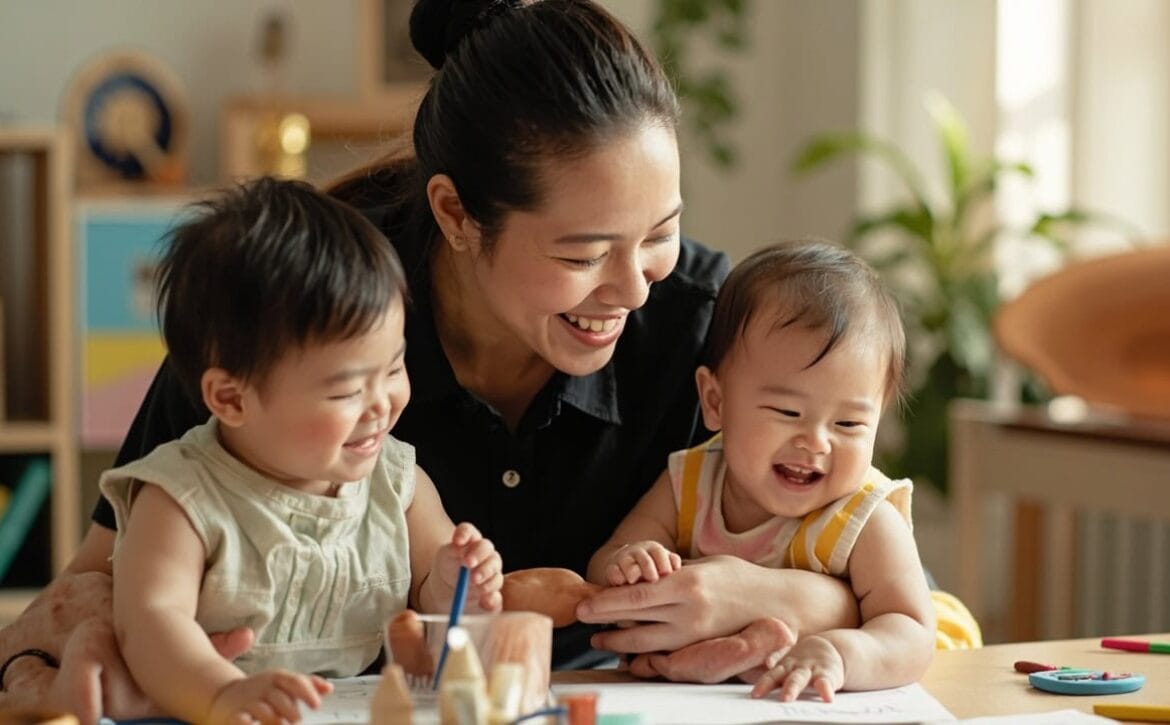
There is a question that many Singapore parents carry quietly. Sometimes it surfaces in the car on the way to school. Sometimes it arrives in that still moment before sleep, when the house finally settles and the mind wanders to the things that matter most.
It is not the question they ask at orientations or bring up at playdates. It lives deeper, woven into the architecture of how they have chosen to raise their children.
When my children are in the same care environment, are they growing together—or getting in each other’s way?
If you have found yourself sitting with this question, you are not alone. And you are not wrong to ask it. This question deserves honest, thoughtful answers—not because there is a single right answer for every family, but because your children deserve a care environment that has been designed with their relationship to each other in mind.
This article is for parents in Singapore making decisions about childcare for multiple children. It is for those who sense that siblings in quality shared care can become something remarkable together. It is also for those who worry that keeping siblings together might complicate rather than enrich their development.
Both instincts are worth taking seriously. And together, they point toward something important: the need to design sibling care with intention, not leave it to chance.
Most conversations about childcare in Singapore focus on one child at a time. We picture a single infant being held, fed, watched, loved. And that picture is right. Every child deserves that quality of attention.
But families with multiple children face a different question. A question about whether the people they love most are being shaped by the same hands, breathing the same air of curiosity and calm, learning to be siblings in a place that takes siblinghood seriously.
When siblings are cared for together in a quality environment, they begin to learn from each other in ways that home—alone with its familiar rhythms—cannot always replicate.
Consider what happens when an older child watches a younger one discover something for the first time. The eighteen-month-old finally stacks three blocks after many failed attempts, and the three-year-old witnesses not just a physical achievement, but a lesson in persistence. She is reminded, through witnessing her sibling’s triumph, that trying again works.
Or consider what the younger child absorbs when watching an older sibling navigate a social situation—a moment of sharing, a turn taken, a frustration expressed and then resolved. The younger child is learning not just what is done, but how it is done: the tone, the patience, the subtle negotiation of needs.
Researchers sometimes call this peer modeling, and it is extraordinarily powerful. Children learn from adults, yes. But they also learn from each other with a particular kind of immediacy that shapes them in ways adult instruction alone cannot reach.
Here is what matters most: this kind of mutual learning does not happen automatically. Siblings who share a space are not necessarily siblings who grow together.
In a quality care environment with carefully considered infant ratios, peer modeling becomes part of the daily fabric. Caregivers notice these moments. They facilitate them. They create opportunities where siblings are invited to collaborate rather than compete, to notice each other rather than simply coexist.
This is the first thing worth understanding: siblings in shared quality care do not just happen to be together. When the environment is designed with their relationship in mind, they become something together. They become partners in their own development.
Let us be honest with each other, because honesty is what Singapore parents deserve. There are real fears that come with the idea of siblings sharing a care environment. These fears deserve to be named, not dismissed.
Parents worry that caregivers will naturally favor one child—the older one who is more verbal, the younger one who is more adorable, the easier one who causes less disruption. And they worry that the other child will feel this, quietly and deeply, over time.
When siblings share a room, they witness each other’s moments of attention and achievement. Parents wonder if this proximity breeds a different kind of resentment than siblings might develop if they each had entirely separate worlds—separate caregivers, separate milestones, separate spaces where no comparison is possible.
Some parents worry that siblings who share everything will lose their individual identities. Others worry that siblings who share care will somehow grow apart rather than together, their sibling bond diluted by the absence of separation and longing.
These are not irrational fears. They are the concerns of parents who are paying attention. And they point to something important: the difference between environments that merely tolerate siblings together and environments that actively design for their flourishing.
A quality care environment does not eliminate sibling conflict. Siblings who share a home, share a classroom, share a life will argue. They will push boundaries. They will sometimes make each other cry. That is what it means to be human and close.
But there is a profound difference between managing sibling conflict and designing sibling partnership.
Most of us grew up in environments where sibling conflict was managed after it erupted. Someone was separated. Someone was reprimanded. Someone was reminded to share. And that is necessary, absolutely. But it is reactive.
What if the environment itself was designed to cultivate the capacities that make sibling partnership possible?
A quality care environment teaches these things through its architecture, its routines, and its caregiver attunement. It teaches co-regulation—the ability to calm yourself not in isolation but in relationship.
When a caregiver models calm in the presence of a child’s big emotion, both siblings witness it. When a caregiver helps one child name their frustration and helps the other child witness that naming without fear, both siblings are learning. They are learning that emotions can be held. That conflict can be navigated. That the people we love most are also the people we must learn to negotiate with most thoughtfully.
This is what we might call sibling design—and it is the difference that separates care environments that merely contain siblings from care environments that cultivate them.
For parents in Singapore researching infant care and childminding options, it helps to understand what quality care actually looks like when sibling partnership is part of the design.
Singapore families face particular pressures that make intentional sibling design especially valuable. The costs of childcare are real. The expectations are high. The complexity of decisions—from infant care to childminding to centre-based options—can feel exhausting.
In this context, parents need more than a service. They need a partner who understands that childcare is not just about keeping children safe and occupied. It is about shaping the people they will become—and the relationships that will define much of their lives.
When siblings share quality care, they are not just being watched. They are being shaped together, in ways that extend beyond what any single-child care arrangement could offer. And in a city where families are navigating dual-income pressures, where extended family is not always close at hand, and where children spend significant hours in care settings—this shaping matters enormously.
Parents often ask: How will I know if this is working? How will I know if my children are flourishing together in care rather than merely tolerating each other?
The signs are not dramatic. They are subtle, daily, almost invisible. But they accumulate into something you can recognize.
Siblings who are flourishing together in care often come home with a different quality of connection:
Thriving together also means that each child is still visible as an individual. Watch for this:
If you ever wonder whether the balance is off—whether one child is always in the shadow, whether conflict is dominating collaboration—that is a conversation worth having with your care partner. That is exactly the kind of observation that quality care welcomes.
Quality care is not a fixed system. It is a responsive relationship. And it adapts when parents and caregivers are in genuine communication.
Ask yourself: Do both of my children come home from care feeling seen? Do both of them have stories to tell, moments they want to share, a sense that their individual self mattered in that space?
If the answer is yes, the sibling dynamic is likely flourishing. If the answer is uncertain, that uncertainty is worth exploring—not as a failure, but as an invitation to deeper partnership with your care provider.
If you are a parent with multiple children making decisions about childcare, here are the questions worth sitting with—not to find a single right answer, but to clarify what matters most to your family.
There is no perfect answer to any of these questions. There is only the answer that fits your family—your children, your circumstances, your hopes. But asking the questions is itself a form of care. It means you are designing with intention, not leaving sibling care to chance.
When we talk about siblings in quality care, we are ultimately talking about a long-term investment in a relationship.
The sibling relationship is one of the few bonds in human life that typically lasts longer than any other. Parents die. Friends come and go. Partners may or may not stay. But siblings, when the relationship is strong, are often the longest thread in a person’s life.
And that relationship is not formed by accident. It is not simply a product of shared genetics or shared bedrooms. It is built in moments:
These are not big dramatic moments. They are small, daily, almost invisible. But they accumulate. They become the texture of a relationship.
Quality childcare, designed with siblings in mind, creates a density of these moments. It protects and grows the sibling bond as a family investment. It does not guarantee that siblings will always be close—that depends on many factors, some of which no environment can control. But it gives the sibling relationship the best possible soil to grow in.
EduNanny enters this conversation in a way that matters—not as a generic childcare service, but as an approach built around the recognition that siblings in quality care can become partners in their own development.
EduNanny is part of the ECDA Childminding Pilot, which means it sits within a framework that takes the role of the childminder seriously. Not as a stopgap. Not as a convenience. But as a developmental relationship of genuine importance.
The pilot is designed to offer families real support, with care structures that include home-based pathways and community or centre-based options. Because Singapore families are not all the same, and their needs deserve responsive design—not a one-size-fits-all solution dressed up as flexibility.
What EduNanny is building goes beyond the transactional. It is creating a place where siblings can be known as siblings—where the childminder understands not just one child’s temperament, but how two or three siblings move together as a system.
Where the routines are designed with the whole family unit in mind. Where collaboration is invited, not just coexistence. Where each child remains visible as an individual even as they grow together.
This is not a promise that sibling dynamics will always be harmonious. Conflict will happen. It always does. But the environment is designed to use those moments—teaching co-regulation, building conflict navigation skills, cultivating the capacities that make sibling partnership possible.
When communication is clear, when there are systems in place that allow for genuine insight into the care environment, parents can trust. And when parents can trust, something opens up. They can stop worrying about whether care is happening well and start noticing how their children are changing—growing, becoming more themselves and more connected.
Parenting in Singapore is exhausting. The costs are real. The expectations are high. The complexity of decisions can feel overwhelming. And somewhere in all of that complexity, you are quietly hoping for something simple:
That last hope—that your children will have each other—is not a small thing. It is everything. And it is not something you can take for granted. It is something you design for.
Siblings who grow up together in quality care have the opportunity to become something unexpected. They have the chance to be more than people who share a family name. They can become first teachers, confidants, collaborators. They can be the people who know each other’s histories most deeply, who have witnessed each other’s small triumphs and big struggles, who carry forward a shared understanding of what it means to be loved and to belong.
The siblings your children will become are being shaped right now. In the decisions you are making today. In the environments you are choosing. In the people you are trusting with the most important work: helping your children learn to be human, together.
If you are looking for a care partner who understands sibling design—who takes sibling partnership seriously, who is part of a pilot designed to offer genuine support to Singapore families—we invite you to begin a conversation with EduNanny.
Explore the options available to you. Understand the pathways that fit your family’s life. See how quality care can be not just aspirational but accessible.
Because your children deserve more than just care. They deserve environments that shape them—not just individually, but in relationship with each other.
The sibling bond is worth designing for. And there is no time like the present to begin.
EduNanny is a Singapore childminding service built on developmental care, thoughtful attention, and the belief that every child—and every sibling relationship—deserves to be understood. Learn more about EduNanny or read about our approach.

There is a moment every parent in Singapore knows. It comes after the tour has ended, after you have walked through the bright hallways and admired the tidy shelves and smiled at the cheerful staff. You have nodded along, taken the brochures, perhaps made a mental note that the centre seemed fine. Perhaps even impressive.
And then you step back into your car, or onto the MRT, and a quieter question arrives:
But how do I really know?
That question is not a sign of doubt. It is a sign of love. It is the question of a parent who understands that choosing care for their infant is not like choosing a restaurant or a gym. It is the question of someone who knows that the first thousand days of a child’s life lay foundations that shape everything that follows.
And that is precisely why it deserves a real answer—not just another tour, not just another brochure, not just another reassuring smile.
The tour is a performance. Not necessarily a dishonest one—but a performance nonetheless. The rooms are tidied. The children are in good spirits, or at least presentable ones. The staff are prepared to be seen and to answer questions. Everything has been arranged to create an impression of quality.
And yet, as any experienced educator will tell you, the things that matter most to a child’s wellbeing are rarely visible in a tour. They happen in the unguarded moments:
None of these can be fully observed in a forty-minute visit. So what can you do? The answer is simpler than becoming a childcare expert overnight. The answer is to ask better questions.
Not the questions that centres are prepared to answer—the ones about accreditation, meals, and operating hours. Those matter, but they are the easy questions. The questions that reveal true quality go deeper. They require a centre to show you something real about how they operate, how they think about children, and what they actually believe matters.
This sounds like a simple question about staff schedules. But it touches something essential. In the early years, children develop security through predictability. They need to know that the face that greeted them this morning will be there again tomorrow.
When that consistency is disrupted, your child’s sense of safety is affected. When you ask this question, listen carefully to the answer:
This is why ratios matter. In home-based childminding through the ECDA Childminding Pilot, the ratio of caregiver to infant can be as low as one to three. That is not just a number. That is a promise that your child will be seen, known, and responded to as an individual.
Ask about the ratio. Ask who your child’s primary caregiver will be. And then ask how often that changes.
Notice the word “typical.” Not the exceptional day, not the special activity planned for your visit. The ordinary Tuesday morning when nothing particularly notable is scheduled.
Young children thrive on predictability. They are not yet old enough to hold a complex schedule in their minds, but they feel security in rhythm—the same sequence of feeding, playing, resting, going outside, coming back in.
When you ask this question, notice whether the answer feels child-centred or parent-centred:
A quality programme has structure, but it serves children—not a structure that performs for adults.
This question is where many parents discover a significant gap between centres. Some offer daily reports, photographs, detailed notes about feeding and sleeping. Others offer little more than a wave at pickup.
What matters is not the format of the communication but its substance:
Ask specifically: What kind of daily reporting do you provide? Can I message caregivers directly? What happens if I have a concern between pickup times?
A centre that welcomes your questions about communication is a centre that has nothing to hide.
A tour is a performance, and you deserve to see beyond it. During your visit, pay attention to what is happening in the background:
The quality you are looking for is warmth that is not performed. It is presence that exists whether or not a parent is watching.
This is where you separate programmes that have thought carefully about early childhood from those that are simply minding children.
The best infant care is not about filling time or even about keeping children safe, though both matter. It is about understanding how infants learn and grow—and designing environments and interactions that support that development.
Listen for language about:
Be wary of programmes that speak primarily about milestones or academic preparation. Infants need warm, consistent relationships, sensory-rich environments, freedom to explore, and adults who respond to their cues.
A programme that understands this will be able to articulate it clearly—and will welcome your questions about it.
Every childcare setting will face moments of challenge. A child struggling to settle. A conflict between toddlers. A child who is unwell. A parent who has a concern.
The question is not whether these moments occur—they will. The question is how they are handled.
Ask what happens when a child is crying inconsolably. Ask about the protocol if your child is unwell. Ask what the process is if a parent raises a concern.
Then listen not just to the policy but to the tone:
The quality of a programme reveals itself most clearly in how it responds to difficulty. A programme that handles these moments with care and genuine problem-solving is a programme that can be trusted.
When you ask these six questions, you are not just gathering information. You are listening for evidence of something coherent—a way of thinking about children that runs through every aspect of how a programme operates.
Quality infant care is not a checklist of features. It is a philosophy made visible in daily practice:
These are not abstract ideals. They are the conditions that allow an infant to feel safe, to explore, to learn, and to grow. And they are what you are really looking for when you walk through those bright hallways and smile at the cheerful staff.
No. Asking these questions is not being difficult. It is being thoughtful. You are doing exactly what a loving parent should do: paying attention to what matters most.
Then you have learned something important. A programme that cannot discuss its approach openly is a programme that has something to protect. That should tell you something.
You cannot know for certain, and that is honest. But you can listen for coherence. Do the answers align with what you see? Does the philosophy match the practice? Does the tone of the conversation feel open and confident—or scripted and guarded? Your instincts matter here.
Before you go:
During the visit:
After the visit:
If you have been reading this article with a growing sense of recognition—if you have been thinking, “Yes, this is what I have been trying to understand”—then you are already thinking like someone who chooses well.
EduNanny by BUTLER is part of the ECDA Childminding Pilot, a programme that represents a different approach to infant and toddler care in Singapore. It operates on principles that align with everything described above.
With ratios of up to one to three in home-based settings, every child receives genuine individual attention. With consistent caregiver relationships, your child builds the security that comes from knowing and being known.
Communication is not an afterthought at EduNanny. It is built into the model. Parents receive regular updates, structured reporting, and direct access to caregivers. Where CCTV is deployed, transparency is institutionalised—not because parents cannot be trusted, but because open communication is the foundation of genuine partnership.
EduNanny operates with pilot fee structures that make quality care accessible. CDA and Baby Bonus can be used, removing unnecessary financial barriers for families across Singapore. The programme is available through centre-based, community, and home-based pathways—because the right match matters, and families deserve options.
EduNanny does not ask for blind trust. It asks only for the chance to show you what it does and why—and to answer your questions with the confidence of people who believe in what they offer.
A programme that welcomes your questions is a programme that trusts itself.
Choosing childcare for your infant is not a small thing. It is not a logistical decision or a convenience choice. It is a decision about who will share in the shaping of your child’s earliest experience of the world. It is a decision about what safety feels like when you are too young to know that word. It is a decision about the kind of relationship your child will have with learning, with other people, with the experience of being away from you and still being okay.
That deserves more than a tour and a brochure.
The framework shared here is not a checklist. It is an invitation to pay attention—to notice what is visible and what is hidden, to ask the questions that matter, to listen for the answers that reveal something true.
Ask about consistency. Ask about rhythm. Ask about communication. Ask about philosophy. Ask about difficulty.
Ask the questions that Singapore parents deserve to ask.
If you are looking for a place that welcomes those questions, that answers them honestly, and that has built its entire model on the belief that your child deserves thoughtful, responsive, genuinely excellent care—we would welcome the opportunity to speak with you.
The right questions do not complicate the decision. They clarify it. They bring you closer to the truth of what your child needs—and to the confidence of knowing you have found it.
That is what we want for you. And that is why asking better questions is not just a skill. It is one of the most loving things a parent can do.

There is a moment, if you are a parent in Singapore, that you know intimately even as you try not to linger in it. It happens at the door, the gate, the threshold of whatever arrangement has become part of your family’s architecture. Your child is in someone else’s arms, or reaching for a caregiver you have chosen, and you are leaving.
And in that moment before the door closes, before you turn and walk to the car or the train or the office, there is a question that moves through you like weather:
What is happening inside my child right now?
This is the question we want to speak to today. Not because it is simple—it is not simple. But because it is the most important question you will ever ask about the hours you are apart, and because it deserves more than reassurance. It deserves understanding.
We live in a culture that has become very sophisticated about what can be measured. We know about milestones. We know about developmental checklists. We can track physical growth on charts, language acquisition on graphs, cognitive readiness on assessments.
And so when parents try to understand what is happening for their child during childcare hours, they naturally reach for these frameworks. They want to know: Is my child hitting the right markers? Is my child safe? Is my child happy?
These are not wrong questions. But they are incomplete. Because what you sense, even if you cannot articulate it, is that something more is happening in those hours. Something that does not show up on a checklist. Something that is being constructed not in the visible world of activities and interactions, but in the invisible architecture of your child’s inner life.
When we speak about what quality childcare builds inside your child, we are speaking about four interconnected capacities. Each one builds on the others. Together, they form the foundation your child will carry into school, into friendships, into adolescence, and into adulthood.
The psychologist John Bowlby described the secure base as the foundation from which a child can explore the world and to which a child can return for comfort when the world feels too large, too new, or too overwhelming. For most children, the secure base begins with a parent. The person who makes the world feel navigable.
But here is what Bowlby and his successors also understood: the secure base can be extended. It can be held by others—not replacing the parent, but alongside the parent, giving the child a second anchor, a third, a network of emotional safety that allows the child to venture further and learn more than they could with only one base.
In a setting where caregivers are consistent, attuned, and emotionally present, your child begins to build a secure base outside the family. They begin to understand: there are people here who see me, who respond to me, who make the world feel safe even when my parent is not in the room.
And from that expanded secure base, something remarkable begins to happen. Your child explores—not just physically, though that too, but emotionally. They encounter frustration and learn that it can be survived. They encounter other children and learn that sharing is hard but possible. All of this is only possible because there is a secure base from which to venture and to which to return.
We talk a great deal in parenting circles about milestones—walking, talking, toilet training, reading. But the milestone that will matter most for your child’s entire life, and the one we least understand how to support, is emotional regulation: the capacity to recognize what you are feeling, to tolerate that feeling, and to respond to it in ways that serve you rather than harm you.
This capacity does not arrive fully formed. It is built over years, through countless small moments of co-regulation—moments when a caring adult helps a child move from overwhelm to calm, from rage to stillness, from despair to hope.
The child cannot do this alone. No child can. The developing brain requires scaffolding, and that scaffolding is provided by the attuned responses of adults who are present, patient, and prepared to carry the child’s emotions until the child can carry them themselves.
In a high-quality childcare environment with a low infant ratio, your child receives consistent co-regulation:
This is the slow, patient construction of the internal capacity that will allow your child to sit in a classroom and listen even when they are restless. To manage exam anxiety without collapsing. To grow into an adult who can feel deeply without being controlled by what they feel.
By social confidence, we do not mean that your child is the loudest in the room, or the most popular, or the natural leader. We mean something quieter and more durable: the belief, deep in your child’s body and mind, that they are a person worth knowing. That they have something to offer to other children. That relationships are navigable, that sharing is possible, that other people’s needs exist alongside their own and that this is not a threat but a reality to be managed with grace.
This belief does not emerge spontaneously. It emerges in relationship. It emerges when a child has had successful experiences with peers—not perfect experiences, not conflict-free experiences, but experiences where adults helped them navigate the inevitable frictions of human connection.
In a well-designed group environment with careful ratios and trained caregivers, your child is learning, hour by hour, day by day, how to be a social creature. They are building the confidence that will allow them to walk into a new classroom and believe that they can find friends. That they can handle it when a friendship hurts. That they are not alone in a world of other people, but equipped to be in relationship with others.
Resilience, in its truest sense, is not about being tough. It is not about never feeling pain. It is about the capacity to be bent without breaking. To encounter difficulty and not be destroyed by it. To experience failure and loss and disappointment and still believe, in your core, that you can recover, that tomorrow is possible, that you are not defined by what has happened to you.
Resilience is built, in childhood, through small exposures to manageable stress—not overwhelming stress, not trauma, not neglect, but the small, survivable stresses that teach the nervous system: this is hard, but it ends. I can handle this. The world returns to okay.
Separation is one of these small, manageable stresses. When you drop your child at childcare and leave, your child experiences a genuine loss—but if the environment is attuned, if the caregiver is warm and consistent, if the separation is brief enough and the reunion reliable enough, your child learns something profound: people leave, but they also come back. The world can feel unsafe and then become safe again. I can survive the in-between.
This is not a lesson that can be taught in words. It must be lived in the body, experienced through repetition, until the child internalizes it as a quiet conviction: I am okay. Even when things are hard, I am okay.
These four pillars—secure base, emotional regulation, social confidence, and resilience—are not soft outcomes. They are the foundation on which everything else, academic success and friendships and mental health and character, will be built.
We live in a culture, here in Singapore, that places enormous emphasis on academic preparation. There are enrichment centres that promise to give your child a head start. There are programs that claim to accelerate cognitive development. There are assessments and evaluations and the looming question of how your child will perform when they enter the formal education system.
We want to suggest to you that this emphasis, however understandable, is backwards.
Here is what developmental science consistently shows and what experienced educators know from watching children grow over years and decades: academic success is built on emotional foundations.
You cannot prepare your child for school by drilling them on what school will teach. You can only prepare them for school by building the internal architecture that will allow them to receive what school has to offer.
The emotional foundation precedes and enables the academic one. This is not opinion. This is developmental science. And it is one of the most important things we can tell you about why the choice of childcare is not a logistical decision but a foundational one.
Understanding the principles is important, but understanding how they are enacted is what will ultimately serve you. Here is what this looks like in concrete terms.
When we talk about quality childminding, we are talking about an approach where the caregiver is not merely a caretaker. The caregiver is an emotional architect—a person whose every interaction with your child is either building or eroding the internal foundation your child needs.
Look for environments where:
The physical environment also matters. A well-designed space allows for exploration without overstimulation. It offers retreat when a child is overwhelmed. It supports both parallel play for younger children and collaborative interaction for older ones.
But the environment is only as good as the people in it. The most beautiful space means nothing if the adults inside it are hurried, distracted, or emotionally unavailable.
You want to know what is happening in those hours. You want to trust what you cannot see. In quality childminding settings, communication is a priority—regular updates, transparent practices, and in many cases, measures that allow you to have visibility into the environment your child is in.
This is not about surveillance. It is about partnership. It is about knowing that the architecture being built inside your child is one you have visibility into, one you can trust.
When we speak about EduNanny by Butler, we are speaking about an approach to childcare that is designed with this internal architecture in mind. Not as an afterthought, not as a marketing concept, but as the animating principle behind every decision about ratios, training, environment, and daily practice.
In an EduNanny setting, your child is not one of fifteen or twenty in a room. The infant ratio means that your child’s emotional states are noticed. That the co-regulation your child needs can actually happen. That when your child is distressed, a caregiver can sit with them, can give them the individual attention that is not possible in an understaffed environment.
This is not a luxury. It is a prerequisite for the kind of emotional construction we have been describing.
The EduNanny approach is grounded in the understanding that the caregiver is an emotional architect. This is why training, consistency, and attunement are central to the model. In an EduNanny environment, your child is not being supervised. Your child is being held in a way that is constructing their inner world.
The EduNanny programme operates within the ECDA Childminding Pilot, which means it is part of a broader effort to recognize and professionalize the work of childminding in Singapore. This brings structures in place—not just the individual commitment of a caregiver, but the institutional framework of the pilot—that support quality, consistency, and accountability. There are pathways for both home-based and centre-based care depending on what suits your family best.
Care is available Monday through Friday, in blocks that serve working parents, at fee structures that aim to make quality care accessible rather than exclusive. The CDA and Baby Bonus schemes are integrated where applicable, so that financial considerations do not force you to choose between affordability and quality.
This is part of a genuine commitment to making emotional architecture accessible to families across Singapore, not just to those who can afford premium boutique services.
We know you have questions. We want to address them honestly.
This is the fear beneath so many drop-off moments. The truth is: if the environment is attuned, warm, and consistent, separation teaches your child something valuable. It teaches them that people leave but they come back. That the world can feel uncertain and then become steady again. That they can survive the in-between and emerge okay.
What matters is not whether your child ever feels distress—that is part of life and cannot be avoided. What matters is how that distress is held. In quality care, your child’s distress becomes material for growth, not damage.
Milestones matter, but they are not the whole story. Look instead for signs of emotional health: Is your child increasingly willing to explore new situations? Do they have at least one relationship outside the family they seem to trust? Can they name their feelings? Do they recover from hard moments? Are they building the capacity to be near other children, to share, to navigate small conflicts?
These are the signs that the inner architecture is being built well.
Here is what we want you to know as you research infant care and childminding in Singapore:
When you choose childcare, you are making a decision about what kind of nervous system you are helping your child build. You are making a decision about what kind of emotional foundation they will carry into Primary One and beyond.
You are making a decision about whether the hours of their early childhood are shaping them with intention or leaving that shaping to chance. That choice will matter far more than any enrichment class you might enroll them in. It is not a small investment. But it is the investment that matters most.
We began with a question that moves through you at the threshold, even when you do not speak it:
What is happening inside my child right now?
We hope, by now, that you have a richer answer to that question than you did before. What is happening is not nothing. It is not mere supervision. It is not just keeping your child safe and occupied until you return. It is the slow, profound construction of a human being—their sense of security, their capacity for emotional regulation, their confidence in the social world, their resilience, their belief in themselves as people who can navigate the challenges of life.
This construction is happening whether you choose quality care or not. Every hour your child spends in any environment is shaping their inner architecture. The only question is whether that architecture is being built with intention and care, by adults who understand what they are doing and why, or whether it is being left to chance.
You do not have the luxury of opting out of this process. Your child is growing. Their brain is forming. Their emotional patterns are being established. The secure base is either expanding or contracting. The resilience is either building or eroding.
The question is not whether to participate in this construction. The question is whether to participate consciously.
When you choose EduNanny, you are not hiring someone to watch your child. You are enlisting a collaborator in the most important work you will ever do—the building of a human being. You are saying: I trust you to help construct what matters most. I trust you to hold my child in a way that strengthens rather than weakens. I trust you to be part of the foundation on which everything else will rest.
At EduNanny, we accept that trust fully. We hold it seriously. We understand that every hello and every goodbye, every moment of frustration and every moment of delight, every interaction your child has in our care is either adding to their architecture or taking from it.
We choose to build. And we invite you to join us in that building—not just today, not just at the door, but in the long, important, quietly heroic work of raising children who will be okay. Children who will be more than okay. Children who will have the emotional foundations to explore, to learn, to connect, to recover, to become whoever they are meant to be.
Because it is worth it. Because your child is worth it. And because you are not alone in this.
Curious about what thoughtful, development-oriented childminding looks like for your family? Connect with EduNanny by Butler to learn more about our approach to infant care and childminding in Singapore. Every conversation begins with listening.
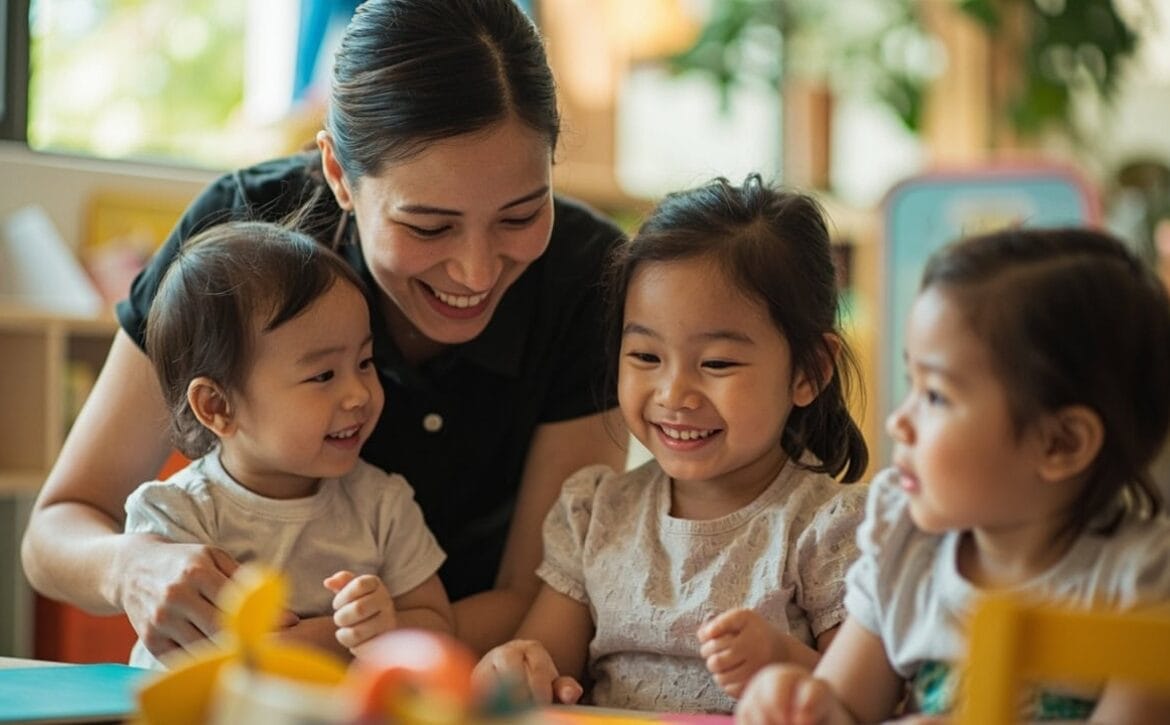
If you are a busy parent, here is what matters most:
Below is a deeper exploration of how this partnership actually works—and what you can do to strengthen it.
There is a moment, familiar to every parent who has enrolled their child in quality care, that arrives without ceremony. The enrollment forms are signed. The orientation is complete. The caregiver has smiled at your child, and your child has, tentatively, smiled back.
And then you leave. You drive to work, or you sit at your desk at home, and you realize that the thing you have been planning for months—the careful research, the visits, the interviews, the weighing of options—has culminated not in a conclusion but in a beginning.
You made a good decision. EduNanny Singapore, operated by BUTLER, is part of the ECDA Childminding Pilot, which means your family has access to trained caregivers, manageable infant ratios, and a framework designed to ensure your child receives attentive, responsive care. Your CDA and Baby Bonus can be applied.
By many measures, you have done what you set out to do. And yet.
The moment after enrollment often brings something unexpected: not relief, exactly, but a new kind of weight. You have placed your child in the care of someone else. You have made a choice, and now you must live inside that choice.
How do you show up for this relationship? What does your child’s caregiver actually need from you? When do you step in, and when do you trust? How do you know if the partnership is working?
These are the questions most parenting content ignores. There is no shortage of guidance on how to choose childcare, how to evaluate quality at the selection stage, how to manage the guilt of the return to work. But once you have chosen, once you have handed over your child to someone you have decided to trust, the conversation shifts. And that is where most advice falls silent.
EduNanny Singapore was built to fill that silence—not just with quality standards, but with a commitment to the ongoing work of partnership.
The partnership between a parent and a caregiver is not a transaction. It is not a handover and a pickup and a monthly invoice. It is a relationship, and like all relationships, it requires tending.
The caregivers at EduNanny are trained professionals operating within the ECDA Childminding Pilot—they bring expertise, observation, and genuine care to the children in their charge. But their capacity to deliver quality care is shaped, in part, by how you show up as a parent.
Choosing quality childcare was the first act. Showing up as an active, thoughtful partner in that care is the second.
What do trained caregivers need from the families they serve? First, they need respect for their professional judgment. When you engage with their observations, when you treat their expertise as valuable rather than secondary to your own instincts, you create space for genuine collaboration.
They need information—not a dossier, not a running commentary, but the kind of contextual knowledge that helps them understand your child as a whole person.
When you tell them your daughter did not sleep well, that matters. When you share that your son is going through a phase where he resists diaper changes, that matters. When you mention that a grandparent visited over the weekend and disrupted his routine, that matters too.
This is not about burdening your caregiver with your parenting anxiety. It is about giving them the tools to serve your child better.
Here is what many parents do not realize: when you treat your child’s caregiver as a professional worthy of information and engagement, you are not weakening your own role. You are strengthening the entire system that surrounds your child.
The caregiver who feels respected, who feels like a partner rather than a subordinate, will bring more attentiveness, more creativity, more genuine investment to the care of your child. This is not sentiment. This is how professional relationships work. Dignity begets excellence.
There is a distinction that matters enormously: the difference between hovering and engaged partnership.
Many parents, out of love and anxiety and the overwhelming desire to protect their child, tip into hovering. They interrogate at pickup. They demand constant updates. They arrive early, hovering at the door, watching. They correct, implicitly and explicitly, how the caregiver interacts with their child.
They make the caregiver feel like an employee under surveillance rather than a professional in partnership.
Hovering feels like care. It is not. Hovering communicates distrust, and distrust is corrosive. It creates tension that children feel. It makes caregivers defensive, and defensive caregivers cannot be fully present.
Engaged partnership looks different. Engaged parents:
The goal is not to manage your caregiver. It is to build a relationship that serves your child.
The practical dimension of this partnership is communication—consistent, thoughtful, daily communication. Not performance, but rhythm.
The morning handoff is not a quick pass. It is an exchange. You tell them what your child needs them to know. You listen to what they noticed that morning. You ask one or two genuine questions, not to audit but to understand. And you leave, calmly, trusting that this is a relationship you are building together.
A calm departure matters more than you might think. When you linger anxiously at the door, re-explaining the same instructions, looking for reassurance yourself, your child reads it as uncertainty about whether this place is safe.
During the day, you might receive an update—a note, a photo, a brief message. This is not a demand you are making. It is a professional courtesy you are receiving.
Your response matters. A warm, brief acknowledgment builds a culture of openness. A dismissive or anxious reply builds walls.
At pickup, you have a conversation. You share what you noticed at home. You ask what they noticed here. You notice patterns over weeks, not just incidents on single days.
You ask “How has she been this week?” not “Why was she crying on Tuesday?” You are building a picture together.
When something is not working—when your child seems unsettled, when a routine is no longer serving them, when something has shifted—you address it. This is not a sign of failure. This is the partnership doing its job.
Recognizing early signs that a partnership needs recalibration is a skill. It requires paying attention to patterns rather than incidents.
A single difficult morning means little. A week of changed behavior, a new resistance, a shift in your child’s mood at pickup—these are signals worth bringing to your caregiver.
“I’ve noticed she seems more tired than usual. Have you seen that too?” is the beginning of a useful conversation. It invites collaboration rather than accusation. It says: I trust you to notice, and I trust that we can figure this out together.
Here is how you give feedback that strengthens rather than strains:
When you give feedback this way, you will often find that your caregiver has already noticed, already has ideas, already wants to work with you on a solution.
And this is the deeper truth: the quality of feedback you give is one of the most direct influences on the quality of care your child receives. A caregiver who feels respected, who feels trusted, who feels like a partner, will go further for your child than one who feels managed.
Your child is watching. They are watching you at the morning handover. They are watching the way you greet the person who will care for them. They are watching the conversation at pickup—the ease or the tension, the laughter or the briskness, the sense that this is a relationship or the sense that it is a transaction.
When your child sees you and your caregiver as genuine partners—people who communicate, who share observations, who are aligned on what your child needs—they receive a profound message. They receive the message that their world is coherent.
That the different parts of their life fit together. That the adult who loves them at home and the adult who cares for them during the day are on the same side.
This is not an abstract philosophical point. It is the difference between a child who can settle into the morning and a child who spends the first hour checking, looking, uncertain. It is the difference between a child who feels safe enough to explore and a child who holds back, guarding themselves against a world that does not feel unified.
There is another dimension to this partnership that deserves attention: your own role in your child’s sense of security.
Your child does not just need a good caregiver. Your child needs a caregiver who is working within a healthy system, and that system includes you.
When you arrive at the morning handover anxious, rushed, projecting worry, your child feels it. When you linger anxiously at the door, re-explaining the same instructions, looking for reassurance yourself, your child reads it as uncertainty about whether this place is safe. When you leave with guilt and worry written on your face, your child learns to match your energy.
It is about being consistent. It is about trusting the process you chose, and trusting the professional you selected. Your child does not need you to feel nothing. They need you to trust enough to show up steady.
The caregiver-parent alliance that makes your child feel safe is built on the foundation of your own willingness to trust.
At EduNanny Singapore, this trust is supported by structure. The ECDA Childminding Pilot maintains ratios designed to ensure attentive care. Where transparency measures are in place, they offer clarity that protects everyone. Communication channels are open. Updates are standard practice.
The infrastructure of professional care exists so that you can trust it, and so your child can feel the benefit of that trust.
But infrastructure is not enough. The trust that makes your child feel safe is also relational. It is built in the daily handoff. It is built in the conversation at pickup. It is built when your child’s caregiver tells you something tender about your child’s day and you receive it with genuine appreciation. It is built when you share something about your child’s life at home and you see it land, see it matter, see it used to understand your child better.
This is what EduNanny Singapore offers: not just a service, but a framework for partnership. Not just trained caregivers, but a structure designed to support the relationship between parent and caregiver. Not just quality standards, but a commitment to the ongoing work of showing up.
The parents who benefit most from this framework are not the ones who micromanage. They are the ones who engage. They are the ones who bring useful information to every handoff. They are the ones who ask good questions and receive answers with openness. They are the ones who notice patterns, who communicate consistently, who trust the process even when it feels uncertain.
They are the ones who understand that choosing childcare was not the end of their involvement but the beginning of a new kind of involvement—a partnership with someone who will spend more waking hours with their child than they will. A partnership that, done well, makes their child feel more known, more secure, more free to be themselves.
The after is where the work of partnership lives. It is daily, and it is quiet, and it does not feel dramatic.
It feels like showing up. It feels like a conversation at pickup that leaves you feeling lighter. It feels like a WhatsApp update that makes you smile. It feels like a child who runs to their caregiver in the morning, who settles quickly, who is learning that the world can hold more than one person who loves them.
Not a child who tolerates care, but a child who thrives in it. Not a caregiver who performs her duties, but one who is genuinely invested in your child’s day. Not a service you purchased, but a partnership you built.
If you are considering infant care or childminding in Singapore, EduNanny Singapore welcomes the opportunity to answer your questions and guide you through what enrollment and partnership actually looks like for your family.

Singapore has made extraordinary investments in early childhood. We have a robust regulatory framework through ECDA, a growing network of childcare centres, and a government that recognizes—in policy terms—that the early years matter. But somewhere between the good intentions of the system and the lived experience of parents, there is a gap.
Parents feel that they are supposed to be grateful for whatever care they can access. That to question quality or to express a preference for something more is a kind of privilege they should not presume. And so they stay silent. They make their decisions quietly. They choose what seems reasonable, what fits the budget, what the relative recommended.
And then they wonder, sometimes for years, whether they chose well.
This silence is not serving anyone.
It is certainly not serving our children, who cannot tell us what kind of care they needed but whose development tells the story anyway—in the words they struggle to find at three, in the social anxiety that emerges at five, in the learning gaps that surface at seven.
The silence is not serving parents, who carry an unnamed guilt that has nowhere to land because no one has given them permission to name what they are actually feeling. And it is not serving the childcare sector itself, which remains trapped in a race to the bottom on price because no one is brave enough to articulate what value actually looks like.
Here is what we have come to understand after years of working with infants and their families in Singapore.
Quality childcare is not about the facilities. It is not about the colorful walls or the imported toys or the gleaming kitchen where meals are prepared. These things matter, in the way that clean sheets matter in a hotel—they signal care, they create comfort, they are worth noticing. But they are not where quality lives.
Quality lives in the space between a caregiver and a child. It lives in the micro-decisions that happen a hundred times an hour: whether to interrupt a child’s concentration to show them something new, whether to step back when a toddler is struggling with a puzzle or step in to rescue them, whether to treat a baby’s cry as a problem to be solved or a communication to be understood.
Quality lives in the training that allows a caregiver to distinguish between a child who is frustrated and a child who is learning, between a child who is testing boundaries and a child who is seeking connection.
Quality is invisible in brochures and on facility tours. It becomes visible over time, in what your child becomes.
And this is where the calculation that parents are making—the silent one, the one they feel guilty about—actually contains something important that they have not yet given themselves permission to articulate.
They are not really asking whether they can afford to spend more on childcare. They are asking whether they can afford not to.
They are asking, in the part of themselves that knows more than they let themselves say, what the hidden cost is of choosing care based primarily on what fits the monthly budget. They are asking what it costs to miss a developmental window that does not reopen. They are asking what it costs when a child’s first experience of being cared for outside the family is one where the ratio is four infants to one caregiver, where the turnover means their face changes every three months, where the emphasis on efficiency means that the kind of responsive, attuned, emotionally available care that builds neural pathways and secure attachment has to be rationed.
We are not here to shame any parent for the choices they have made. The childcare market in Singapore is under enormous pressure, and many families have no real choice at all. But we are here to say that the conversation about cost deserves to be had with clarity, not with guilt. And we are here to offer a framework—not a sales pitch, a framework—for thinking about what you are actually paying for when you choose childcare, and what you are actually paying when you do not.
Let us talk about what separates a price from a value.
In the childcare landscape, the price is the number you see on the enrollment form. It is the monthly fee, the annual deposit, the material fees and enrollment charges. The price is concrete. It is what you negotiate, what you compare, what keeps you up at night when the budget is tight.
But value is different. Value is what you get for that price, measured over time, measured in outcomes that matter.
A cheap childcare arrangement has a price that is easy to pay today. But it may have a value that costs you tomorrow.
Premium childcare has a price that is visible on the enrollment form. But it has a value that accrues over years.
This is what we mean when we talk about the invisible return on investment in quality childcare. It is not visible on the brochure. It does not show up in the monthly invoice. But it is real, and it compounds over time, and it is the most important financial decision many families will make in their first decade of parenting.
We know that talk of investment and returns can start to sound cold. Like we are reducing a child to a spreadsheet, like we are treating love as a line item. That is not what this framework is about.
It is about giving parents permission to think clearly about something that deserves clear thinking.
It is about recognizing that the guilt they feel about spending money on childcare is often the guilt of someone who has been told that money and love are in opposition, that wanting quality means you are materialistic, that if you really loved your child you would not need to spend so much.
This guilt is worth examining. Not dismissing—examining.
Because underneath it, often, is a parent who understands something true: that children are not resources to be optimized, but they are also not immune to their environments. That the love a parent feels is necessary but not sufficient, because children spend enormous amounts of time in the care of others, and those hours matter. That wanting the best possible foundation for your child is not vanity—it is parenthood.
And it is about recognizing that the guilt some parents feel about choosing cheaper care is also worth examining—not to add to their burden, but to give them language for what they may already sense. That the feeling of something not being quite right, of wishing your child could have more individual attention, of worrying about whether the caregiver truly knows your child as an individual—that feeling is not neurosis. It is data. It is your parental instincts telling you something that the market has not given you the tools to articulate.
Singapore parents deserve better than an impossible choice between guilt and compromise. We believe the decision between what is financially comfortable and what is developmentally optimal should not be a choice that parents have to make.
EduNanny by BUTLER participates in the ECDA Childminding Pilot—a framework that represents Singapore’s most thoughtful attempt to create pathways for quality home-based and community-based childminding. This approach recognizes that not every family needs or wants centre-based care, and that some of the highest-quality early childhood experiences happen in home environments where ratios are lower, where the setting is domestic and familiar, where a child can develop at their own pace without the artificial pressures of large-group care.
This is not a compromise. For many families, it is a superior choice.
Our approach is built around a philosophy that may seem simple but is demanding to deliver: the relationship between a caregiver and a child is the foundational unit of early childhood experience. Everything else—the curriculum, the activities, the learning outcomes—flows from this relationship.
Ratios of up to one to three infants. Because you cannot fake attunement. You cannot manufacture responsiveness when the numbers are against you. A caregiver responsible for three infants can know each one deeply. A caregiver responsible for ten cannot, no matter how talented or well-intentioned they are. The math is not complicated. The implications are profound.
Radical transparency. Parents receive regular updates—not just photos, though those matter, but genuine insight into their child’s day, their development, their emerging patterns and preferences. Where CCTV measures are deployed, they are not there to surveil caregivers but to build trust, to give parents the confidence that comes from knowing they can see what is happening when they cannot be there.
Recognized professionalism. When you choose EduNanny, you are not hiring someone to watch your child while you work. You are inviting a trained, vetted, continuously supported early childhood professional into your family’s life. Someone who understands infant development, who can identify when a child’s play is revealing a new cognitive milestone, who knows the difference between a child who is being difficult and a child who is trying to tell you something they do not yet have words for.
The ECDA Childminding Pilot framework allows us to operate with standards that are real and verifiable, not just aspirational. Parents can access subsidies and support structures that make premium care accessible. Your Baby Bonus and CDA can be used in the way you intend—as an investment in your child’s early years.
As you evaluate childcare options in Singapore, we invite you to use this framework—not to choose EduNanny specifically, but to choose with clarity.
Ask not what childcare costs. Ask what it delivers.
Ask not what is the price. Ask what is the value.
Ask not what fits the budget this month. Ask what foundation am I building for the years ahead.
Every child deserves to be known in their early years. Every parent deserves to make this decision with clarity, not guilt. And every family deserves a framework for thinking about childcare that honors both the financial reality of raising children in Singapore and the developmental reality of what young children need to thrive.
You are not just choosing childcare. You are choosing a foundation. And foundations deserve to be built with care.
The child who learns to trust in their first relationships, who learns that the world is a place where they are known and valued, who develops the security to explore and the confidence to learn—that child carries something forward into every classroom, every friendship, every challenge they will face for the rest of their lives.
What you are paying for when you choose quality childcare is:
We created EduNanny because we looked at the landscape and saw that something was missing. Parents navigating an impossible system alone. Children who deserved more than they were receiving. Caregivers who wanted to do their work well but were set up to fail by ratios and expectations that made excellence impossible.
We believe that quality infant care and childminding should not be the exclusive domain of families with six-figure household incomes. We believe in a childcare option that treats parents as the thoughtful, loving decision-makers they are, rather than as consumers to be managed.
That belief remains. And it is matched by a conviction that every family who walks through our doors, or reaches out to learn more, is making a choice that matters—not just for their child’s next few years, but for the people they will become.
We would be honored to have that conversation with you. Not the sales conversation that tries to convince you we are cheapest or easiest, but the honest conversation about what your child needs, what your family is building, and whether we are the right partners for that work.
Because this decision is too important to be made in a fog of guilt and comparison and marketing noise. It deserves clarity. It deserves honesty. And it deserves to be made by parents who have been treated as wise enough to handle the truth about what they are really buying.
EduNanny Singapore is here for that conversation. We are here for the families who are ready to have it. And we are here, long after the enrollment forms are signed, to be the kind of care that makes a difference in the only way that ultimately matters:
In the child who grows up knowing they were loved, and known, and given the best possible start.
That is what we are paying for. That is what we are here to deliver.
EduNanny by BUTLER operates Monday through Friday across Singapore. We are part of the ECDA Childminding Pilot, making quality home-based infant care accessible through recognized frameworks and subsidy support. If you are ready to have the honest conversation about what your child needs, we would welcome the opportunity to speak with you.

The morning arrival is not merely a logistical transition. For a young child—whether she is eleven months old and still building the conviction that the world is reliably kind, or thirty months old and testing every boundary with fierce, magnificent determination—the arrival sets the emotional weather for everything that follows.
A hurried handoff from car seat to door tells a child’s nervous system one story. A slow, intentional crossing of the threshold—the caregiver’s voice already warm, their hands already open, the child’s name spoken like it matters—tells a different one.
What separates a quality childcare day from a merely safe one is often decided in those first sixty seconds. Does the caregiver read the child’s face? Do they pause—really pause—to receive the child before turning to the parent with a word of reassurance, a shared observation, a moment of genuine connection over the small fact of this particular child’s particular morning?
A quality arrival is not scripted. But it is intentional. And that intention is what tells a child: I see you. You are not just another arrival. You are the one I have been expecting.
At EduNanny Singapore, this is not left to chance. The ECDA Childminding Pilot—whether through the home-based pathway or the community and centre-based pathways—structures this arrival with trained caregivers who understand that the body carries what the mouth cannot yet say.
A child’s clenched jaw, a stiff shoulder, a grip too tight on a parent’s sleeve. These are not behaviors to manage. They are information to receive. And a caregiver who has been trained to receive them transforms what could be a difficult morning into the first brick of a child’s sense of emotional safety.
Safety is not the opposite of learning. It is the foundation on which all learning stands. And it begins at the threshold, in a sixty-second exchange that most parents never get to witness.
Once the door closes, what unfolds is something we have failed, as a society, to adequately describe. We talk about childcare in logistics: hours of operation, staff ratios, curriculum frameworks. Those things matter enormously—but they describe the skeleton, not the living body of a quality day.
What actually happens, between nine in the morning and five in the evening, in a place that is doing this well, is something far more alive than a schedule.
It is free play.
You might think: my child plays at home. I play with my child. What is so special about play in a childcare setting? Here is what is special: the difference between play and quality free play, guided by a trained and attentive caregiver, is the difference between a child building a tower of blocks alone and a child building that same tower while a caregiver narrates the process, asks a question, adds a small challenge at exactly the moment the child is ready for one.
Free play in a quality setting is not the absence of structure. It is a curriculum that most educational systems have yet to fully understand.
The caregiver’s role in all of this is not supervision. It is something closer to a choreographer who knows when to step in and when to step back. A trained caregiver watches a child at play the way a musician listens to a phrase—not waiting for their turn to speak, but attending to what the play is actually saying.
Is this child working through something that happened at home? Is this child practicing dominance or collaboration? Is she in deep, productive flow that must not be interrupted?
At EduNanny, the infant ratios—up to one to three, depending on the pathway and age group—make this kind of attunement genuinely possible. When a caregiver is not stretched across eight or ten infants, she can crouch down beside the one who has just discovered the sound a wooden spoon makes against a metal bowl. She can say, “You’re listening to that. It sounds like a drum, doesn’t it?”
Four words. But in those four words, language is being woven into experience. Vocabulary is being attached to sensation. The neural scaffolding of language development—which happens fastest in the first years of life—is being built, one quiet observation at a time.
This is the invisible curriculum. It does not appear on a lesson plan. It does not produce a measurable output by the end of the week. But it accumulates. Slowly, invisibly, and then—one day, at the dinner table, or in the playground, or in the way your child looks at a stranger and says something surprising and precise—it becomes visible.
We know from decades of developmental research that the number of words a child hears in the first three years of life correlates meaningfully with later language outcomes, literacy, and even broader cognitive flexibility. But the quantity of words is only part of the story.
The quality of language interaction—the back-and-forth, the caregiver’s responsiveness to a child’s attempt at communication, the way language is used to narrate, reflect, and name what a child is experiencing—that is where the real developmental power lives.
A caregiver in a quality setting is not just talking. She is dialoguing. When a nine-month-old babbles and points at a picture book, the caregiver does not simply name the object. She responds to the babble as if it were a contribution. She pauses, she mirrors, she extends:
“You see the bird. Yes! The bird has wings. What do birds do? They fly. Can you show me flying?”
This is not performance. This is the natural architecture of language development—responsive, reciprocal, and rooted in genuine relationship.
Here is what is so often missing from the conversation about infant care: this does not only happen during story time or circle time. It happens during lunch. During diaper changes. During the walk to the playground. During the quiet moment when a child is struggling to put on her own shoe and a caregiver says, “You’re working so hard on that. Let me hold it for you. Can you pull the strap tight?”
Every one of those exchanges is an opportunity for language. Every one of them, in a quality setting, is taken.
By the time a child is two, she is not only her parent’s child. She is a member of a peer group. She is beginning to understand that other children have desires that differ from her own. That sharing is not intuitive—it is learned. That anger is not forbidden, but must be expressed in ways that do not harm. That kindness is not weakness. That another child’s tears can matter to her.
One of the most quietly profound gifts a quality childcare setting offers is a child’s first real laboratory for human relationship. Not the relationship with a parent—that one is given, safe, bound by blood and deep history. But the relationship with a peer: a stranger who becomes a friend, a friend who takes your toy, a child who smiles when you walk through the door.
These are the first friendships, and they are not lesser because they happen at two years old. They are foundational.
A trained caregiver does not simply monitor peer interactions for safety. She structures opportunities for social engagement, reads the emotional temperature of a group, and models the language of negotiation, empathy, and resolution.
When a caregiver sits beside two children reaching for the same toy and says, “I see two hands and one truck. What can we do?”—she is doing something extraordinary. She is taking a moment of potential conflict and turning it into a lesson in problem-solving, social reasoning, and communication. She is teaching children that their feelings matter and that other people’s feelings matter too.
Picture this: a child who has been engaged, stimulated, curious, challenged, and socially active for three hours. What does that child need?
She needs rest.
In our enthusiasm for stimulation and early learning, we have sometimes forgotten that young children are not small adults. Their bodies and brains require rhythms—rest, nourishment, movement, rest again—that are not interruptions to learning but integral to it.
A child who is overtired does not learn more slowly. She stops learning entirely, because her nervous system has shifted from openness to protection.
A quality childcare day is a breathing thing. It expands and contracts:
These rhythms are not custodial necessities. They are developmental design.
When a caregiver reads the signs of fatigue—a child’s face going still, a slowing of movement, a turn toward a quieter corner—and responds not with a command to stay awake but with the offer of a rest space, a story, a soft voice—she is doing something no curriculum can prescribe. She is attuning to a child’s biology. She is saying: your body’s needs are not inconvenient. They are important.
Shared meals—the slow introduction of new textures, the social pleasure of eating together at a small table—are another thread in this rhythm. At EduNanny’s settings within the ECDA Childminding Pilot, these shared moments are part of the relational architecture. Food is not fuel. It is connection.
This rhythm of rest, nourishment, and movement—repeated, trusted, held—is what gives a child the deep internal confidence that the world is a predictable place. And that confidence is the soil in which every other kind of growth takes root.
There is a moment at the end of every quality childcare day that I find almost unbearably poignant. It is the pickup.
A parent walks through the door. The child looks up—and here is where the day’s invisible architecture becomes visible.
Ask yourself:
That face, that body, that voice—they are a daily report. Not a perfect one, because children are not simple and neither are the days. But a meaningful one.
A child who carries home ease, curiosity, and connection is a child who has lived through a day of genuine care. A child who comes home flat, dysregulated, shut down, or anxious is a child whose day’s architecture had gaps in it.
What EduNanny wants for every parent who walks through their door is the first experience. Not every day—because children have hard days, illness comes, developmental leaps disrupt sleep, and nothing is perfectly linear. But as a pattern. As a reliable truth.
The child you drop off in the morning is not the same child who comes home in the evening—not because something was done to her, but because something was built inside her. The tower of blocks became a lesson in persistence. The disagreement over the red truck became a lesson in voice. The story about a bird became a word that lives somewhere inside her now, waiting to come out.
This is what a quality day accumulates into: a visible child. A child who is more confident than she was last month. A child who says words you did not teach her. A child who looks at a new situation and leans in rather than pulls back. A child who trusts, broadly and without qualification, that the world will receive her well.
If you are a parent in Singapore researching infant care, your worries are real and they deserve honest answers—not reassuring platitudes.
The anxiety of separation is one of the most painful experiences of early parenthood. But research and experience consistently show that when a child is placed in a quality environment—one where the arrival is warm, the caregiver is attuned, and the day follows predictable rhythms—the child does not feel abandoned. She feels held by a different set of hands.
The key variable is not the absence of a parent but the presence of a responsive, trained caregiver who can receive the child’s signals and respond with warmth.
This is a fair and important question. At EduNanny, communication with parents is built into the model’s philosophy. Updates that go beyond “she ate well”—sharing a meaningful observation, a small triumph, a moment of curiosity—are part of what distinguishes genuine professional care from mere supervision.
This matters deeply. The architecture described in this article should not be a privilege reserved for those who can pay a premium. It should be available to every family that needs it.
The EduNanny approach within the ECDA Childminding Pilot takes this seriously—structuring pilot fees, enabling CDA and Baby Bonus usability, and aligning Monday to Friday care blocks with real family schedules. Excellence and accessibility are held with equal seriousness.
Look for these signs when visiting:
Beneath all of this—beneath the arrival ritual, the guided play, the language exchanges, the social lessons, and the rhythm of the day—there is a dimension that must be named: the caregiver’s internal experience, her professional stance, and the framework that makes quality possible.
A caregiver who can observe with precision, respond with warmth, and adapt with flexibility is not born that way. She is trained. She is supported. She is respected. And she is working within a system that has made quality a priority, not just an aspiration.
This is where EduNanny Singapore stands apart. The ECDA Childminding Pilot, across its home-based and community or centre-based pathways, is not simply a service delivery model. It is a statement of values—a conviction that infant and early childhood care is a professional practice worthy of serious investment, serious training, and serious recognition.
The small ratios—up to one to three in infant care—are not a feature added for marketing. They are the structural precondition for everything described in this article: the attunement, the language-rich interactions, the social curriculum, the responsive rhythm of the day.
When a caregiver can give her full attention to one or two or three infants, she can see what she cannot see when she is managing ten. And what she sees changes everything.
Communication with parents—transparency about the day’s rhythm, honest sharing of observations, the kind of updates that go beyond “she ate well” to “she tried something new today”—is not a courtesy. It is an extension of the trust that began at the morning threshold.
The childminder—the trained caregiver who spends her days holding, narrating, feeding, comforting, and educating young children—is one of the most consequential professionals in a child’s life. Too often, the role is undervalued, underpaid, and undertrained.
The EduNanny approach insists on reversing this. It treats the caregiver not as a babysitter with a title but as a professional whose daily decisions are shaping the architecture of a child’s brain, a child’s capacity for trust, a child’s first understanding of what the world feels like when it is kind.
That dignity matters. It matters to the caregiver. And it matters—perhaps even more than we realize—to the child, who reads far more than we give them credit for, and who knows, at some level too deep for language, whether the person caring for her is doing so from professional skill or from mere obligation.
Coming back to that silence in the hallway. The parent at the door. The child against the hip. The caregiver waiting, already warm, already attentive.
That parent—and I say this with no judgment, because you have been that parent—is carrying a question that is not really about childcare at all. The question is deeper than that. The question is: Is what I am doing enough? Am I enough?
Here is what I believe, after years of sitting with this work, with families, caregivers, and children: the parent who asks that question is already the parent who cares. The fact that you are here, reading this, thinking about these things, means you are already building the right architecture—at home, in your relationship with your child, in the choices you are making about who will share in the sacred work of raising them.
Choosing a childcare arrangement is not an abdication of that responsibility. It is an extension of it. It is the recognition that one set of hands—no matter how devoted—cannot build everything alone. That a child benefits from more voices, more perspectives, more relationships, more worlds to explore. That the village is not a metaphor. It is a necessity.
And when you choose a village with intention—when you choose caregivers who are trained, settings that are designed, rhythms that are deliberate—you are not leaving your child. You are placing your child in a context where they will be seen, heard, fed, rested, challenged, and loved by people who have chosen this work for reasons that matter.
EduNanny Singapore, through the ECDA Childminding Pilot, is that choice. Not because perfection exists—it does not, in childcare or anywhere else. But because intentionality exists. Professional care exists. A genuine, evidence-informed, relationship-centered approach to the hours between drop-off and pickup exists.
When you choose it—when you trust your child to a place that has thought as carefully about your child’s day as you do—you are not abandoning your role as the most important person in your child’s life. You are completing it. You are saying: I see what this child needs. I am going to find the people who can give it. And I am going to trust that the architecture they build—one day, one rhythm, one attunement at a time—will hold.
That is not a leap of faith. That is a considered choice. And it is one of the most loving things a parent can do.
The hours between drop-off and pickup are not lost hours. They are built hours. They are shaped, deliberate, full of the kind of quiet, extraordinary work that no one is filming and no one is applauding. And your child is living inside them, growing inside them, becoming someone inside them.
That child who is becoming—that one—is worth every ounce of care we can give.
At EduNanny Singapore, that care is our commitment. Learn more about our approach or reach out to begin a conversation about what quality, development-oriented childminding can look like for your family.

Let us begin where all parents begin: with a question that arrives long before you have language for it.
What do I actually want for my child?
Not what the parenting books say you should want. Not what your own parents chose, or what your friends are choosing, or what you thought you would want before you became a parent. What do you, this particular parent, to this particular child, in this particular season of life—what do you actually want?
This question is the hidden engine beneath the entire childcare search. It is why you can read the same centre philosophy twice and feel drawn toward it for reasons you cannot immediately articulate. It is why one caregiver’s warmth registers differently than another’s, even when both are professionally qualified. It is why some options close themselves off to you almost immediately, as if your instincts knew before your reasoning caught up.
The search for quality childcare is, at its core, a search for self-knowledge.
Across countless conversations with families, a pattern emerges. Parents arrive with questions about ratios and curricula, about safety protocols and communication practices. And gradually, through the act of examining these questions seriously, something surfaces that was present all along but had not yet found form.
There is a particular quality of honesty that surfaces during this process. It is the honesty of a parent who has stopped performing readiness and started actually being ready.
That readiness does not arrive as a single dramatic revelation. It arrives in small moments of self-confrontation that feel, at the time, almost uncomfortable:
These are the quiet admissions that mark a real shift in parental identity. They signal that you have moved past the stage of collecting information and into the more vulnerable territory of understanding what you actually believe.
Singapore parents consistently reveal, in this process, that they believe in paying attention. They believe in not rushing. They believe that the first thousand days of a child’s life are not merely a developmental phase to be survived but a foundational period to be inhabited fully—with presence, with intention, with care that meets the infant where they are.
And here is what becomes possible when that shift occurs: doubt, which may have been your constant companion in those earlier weeks, begins to transform.
Not into certainty—there is no childcare decision that comes with an absolute guarantee, nor should any honest provider offer one. But into something more durable than certainty. Into conviction.
Conviction is not the absence of questions. It is the presence of answers you have arrived at through your own honest reckoning. It is knowing that the choice you are making is not because you were overwhelmed, or because it was convenient, or because you ran out of time to look further. It is knowing that this choice is yours—that you have examined it, that it reflects what you value, that you will carry it forward with full awareness of what it means.
There is a particular freedom in this kind of conviction. It does not make parenting easier, exactly. But it makes it steadier. When you know why you chose what you chose, you inhabit that choice differently. You are not defending it or second-guessing it. You are simply living it, with the quiet confidence of someone who has looked inward and found their own answers.
All of this—the identity shift, the values clarification, the move from doubt to conviction—does not happen in a vacuum. It happens in the real, practical, sometimes overwhelming context of modern Singaporean parenthood.
Singapore parents carry more than most:
Into this context, the childcare search arrives not as a simple transaction but as a confrontation. And for parents who choose to face that confrontation honestly, the search becomes what it has the potential to become: a doorway into a more intentional version of family life.
EduNanny Singapore was built, in part, to honour this discovery. Because the parents who emerge from this search with clarity are not the parents who found the easiest solution or the most affordable option or the one that caused the least disruption. They are the parents who chose from a place of genuine knowing. They are the parents who stopped performing logistics and started practising intention.
After all this searching and self-reflection, what does quality care actually look like when you find it?
It looks like a caregiver who has the capacity to truly see your child—not just manage them, but notice them. To register the subtle shifts in mood, the emerging interests, the small victories that happen in any given morning. It looks like infant ratios that enable genuine attention, not just compliance with minimum standards.
It looks like honest communication. Updates that tell you something real about your child’s day, not just confirmation that they survived it. It looks like a provider who welcomes your questions, who does not treat transparency as a burden but as a natural part of caring for your family.
The childminder is not a stopgap. She is a professional who participates in the most foundational period of a child’s development. She is someone whose presence, warmth, and attentiveness will leave fingerprints on the kind of person that child becomes. When you choose quality childcare, you are choosing to entrust a significant portion of your child’s early experience to another human being—and that human being deserves to be recognised not just as a line item in a budget, but as a professional whose work matters, whose role carries weight, whose contribution to your family is real and significant.
Within the ECDA Childminding Pilot, these values are translated into practical commitments:
These are practical pathways built around the reality that Singapore families are diverse, and that one size does not fit all when it comes to something as important as your child’s early care.
Let us be honest about something else that matters enormously in the practical reality of Singapore parenthood: the cost.
Childcare is not inexpensive, and the honest conversation about affordability is one that too many providers avoid. EduNanny Singapore takes a different approach. Within the ECDA Childminding Pilot fee structures, there is a genuine effort to make quality care accessible—not free, because quality has costs, but accessible in a way that does not require parents to choose between their values and their household budget.
The use of the Child Development Account and Baby Bonus funds where applicable is not a marketing strategy. It is a practical recognition that Singapore has built systems to support families, and those systems should be accessible to families who are making intentional choices about their children’s care. Using these resources is not a compromise. It is a smart, deliberate use of what is already available to you.
Monday to Friday care blocks are designed around the reality of working parenthood. The rhythm of the week is real. The need for consistent, reliable care that does not add to the logistical anxiety of an already demanding season is real.
As you move through your search toward conviction, here are the questions worth holding:
The parent who chooses from genuine clarity does not need to second-guess. They may still have questions—good parents always do. But they have moved through the search honestly, and they have found something true about themselves in the process.
If you are navigating this journey and need answers at hours when answers are not readily available, Thomas, the EduNanny AI assistant, is available to help. Not because technology replaces human warmth—it does not, and any honest conversation about childcare must begin with the recognition that what infants need is human presence and human relationship. But because parents navigating this journey often need quick access to information about pilot pathways and eligibility, about how to use their CDA funds, about what questions to ask on a tour. Thomas is there for that: practical guidance in the midst of a complex, emotionally charged decision.
Let us return, one final time, to the parent you have been meeting throughout this article.
You have been searching. You have been confronting questions you did not expect to face. You have been discovering what you actually value beneath all the information you have been collecting. You have been moving, perhaps slowly, perhaps with significant effort, from doubt toward conviction—from the vague discomfort of not knowing what you want to the quieter, steadier clarity of knowing why you chose what you chose.
And you have been becoming someone. Not someone you invented or imagined. Someone who emerged through the honesty of the search itself. Someone who is more intentional, more attentive, more willing to choose from a place of genuine knowing rather than from the noise of expectations and comparisons and other people’s opinions.
This is who you are becoming. And this is the parent who will raise your child—not the parent you thought you were supposed to be, but the one you are actually becoming through the work of paying attention.
EduNanny Singapore is here for that parent. Not to tell you what to choose, but to walk alongside you as you figure out what you believe. Not to promise that everything will be simple, but to offer the kind of care that makes intentional parenting possible. Not to be the authority on your family, but to be the partner who recognises that you have already begun the most important work: the work of looking inward and choosing with clarity.
The search for quality childcare is, in the end, not separate from parenting. It is part of it.
Every time a Singapore parent asks the honest question—What do I actually want for my child?—and refuses to settle for the first convenient answer, they are already practising the kind of parenting that changes lives. Every time a parent looks inward during that search and finds their own values waiting for them, they are already becoming the parent their child needs.
EduNanny Singapore is honoured to walk this path with you.
If you are ready to explore what intentional childcare looks like for your family, EduNanny Singapore is here to answer your questions honestly and help you find the right fit.
Visit EduNanny Singapore or start a conversation with Thomas, your AI assistant, any time. There are no wrong questions here—only the honest ones that will help you find what you are actually looking for.
You have already begun the work. Now it is time to find the partner who will walk it with you.

When you drop your child at childcare, what are you really looking for?
Most parents answer: someone kind. Someone patient. Someone who will keep my child safe and happy.
These are legitimate needs. But they are not the whole answer. After years of working alongside families across Singapore, we have come to understand something deeper about what parents actually need when they make this choice.
You need your child to be seen.
Not supervised. Not merely kept safe, fed, and occupied. Seen. Observed. Understood by someone who knows what to look for, who notices what matters, and who can tell you—with precision and care—who your child was while you were apart.
This is the difference between childcare that merely fills hours and childcare that actually shapes them.
When a trained caregiver enters a room with an infant or a toddler, she is not simply present. She is observing. Here is what that looks like across a single day of care:
A child who has been in care for three weeks enters, still adjusting to the routine. The caregiver notes that she is crying less at dropoff than last week, but still hangs back at the door, scanning for her mother.
Rather than simply comforting her, the caregiver has been tracking this pattern. She noticed that the child settles more quickly when offered a specific book—the one with the yellow cover her mother mentioned in conversation last Friday. She documents this in her daily record and shares it with the mother at pickup, not as small talk, but as meaningful information: here is what I observed, here is what it tells us, here is how we are responding.
During free play, a caregiver observes a toddler who typically engages in parallel play beginning to watch another child building with blocks. She sees the moment of interest—the leaning forward, the hand that reaches out tentatively before pulling back.
This is significant. The caregiver does not rush the interaction. She positions herself nearby, available but not intrusive. Later, when she documents the day’s observations, she records it as a potential milestone: increased interest in cooperative play emerging.
An infant pushes away the spoon, turning her head away. The caregiver does not force the feeding. She notes the pattern. This child has been doing this for two days now.
Could be a phase. Could be a sign of illness beginning. Could be a preference change. The caregiver documents it and flags it for the parent’s awareness. This is how patterns emerge. This is how concerns get caught early, before they become problems.
A caregiver notices a toddler who is usually talkative becoming unusually quiet. He moves to a corner of the room. His breathing seems slightly labored.
She checks his temperature. It is slightly elevated. She documents her observation and contacts the parent directly, clearly, calmly, with specific information: he has been quieter than usual, he moved away from the group, I noticed his breathing, his temperature is currently at this reading, here is what I have observed.
These are not casual observations. They are trained observations.
EduNanny caregivers develop these skills through structured training, practice, and ongoing professional development. Our participation in the ECDA Childminder Pilot reflects our commitment to establishing real standards for what professional childminding looks like in Singapore.
The observation framework our caregivers follow is not a bureaucratic checklist. It is a professional discipline. They learn to observe across developmental domains:
Caregivers learn to document in ways that are useful, not just complete. They learn to communicate observations to parents in language that is clear, specific, and actionable. And they do this consistently, day after day, so that patterns emerge and development tells its own story.
Parents who experience this approach describe something specific: the pickup conversation changes. Instead of “how was her day”—a question that invites vague answers—parents arrive with the updates their caregiver shared throughout the day. They build on them. They follow up.
The conversation between parent and caregiver becomes a partnership: a shared understanding of who this child is and how she is growing. Parents tell us they feel, for the first time, that they truly know what happened during the hours they were not there.
That knowledge is not just reassuring. It is transformative. It allows parents to continue their child’s development at home in alignment with what is happening during care. It allows them to trust—genuinely trust—because trust is built on evidence, not faith.
When you choose care for your infant or toddler in Singapore, you should be able to expect:
Warmth without training is instinct. Warmth with training is expertise. And expertise is what gives warmth its power to actually help a child grow.
There is a difference between a caregiver who notices your child is upset and a caregiver who notices that your child is upset in a specific way—a way that signals anxiety rather than ordinary frustration, a way that has been emerging over the past several days, a way that might be connected to a developmental leap or a change at home.
There is a difference between a caregiver who knows your child is making progress and one who can tell you exactly what that progress looks like, when it began, what preceded it, and what it suggests about the weeks ahead.
For families across Singapore, this quality of care is within reach. CDA and Baby Bonus funds are usable for EduNanny services, because professional observation should not be a privilege available only to families with significant means.
If you are researching infant care or childminding in Singapore, here are the questions worth asking:
EduNanny offers home-based and community-based pathways that recognize a simple truth: infants and toddlers thrive in environments that feel domestic, warm, connected. Not institutional. Our caregiver ratios allow for attention that larger childcare centres simply cannot provide. This is not a trade-off against professionalism—it is a different model of care, one designed around the developmental needs of infants and toddlers rather than administrative efficiency.
Watching is easy. Anyone can watch. Supervision is simple. Safety is baseline.
But observation is a skill. It requires training. It requires systems. It requires commitment to the kind of attention that actually helps a child grow.
When you choose EduNanny, you are choosing a service that participates in the ECDA Childminder Pilot because we believe that childminding in Singapore deserves to be taken seriously as a profession. You are choosing caregivers who have been trained not just to be present but to be attentive. You are choosing systems and standards that exist because Singapore’s children deserve them.
We invite you to experience the difference between childcare that watches and childcare that observes. Come and see what that difference looks like in practice. Come and meet the caregivers who have devoted themselves to this work. Come and discover what it feels like to leave your child with confidence that comes not from blind trust, but from knowing—actually knowing—what happens during the hours you cannot see.
Your child is being seen. That is what we promise. And that is what we deliver, every single day, because we believe that every child in Singapore deserves to be known.
EduNanny provides professional infant care and childminding services for families across Singapore. Speak with our team to learn more about our approach to developmental, observation-based care.

There is a question that lives quietly in the hearts of every parent who entrusts their child to someone else’s care. It does not appear on intake forms. It rarely surfaces in the conversations you have at the school gate or during pickup. But it is there, underneath the logistics and the schedules and the practical arrangements—a question so tender and so important that it shapes every decision you make about who will care for your child when you cannot.
The question is not whether your child is safe. That, of course, is the foundation—the non-negotiable. You have already done that work of vetting and trusting. The question runs deeper than that.
The question is: is my child flourishing?
Is there something happening inside my child—something invisible to most eyes but deeply real—that speaks to wellbeing, to curiosity, to the quiet confidence that comes from feeling held, known, and understood?
This is the question we want to speak to today. Not because we have all the answers, but because we believe it is the right question. And because we believe that when you know what to look for, thriving is not a mystery. It is observable. It is present. And it is what quality care makes possible.
There is a meaningful difference between a child who is surviving and a child who is thriving. A child who is surviving is okay—they are fed, changed, comforted. They make it through the day.
But a thriving child has a quality of presence that is unmistakable. There is a brightness in their eyes. There is a spontaneity to their engagement. There is an ease that goes beyond mere compliance—an inner settledness that says: I am comfortable here. I am confident in this space. I know what happens next, and I feel good about it.
This distinction matters enormously, because Singapore parents are not merely looking for a place that will keep their children alive and content for the day. You are looking for a place where something deeper is happening. Where your child’s inner world is not just being preserved but being nurtured.
The first thousand days of a child’s life are a window of extraordinary sensitivity and potential. The neural pathways that will govern emotional regulation, social connection, curiosity, and resilience are being formed now. What happens in these days leaves an imprint that echoes forward into childhood, adolescence, and adulthood.
Watch a child who is truly thriving in their care environment. You will notice things that go far beyond whether they are smiling.
Here is what is important to understand: this kind of thriving does not happen by accident. It is not simply a matter of time passing or a child growing. It is cultivated—or not cultivated—by the environment in which your child spends their early years.
The environment matters enormously. Not just in the abstract, but in the specific, concrete ways that a quality care setting is designed and staffed and run.
When we talk about quality care, we are not using the word loosely. We are pointing to something specific:
This is why the search for childcare is not merely a logistics exercise. It is one of the most consequential decisions you will make in your child’s early years. The place where your child spends their days is not just a place where they are supervised. It is a place where their brain is being shaped, where their emotional patterns are being established, where their sense of self in relation to others is being formed.
So what should you look for? How do you know whether the environment your child is in is one that genuinely supports their thriving?
You observe. Not just at pickup, when everything has been arranged for your eyes, but in the way you can. You watch how the children move through the space. You notice whether they seem tense or relaxed, guarded or open.
You look at the faces of the caregivers and ask yourself: do these adults seem genuinely present? Do they seem to enjoy being with children? Are they calm? Are they responsive?
You watch the interactions—not the grand gestures, but the small, everyday moments of connection. The way a caregiver kneels to speak at a child’s level. The way a cry is met with swift and gentle attention. The way a child’s small accomplishment is noticed and celebrated. These small moments are not small at all. They are the texture of your child’s daily experience, and they add up to something enormous.
You ask questions. Not just about safety protocols and meal plans and nap schedules—though those matter—but about philosophy:
The answers to these questions will tell you whether this is a place that sees your child as a whole person—an inner world to be nurtured as well as a small body to be cared for.
You trust your own observation. You know your child better than anyone. You know what their thriving looks like, even if you have not yet had the language for it. When you see the signs—the curiosity, the confidence, the social ease, the inner calm—you will recognize them. You have been your child’s first and most attentive observer since the moment they were born. That instinct is not something to override. It is something to trust.
Singapore parents are navigating something genuinely complex: the challenge of returning to work, the challenge of finding care that meets the highest standards, the challenge of trusting someone else with the most precious person in your life.
We know that beneath all the practical arrangements, there is a profound hope—that your child will be okay, yes, but also that they will flourish. That something beautiful and important will be happening during the hours you are apart.
Affordability is a real concern for many families. Quality care should not be reserved only for those with significant resources. The pilot fee structures are designed to make quality care accessible, and CDA and Baby Bonus funds can be used to support enrollment.
Communication and transparency are central to how we work. When parents feel secure in their knowledge of what is happening, they can relax into the confidence that comes from genuine thriving rather than anxiety about the unknown.
EduNanny was founded with this understanding at its heart. We are part of the ECDA Childminding Pilot, which means we operate within a framework that values quality, oversight, and the professional development of caregivers.
Our caregivers are trained not just in the technical aspects of infant and child care, but in the deeper understanding of child development. They know how to read the cues that indicate a child is thriving or struggling. They know how to create environments that invite curiosity. They know how to respond to emotional distress with calm and steadiness. They know how to nurture the inner world of each child in their care.
We offer pathways designed to meet different family needs:
Our caregiver ratios are designed to ensure responsiveness—up to one to three infants, depending on the pathway, so that every child receives the attention and attuned care that thriving requires.
Beyond structures and services, what we want to offer you is something simpler and more profound: the assurance that your child’s inner world matters. That the wellbeing you long for them is not a luxury or an afterthought. That it is the very centre of what we do.
We have also developed resources to support you along the way. Our Thomas AI Chatbot is available to help answer questions about child development, to offer guidance when you are uncertain, to be a resource you can rely on at any hour. Parenting is not a solitary journey, and we want to be a partner you can rely on—not just in the logistics of childcare, but in the larger project of raising a thriving child.
When you choose care for your child, you are not choosing a service. You are choosing an environment in which your child’s inner world will unfold. You are choosing the people who will witness your child’s first discoveries, who will comfort their first sorrows, who will celebrate their first triumphs.
These are not small responsibilities. They are sacred ones. We take that responsibility seriously. We believe that every child deserves to flourish—not just to be safe, not just to be occupied, but to truly thrive. We believe that this thriving is visible, recognizable, and worth attending to with all the care and attention we can muster.
The question you have been asking—Is my child truly thriving?—is the right question. You do not need to set it aside or wait for someone else to answer it for you. You can see it for yourself. You can observe the signs: emotional regulation, spontaneous curiosity, social ease, confident communication, physical confidence, inner calm. You can trust what you see.
And when you see those signs, you will know that your child is not just surviving but flourishing—that something beautiful and important is happening in their inner world, even when you are not there to witness it directly.
EduNanny exists to walk alongside you in this journey. To be the environment your child thrives in. To be the partner you can trust with the most important work of your life: raising a child who is confident, curious, emotionally grounded, socially at ease, and full of joy.
Your child’s inner world is waiting to flourish. Let us help you find the space where that can happen.
Explore how EduNanny supports your child’s holistic development. Visit our website or speak with our team to learn more about our home-based and community-based childminding pathways.
You can also learn more about EduNanny and our commitment to quality, development-focused childminding in Singapore.