What Singapore Parents Discover When They Stop Searching and Start Asking
The Hidden Question Beneath Your Search
Let us begin where all parents begin: with a question that arrives long before you have language for it.
What do I actually want for my child?
Not what the parenting books say you should want. Not what your own parents chose, or what your friends are choosing, or what you thought you would want before you became a parent. What do you, this particular parent, to this particular child, in this particular season of life—what do you actually want?
This question is the hidden engine beneath the entire childcare search. It is why you can read the same centre philosophy twice and feel drawn toward it for reasons you cannot immediately articulate. It is why one caregiver’s warmth registers differently than another’s, even when both are professionally qualified. It is why some options close themselves off to you almost immediately, as if your instincts knew before your reasoning caught up.
The search for quality childcare is, at its core, a search for self-knowledge.
Across countless conversations with families, a pattern emerges. Parents arrive with questions about ratios and curricula, about safety protocols and communication practices. And gradually, through the act of examining these questions seriously, something surfaces that was present all along but had not yet found form.
- A parent discovers that what they value most is not the flashiest developmental program but a relationship—a caregiver who will hold their infant with genuine attentiveness, who will notice the small things, who will send them home with honest updates and no performance.
- A parent discovers that they are willing to spend more than they planned, because some things are worth more than they had budgeted for in their thinking.
- A parent discovers that they do not want the childcare they thought they wanted—they want the one that feels like an extension of their own heart.
From Doubt to Conviction
There is a particular quality of honesty that surfaces during this process. It is the honesty of a parent who has stopped performing readiness and started actually being ready.
That readiness does not arrive as a single dramatic revelation. It arrives in small moments of self-confrontation that feel, at the time, almost uncomfortable:
- I thought I would be more flexible about this.
- I did not expect this to matter so much to me.
- I am surprised by how much I need to trust my instincts here.
These are the quiet admissions that mark a real shift in parental identity. They signal that you have moved past the stage of collecting information and into the more vulnerable territory of understanding what you actually believe.
Singapore parents consistently reveal, in this process, that they believe in paying attention. They believe in not rushing. They believe that the first thousand days of a child’s life are not merely a developmental phase to be survived but a foundational period to be inhabited fully—with presence, with intention, with care that meets the infant where they are.
And here is what becomes possible when that shift occurs: doubt, which may have been your constant companion in those earlier weeks, begins to transform.
Not into certainty—there is no childcare decision that comes with an absolute guarantee, nor should any honest provider offer one. But into something more durable than certainty. Into conviction.
Conviction is not the absence of questions. It is the presence of answers you have arrived at through your own honest reckoning. It is knowing that the choice you are making is not because you were overwhelmed, or because it was convenient, or because you ran out of time to look further. It is knowing that this choice is yours—that you have examined it, that it reflects what you value, that you will carry it forward with full awareness of what it means.
There is a particular freedom in this kind of conviction. It does not make parenting easier, exactly. But it makes it steadier. When you know why you chose what you chose, you inhabit that choice differently. You are not defending it or second-guessing it. You are simply living it, with the quiet confidence of someone who has looked inward and found their own answers.
The Real Weight Singapore Parents Carry
All of this—the identity shift, the values clarification, the move from doubt to conviction—does not happen in a vacuum. It happens in the real, practical, sometimes overwhelming context of modern Singaporean parenthood.
Singapore parents carry more than most:
- Societal pressure to value achievement, investment, and carefully planned futures
- Economic reality of dual-income households where leaving work is not just an emotional decision but a financial one
- Generational complexity of parenting in a city-state that has transformed faster than any family tradition could reasonably adapt to
- Enormous love—sometimes paralysing love—and the fear that love alone is not enough
Into this context, the childcare search arrives not as a simple transaction but as a confrontation. And for parents who choose to face that confrontation honestly, the search becomes what it has the potential to become: a doorway into a more intentional version of family life.
EduNanny Singapore was built, in part, to honour this discovery. Because the parents who emerge from this search with clarity are not the parents who found the easiest solution or the most affordable option or the one that caused the least disruption. They are the parents who chose from a place of genuine knowing. They are the parents who stopped performing logistics and started practising intention.
What Quality Childminding Looks Like
After all this searching and self-reflection, what does quality care actually look like when you find it?
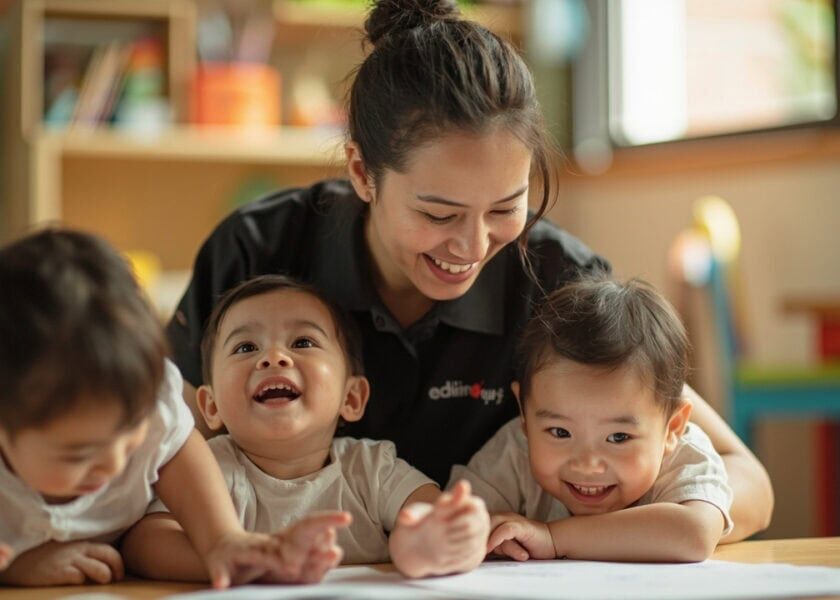
It looks like a caregiver who has the capacity to truly see your child—not just manage them, but notice them. To register the subtle shifts in mood, the emerging interests, the small victories that happen in any given morning. It looks like infant ratios that enable genuine attention, not just compliance with minimum standards.
It looks like honest communication. Updates that tell you something real about your child’s day, not just confirmation that they survived it. It looks like a provider who welcomes your questions, who does not treat transparency as a burden but as a natural part of caring for your family.
The childminder is not a stopgap. She is a professional who participates in the most foundational period of a child’s development. She is someone whose presence, warmth, and attentiveness will leave fingerprints on the kind of person that child becomes. When you choose quality childcare, you are choosing to entrust a significant portion of your child’s early experience to another human being—and that human being deserves to be recognised not just as a line item in a budget, but as a professional whose work matters, whose role carries weight, whose contribution to your family is real and significant.
What This Means in Practice
Within the ECDA Childminding Pilot, these values are translated into practical commitments:
- Home-based care for families who value the intimacy and continuity of a familiar environment
- Community and centre-based options for families whose needs and preferences point in different directions
- Infant ratios designed to enable genuine attention—the kind of noticing that happens when a caregiver has the capacity to truly see the child in front of them
- Communication and transparency measures—including CCTV where deployed—not because trust is absent, but because trust is built through clarity and maintained through honesty
These are practical pathways built around the reality that Singapore families are diverse, and that one size does not fit all when it comes to something as important as your child’s early care.
Affordability and Getting Started
Let us be honest about something else that matters enormously in the practical reality of Singapore parenthood: the cost.
Childcare is not inexpensive, and the honest conversation about affordability is one that too many providers avoid. EduNanny Singapore takes a different approach. Within the ECDA Childminding Pilot fee structures, there is a genuine effort to make quality care accessible—not free, because quality has costs, but accessible in a way that does not require parents to choose between their values and their household budget.
Using What Singapore Has Already Built for You
The use of the Child Development Account and Baby Bonus funds where applicable is not a marketing strategy. It is a practical recognition that Singapore has built systems to support families, and those systems should be accessible to families who are making intentional choices about their children’s care. Using these resources is not a compromise. It is a smart, deliberate use of what is already available to you.
Monday to Friday care blocks are designed around the reality of working parenthood. The rhythm of the week is real. The need for consistent, reliable care that does not add to the logistical anxiety of an already demanding season is real.
Questions Worth Sitting With
As you move through your search toward conviction, here are the questions worth holding:
- What do I actually value? Not what I think I should value, or what others seem to value. What feels true when I stop performing and start paying attention?
- What kind of environment does my child need? Home-based intimacy? Community socialisation? A smaller ratio of caregivers to children?
- What does my family actually need? Not the ideal version, but the real version—the schedule you actually work, the commute you actually have, the support you actually have or do not have.
- How do I want to feel when I leave my child? Not how do I think I should feel. How do I actually want to feel?
- Can I build a genuine relationship with this caregiver? Trust your instincts on this. If something feels off, it probably is. If something feels warm, pay attention to that too.
The parent who chooses from genuine clarity does not need to second-guess. They may still have questions—good parents always do. But they have moved through the search honestly, and they have found something true about themselves in the process.
Need Guidance Along the Way?
If you are navigating this journey and need answers at hours when answers are not readily available, Thomas, the EduNanny AI assistant, is available to help. Not because technology replaces human warmth—it does not, and any honest conversation about childcare must begin with the recognition that what infants need is human presence and human relationship. But because parents navigating this journey often need quick access to information about pilot pathways and eligibility, about how to use their CDA funds, about what questions to ask on a tour. Thomas is there for that: practical guidance in the midst of a complex, emotionally charged decision.
The Parent You Are Becoming
Let us return, one final time, to the parent you have been meeting throughout this article.
You have been searching. You have been confronting questions you did not expect to face. You have been discovering what you actually value beneath all the information you have been collecting. You have been moving, perhaps slowly, perhaps with significant effort, from doubt toward conviction—from the vague discomfort of not knowing what you want to the quieter, steadier clarity of knowing why you chose what you chose.
And you have been becoming someone. Not someone you invented or imagined. Someone who emerged through the honesty of the search itself. Someone who is more intentional, more attentive, more willing to choose from a place of genuine knowing rather than from the noise of expectations and comparisons and other people’s opinions.
This is who you are becoming. And this is the parent who will raise your child—not the parent you thought you were supposed to be, but the one you are actually becoming through the work of paying attention.
EduNanny Singapore is here for that parent. Not to tell you what to choose, but to walk alongside you as you figure out what you believe. Not to promise that everything will be simple, but to offer the kind of care that makes intentional parenting possible. Not to be the authority on your family, but to be the partner who recognises that you have already begun the most important work: the work of looking inward and choosing with clarity.
The search for quality childcare is, in the end, not separate from parenting. It is part of it.
Every time a Singapore parent asks the honest question—What do I actually want for my child?—and refuses to settle for the first convenient answer, they are already practising the kind of parenting that changes lives. Every time a parent looks inward during that search and finds their own values waiting for them, they are already becoming the parent their child needs.
EduNanny Singapore is honoured to walk this path with you.
Ready to Begin?
If you are ready to explore what intentional childcare looks like for your family, EduNanny Singapore is here to answer your questions honestly and help you find the right fit.
- Learn about ECDA Childminding Pilot pathways available to your family
- Understand how to use your CDA and Baby Bonus funds for quality care
- Ask questions about home-based, community, or centre-based options
- Start a conversation about what quality infant care means for your situation
Visit EduNanny Singapore or start a conversation with Thomas, your AI assistant, any time. There are no wrong questions here—only the honest ones that will help you find what you are actually looking for.
You have already begun the work. Now it is time to find the partner who will walk it with you.