The Science Behind Your Child’s Multiple Attachments
The Science Behind Your Child’s Capacity to Love
Across Singapore, parents navigate this tension largely in silence. They do not mention it at playdates. They do not raise it with their pediatricians. They hold it privately, somewhere between pride in their child’s social development and a quiet fear that the world is gradually taking over a space that was meant to belong to them alone.
This gap between intellectual understanding and visceral feeling is real. You may know, on some level, that children benefit enormously from consistent, responsive care. You chose your arrangement for exactly this reason. But what you feel — that sense that your bond with your child is somehow, in some way you cannot articulate, at stake — persists.
Understanding what research actually tells us can help bridge this gap:
- Children are capable of forming multiple secure attachments, not just one
- A caregiver bond does not threaten your parent-child relationship — it strengthens it
- What your child learns with their caregiver builds on what you have already given them
- Quality care creates the conditions for a healthy secondary attachment
- Your child’s affection for their caregiver is a sign of healthy development, not a warning sign
Where Attachment Theory Begins
In the 1950s, the British psychologist John Bowlby developed what would become one of the most transformative ideas in developmental psychology: the concept of attachment. He observed that human infants are born with an innate drive to seek proximity to a caregiver — not for food alone, but for safety, for comfort, for the reassurance that the world is a navigable place.
When a caregiver is consistently responsive, a child develops what Bowlby called a secure attachment: an internal working model that says, in essence, I am worthy of care, and others can be trusted to provide it.
The Evolution of Understanding
For decades, this foundational work led to a simplified understanding: one primary attachment figure, usually the mother. The research at the time seemed to support this. But as the field advanced — as researchers like Mary Ainsworth, Michael Lamb, and many others expanded Bowlby’s framework — a more nuanced picture emerged.
What the evidence now shows, consistently and across cultures, is that children are not limited to a single attachment figure. They have the capacity, and often the developmental need, to form multiple secure attachments.
This is not a deviation from healthy development. It is healthy development.
The child who runs to grandmother with the same confidence she runs to mother. The toddler who settles in the arms of a trusted aunt when mother is ill. The preschooler who calls a regular childcare provider a second name for love. These are not signs that the primary bond is weakening. They are signs that the primary bond is strong enough — secure enough — to serve as a foundation from which the child can reach outward.
The Secondary Secure Base
Attachment theory has a term for this: a secondary secure base. The primary attachment figure — you, the parent — remains the anchor. But around that anchor, children build a network of trust. They distribute their emotional security across trusted adults who have earned it through consistent presence, warmth, and responsiveness.
Here is what is most important for you to understand: this distribution does not divide your child’s sense of security. It multiplies it.
What You Are Actually Witnessing
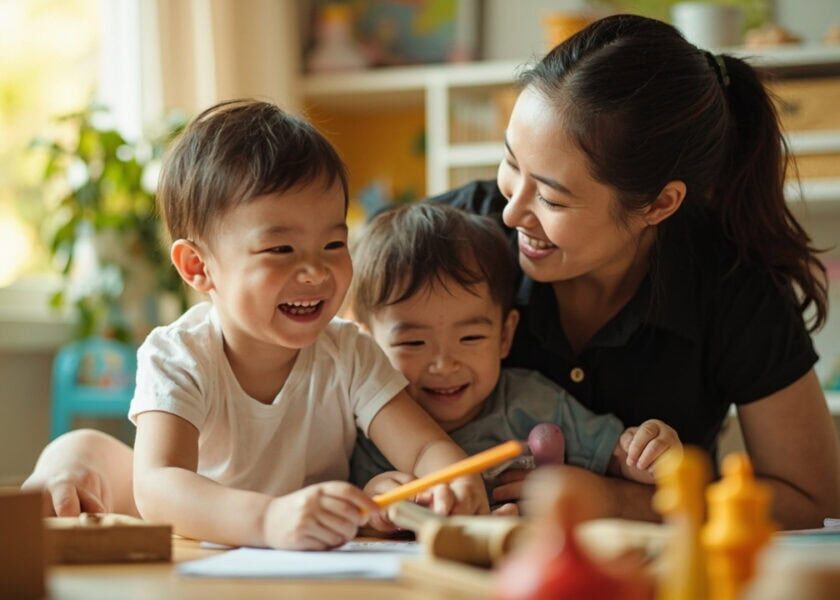
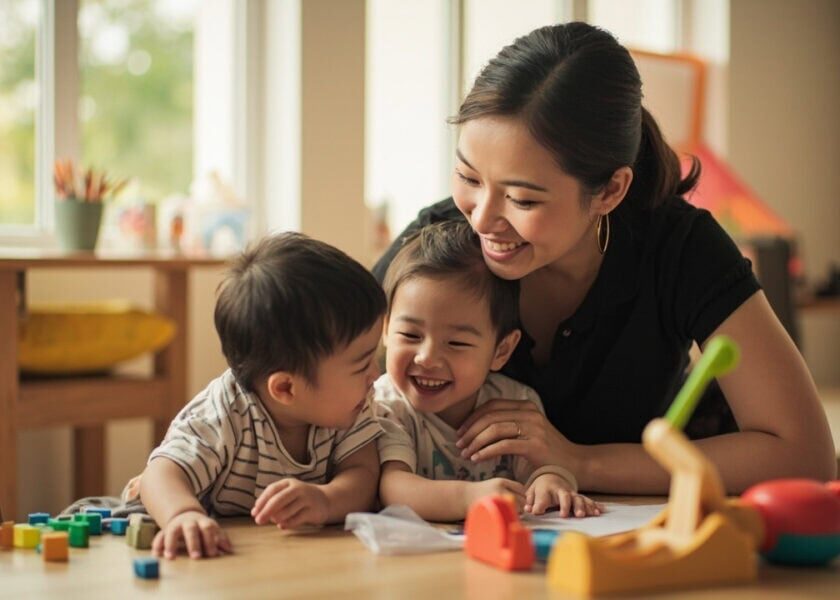
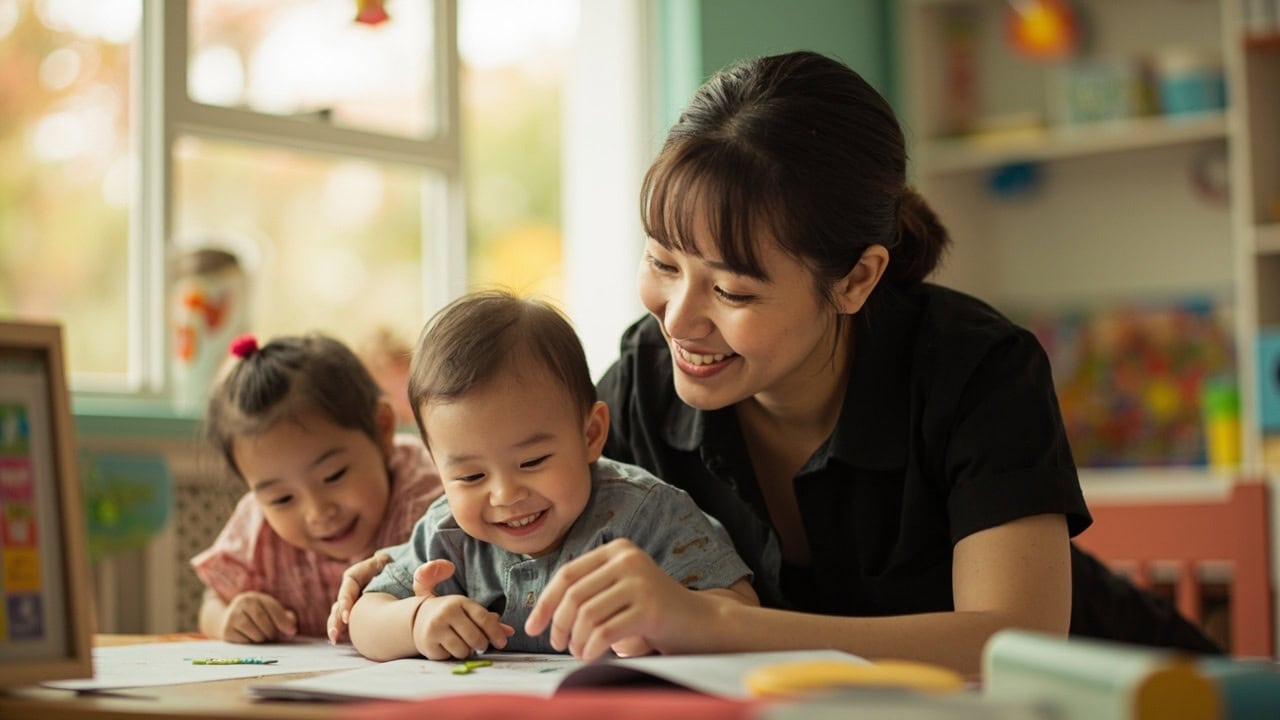
When your child reaches for their caregiver at drop-off — when they mention her name with warmth, when they ask for her during the weekend, when they show signs of genuine affection for someone outside your family — what you are witnessing is not a threat to your bond.
You are witnessing the successful formation of a secondary secure attachment. You are witnessing proof that your child has the capacity for trust, that their primary bond with you has given them the emotional scaffolding to reach toward others and feel safe doing so.
What This Does Not Mean
I want to be clear about what this does not mean. It does not mean the caregiver bond is identical to the parent bond. It does not mean your child will love you and their caregiver with the same intensity, in the same way, for the same reasons.
The parent-child attachment has a depth and a history that no other relationship can replicate — it begins before birth, it is shaped by a million small moments of intimacy, it carries the weight of biology and memory and identity in ways that are simply incomparable.
That bond is not in competition. It is not being diluted. It is, in fact, the very reason the secondary bond can form at all.
What This Does Mean
What it does mean is that your child is developing normally. It means their caregiver is doing her job — not just competently, but excellently. And it means that the care arrangement you have chosen is providing something real and valuable for your child’s emotional and cognitive development.
Signs of a Healthy Caregiver-Child Attachment
Understanding attachment theory is one thing. Recognizing it in your own child’s life is another. Here are the signs that indicate a healthy secondary attachment has formed:
- Easier separations at drop-off — not because they do not love you, but because they trust the environment you are leaving them in
- Excitement or comfort when they see their caregiver, not anxiety or avoidance
- Using the caregiver as a safe base for exploration — venturing away to play, then checking back, then venturing further
- Accepting genuine comfort from their caregiver during moments of distress, and being soothed in a way that is restorative, not merely compliant
- Warm mentions of the caregiver during times apart — asking about her, recalling moments from their day together
These are not just signs of good childcare. They are signs of secure secondary attachment — and research consistently shows that children who have access to multiple secure attachments demonstrate:
- Stronger social-emotional competencies
- Greater emotional regulation
- More resilience in the face of stress
- Enhanced cognitive flexibility
The neurological pathways that support these capacities are literally being built in the context of these relationships.
What This Means for Your Child’s Future
When a child knows, with embodied certainty, that they are safe with more than one person — that multiple adults can be trusted to see them, respond to them, protect them — they develop what psychologists call generalized security. They carry a fundamental belief that the world is a responsive place.
And that belief, laid down in the early years, becomes the architecture for how they will relate to others for the rest of their lives.
How Quality Care Creates These Conditions
Not all caregiver-child relationships become secondary secure attachments. The conditions matter. Understanding what quality care actually requires helps explain why some arrangements produce this kind of emotional security and others do not.
The Critical Role of Responsiveness
Secure attachment — primary or secondary — forms when a caregiver responds to a child consistently, warmly, and appropriately. This means noticing what the child needs, meeting that need, and doing so in a way that feels genuine rather than mechanical.
When a caregiver is responsible for too many children, the quality of responsiveness degrades. Interactions become hurried. Individualized attention becomes scarce. The conditions for secure attachment become harder to achieve.
Why Ratios Matter
One of the most concrete ways to assess whether a care arrangement can support healthy attachment is caregiver-to-child ratios. When a caregiver has time to observe carefully, respond consistently, and build genuine familiarity with each child in their care, the conditions for a secondary secure attachment can emerge.
When those ratios are stretched thin — one caregiver to five, six, or more infants — the responsiveness required for attachment simply cannot be sustained at the level children need.
What This Means for Parents
For parents navigating this decision, these are not abstract considerations. They are the structural foundations that determine whether your child will experience their caregiver as another safe harbor — or merely another place. Ask about ratios. Ask about caregiver training. Ask about how the environment is designed to support individual attention.
These questions are not paranoid. They are informed.
EduNanny Singapore and the Multi-Bond Model
Let me share how these principles shape what we do at EduNanny — not as marketing language, but as explanation of why our model is designed the way it is.
Built for Attachment
EduNanny by BUTLER operates as part of the ECDA Childminding Pilot, and that context shapes our approach. We are committed to a standard of care that meets, and in many ways anticipates, the standards being developed for quality childminding in Singapore.
With up to one to three infants in our care, our caregivers have the time and attention to do what quality attachment requires: respond consistently, observe carefully, and build the kind of trusting relationship that becomes a genuine secondary secure base.
This is not an incidental detail. It is foundational to how we work.
Transparency as Partnership
We also believe transparency is an expression of trust. For families where CCTV measures are deployed, this openness is not about surveillance — it is about partnership. When you can see into your child’s day, when you have windows into what is happening in their small world while you are apart, the ambiguity that breeds anxiety begins to dissolve.
You can see your child with their caregiver and observe not a replacement of your role, but a reinforcement of it — a second safe place in your child’s expanding world.
Support for the Whole Family
We know that parenting in Singapore carries real pressures — the demands of careers, the cost of living, the desire to give children every advantage, the weight of cultural expectations. We do not presume to resolve all of that.
But we do believe that the structural features of our service — the ratios, the training, the intentional cultivation of caregiver-child bonds, the communication and transparency — create the conditions for what you have been reading about: a secondary secure attachment that strengthens rather than threatens your family’s ecosystem.
For those moments when questions arise, when uncertainties surface in the evening after a long day apart, we have developed Thomas, our AI Chatbot, to offer responsive, informed support. Thomas does not replace human judgment or human warmth, but it does offer a resource for the kinds of questions modern parents carry.
A Reframe That Changes Everything
There is a way of thinking about a child’s multiple attachments that I find clarifying, and I want to share it with you as we close.
The parent-child bond is not like a reservoir that gets depleted when other relationships draw from it. It is more like a wellspring — something that, when healthy and deep, produces more of itself.
The love you have for your child, the security you have given them, the trust they have learned in your arms — these are not diminished by the trust they learn in someone else’s arms. They are echoed and extended.
Speaking Directly to You
Now let me speak to the part of you that is still feeling that small, quiet unease.
What you are experiencing is not a sign of failure or a warning that something is wrong. It is an echo of the very love you have built.
You love your child deeply. That love is the reason your child can love others. Your child’s capacity to trust, to attach, to reach toward someone outside the family — this is your doing. This is the gift of the bond you have formed.
But I also want to acknowledge that loving something deeply makes us vulnerable to the possibility of sharing it. And that vulnerability is real. It is not irrational. It is human.
You do not push it away or punish yourself for feeling it. You allow it. You recognize it as a tender expression of your investment in your child’s life.
And then — this is important — you find ways to hold it alongside the understanding that your child’s affection for their caregiver is, in fact, good news.
Both feelings can coexist. Relief and unease, pride and vulnerability, gratitude and something more complicated — these are not mutually exclusive. You can feel all of them at once and still be the kind of parent your child needs.
The Language You Can Use at Home
One of the most powerful ways to process and honor this experience is deceptively simple: talk about the caregiver at home in ways that validate the relationship without positioning it as competition with yours.
When your child mentions their caregiver — when they say her name with warmth, when they recall something that happened during the day — you might say:
- “It sounds like she makes you feel safe. That is such a special thing.”
- “I love hearing about your day with her. Tell me more.”
- “It’s wonderful that you have so many people who care about you.”
This does not take anything away from you. It teaches your child that their relationships are valued, that the adults in their life are not in opposition to one another, and that love is not a finite resource to be hoarded and defended.
Infrastructure For, Not Against
Your child’s caregiver bond is not infrastructure against your bond. It is infrastructure for your bond. It is one more layer of support in the ecosystem your child is growing within.
And when that ecosystem is strong — when your child has multiple secure attachments to draw from — they return to you differently. More openly. More confidently. They return not because they have to, but because they want to, because your home is one of many places in their world where they feel completely at ease.
When Your Child Reaches for Their Caregiver
So when your child reaches for their caregiver at drop-off, when they mention her name with warmth, when they show you through their comfort and their confidence that they have found another safe harbor in the world — I hope you will feel something shift.
Not the absence of that tender, ambiguous unease — that may come and go, and that is human. But alongside it, or perhaps instead of it, a quiet recognition:
- This is what working looks like.
- This is what love built.
- This is my child, learning to trust, learning to love, learning that the world has more than one place for them.
And one of those places is the one you chose.
We are honored to be part of your village. Not the whole village. Not the most important part. But a part — a trusted, intentional, carefully cultivated part — that exists to support the extraordinary work you are doing as a parent in Singapore today.
If you are exploring infant care options in Singapore and want to understand how quality childminding can support your child’s development — and your family’s wellbeing — we invite you to continue the conversation with us.
Explore EduNanny Singapore and discover how our approach to caregiver-child attachment might fit your family’s needs.
#SecureAttachment #ChildcareSingapore #InfantCareSG #MultipleAttachments #EduNannySingapore