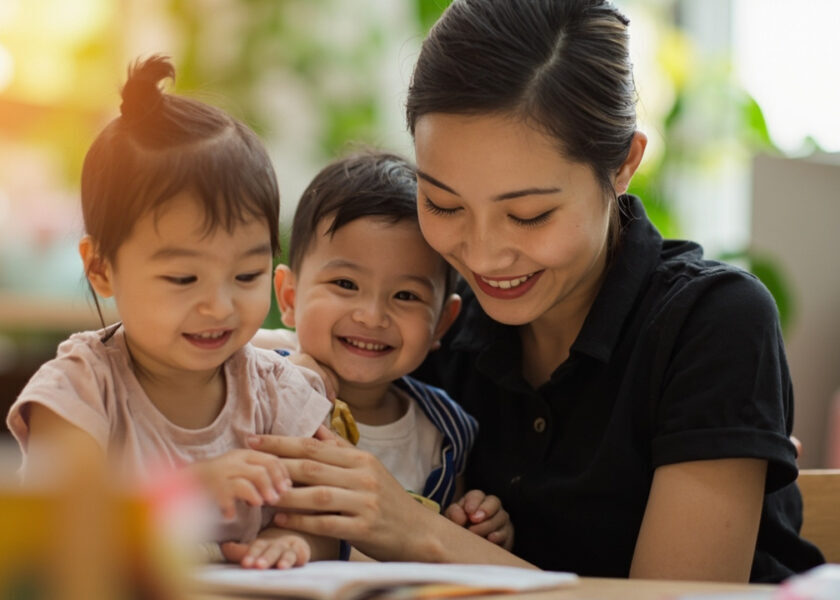
The Mechanism Behind Quality Childcare Every Singapore Parent Should Understand
The Quiet Question Every Parent Carries
Working alongside families across Singapore, we have learned something important: the modern Singapore parent has moved beyond needing reassurance alone. You have absorbed the messages about peace of mind, partnership, and the village it takes to raise a child. That matters—and it is real.
But now something deeper is at work. You want to understand the mechanism. You want to know why quality produces what you observe: the growing confidence, the emerging words, the way your child seems to understand the world a little better each week.
You want to understand what is actually happening during the hours you are apart—not because you doubt, but because understanding is its own form of trust. A deeper one.
And that is exactly what we want to offer you.
How Quality Childcare Works
Quality childcare begins with observation. It begins the moment your child walks through the door each morning.
A trained caregiver—one prepared to read the signals of young children—does not simply greet your child. She observes. She notes the quality of their walk. The way they carry their body. Whether they move with the easy confidence of a child who slept well, or with the slight hesitance of one who did not.
She notes the expression. Whether your child reaches for a familiar toy or pauses to take in the room. These are not guesses. These are trained observations—the kind that come from understanding infant and child development deeply enough that you can read a child’s morning state the way a musician reads the first notes of a piece and knows what kind of hour it will be.
This is what quality care looks like at its foundation: active, trained, intentional observation that informs everything that follows.
Once she has read your child’s morning state, the caregiver adapts. She does not deliver a pre-planned curriculum like a broadcast. She receives your child, reads the signal, and responds.
Perhaps your child needs more time to settle before joining a group activity. Perhaps today is a day for parallel play alongside another child rather than collaborative play. Perhaps your child is fizzing with energy and needs gross motor movement before they can sit and focus.
The trained caregiver reads all of this in real time, because she has been prepared for exactly this work, and she adapts.
This is what we mean when we speak about the difference between supervision and care:
- Supervision keeps a child safe.
- Care—quality care—creates the conditions for development while keeping the child safe.
Understanding that difference changes how you evaluate any childcare arrangement.
Play Is Real Learning
Now let us talk about play, because this is where the intelligence of quality care becomes most visible—and most often misunderstood.
Play is not what happens when real learning is not happening. Play is real learning, operating in the language children know best.
When a caregiver builds a tower and lets it fall, watching your child’s face to see what they do next—that is not filler. That is responsive interaction at its finest. The caregiver is asking: Are you interested in gravity? In cause and effect? In the emotion of destruction and rebuilding? What captures you?
And then building the next moment of engagement from that answer.
This is called developmental scaffolding, and it is one of the most powerful things that happens in quality childcare. The caregiver reads your child’s current level of understanding, offers a challenge just slightly beyond it—not so far that it frustrates, not so close that it bores—and supports your child to reach a little further than they could alone.
It sounds simple. It is simple, in the way that the best things in life are simple after someone has done the hard, expert work of making them so.
This happens throughout the day—not in isolated activity blocks, but in the natural rhythm of eating, resting, moving, and exploring. Quality childcare does not compartmentalize learning into scheduled sessions. It weaves it through the entire day, because that is how young children learn: in context, in relationship, through repetition and curiosity and the steady, warm presence of someone who is paying attention.
The Environment as a Developmental Tool
Walk into a well-designed childcare space and you may notice: the colors are soft but not plain. The shelves are low and accessible. The materials are varied—wood, fabric, natural objects—and there is enough of each to go around but not so much that the space feels cluttered.
This is not interior decoration. This is environmental design for development.
Every element has been considered:
- The open shelving that invites independence
- The defined spaces for quiet and for movement
- The natural light
- The texture underfoot
Young children read their environment the way adults read a room. They feel its order, its warmth, its invitation to explore—or its demand to be still.
A quality childcare environment is designed to say, in a language your child understands: This is a place where you can be safe and curious at the same time.
That is not a small thing. That is everything.
Documentation and the Communication Loop
Here is another layer that matters enormously—and that parents rarely see: documentation.
In quality childcare, your child’s day is not just experienced. It is observed, recorded, and reflected upon.
The caregiver or the team will note milestones as they emerge. Not as a bureaucratic exercise, but as a living record of your child’s development:
- The first time your child uses a pincer grasp deliberately
- The shift from babbling to what sounds like an attempt at a word
- The moment they choose to share a toy rather than hold it alone
These are documented not for filing, but for communication. Because you, as a parent, deserve to know what we see. And because this record allows us to ensure that what we offer your child is always calibrated to where they are—not where a generic schedule says they should be.
This documentation feeds directly into how we talk with you.
At EduNanny, communication is not a courtesy. It is a practice. We believe the loop between caregiver and parent should be continuous and genuine—not just the end-of-day summary that says lunch was eaten and a nap was had, but real, thoughtful exchange about:
- What your child is discovering
- What challenges them
- What excites them
- What they are working on in their own quiet developmental plan
Some of our arrangements include transparent communication measures that allow you to feel connected to your child’s day. We know that when you understand what is happening, your confidence as a parent grows. And that matters to us as much as your child’s development does.
Why Ratios and Continuity Matter
We should speak plainly about something often discussed in terms of compliance but deserves to be understood in terms of its actual purpose: caregiver ratios and continuity.
EduNanny operates within the ECDA Childminding Pilot framework, which allows for arrangements with up to one to three infants depending on the pathway—home-based, community-based, or centre-based.
We take this seriously because the numbers are not just regulatory language. They are the architecture of attention.
A caregiver who is responsible for one or two infants at a time can:
- Observe with depth that is simply not possible in a large group setting
- Respond in real time to individual cues
- Document development as it unfolds
- Adapt the day continuously to individual needs
Your child is not one of many. Your child is seen.
Beyond ratios, having the same caregiver over time—rather than rotating staff—means that person develops a genuine understanding of your child’s individual rhythms, preferences, and developmental trajectory. That relationship, built over weeks and months, is not a luxury. For a young child, it is the foundation of security.
And from security, everything else grows.
Accessibility and Ongoing Support
This is why the ECDA Childminding Pilot structure matters beyond the regulatory label. The pilot represents a pathway designed to be accessible and thoughtful:
- Affordable within the pilot fee structures
- Flexible Monday to Friday care blocks that work with the rhythm of a working family’s week
- Supported by schemes many Singapore families can access
Many families find that their Child Development Account and Baby Bonus can be used, which reduces the financial weight of quality care without reducing its quality. These are not small practical advantages. They are the kind of practical intelligence that allows premium care to be genuinely available—not just theoretically ideal.
We have also developed our Thomas AI Chatbot as part of the EduNanny experience—a resource designed to support you in the questions that arise between visits, between conversations with your caregiver, in the quiet moments when you wonder about something your child did or said and you want context, support, or simply a thoughtful answer.
Thomas is there for the parenting questions that do not follow office hours. Because quality care extends beyond the hours of physical care. It extends into your understanding, your confidence, your relationship with your child’s development. We want to be a resource for all of it.
Your Real Questions, Answered
“Will my child feel secure with someone else?”
Security comes from continuity, warmth, and responsiveness—not from parental presence alone. A trained caregiver who knows your child’s rhythms, responds consistently, and builds a genuine relationship over time becomes a source of secure attachment. This is not a replacement for you. It is an extension of the secure base you are already building.
“How do I know what’s happening when I’m not there?”
Quality care makes the invisible visible through documentation and communication. You should receive regular, thoughtful updates—not just checklists, but real observations about your child’s day, their discoveries, their moments of struggle and triumph. If you don’t know what happened, quality has not been delivered.
“Is this worth the investment?”
The first thousand days of your child’s life are not just a phrase. What happens in those days—in the quality of relationships, stimulation, security, and responsive care—shapes developmental foundations. Quality childcare is not an expense. It is an investment in the architecture of your child’s future.
How to Evaluate Quality When Choosing
If you are currently researching childcare options in Singapore, here is what to look for:
- Ask about observation practices. How do caregivers assess your child’s morning state? What does their intake process look like?
- Observe responsiveness. When you visit, notice whether caregivers adapt to what children need in the moment—or whether they follow a rigid schedule regardless.
- Examine the environment. Is it designed for independence? Are materials accessible? Does it feel warm and ordered?
- Ask about documentation. How do they track development? How do they share this with parents?
- Understand ratios and continuity. How many children per caregiver? How often do caregiver assignments change?
- Test communication. Ask to see sample updates. Are they thoughtful and specific, or generic?
- Trust your observation. Watch how caregivers interact with children. Do they kneel to the child’s level? Do they respond to cues?
The answers to these questions will tell you whether you are looking at supervision, or whether you are looking at care.
The Central Insight
When you choose quality childcare, you are not outsourcing a problem. You are investing in a developmental environment that operates with trained intelligence, intentional design, and genuine care.
What your child experiences in those hours—the scaffolding, the observation, the responsive warmth, the carefully designed environment, the documentation that tracks their growth—is not invisible work. It is invisible to you on a day-to-day basis. But it is not invisible to your child. They feel it. They absorb it.
And the outcomes you see—the confidence, the curiosity, the way they move through the world with a sense that it is interesting and navigable—those outcomes are not accidents. They are the visible result of an invisible framework that has been built with great care.
You have already made the decision to trust. Now you understand why your trust is so well placed.
Because behind every gentle morning greeting, every patient response to a toddler’s frustration, every quiet note in a developmental record, every adaptation to your child’s unique rhythm—there is trained intention. There is expert preparation. There is a commitment to doing the work that your child deserves, and that you, as a parent, deserve.
EduNanny is here for that work. For every day, with clarity and with care.
Curious about what quality childminding looks like for your family? Explore EduNanny’s approach—built on trained observation, responsive care, and genuine partnership with parents across Singapore.
Have questions or ready to take the next step? We’d love to hear from you.