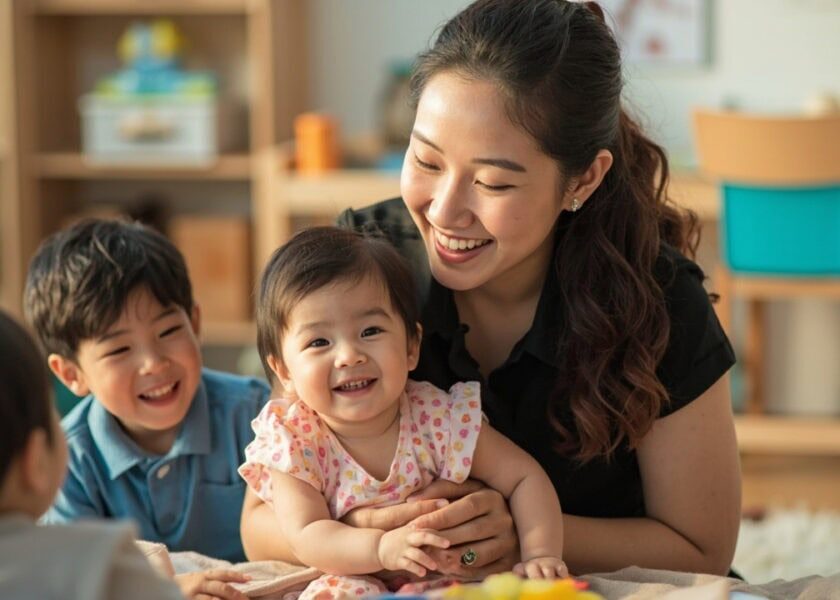
The Room Is Speaking Before Anyone Says a Word
The Sensory Curriculum: Why the Room Comes First
We have become, in Singapore, extraordinarily sophisticated consumers of education. We visit multiple centres. We compare curricula. We ask about teacher qualifications, student-teacher ratios, the philosophy of play-based learning versus structured readiness. We are thorough, we are prepared, and we are often left feeling, after all of it, vaguely uncertain.
Because something in the room told us one thing, and the brochure said another, and we are not sure which voice to trust.
Here is what this means: we have been taught to read spreadsheets, not spaces. We have been trained to evaluate credentials, not atmospheres. And in doing so, we have often dismissed the very first and most important signal available to us—the signal our own nervous system began processing the moment we stepped through the door.
The built environment of a childcare space is not cosmetic. It is not background. It is not a pleasant afterthought. It is foundational. It is, in the truest sense, the first curriculum your child will encounter.
The Quality of Light
Walk into one childcare space and the light is flat, institutional, buzzing faintly with the hum of fixtures chosen for efficiency rather than for how they land on a child’s skin. The room is functional. It is clean. It is not hostile. But something in you relaxes only slightly.
Now walk into another. The light is warmer. It shifts. It falls differently across a reading nook than it does across a block-building corner. Perhaps there are windows—real windows—with light that moves through the day, that teaches time without a clock, that reminds everyone in the room that the world outside is real and present and connected to this one.
The light matters because a child’s nervous system is still calibrating. It is learning what is safe, what is soothing, what is overwhelming. Harsh, flickering, or overly fluorescent environments keep the stress response gently activated—not enough to harm, but enough to wear. Warm, natural, well-regulated light calms. It invites presence. It tells a child, without words, that someone thought about how this room would feel to live in.
The Acoustic Environment
Singapore childcare centres are busy places. The sound of learning is not silent—you do not want silence for young children. But the sound matters.
Is there an echo that makes every cry and shout rebound and amplify until the room vibrates with a kind of sonic anxiety? Or is the room designed with attention to acoustics—soft materials on walls and floors, spaces arranged to absorb rather than amplify, a soundscape where a teacher can lower her voice and still be heard?
When noise is managed with intention, children learn something profound: that big feelings are allowed, that they will not cause chaos, that help is nearby and measured and calm. This is the beginning of emotional regulation. This is a room teaching a child that feelings are survivable because the environment around them has been organized to hold them.
The Smell of Care
And then there is smell. This one makes people uncomfortable, which is precisely why it matters. We do not like to talk about smell because smell is intimate. Smell bypasses our defenses. It tells us things we cannot argue with.
A childcare room that smells of harsh disinfectant—the kind that tries to erase all evidence of human habitation—is not a clean room. It is a room that has confused cleanliness with care. Real cleanliness in an infant and toddler environment is meticulous. But it does not assault the nose. It smells of wood, of fabric, of food being prepared, of the particular warm sweetness that accumulates when many small bodies share a space.
A room that smells right tells you something has been thought about the whole child—not just the visible surfaces, but the invisible ones too.
Spatial Arrangement and Physical Agency
Walk through the spatial arrangement. Watch where your eyes go.
In a room designed with intention, you will notice something remarkable: children can move. Not just from activity to activity, not just along predetermined paths, but freely, with their whole bodies, into spaces that welcome them. There are corners for retreating. There are open areas for running and falling and getting up again. The furniture is scaled to children, yes, but it is also arranged with respect for how children actually move—which is not in straight lines, which is not predictably, which is with a kind of joyful and sometimes chaotic aliveness.
Watch the children themselves. Not what they are doing, but how they are doing it. Are their shoulders tight? Are they looking around frequently for an adult? Or are they absorbed, expansive, loose in the way that children are only loose when they feel genuinely safe?
This is what the spatial arrangement reveals: whether the room believes the child is capable of agency, or whether it believes the child needs to be contained.
Intentionality Over Perfection: Trusting What Your Body Already Knows
I want to pause here, because I know what some of you are thinking. You are thinking: but Singapore is Singapore. Space is expensive. Centres are small. Not every room can be a Scandinavian dream of natural wood and floor-to-ceiling windows.
I know. And I want to be direct with you about what I am not saying.
I am not saying you need perfection. I am not saying the room with the lower budget, the smaller footprint, the older building is failing your child. What I am saying is something more nuanced, and I believe more important: look for intentionality.
Intentionality is the difference between a room that has been designed and a room that has merely been furnished. It is the difference between a childcare space where someone asked, “How will this feel to a two-year-old nervous system?” and a space where someone asked, “Did we stay within budget and meet the regulatory minimums?”
Both rooms might pass a checklist. Only one of them will pass the test your body administers the moment you walk through the door.
When you walk into a childcare environment, your nervous system is gathering data at a speed your conscious mind cannot match. Before you have processed the qualifications on the wall, before you have noted the ratio of caregivers to children, your body has already formed an impression. It knows if the room feels safe. It knows if the pace feels frantic or calm. It knows if the adults in the room are present or distracted, warm or merely polite.
We have learned, as modern parents, to distrust this knowing. We have been taught that instinct is bias, that emotion clouds judgment, that the responsible thing to do is to rely on metrics and credentials and objective criteria. And those things matter. They matter enormously. But they are not sufficient. They cannot tell you what it feels like to leave your eight-month-old in someone else’s arms. They cannot tell you whether your child will wake from a nap into a room that feels like a continuation of the safety they fell asleep in.
Your felt sense of a childcare environment is a form of intelligence. It deserves to be listened to, examined, and trusted—not as the only criterion, but as a legitimate and important one.
The parents who feel most confident in their childcare choice are not the ones who found the centre with the best credentials on paper. They are the ones who walked into a room and felt, in some wordless way, that this was a place where their child would be known. Where the caregivers moved with a kind of attunement that spoke of consistency, of genuine relationship, of a philosophy that had been thought through from the inside out.
The environment reflects the care philosophy because the environment is the care philosophy, made visible. The room does not lie. It cannot. It is too honest a thing, too public an expression of what happens when no one is watching.
What to Actually Look For on a Tour
Beyond the checklist, here is what matters when you visit a childcare space in Singapore.
Observe Caregivers When They Are Not Being Watched
Do they speak to children at eye level? Do they get down on the floor? Do their faces soften when a child approaches, or do they maintain a kind of pleasant professional distance? These small moments reveal whether caregiving is a performance or a practice.
Notice the Pace of the Room
Does it feel rushed, as if there is always something happening next? Or does it feel like there is time—time for a child to finish what they are doing, time for a caregiver to wait rather than redirect? For infants and toddlers, pace is not a minor consideration. A hurried environment is a stressed environment, even when no one is explicitly rushing.
Watch Whether Children Belong to the Space
Do the children in the room seem to belong there, as if the space has been built around their rhythms rather than having had children inserted into it? Or do they seem managed by the environment rather than invited by it?
Ask About Caregiver Consistency
In Singapore’s childcare landscape, caregiver turnover is one of the most significant sources of distress for children and parents alike. An infant or toddler cannot form the secure attachment that supports healthy development if the face that cares for them keeps changing.
When you visit a centre, ask about consistency. Ask how long the caregivers in the infant room have been there. Watch whether the children in the room show recognition, comfort, a particular ease with the adults around them. These are signs that relationships have been allowed to deepen, and that matters more than almost any curriculum you could name.
Your Child’s Environment Is Writing Something Into Their Nervous System
The room your child lives in, in those early years, is shaping them in ways that no curriculum can override. The sensory architecture of their daily life—the quality of the light, the consistency of the sounds, the smell of safety, the spatial permission to move and explore and retreat—is writing something into their nervous system that will stay with them.
Not because the room is perfect, but because the room is present. Because it has been thought about. Because somewhere, someone decided that what happens in this room matters, and that the children who live here deserve environments worthy of them.
You are not being too fussy when you feel that something is off in a space. You are not being anxious when you cannot articulate why a room unsettled you. You are reading a text that most people have not learned to read. And the fact that you are reading it—the fact that you care enough to feel something—is itself evidence that you are the right kind of parent for the job.
Your instincts and the checklist serve different purposes. The checklist tells you whether a centre meets minimum standards—whether ratios are within regulations, whether staff are certified, whether safety protocols are in place. Your instincts tell you whether this particular room, with these particular people, is the right environment for your particular child. Both matter. Neither is sufficient on its own.
You will not find perfection. You are looking for intentionality. You are looking for a room where someone asked how it would feel to a small person. You are looking for caregivers who stay. You are looking for an environment that feels, in your body, like a place where your child could thrive—not because it is flawless, but because it is thoughtful, warm, and attuned.
Trust the Room. Trust Yourself.
Here is what I want to leave you with, as you begin or continue your search for childcare in Singapore.
The room your child will spend their earliest years in is not a backdrop. It is not a convenience. It is not a place where they are simply minded while you work. It is the first world they will come to know. It is teaching them, every single day, whether the world is safe, whether people are warm, whether their feelings are allowed and held, whether their bodies are trusted and respected.
You have the capacity to read this room. You have been using this capacity since before your child was born. And now, with a little more awareness of what you are noticing and why, you can bring that capacity into sharper focus.
When you walk into a childcare space, walk in with your whole self. Notice the light. Listen to the sound. Breathe in what the room smells of. Watch how the children move, how the caregivers engage, how the space itself seems to feel about the people in it.
And then trust what you feel.
Because somewhere, there is a space that will feel, in the deepest part of you, like the right beginning for your child. A space where the environment and the philosophy speak the same language. A space where your instincts and your checklist agree.
That space is waiting. And when you find it, you will not need a brochure to tell you. You will know.
For families seeking a model built on these principles—thoughtfully arranged environments, intentionally low ratios, and a philosophy that holds a child’s sensory world as central to their development—EduNanny Singapore’s ECDA Childminding Pilot was designed with exactly this in mind. From the quality of the space to the consistency of the caregivers within it, every element reflects a belief that a child’s environment is not a backdrop to learning. It is the learning itself.
Explore EduNanny Singapore to learn more about what intentional infant and toddler care looks like in Singapore.