Baby Not Crawling? What to Notice and When to Ask
EDUNANNY® BY BUTLER · INFANT GUIDE
If your baby is not crawling, look beyond that one movement. Some babies do not crawl before walking, but that does not mean every concern about movement should be set aside.
For parents and carers of babies aged 7–12 months, the useful next step is to notice everyday abilities, offer suitable play and speak with your baby’s doctor when something concerns you. A floor-play activity cannot decide whether development needs assessment.
Does every baby need to crawl?
HealthHub’s first-year guide explains that not all babies crawl before they walk; some move by bottom shuffling. It describes crawling as a stage that not every child goes through.
That answers a general question about crawling. It does not establish why your own baby is not crawling or whether their wider development needs attention. Avoid using another baby’s crawling age as a pass mark, or treating one good play session as reassurance about everything else.
What else should I notice?
Describe what you see in ordinary moments: how your baby changes position, reaches for an object or uses their hands. Record the support they need as well as the actions they start themselves. There is no need to arrange a home test.
The CDC’s current nine-month checklist includes getting into a sitting position, sitting without support and transferring an object between hands. Crawling is not listed. The checklist supports monitoring and discussion; it does not replace a validated developmental screen.
Use the checklist for the relevant age, rather than expecting every skill throughout the whole 7–12-month range. Our broader developmental milestones guide links the age-specific checklists and explains how to use observations at healthcare appointments.
| Notice | Record | Keep open |
|---|---|---|
| A familiar action | RecordWhat your baby does themselves and what support is present. | Keep openOne action cannot describe the full pattern of development. |
| A concern | RecordWhat you have noticed, when it began and the situations in which it happens. | Keep openA clinician can assess the concern; a caregiver note cannot establish its cause. |
| A change | RecordAny skill your baby previously used and no longer uses. | Keep openShare a loss of skills promptly with your baby’s doctor. |
This is an original conversation aid, not a screening tool or a list of movements to practise until your baby performs them. You can raise a concern without completing every row.
How can I offer play without making crawling the goal?
The CDC suggests placing toys on the floor or a play mat to invite crawling, scooting or rolling. Begin with a toy your baby can comfortably reach and explore; adjust the invitation to their interest and ability. Staying close allows you to notice when to pause or finish.
Use a clear floor area for awake play with an attentive adult. Our floor-play space check covers the surrounding room and supervision before choosing an activity.
Follow the toy’s age recommendations and instructions, and inspect its condition. The Consumer Product Safety Office advises keeping older children’s toys out of younger children’s reach and setting aside damaged toys or loose parts. A smooth-looking toy or a photograph does not establish suitability.
If your baby watches, reaches or rolls, let that response guide the exchange. If they turn away, become unsettled or need rest, pause or stop. Repeated prompts to produce a particular movement are not needed for this observation.
When should I speak with my baby’s doctor?
Act early if your baby is missing a milestone on the relevant checklist, has lost a skill or you have another concern. The CDC advises discussing this with the child’s doctor and asking about developmental screening. You do not need to wait until 12 months or until a play routine has been tried repeatedly.
For example, sitting without support is on the nine-month checklist. If your nine-month-old is not doing this, discuss it with their doctor rather than focusing only on crawling. This is a reason to ask for assessment, not a diagnosis made from an article.
Bring a short description of what you have noticed. If your baby was born prematurely or has particular healthcare needs, tell the doctor so these can be considered when discussing development.
- What does my baby do independently, and what support do they need?
- When did I first notice the concern, and has anything changed?
- Is developmental screening or further assessment appropriate?
A nanny or childminder can contribute factual observations from care. Keep the healthcare professional’s role clear: deciding whether a developmental assessment or intervention is needed belongs with the appropriate clinical team.
Keep the next step specific
You can make room for ordinary play and ask for advice at the same time. A useful note says what happened, rather than labelling your baby as slow, lazy or behind.
For example, an illustrative note might read: “At nine months, my baby reaches for a toy while sitting with support. I would like to discuss sitting and movement.” It does not claim that this is a real child’s history or explain the cause. Its purpose is to make the question clear enough to discuss.
Sources and image credit
- HealthHub: Your Growing Baby — the first-year FAQ on babies who do not crawl.
- CDC: Milestones by 9 Months — current checklist, monitoring limits, play ideas and acting early on concerns.
- CPSO: Safety Tips on Children Toys — age instructions and toy condition.
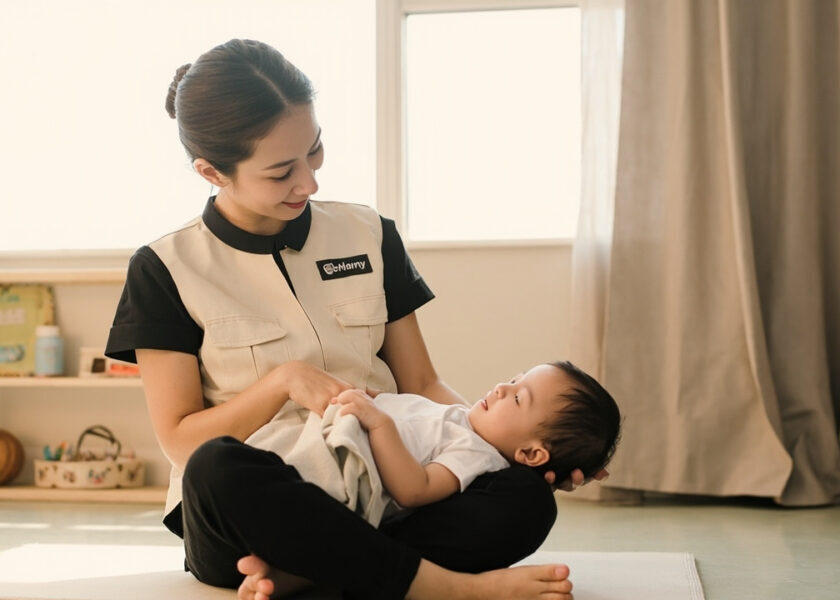
Stock photograph by Marina Abrosimova on Unsplash, used under the Unsplash licence. Illustrative toys; no particular toy or age suitability is endorsed. This is not a photograph of EduNanny staff or clients.