Fraud Blocker edunanny.com
edunanny-063190e9b700edb475c77ac215da94d2
April 18, 2026

Beyond Adequate: Understanding the Standard of Professional Infant Care in Singapore

What This Article Covers

  • The hidden gap between trained caregivers and truly professional infant care
  • What expert caregiver responsiveness looks like in practice
  • How to evaluate caregiver quality with informed observation
  • Questions every parent can ask to assess care
  • How professional care differs at the developmental level

What Professional Caregiving Actually Looks Like

Let me walk you through what professional caregiving actually looks like—not the version we put in brochures or the one we wish were true, but the real craft of it. Because you deserve to understand what your child is receiving.

A Scene You Might Recognise

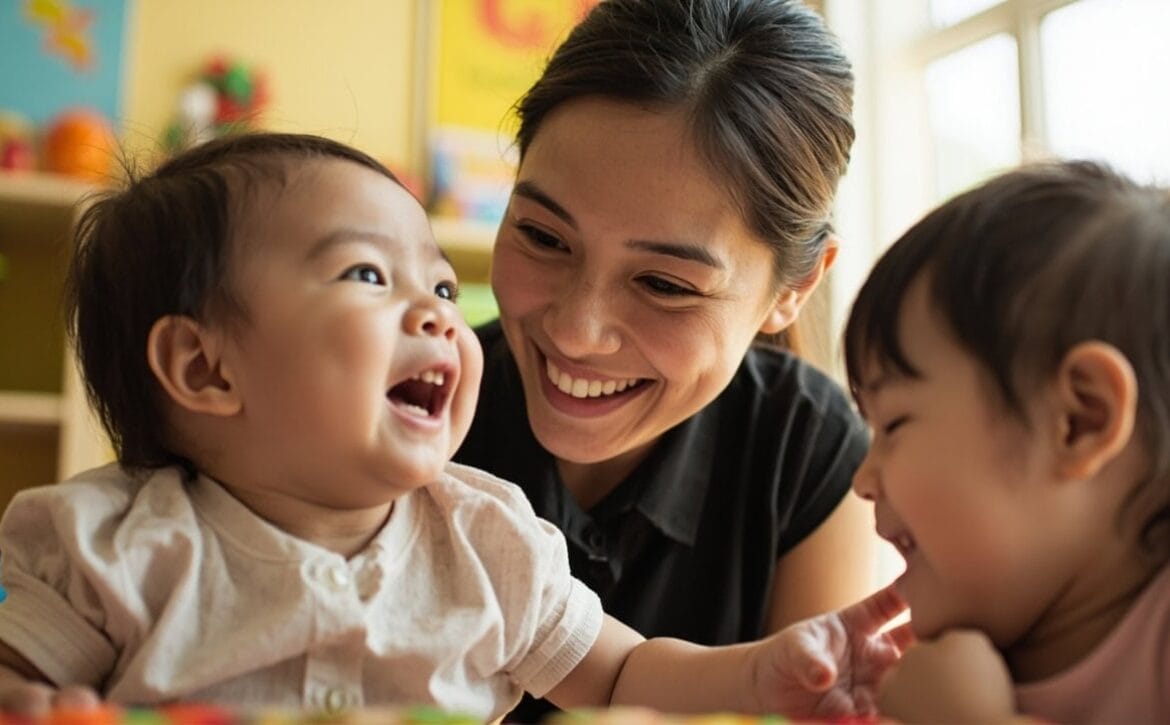
It is mid-morning at a well-run infant care setting. A caregiver is sitting on the floor with three babies, each at a different stage of exploration.

One is carefully placing stacking cups in a line, then knocking them over, then rebuilding—the same sequence, over and over, with absolute concentration. Another is watching from a seated position, taking in everything. The third is beginning to fuss, a small whimper building toward something larger.

What you are watching, if you know what to look for, is a choreographed response that took years to learn. The caregiver notices the whimper before it becomes a cry—not because she has supernatural hearing, but because she has trained her attention to register the frequency of infant distress the way a musician learns to hear a wrong note in a chord.

She shifts her body slightly, creating a calming presence, while simultaneously noting that the child stacking cups has reached the satisfaction point of that activity and will need a transition soon. She speaks softly to the fussing infant—not with generic reassurance but with the specific tonal warmth that developmental research has shown activates the parasympathetic nervous system in young children.

She does all of this while the other caregiver in the room continues a gentle interaction with a fourth child working on pulling to stand.

This is not instinct. This is craft. And it is the difference between a trained professional and someone who simply loves children.

The Research Behind the Practice

Research on early childhood development has consistently shown that the quality of caregiver responsiveness in the first years of life shapes:

  • The architecture of a child’s stress response system
  • Their capacity for emotional regulation
  • Their ability to form secure relationships
  • Later academic readiness and social-emotional competency

These are not soft observations. These are measurable outcomes in brain development, hormonal regulation, and social-emotional competency that follow children into primary school and beyond.

What this means, practically, is that the difference between adequate and excellent caregiving is not a luxury. It is about whether your child’s stress response system is being calibrated toward resilience or toward hypervigilance. Whether their communication attempts are being met with responsive engagement or polite tolerance. Whether their individuality—the specific tempo of their temperament, the particular ways they seek connection—is being seen and honoured, or folded into the convenience of group routines.

The Rhythm of Responsiveness

When you visit a childcare setting, watch for what we call the rhythm of responsiveness.

Notice how quickly caregivers shift their attention when a child’s state changes. A professional caregiver does not wait for a problem to escalate before responding. She notices the earliest pre-cry signals:

  • The change in skin tone
  • The slight stiffening of posture
  • The shift in eye contact

And she adapts. This is not hovering. It is professional attention—the same quality of focus that a skilled surgeon brings to an operating room or a pilot brings to a takeoff sequence.

The Environment Reflects Intention

Notice, too, the environment itself. In truly professional care, nothing in the room is accidental:

  • Spacing of play materials—the distance between a lying infant and a seated one
  • Safety design—proximity of soft surfaces for fall zones
  • Developmental elements—mirrors at infant eye level to support self-recognition and object permanence
  • Environmental regulation—considered lighting, managed acoustics, temperature monitored for sleep regulation

Every element has been arranged with developmental intention. Compare this to untrained caregiving: a room full of toys that could be anywhere, a caregiver who responds when a child cries rather than when they signal distress, an environment that changes based on what is convenient rather than what advances learning.

This is not malicious. It is simply the difference between amateur care and professional care—and it compounds in ways that matter enormously over time.


Why Individualisation Sets Professional Care Apart

Trained caregivers know that individualisation is where the craft truly shows. A professional caregiver does not treat every child identically.

She knows that:

  • One infant needs a longer wind-down period before sleep because her nervous system takes longer to regulate
  • Another needs immediate responses to distress because inconsistent responsiveness has created anxiety about abandonment that careful consistency can gradually repair
  • A third needs more physical challenge, more opportunities to test her body’s capabilities, because her developmental trajectory includes a strong drive toward mastery

Within the group, she holds appropriate ratios that allow for individual attention while preserving the social benefits of peer interaction. But she is reading each child as a distinct person with distinct needs, and adjusting her approach accordingly.

Communication That Tells You Something

Professional communication is different in kind, not just in frequency.

You have probably received the generic update: “She had a good morning. She ate well. She played with the other children.” This is politeness. It is not information.

A trained caregiver tells you something different. She tells you that:

  • Your daughter showed frustration when a tower she was building fell—a sign of emerging persistence that you might want to reinforce at home by celebrating the attempt rather than just rebuilding it for her
  • Your son seemed more tired than usual and we offered an earlier nap, which suggests he may be coming down with something and you might want to monitor his temperature tonight
  • Your child has discovered a new way of expressing curiosity—by tilting her head and looking at objects sideways—and we are encouraging this because it relates to depth perception development

This is professional communication. It is precise, observation-based, and actionable. It tells you what your child is actually doing and why it matters. And it invites you into a partnership rather than delivering a report.


How Professional Care Sustains Itself

You might be wondering: how does this professional quality sustain itself? How does a caregiver maintain this level of attention day after day, year after year, without burning out or sliding into routine?

The answer is discipline. The warmth you see in an excellent caregiver—the genuine affection, the easy smile, the intuitive comfort she offers a distressed child—this is not separate from professionalism. It is sustained by it.

Professional caregivers have techniques for:

  • Self-care and emotional regulation
  • Processing the difficult moments that come with infant care
  • Understanding that their own stress is contagious—that infants read their nervous systems with extraordinary sensitivity

Managing themselves is part of the job. They debrief with colleagues. They reflect on their practice. They grow.

And this professional discipline compounds. The caregiver who has spent five years reading infant cues becomes better at reading infant cues than the one who has spent two. The caregiver who has supported children through hundreds of separations and reunions becomes expert at the reunion moment—the brief, crucial interval when a parent returns and the child must integrate their day away with their parent’s presence.

She knows how to facilitate that transition. She knows not to rush it, not to interrupt it, and not to manufacture it. She steps back with quiet confidence and allows the family to reconnect in their own way, present but unobtrusive.


What to Look For and Ask

Choosing a professional caregiver is not the same as choosing a kind person. Kindness is necessary but insufficient.

What you need is kindness organised by expertise. Warmth that is sustained by professional discipline. Attention that is trained to see what untrained eyes would miss.

Questions Every Parent Can Ask

The next time you drop your child at childcare, or welcome a childminder into your home, look with informed eyes:

  • Does the caregiver notice before problems escalate?
  • Does the environment reflect developmental intention?
  • Does the communication tell you something or just reassure you?
  • Does the care feel generic or genuinely individualised?

Ask questions. Not as an anxious parent, but as an informed one:

  • What is my child’s day like?
  • What have you observed about their development?
  • How do you handle the moments when they struggle?

These are not intrusive questions. They are the questions of a parent who understands that professional care is a craft, and who expects to be served by that craft.


Professional Care That Meets This Standard

At EduNanny by BUTLER, caregivers are prepared through the ECDA Childminding Pilot, a framework that represents Singapore’s most thoughtful approach to professionalising home-based and centre-based infant care. This is not a generic certification. It is a structured pathway that builds caregiver competency in infant development, safety protocols, responsive caregiving, and communication skills that allow parents to remain connected to their child’s day even when they are apart.

The programme offers both home-based and centre-based pathways, so families can choose the arrangement that fits their circumstances—whether that is a caregiver who comes to your home, or a community setting that brings together small groups of infants in a carefully designed environment.

Infant ratios are intentional. EduNanny maintains ratios of up to one caregiver to three infants, because the quality of individual attention is not an abstraction—it is measurable, and it matters. In a room with fewer infants per caregiver, there is more time for responsiveness, more capacity for individualisation, more bandwidth for the professional observation that makes a difference.

Caregivers are trained to communicate with the precision described earlier—because parents deserve to know what their child is actually experiencing, not just that they are safe. EduNanny implements communication and transparency measures that allow you to remain connected to your child’s day. Where deployed, CCTV provides an additional layer of assurance. But beyond the technology, transparency is a philosophy.

What Singapore Parents Face

Singapore parents face pressures that are specific to this context:

  • The cost of living and demands of dual-career households
  • The geographic distance from extended family
  • Cultural expectations around educational achievement that begin earlier here than in many other places

These pressures do not diminish your child’s need for excellent care—they intensify it. The infants in our programme are growing up in one of the most dynamic, demanding cities in the world. They deserve caregivers who are not just well-meaning but professionally excellent. They deserve the craft.

One of the most important things learned in witnessing thousands of handover moments between parents and caregivers is this: the best care is not provided by people who are merely competent. It is provided by people who understand the significance of their role—who know that in those early years, every interaction is encoding something into a child’s developing brain, and who feel the weight of that responsibility and meet it with skill.

Your Standard to Hold

Professional caregiving is work that looks easy because it is done well. It is attention that feels like love because it is sustained by knowledge. It is the craft of raising human beings, and it deserves to be recognised as such.

When you leave your child in someone else’s care, you are making a profound act of trust. You deserve to make that trust with eyes open, understanding what quality looks like and why it matters. You deserve to partner with caregivers who see your child as a person being formed—not a task to be completed.

That is the standard we hold at EduNanny by BUTLER. Not just adequate supervision. Not just kindness. Professional craft, practised with warmth and sustained by expertise.

Because your child is not a task to be completed. They are a person being formed, and that formation deserves nothing less than professional care.


For families seeking professional infant care in Singapore, learn more about EduNanny’s approach to development-focused childminding, or connect with our team to explore whether our programme is the right fit for your family.


edunanny-06318daf4532205b0a699eb0c46bc499
April 18, 2026

The Partnership That Makes Quality Childcare Last

The Invisible Relationship That Determines Whether Your Child’s Care Thrives or Fades

There is a moment, familiar to most parents in Singapore, when you first leave your child with someone else. You have made the decision. You have toured the facility or met the caregiver. You have checked the ratios, reviewed the credentials, and walked through the door on your first morning with your heart in your throat and a list of instructions folded in your pocket.

But then what?

You go to work. You sit in meetings. You answer emails. And somewhere across the city, your child is learning to trust a new person, navigating a new space, building the first foundations of a world that now extends beyond your home. And you are not there.

Most parents spend enormous energy arriving at that threshold. We agonize over the choice. We seek recommendations, compare ratios, evaluate environments. We prepare for the decision the way we might prepare for surgery — with research, with anxiety, with the belief that the quality of our preparation will determine the quality of the outcome.

And then we step through the door, and we often stop there.

But here is the quiet truth that most childcare content never tells you: the decision is not the destination. It is the beginning. And the single greatest determinant of whether quality endures over the months and years ahead is not the curriculum you chose or the facilities you inspected. It is the relationship you build with the person you have entrusted with your child’s days.


The Decision Is Not the Destination

You found the right place. You reviewed the credentials. You walked through the classrooms or the caregiver’s home and felt something settle — a sense that this was the right fit. You handed over the feeding schedule, the nap times, the preferred method for soothing tears.

And then, day by day, something subtle happens.

The updates from home become fewer. The insights about your child’s emerging fears or new words or changing appetite feel like things you should mention but somehow never do. You assume the caregiver is observing. You assume they are noticing what you notice. You begin to treat the relationship as a professional transaction: you deliver your child in the morning, they return in the evening, and the exchange is complete.

Meanwhile, the caregiver — who genuinely cares, who entered this profession because she loves children and has trained for this work — is left to piece together your child’s inner world from fragments. She notices that your daughter has been extra clingy this week but does not know that there is a new baby in the house. She sees your son push away food but does not know that he stayed up late last night because his grandparents were visiting and the routine shifted entirely.

She is doing her best with half the story.

This is not a failure of trust or love. It is a failure of partnership. And it is almost never intentional.

Why Communication Breaks Down

The breakdown in parent-caregiver communication rarely comes from hostility or indifference. It comes from something more subtle:

  • Quiet assumptions. We assume the caregiver is observing what we observe, knows what we know, sees what we see at home. We rarely question this assumption until something feels “off.”
  • Boundaries between “home” and “care.” We draw a line between the two worlds, treating them as separate domains rather than interconnected parts of our child’s whole life.
  • Thinking of childcare as a service. We update on schedules but not on stories. We share food and sleep but not the small developments, the regressions, the anxieties, the things shifting at home that will inevitably show up at the caregiver’s door.

When something feels slightly off months later — the communication feels thin, you do not quite feel like you know what is happening in your child’s day, even though they are in care five days a week — the answer is almost always the same: you invested in the decision, but not in the relationship.


The Tension Every Parent Feels

Before we go further, let us acknowledge something important.

Being a parent in Singapore is hard in ways that are specific to this city. You may be working long hours. You may be managing extended families and intergenerational expectations. You may be navigating the impossible arithmetic of childcare costs against salaries. You may be the first generation of parents in your family to place your child in formal care, and there is no inherited wisdom telling you how this is supposed to work.

You are doing your best with what you have.

And yet — good partnership requires something from parents too. It is not passive. It is not something that simply happens when you have chosen well. It is an ongoing practice, a daily act of intention, a willingness to show up in the relationship with the same care and attention you bring to everything else in your child’s life.

This is not about guilt. It is about agency.

Quality childcare is not a product you purchase. It is a relationship you build. And like any relationship that matters, it requires both people to invest, to show up, to communicate — not just at the beginning, but consistently over time.


From Client to Partner: The Shift That Changes Everything

Here is what becomes possible when you stop thinking of yourself as a client and start thinking of yourself as a partner:

  • You stop waiting to be updated and start actively contributing
  • You stop treating concerns as criticisms and start approaching them as collaborative problem-solving
  • You stop assuming the caregiver knows your child and start ensuring they do

Sharing the Full Story

When you share your child’s story — not just the schedule but the development, the personality, the texture of who they are becoming — you give the caregiver something no training can provide: context.

You walk in on Monday morning and say, “She had a difficult weekend. There were big emotions. Please be patient if she seems off today.”

In that single sentence, you have saved the caregiver hours of confusion, your daughter hours of unmet needs, and yourself the worry that comes from not knowing.

Approaching Concerns as Conversations

When you hear about a concern and bristle — wondering if this means you chose wrong — you miss an opportunity. A caregiver who notices and tells you is a caregiver who is paying attention.

When you approach a concern not as a complaint but as a conversation — “I noticed something and I wanted to share it with you, can we talk about how to handle it together?” — you invite expertise rather than defensiveness. You signal that you see the caregiver as a professional colleague with knowledge you respect, not as an employee whose job is to defer to your preferences.

Asking Better Questions

We ask, “How was my child’s day?” and we accept “It was good” because we do not know how to ask better questions.

But when you ask specific questions and receive specific answers, you build a picture of your child’s day that is richer than “it was fine.” You learn that your son discovered a new way to stack blocks, that he ate well but pushed the peas to the side with remarkable persistence, that he laughed when the caregiver read the bunny book but covered his ears during the music session because the volume was too loud for his sensitive hearing.

These are not trivial details. These are the building blocks of a shared understanding of your child.


The Daily Practices That Sustain Quality Partnership

Partnership is not built in grand gestures. It is built in small, consistent acts of communication, generosity, and mutual respect:

  • A text message in the evening sharing something your child did at home that the caregiver should know
  • A note in the communication book about a change in routine or a new development
  • A conversation at pickup that goes beyond “any incidents?”
  • A willingness to say, “I noticed this at home, I thought you should know”
  • Sharing what is happening at home — a move, a new sibling, a parent visiting, a grandparent unwell, a change in your work schedule

These practices do not take much time. But they require something harder than time: they require you to see the relationship as yours to maintain, not just yours to benefit from.


What This Looks Like From the Other Side

Let me tell you what partnership looks like from the caregiver’s perspective — watching your child for up to nine hours a day, five days a week.

She woke up this morning and thought about your child. She thought about how your daughter has been working on a new gross motor skill, how she is almost confident enough to climb the small ladder at the playground but still hesitates at the top. She has been giving your daughter small challenges all week, backing off when the anxiety spikes, encouraging gently when the confidence rises.

She knows your child’s rhythms, her preferences, the exact pitch of voice that soothes her, the particular order of the bedtime routine that signals safety.

And she has been waiting for you to ask her about it.

Not because she craves validation, but because partnership is a two-way street, and she can only give what she receives. When parents share the story from home, she can connect the dots. When parents ask about the story from care, she knows that her observations matter, that she is part of a larger narrative about your child’s development.


The Invisible Gift You Give Your Child

When the bridge between home and care is strong, children feel it. They do not have the language to describe it, but they sense the coherence.

They notice that the person at home and the person at care seem to know the same things about them. They notice that when something is difficult at school, someone at home already knows. They notice that their worlds are not competing for their loyalty but are working together on their behalf.

For a child, the experience of two trusted adults collaborating — of understanding each other, communicating with each other, respecting each other — is the earliest and most powerful model of what healthy adult relationships look like. It teaches them that:

  • Expertise can be shared
  • Concerns can be raised without threat
  • Asking for help is a sign of strength
  • The people who care for them can be trusted to care about each other as well

This is the invisible gift you give your child when you invest in the parent-caregiver partnership. And it is invisible precisely because it does not show up in any report card or development milestone.

It shows up in the quiet, cumulative sense your child carries that the world is generally safe, that the adults around them are generally reliable, and that they can move between spaces without having to leave part of themselves behind.


What Quality Childminding Actually Looks Like

In Singapore, parents have two primary pathways for infant care: centre-based childcare and home-based childminding. Both can provide quality care. Both can fail to do so. The difference is not the setting — it is the relationship.

But the structure of care does matter. Here is what to look for:

  • Ratio and attention. A caregiver who is responsible for fewer infants can know each child more deeply. She notices the small changes. She builds the kind of relationship that becomes a genuine developmental resource, not just a supervision arrangement.
  • Relational continuity. Quality care means your child builds a consistent relationship with the same caregiver over time — not a rotating cast of strangers. Ask how long caregivers typically stay, and what happens when a caregiver does leave.
  • Communication systems. How does the caregiver share what happens during the day? Is there a daily update? Are you getting glimpses of your child’s life in care — not surveillance, but meaningful windows into their world?
  • Transparency and trust. You should feel like you can raise concerns, ask questions, and contribute to your child’s care — not like you are on the receiving end of reports from a service provider.

The model of care should make partnership natural, not an uphill battle. If the structure around you does not support two-way communication, partnership becomes exhausting rather than empowering.

EduNanny’s Approach: Built on Partnership

What I have described — this philosophy of partnership, this daily practice of communication and mutual respect — is not an abstract aspiration for EduNanny. It is the foundation on which everything else is built.

EduNanny by BUTLER operates under the ECDA Childminding Pilot, and this is not simply a regulatory designation. It is a commitment to a particular model of care — one that recognizes that infants and young children need not just safety and stimulation but relational continuity.

A ratio of up to three infants to one caregiver is not simply a staffing structure. It is the architecture of attention. It is what makes it possible for a caregiver to know your child deeply, to notice the small changes, to build the kind of relationship that becomes a genuine developmental resource.

Our home-based pathway offers something that centre-based care often cannot: an environment where the caregiver’s home becomes, for your child, a second familiar space. Where the routines and rhythms of daily life are lived rather than simulated. Where the relationship between caregiver and child has the texture of real life — meals shared, outdoor walks taken, siblings playing alongside each other, the particular chaos and warmth of a home where a child belongs.

We know that for many Singapore families, cost is a genuine concern. The pilot fee structures are designed to make quality childminding accessible, and we actively support the use of CDA and Baby Bonus contributions, because we believe that financial constraints should not determine whether a child receives the kind of attentive, relationship-based care that shapes their earliest years.

Where our model includes communication and observation measures, we implement them not as surveillance but as bridges. When parents can see into their child’s day — not constantly, not intrusively, but meaningfully — the relationship between home and care is strengthened. The invisible becomes visible. The partnership becomes real.


What Parents Often Wonder

“How do I know if my child is safe and well-cared for?”

Safety and wellbeing are the baseline, not the ceiling. Beyond credentials and inspection reports, ask yourself: do you feel like you know what is happening in your child’s day? Does the caregiver share observations proactively? Can you ask questions and receive thoughtful answers? The quality of communication is often the clearest window into the quality of care.

“What if I have concerns about my child’s development or wellbeing?”

A good caregiver will notice and share concerns with you. A great caregiver will do so in a way that invites collaboration rather than defensiveness. If you find yourself dreading updates or bristling at concerns, it may be a sign that the communication style does not align with your needs — or that the model itself does not support genuine partnership.

“How do I build this partnership when I am working long hours?”

Partnership does not require hours. It requires consistency. A brief morning note about something happening at home. A quick question at pickup. A text in the evening sharing a development. These small moments, accumulated over time, build the bridge between your two worlds.

“Is home-based childminding right for my family?”

Every family is different. Home-based childminding offers relational continuity, a familiar home environment, and a ratio that allows for deep attention. Centre-based care offers structure and, in some cases, socialisation with peers. The right choice depends on your family’s values, your child’s temperament, and your own comfort with the partnership model.

“What should I look for when choosing infant care in Singapore?”

  • Visit more than once. The first visit is curated. The second visit tells you more.
  • Ask about caregiver retention. High turnover is a red flag — relational continuity matters.
  • Pay attention to communication during the enquiry process. Do they answer your questions? Do they listen to your concerns? This is a preview of the partnership to come.
  • Trust your gut. You are looking for a partner in your child’s care. Do you feel heard? Respected? Understood?
  • Ask about the daily rhythm. What does a typical day look like? How do they share updates with parents?
  • Consider the ratio. Fewer infants per caregiver means more individual attention and deeper relationship-building.

The Long Game

The partnership between parents and caregivers is the invisible contract that determines whether childcare quality lasts. Whether your child feels aligned in their two worlds. Whether the relationship your child forms with the adults who care for them teaches them that trust is possible, that collaboration works, and that they do not have to choose between the people who love them.

This is not a transaction. It is not a service. It is a relationship that your child’s development depends on.

And it begins, not on the day you enrol, but in every small moment after — every message shared, every story told, every time you choose to treat the person caring for your child as exactly what she is: a partner in the most important work of your life.

If you are looking for a model of care that is built on this belief — where partnership is not just encouraged but structured into the daily rhythm of care — we invite you to learn more about EduNanny by BUTLER.

Explore our approach to infant care and home-based childminding in Singapore. Ask us questions. Visit us. See for yourself what quality partnership looks like in practice.

Because when you invest in the relationship, everything else follows.


For families in Singapore seeking thoughtful, development-oriented childcare built on genuine partnership, EduNanny by BUTLER offers a home-based childminding approach under the ECDA Childminding Pilot. We welcome the opportunity to speak with you about what your family needs.

edunanny-063189e7f782c440b6f9bf726e9cb0eb
April 17, 2026

The First Thousand Days Why Quality Infant Care Is Worth It

The Moment Every Parent in Singapore Knows

There is a moment you will recognize. It comes quietly, often late at night, after the children have finally slept. You are looking at your phone, or a brochure, or a website, and you see the number. And something in your chest tightens. Because the number is real. It is more than you expected. And your heart says yes while your mind says wait.

This is where we begin. Not with promises. Not with polished photographs of smiling babies. We begin with honesty, because you deserve that more than you deserve reassurance.

The truth is this: choosing quality childcare for your infant is one of the most consequential decisions your family will make in the early years. It is also one of the most significant expenses in the short term. These two facts exist in tension, and no one benefits from pretending otherwise.

You are not being unreasonable when you hesitate. You are not being uncommitted to your child if you question the cost. You are being a thoughtful adult who understands that resources are finite, that priorities must be weighed, and that love alone does not pay the bills. The parents who pause at the price of quality care are not loving their children less. They are loving them responsibly. And that responsibility deserves to be met with respect, not manipulation.


Why This Decision Feels So Heavy

When you see the monthly figure for quality infant care in Singapore, your first instinct might be to compare it against other expenses. The mortgage. The car. School fees down the road. This comparison feels logical, but it quietly misframes the question.

The decisions made in the first thousand days of a child’s life ripple outward in ways that are difficult to measure and impossible to undo. The brain is building itself at a speed it will never again achieve. The emotional architecture that will determine how this child relates to trust, to learning, to others, to themselves, is being laid in foundations invisible to the eye but profound in their consequence.

This does not mean you should feel guilty if full-time premium care is not right for your family. It means that if you are considering it, you deserve to weigh it fairly. Not against the cost of a nice holiday or a new phone, but against what you are actually trying to build: a foundation for a human being who will carry that foundation for the rest of their life.

What Quality Care Actually Prevents

Consider what quality care actually prevents. It prevents the subtle but accumulating stress of a child who learns, in those earliest weeks, that crying brings no response, or a delayed one, or one that is hurried and distracted. It prevents the quiet erosion of security that happens not in dramatic moments but in the ordinary, repeated experience of need going unmet.

These are not visible on a balance sheet. They will not appear on this month’s invoice. But they will appear in years to come, in ways that no one will trace back to a Tuesday afternoon when no one came quickly enough.

“The question is not whether you can afford premium care. The question is whether you can afford not to choose it.”

For families in Singapore who have the means, the question shifts from is this worth it to why would I settle for less when I know what is at stake.


What Quality Infant Care Actually Looks Like

Let us be specific. When we speak of quality infant care, we are speaking of something concrete, not aspirational.

At EduNanny, we operate with up to one caregiver to three infants in our care. This ratio is not a marketing figure. It is a commitment to the reality that an infant cannot wait. An infant cannot be comforted in a queue. An infant needs a response that is immediate, consistent, and warm, because that is how the infant learns that the world is safe, that people can be trusted, that they themselves are worthy of attention.

The Details That Matter

In quality infant care, every interaction is an opportunity for development:

  • Responsive feeding that treats the infant as a communicating person, not a schedule to be maintained
  • Attentive soothing that acknowledges distress rather than waiting for it to pass
  • Sensory-rich environments that allow safe exploration appropriate to developmental stage
  • Consistent caregiver relationships that allow the infant to form secure attachments
  • Developmental observation that tracks progress and flags concerns early

A changed nappy can be a moment of connection. A held gaze is a lesson in trust. The way a caregiver receives a child at handover teaches that child something about the world. These are not soft ideas. They are the mechanics of early brain development, and they happen every single day, in every single interaction.

What Premium Care Returns to You

Quality care also restores you. The parent. The mother or father who has been giving everything for months, through sleepless nights and endless demands and the beautiful, exhausting weight of small hands.

There is a particular kind of depletion that comes from doing it all alone, or almost alone, with only fragments of time that do not add up to rest. And rest is not a luxury. It is the foundation of patience, of creativity, of the emotional availability that your child needs from you.

A premium care arrangement does not replace your role. It supports it. It creates the space in which you can breathe, recover, and return to your child with something real to offer. The evenings that follow a day of good care are different. The weekends feel different when you have had a Thursday that worked.


Thinking About Cost Honestly: The True Comparison

Let us talk about money in the way a thoughtful friend might. Not to sell you, but to help you see clearly.

The monthly fee you are considering for quality infant care is real. But consider what it replaces.

The Hidden Costs of Fragmented Care

In Singapore, many families piece together care through a rotating cast of helpers, relatives, or informal arrangements. These alternatives impose their own costs, often invisible:

  • The guilt of asking family members to sacrifice their own time and energy
  • The geography of juggling pickups and drop-offs across different locations
  • The anxiety of wondering whether today is the day the arrangement falls through
  • The developmental compromise of care that is available but not attuned
  • The relationship strain that accumulates when parents are running on empty
Factor Premium Care Fragmented Care
Monthly cost Transparent, structured Distributed, often underestimated
Caregiver consistency Consistent primary caregiver Multiple caregivers, transitions
Developmental support Trained, observed, intentional Varies by caregiver
Parent peace of mind High (transparency, communication) Often uncertain
Parent capacity restoration Predictable, reliable Unreliable, exhausting

Support Structures Available to Singapore Families

Several structures exist to make quality care more achievable:

  • ECDA Childminding Pilot: Fee structures designed to be accessible within this framework
  • Child Development Account: Funds can be directed toward eligible services
  • Baby Bonus Scheme: Can be applied toward childcare expenses
  • Flexi Work Arrangements: Employers increasingly support part-time or flexible care models

Using these tools is not taking a shortcut. It is being smart about your resources. Singapore has built these structures deliberately to support families who are serious about quality care. They exist because the government recognizes that early investment compounds.


What to Look For and How to Trust

We know that trust is not automatic. It must be built, and it must be visible. For families considering infant care, the fear of the unknown is real. Who will be with my child? What will their day look like? How will I know they are safe, and thriving, and being treated with the care they deserve?

These are not unreasonable fears. They are the reasonable concerns of people who love deeply and want to choose wisely.

Questions to Ask Any Provider

  1. What is the caregiver-to-infant ratio? Lower ratios mean more individual attention. This is the most important structural question you can ask.
  2. What preparation do caregivers receive? What ongoing development do they have? Childminding is a skilled profession, not an entry-level job.
  3. Who is the primary caregiver? Will your child have consistency, or a rotating cast? Attachment requires consistency.
  4. How will you communicate with me? How quickly will you be told if something goes wrong?
  5. What happens when a caregiver is sick? The answer tells you about the provider’s infrastructure.
  6. How do you handle developmental concerns? A quality provider will have a clear process.

How Quality Providers Demonstrate Trustworthiness

  • Open communication: Regular updates about routines, milestones, and observations
  • Caregiver qualifications: Training, background, and ongoing professional development
  • Environmental visibility: Where deployed, measures that allow parents to see what is happening in real time
  • Parent partnership: A relationship that respects your role as the parent, not a transaction

Common Concerns, Addressed Honestly

“What if my child doesn’t adjust?”
Adjustment takes time, and quality caregivers understand this. They work with families to create gradual transitions, consistent routines, and responsive care that helps the infant feel secure.

“What if we can’t afford it full-time?”
Not every family needs the same solution. Part-time arrangements, flexible scheduling, or a hybrid approach may serve your family better than an all-or-nothing model. The goal is not to fit your family into a service. It is to find care that fits.


Our Commitment to Families

EduNanny exists because we believe that childminding is a profession of profound importance. The people who do this work deserve to be trained, supported, and trusted with the most vulnerable members of our community.

Our caregivers are not interchangeable figures. They are chosen, prepared, and accompanied in their work. They understand infant development not as an abstraction but as a daily practice.

We offer both home-based and community pathways, because families are not all the same, and the solution that works for one household may not work for another. Monday through Friday care blocks provide the consistency that infants need while honoring the reality of working family life.

We provide tools like the Thomas AI Chatbot to help you navigate questions, manage the logistics of care, and feel genuinely supported throughout the process, not just when you are on-site.

We maintain open communication, provide transparency about daily routines and developmental observations, and where deployed, offer measures that allow you to see what is happening in real time.

This is why we do what we do. Not because childcare is a business. Because children are the business of everyone, and the way we care for them in these earliest days shapes what they become.


To the Parent Still Carrying That Tension

If you are still reading, you are probably still carrying that tension in your chest. The pull between what you want for your child and what the numbers allow. We want you to know that you are seen.

The hesitation you feel is not a sign of failure. It is a sign of caring deeply enough to ask the hard questions. You are doing exactly what a thoughtful parent should do: weighing the decision seriously, because your child deserves to be weighed seriously.

We are asking those questions alongside you, and we have built something that we believe offers a real answer, grounded in honesty, delivered with respect, and designed to grow alongside your family.

The first thousand days are not just a phrase. They are the ground on which everything else is built. And the choice you make about who walks beside you and your child during those days is not a line item. It is a foundation. It is the quiet, daily decision to say: you matter enough for me to choose carefully. You are worth the investment, even when it costs something. You are worth rest, and warmth, and someone who will notice when you reach out your arms.

We would be honored to be that someone. Not because we have all the answers, but because we are committed to asking the right questions alongside you, for as long as you need us.


If this article has resonated with you, we invite you to continue the conversation. Every family is different, and the right care arrangement for your child is the one that fits your family’s needs, rhythm, and values. There is no obligation. There is no pressure. Just a genuine conversation about what matters most to you.

The first thousand days are happening now. Let us walk this road together.

Speak with us about your family

edunanny-063186cdb5ff617dccda7f29b9a829a6
April 17, 2026

You Are More Than Enough: Reclaiming Your Role as a Working Parent

“`html

The Question Every Singapore Working Parent Carries Alone

There is a moment that most Singapore parents know, even if they have never spoken it aloud.

It happens early in the morning, before the traffic has thickened on the expressway and before the hawker centre has filled with its familiar clatter. You are standing at the door of your home, your child in someone else’s arms, and a thought moves through you like a current. It is not a dramatic thought. It does not announce itself. It is quiet, and it is persistent, and it asks a question that has no easy answer:

Am I still the most important person in my child’s life?

You leave for work. You get on the bus or into your car or onto the MRT. You open your laptop at your desk and you do the work that requires your attention. But somewhere beneath all of that ordinary, necessary life, that question keeps circling. It is the question that most childcare advertisements do not address. It is the question that most parenting articles sidestep. It is the question that you carry alone, in the quiet spaces of your day, because it feels too vulnerable to say out loud.

This article is for you. Not to answer that question with reassurance or platitude, but to walk alongside you through it, because you are not alone in it, and because the answer is richer and more surprising than the question allows you to see.


What You May Already Be Discovering

Let us begin with what you already know: Singapore is a city that runs on the energy of working parents. You know this because you are one. You know the mathematics of it—childcare fees, mortgage calculations, the cost of maintaining a household in one of the world’s most expensive cities. You know the logistics of it—picking up after daycare closes, coordinating with grandparents, managing the choreography of two working schedules and one small person whose sleep does not respect corporate calendars.

But beneath the logistics, there is something else. There is the feeling that you are building something, even when it does not always feel like building. There is the sense that the choices you are making now—the ones that involve strangers caring for your child, the ones that mean you are not always the one there when your son says his first word or your daughter takes her first unaided step—these choices are not just practical accommodations. They are moral decisions. They are decisions about who you want to be as a parent and what kind of family you want to create.

And this is where the quiet fear lives. Not in the logistics, but in the moral territory. The fear that by choosing to work, by choosing to entrust your child to someone else for the most hours of the day, you are making a choice that says something about your priorities. The fear that your child will look at you and see someone who was there when it was convenient, rather than someone who was there because it mattered. The fear, deepest of all, that you are becoming optional in your own child’s life.

I want to tell you something about that fear. It is not wrong to feel it. It is not a sign of weakness or guilt or poor priorities. It is a sign that you take your role as a parent seriously. But the fear, however understandable, is based on an incomplete picture of what it means to love and raise a child. And once you see the complete picture—once you see what actually happens when a child is loved by many—the fear begins to dissolve. Not because it is suppressed, but because it is replaced by something truer.

Love Is Not a Finite Resource

The first thing you will discover, if you have not already, is that love is not a finite resource that gets divided among the people who hold your child.

You learned something about love before you became a parent, and that something probably involved scarcity. Romantic love gets divided when a partner strays. Parental love gets contested in custody battles. Friendship gets rationed when there are only so many hours in the day. We are surrounded by a culture that teaches us, quietly and constantly, that attention and affection are zero-sum games. That when someone else receives love, there is less available for you.

But the love a child feels—the love that forms the foundation of a secure, thriving human being—is not like that. It is not a cup that empties as it is poured. It is more like a language that grows richer the more it is spoken. A child who is held by one person and loved deeply learns one word in that language. A child who is held by three people and loved deeply learns three words. And those words do not cancel each other out. They build on each other.

This is not a theory. You can see it in your own child already, if you look. The way your baby lights up when your mother walks into the room, even though your mother has only been coming around for a few months. The way your toddler reaches for your sister with a familiarity that feels like memory, even though they have only met a handful of times. Children are not confused by multiple loving adults. They are expanded by them. They learn that the world contains people who will catch them, and this knowledge does not make them love you less. It makes them love you from a place of security rather than desperation. It makes your love a foundation, not a ceiling.

Your Role Expands, Not Contracts

The second thing you will discover is that choosing quality childcare does not contract your role as a parent. It expands it.

There is a version of parenting that is defined by presence. By being there for every feeding, every nap, every cry, every milestone. This version of parenting feels intuitive, and in many ways it is. We are mammals, after all. Our biology whispers to us that the baby should be close, that the mother should be present, that the unit of care is one-to-one and constant. This is not wrong. For some families, in some circumstances, this is exactly what they need.

But for many Singapore parents, the mathematics of modern life make this version of parenting impossible. And here is what is remarkable: when you accept the impossibility of that original vision, when you stop trying to be the sole provider of every need, you discover something unexpected. You discover that you have been thinking about your role too narrowly.

A parent who drops their child at a quality childcare arrangement in the morning is not abandoning their role. They are exercising it. They are the one who researched the arrangement. They are the one who chose it. They are the one who will come home and integrate what happened during the day into their child’s narrative. They are the one who decides what the family does on weekends, what books fill the shelves, what values get modeled at the dinner table.

They are, in a very real sense, the curator of their child’s world. This is not a diminished role. It is a different one. It is the role of an architect rather than a builder, a director rather than an actor, a gardener rather than the soil. And it is a role that becomes more, not less, important when the child is also being cared for by others. Because now you are not just providing care. You are making choices about what kind of care matters, what kind of environment supports your child’s development, what kind of people you trust to be part of your family’s story.

Intentional Connection Over Continuous Presence

The third thing you will discover is that the relationship between you and your child deepens through intentional connection, not continuous presence.

This is the paradox that most parents discover only after they have made the choice to use quality childcare: that being with your child less does not mean knowing them less. In some ways, it means knowing them more.

When you pick up your child at the end of the day, you are not just resuming a routine. You are receiving a report. You are being told, through the energy your child brings home, through the songs they sing, through the way they describe their friends and their activities, what their day was like. You are being invited into a world that exists beyond your direct observation.

And because you are not exhausted from twelve hours of non-stop caregiving, you have the attention to receive that invitation. You have the capacity to listen, to engage, to wonder. This is what I mean by intentional connection. It is not the connection of someone who is present but distracted, who is there but checked out. It is the connection of someone who has been away and is genuinely glad to be back, who asks real questions and listens to real answers, who is there in body and in attention.

Children are extraordinarily perceptive. They know the difference between a parent who is physically present but emotionally absent and a parent who is present in the way that matters. They do not need you to be there every moment of their early years. They need you to be there in the moments that count, and they need those moments to be real.

The Story You Tell Becomes the Life You Live

The fourth thing you will discover is that the story you tell about your family can change—and this matters more than you might think.

Families are held together by narratives—by the stories they tell about who they are and what they are doing. And if the story you tell about your family is one of guilt, of compromise, of sacrifice, that story will shape how you feel about every decision you make. It will make you defensive when people ask about childcare. It will make you second-guess yourself in the quiet moments. It will make the whole enterprise of working parenthood feel like a long apology for something you should have done differently.

But if the story you tell is different—if the story you tell is one of investment, of intentionality, of building—then everything shifts. You are no longer a parent who is doing something to your child. You are a parent who is doing something for your child. You are investing in their social development, in their exposure to other languages and learning styles and ways of being in the world. You are building a foundation of security that they will draw on for the rest of their lives.

This is not spin. This is not positive thinking applied to a difficult situation. This is simply what happens when you look honestly at what quality childcare actually provides: your child receives relationships that will shape them in positive ways. You gain the capacity to be fully present in the time you do have together. Your family gains stability that allows it to thrive over the long term.

And when you begin to tell that story about your family—when you let go of the narrative of sacrifice and step into the narrative of investment—something remarkable happens. You stop feeling like a parent who is failing. You start feeling like a parent who is building something. And that feeling, that sense of purpose and forward momentum, is one of the greatest gifts you can give your child.

Quality Childcare Makes You More, Not Less

The fifth thing you will discover is that quality childcare makes you more of who you are, not less.

When you are trying to be everything to your child—provider, entertainer, educator, protector, chef, chauffeur, nurse, playmate, bedtime companion—you are spread thin. You are running on fumes. You are not fully present in any single moment because you are always thinking about the next thing you need to do.

But when you have the support of a quality childcare arrangement, something changes. The burden lifts, not completely, but enough. And in that space, you find yourself again. You find the energy to be patient. You find the creativity to play. You find the attention to really listen when your child tells you about their day. You find the capacity to be present, not because you are forcing yourself, but because you are not depleted.

This is not selfish. This is not a luxury. This is the condition for genuine parenting. You cannot give what you do not have. You cannot be present for your child if you are running on empty. And quality childcare is one of the ways you fill the tank—not the only way, but a way. A way that allows you to show up for your family as the best version of yourself, which is what your family deserves.


What Quality Childminding Looks Like in Singapore

Now I want to speak directly about what this means in the context of Singapore, because the landscape here is specific and the choices are specific and the pressures are specific.

Singapore is a city that expects a lot of its parents. The cost of living is high. The expectations around educational achievement begin early and do not let up. The pace of life is relentless, and the infrastructure that supports families, while strong in many ways, can still leave parents feeling that they are navigating a complex system without a map.

The ECDA Childminding Framework

The ECDA Childminding Pilot represents a genuine effort to meet families where they are and to provide options that fit the realities of Singapore life. It creates pathways for home-based and community-based childcare, with structured support and oversight that gives parents confidence in the arrangements they choose.

Within this framework, quality childminding is defined by several key elements:

  • Appropriate infant ratios — ensuring that every child receives the attention and responsive care they need during these crucial developmental months
  • Transparent communication — regular updates, open environments, and systems that let parents know what is happening with their child during the day
  • Trained and vetted caregivers — professionals who understand infant development, attachment, and the specific needs of young children
  • Safe and nurturing environments — spaces designed for infants and toddlers, with appropriate stimulation and care protocols
  • Values alignment — caregivers who share your understanding of what matters most for your child

Common Concerns Singapore Parents Carry

Even with understanding, concerns remain. That is normal. Here are the questions parents most often carry:

“Will my child form a stronger attachment to their caregiver than to me?”
Children form multiple attachments, and these attachments serve different purposes. Your attachment as the parent is foundational—it is the secure base from which your child explores the world. The attachment your child forms with quality caregivers is complementary, not competitive. Think of it this way: a child who has a strong bond with their grandmother still knows who their parents are. Multiple loving relationships do not dilute each other; they create a richer emotional world for your child.

“Am I missing important developmental milestones?”
You may miss witnessing a first word spoken at childcare—but you will be the one who hears that word repeated at home, who celebrates it, who builds on it. You may miss a first unaided step—but you will be the one who watches your child walk toward you with the biggest smile. Quality childcare does not replace the moments that matter; it adds to the village that celebrates them.

“What if the caregiver doesn’t care for my child the way I would?”
This is why choosing quality matters so much. A good childcare arrangement is not looking to replace your parenting; it is providing care that complements and supports it. The right caregiver will have their own style, but that style should align with your values—your priorities for your child’s comfort, development, and wellbeing. This is not about finding someone who parents exactly like you; it is about finding someone you trust to care for your child with warmth and professionalism.

“Will my child be sick all the time?”
Young children in group settings do encounter more germs—that is a reality. But this exposure also strengthens their immune systems over time. Quality childcare programs have protocols for hygiene and illness management that protect your child. And the social and developmental benefits of quality care typically outweigh the temporary discomforts of the occasional illness.

Questions to Ask During Your Search

  1. What is your infant-to-caregiver ratio?
  2. What training do your caregivers have?
  3. How do you handle illness and medical emergencies?
  4. What does a typical day look like for an infant?
  5. How do you communicate with parents?
  6. What is your approach to feeding, sleeping, and soothing?
  7. How do you support children with specific needs or temperaments?
  8. What are the policies around sick children returning?
  9. How do you handle discipline or behavioral challenges?
  10. What does the settling-in process look like?

Understanding the Financial Side

Singapore offers several schemes to help manage childcare costs. These include subsidies through the Ministry of Social and Family Development, the Child Development Account (CDA) which provides government matching for your savings, and the Baby Bonus Cash Gift. When evaluating costs, consider not just the base fee but what is included—meals, diapers, activities, and supplies can vary between arrangements.


Reclaiming the Word “Enough”

I want to close by reclaiming a word that I think parents in Singapore have lost, and that is the word enough.

Your child is enough. Just as they are. Not because they hit every milestone at exactly the right time, not because they are meeting every expectation, not because they are performing at the top of whatever standard has been set for them. They are enough because they are your child, and they are loved, and they are learning, and they are growing, and that is what children are supposed to do.

And you are enough. Not because you are with your child every moment of every day. Not because you have read every parenting book and implemented every strategy. Not because you never feel doubt or fear or uncertainty. You are enough because you are trying. Because you are making hard choices out of love. Because you are building something, even when you cannot see what it will become.

The Architect, Not the Soil

Quality childcare does not mean your child needs something you cannot provide. It means your child is ready to receive more than one person can give, and you are wise enough to provide it. It means you understand that raising a child is not about you being everything to them. It is about you being the architect of the world they grow up in.

That is not a diminished role. That is the role that matters most.

And if you are standing at that door in the morning, your child in someone else’s arms, and the quiet question is moving through you—Am I still the most important person in my child’s life?—let me answer you.

Yes. Not because you are always present, but because you chose this. Because you are making the decisions that shape your child’s world. Because the love you have given your child has made them ready to love others, and that readiness is your gift. Because the relationships your child forms in quality childcare are possible because you created the conditions for them. Because you are not the only person who loves your child, and that was never the goal. The goal was to raise a child who knows they are loved, who can trust, who can attach, who can thrive.

You are doing that. Every day you show up, every choice you make, every moment you spend being present in the time you have—you are doing that.


Begin the Conversation

Finding the right support for your family is not a small decision. It involves trust, consideration, and a genuine match between what your child needs and what a care arrangement can provide. If you are exploring quality infant care within Singapore’s ECDA Childminding framework, we would be glad to walk this road with you.

EduNanny operates within the ECDA Childminding Pilot framework, with infant ratios designed to ensure every child receives the attention and responsive care they need. Our communication practices—including transparency measures and, where deployed, CCTV systems—are designed to give parents the confidence that comes from knowing what is happening with their child during the day. Our care arrangements run Monday through Friday, with fee structures that are accessible within the pilot framework, and we work with families to ensure that CDA funds and Baby Bonus can be applied in ways that reduce the financial burden.

But all of that—the infrastructure, the ratios, the communication tools, the subsidies—these are not the point. They are the foundation. The point is what happens on top of that foundation: a child who is thriving, a parent who is present, a family that is building something together.

We know that for many parents, the decision to engage quality childcare is not easy. It involves trust. It involves vulnerability. It involves letting go of the fantasy that you can and should do everything alone. But we also know what happens when parents make that choice—when they partner with caregivers who are skilled and warm and committed, when they allow their child’s world to expand beyond what they themselves can provide.

What happens is that families become stronger. What happens is that children develop in ways that surprise and delight. What happens is that parents discover capabilities and insights they did not know they had.

The fear you feel is real. Honor it. Then let it go. And trust that what you are building is enough.

If you are ready to explore what quality infant care can look like for your family—with the transparency and warmth your child deserves—we would be glad to hear from you. No pressure, no obligation. Just a conversation about what you are looking for and how we might be able to help.

Because you are not just a parent who needs childcare. You are a parent who is building something. And that something is worth investing in.

You can learn more about who we are and what we stand for, or reach out to begin a conversation.


You are enough. Your child is enough. And what you are creating together, one choice at a time, is enough.

“`

edunanny-063182d3038ffa77d2568996df863ff3
April 17, 2026

What Actually Happens in the Hours You’re Not There

The Question Every Singapore Parent Carries Out the Door

There is a particular quality to the silence in a room after you have left your child. It is not simply the absence of sound. It is the weight of distance, the invisible thread stretched between you and the small person now in someone else’s care.

You have kissed them goodbye. You have handed over the bag with the spare clothes, the milk bottles, the comfort object that smells like home. And then you walk out the door, and the question forms before you have consciously asked it:

What is happening now? Are they reaching for someone who is reaching back?

This is not doubt. This is the geometry of love in a modern family—the recognition that our children need care we cannot always provide in the hours we must be elsewhere. Singapore parents understand this geometry intimately. The commute that begins before dawn. The meetings that run past the evening light. The career that funds the life you are trying to build around your child.

You did not choose to be apart. You chose to be present in every way you know how—and that includes finding someone worthy of the hours you cannot fill yourself.

So the question is not whether you trust the person you have left your child with. The question is something deeper: What is actually happening in those hours?

Is your child being kept safe—that baseline every parent requires? Or is something more happening? Is someone doing something meaningful with the hours, or simply filling them?

This is the question we are going to answer. Because once you understand what professional caregiver craft actually looks like—once you can see it the way you see the hands of a skilled surgeon or the brushstrokes of a careful painter—you cannot unsee it.


Supervision and Care: The Floor Is Not the Ceiling

The first thing to understand is that there is a fundamental difference between supervision and care—between watching a child and knowing a child.

Supervision asks: Is this child safe? Is this child fed? Is this child not crying? These are essential things. But they are the floor, not the ceiling.

Professional caregiver craft operates at a different altitude entirely. It asks different questions: What is this child working on right now? Where is their development moving? What do they need to take the next step? What does this small frustration mean, and how should I respond?

This is not about warmth or love for children—though warmth is indispensable. It is about professional knowledge applied with intention.

What a Trained Caregiver Sees

When a trained caregiver enters a room, the space becomes legible to them in a way it is not to an untrained eye. They are reading it the way a musician reads a score—not just seeing the notes, but hearing what they mean.

Consider a specific moment. Your child has been working on a puzzle for fifteen minutes. A supervised child might receive comfort when the frustration peaks and the pieces scatter. But a trained caregiver notices something else: the frustration threshold is rising, and the moment is approaching when a small, well-timed intervention will transform this from a potentially defeating experience into a scaffolded success.

The caregiver does not wait for failure. They notice the approach of challenge the way a good editor notices the paragraph before the awkward sentence arrives.

What ECDA Training Equips Caregivers to Do

ECDA’s Childminding Training equips caregivers with frameworks for understanding infant and toddler development that most parents—however devoted—have never been taught. Not because they are not excellent parents, but because this is specialized knowledge.

The way a trained caregiver reads a child’s body language, the way they interpret a shift in vocalization, the way they recognize the difference between exploratory frustration and genuine distress—these are skills. They are learnable. They are taught. And they make a measurable difference in what happens during the hours you are apart.


The Moments That Build Your Child: Developmental Care in Practice

Throughout the day, in moments that may seem unremarkable from the outside, professional craft is being applied with intention. Here is what that looks like.

The Morning Transition

Consider a morning routine that most parents experience as a series of logistical challenges: wake, change, feed, dress, transport. To an untrained eye, this is just the machinery of the day.

But a professional caregiver knows that the transition from home to care environment is a developmental moment in itself. How the caregiver greets your child matters enormously:

  • Do they kneel to eye level, or do they remain standing?
  • Do they name what they see in the child’s face?
  • Do they acknowledge the small grief of parting with genuine recognition?

Research in developmental psychology consistently shows that a child who feels met enters the day differently than a child who feels processed. The neurological tone is set by these first moments. A child who arrives feeling seen carries that security into their play, their exploration, their interactions with other children.

Scaffolding: Transforming Play Into Learning

At play, the caregiver is not merely present but observing—tracking which toys your child returns to, what social configurations they seek, where their attention holds and where it fragments. These observations are not idle data collection. They are the raw material of responsive interaction.

When your child builds a tower and it falls, a supervised child might simply receive comfort. A developmentally supported child receives something more precise: a caregiver who reads the specific quality of the frustration, who responds at exactly the level the child needs.

Sometimes just presence is enough. Sometimes a small suggestion. Sometimes a reframe that extends the play into something richer.

The difference between these responses is significant: the difference between a child who learns that failure ends play and a child who learns that failure is part of play.

Scaffolding—the temporary support a skilled caregiver provides to help a child accomplish what they cannot yet accomplish alone—is not doing it for the child, nor leaving them to struggle unaided. It is offering exactly the right amount of help at exactly the right moment. It is responsive. It is calibrated. And it is happening throughout your child’s day with a professionally trained caregiver.

Language Development: The Hours That Build Your Child’s Voice

Language development is one of the most visibly transformed domains when professional care is in play.

A supervised child hears words. A professionally supported child receives something we might call linguistic nutrition—a caregiver who narrates the world back to them, who expands their nascent sentences, who waits for their communication and responds to its meaning rather than its form.

When your child points and says “bird,” a trained caregiver might say, “Yes, that is a bird. Do you see how it is flying? It is flying to its nest.”

The child’s single word has become a conversation. Multiply this across hundreds of interactions over months, and you begin to understand why caregiver qualifications matter more than most parents realise. They are not decorative credentials. They are the foundation of every conversation your child has during the hours you cannot be there.

The Architecture of Attention

There is also, in professional caregiver craft, something we might call the architecture of attention. A trained caregiver does not simply respond to what happens. They curate the day’s rhythm in ways that serve developmental need.

They understand that toddlers and infants regulate through external structure—that the unpredictable world becomes navigable when the day’s patterns are reliable, when transitions are named and prepared for, when the ratio of stimulation to calm is consciously managed.

A skilled caregiver knows when to offer challenge and when to offer rest. They know that an overstimulated child is not a strong child, that the drive for “more” is sometimes the enemy of “enough.” They build the day the way an architect builds a space: with attention to flow, to light, to what the inhabitant needs to thrive.


A Day in Professional Care: What Happens When You Are Not There

The difference between supervision and professional care becomes concrete when we trace it through the hours of a day.

Time Period What Supervision Provides What Professional Care Provides
Morning arrival Safe handoff, routine check Warm, intentional greeting at eye level; recognition of child’s emotional state; settling support
Free play Child is safe, not fighting Active observation; responsive interaction; scaffolding at developmental thresholds
Language moments Basic communication understood Narrative enrichment; sentence expansion; vocabulary extension in response to child’s interests
Transitions Child moved from activity to activity Named transitions; preparation for change; regulation support during shifts
Frustration moments Comfort when upset Calibrated response at the precise level needed; teaching through challenge
End of day Child handed back Narrative documentation; communication of observations; partnership with parents

This is what professional caregiver craft looks like across a day: not just presence, but intention. Not just safety, but growth. Not just watching, but knowing.


What EduNanny Offers Singapore Families

This is why EduNanny has chosen the path it has. Our caregivers are not simply warm-hearted people who enjoy children—though warmth is indispensable. Our caregivers are trained professionals who understand infant and toddler development, who have been equipped to observe and respond with intention.

We participate in ECDA’s Childminding Pilot, which recognises that professional childcare is not a compromise—it is a developmental resource that Singapore families deserve.

What the Childminding Pilot Offers

  • Caregiver-to-child ratios carefully calibrated to allow genuine attention—up to one to three infants in our home-based pathways
  • Consistent Monday through Friday care blocks that provide the stability young children require for security and growth
  • Affordability built into the pilot structure, including the usability of CDA and Baby Bonus funds
  • Professional training that goes beyond warmth to include developmental frameworks, observation skills, and responsive interaction techniques

Transparency and Partnership

We know that trust requires transparency. Parents receive regular updates that go beyond the perfunctory. We provide narrative documentation that helps you understand not just that your child ate and slept, but how they engaged, what captured their attention, where they showed growth.

Where CCTV measures are deployed, they serve not surveillance but partnership—allowing you to see what we hope will become visible to you through your own growing understanding of caregiver craft.

Addressing Your Real Concerns

Am I letting my child down by not being there?

You are not dropping your child into a void. You are placing them in a professional relationship that will shape their world in ways you may not immediately see but will one day recognise with gratitude. The security they develop will carry them into every new social situation. The language they acquire will become their voice. The curiosity that was scaffolded through carefully chosen challenges will become the drive that carries them through school and work and life.

How do I know quality care when I see it?

There is a moment we have seen parents experience again and again. It is the moment when a parent, after weeks or months of working with a trained caregiver, suddenly sees something they had never noticed before. They watch their child at play, and they see the caregiver kneeling nearby, and they recognise—perhaps for the first time—what is actually happening in that small interaction: the pause before the response, the way the caregiver’s voice rises slightly to acknowledge a discovery, the gentle extension of language.

And the parent thinks: This is a skill. This is expertise. This person is doing something with their time and attention that I could not have done myself, even if I had been there.

This is the moment we exist to create. Not the moment of reassurance, which fades. The moment of recognition, which transforms.


How to Evaluate Infant Care in Singapore

If you are evaluating childcare options, here are the questions that matter most.

Questions to Ask Any Provider

  1. What training have your caregivers received, and how is it maintained?
  2. What is the caregiver-to-child ratio, and why does that ratio matter for developmental support?
  3. How do caregivers document and communicate what happens during the day?
  4. How do caregivers approach the morning transition and end-of-day handoff?
  5. What does a typical day look like in terms of structure, stimulation, and rest?
  6. How do caregivers respond when a child is frustrated or distressed—not just comforted, but supported through the moment?
  7. How is language development supported in everyday interactions?

What to Look For in a Visit

  • Do caregivers kneel to children’s eye level, or speak primarily from above?
  • How do caregivers respond when a child is struggling—is it timed to the child’s need?
  • Do you hear language enrichment—narration, expansion, conversation?
  • Is the environment structured but not rigid—predictable patterns with space for exploration?
  • Do caregivers seem to be actively observing, or passively present?

The Bridge, Not the Gap

In a city where families are stretched thin by ambition, by economics, by the sheer logistics of modern life, it is a profound gift to know that the hours apart are not hours lost. They are hours invested—in a place where your child is known, observed, scaffolded, supported.

They are hours in a place where professional judgment shapes every transition and professional warmth holds the child through every small challenge. In a place where the caregiver is not merely present but present with intention, with training, with the full weight of their expertise focused on the child before them.

You are giving your child something extraordinary: not just a caregiver, but a professional craftsperson whose expertise is devoted entirely to their unfolding.

And you are giving yourself something equally extraordinary: the freedom to be present in your own life, to pursue your work and your ambitions, to be the parent you need to be—confident that in your absence, another professional is doing meaningful, intentional, skilled work with your child.

Work that matters. Work that shapes. Work that you now have the language to understand and the trust to celebrate.

The question you carried out the door this morning—what is happening now?—has an answer. It is this:

Your child is in the presence of a professional whose craft is devoted to their flourishing. Your child is being seen, known, and grown.

And you, by choosing this care, by seeking understanding rather than settling for reassurance, have become the kind of parent who builds not just a life for your child but a framework of support that extends beyond your own capacity.

The hours apart are not a gap. They are a bridge. And across it, your child’s future is being built, one intentional moment at a time.


If you are ready to explore what professional caregiver craft can offer your family, we welcome the opportunity to answer your questions. Visit our spaces. Watch what happens when you know what to look for. We think you will like what you see.

edunanny-06317ee4f0b69926f54a38f62e050cd4
April 17, 2026

The Relationship at the Heart of Quality Childcare

The Most Important Choice Is Not on Any Brochure

Let us say this plainly: what you are choosing is not a program. What you are choosing is a person. And more than that, you are choosing a partnership between that person and your family that will shape your child’s inner world in ways no curriculum can replicate.

This is the conversation that Singapore parents need to have. Not the one about ratios and regulatory compliance—though those matter. Not the one about developmental milestones and enrichment outcomes—though those matter too. The conversation about the human relationship at the center of it all.

When we think about what children need in their earliest years, most of us reach for concepts like security, stimulation, and routine. These are real needs, and any responsible childcare arrangement must meet them. But children do not experience these needs as abstractions. They experience them through specific people: a warm voice, a consistent presence, a face that responds when they reach out.

The Challenge of Recognizing What Cannot Be Audited

Here is what makes this both urgent and challenging: you must recognize relational quality before you can enroll. The relationship has not yet formed when you are making your decision. You are choosing the potential for relationship. This is the puzzle that no checklist can solve, no tour can fully reveal, and no accreditation can guarantee.

The caregiver who spends five days a week with your child is not simply providing a service. That person is becoming part of your child’s psychological architecture. Over time, specific experiences accumulate into something deeper: an internal working model of what relationships feel like, what trust means, and how the world responds to their needs.


Service Relationship vs. Caregiver Relationship

Understanding the difference between these two types of relationships gives you a framework for discernment when evaluating childcare options in Singapore.

Service Relationship

  • Transactional in nature
  • Defined by deliverables, response times, and professional competence
  • Necessary but insufficient
  • Focuses on completing tasks efficiently

Caregiver Relationship

  • Relational in nature
  • Defined by curiosity, attentiveness, and genuine investment
  • Sees your child as a specific, individual human being
  • Joins your family’s existing ecosystem rather than creating one from scratch

What to Look for Before You Enroll

When you meet a caregiver—whether at a centre tour, a home visit, or an introductory session—here are the qualities that reveal whether what you are encountering is the potential for genuine relationship.

Curiosity About Your Child as an Individual

Notice whether they ask questions about your child. Not perfunctory questions, but questions that reveal genuine curiosity: What makes your child laugh? What are they working on right now? What does the morning routine look like at home?

A caregiver who asks these questions is not simply gathering information. They are signaling that they understand your child arrives with a history, a temperament, and a personality that matters.

A Different Tone for Your Child

Notice whether they speak to your child differently than they speak to you. The tone should soften. The attention should shift. In a genuinely relational environment, your child is the primary audience, not a secondary concern.

Interest in Your Family’s Values

Notice whether they are curious about your family’s values. How do you handle bedtime? What are the rhythms of your household? What matters most to you in how your child is cared for?

A caregiver who asks these questions is signaling that they understand they are joining an existing ecosystem, not creating one from scratch.

These are the qualities that cannot be audited on a tour. They are not in the brochure. They are not on the curriculum summary. They are in the person.


Signs That Trust Is Deepening

When the relationship is working, you will notice it. Not in grand moments, but in small ones.

  • A caregiver who texts you about something your child said today, unprompted
  • A report that feels less like a checklist and more like a conversation: “She was so proud of herself this morning when she managed the climbing frame. I think she’s been practicing at home.”
  • A caregiver who remembers that your child was excited about something last week and follows up on it
  • A rhythm of communication that feels like partnership rather than performance

These are signs that trust is deepening. And as trust deepens, your child feels it. The child whose caregiver has a genuine relationship with the family is a child who is more secure, more curious, and more ready to explore. Not because the program is better, but because the world feels safer.

When You Know, You Know

There is a moment—and every parent who has found the right caregiver eventually describes it—when you realize that the person caring for your child is no longer simply a service provider in your mind. They are part of the village.

You trust them with your child’s welfare not because of what they know, but because of who they are. You can leave for work in the morning and feel, genuinely, that your child is in the care of someone who loves them.

That word is not too strong. It is precisely right.


How EduNanny Makes This Possible

EduNanny by BUTLER has built its approach around something that goes deeper than matching families with childcare providers. Under the ECDA Childminding Pilot, EduNanny has created pathways that allow for both home-based and centre-based care, with infant ratios of up to one to three—ensuring that the conditions for genuine relationship are actually possible.

Structures That Serve the Relationship

Element How It Supports Relationship-Building
Monday to Friday care blocks Consistency allows trust to develop over time
Low infant ratios Each child receives meaningful individual attention
Communication rhythms Regular updates create transparency and partnership
CCTV measures (where deployed) Gives families confidence to let trust grow
Pilot fee structures Makes quality relationship-based care accessible across Singapore

But these are not the differentiator. The differentiator is the recognition that all of these structures exist to serve the relationship, not the other way around.


Answering Common Parent Questions

How do I know if a caregiver is genuinely invested?

Ask yourself: does this person ask about my child’s individual personality, preferences, and history? Do they speak about my child with warmth and specificity, or in generalities? Do they seem curious about our family’s values and routines, or do they present a one-size-fits-all approach?

What if the relationship doesn’t develop?

The structures that support relationship-building—consistency, low ratios, regular communication—also create the conditions where you can evaluate whether the relationship is forming as it should. Open communication rhythms mean you can address concerns early, before small issues become larger ones.

Is relationship-based care affordable for average Singapore families?

Under the ECDA Childminding Pilot, EduNanny has designed fee structures intended to be accessible. CDA and Baby Bonus usability means families across the economic spectrum can participate. The conditions for genuine relationship should not be available only to those who can afford premium boutique arrangements.


The Relationship You Are Really Choosing

When you find a caregiver who is curious about your child, who asks about your family’s values, who communicates not because they must but because they care, who treats your child as a specific person rather than a charge, who becomes part of the village you are building around your child—you will know it.

And when you know it, you will understand that this is what childcare was always supposed to be.

This is not just adequate care. This is not just professional care. This is the kind of care that becomes part of your child’s story.

What EduNanny is here to make possible is this: the relationship that transforms childcare from a service into a partnership. The relationship that gives your child a foundation of trust, security, and genuine warmth. The relationship that lets you leave for work each morning knowing your child is loved.

That is what you are choosing when you choose childcare. That is what EduNanny is here to make possible.


EduNanny by BUTLER operates under the ECDA Childminding Pilot, offering home-based and centre-based care pathways designed to support the caregiver-family relationship at the centre of quality infant care. Speak with our team to explore how our approach makes genuine partnership possible for your family.

Learn more about the EduNanny approach →

edunanny-06317bfcdf977dc41c2324a5bd0d0bae
April 17, 2026

What Your Senses Reveal About Singapore Infant Care Quality

Reading a Childcare Space: Your Body Already Knows

When you visit a childcare centre in Singapore, you are handed tour checklists, credential reviews, and programme explanations. But here is what research and experience consistently show: quality in infant care registers in the body first, and the body is rarely wrong.

Before you ask a single question, your senses are already collecting data:

  • Sight: Does the room show evidence of children’s actual inhabitation, or just careful staging for adult visitors?
  • Sound: How does the acoustic environment contain children’s natural vocalisations without suppressing them?
  • Touch: Were materials chosen for durability alone, or for what they feel like in a small child’s hands?
  • Smell: What does the air tell you about daily attention to detail?
  • Felt safety: Does your body relax or tighten, and what does that synthesis of signals mean?

Quality in infant care does not announce itself with certificates on the wall. It does not arrive in the orientation pack or the welcome brochure. It lives in the texture of things—in the weight of silence between sounds, in the particular way a room smells at ten in the morning when thirty small people have been living in it since seven.

The child’s sensory world is not a backdrop to development. It is development. The light your child wakes to. The sound they fall asleep to. The texture of the things their hands reach for. The smell of the room their body absorbs and makes part of their sense of what home feels like. These are not amenities. They are the substance of early experience.

So let us walk through a childcare visit together, sense by sense, and notice what you may have been trained to overlook.


What You See: Evidence of Real Inhabitation

The visual landscape of a childcare environment is not decoration. It is not the managed first impression designed to reassure adults. It is the world that a child who cannot yet walk, who cannot yet speak, who cannot yet tell you anything about their day, will inhabit with their whole body.

When you enter a room, do not look at the posters on the wall or the artwork at child height. Look at the ceiling. Look at where the light falls. Look at whether the room feels open or compressed, whether there are pockets of calm and corners of chaos, whether the space seems to have been arranged by people who think about children or people who think about the people who visit.

The Showroom Problem

A room that has been designed for children, but not loved by them, has a particular quality. It is clean. It is organised. It may even be beautiful. But it has the quality of a showroom.

The materials are in place. The ratios are correct. The developmental categories are properly labelled. What it lacks is evidence of inhabitation:

  • No small scratches on the wooden table from children learning to grip
  • No worn patches on the floor where bodies have moved and rested and risen again
  • No accumulated texture of daily life

A room that is truly loved in tells you that people have been present in it. That children have touched and explored and made marks. That the space has been held around the children’s actual experience rather than curated for an adult’s assessment visit.

When you see this, you are seeing something that cannot be faked by a fresh coat of paint and a well-stocked shelf of wooden toys. You are seeing the physical environment understood as the child’s first curriculum. The room is not background. The room is message.

Ask yourself: When I look at the ceiling, where does the light fall? Is there natural light? Is the space arranged for a child’s visual comfort, or for an adult’s visual approval?


What You Hear and Smell: The Truth in Everyday Details

Listen. Not to the guide who is telling you about the curriculum, not to the director who is explaining the philosophy, but to the actual sound of the space when no one is performing for you.

The acoustic environment of a childcare room is one of the most honest indicators of what is happening inside it. A room that is comfortable for children does not sound like a room that is comfortable for adults.

Sound as a Quality Marker

Children’s natural vocalisations—their calls and exclamations and the half-sentences they speak to themselves and each other—have a particular frequency and rhythm. When a room is genuinely calibrated for children’s comfort, these sounds feel contained. Not suppressed. Not silenced. Contained. The way a good conversation is contained by a warm room.

Listen for what is happening to those sounds when you are still in the corridor, before the guide opens the door:

  • Are they bouncing off hard surfaces and becoming harsh?
  • Are they absorbed and softened by thoughtful acoustic design?
  • Is there a constant low background hum of ventilation that masks natural sounds and forces everyone to speak louder?

The emotional climate of a room lives in its soundscape. Children who feel safe are not silent. They are vocal, curious, expressive. But the expression happens within a felt sense of containment.

Before you enter, stand in the corridor. Close your eyes. What do you hear? And what does that sound tell you about how children are allowed to be themselves in that room?

The Most Honest Sense

Smell is perhaps the most honest sense, and the most often overlooked. A childcare room cannot hide what it smells like. And what it smells like is the truth of what happens there every day.

A room that smells of stale food, of damp cloth, of the accumulated residue of meals not cleaned and spills not attended, is telling you about the quality of daily attention. It is telling you that someone is managing the visible tasks but not the invisible ones.

A room that smells clean in a particular way—not of industrial disinfectant but of warm food and natural materials and the particular scent that a space acquires when it has been lived in with care—is telling you that there are people attending to the details that do not appear on inspection checklists. That someone is thinking about what it is like to be a child whose sense of smell is acute and unfiltered.

The nose knows. In a childcare context, the nose knows things that no conversation will reveal and no credential will guarantee. When you walk into a space and it smells like the right kind of lived-in, that is data. Trust it.


What You Touch and Feel: Materials and Emotional Safety

Run your hand along a shelf. Feel the edge of a table. Pick up one of the objects a child might hold. What does the material tell you?

There is a vast difference between objects that have been chosen for durability and objects that have been chosen for the way they feel in a child’s hands. The difference is not price. It is attention. It is the question of whether someone asked, when they were selecting these things, what it would feel like to be small and to hold this, to mouth this, to explore this with the whole of your body.

The Message of Materials

When children are given materials that respect their developmental reality, the materials tell you. They have weight. They have texture. They have the quality of real things rather than plastic approximations.

A wooden bowl feels different in a child’s hands than a plastic bowl. The difference is not trivial. It is in the message the child receives about what they are allowed to hold, what the world offers them, what their sensory experience is worth.

Sensory development in the first years of life is not a bonus. It is the foundation upon which everything else is built. The child who is given rich tactile experiences—who is allowed to feel the difference between rough and smooth, cold and warm, wet and dry—is building neural pathways that will serve them in every domain of learning.

Felt Safety: The Sense With No Physical Organ

Now there is one more sense, and this is the one that has no physical organ, and yet it is perhaps the most powerful of all. It is the sense of felt safety.

You have experienced this. You enter a space and something in your body either softens or tightens, and you cannot always name it. Perhaps it is the way a caregiver is sitting on the floor, their body oriented toward a child in a way that suggests presence rather than supervision. Perhaps it is the temperature of the room. Perhaps it is the quality of the eye contact you witness between a teacher and a child.

Felt safety is the presence of something else. It is the quality of a space that has been understood from the inside out. A space that has been designed not for the adult who will visit it once, but for the child who will inhabit it daily.

When your body relaxes in a childcare environment, it is because you are reading—below the level of conscious thought—that this space has been made for its actual inhabitants. That the people in it have been thought about. That the children have been placed at the centre of every decision, not as a slogan but as a practice.

Pick up a toy from the shelf. Feel its weight. Run your thumb along its edge. Ask yourself: If I were one year old, would this feel like something the world thought I deserved to explore?


Your Sensory Toolkit: A Practical Guide for Singapore Parents

Here is what we want you to take from this. The next time you walk into a childcare space:

  1. Pause at the door. Let your body arrive before your mind.
  2. Notice what you see. The ceiling, the light, the worn places that tell you children have been here.
  3. Notice what you hear. The corridor sound before you enter. The quality of containment in the room.
  4. Notice what you feel. When your hand touches a door handle, a shelf, a toy—what is that material telling you?
  5. Notice what you smell. Clean in the right way. Lived-in warmth.
  6. Notice your shoulders. Are they rising or dropping? That half-inch is information.

This is not a mystical gift reserved for certain parents. It is a skill, and like all skills, it improves with attention. The more you practise reading spaces with your whole body, the more accurate your reading becomes.

You are not looking for perfection. You are looking for evidence of presence. Evidence that the people in this space are paying attention to what it is like to be a child here, now, in this body, on this day.

Addressing Common Concerns

How do I know if I can trust my feelings?

Your feelings are not decoration around the real work of decision-making. They are the instruments through which you read the world your child will live in. The doubt you feel about trusting yourself is often the result of being handed checklists that bypass these instruments entirely.

Trust the half-inch your shoulders drop. Or do not trust it yet—but notice it. Start collecting data from your sensory experience, and over time you will see whether your readings align with what you later learn about the quality of care in those spaces.

What if I make the wrong choice?

The pressure of this decision can feel enormous. But remember: the child you are choosing care for cannot yet tell you what their experience of a space is. They cannot give you reviews or testimonials. They can only live in the room and let their body form impressions they will carry into their future.

What about the cost? How do I evaluate value?

Affordable infant care in Singapore is a real concern for many families. Beyond the financial architecture: value in infant care is not just what you pay per month. It is what your child is building during these foundational years. Sensory development, neural pathway formation, the felt sense of safety—these are not luxuries that can be deferred. They are the substance of early experience.


What Quality Childminding Looks Like in Singapore

Singapore parents have specific realities to navigate. Government-certified infant care centres, ECDA regulations, Child Development Co-Savings (Baby Bonus) schemes, and CDA accounts all shape the landscape of choice. But beneath the administrative framework, the same sensory questions apply.

Beyond the Regulatory Floor

ECDA licensing requirements establish minimum standards—staff qualifications, child-to-caregiver ratios, space requirements, hygiene protocols. These matter. But they describe a floor, not a ceiling. The question beyond compliance is always: what is the quality of daily attention in this space?

In infant care, the child-to-caregiver ratio is not just a number on a checklist. It is the difference between a caregiver who can truly see and a caregiver who can only supervise. When ratios are tight—fewer children per adult—caregivers can respond to individual cues, notice the texture of a child’s cry, sit on the floor with sustained attention rather than scanning supervision.

What Quality Looks Like in Practice

  • A caregiver kneeling to a child’s eye level rather than bending down from standing
  • Smooth transitions between activities that feel unhurried
  • Children who move freely and explore without constant redirection
  • Food that smells like food and is served with attention to the children’s developmental stage
  • A schedule that serves children’s rhythms, not only adult convenience
  • Caregivers who seem present rather than hurried, attentive rather than rushed

The ECDA Childminding Pilot

Singapore’s ECDA Childminding Pilot exists because the city-state understands, at a policy level, that the first years of life require more than institutional care. They require the kind of attention we have been describing—caregivers who are not managing children but inhabiting space with them.

Within this framework, providers like EduNanny offer pathways designed to recognise the diversity of Singapore’s families:

  • Home-based care for children who thrive in smaller, more intimate environments
  • Community and centre-based care for families who find community in shared spaces
  • Monday to Friday care blocks that align with the rhythms of working family life
  • CDA and Baby Bonus usability, so that Singapore’s practical financial architecture supports rather than complicates your choices

In programmes that maintain attentive caregiver ratios, the difference is tangible. Fewer children per adult means presence rather than oversight. It means the kind of sustained attention that the sensory framework above requires.

For families exploring these options, transparency matters. Where providers implement measures like CCTV, the question worth asking is: does this serve openness and trust, or does it serve anxiety and surveillance? The intention behind such tools shapes their effect on the relationship between caregivers and families.


Trust the Knowing: A Final Word

We are not asking you to trust us because of what we say about ourselves. We are asking you to trust what you sense. To trust that your reading of a space is valid. To trust that the half-inch your shoulders drop, or the half-inch they do not, is information.

The child you are choosing care for cannot yet tell you what their experience of a space is. They cannot give you reviews or testimonials. They can only live in the room and let their body form impressions they will carry into their future.

When you find a space where what you see and hear and touch and smell and feel all point in the same direction—you will know. And that knowing is the beginning of something good for your child, and for you, and for the family you are building together.

The next time you walk through a childcare door, pause. Let your body arrive before your mind. Notice. And trust that you already know more than you have been taught to believe.

If what you sense points toward a provider whose approach aligns with what you have been noticing, we would welcome the conversation. Not to perform for you, but to meet you where you are and answer whatever questions have arisen from your reading of the space.

Begin your search with presence, not checklists. You already have the instruments you need.


At EduNanny, we believe that choosing infant care should feel like the beginning of a trusted partnership—not a leap into the unknown. Learn more about our approach or reach out to begin a conversation.

edunanny-06317877c52a527cc1b284fd79cc0b11
April 17, 2026

Raising a Village: Singapore’s Modern Approach to Family Care

The Feeling You Cannot Quite Name

You know the feeling. It arrives in the morning, when you kiss your child’s forehead and hand them to someone who is not their grandmother. It surfaces in family dinners when your mother asks, without accusation but with genuine bewilderment, why you have arranged other care when she is right here, ready and willing, having raised three children in this very same way. It lodges itself in your chest when your mother-in-law gently suggests that you do not trust her, that you are choosing strangers over family, that something has gone wrong in the way you are choosing to raise your child.

What you are experiencing is not a parenting failure. What you are experiencing is one of the most profound and specific tensions of modern Singapore life — the space where deep cultural expectation meets an honest recognition that what you want for your child may not look exactly like what your parents had.

Singapore has always understood the village concept intuitively. Multigenerational living, extended family involvement, the grandmother who is as much a caregiver as the parents themselves — these are not new ideas here. They are the foundation on which an entire culture was built. And it is precisely because this model has worked so beautifully for so long that it feels so difficult to question, even gently, even partially.

Somewhere between the well-meaning advice and the quiet family expectations, Singapore parents have been handed a story that goes like this: there is a right way to raise a child, and that way involves family, only family, and more family. Asking for anything else — professional help, structured care, expert support — is an admission that you do not trust your own family to do the job they have always done.

But consider what this story costs you. It costs you the peace of knowing that you have made a thoughtful, researched decision about your child’s care. It costs you the ability to see your parents’ involvement clearly — not as the sole source of your child’s early years, but as one essential voice in a chorus of care. It costs your child the experience of growing up in a family that is expanding its definition of village rather than defending a shrinking one.

Here is what we have learned from sitting with hundreds of Singapore families in this exact moment: the fear that you are choosing between family bonds and quality care is a false choice. It is a choice that has been presented to you so many times, in so many ways, that you have started to believe it is real. But it is not real.


What Children Actually Need

Children who grow up with grandparent love and expert professional care do not develop diluted attachments. This is not a comfortable platitude — it is what actual development looks like when children are given the gift of a truly integrated village.

Think about what happens in a week of your child’s life when grandparent care is the only option. The bond is real and deep, but it is also singular. One person carries the full weight of those early years. That person ages. That person tires. That person may live across the island, or may be managing their own health, or may need a break they feel they cannot take because the alternative is unthinkable.

Now think about what happens when your child has both. When a grandparent visits on the weekend and brings their specific, irreplaceable presence — their stories, their recipes, their way of holding a child that is shaped by a whole life lived before — that bond is not weakened by the existence of weekday care. It is strengthened.

The child returns to that grandparent not as a stranger being handed over, but as a child who has been flourishing, who has been seen and heard and held, who comes home full rather than depleted. The grandparent gets a child who is ready to play, ready to listen, ready to receive their particular brand of love with joy instead of anxiety. The relationship deepens precisely because it is no longer the only source of care. It becomes what it has always deserved to be: a chosen relationship, a treasured one, the kind of bond that happens when someone shows up not out of obligation but out of love.

Your child learns something precious in this arrangement. They learn that love is not a finite resource that must be parceled carefully between the people who matter most. They learn that family is not a competitive arena where one caregiver’s presence diminishes another’s. They learn, from the very beginning, that the world contains more than one kind of knowing, more than one kind of warmth, and that they are held by more people than they ever expected to need.


The Village Concept, Modernised

Every culture in every corner of the world has understood, intuitively and explicitly, that children are raised by communities, not individuals. What is new — what modern Singapore has made necessary — is the intentional, deliberate construction of that village in a context where families are increasingly mobile, where parents work demanding schedules, where grandparents may live across the island or across the causeway, where the old models of multigenerational living have given way to something more complex and more choiceful.

Your parents built their village with the resources available to them. For many of them, that meant living with or near extended family, sharing childcare across generations, relying on neighbours and community in ways that urban Singapore has made harder to sustain. They did what was right for their time. You are doing what is right for yours.

There are grandparents in Singapore who are not comfortable with professional care entering the family picture. Who feel that their competence is being questioned, that their relevance is being diminished, that the role they expected to play in their grandchild’s life is being taken by strangers. These feelings are real. They deserve to be named and respected, not dismissed or overridden.

But here is what we have seen happen again and again in the families we work with: when grandparents see what quality care actually looks like, when they see their grandchild thriving under a model that was built to honour family rather than bypass it, when they see that professional care has made their grandchild more present and joyful during their own time together — something shifts. The fear gives way to relief. The competition dissolves into collaboration.

And what emerges is something that looks remarkably like the village every child deserves — not a village of one, carrying the entire weight of early childhood on tired shoulders, but a village of many, each contributing what they do best, each valued for what they bring.

The village your child deserves is not a relic of the past. It is a structure you build, brick by careful brick, with the people and resources that are right for your family. And professional quality care is not the demolition of that village. It is one of the most important bricks you will ever place.


What Quality Childminding Looks Like

If you are going to invite someone into your family’s daily life — someone who will care for your infant during the hours when you cannot be there yourself — it matters what that care looks like. Not every arrangement that calls itself childcare is the same. Understanding the difference is not about perfectionism. It is about understanding what your child actually needs in those early years.

Infants and young children need consistent, responsive care. They need to be seen by someone whose attention is not impossibly divided. They need routines that feel safe and familiar. They need to be in environments where their family’s values — including cultural and dietary traditions — are respected and woven into daily life.

They need someone who sends you home at the end of the day not just with a sleeping baby, but with a photo and a small story, because you want to feel connected to the texture of their hours, not just reassured of their safety. Someone who asks about grandma’s weekend visit. Who celebrates when your mother brings specially made dishes for your child because they understand that this is not interference or competition. It is family. And family, in the way the best care models think about it, is always the point.

Quality care for infants is not a substitute for family. It is a complement that makes the family part of care stronger, not weaker.


Care Built Around Your Family

For families exploring their options, the choice often comes down to finding care that complements rather than replaces what parents and grandparents already provide. The best models of childminding are designed with this in mind — built to integrate with your family’s rhythms, values, and existing relationships rather than operate as a separate world apart from them.

This means the foods your child eats are guided by your preferences and your family’s food culture. The songs your child hears are the ones you have chosen. The routines that structure their day are developed in conversation with you, so that when your child moves between care and home — and between care and grandparent visits — they are not navigating a jarring shift between unrelated environments. They are experiencing a continuity of love and expectation that makes them feel safe and known, no matter who is holding them.

What Thoughtful Childminding Includes

  • Structured within Singapore’s regulatory context — operating within frameworks designed specifically for Singapore’s context, built by people who understand what it means to raise a child in a HDB flat in Jurong, in a condo in District 9, in a landed property in Bishan
  • Small caregiver ratios — caregivers work with up to one to three infants, so your child is seen, known, and held by someone whose attention is not divided beyond what developmental understanding tells us is effective
  • Flexible care blocks — Monday to Friday, structured around the realities of working parents’ lives
  • Accessible fee structures — designed with families in mind, working with Child Development Account and Baby Bonus savings where applicable
  • Home-based or centre-based options — families can choose what fits their situation best

What matters most is that caregivers are vetted, trained, and supported within a structure that prioritises safety without sacrificing warmth. Families should feel connected to what is happening in their child’s day — not anxious about it.

The goal of every well-designed system is to give parents the peace of mind to focus on their work, their own wellbeing, their relationship with their partner, the many demands that modern parenting makes — and to come home at the end of the day to a child who runs to them with joy, because they have been well cared for and they know it.


Building the Village Your Child Deserves

Here is the thing we want you to carry with you, long after you leave this article. The guilt you feel is not irrational. It is the product of a culture that has told you, in a thousand subtle and not-so-subtle ways, that there is a right way and a wrong way to raise a child, that involving anyone outside the family is an admission of failure, that the best mothers and fathers are the ones who do it all themselves, who need no help, who sacrifice everything and call it love.

That story is a story. It is not the truth.

The truth is that the most loving thing you can do for your child is to build them a village. The most loving thing you can do for your parents is to let them be part of that village in a way that honours their capacity and preserves their joy. The most loving thing you can do for yourself is to stop believing that asking for help is the same as not being enough.

You have done the research. You have asked the questions. You have weighed what your parents gave you against what you want for your own child, and you have made a decision that comes from love, not fear. That decision is not a betrayal. It is an expansion. It is your family growing in a direction that still honours where it came from.

Your child will not remember every detail of their early days with the precision of a photograph. But they will carry, in their body and in their heart, the feeling of being loved. They will carry the sense that the world is a place where people show up for each other. They will carry the knowledge — not learned but felt, absorbed through years of experience — that they belong to a family that is bigger than one person, more resilient than any single relationship, capable of holding more love than any one of them could give alone.

When your child grows up with grandparent visits and professional care and a weekday rhythm that is structured and nourishing and kind, they are not experiencing something lacking. They are experiencing something rare and precious: a family that loved them enough to build something new without pretending the old was wrong. A family that chose quality without abandoning tradition. A family that understood, at the most fundamental level, that the village a child deserves is not a fixed inheritance from the past but a living, evolving architecture of care that you have the courage to construct.

The village your child deserves is not a perfect one. No village is. It will be messy and complicated and full of competing opinions and different ways of doing things and grandparents who spoil and caregivers who are still learning and parents who are exhausted and children who are radiant and whole. It will be human. It will be real. And it will be enough.


Thinking through your options?

EduNanny welcomes conversations with families who are exploring what thoughtful, development-oriented childminding could look like for their situation — no pressure, no commitment, just a thoughtful discussion about what your family actually needs.

Get in touch to start a conversation.

edunanny-0631719333487d1bd3e42907b0ef2327
April 17, 2026

What Singapore Parents Really Look for in a Childcare Caregiver

The Moment Every Singapore Parent Recognizes

There is a moment every parent in Singapore will eventually recognize. It arrives quietly, often at night when the house is finally still, and you find yourself studying the face of a stranger—not on a screen, not in a photograph, but in the careful sentences of a biography, the measured tone of an introductory email, the slight hesitation in a voice during a video call.

You are trying to answer a question that has no fully satisfying answer. You are trying to know a person you cannot fully know—yet.

Choosing childcare is not really about choosing a centre. It is not about square footage, curriculum frameworks, or the colour of the walls. It is about a human being. It is about whether you can trust another person to hold the most precious thing in your life during the hours when you cannot be there.

It is about whether your child will be safe—but also whether they will be seen. Whether someone will notice when they are frustrated before the frustration becomes a meltdown. Whether someone will know that your particular child needs to be held differently when they are tired. Whether someone will understand that what looks like stubbornness is actually persistence, and what looks like indifference is actually overwhelm.

This is the real decision. This is what keeps Singapore parents awake at night, even when they have done all the research, toured all the facilities, and read all the reviews. They are not really asking, “Is this a good centre?” They are asking: “Who will be there with my child? Who will know them the way I know them? Who will love them the right way?”


Why the Right Caregiver Matters More Than the Right Programme

Every parent in Singapore has access to information about childcare options. You know the difference between centre-based and home-based care. You understand regulatory frameworks, licensing requirements, and teacher-to-child ratios. You may have already weighed the options, visited the spaces, and made your calculations.

What we have found, in conversations with thousands of Singapore parents, is that this information is necessary but not sufficient. It answers the structural question—where will my child go?—but it does not answer the human question: who will be there with them?

You can tour a facility and feel impressed by its design. You can review a curriculum and find it comprehensive. But when it comes time to actually leave your child, what you want to know is simpler and harder: Will this person understand my child? Will they notice the things I notice? Will they respond the way I would respond?

These are not questions that square footage or lesson plans can answer. They are questions about a human being—and they deserve an answer that takes the person seriously.

Professional Skills That Make the Difference

A truly exceptional caregiver brings a combination of qualities to every interaction:

  • Observational skill: The ability to notice subtle signals—a shift in posture, a change in breathing, a particular quality of cry that means something different than it did yesterday—and respond in a way that meets the child exactly where they are.
  • Emotional regulation: The capacity to remain calm when a child is dysregulated, to hold space for difficult emotions without becoming overwhelmed, to be present with distress without abandoning the child to it.
  • Professional judgment: The ability to make good decisions in ambiguous situations, to navigate transitions smoothly, to read situations accurately and respond appropriately.
  • Genuine curiosity: Not vague or sentimental, but precise and attentive—a genuine interest in noticing things, remembering details, understanding this specific child as an individual.

These are professional skills—not instinct alone, but capacities that can be identified, cultivated, and refined. Exceptional caregivers understand that a child’s distress is not a problem to be solved but a communication to be understood. They know that security is not given through grand gestures but through the reliable, attentive presence that shows up again and again, day after day.

Why the Right Conditions Matter

Here is what Singapore parents often discover: this kind of professional is rare. Not because there are no capable caregivers, but because the conditions that allow caregivers to thrive are not always in place.

A caregiver who is exhausted, undervalued, unsupported, and stretched too thin cannot give what they do not have. The attunement that makes early care transformative requires something from the caregiver—and that something must be replenished. It must be tended to, the same way they tend to the children in their care.

Exceptional caregiving is not just about individual qualities. It is about the ecosystem that supports those qualities—the training, the supervision, the compensation, the professional respect—that allows a caregiver to bring their best self to this work, day after day.


What We Look For—and How We Support

What separates a caregiver from a quality caregiver—the kind of person who becomes, over time, almost a member of your family? The answer is more specific than you might expect.

We look for people who are genuinely curious about children. We look for emotional stability—not in the sense of being unaffected, but in the sense of being regulated. We look for professional judgment that can navigate the unpredictable moments of early childhood. And we look for what we call professional heart—a combination of warmth and professionalism that is difficult to describe but immediately recognizable.

The caregiver who takes their work seriously without taking themselves too seriously. Who can be playful and warm while maintaining appropriate boundaries. Who genuinely enjoys being with children, not as an abstract category but as specific, demanding, delightful, exhausting, wonderful individuals.

These qualities do not always appear on a resume. They cannot always be verified through credentials alone. They must be identified through careful selection processes—through conversations and observations, through the kind of assessment that looks for the whole person, not just their qualifications. The right person matters more than the right credential. Credentials are a starting point, not an ending point.

How We Invest in Our Caregivers

Once we have found caregivers with these qualities, we do not simply hand them an assignment and wish them well. We invest in their development as professionals, because we believe that exceptional caregiving is not a fixed state but an ongoing practice.

  • Continuous training in child development, responsive caregiving, and the specific challenges of the Singapore context—thoughtfully developed content that takes Singapore seriously, not generic training pulled from international best practices without adaptation.
  • Supervision and mentorship so caregivers are not isolated practitioners left to figure everything out alone. They are part of a community of practice—a professional network, a team that takes collective responsibility for doing this work well.
  • Fair compensation because treating caregivers as professionals means paying them professionally. When caregivers are stretched too thin, paid too little, and treated as interchangeable labour, the children suffer.

This is what we mean when we talk about professional standards. It is not just about what we ask of our caregivers. It is about what we provide to them. It is about creating the conditions in which excellence is possible.


The Parent-Caregiver Partnership

There is another dimension to this work that is sometimes overlooked: the relationship between parent and caregiver.

When you entrust your child to another person, you are entering into a relationship that will shape your family’s daily life for as long as you are in care. This is not a transaction. It is not simply a service you purchase and receive. It is a partnership—a collaboration between adults who share a common purpose and a common commitment to your child’s wellbeing.

Some parents find this easy. They are naturally trusting, comfortable with delegation, secure in their own role as parents even when someone else is providing care. But many parents find it difficult. They feel uncertain about what to ask. They worry that expressing concerns will seem like criticism. They are not sure how to build a genuine relationship with someone they hired—someone who is technically an employee but who has become, in effect, a significant figure in their child’s life.

We believe this relationship should be nurtured intentionally, not left to chance.

Transparent Communication

Our caregivers are trained not just in caring for children but in communicating with parents. They understand that transparency is not optional—it is the foundation of trust.

They provide regular updates that go beyond the perfunctory: genuine observations, thoughtful reflections, honest sharing of what the day was actually like. Where deployed, communication systems provide real-time visibility into the care environment. CCTV measures offer an additional layer of transparency, not as surveillance but as assurance.

This is not about distrust. It is about acknowledging that trust must be built, and that building it requires openness.

Working Through Challenges Together

When there are concerns, we want to hear them. When there are questions, we want to answer them. When there are difficulties, we want to work through them together.

The parent-caregiver relationship is not a hierarchy in which one party directs and the other obeys. It is a partnership of equals who bring different expertise and different perspectives but share a common commitment to the child at the centre.


What This Means for Your Child

In the first years of life, your child is not just growing physically. They are building the foundations of everything they will become.

Their sense of security. Their capacity for connection. Their willingness to explore and learn. Their understanding of whether the world is a trustworthy place. These are all being formed in the context of their early care relationships.

The child-caregiver relationship is not peripheral to development. It is central to it. It is the context in which the brain develops its architecture. It is the environment in which emotional regulation capacities are built. It is the foundation on which all later learning rests.

This is not sentiment. This is developmental psychology, confirmed by decades of research. The child-caregiver relationship shapes neural pathways, influences stress response systems, and establishes templates for future relationships.

The Small Moments That Matter

But here is what we have also learned: this is not about grand interventions. It is not about elaborate curricula or sophisticated educational programmes.

It is about the small moments:

  • The caregiver who responds to a child’s needs with patience and care, again and again.
  • Reading a child’s cues accurately—the subtle shift in mood, the emerging frustration, the moment of curiosity that could be nurtured or missed.
  • Being present enough to notice, skilled enough to respond, and committed enough to keep showing up.

A caregiver who can do this is not just providing childcare. They are contributing to your child’s development in ways that will last a lifetime. They are giving your child something precious: a secure base from which to explore the world, a sense of being known and valued, an early experience of relationships as reliable and trustworthy.


EduNanny Singapore: Built on This Understanding

EduNanny Singapore, a service by BUTLER, was built on this understanding. We are part of the ECDA Childminding Pilot, which means our approach has been reviewed and recognized within Singapore’s regulatory framework for early childhood care.

We offer both home-based and community-based pathways, because we know that families have different needs and different preferences. Some children thrive in the intimacy of a home environment. Others benefit from the social dynamics of a group setting. We provide options, not assumptions.

Feature What It Means for You
Infant ratios up to 1:3 Young children receive individualized attention. Responses are timely. Observations are careful. Attuned care is possible because caseloads are manageable.
CDA and Baby Bonus eligible Singapore’s family support financial architecture works for you, not against you. Exceptional care is accessible, not just for families with unlimited resources.
Monday to Friday care blocks Reliable, consistent coverage that accommodates the realities of working family life in Singapore.
Thomas AI Chatbot Quick answers and reliable guidance available when questions arise at any hour. Extended support that complements human care, not replacing it.

Questions to Ask When Evaluating Any Provider

The best philosophy means nothing if it cannot be implemented in the real conditions of Singapore family life. When evaluating your options, ask specifically about:

  1. The caregiver, not just the centre. Who will be with your child? What is their training? How are they supported? The person matters more than the programme.
  2. Actual ratios and caseloads. Individualized attention requires manageable numbers. Understand what the real caregiver-to-child ratio is, not just what is legally permitted.
  3. Communication practices. How will you know what happens during the day? How are concerns addressed? What does transparency look like in practice?
  4. Support systems for caregivers. Caregivers who are unsupported, undertrained, and underpaid will struggle to provide the quality of care your child deserves.

After the research and visits, pay attention to how you feel. The right provider should feel like a partnership, not a transaction.


The Decision You Are Really Making

There is a moment when you hand your child to someone else. It might happen at a centre entrance, at the door of a home, or in the living room of a caregiver who has become almost family. It is a moment that never becomes routine, no matter how many times it happens.

You look at the person you are trusting, and you make a silent calculation. You assess whether your child is safe. Whether they will be happy. Whether they will be known.

You cannot fully know the answer. No parent can. You can only make the best decision you can with the information available, and then trust that decision, and then hope.

What we want you to know is that we take this responsibility seriously. Not as a marketing claim, but as a daily commitment.

Every caregiver on our team has been selected because we believe they can be trusted with your child’s formative years. Every system we have built exists because we believe exceptional care requires intentional support. Every standard we maintain reflects our understanding that what happens in the early years matters—and that the person who provides that care matters most of all.

When you choose EduNanny Singapore, you are not choosing a building. You are not choosing a programme. You are choosing a relationship—a real, human, fallible, but deeply committed relationship between your child and the person who will care for them.

That relationship will shape your child’s days. It will influence their sense of security, their capacity for connection, their understanding of what the world is like. It will be, in ways both subtle and significant, part of who they become.

We know what that means. We take it seriously.

And we have built everything we do around the understanding that your child deserves to be known—not as a client, not as a case, but as the specific, unique, unrepeatable person that they are.

Begin With a Conversation

The decision about who will care for your child is one of the most important decisions you will make. You deserve to explore your options with care, ask questions freely, and feel confident in what you learn.

We are here for that conversation—not to pressure you, but to help you understand what we offer, what we believe, and why we believe it.

If you are exploring infant care or childminding options in Singapore, we invite you to speak with us. Learn about our approach, meet our caregivers, and ask anything you need to ask. There is no obligation. There is only the beginning of a relationship that could make all the difference.

Because you are not doing this alone. You are bringing in people who will walk beside you. Who will know your child. Who will love them the right way—not as a substitute for your love, but as an extension of it.

That is what EduNanny Singapore offers. That is what we have always been about.

And that is what your child deserves.

edunanny-06316e13c070cc71702bc9ab42a826c5
April 17, 2026

More Than One Kind of Love Singapore’s Modern Approach to Childcare

The Question No One Is Asking

There is a particular silence that Singapore parents know well. It is the pause that follows when your mother watches you prepare your child’s bag for their first week at childcare, and asks, gently but pointedly, “Are you sure?” It is the way your mother-in-law rearranges her face into something she thinks is supportive while asking whether the baby might not be better off with family.

These moments do not announce themselves as conflict. They arrive quietly, wrapped in love, in concern, in the genuine bewilderment of a generation that raised children differently and cannot quite understand why you would choose otherwise. And because they arrive wrapped in love, you cannot simply dismiss them.

If you have felt this, I want you to know something before anything else: you are not wrong. And neither are they.

That is the truth that sits at the center of everything we are going to speak about today, and it is the truth that Singapore’s childcare conversation almost never names directly. Because the narrative that usually plays out is one of two sides, of tradition against modernity, of old ways and new ways. And that narrative, however well-intentioned, misses the point entirely.

What Your Family Is Really Asking

When your mother says, “In my day, we managed,” she is not simply making a factual claim about the past. She is telling you something about who she is, about what she accomplished, about the strength she found when she had no other option.

When your father-in-law wonders aloud whether your child might not thrive better with family, he is not criticizing your decision. He is grieving, in a small and private way, a role that he expected to play and is uncertain how to play in this new configuration.

When grandparents express concern about external childcare, they are often asking a question that has very little to do with childcare at all. They are asking: do you still need us? Are we still important? Does our love still matter?

These are not unreasonable questions. They are, in fact, the most reasonable questions in the world.


Wisdom Versus Methodology

Here is an idea that can change the way you hold this entire conversation with your family. It is the distinction between elder wisdom and elder methodology. This distinction is not about dismissing what your parents know. It is about recognizing that wisdom and method are not the same thing.

Elder Wisdom

Elder wisdom is the understanding that children need consistency, that they need to feel secure, that they need to know they are loved beyond any shadow of doubt. Elder wisdom is the knowledge that a child’s first relationships shape the architecture of their capacity to love and be loved for their entire lives. Elder wisdom is the insight that a child who feels held will take bigger risks, explore more freely, and return to base more confidently when the world becomes uncertain.

This wisdom is timeless. It belongs to no particular era. Your grandmother possessed it. Your grandchildren will possess it. It is the inheritance that passes through generations not because it is taught, but because it is caught.

Elder Methodology

Elder methodology, on the other hand, is the specific way that this wisdom was expressed in a particular time and place. The foods that were believed to be strengthening. The sleep arrangements that were standard practice. The pace at which children were expected to meet milestones. The assumption that mothers, in particular, should be the primary caregivers in the earliest years.

These are not wisdom. These are conventions. They were the best understanding available at the time, shaped by the knowledge, the resources, and the social structures of that era. And they shifted. They will continue to shift. That is not a betrayal of wisdom. That is wisdom in motion.


Two Chapters, One Story

Your parents raised their children in a Singapore that was still finding its footing, in a society where options were fewer, where extended family was often closer at hand, where the formal childcare sector looked nothing like it does today. They made the best choices they could with what they had. You are making the best choices you can with what you have.

These are not contradictions. These are chapters in the same story.

What you are seeking, when you search for quality childcare, is not someone to love your child more. No one will ever love your child more than you do. What you are seeking is a complement to the love you already give. You are seeking support that enables you to be present when you are present, and excellent care when you are not.

You are seeking a village. Because it takes a village, and the village has changed shape but not purpose.


What Quality Childminding Actually Looks Like

Before exploring how to bridge the generational gap, it helps to be clear about what you are actually looking for — and what differentiates quality care from the kind of care your grandparents may be imagining when they express concern.

Quality infant and childminding care, in the contemporary Singapore context, means several things that are worth naming plainly:

  • Small ratios. Your child is known, seen, and responded to as an individual rather than as one among many. Caregivers have the capacity to notice the nuances of infant communication, the shifts in mood, the small victories of new skills.
  • Developmentally intentional care. Warmth is necessary but not sufficient. Quality care means caregivers who understand early childhood development as a discipline — who know what infants and toddlers need at each stage, and who create environments and interactions that actively support that development.
  • Consistent, responsive relationships. Your child builds trust not through the presence of any single caregiver but through the reliable presence of caring adults who respond consistently. This is not so different from what grandparents instinctively know about holding a baby: that responsiveness builds security.
  • Safe exploration. A quality care environment gives your child the freedom to explore, to experiment, to fail and try again, within boundaries that keep them safe. This is where child development research and grandparent intuition genuinely converge.
  • Transparent communication. Modern quality care providers offer families genuine insight into the child’s day — not because parents cannot trust, but because sharing that window strengthens the web of care surrounding your child.

EduNanny: Expanding the Circle

EduNanny, as part of the ECDA Childminding Pilot, represents a thoughtful answer to the question Singapore families are quietly asking. It is an approach designed specifically for infants and young children, understanding that the first years of life carry a weight and a significance that contemporary research continues to illuminate.

With small ratios that ensure your child is known and seen as an individual, EduNanny creates the conditions for the kind of consistent, responsive care that elder wisdom has always known children need — delivered through a methodology shaped by current understanding.

And here is what matters enormously in the conversation you are having with your family: EduNanny is not asking your child to forget where they came from. It is not asking your child to love their grandparents less. It is doing something more interesting and, frankly, more aligned with Singapore’s deepest values. It is expanding the circle.

In Singapore, we understand this instinctively in other domains. We understand that a child can have grandparents who teach them Mandarin and a school that teaches them English and both are true additions to their life, not subtractions from each other. We understand that family is not diminished by friendship but enlarged by it.

And yet, when it comes to childcare, we suddenly act as though adding professional care must mean subtracting family involvement, as though the pie is only so large and someone must lose.

It is not a pie. It is a garden. And a garden does not suffer from having more than one person who tends it.

When your child spends their day in quality care, they are not spending their day learning to love someone else more. They are spending their day in a carefully designed environment where their development is actively supported. And then your child comes home. And your mother, or your mother-in-law, or both, are there.

And they read to your child in Mandarin. Or they cook the food that your child will only eat at their house. Or they simply hold your child in a way that is different from any other holding, that carries the weight of generations, that says without words: you come from here, you belong to us, we have been waiting for you your whole life.

No childcare programme can replicate that. And EduNanny does not pretend to. What EduNanny does is trust that this relationship exists, and build its approach in recognition of it.

Addressing What Grandparents Actually Worry About

There is another dimension to this that deserves attention. When you choose premium childcare in a Singapore multigenerational family, you are not just making a decision about your child. You are navigating a web of expectations about what a good daughter or son-in-law looks like, what filial piety requires of you, how you balance respect for elders with the responsibility you feel toward your own child.

Here is what I want to say to you about this, as clearly as I can. Filial piety, at its most profound, is not about obeying your parents in every particular. It is about honoring them. And honoring them means taking seriously the responsibility they entrusted to you when they gave you the gift of your own child.

If your parents truly raised you well, then they raised you to think for yourself, to evaluate evidence, to make decisions that you can stand behind. That is the gift. The child is what you do with it.

For grandparents themselves: what your own children are really asking for when they seek quality childcare is not to push you away. They are asking you to trust them. They are asking you to see them not as the child you raised, but as the parent they are becoming. This transition is not always comfortable. It requires you to let go of certainty, to accept that the world has changed and that what was right for your children may not be what is right for your grandchildren — not because you did anything wrong, but because the world itself has changed.

Practical Language for Difficult Conversations

When grandparents are concerned, the natural impulse is to feel defensive, to close ranks, to present a unified front that inadvertently deepens the divide. EduNanny operates differently. It invites families in. When you share your child’s day with those who love them most, you are not building walls. You are opening windows.

Practical language that can help:

  • Acknowledge what they gave you. “Mum, the reason I know how to look for quality care is because you taught me what good care looks like. I’m using that.”
  • Name what they still do. “The way you hold James — the way he lights up when he sees you — nothing can replace that. That’s not what I’m looking for. That’s yours.”
  • Share the day, not the defense. Rather than defending your choice, simply share what your child experiences. Let the quality speak.
  • Invite, don’t convince. “Would you like to see where she goes during the day? I’d love to show you.”

You Are Not Torn

There is a question that Singapore parents often find themselves asking in the middle of the night, when the house is quiet and the weight of family expectations presses down and they wonder whether they are doing the right thing.

The question is: am I enough? Am I a good parent? Will my child be okay? Will my parents ever understand?

I cannot promise you that your parents will understand. Some wounds of incomprehension take time, and some never fully heal. But I can promise you this: your child will be okay. Not because any single choice guarantees a particular outcome, but because your child is loved.

Your child is loved by you, fiercely and completely. Your child is loved by grandparents who may not agree with your choices but who would move mountains for that small person. Your child is loved by caregivers who chose this work because they believe that every child deserves to be known, to be held, to be helped to grow.

Your child has more people who love them, not fewer. That is not a problem. That is the answer.

You are not torn. You are not divided against yourself.

You are a parent who loves your child and a child who loves your parents. Both of those things are true. Both of them matter. You do not have to choose. You only have to hold the tension long enough to see that it was never a tension at all. It was always a harmony. It just needed a different arrangement of voices to hear it.


Starting a Conversation

If you are a Singapore parent standing at the beginning of this decision — researching infant care, weighing your options, feeling the weight of what your family might think — here is where I would encourage you to start.

  • Get clear on your why. Not to defend it to others, but because knowing why you are making this choice will give you the steadiness to hold it with grace when others question it.
  • Assume your parents’ love is real. When they express concern, they are not attacking you. They are asking a question about their own place in your child’s life. Answer that question, not the one you think they are asking.
  • Look for programmes that invite family in. Transparency, communication, and openness are not signs of weakness. They are the architecture of trust — and trust is what allows a village to function.
  • Give it time. Family acceptance often comes not from winning an argument but from demonstrating, day after day, that your choice has made your child more loved, not less.
  • Know that you are allowed to want more than one kind of care. You are allowed to want professional, developmentally intentional care and grandparent love. You are allowed to build a bigger table.

EduNanny understands all of this. That is why the programme is designed not just around the child, but around the family. Within the ECDA Childminding Pilot, there is flexibility about pathways — whether home-based or community-based care best serves a particular family’s circumstances. There is attention to the practical realities that Singapore families face, to making quality care accessible through structures like CDA and Baby Bonus usability, to offering care blocks that match working parents’ actual lives.

These are not peripheral concerns. They are part of a vision that says: we see you as you are. We see your mortgage and your commute and your multigenerational household and the way your mother-in-law drops by unannounced on Tuesdays. EduNanny is not asking you to become a different kind of family. EduNanny is asking to join the family you already are, in a role that you define, that complements rather than competes.

EduNanny is proud to serve Singapore families in all their complexity, their multigenerational tenderness, their quiet tensions and their fierce loyalties. We know that you did not choose this path because you wanted to leave anyone behind, but because you wanted to bring everyone forward.

We are here for that. For all of it. For the child, and for the family, and for the complicated, beautiful act of loving both at the same time.


If you are ready to explore what quality childminding looks like for your family — with all its complexity, its multigenerational texture, its fierce and tender love — EduNanny is ready to listen. Not to convince you, but to understand. Because the right choice for your child is the one you make with your whole heart, with your family’s love, and with all the information you need to feel confident.

Ready to learn more? Reach out to speak with the EduNanny team about your family’s circumstances, your child’s needs, and how they can walk this path alongside you. You can also learn more about EduNanny and their approach to infant care and childminding within the ECDA Childminding Pilot.