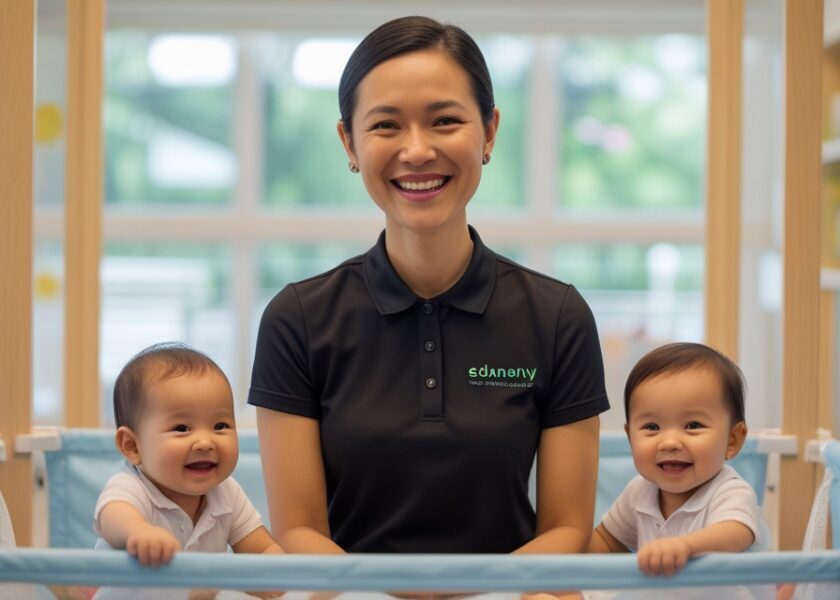
The Village That Rests: Singapore Families Redefining Childcare
The Guilt That Has No Name
There is a moment — quiet, unremarkable by most measures — when a Singapore parent realizes their own parents have slowed down. It does not announce itself. It arrives in the ordinary spaces.
A grandmother who once chased a toddler around the playground now watches from the bench, catching her breath. A grandfather who carried your child on his shoulders last year quietly suggests they sit this one out today. A phone call comes at seven in the evening and your mother sounds tired — not the tired of a long day, but the tired of years accumulating.
You feel it before you name it. And then you try not to think about it, because naming it means confronting a question you are not ready to ask: what happens to the care of your child when the people who have always been the default answer are themselves becoming the ones who need care?
And underneath that question is another one — the one you have been having with yourself, in the small hours, in the shower, in the car between meetings. It goes like this:
I want more for my child. I want a level of stimulation, of developmental intentionality, of safety that I am not sure our current arrangement can sustain. I want my child to be in a space where the ratios mean someone can actually see them — really see them — in the way they deserve. And I want my parents to be present in my child’s life, but not at a cost that depletes them. I want both. I want all of it. And I do not know how to hold that without feeling like I am failing everyone.
If you recognize that feeling, I want you to know something. You are not failing anyone. You are standing at the exact center of one of the most complex, most tender, most characteristically Singapore decisions a family can make.
The result is a peculiar kind of silence. Parents who have privately decided they want professional care for their child. Parents who then spend weeks, sometimes months, not telling their parents — not because they are dishonest, but because they do not know how to say something that feels, to their own ears, like a betrayal.
It deserves more than a quick conversation in the kitchen or a decision made out of guilt or a decision made out of fear. It deserves thought. It deserves honesty. It deserves the kind of clarity that comes not from having the right answer but from understanding the question deeply enough to find your own right path through it.
Singapore’s Cultural Landscape: Why This Feels Different Here
Singapore is not a culture that treats family care as negotiable. This is not a criticism — it is a description, and it matters because it shapes the emotional terrain parents are navigating.
For Chinese families, the filial obligation runs deep, not as a rulebook but as a lived architecture. The expectation that grandparents will step in is woven into assumptions about how families function, how children are raised, how adult children fulfill their obligations to those who raised them.
For Malay families, the extended family is not a support system — it is the system. Childcare is rarely a question of whether grandparents will help, but rather how the rhythms of three generations will interweave.
For Indian families, the grandparents-as-primary-carers model carries generational weight and cultural meaning that a quick pivot does not easily dissolve. There are stories here, rituals, expectations about who does what and when.
And for expatriate families, there is the additional layer of wanting to honor local customs while operating within a framework that does not always make that easy. You chose to raise your child in Singapore — but which Singapore? The one your colleagues navigate, or the one your helper’s family navigated, or the one your neighbour’s family has navigated for three generations?
These are not stereotypes. They are contexts. And every Singapore parent — regardless of background — is living inside at least one of them, often several, simultaneously.
What does that mean in practice? It means that when a Singapore parent begins to consider professional childcare, they are not simply making an educational decision. They are stepping into a conversation about loyalty, about obligation, about what it means to be a good child and a good parent at the same time.
What Grandparents Fear — and What They Bring
Here is what is rarely said, though every grandparent knows it. When a family begins the conversation about transitioning from full family care to a blended arrangement, grandparents are not simply pleased or disappointed. They are grieving. Quietly, privately, often without the language to express it.
A grandmother told me, in a conversation I think she had been waiting to have for months, that she loved her granddaughter more than she could say. But she also said something harder: that caring for her full time had become, over the past year, less like joy and more like obligation.
That she loved the girl but had lost herself somewhere in the routine of meals and naps and the endless repetition of the same picture book. That she was tired in a way that sleep did not fix.
And that when her daughter first raised the idea of professional childcare, her first reaction was relief — and then shame at the relief.
What Grandparents Actually Fear
- Replacement. Not being needed anymore. The quiet terror that someone else will do the job they have been doing, and do it well enough that their role becomes unnecessary.
- Obsolescence. That they will become peripheral to their grandchild’s daily life — present but no longer central.
- Judgment. That the decision reflects on them. That their children are choosing professional care because they were not good enough.
- Abandonment. Not just for the child, but for themselves. The fear of losing the daily rhythms that have given their post-retirement life structure and meaning.
- Grief without permission. The difficulty of mourning a role change when everyone around them seems to be celebrating a positive decision.
Understanding this is the first step toward navigating it with grace. But understanding what grandparents fear is only half the picture. The other half is understanding what they actually bring — and why that matters more than ever when the caregiving arrangement changes.
Think about what grandparents actually bring to a child’s life. Not what they do — the feeding, the fetching, the supervising of screen time — but what they are.
They are the link to a past that a child cannot access any other way. They carry stories. Dialects. Family recipes. The sound of a grandmother’s voice speaking in Cantonese, Teochew, Hokkien, or Tamil that the child will one day wish they had learned.
They are the keepers of continuity in a world that moves too quickly, and they give a child something no curriculum can: the knowledge that they come from somewhere, that they belong to a lineage, that they are not the first child in this family to be loved and tended and watched over.
A grandfather who survived the sixties, who built something from nothing, who carries wariness in his posture and resilience in his bones — that grandfather gives a child something no early childhood educator, however excellent, can replicate. He is a living bridge between a history the child cannot remember and a future the child is just beginning to imagine.
This matters. This is not sentimental. This is developmental. Children who have strong connections to their extended family have stronger sense of identity, stronger cultural grounding, and stronger emotional foundations than those who do not.
The Insight That Changes Everything
Now ask yourself: does professional childcare take that away? Or does it, when thoughtfully designed, create the conditions for it to flourish?
Here is the insight that changes everything. The grandparent role and the professional caregiver role are not in competition. They are not even on the same axis.
What grandparents offer — identity, belonging, emotional depth, cultural continuity — is fundamentally different from what premium professional care offers — developmental intentionality, structured learning, expert attention, consistent ratios that allow a child to be truly seen.
These are complementary gifts. And the families that navigate this transition most gracefully are the ones who stop asking which one is better and start asking how both can be better.
When a grandparent is no longer the primary caregiver five days a week, something remarkable can happen. Sunday lunches become sacred rather than routine. The afternoon with grandmother is not a daily obligation that neither of them can wait to end — it is a special occasion, full of intention.
She has energy because she has rest. She has attention because she is not depleted. She tells stories because she has had time during the week to remember them.
She is not the weary primary caregiver who resents being needed. She is the grandparent — who is, if we are honest, the role she was always meant for.
What Quality Childminding Looks Like — and Why EduNanny
If you are going to make this transition, it matters that what you are transitioning to is genuinely excellent. Not just adequate. Not just licensed. But the kind of care that you can trust with the same instinctive trust you have when you leave your child with your own mother — the trust that comes from knowing they are safe, seen, and developing in ways that matter.
Ratios matter. In infant care, the number of caregivers to children determines whether your child is one face in a crowd or one of three in the full attention of someone trained and intentional. This is the difference between supervision and attunement.
Training matters. Professional caregivers understand child development in ways that are different from — not better or worse than — what grandparents offer. They know what children need at each stage. They can respond to developmental milestones, identify when something needs attention, and create environments that actively nurture learning.
Intentionality matters. Premium care is not just keeping children safe until parents return. It is actively creating the conditions for development — through play, through interaction, through the kind of responsive caregiving that builds secure attachment.
Communication matters. When grandparents can see what their grandchild is doing during the day — not through surveillance, but through thoughtful updates — it demystifies professional care and allows them to remain connected to the child’s experience.
EduNanny was built for exactly this moment. Not to replace the family — that framing misses the point entirely — but to stand alongside it, with a quality of care that parents can trust and a philosophy that welcomes the whole family into the process.
Operating under the ECDA Childminding Pilot, EduNanny is part of Singapore’s deliberate effort to expand what family care can look like — offering home-based pathways that keep professional care within familiar surroundings, and centre-based options where families prefer them. The pilot structure means these services are accessible, with fee frameworks designed to make quality care a realistic choice rather than a luxury.
The ratios matter here. Up to one-to-three infant care ratios mean that each child is not one face in a crowd — they are one of three, in the full attention of a trained, intentional caregiver. For a parent who has been worried about whether their child is getting enough stimulation, enough attunement, enough genuine presence, this is not a small thing. It is the difference between care and care with depth.
For the grandparents who are worried — and they are worried, even when they do not say it — EduNanny’s approach communicates something important. The child is not being handed to strangers. The child is being placed in a professional environment designed to nurture everything the family has already begun.
The caregiver is not replacing the grandmother. She is continuing the work that the grandmother started — with expertise, with structure, with the developmental intentionality that reflects what modern early childhood science understands about how children learn in these critical early years.
EduNanny communicates this through transparency, through regular updates, through the kind of openness that allows a grandparent to feel included rather than excluded. Not surveillance — connection. There is a difference, and it matters. One is distrust made visible. The other is a bridge built between two worlds that might otherwise drift apart.
What EduNanny is really offering, in practical terms, is this: a structure that allows the family to function rather than fracture.
- Monday to Friday care blocks that free the grandparent to rest, to be a grandparent, to be present on the weekend without the depletion that has been quietly eroding the relationship
- CDA and Baby Bonus usability that makes the financial conversation less fraught
- Singapore-wide relevance because this is not a problem confined to one estate — it is a national reality, and it deserves a national response
Having the Hard Conversation
The families that navigate this transition best are the ones who bring grandparents into the conversation early, who explain the reasoning with respect and care, and who actively work to redefine — not eliminate — the grandparent role.
Professional care does not break the grandparent bond. What breaks it is silence, and judgment, and the assumption that the decision has already been made without them. What preserves and strengthens it is honesty, and invitation, and a deliberate restructuring of the role so that it remains meaningful — not diminished, but redefined.
How to Have This Conversation
- Start with appreciation. Before anything else, name what your parents have given. Not generically — specifically. “Ma, you have been so generous with your time. You have given us peace of mind for two years. We see that.”
- Name the change you have observed in them. “I have noticed you seem more tired lately. I worry that we have been relying on you too much.”
- Share your own anxiety — honestly. “I want more for our child than I feel we are currently giving them. But I also do not want to lose you in this process.”
- Present the solution as an invitation. “I have found something that I think can help. I want to show you. And I want you to be part of deciding what this looks like for our family.”
- Redefine the role together. “What I actually want is for you to be a grandparent — not the primary caregiver. I want you to have your weekends. I want you to come with us to the park when you want to, not because it is your job. And I want you to be the one who tells our child stories about Singapore in the old days, not the one who is too tired to remember them.”
If Your Parents Resist
Sometimes the resistance is not about the decision itself but about feeling excluded from it. If your parents are resisting, ask yourself: have they been involved in the process? Have they seen the space? Have they met the caregivers? Have they been consulted about what they want their role to look like going forward?
If the answer is no, start there. Bring them in. Show them that this is not about replacing them — it is about creating a sustainable arrangement where everyone can thrive.
A Word to Grandparents — and the Decision Ahead
I want to pause here and speak directly to the grandparent who might, in some version, be reading this.
You have given so much. Your hands raised children, then grandchildren. You have carried them, comforted them, taught them the words for things in languages that are slowly disappearing from daily use. You have given your children the gift of time — time to work, time to build, time to become who they needed to become — and you did it without fanfare, without expectation of recognition, because that is what you do. That is who you are.
But I also want you to hear this: your value to your grandchild was never measured in hours. It was measured in presence, in the quality of your attention, in the irreplaceable fact of your existence in their world.
And the best thing that can happen for that presence is for it not to be exhausted. The best thing for that attention is for it to come when you are rested, when you are genuinely delighted to be there, when you are not running on the fumes of a care arrangement that was never designed to sustain itself indefinitely across generations.
You are not being replaced. You are being freed to be what you have always been — irreplaceable. And the families who understand this are the ones who will sit across from you, have the hard conversation with honesty and love, and invite you into a new shape of involvement rather than pushing you out of one.
So if you are standing in that quiet, unremarkable moment — the one where you realize your parents are ageing and your child is growing and the old arrangement is fraying at the edges — I want you to know that what you are feeling is not weakness.
It is wisdom. The wisdom to see that the situation has changed. The courage to want something better for everyone, not just the child. And the love — the deep, complicated, thoroughly Singaporean love — that wants to hold your parents close even as you make a decision that feels, in the moment, like letting go.
You are not letting go. You are making room.
You are making room for a role that your parents were always meant to play — not the weary primary caregiver, but the grandparent. The one who arrives on a Saturday morning with mangoes from the market and stories from the old country and a rested, generous attention that is worth more than any number of weekdays of dutiful, depleted care.
And you are making room for yourself — for the parent who can go to work with genuine peace, who can trust the people caring for their child not because they are family but because they are excellent, because they are trained, because they are part of a system that Singapore is building, right now, to give its children the start they deserve.
This is what the best Singapore families are doing. They are not choosing between the village and the professional. They are building a village where the village gets to rest.
Where the grandmother who has given decades of care is finally allowed to receive some. Where the child benefits from the best of both — the warmth and history and unshakeable love of family on one side, and the intentional, expert, developmentally rich environment of professional care on the other.
And the child — let us not forget the child at the centre of all this complexity — thrives in a family that functions rather than fractures. A family where the adults have been honest with each other. Where the grandmother is not secretly exhausted. Where the parents are not secretly guilty. Where Sunday lunch is not a minefield but a celebration.
Where the child grows up knowing, in their bones, that they are loved by many — and that the many are not competing for the same depleted resources but are each giving what they do best, from a place of fullness rather than exhaustion.
That is what EduNanny is. Not a replacement. Not a compromise. Not a concession. It is an act of family stewardship — the recognition that raising a child well in modern Singapore is not a solo performance by any one caregiver. It is a symphony. And a symphony needs different instruments playing their distinct parts, each with clarity and purpose, each contributing what only they can give.
Where to Start
- Have the conversation. Not to announce a decision, but to begin a dialogue. Ask your parents what they want. Listen to what they say — and to what they do not say.
- Visit options. If EduNanny feels like the right fit, start with a conversation. See the spaces. Meet the caregivers. Bring your parents if they are willing.
- Reframe the narrative. This is not about replacing anyone. It is about creating a sustainable arrangement where everyone can thrive — especially your child.
- Trust the process. The transition will have friction. That is normal. What matters is that everyone in the family feels heard, valued, and included in shaping what comes next.
Ready to explore what EduNanny can offer your family? Visit our website or speak with our team to learn more about our infant care and childminding options across Singapore. We welcome the whole family into the conversation — because this is, after all, a family decision.
#SingaporeChildcare #EduNannySG #InfantCareSingapore #GrandparentBond #MultiGenerationalFamily