Building the Modern Singapore Childcare Village Together
The Moment That Starts Every Conversation
There is a moment that plays out in homes across Singapore every single morning. A young mother in a Jurong flat is getting ready for work. Her mother-in-law—ah ma to the child—has already arrived, carrying昨晚煲的汤 and a stern expression. The baby is crying. The mother is trying to explain that she has arranged for a childminder to come today, someone trained, with proper ratios, someone her daughter will be safe with.
The grandmother hears something different: you don’t trust me.
That flicker in her eyes. That slight stiffening of the shoulders. That quiet hurt that everyone in the room can feel.
This moment—in HDB living rooms and landed properties across this island—is where we need to begin. Not with childcare philosophies. Not with developmental science. With the truth that many Singapore parents carry every day: choosing how to care for your child is never just a logistical decision. It is an emotional negotiation. A cultural act. A conversation about love, obligation, and what we owe to the people who raised us and the child we are raising now.
Two Kinds of Wisdom
Let us be honest about what we are really discussing when we talk about grandparents and childcare in Singapore. We are discussing something profound: the collision between two kinds of wisdom.
There is the wisdom of experience—the knowledge that comes from having raised children, from knowing the weight of a newborn, from understanding that this fever will pass, that this crying means hunger not pain, that children need roughness as much as tenderness. This wisdom is real. It is earned. It cannot be taught from a textbook or a training module.
And then there is another kind of wisdom—the wisdom of understanding how children develop in ways that previous generations could not have known. The science of early brain architecture. The research showing that the first thousand days shape not just who a child becomes but how their brain is literally built. The evidence that responsive, attuned caregiving in infancy creates neural pathways that support emotional regulation, language acquisition, and cognitive flexibility for a lifetime.
This wisdom is also real. It is also earned. It comes from decades of research that Singapore’s own early childhood frameworks have been built upon.
The tension that many Singapore parents feel is not about which wisdom is greater. It is about how to honor both at once. How to say to the grandmother who raised three healthy children: what you did was beautiful and right for your time, and what I am learning now is also beautiful and right for this time, and I need both of these truths to coexist in my child’s life.
This is the real conversation. Not childcare logistics. Not who is better. But how do we build a family that holds multiple truths at once?
What Children Actually Need
Here is what decades of research into child development have shown us, and what quality childminding programmes are built around: children do not have a fixed amount of love to receive. They are not pies that can only be cut into so many slices.
A child with two devoted parents, four attentive grandparents, a professional childminder, and loving extended family does not love any of these adults less because there are more of them. What they receive is not diminished by being shared. What they develop is not weakened by being supported from multiple angles.
Children who have multiple secure attachments—to different adults who love them in different ways—develop what psychologists call a “broader attachment base”. They learn that adults can be trusted. They learn that the world contains people who will respond when they call. They learn that love is not a scarce resource but a renewable one.
What professional care offers is not love in competition with grandparent love. It offers something complementary: structured developmental support, infant-specialized training, and attuned responsiveness—the specific kind of caregiving that research shows shapes early brain development in particular ways.
This is not to say that grandparents cannot provide developmental support. Many do, beautifully. But the reality is that most grandparents—regardless of how much they love their grandchildren—were not trained in infant development. They were not taught about the importance of language narration, of responsive feeding, of creating environments that stimulate without overwhelming. They were raising children in a different Singapore, with different knowledge and different expectations.
The Additive Conversation
The question then becomes: how do we help families have this conversation?
In Singapore, this conversation carries particular weight. In Chinese families, there is often an expectation that grandparents will be actively involved in childcare—that this is both their right and their role. In Malay families, the extended family has traditionally been the primary unit of childcare support, with expectations of shared responsibility across generations. In Indian families, grandparent involvement carries spiritual and ritual significance; grandparents are not just caregivers but conduits of tradition.
These are not obstacles to be navigated around. They are realities to be respected.
What works is something we call the “additive conversation”. The language matters enormously.
- It is not: we need someone else to care for your grandchild because you are not enough.
- It is: we want our child to have more—of learning, of stimulation, of developmental support—and we want you to be part of that village, not less part of it.
- It is not: professional care is better than what you can provide.
- It is: there are things that professional care can add to what you already beautifully provide, and we want both.
There is also something important to acknowledge: grandparent childcare, especially as primary care, can be demanding. Many grandparents in Singapore are exhausted, dealing with their own health challenges, feeling they cannot say no because family expectation demands they say yes. The conversation about professional care can also be an act of compassion toward grandparents. One parent told us: “We want you to enjoy your grandchild, not to be exhausted by them.”
Mrs. Chen’s Story: From Fear to Expansion
Mrs. Chen is sixty-three years old. Her daughter, Li Ling, works in finance. When Li Ling returned to work after her maternity leave, her husband suggested—that they had discussed it—that perhaps the grandmother could look after the baby on some days, and a professional childminder on others.
The suggestion, as Mrs. Chen later described it, felt like a door closing.
“I raised two children,” she told a family mediator she eventually agreed to see. “I know how to hold a baby. I know how to feed them. I know more than anyone coming into my daughter’s house can know.”
Her daughter heard something different in her mother’s words: I am scared of being left out. I am scared that the bond I have with my grandchild will belong to someone else. I am scared that I am no longer needed.
These fears are not irrational. They are the fears of a generation of Singaporeans who built this country through sacrifice and hard work, who raised families in circumstances of scarcity, who poured everything into their children—and who now wonder if that sacrifice is being set aside as though it were insufficient.
We cannot argue these fears away. We cannot explain them into silence. What we can do is offer a different framework. One where professional care is not a replacement for grandparent love but an expansion of the village that surrounds a child.
After the family mediation, after several difficult conversations, after her daughter learned to say “I need your wisdom, I need your help, and I also need this” in a way her mother could really hear—something shifted.
The childminder began coming to the home on Tuesday and Thursday mornings. Mrs. Chen would arrive at eight to settle the baby before the childminder came. She would stay for an hour or so, having breakfast with her daughter and granddaughter, being grandmother. And then she would leave, not because she was being pushed out but because she had already given what she was best placed to give: presence, love, continuity, the sense of being held by family.
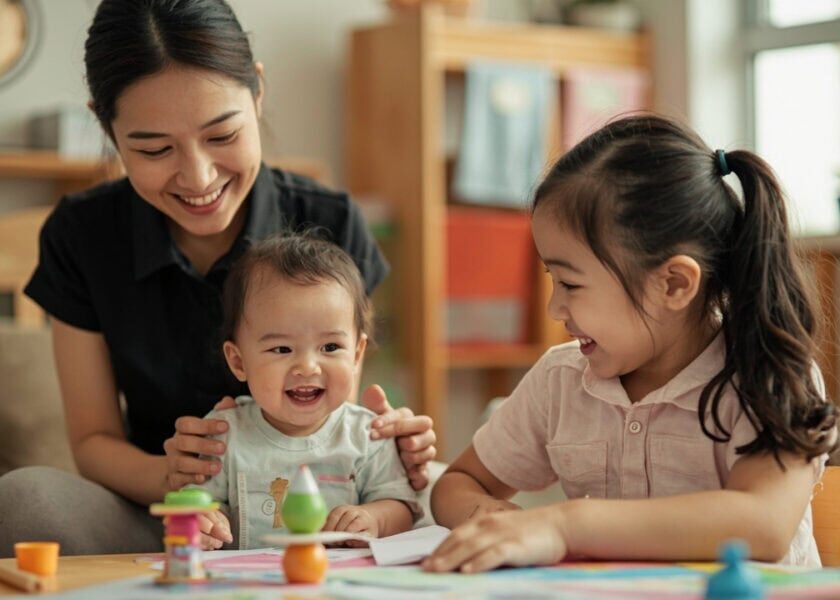
The childminder brought something different. Language activities. Motor development exercises. The structured play that research shows matters so much in these early years.
And Mrs. Chen, watching her granddaughter develop in new ways, began to see that this was not a threat to her role. It was an expansion of the village.
“She learns things from the childminder,” Mrs. Chen told us recently, and there was no bitterness in her voice, only curiosity. “She says words now. More than my other grandchildren did at this age. I don’t know how the young girl does it. But my granddaughter—she is doing well.”
That word well carries everything. It is the word that parents in Singapore are searching for when they make these decisions. Not perfection, not guarantee, but well. Is my child well? Are they developing? Are they safe? Are they loved? And crucially: are all the adults in their life feeling honored and purposeful?
What Quality Childminding Looks Like
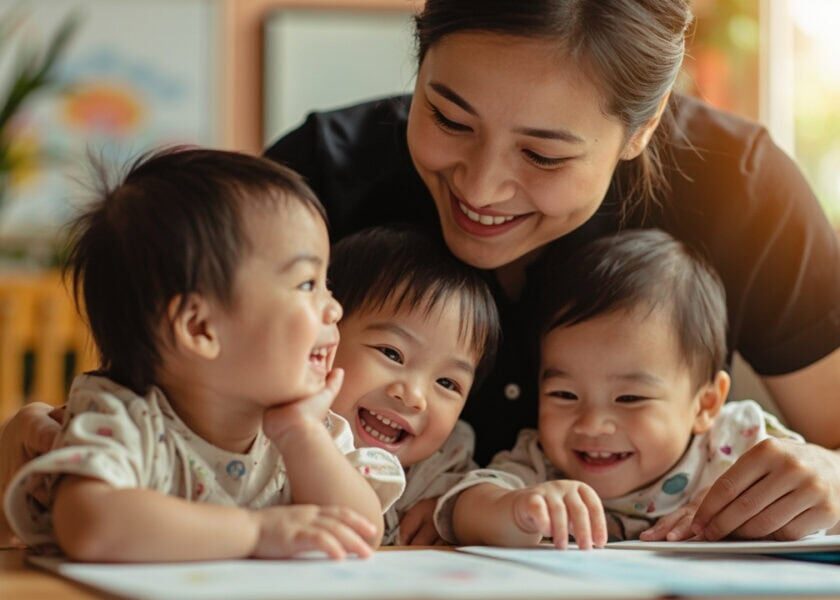
When we designed the EduNanny programme, we did so with this family complexity in mind. We are not a centre that separates children from families. We are a programme that understands children exist within webs of relationship—particularly here in Singapore, where multigenerational living and close family involvement are not aberrations but the norm.
Our childminding service operates under the ECDA Childminding Pilot, which means we meet regulatory standards for infant care that parents can trust. Our caregiver ratios are designed for safety and attunement: up to three infants per caregiver, which is not a bureaucratic specification but a recognition that infants need individual responsiveness. You cannot be truly attuned to a child when you are caring for six.
Our caregivers are trained. They understand infant development, yes, but they also understand something equally important: how to be part of a family system. How to communicate with parents. How to respect grandparent involvement. How to position themselves not as replacements but as partners.
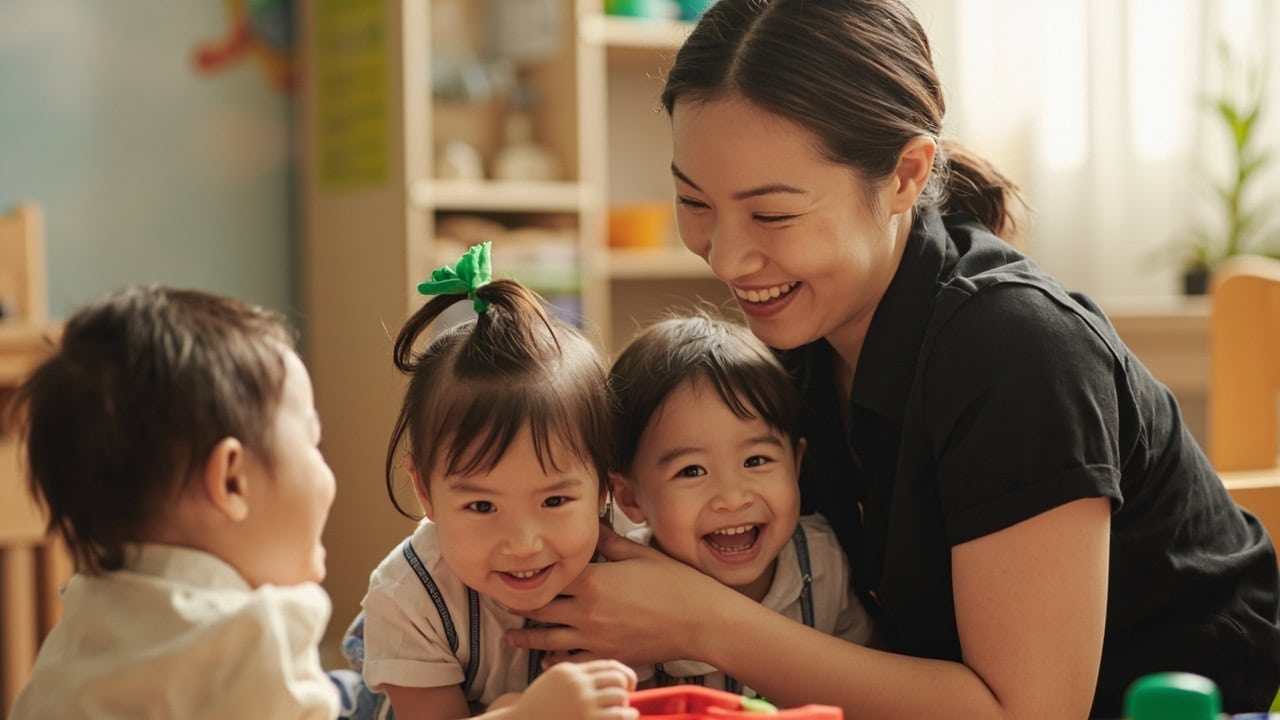
We offer home-based pathways, because we know that for many Singapore families, the home is the natural environment for infant care—where the child is comfortable, where the family can be involved, where the transition from parent to caregiver can happen with less disruption. We also offer connections to community and centre-based pathways where families need them, because we understand that different families have different needs.
And we have built in the kind of transparency that modern parents need: communication systems that keep families informed, and where deployed, CCTV measures that provide reassurance without being intrusive. We know that trust is not assumed. It is built, slowly, through consistent action and honest communication.
Making Professional Care Accessible
For families concerned about cost—and in Singapore, with the pressures of mortgage and inflation and the cost of raising children, this concern is real—our pilot fee structures are designed to be affordable. CDA and Baby Bonus funds can be used, which means the financial architecture that Singapore has built for families actually supports this kind of care.
Addressing Common Parent Concerns
Will professional care damage my relationship with my child?
No. Research consistently shows that what matters most is the quality of the parent-child relationship, not the quantity of time spent together. What children need from parents is attunement, responsiveness, and presence—qualities that a few focused hours of engaged interaction can provide more effectively than exhausted, distracted hours of proximity.
Will my parents feel rejected?
This depends entirely on how the conversation is approached. The additive framework—inviting grandparents into an expanded role rather than asking them to step aside—makes rejection unlikely. Many grandparents, given honest acknowledgment of their value and a clear role in the child’s life, find that professional support actually allows them to enjoy grandparenting more.
Is my child too young for multiple caregivers?
Infants are remarkably adaptable when transitions are handled sensitively. What they struggle with is inconsistent, unpredictable care. What supports healthy development is secure attachments with multiple attuned adults. A professional childminder who is trained, consistent, and integrated into the family system provides exactly this kind of reliable care.
How do I choose between home-based care and centre-based care?
This depends on your family’s needs and your child’s temperament. Home-based care offers familiarity, one-on-one attention, and seamless family involvement. Centre-based care offers structured environments, peer interaction, and curriculum-based learning. Many families find that a combination works best, or that their needs shift as their child grows.
What if my budget doesn’t stretch to professional care?
CDA and Baby Bonus funds can be used for approved childminding services under the ECDA pilot. Explore what your family qualifies for, and consider whether supplementary professional care—even part-time—might reduce the load on grandparents who may be feeling the strain of primary caregiving.
Moving Forward Together
What EduNanny offers, ultimately, is not just childcare. It is a vision of what modern Singapore families can be. Not the nuclear family in isolation, insulated from grandparents and extended family. Not the traditional family where grandparent involvement is obligatory and unexamined. But something new: a childcare village where each person contributes what they do best, where generational wisdom and professional expertise coexist, where children benefit from more love and more learning rather than less of either.
This vision requires something difficult. It requires parents to have conversations they would rather avoid. It requires grandparents to accept that they cannot be everything, and that this is not a failure but a gift to the child. It requires everyone in the family to accept that the childcare landscape has changed, and that adaptation is not abandonment.
We know this is hard. We know that every family that walks through our doors carries some version of this complexity. We do not pretend it is simple.
What we offer is a partner in navigating it. A framework that respects the emotional reality of Singapore families. Caregivers who are culturally competent as well as developmentally skilled. Transparent communication. Regulatory standards that parents can trust.
The children are watching. They are watching how their parents negotiate with grandparents. They are watching how their grandparents adapt to new realities. They are learning, from the earliest age, what family means and how love is expressed.
What do we want them to learn?
We want them to learn that love is not diminished by being shared. That families can grow and change without breaking. That asking for help is not weakness. That the village is not a fixed structure but a living thing, something that can be rebuilt and expanded with each generation.
If you are navigating this complexity in your own family—if you are trying to honor what your parents want while choosing what your child actually needs—we understand. We have walked this road with many Singapore families, and we know there are no perfect solutions, only the ones that work for yours.
We invite you to start a conversation with us. Not to take over, but to support. Not to replace your village, but to join it.
EduNanny is a trusted, development-oriented childminding service for Singapore families. Learn more about our approach or read our story.