Your Child’s World Should Not Split When You Leave
The Fear Every Singapore Parent Carries
There is a thought many Singapore parents carry in silence. It surfaces in the quiet moments before a first morning drop-off, in the hesitation before signing enrollment papers, in the way a mother lingers at the gate and wonders if she is making the right choice.
It is not a thought about safety. The centres are clean. The caregivers are vetted. The ratios are right. That part, parents have already checked.
The thought is harder to name. It is something like this: when my child is in someone else’s care, will the world my child is learning to navigate still be mine? Will the values I am trying to shape still be the values that guide her? Will the way I respond when she reaches for something she cannot have be the way someone else responds?
Will the rhythms we have built together at home—the morning gentleness, the bedtime wind-down, the way we speak to her like she matters and her questions matter—continue when I am not in the room?
Or will there be two worlds now? Two sets of expectations, two patterns of response, two languages of love that my child must somehow hold together.
This is the fear that no one quite says out loud. Because saying it feels like distrusting the very people you are entrusting with your child’s most vulnerable hours. And so parents swallow it, rationalise it, hope it is not as real as it feels.
But it is real. And it deserves to be met honestly—because the solution to an unspoken fear is not to ignore it. It is to address it directly.
The Quiet Truth About “Split” Worlds in Childcare
When your child enters any childcare arrangement, they step into a new environment with its own rhythms, expectations, and ways of responding to behaviour. This is simply the nature of care outside the home.
Children are extraordinarily perceptive. They learn quickly that certain behaviours earn approval in one setting and different behaviours earn approval in another. A child may discover that school values sitting still and raising hands, while home welcomes boisterous energy and spontaneous questions. They adapt. Children are remarkably resilient, and adaptation is a survival skill.
But here is what many parents instinctively sense: adaptation is not the same as flourishing. A child can learn to navigate two different worlds successfully while still experiencing a quiet, persistent drain on their sense of security and identity. When a child’s energy goes toward managing transitions and reading different social cues, less energy remains for the deep, confident growth that comes from a unified developmental experience.
Parents do not choose childcare because they want to replace their influence. They choose it because modern Singapore family life often requires support. The question is not whether childcare is necessary—for most families, it is not a matter of if but how.
The real question is whether the childcare you choose will add to your child’s world or divide it.
When childcare operates as a standalone system with its own philosophy, its own rhythms, its own language, the split is inevitable. But it does not have to be that way.
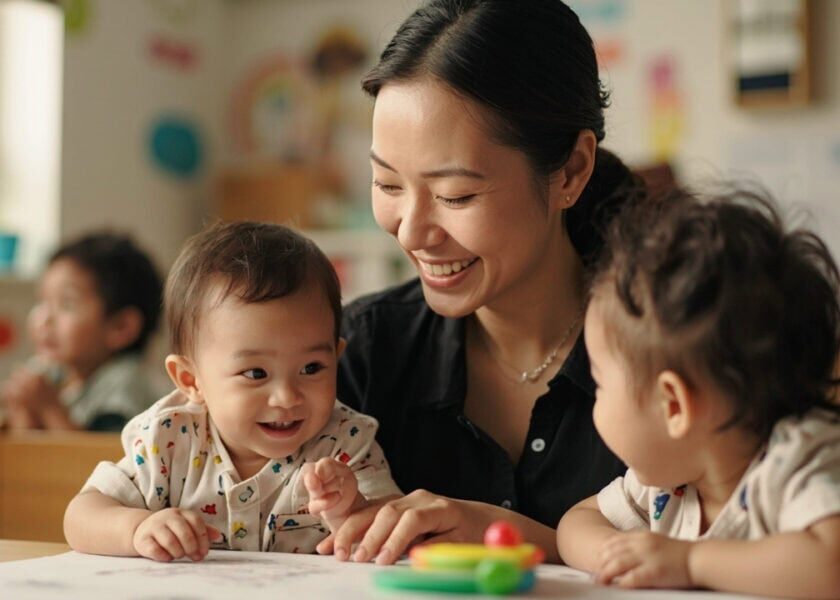
When childcare is designed with intention—when the caregiver is aligned with the family’s values before a single hour of care begins—the child does not enter a second world. The child remains in the same world, just with more hands to hold them.
This is what aligned development means. Not the same building. Not the same logo on the door. But the same foundation. The same principles running through the hours at home and the hours apart. The same responsiveness, the same respect, the same understanding of who this particular child is and what this particular family is building.
How Alignment Actually Works in Practice
Alignment is not a vague promise. It is a deliberate process that begins before the first drop-off and continues through every day of care.
When a family enters an aligned childminding arrangement, they are not simply handed a caregiver. They enter into a partnership designed to understand them. These questions shape the matching process:
- How does this child like to be comforted?
- What words does the family use when they encourage and when they set limits?
- What is the pace of the morning routine, the temperament of bedtime?
- What rhythm makes this family feel like themselves?
These are not bureaucratic questions. They are the questions that determine whether the hours apart will feel like continuity or contradiction.
The structural conditions that make true alignment possible matter here. Smaller ratios—one caregiver to three infants at most—mean the caregiver can learn one family’s language instead of trying to speak a generic one. They can observe not just that a child is upset but how this child specifically expresses distress and what this family specifically does in response. They can mirror. They can extend. They can be, in the truest sense, a continuation.
When alignment exists, something remarkable happens. The child’s day does not fragment into chapters that contradict each other. The morning continues into the afternoon. The afternoon carries the same emotional signature as the evening. There is no moment when the child must pause and recalibrate, no mental adjustment required to shift from one set of expectations to another.
Consider what this means in practical terms:
- The caregiver knows that in your family, when your toddler is frustrated, you kneel down to eye level and name the feeling before offering the solution. And they do the same.
- Feeding schedules reflect what you have been building at home, not what is most convenient for a group routine.
- Mealtimes reinforce the independence you are cultivating, where your child is allowed to try, to mess, to learn, because you have communicated that this is how your family approaches growth.
- Observation notes come back to you in language you recognise, that describe your child’s progress in terms you would use yourself, because the caregiver has been listening to how you speak about your child and reflecting it back with professional clarity.
Addressing the Concerns Singapore Parents Actually Have
“What if the caregiver doesn’t share my parenting philosophy?”
Alignment is not about identical philosophies on every detail. Your child’s caregiver does not need to have read the same parenting books you have. What matters is the underlying orientation toward your child—the way care is given must feel like it comes from the same place even when it comes from different hands.
“Can this kind of care actually be affordable?”
Premium aligned care should not be reserved for families with unlimited resources. Structured childminding arrangements within recognised frameworks can make quality alignment accessible. This includes practical support like pilot fee structures, usability of CDA funds and Baby Bonus, and care arrangements that offer consistency without rigidity.
“What if something goes wrong?”
When a caregiver is genuinely aligned with your family’s values, communication flows naturally. You are not navigating a foreign system with unclear escalation paths. You are in a partnership where concerns are addressed quickly because everyone is reading from the same page.
How to Evaluate Whether a Childcare Arrangement Offers True Alignment
Before committing to any childcare arrangement, ask yourself these questions:
- How does the arrangement learn your family’s specific rhythms? Look for evidence of a genuine matching and orientation process, not just a quick questionnaire.
- Will your child be one of many, or will your child be known? Smaller ratios and intentional matching create the conditions for genuine alignment. A caregiver managing ten children cannot mirror your family’s specific approach.
- Does the feedback language feel familiar? When you read observation notes or reports, do they use language you would naturally use? Or does it feel foreign, clinical, misaligned with how you think about your child?
- Can you see evidence of values alignment, not just safety compliance? Safety is baseline. Ask how the arrangement handles common situations—transitions, frustration, independence—and whether the approach mirrors your own.
- Is there a genuine partnership structure? Alignment is not something that happens once at enrolment. It requires ongoing communication and adjustment.
Your Child’s World, Whole and Unbroken
Children do not thrive in fragments. They thrive in environments where the world makes sense, where the adults around them are reading from the same page, where the messages they receive are consistent enough to build on rather than contradictory enough to decode.
When that alignment exists, the child’s energy—finite and precious—stays directed outward toward exploration and growth rather than inward toward navigation and translation.
This is the gift of continuity. Not just peace of mind for the parent, though there is that. But actual developmental advantage for the child. When the world makes sense, when the signals are clear, when the people who care for you are reading from the same page, a child grows with a kind of confidence that divided environments simply cannot produce.
EduNanny is not here to replace the family. That is perhaps the most important thing to say. The family remains the source, the foundation, the primary context for everything that matters in your child’s development.
EduNanny is here to extend that context, to carry it forward during the hours you are apart, to be the trusted hands that do not introduce a second story but continue the first.
When you drop your child at the gate in the morning, you are not handing them over to a separate world. You are placing them in a space that has been designed to feel, as much as anything outside the home can feel, like yours. The rhythms they know are present. The values they are learning are present. The language of love your family speaks is present, translated through a caregiver who has been thoughtfully matched, thoroughly oriented, genuinely aligned with what you are building.
And when you pick them up at the end of the day, you will not spend the evening untangling two worlds. You will spend it in the same world you have always been in, with a child whose energy has gone into growing rather than navigating, whose confidence has deepened rather than fragmented, whose story has continued uninterrupted even though you were not in the room.
If you have felt that quiet splinter of worry and not known what to do with it: you are not overthinking this. You are not being difficult. You are noticing something important, something that actually matters in your child’s development.
The fear you feel is pointing you toward a real question, and the real question has a real answer.
Aligned care offers continuity—not just supervision. It offers the assurance that your child’s growth does not pause when you are apart, that the hours you spend apart are still hours in the same story, still days in the same journey, still steps in the same direction.
You are not choosing between your family and your future. You are choosing a partner who will stand beside your family’s vision and make it grow.
If you are ready to explore what aligned development could look like for your family, we invite you to learn more about EduNanny’s approach and begin a conversation about your child’s care journey.
EduNanny is a Singapore-based childminding and childcare service built on developmental continuity, family alignment, and thoughtful, professional care. To learn more about our approach, visit our About Us page or explore our ECDA-registered childminding pilot programme. We welcome the opportunity to connect with your family.