How Singapore Couples Can Choose Childcare Without Losing Themselves
Singapore Asks So Much of Its Parents
We need to name this clearly, because it is the soil this whole conversation grows from.
We live in a city where both parents working is not a lifestyle preference — it is an economic reality for the vast majority of families. The cost of raising a child, the expectations of career continuity, the housing logistics, the distances between school and home and office — none of this was designed with gentleness in mind.
And on top of all of that, there is the weight of a culture that takes education seriously, sometimes so seriously that it can feel like the very first years of a child’s life are already a competition being staged in the nursery.
So when a couple sits down to think about childcare, they are not actually sitting down to think only about childcare. They are sitting down with their fears about money, their guilt about time, their memories of their own childhoods, their anxieties about whether they are good enough parents, and the accumulated pressure of a society that seems to have very strong opinions about what children need and when.
No wonder it is hard to talk. No wonder the conversation that should be the foundation of everything else — how will we care for our child together — becomes the conversation that gets scheduled for later. After the tour. After the decision. After the thing is done.
But here is what happens when you defer that conversation: one parent fills the silence. One parent quietly takes ownership of the search, the research, the worrying. And that is where the misalignment quietly begins — not with a fight, but with a silent redistribution of responsibility that neither of them chose.
The Three Patterns of Misalignment
Let me describe what these patterns actually look like, because recognising them is the first step toward navigating them as partners rather than opponents.
Different Attachment Languages
One parent experiences childcare primarily through the lens of warmth and bonding. They ask: Will my child feel safe? Will they be held enough? Will this person love my baby?
The other parent experiences it through the lens of development and structure. They ask: Will they be stimulated? Will they learn? Will this environment stretch my child’s potential?
Neither of these is wrong. They are both genuine, deeply held convictions about what children need. But when they sit in the same room without being named, they create friction that feels personal.
It sounds like: You care more about their curriculum than whether they are happy.
Or: You keep dismissing every option because none of them are perfect, and our child needs stability, not perfection.
These are not attacks. They are two people who love the same child translating their love into different priorities and not recognising the love underneath the different priorities.
Uneven Doubt
One parent feels confident. The other parent is quietly uncertain — not about loving their child, never about that, but about whether the choice they are making is right.
The confident parent interprets the uncertain parent’s hesitation as weakness, or indecision, or a lack of commitment. The uncertain parent reads the confident parent’s certainty as dismissiveness, or as a fear of admitting doubt.
Neither reading is fair, but both feel true in the moment.
And so the uncertain parent stops talking. They nod along. They defer. And then, months later, when the childcare arrangement is in place and something is not working, the doubt resurfaces — but now it carries resentment, because it has been waiting.
Guilt Asymmetry
Here is something that is almost never said out loud: guilt does not distribute itself equally between two parents.
In most Singapore households, one parent carries more of it — and it is not always the same parent.
Sometimes it is the mother who feels the weight of leaving her infant, who questions whether her career ambitions are selfish, who reads one article too many about attachment theory and spirals quietly at two in the morning.
Sometimes it is the father who feels invisible in the conversation, who has opinions about childcare that he has learned not to voice because they get reframed as undermining, who quietly wonders if his role is to provide and protect rather than to think and feel alongside.
And sometimes the guilt sits between them — I feel guilty that you feel guilty — and it becomes a third presence in the marriage, one that no one invited and no one knows how to address.
These are not marriage problems. These are marriage weather. Every couple has them. The question is not whether these tensions exist — it is whether you have the language and the framework to meet them as partners rather than as opponents.
How to Choose Childcare Together — And Why the Conversation Matters More Than the Choice
Here is the heart of what we have learned through years of walking alongside families in Singapore: childcare is not a logistics decision that you make and move on from. It is a relationship decision that reveals and shapes everything else in your family.
The way you choose childcare tells you something about how you make decisions together. The way you communicate about it — or fail to — tells you something about the emotional safety in your relationship. And the outcome of that choice, for better or worse, will land in your child’s life and in yours for years.
That is why the conversation matters more than the choice itself. Not because the choice is unimportant — it is profoundly important — but because the quality of the conversation is what determines whether you make the choice as allies or as strangers performing the motions of partnership.
And allies make better decisions. Not perfect ones. Allies still struggle, still doubt, still worry. But they do it together, and that changes everything.
The First Move: Name What You Are Actually Afraid Of
Not the stated fear — I am worried about the teacher-to-infant ratio — but the felt fear underneath it.
- I am afraid that by choosing care outside the home, I am telling my child that work matters more than they do.
- I am afraid that by not choosing the most academically strong option, I am setting them back in a city that will not slow down for them.
- I am afraid that I will look back and wish I had been there more.
These fears are not irrational. They are the product of loving someone completely and living in a world that does not make it easy.
When two parents can name their fears to each other — not to be fixed, not to be talked out of, but simply to be witnessed — something shifts. The fear stops being a secret. And a fear that has been spoken loses its power to drive decisions from the shadows.
The Second Move: Name Your Values Out Loud
Not the abstract ones — every parent wants their child to be safe, happy, and loved. The specific ones. The ones that might actually pull you in different directions.
One parent might say: What matters most to me is that my child’s days have a gentle rhythm — predictable, warm, unhurried.
The other might say: What matters most to me is that my child is in an environment that is actively curious about who they are becoming — that notices them, that responds to them, that tracks their development.
These are both beautiful values. They are not in conflict — but they will point toward different kinds of care. And that is not a problem. That is information.
The conflict only becomes destructive when it stays unspoken, when each parent assumes the other must already know and share their values, and then feels betrayed when the choice does not reflect them.
The Third Move: Let Go of the Hierarchy
This is the hardest move, and it requires honesty about why.
Childcare is not a domain where one parent should be the expert and the other the supporter. Childcare is a shared undertaking. It lives in the space between you.
If one parent is managing it alone — the research, the visits, the worrying, the logistics — that is not delegation. That is one partner quietly opting out of the most important relational work that childcare demands, which is not the care itself but the conversation about it.
Common Concerns Couples Bring to This Conversation
What if we simply cannot agree? Agreement is not the goal. Understanding is. Two parents can choose different priorities and still arrive at a decision together if they have genuinely heard what the other is carrying. The conversation itself is the alignment. If you are having the conversation with openness and curiosity rather than defensiveness, you are already aligned in the way that matters.
What if one of us travels frequently for work? This changes the dynamic. The parent who is home more often may feel they are carrying more of the decision-making weight. This is exactly where explicit conversations about shared ownership become essential — not just for childcare logistics, but for the emotional landscape of the choice.
What if our parents have strong opinions? Multigenerational input can be valuable, but it can also create noise. The key is to return to your own values as a couple. You are the ones raising this child. The opinions that matter most in your household are the ones coming from the two people who live there.
What Quality Childminding Actually Looks Like
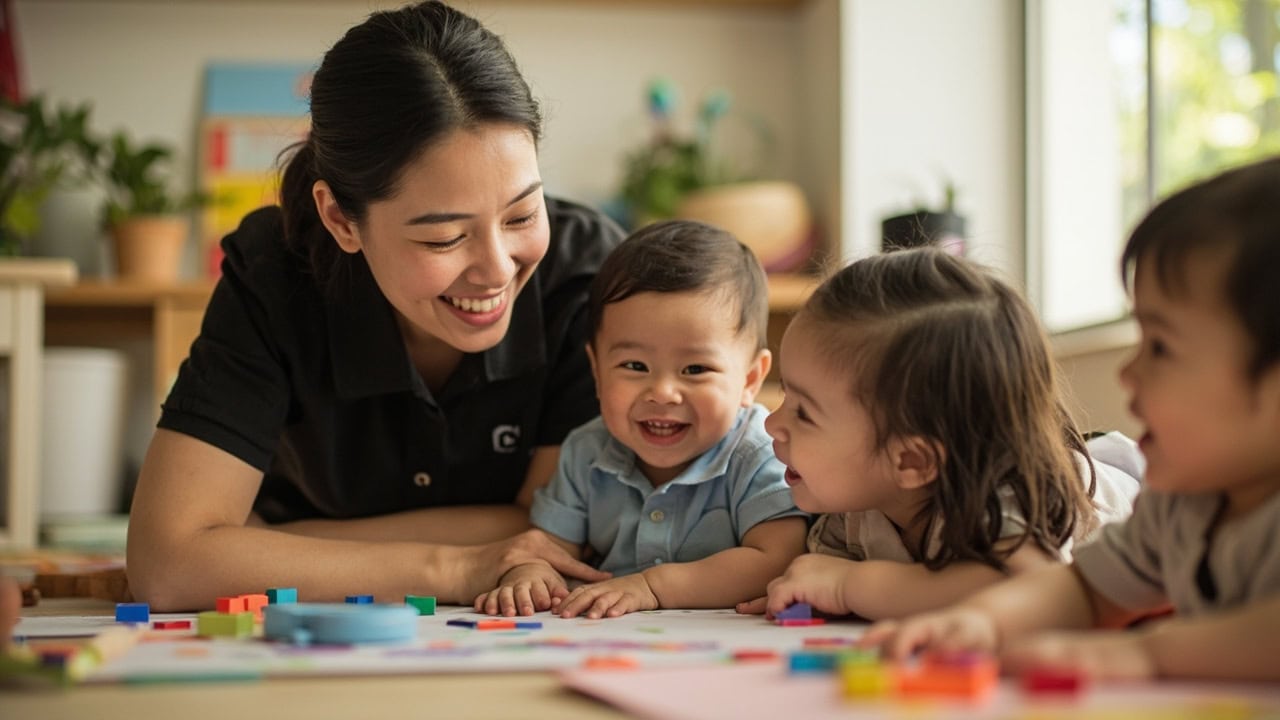
In Singapore, parents often feel they must choose between a centre-based programme and a domestic helper. But there is another option — one that offers a different balance of warmth, attention, and professional care.
Quality childminding, in the home-based setting, is characterised by ratios that allow each child to be truly seen. When a caregiver is responsible for fewer infants, the quality of attention changes in ways that are real and measurable and felt.
These are the elements that matter most when you are evaluating a childminding arrangement:
- Low infant-to-caregiver ratio: More individual attention, stronger attachment bonds
- Consistent, vetted caregivers: Reliability and trust for your family
- Warm, home-based environment: Gentle routines, less overwhelm for young children
- Transparent communication: Parents feel secure and informed
- Structured oversight and support: Caregivers are professionals, not afterthoughts
The quality of care your child receives in the first years matters because those years are where your child is building their understanding of whether the world is safe, whether people are trustworthy, whether they are worth loving. That is not sentiment. That is what the research consistently tells us, and more importantly, that is what every parent intuitively knows and quietly fears.
How EduNanny Fits Into This Picture
EduNanny was built on a conviction that matters deeply to us: that families in Singapore deserve more than a service. They deserve a partner. A partner who understands that when you are choosing childcare, you are not just evaluating a facility or a caregiver — you are making a statement about what your family values, and you need someone who takes that seriously.
EduNanny is part of the ECDA Childminding Pilot, and that means something real for your family. It means the arrangements available through us are structured around ratios that allow each child to be truly seen — up to one to three infants in home-based settings. It means our caregivers are vetted, trained, and supported as professionals, because the dignity of the childminder and the quality of the care are not separate things. One depends on the other.
For families navigating this decision as a couple, the practical details have been thought through with the same care you are bringing to your conversation:
- Care is available Monday through Friday, in blocks that reflect the reality of working life in Singapore
- Fees are structured to be accessible within the pilot framework
- Your Baby Bonus CDA funds can be used — because the last thing a couple needs, in the middle of a conversation about what kind of care their child deserves, is to feel that they can only afford what they cannot accept
When we talk about transparency, we mean it in ways you can verify. Where deployed, communication tools and monitoring measures — including CCTV — are in place not because we distrust our caregivers but because we trust you to need reassurance. Parents who feel secure ask better questions, notice more, and bring more of themselves to the relationship with their child. That is not a side effect. That is the point.
And through our Thomas AI Chatbot, parents can get thoughtful, responsive answers to their questions at any hour, because the anxiety about childcare does not keep office hours. If you are lying awake at eleven wondering whether the transition is going well, or whether your two-year-old’s reluctance to go to the caregiver means something is wrong, or whether you are making the right choice — you should not have to wait until the morning.
Begin the Conversation You Have Been Avoiding
You cannot pour certainty into your child if you are fractured by doubt and unspoken tension in your own partnership. The parent who feels guilty and alone cannot show up fully for their child. The parent who feels unheard cannot listen with patience. The couple who have not named their different values cannot move forward with the kind of quiet confidence that children sense and thrive on.
So before you choose a centre or a caregiver or a programme, have the conversation you have been avoiding.
Not the logistics conversation. The real one.
- Tell your partner what you are afraid of.
- Ask them what they are afraid of.
- Name the values you are each carrying into this decision — not to argue about them, but to understand them.
- Let go of the idea that one of you should be in charge of this.
And then, with that foundation, go and look at your options together — not as two people doing research, but as two people who are choosing the environment in which your child will spend most of their waking hours in the first and most formative chapter of their life.
EduNanny is here for that. We are here to respect both of you and the relationship between you. We are here to offer care that meets the standard your child deserves and the honesty your family needs.
Not a perfect solution — there is no such thing. But a thoughtful one. A human one. One that understands that childcare in Singapore is not just a practical matter. It is one of the most intimate decisions you will ever make.
And you do not have to make it alone.
Choosing childcare is not just about finding the right caregiver — it is about finding the right partners in raising your child. We welcome the chance to speak with you, answer your questions, and help your family move forward with confidence.