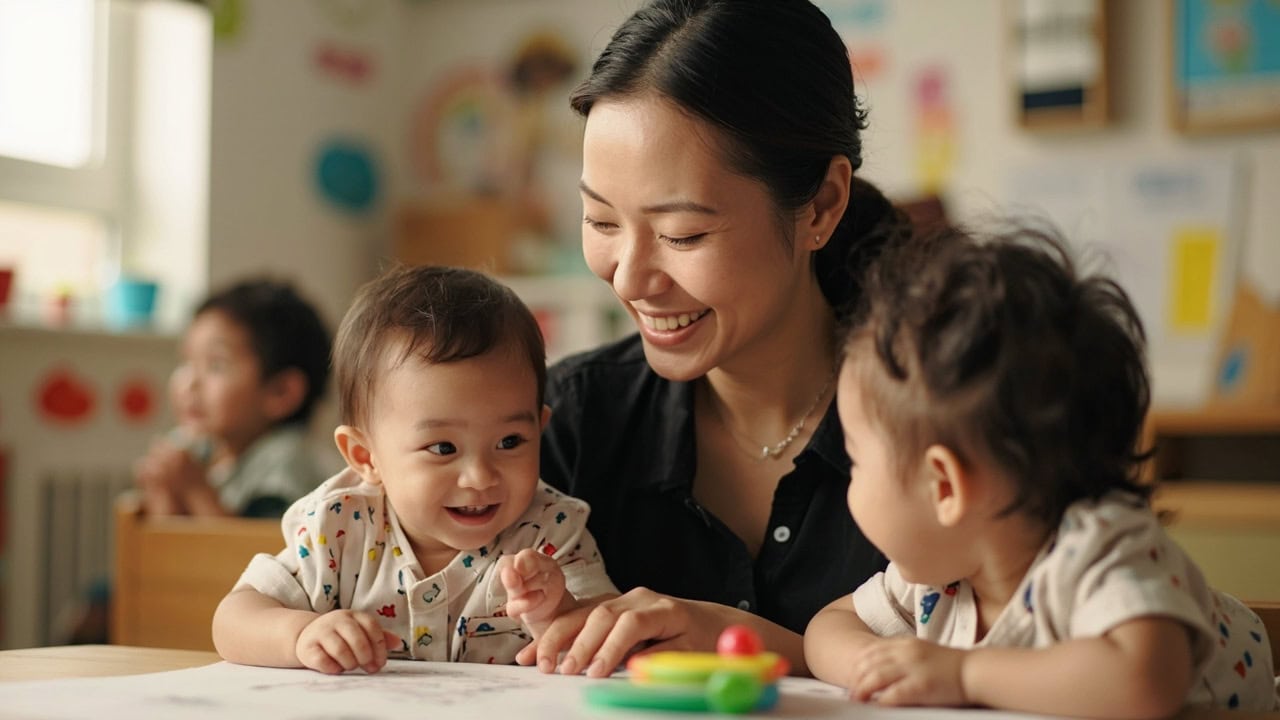
Beyond Happy: Understanding True Child Development in Singapore
The Quiet Worry Every Singapore Parent Carries (And What to Do About It)
There is a particular kind of quiet worry that lives in the back of a parent’s mind—not the urgent anxiety that demands immediate action, but something more persistent, more diffuse. It surfaces at odd moments. Perhaps when you watch your child at the dinner table and notice how differently they seem to express frustration than they did six months ago. Perhaps when you hear them attempt a new word and wonder where they learned it. Perhaps when someone asks you a simple question—how is your child doing?—and you realize you do not quite have the answer you wish you had.
Here is what we want you to know: you are not failing as a parent. You are not insufficiently attentive. The uncertainty you feel is not a character flaw. It is, in fact, a sign that you are paying attention to something real. You understand that your child’s development matters enormously, and that you want to be sure the people caring for your child during the day are genuinely nurturing that growth—not merely keeping them safe, fed, and entertained.
You are already observing your child’s development every single day. You notice when they master a new physical skill, when their emotional responses shift, when their language surprises you, when they navigate a social situation with growing sophistication. You may not have called these observations developmental milestones. But you have noticed. And those observations are not trivial—they are the raw material of understanding.
That distinction—between a child who is safe and a child who is thriving—is the one that matters most. And it is the distinction that Singapore parents are often left alone to make, without language, without framework, and without the confidence that comes from knowing what to look for.
The Five Developmental Domains to Watch
Quality childcare nurtures your child’s growth across five interconnected domains. When you know what to look for, you can read your child’s development like a living report card—not a test score, but a clear picture of who they are becoming.
- Emotional Regulation: Your child’s growing ability to name, manage, and recover from big feelings.
- Social Confidence: Their emerging belief that relationships are reciprocal and that they have something to contribute.
- Language and Communication: Not just vocabulary size, but the complexity and responsiveness of their expression.
- Motor Development: Both gross motor skills (running, climbing) and fine motor skills (manipulating objects, holding a pencil).
- Cognitive Persistence: Their growing capacity to focus, persist through difficulty, and approach challenges with curiosity.
Keep reading for a deeper understanding of each domain, what thriving looks like in practice, and how to evaluate whether your childcare arrangement is genuinely supporting your child’s growth.
What Thriving Looks Like: The Five Domains in Action
These five domains are not separate silos. They interact constantly, supporting and reinforcing one another. When a child is developing well across all five, you see it holistically—in the way they move through the world, in the questions they ask, in the relationships they form, in their growing sense of themselves as effective, valued human beings.
1. Emotional Regulation
In the first years of life, children are learning to manage the overwhelming intensity of their own emotions—a process that will continue for decades, but whose foundations are laid in earliest childhood.
A child who is developing well in this domain does not need to have mastered emotional control. That would be developmentally inappropriate. What you look for is progress: the emerging ability to calm down with support, the growing vocabulary for feelings, the increasing capacity to tolerate small frustrations without total dissolution.
Consider the child who begins at a new childcare arrangement and, over several weeks, begins to exhibit a different quality of emotional resilience. Not because something dramatic has happened, but because someone has been thoughtfully helping them name their feelings, teaching them simple strategies for managing disappointment, and responding to their distress with consistency and warmth.
The child who returns home and, for the first time, can say “I was sad because Jayden took my block” rather than simply dissolving into tears—this is a child whose emotional development is being actively nurtured. A quality caregiver notices when a child is becoming dysregulated and responds not with punishment or dismissal but with presence, warmth, and gentle guidance toward equilibrium. Over time, this repeated experience builds the neurological pathways that will later allow a child to manage their own emotions with increasing independence.
2. Social Confidence
This is distinct from mere sociability. A child can enjoy the company of others without being socially confident. Social confidence means the child has learned, through repeated positive experiences, that other people are interesting, that relationships have reciprocity, and that they have something to contribute to a social dynamic.
Consider the child who, after a few months in a quality environment, begins to engage differently with other children. Not simply playing alongside them—which is already valuable—but initiating, negotiating, sharing with a growing sense of social confidence that was not there before.
This is not a personality transplant. It is the result of a caregiver who creates opportunities for supervised peer interaction, who models social language, who helps children navigate small conflicts with patience and clarity. When you observe your child initiating play, negotiating with another child, or seeking out a familiar adult for comfort or conversation, you are seeing social confidence in action.
3. Language and Communication
Singapore parents often report being surprised by the words their children pick up at childcare—words they did not consciously teach, phrases that clearly originated in a caregiver’s daily narration. This is no accident.
Skilled caregivers understand that language development is not a passive process. It requires rich, responsive interaction: talking with children about what they are doing, reading and singing with intention, expanding on children’s early utterances, and creating an environment where communication is not just functional but genuinely valued.
You can see evidence of this domain’s development when your child’s language begins to grow in complexity—when they start to combine words, to ask questions, to engage in the back-and-forth of genuine conversation. A quality childcare arrangement should leave you marveling, regularly, at your child’s growing ability to make themselves understood.
4. Motor Development
Motor development encompasses both gross motor skills (large movements like running, climbing, and jumping) and fine motor skills (smaller, more precise movements like manipulating objects, using utensils, and eventually holding a pencil).
Physical development in early childhood is not merely about burning energy or keeping a child physically fit. It is about building the neurological connections that support all later learning. A child’s ability to control their body, to coordinate their movements, to persist in physical challenges—these capabilities are foundational to cognitive development, to confidence, to independence.
These are the quiet achievements of developmental childcare. They happen in the texture of daily interaction—in the way a caregiver narrates a child’s actions to help them build language, in the way they set up an environment that invites physical exploration, in the way they notice when a child is frustrated and offer just enough support to help them persist without taking over.
5. Cognitive Persistence
Sometimes called executive function in older children and adults, cognitive persistence is observable even in infants and toddlers as the emerging capacity to focus attention, to persist in the face of difficulty, to experiment with cause and effect, to begin to solve simple problems.
This is the domain most likely to be overlooked in early childhood settings, because it is less visible than physical play or language growth. But it is arguably the most consequential for long-term success.
A child who is developing well in this domain shows increasing ability to concentrate on a task, to try again after failure, to approach a challenge with curiosity rather than immediate frustration. A quality caregiver nurtures this by setting up environments and activities that invite sustained engagement, by resisting the urge to immediately intervene when a child struggles, and by celebrating effort and process rather than simply outcomes.
What Quality Childcare Looks Like in Daily Life
The question is not whether your child is happy. Happiness is important, and any childcare that does not prioritize your child’s emotional wellbeing is unacceptable. But happiness alone is not enough. A child can be happy in an environment that does not challenge them, does not expand their capabilities, does not prepare them for the complexity of the world they are growing into.
So what does quality look like in practice?
- Caregivers who are trained to observe, not just supervise. Someone is paying attention—not just in the moment, but over time, with intention and care.
- Intentional interaction—conversation, narration, responsiveness—that happens throughout the day, not just during designated activities.
- An environment designed to invite development: materials at the right developmental level, space for physical exploration, opportunities for social interaction that are guided without being controlled.
- Communication with parents that is specific, honest, and developmental rather than vague and reassuring.
- Consistency—day after day, week after week—a reliable presence that allows the child to feel secure enough to take risks, to try new things, to grow.
Quality childcare creates the conditions for developmental growth: small group settings where each child can be truly known, supervised peer interactions that are guided rather than laissez-faire, and caregiver behavior that models warm, respectful relationship-building.
How EduNanny by BUTLER Nurtures This Growth
At EduNanny by BUTLER, we have built our service around the understanding that quality in early childhood care is not accidental. It is designed. It is trained. It is maintained through attention, reflection, and genuine care for the work.
We participate in the ECDA Childminding Pilot, and we take that participation seriously. We understand that for Singapore parents, the decision about childcare is not just a logistical one—it is a developmental one, a relational one, and an emotional one.
Thoughtful caregiver ratios. In our infant care arrangements, we maintain ratios of up to one to three, which means your child receives the kind of individualized attention that makes genuine developmental support possible. This allows caregivers to know each child deeply—their temperament, their current interests, their emerging challenges, their particular strengths—and to respond with the kind of tailored care that generic supervision cannot provide.
Trained caregivers, not just warm adults. Our caregivers are trained in child development, in observation, in the specific practices that support each of the five domains we have discussed. They understand that their role is not to entertain or to merely keep children safe, but to nurture growth—in all its complexity, across every domain that matters.
Transparency for parents. When your child is in our care, you should know what is happening—not in invasive, minute-by-minute detail, but in the meaningful sense that you can ask questions and receive thoughtful answers, that you can understand what your child is working on developmentally, that you feel connected to the daily life of growth rather than shut out of it.
Accessible quality. For parents concerned about the practical realities of arranging childcare in Singapore, we offer clarity alongside quality. Our care operates within the ECDA Childminding Pilot framework, with Monday to Friday care blocks designed to support working families. Fees are structured within the pilot’s accessibility goals, and we are happy to explain how CDA and Baby Bonus funds can be applied—because we believe quality care should be within reach for families across Singapore.
Questions to Ask During Your Childcare Tour
How do you know, when you visit a childcare arrangement, whether it is genuinely focused on development or merely on containment? Here are questions that can help you evaluate whether a childcare arrangement is the kind of developmental partner you are looking for. These are not trick questions or confrontational ones. They are the questions of a parent who takes their child’s development seriously—and any quality arrangement should welcome them.
| Domain | Questions to Ask |
|---|---|
| Observation | How do caregivers track your child’s development? Not in the vague sense of “we keep an eye on them,” but in the specific sense of systematic, sustained observation that allows patterns to be identified and progress to be understood. |
| Emotional Regulation | When a child is upset, what happens? Is there a consistent approach, trained in child development principles, that helps the child learn to manage their emotions? Or is the approach inconsistent, reactive, focused simply on stopping the visible distress without attending to its source? |
| Language | How do caregivers support language development in their daily interactions? Are they trained in techniques like narration, expansion, and responsive conversation? Is language valued as a developmental domain, or is it simply assumed to happen naturally? |
| Motor Development | What opportunities does the environment provide for gross and fine motor skill development? Is there outdoor space or gross motor time? Are fine motor activities available and appropriately challenging? |
| Cognitive Persistence | How do caregivers respond when a child is struggling with a task? Do they intervene immediately, or do they offer just enough support to help the child persist and eventually succeed? Is the environment set up to invite focused engagement, or is it chaotic or over-stimulating? |
| Parent Communication | What can you expect in terms of updates about your child’s day? How are developmental observations shared? Are you treated as a partner in your child’s growth, or as a customer who should simply be satisfied? |
These questions will not tell you everything. But they will tell you something important: whether the people running the arrangement understand that their work is developmental, not merely custodial. And that understanding is the foundation of everything else.
Your Child Is Becoming Someone Remarkable
Singapore parents face real pressures—long working hours, demanding career expectations, the high cost of living, and the genuine difficulty of finding care that meets both the emotional and developmental needs of their children. We do not pretend these pressures do not exist. But we believe the solution is not to lower expectations. It is to make quality legible, accessible, and understandable—so that parents can make decisions from a place of knowledge rather than guesswork.
Here is what we want you to carry with you beyond any specific questions or observation strategies: the most important developmental indicator is your own child.
The child who comes home from quality childcare should, over time, show visible signs of growth across the domains we have discussed. They should be developing emotional language, social confidence, language complexity, motor fluency, and cognitive persistence—not in any linear or uniform way, but in the messy, individual pattern that is uniquely theirs.
You know your child. You have known them since before they were born. And you are more capable than you may realize of reading whether they are thriving, not just happy.
If your child is in a quality arrangement, you should feel, over time, an increasing sense of confidence—not because someone has told you to feel confident, but because the evidence is there in your child’s growth. You should be able to articulate what is happening developmentally. You should be able to ask questions and receive answers that satisfy your genuine curiosity. And you should feel, in your bones, that the people caring for your child are growing alongside them—not just watching, not just keeping, but nurturing.
If you do not feel this, that is information. Not a reason for guilt or panic, but a reason to ask harder questions, to observe more carefully, to consider whether the arrangement you have chosen is truly serving your child’s developmental needs.
The first thousand days of a child’s life are not a cliché. They are a biological reality. The neural connections being formed, the emotional patterns being established, the social and language foundations being laid—these are not things that can wait. They are happening now, every day, in the environment where your child spends their waking hours.
And the question you are asking—quietly, persistently, with the kind of worry that is really just love in disguise—is whether that environment is worthy of the extraordinary work your child is doing.
The answer is: you can know. You can observe. You can ask. And when you find the right arrangement, you will feel it—not just in your mind, but in the visible, tangible evidence of your child’s growth.
We are not asking you to trust us blindly. We are asking you to observe, to question, to engage. We are offering ourselves as a resource—not just as a service, but as a partner in your child’s development. And we are confident that when you see what we do, when you understand why we do it, and when you observe the children in our care growing across every domain, you will recognize the difference.
Let us help you make sure the care they receive is worthy of that becoming.
Curious about how EduNanny by BUTLER approaches early childhood development? Learn more about our approach or get in touch with any questions. We welcome the opportunity to answer them.